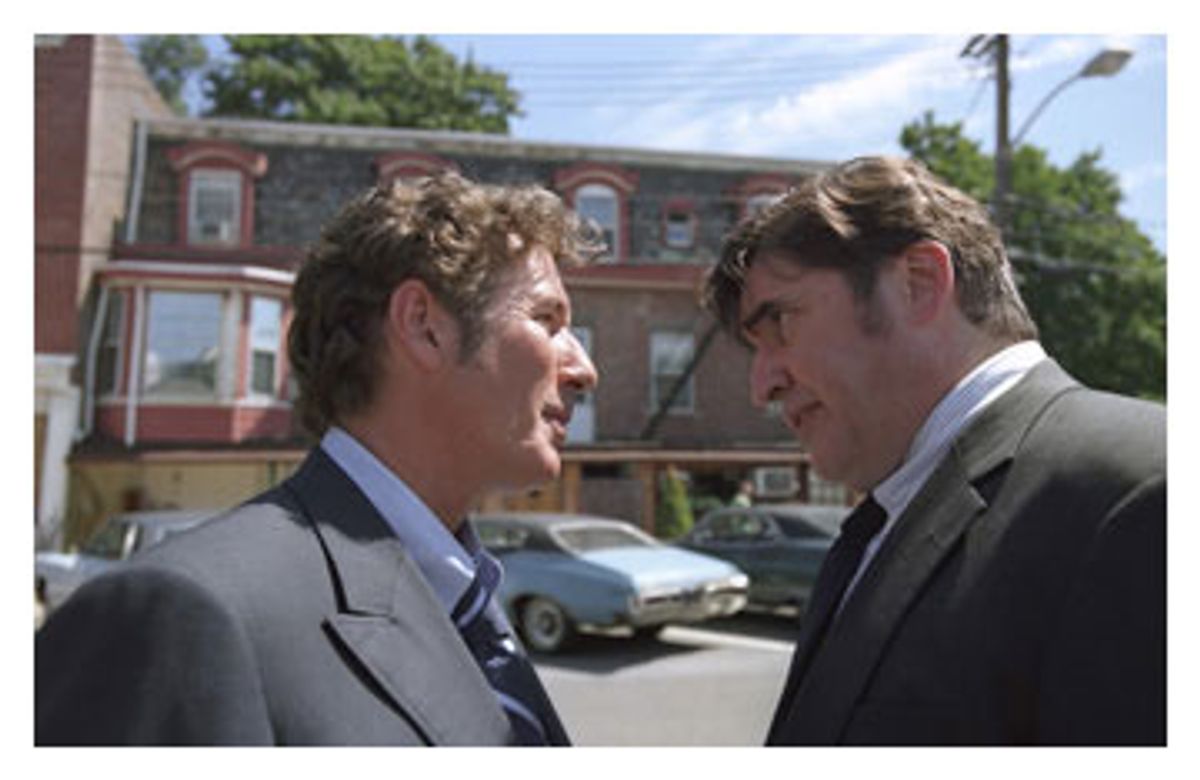
Lasse Hallström’s “The Hoax” is an entertaining botch of a movie. There’s a great picture lurking somewhere in the story of how, in 1971, writer Clifford Irving (played here by a foxy, suitably charismatic Richard Gere) fooled both McGraw-Hill and Life magazine into believing that the reclusive, nutso billionaire Howard Hughes had chosen him, privately and mysteriously, to write his authorized biography. Irving, broke at the time and desperate for a book deal, kicked off the elaborate hoax by forging a series of handwritten communiqués, claiming they had been sent to him directly by Hughes.
After enlisting the help of his friend Richard Suskind (Alfred Molina, in a tremulous, sweaty, funny performance) as a researcher, he deepened and widened his crazy scheme: “The Hoax” — which is based on fact, although Hallström and screenwriter William Wheeler freely admit they’ve done some movie-style embellishment — shows us an obsessed Irving dressing up as Hughes circa 1935, complete with a slim, penciled-on mustache, apparently attempting to enter the body of the essentially fictional character he’s created. Whenever anyone from McGraw-Hill (such as Irving’s barracuda editor, Andrea, played by an amusingly brittle Hope Davis) or Life (such as the officious managing editor Ralph Graves, played by Zeljko Ivanek) would challenge him on a dubious Hughes-related claim, he’d manufacture an explanation so audacious that they’d willfully, and stupidly, believe him.
The first half of “The Hoax” details how Irving parlayed his desperation into big bucks (even though his high-stakes deception eventually earned him a jail term). Hallström shows Irving zipping around early-’70s Manhattan, donning black tie to attend Truman Capote’s Black and White Ball (which the filmmakers acknowledge was held in 1966, although the event was too glamorous for them to resist), where he tries desperately to avoid the gaze of his erstwhile mistress, celebrity-actress bombshell Nina Van Pallandt (portrayed, with lethal, droopy-eyed charm, by Julie Delpy). He’s trying to be a good husband to his Swedish-German wife, Edith (Marcia Gay Harden, surprisingly believable in lank blond hair), who sticks by him even in the face of infidelity and bankruptcy. (Near the beginning of the picture, a mover’s truck shows up at the Irvings’ suburban home to repossess her favorite couch.)
Desperate times call for desperate measures, and Hallström and Wheeler have a great time setting up and embroidering Irving’s increasingly elaborate scheme. When Suskind, jittery during a meeting with Life magazine honchos, inexplicably utters the words, “He gave me a prune,” Irving, without missing a beat, concocts an elaborate story about how the two met Hughes in one of his exotic hideaways, and the eccentric germophobe reached out from the mosquito netting around his bed to offer Suskind a piece of shrunken, organic fruit. The editors and execs clustered around Irving beam with pride, thrilled to be a party to this unprecedented (and potentially very lucrative) venture. We know, as Irving does, that the joke is on them, and it’s a delicious one.
Hallström, Wheeler and the actors at first treat Irving’s feat of magnificent trickery as a kind of performance art rather than an illegal act. Gere’s Irving is a glamorous scalawag, and the boldness of his stunt makes our current brand of lit fakery seem cheap and puny by comparison: Kids today have no extravagance, no class. (Making up your own autobiography, à la James Frey, is for wimps.)
“The Hoax” loses steam as it increasingly focuses more on Irving’s emotional and psychological unraveling. I suppose that had to happen: It would just be too irresponsible to make a movie treating Irving like a folk hero. Aside from the fact that what Irving did was illegal and unethical, he did, at least in terms of what the movie tells us, treat the people closest to him very shabbily.
Naturally, when “The Hoax” devolves into a moral, cautionary tale, it becomes a lot less fun. You long for moments like the one, early in the picture, in which the discreetly pompous Life editor Graves gives Irving a tour of the magazine’s offices. He points to a blown-up photo of Neil Armstrong walking on the moon and says, with bland superiority, “History. Quite a responsibility.” It’s enough to make anybody want to try to get away with making stuff up.
James Frey has forgiven Oprah Winfrey. Yes, according to the New York Post, the faux-memoirist is graciously allowing Oprah the chance to interview him in the upcoming month about his new book despite how rude she was to him back in 2006, when she revealed to the world that details in his memoir “A Million Little Pieces” were fabricated. According to a “source” (or “James Frey”), Oprah apologized to the writer long ago.
“Oprah apologized to James a couple of years ago, and he appreciated it. So he agreed to go back on her show and talk about everything that’s happened over the last five years.”
Sorry, I missed that: What did Oprah apologize to James Frey for? Calling him out on lying about his memoir? Creating a firestorm that drew enough international attention that James was able to create a writer-factory to churn out teen alien romance novels, befriend artists and intern for Gawker? I actually think Oprah should be apologizing to us, not Frey.
Oh, and in case you are wondering what Frey’s been up to in the last five years (besides not paying people to write “I Am Number Four”), he’s been writing a book designed to tap into the lucrative “Christian Outrage” market:
“The Final Testament of the Holy Bible,” out tomorrow … in which the Second Coming of Christ takes place in the Bronx projects — but the messiah turns out to be a former alcoholic who impregnates a prostitute. It’s being published in a limited edition of 10,000 copies by Gagosian Gallery and as an e-book by Frey and WME.”
Hey, Oprah, I know you only have a couple of shows left for your syndicated program, and you’re probably thinking that since the Frey scandal was such a huge deal five years ago, this would remind people of some of your bigger stories. But please don’t let this dick come on your show and give him even more free publicity for his tour of smugness.
I’m just hoping that the fact that your people refused to comment on this story means it was something James leaked himself in an effort to force your hand into letting him back on again. And for all our sakes, I hope you don’t. Because, in truth, I would watch that show. I would hate myself for it, but the ratings would be amazing.
Continue Reading
Close
Apparently James Frey has a tiny man in his head, like some kind of internalized boss, who barks, “You haven’t enraged anyone lately!” and starts cracking the whip whenever things slow down. This week, we learned that Frey will deliver a book he discussed in an interview with the Rumpus back in 2008, “The Final Testament of the Holy Bible,” which will depict the return of Jesus Christ as a drunk who consorts with hookers and canoodles with other men. The book will be published in a limited edition by an art gallery and self-published by Frey “online,” which presumably means in e-book format. This event will take place on April 22, Good Friday.
I know! Shocking, right? Frey says that he expects to “get blasted” for this. The press has happily joined him in rubbing its hands together over the prospect, deploying words like “controversial” and “firestorm” in stories that Frey promptly posts to his website. “I tried to write a radical book. I’m releasing it in a radical way,” Frey told the New York Post. So it’s possible his Christ might be a skateboarder, too.
But seriously, who besides good ol’ Bill Donohue at the Catholic League can possibly be counted on to take offense at such a stunt? “I’m sure the religious right will go crazy,” Frey said. Well, at least someone is sure. But since Philip Pullman barely raised a snort from them with “The Good Man Jesus and the Scoundrel Christ” last year — and that was a famous atheist’s revisionist account of the historical Jesus, not just a fancifully smutty imagining of his second coming — I would not advise the author to hold his breath.
In fact, there’s already a long history of revisionist literary accounts of Jesus’ life and social criticism disguised as fiction depicting his return. Among the most renowned in the first category are “The Last Temptation of Christ” by Nikos Kazantzakis (1951), “Quarantine” by Jim Crace (1997) and “The Gospel According to the Son” by Norman Mailer (1999), as well as the comic romp “Lamb: The Gospel According to Biff, Christ’s Childhood Pal” by Christopher Moore (2001) and about a zillion New-Agey retellings that turn Mary Magdalene into the heroine.
The observation that the Jesus of the Scriptures would be dismayed at what his professed followers get up to today is also by no means rare. In 2008, Roland Merullo published “American Savior,” in which a pro-choice Jesus runs for president, and in 1990, James Morrow’s “Only Begotten Daughter” has the Messiah reincarnated as a woman. Science fiction writers have been particularly fond of using the trope to illuminate the hypocrisies and injustices of our time, as Frey presumably intends to do. Theodore Sturgeon’s last novel, “Godbody,” features a savior who communicates divine love by touch and who predictably winds up slaughtered by a mob. And surely the best-known crypto-Christ in all science fiction is Valentine Michael Smith of Robert A. Heinlein’s “Stranger in a Strange Land,” a human instilled with the hippieish values of Mars, who meets an equally ugly end.
The most celebrated literary second coming of all, however, is the “Grand Inquisitor” section from Dostoyevsky’s “The Brothers Karamazov,” in which Christ returns to Medieval Spain and is sentenced to be burned at the stake by the Inquisition. The Grand Inquisitor visits him in his cell on the eve of the execution and delivers a long explication of how the Church has moved beyond his teachings after realizing that the vast majority of human beings cannot cope with and do not really want freedom. It’s a profound meditation on courage and free will. That’s a tough act to follow, Mr. Frey, no matter how radical you’re prepared to get.
But controversial? Not really. Kazantzakis’ novel did provoke some genuine furor when it was first released 60 years ago, and the book has a history of being banned. Nowadays, however, you can’t expect mere print to get you properly blasted. You need pictures. Protesters picketed theaters screening Martin Scorsese’s film adaptation of “The Last Temptation of Christ” in 1988, and are believed to have seriously damaged its earnings. The following year, conservatives used Andres Serrano’s photograph “Piss Christ” as an argument to defund the National Endowment for the Arts, which gave him $15,000 for the work. A decade later, New York City Mayor Rudolf Giuliani tried to evict the Brooklyn Museum for exhibiting a purportedly blasphemous painting.
So no wonder Frey has hooked up with the art world for this particular scheme. It’s like going to Blackwater for bodyguards; making the holy rollers mad is just what they do. Still, the project itself seems a miscalculation. So far, Frey’s notoriety has been founded on two pillars: producing a memoir that turned out to be partially fabricated and running a sort of book factory in which recent MFA graduates are gulled into laboring like sweatshop seamstresses for meager pay. Before that, he attracted attention by bad-mouthing more famous writers.
The genius of this strategy is that it focuses on offending that tiny class of Americans who still care about books and can be expected to notice the people who write them. Who else would wax indignant on the porous boundary between fiction and nonfiction and/or the exploitation of aspiring novelists? And that’s certainly not the same crowd who rants about the War on Christmas or tries to put prayer back in schools. In fact, it’s not clear that that crowd ever reads anything — including the Bible. Even Pullman, who was piping atheist propaganda directly into our school libraries for a nearly a decade, didn’t get called on it until they made his book into a movie.
Could it be that Frey, for all this talk about getting blasted, is now courting the very people he once specialized in outraging? You can become a minor hero to the liberal intelligentsia if your work gets you persecuted by bullies like Bill O’Reilly. Of course, that would involve Frey making himself over as a victim, when the world he inhabits seems much happier to cast him as the villain. A role-change like that isn’t going to be easy. As a matter of fact, it’s going to take a miracle.
Further reading
The New York Post on James Frey’s announcement of “The Final Testament of the Holy Bible”
The Rumpus interviews James Frey
James Frey’s website
New York magazine on Full Fathom Five, James Frey’s fiction factory
Salon on the fabrications discovered in James Frey’s memoir, “A Million Little Pieces,” in 2006
Continue Reading
Close
“I Am Four” came in No. 3 at the box office this weekend, which means James Frey is going to have a hard time finding more gullible students to write further sequels in his “collaborative” series. His writing factory, Full Fathom Five, has already been outed by New York magazine as a “novel assembly line” which exploits its young ghostwriters by paying them very little but offering the incalculable experience of writing under a man that Oprah once scolded.
Still, Frey is determined to make his formulaic alien love story pay off, even though only the first book has been released. (The film rights were sold a year before the novel was actually published.) In order to cash in on the supernatural success of YA novels like “Harry Potter” and “Twilight” — as well as the awesome merchandising opportunities in the kiddie market — Frey is going to have to look to even younger aspiring novelists to con into writing his books for him. Which brings us to the trailer of the next episode “I Am Number Five,” written by Ms. Shulman’s fifth-grade English class.
Voices in darkness
Announcer: They said he’d never fit in.
Old man yelling: You’ll never fit in with the humans!
Announcer: They said he was an alien.
Boy Alien: I know what I am now.
Human Girl: Say it.
Boy Alien: Alien.
Announcer: They said no human would ever love him.
Human Girl: I love you.
Announcer: But they were wrong.
Boy Alien: I shoot electricity out of my hands. Garrrgh!
Announcer: Dead wrong.
Bad Alien steps out of darkness to blow up an entire block in this really sick way, like “Independence Day” except better.
Bad Alien: Pew pew! Lasers! Pew pew pew!
Good Alien: Nooo!
Explosions. Wow! Bad alien puts on sunglasses and walks away slowly from the really big fireball.
Darth Vader: Bad Alien, have you destroyed Number Four?
Bad Alien: Not yet, your excellence.
Darth Vader crushes him with The Force.
Darth Vader: Time to bring out the big guns. What do you say, boys?
Aliens from “Alien,” “Aliens,” and “Alien: Resurrection”: Scrreeeeech! (Translated at the bottom: Your wish is our command!)
Cut to:
Girl: I love you so much.
Boy Alien: Cool. Let’s kiss with tongue.
They kiss, it is really gross.
Girl: But how will we ever be together if there will always be Mogadorians trying to kill you?
Boy Alien: I don’t know yet. We need to find Number Five.
Girl: Oh, how many of you are there?
Boy Alien: (Puts on sunglasses, stares into the distance) A gazillion.
Girl: That is a lot.
Rustling in the brushes. Number Five pops out, with a laser sword that can shoot out plasma rays. It is made of the same stuff as Wolverine’s claws. She and Boy Alien fight. (Oh yeah, she’s a Girl Alien, too.)
Boy Alien uppercuts Girl Alien. A plasma burst blows up a tree. She sweeps him with her feet and jumps up. He jumps up. She punches him but he blocks her, and then he punches her but she blocks it and then she does a back flip and lands on her feet and then she karate chops a tree and it falls down, because even though she is a girl, she is super strong. The tree falls and it almost falls on the Girl, but the Boy Alien runs really fast and holds up the whole tree with one hand right before it hits his girlfriend.
Boy Alien: Argh! (Throws the tree and it flies a billion miles away.)
Girl Alien: (Sheaths sword) So the legends are true! You are Number Four!
Boy Alien: I am!
Girl Alien: I am Number Five.
Boy Alien: Nice to meet you.
Girl Alien: Likewise, I’m sure. Quickly, we have to run away, because the Mogadorians are after us to kill our entire species.
Boy Alien: (Grabs magic amulet from his pocket, which starts to glow with unearthly light) I’d like to see them try!
Girl: Cool amulet. I wish my mom would buy me something that cool-looking. Then maybe I wouldn’t have run away from home with an alien.
Boy Alien: I know you are, but what am I?
Announcer: This summer, prepare to blown away … into space!
Boy Alien stops a speeding car with his hands. It explodes.
Human Girl: You must take a ton of Ritalin.
Announcer: “I Am Number Five.”
Really big explosion, and then out of that explosion comes a speedboat, and it’s on fire but looks really cool. Also, it’s flying because it’s also an alien saucer.
Fade to black.
Continue Reading
Close
If you feel like a substandard knockoff “Twilight” movie is far better than no “Twilight” movie at all — well, first of all, there is no mockery or judgment here. This is a safe space. You can share with us. The disease is much, much bigger than you are. We get it. Yes, I think a Higher Power could help you, but that choice is yours. You understand, or at least your rational mind does, that “I Am Number Four” is an ultra-expedited movie-type product adapted from the first volume of “Lorien Legacies,” the utterly cynical young-adult alien franchise created by James Frey, he of the not-entirely-truthful memoir. The distance between this movie and anybody who actually cares — about it or anything else, frankly — is measured in light-years and filled with dark matter, like the distance between galaxies.
But if you’re simply not going to be able to resist this ludicrous yarn about young extraterrestrial hotties on the run, or the spectacle of model-rific wannabe celebrities simulating an implausible American teen romance, then I am here to tell you that I sat through all of “I Am Number Four” and it was boring and silly but not atrociously bad. No, that’s much too glowing; allow me to back up and rephrase. It is atrociously bad, basically. But the thoroughgoing pointlessness of the whole enterprise is somewhat mitigated by the fact that once our human and semi-human heroes finally get to some high-powered shootouts with the trench-coated, black-hatted alien hunters, director D.J. Caruso (“Disturbia”) handles them with unexpected brio. That, plus there’s a badass Australian chick who shows up late, sort of a young Nicole Kidman type in leather pants. What she has to do with the story I’m not sure, but that’s never a bad idea.
When first we meet brawny, lantern-jawed Number Four, aka John Smith (played by Alex Pettyfer, a 20-year-old English cover boy), he is preparing to do some night swimmin’ off a Florida beach with a lithe young lady of his acquaintance who isn’t particularly wearing clothes. She apparently finds it a vibe-killer when John starts to glow radioactively and emit blue-white LED-style light from his palms, and flees the scene. (No, they aren’t doing that at the time. You and your mind!) So that’s when John and his oddly young, neatly coiffed pseudo-dad, Henri (Timothy Olyphant), have to pack up the truck and head out for the heartland burg of Paradise, Ohio, where further adventures will of course ensue. (Still looking for your cultural-studies dissertation topic? OK, here: What’s up with the weird sexualization of father figures in tween-oriented fantasy?)
While they’re on the road, John gives us the blah-blah: He is the fourth in a series of nine Whatever-the-Heckian refugees from the planet Hooble-de-Hoo, who are being hunted down in order by the evil Whumpsamacallums, who sneer and wear black and look vaguely like Lord Voldemort and seem to be having more fun than anybody else in the story. OK, no, those aren’t the real names, but they might as effing well be, since Frey and co-author Jobie Hughes (who write under the pseudonym Pittacus Lore) just picked their proper nouns out of the fair-use grab bag. John’s home planet is called Lorien, a shameless, oughta-be-illegal J.R.R. Tolkien rip-off, while the wisecracking bad guys are from Mogador, which in our world is actually a city in Morocco. Oh, and John has a shape-shifting lizard-puppy creature called Bernie Kosar, which is sort of funny except that if you get the reference you are, like me, much too old for this entire franchise.
I digress, but that’s because there’s so little to say. Until the shooting started, I kept slipping off the surface of the movie, like a man clinging to the outside of an inflated balloon. John and Henri hit Paradise vowing to lie low, but John immediately hits it off with Sarah (Dianna Agron), a lovely blond girl who is of course utterly unconvincing as the cheerleader-turned-photographer social outcast she’s supposed to be. Agron keeps the top button of her cute little pastel cardigans buttoned, and if that’s not symbolic I’m handing in my membership card to the International Semiotics Union right now. (Yes, yes, yes, I know, yes: Pettyfer and Agron are now an off-screen couple as well. But why do I know that?) John becomes enmeshed in an uninteresting romantic triangle with Sarah and Mark (Jake Abel), her arrogant football-star ex, and comes to the aid of science nerd Sam (Callan McAuliffe), who looks suspiciously like a teenage TV star pretending to be a science nerd.
Then again, nobody in this cast shows the slightest ability or inclination to go beyond presentational, faux-sincere, prime-time-soap-style acting, except for Canadian comedian Kevin Durand, who turns a few lines as the malicious leader of a Mogadorian commando team into the movie’s most enjoyable moments. Unlike everybody else in the movie, he doesn’t have to wander around in the frame waiting for the MOR teen pop on the soundtrack to stop so he can say something meaningful. He just wants to kill some adorable young people, and I can’t say I blame him. Caruso and his team of screenwriters (Alfred Gough, Miles Millar and Marti Noxon) never provide enough back story or drama to make us care about Lorien and Mogador or John and Sarah or Number Four and Number Six (that would be the Aussie hellcat). Which leads us to the one and only point of similarity anyone will ever note between this movie and John Milton’s “Paradise Lost”: In both, you kind of want the bad guy to win.
Continue Reading
Close
Novelist and editor William Dean Howells famously told Edith Wharton that the problem with American audiences was that they always wanted “a tragedy with a happy ending.”
That longing explains what led to the recent controversy over Herman Rosenblat’s Holocaust memoir, “Angel at the Fence: The True Story of a Love That Survived,” now canceled by the publisher Berkley Books, though a film version may still be in the offing.
The story won hearts across America and its teller appeared twice on “Oprah.” As a young boy, Rosenblat wound up in the German concentration camp of Schlieben, 95 kilometers northeast of Leipzig in eastern Germany. This satellite camp of Buchenwald made munitions, and for six months (or seven according to some versions) he had wordless encounters across the barbed-wire fence with a Jewish girl hiding locally, pretending to be Christian. For that whole period, she threw him food. Fifteen years later, they met on a blind date in New York and discovered, to their mutual amazement, that he was the boy behind the barbed-wire fence and she was the girl who fed him. And so, they were married.
I missed this heartwarming tale in all its versions online and elsewhere, but as soon as I tuned in to it in December, when the New Republic reported that there were doubts about Rosenblat’s forthcoming book, I realized it didn’t add up, couldn’t add up. My parents were Holocaust survivors, and I’ve read about and studied the Holocaust for over 30 years, publishing fiction and essays about the legacy of survivors’ children. Nobody was allowed to approach concentration camp fences on either side, prisoners or strangers. The fences were usually electrified and extremely well guarded. The notion that any kind of communication like the one Rosenblat describes could continue unobserved at a concentration camp for six months, let alone six days, is risible.
In one online version of the story, Rosenblat addresses the improbabilities at their first meeting, but in doing so, further undercuts his own veracity: “Of course, you couldn’t touch the fence, because it was electrified. And even if you got near the fence, the Nazis would shoot you. Yet something on the other side of the fence caught my eye: a young girl, 10 years old, hiding behind a tree … I asked this little girl, in German: ‘Do you have anything to eat?’ I saw that she didn’t understand me, so I repeated the question in Polish. Next thing I knew, she reached into her coat, took out an apple, and threw it toward me … it actually landed in between the two rows of barbed wire, so I took a big risk crawling in there to reach it. But it was worth it. How long since I’d seen an apple!”
Given the height of the fences and their solidity, how could a little girl have thrown food over the outermost one and how could he have crawled between them without anyone noticing?
A memoirist friend of mine opined that if Rosenblat had been a talented writer, he would have taken the fence “story” and turned it into a dream sequence; after all, camp inmates did dream about food, as Primo Levi and many others have reported. Rosenblat belatedly told the New York Times, “In my dreams, Roma will always throw me an apple, but I now know it is only a dream.” Of course, a dream in Rosenblat’s memoir wouldn’t have earned it the same kind of notoriety, despite the fact that the story of anyone surviving the camps is in itself astonishing enough without having to embellish the truth.
Still, it’s not surprising that Rosenblat’s ghost writer, his agent and his editor were taken in, and didn’t ask enough questions. Ditto Oprah, who seems to be making a habit of pushing faked memoirs. Rosenblat’s story satisfies our American need for romance; our desire to find a happy ending even in the most unspeakable tragedies; our desperate and perhaps juvenile need to feel that even in the Holocaust, love and kindness overshadowed evil.
The truth is far less romantic. Anna Pawelczynska, a Holocaust survivor who became a sociologist and wrote about Auschwitz years after her liberation, observed in her book, “Values and Violence in Auschwitz,” that the golden rule was not a good vade mecum in the camps, where Western norms had collapsed under the Nazi onslaught of brutality. But it did exist in an altered form: “Do your neighbor no harm, and if possible, help him.”
A late cousin of my mother’s once told me that my mother saved her life in their camp by getting her some cheese when she was sick. She didn’t know how my mother managed, but she was convinced that given the miserable rations, the meager amount of extra protein was enough to help her recover.
My mother never told me this story herself, and as a story, it’s not big enough to make it to Oprah or a film. It doesn’t satisfy our need for dramatic, splashy events that can somehow turn tragedy into triumph. But it’s far closer to the truths of the Holocaust — that in the face of this rampaging evil, acts of heroism and mere kindness were few and far between, and often only in a minor key — truths that decades of memoirs, films, histories and Holocaust education courses don’t seem to have brought home.
Continue Reading
Close