Afghanistan

From Norman Rockwell to Abu Ghraib

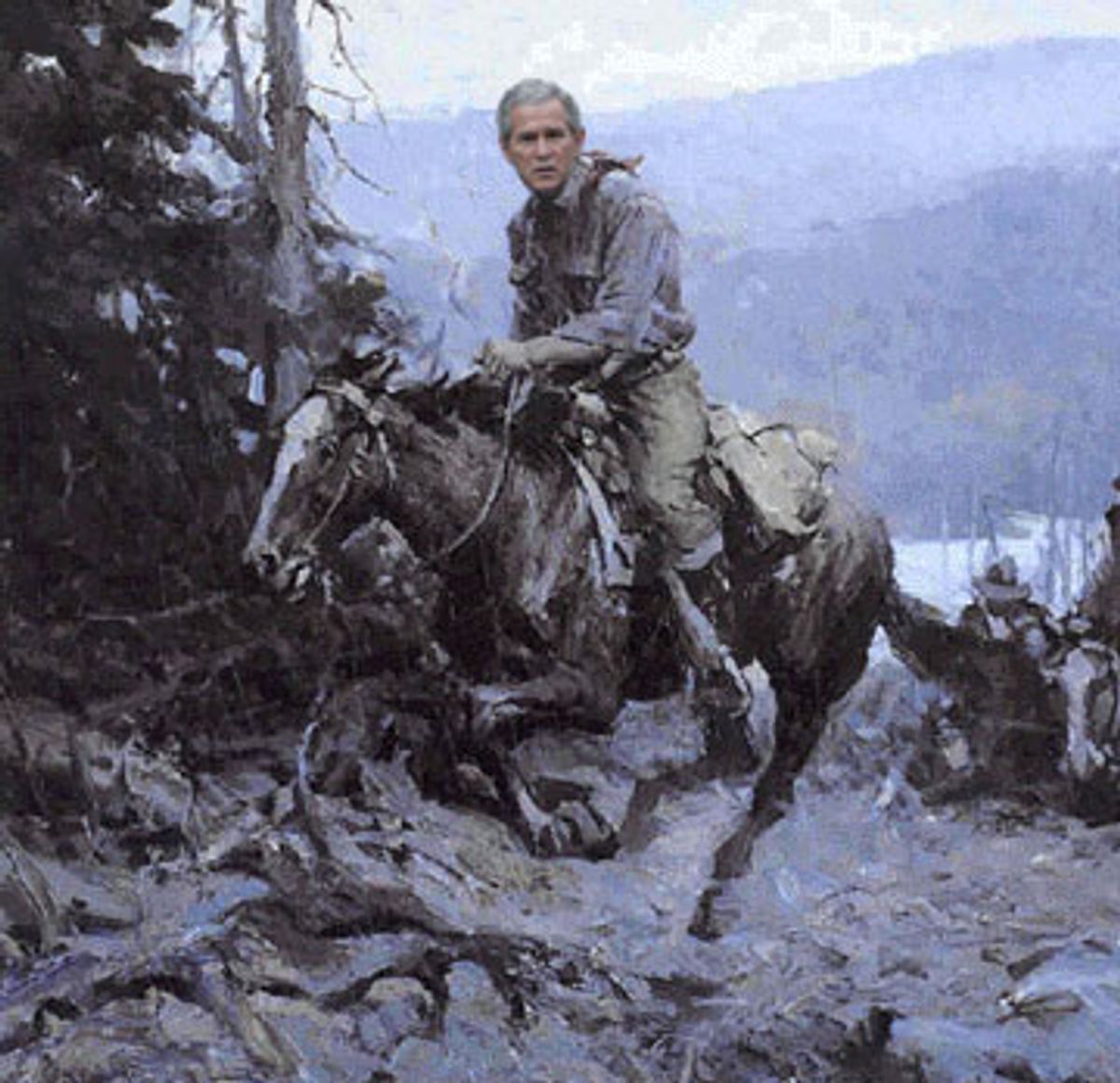
To understand how Bush justifies a torture policy that is the bane of our nation, consider the sentimental cowboy art that decks his Oval Office walls.

  • more
    • All Share Services

From Norman Rockwell to Abu Ghraib

Having written extensively on the Bush administration’s torture policy for Salon, I concluded, in light of the shocking photographs from Abu Ghraib, that the visual medium is the most powerful and penetrating way to communicate the policy. More than two years ago, I brought the idea of making a documentary on the Bush policy to Alex Gibney, the director of “Enron: The Smartest Guys in the Room. Alex shared my sense of urgency, and “Taxi to the Dark Side” will premiere April 27 at the Tribeca Film Festival. (Alex is the director; I am executive producer.)

Through the film runs the story of an Afghan taxi driver, known only as Dilawar, completely innocent of any ties to terrorism, who was tortured to death by interrogators in the U.S. prison at Bagram Air Base in Afghanistan. “Taxi to the Dark Side” traces the evolution of the Bush policy from Bagram (Dilawar’s interrogators speak in the film) to Guantánamo (we filmed the official happy tour) to Abu Ghraib; its roots in sensory deprivation experiments decades ago that guided the CIA in understanding torture; the opposition within the administration from the military and other significant figures (the former general counsel of the Navy, Alberto Mora, and former chief of staff to Secretary of State Colin Powell, Lawrence Wilkerson, explain how that internal debate went, while John Yoo, one of its architects, defends it); the congressional battle to restore the standard of the Geneva Convention that forbids torture (centered on John McCain’s tragic compromise); and the sudden popularity of the Fox TV show “24″ in translating torture into entertainment by means of repetitious formulations of the bogus ticking-time-bomb scenario.

Yet “Taxi to the Dark Side” is more than an exposé of policy. Its irrefutable images are the counterpoint to the peculiar aesthetics propagated in the age of George W. Bush, in which, through the contradictory styles of softening nostalgia and hardening cruelty, the president and his followers seek to justify their actions not only to the public but also to themselves.

The notion that there might be an aesthetic that informs the Bush presidency would seem to be an unfair and artificial imposition on a man who prizes his intuition (“I’m a gut player”) and openly derides complication (“I don’t do nuance”) — that is, if Bush himself did not insist on the connection. Indeed, he appears on the official White House Web site, conducting a tour of the art and artifacts he has chosen to decorate the Oval Office, assuming the duty of docent himself. He holds forth on the large windows and the rug with rays of the sun emanating from the seal of the president and the provenance of his desk before getting to the artwork. (On April 19, Bush recounted to a crowd in Tipp City, Ohio, a story he has told many times, of how he commissioned his wife, Laura, to design the rug and then in defense of his Iraq policy simply remarked, “Remember the rug?”)

“Each president can put whatever paintings he wants on the wall. I’ve chosen some paintings that kind of reflect my nature,” Bush says in his video tour. He points to portraits of Abraham Lincoln (“The job of the president is to set big goals for the country”) and George Washington (“You couldn’t have the Oval Office without George Washington on the wall”) and pats busts of Lincoln (“You can tell he’s one of my favorites”), Dwight Eisenhower (“steady”) and Winston Churchill (“gift of the British prime minister … Churchill was a war leader … resolute, tough”).

Bush takes special pride in pointing out two paintings he has hung that highlight his motives and legacy. He consciously placed these pictures in the Oval Office at the beginning of his tenure to serve as prescient cultural markers. “The Texas paintings are on the wall because that’s where I’m from and where I’m going,” he says.

One of them, by little-known painter and illustrator William Henry Dethlef Koerner, titled “A Charge to Keep,” depicts a hatless cowboy followed by two other riders galloping up a hill. Their faces are intent as they pursue some quarry in the distance that cannot be seen by others. Or are they being chased? “I love it,” Bush said, further explaining his intimate feeling for the painting to reporters and editors of the Washington Times, a conservative newspaper. He offered his interpretation: “He’s a determined horseman, a very difficult trail. And you know at least two people are following him, and maybe a thousand.” Bush added that the painting is “based” on an old hymn. “And the hymn talks about serving the Almighty. So it speaks to me personally.” When he was governor of Texas and the painting hung in his office, Bush wrote a note of explanation to his staff: “This is us.”

W.H.D. Koerner, born in 1878, was a German immigrant who settled with his family in Iowa. After an early stint as a rapid-hand illustrator for the Chicago Tribune before photographs became commonplace in newspapers, he studied at the Howard Pyle School of Art, in Delaware, led by the leading illustrator in the country. Koerner then became a regular illustrator for the Saturday Evening Post, a mass magazine that appealed to small-town sentimentality and mythology in an age before the spread of radio. The magazine’s trademark was its hundreds of covers produced by Norman Rockwell, a commercial artist whose ubiquitous work in advertising and his glossy but homey kitsch for the Saturday Evening Post gained him a reputation as one of the definers of everyday Americana.

The magazine used Koerner especially to provide pictures to accompany short stories about cowboys. In 1912, it gave Koerner the choice assignment of illustrating Zane Grey’s “Riders of the Purple Sage.” The Koerner painting that now hangs in the Oval Office first appeared as an illustration for a cowboy story called “The Slipper Tongue” in the June 3, 1916, issue. The next year, the magazine reprinted the illustration to accompany another cowboy story, “Ways That Are Dark.” (Both of the writers of these short stories were forgettable figures in the western pulp fiction tradition, originated in the late 19th century by Ned Buntline, inventive publisher of Wild West dime novels and mythologizer of “Buffalo Bill” Cody and “Wild Bill” Hickok, who in the process became the wealthiest author of his time.) Two years after his illustration was first printed, Koerner resold it to Country Gentleman magazine, to go with another western called “A Charge to Keep.” The editors of Country Gentleman didn’t seem to mind that the picture had been used twice before by another publication.

In 1995, at Bush’s inaugural as governor of Texas, his wife, Laura, selected an 18th century Methodist hymn, written by Charles Wesley, titled “A Charge to Keep.” Its words in part are:

A charge to keep I have,
A God to glorify,
A never-dying soul to save,
And fit it for the sky.

To serve the present age,
My calling to fulfill:
O may it all my powers engage
To do my master’s will!

After the ceremony, one of Bush’s childhood friends, Joseph I. “Spider” O’Neill, managing partner of his family’s oil and investment company, told him that he owned a painting, remarkably enough titled “A Charge to Keep,” and that he would happily lend it to the governor. O’Neill and his wife, who attended Southern Methodist University with Laura, as it happened had also played Cupid in arranging the first date between George and Laura. Presented with the cowboy painting, Bush enthusiastically displayed it at the Governor’s Mansion and now the White House.

The idea of Bush as a Christian cowboy, dashing upward and onward to fulfill the Lord’s commandments, inspired him to title his campaign autobiography (written by his then communications advisor, Karen Hughes) “A Charge to Keep: My Journey to the White House.” Sample: “I could not be governor if I did not believe in a divine plan that supersedes all human plans.”

On the White House Web site, Bush continues his tour of his favored artwork, drawing attention to an additional painting, by regional Texan artist Julian Onderdonk, which portrays in soft beige tones one of the most iconic and historic places in the state — the Alamo. The painting features indistinct Mexican women making tortillas in the plaza of the mission that the Mexican army besieged in the Texas war of independence of 1836. Nearly every man was killed, a massacre that became symbolic of a heroic last stand and a rallying cry for revenge. As everyone knows who has ever read one of the many histories or novels about the conflict or seen the TV series of the 1950s, “Davy Crockett,” or any of the movies titled “The Alamo,” such as the one featuring John Wayne as Davy Crockett, the ragtag defenders knew they were doomed but decided to fight the overwhelming Mexican army. In an incident that may be apocryphal, the commander, William Travis, drew a line in the ground, urging those who wished to leave to cross it; none did. Thus dying for the cause became the red badge of courage. Dying was “never dying,” as the old hymn said, but gave birth to the republic of Texas.

Studying the racing cowboy, Bush gleans a moral lesson to stay the course, even if its end cannot be seen; his certainty that he is followed, not just by two men but also by “thousands”; and his conviction that his hot pursuit is divinely guided. As he gazes at the Alamo he is reminded that doubt and skepticism are equivalent to cowardice and capitulation, that battling to the end will lead to redemption and resurrection.

In his private study off the Oval Office, Bush displays another artifact, but one that is not featured on the Web site tour — Saddam Hussein‘s pistol, seized after U.S. soldiers captured him in December 2003. “It’s now the property of the U.S. government,” Bush announced at a press conference shortly afterward. The president has had the gun mounted like a trophy. “He really liked showing it off,” a visitor told Time magazine. In his fortress of solitude, surrounded by images of the rider and the Alamo, the determined pursuer and the last stand, the gun has become a token of Bush’s inevitable victory.

Bush understands his war in Iraq through his Western artifacts — a West, by the way, without any manifestation of Native Americans. The more resistant the reality in Iraq, the tighter he clings to the symbolism of the West. And so do those who support him. “America has a vital interest in preventing the emergence of Iraq as a Wild West for terrorists,” Sen. John McCain declared on April 11. But there is a dark side to the Wild West show of the conservative mind (just as there was to the Wild West). “We have to work the dark side,” said Vice President Dick Cheney a week after the Sept. 11 terrorist attacks.

One week after Cheney’s statement, on Sept. 25, 2001, the Department of Justice sent the White House a memo titled “The President’s Constitutional Authority to Conduct Military Operations Against Terrorists and Nations Supporting Them.” The memo declared that there were “no limits” on the president’s powers to wage a war without any known end and that the president was invested with powers to stage “preemptive” strikes against any target he designates at any time without consulting Congress.

On Aug. 1, 2002, another memo, co-written by the chief of the Office of Legal Counsel of the Justice Department, Jay Bybee, and his deputy assistant, John Yoo, who had been the author of the earlier Sept. 25, 2001, memo, laid out the rationale for a new policy on torture.

On Jan. 25, 2002, White House legal counsel Alberto Gonzales stated in a memo to President Bush that the Geneva Conventions Common Article Three to which the U.S. is a signatory and that forbids torture was obsolete: “In my judgment, this new paradigm renders obsolete Geneva’s strict limitations on questioning of enemy prisoners and renders quaint some of its provisions.”

Now, Bybee and Yoo redefined torture. In their memo they recast techniques illegal under the Geneva Conventions as acceptable: “Physical pain amounting to torture must be equivalent in intensity to the pain accompanying serious physical injury, such as organ failure, impairment of bodily function, or even death.” Bush promptly ordered implementation of the new policy. Thus the decision whose grotesque consequences were enacted at Abu Ghraib began at the top of the chain of command. When the Bybee memo was exposed the administration declared that it had been rescinded. But the “coercive interrogation techniques,” as Bush calls them, continued. “This program won’t go forward if there’s vague standards applied like those in the Geneva Conventions,” he said on Sept. 15, 2006. He assailed Congress for trying to legislate against torture and reiterated that Article Three is “so vague.”

An obsession with torture has not been restricted to the White House. It has spread into the larger culture, especially through a popular TV series, on Rupert Murdoch’s Fox entertainment channel, called “24.” Every week, a fictional hero named Jack Bauer, an agent for a fictional government Counter Terrorist Unit, races the clock, in fantastic ticking-time-bomb scenarios, to thwart terrorist plots. Bauer’s favored method is torture. Agent Bauer has shot one suspect’s wife, staged a fake execution of another’s child, electrocuted another bad guy and even tortured his own brother. Bauer is also tortured from time to time, fostering an impulse for vengeance. From 2002 through 2005, the Parents Television Council, a watchdog group, counted 67 torture scenes on “24.”

In March 2006, in Washington, the Heritage Foundation, a right-wing think tank, sponsored a panel discussion devoted to “24,” titled “America’s Image in Fighting Terrorism: Fact, Fiction, or Does It Matter?” Lending verisimilitude to the celebration of the fictional TV series, Secretary of Homeland Security Michael Chertoff was the first speaker. “Frankly,” he said about the program, “it reflects real life.” He expressed a wish that terror investigations could be more like those on TV. “I wish we could have a rapid execution of tasks within 24 hours,” Chertoff said. Howard Gordon, the show’s executive producer, conceded, “When Jack Bauer tortures, it’s in a compressed reality.”

The moderator, right-wing talk show host Rush Limbaugh, boasted, “Everybody I’ve met in the government that I tell I watch this show, they are huge fans. Vice president’s a huge fan. Secretary [of Defense Donald] Rumsfeld is a huge fan.” In fact, on the same day as the Heritage Foundation event the producer and director of “24″ were feted at a private lunch at the White House. Jane Mayer of the New Yorker reported: “Among the attendees were Karl Rove, the deputy chief of staff; Tony Snow, the White House spokesman; Mary Cheney, the Vice-President’s daughter; and Lynne Cheney, the Vice-President’s wife, who, [Joel] Surnow [the show's director] said, is ‘an extreme ’24′ fan.’”

But “24″ is more than the return of the repressed. Administration officials seem to view it as the war on terror in its ideal form, utterly without “quaint” restraints or actual frustrations. “24″ is torture without excuses or embarrassment. Bush administration fans apparently project themselves onto agent Bauer, whose methods are always cheered and whose own suffering ends within the hour. For them it is all more real than real life.

John Yoo, in his book justifying torture, “War by Other Means,” published in 2006, even cited “24″ as a legitimate intellectual proof for the policy he helped put into place: “What if, as the popular Fox television program ’24′ recently portrayed, a high-level terrorist leader is caught who knows the location of a nuclear weapon?” he writes about the most grandiose of ticking-time-bomb plots. This sort of scenario invariably prompts agent Bauer’s remorseless threat to terrorist suspects: “You are going to tell me what I want to know. It’s just a question of how much you want it to hurt.” Thus the lines between fact and fiction, reality and kitsch, and policy and entertainment are blurred.

The distance between the cowboy paintings Bush proudly displays in the Oval Office and the secret-agent torture porn that his administration officials not so secretly watch with envy reflects a yawning chasm in the sensibility of kitsch. Koerner’s Western pictures depict an idealized past, where never is heard a discouraging word. At the Saturday Evening Post, he joined with Norman Rockwell to create the brush strokes of a warming nostalgia.

These enduring images infused Reaganism with its emotional culture. Ronald Reagan, after all, had been raised at the turn of the century in small-town Illinois and became a contract player in Hollywood’s dream factory. Communicating kitsch was second nature to him. The perfect representation came in the TV commercial for his reelection campaign in 1984. As an American flag was raised in a small town, the voice-over intoned: “It’s morning again in America.” The past was present and all was right with the world.

Now, kitsch has been radically remade. No longer evoking nostalgic utopianism, kitsch releases the compulsions of fear. Under Bush, kitsch has been transformed from sentimentality into sadomasochism.

Sidney Blumenthal, a former assistant and senior advisor to President Clinton, writes a column for Salon and the Guardian of London. His new book is titled "How Bush Rules: Chronicles of a Radical Regime." He is a senior fellow at the New York University Center on Law and Security.

Memorial Day’s lessons in amnesia

If nothing else, the holiday allows us to reflect on our commitment to forgetting bloody conflicts

  • more
    • All Share Services

Memorial Day's lessons in amnesia (Credit: Carly Rose Hennigan via Shutterstock)
This piece originally appeared on TomDispatch.

It’s the saddest reading around: the little announcements that dribble out of the Pentagon every day or two — those terse, relatively uninformative death notices: rank; name; age; small town, suburb, or second-level city of origin; means of death (“small arms fire,” “improvised explosive device,” “the result of gunshot wounds inflicted by an individual wearing an Afghan National Army uniform,” or sometimes something vaguer like “while conducting combat operations,” “supporting Operation Enduring Freedom,” or simply no explanation at all); and the unit the dead soldier belonged to.  They are seldom 100 words, even with the usual opening line: “The Department of Defense announced today the death of a soldier who was supporting Operation Enduring Freedom.” Sometimes they include more than one death.

They are essentially bureaucratic notices designed to draw little attention to themselves.  Yet cumulatively, in their hundreds over the last decade, they represent a grim archive of America’s still ongoing, already largely forgotten second Afghan War, and I’ve read them obsessively for years.

Into the Memory Hole

May is the official month of remembrance when it comes to our war dead, ending as it does on the long Memorial Day weekend when Americans typically take to the road and kill themselves and each other in far greater numbers than will die in Afghanistan.  It’s a weekend for which the police tend to predict rising fatalities and news reports tend to celebrate any declines in deaths on our roads and highways.

Quiz Americans and a surprising number undoubtedly won’t have thought about the “memorial” in Memorial Day at all — especially now that it’s largely a marker of the start of summer and an excuse for cookouts.

How many today are aware that, as Decoration Day, it began in 1865 in a nation still torn by grief over the loss of — we now know – up to 750,000 dead in the first modern war, a wrenching civil catastrophe in a then-smaller and still under-populated country?  How many know that the first Decoration Day was held in 1865 with 10,000 freed slaves and some Union soldiers parading on a Charleston, South Carolina, race track previously frequented by planters and transformed in wartime into a grim outdoor prison?  The former slaves were honoring Union prisoners who had died there and been hastily buried in unmarked graves, but as historian Kenneth Jackson has written, they were also offering “a declaration of the meaning of the war and of their own freedom.”

Those ceremonies migrated north in 1866, became official at national cemeteries in 1868, and grew into ever more elaborate civic remembrances over the years.  Even the South, which had previously marked its grief separately, began to take part after World War I as the ceremonies were extended to the remembrance of all American war dead.  Only in 1968, in the midst of another deeply unpopular war, did Congress make it official as Memorial Day, creating the now traditional long holiday weekend.

And yet, when it comes to the major war the United States is still fighting, now in its 11th year, the word remembrance is surely inappropriate, as is the “Memorial” in Memorial Day.  It’s not just that the dead of the Afghan War have largely been tossed down the memory hole of history (even if they do get official attention on Memorial Day itself).  Even the fact that Americans are still dying in Afghanistan seems largely to have been forgotten, along with the war itself.

As the endlessly plummeting opinion polls indicate, the Afghan War is one Americans would clearly prefer to forget — yesterday, not tomorrow.  It was, in fact, regularly classified as “the forgotten war” almost from the moment that the Bush administration turned its attention to the invasion of Iraq in 2002 and so declared its urge to create a Pax Americana in the Greater Middle East.  Despite the massive “surge” of troops, special operations forces, CIA agents, and civilian personnel sent to Afghanistan by President Obama in 2009-2010, and the ending of the military part of the Iraq debacle in 2011, the Afghan War has never made it out of the grave of forgetfulness to which it was so early consigned.

Count on one thing: there will be no Afghan version of Maya Lin, no Afghan Wall on the National Mall.  Unlike the Vietnam conflict, tens of thousands of books won’t be pouring out for decades to come arguing passionately about the conflict.  There may not even be a “who lost Afghanistan” debate in its aftermath.

Few Afghan veterans are likely to return from the war to infuse with new energy an antiwar movement that remains small indeed, nor will they worry about being “spit upon.”  There will be little controversy.  They — their traumas and their wounds — will, like so many bureaucratic notices, disappear into the American ether, leaving behind only an emptiness and misery, here and in Afghanistan, as perhaps befits a bankrupting, never-ending imperial war on the global frontiers.

Whistling Past the Graveyard of Empires

If nothing else, the path to American amnesia is worth recalling on this Memorial Day.

Though few here remember it that way, the invasion of Afghanistan was launched on a cult of the dead.  These were the dead civilians from the Twin Towers in New York City.  It was to their memory that the only “Wall” of this era — the 9/11 Memorial at Ground Zero in lower Manhattan — has been built.  Theirs are the biographies that are still remembered in annual rites nationwide.  They are, and remain, the dead of the Afghan War, even though they died before it began.

On the other hand, from the moment the invasion of Afghanistan was launched, how to deal with the actual American war dead was always considered a problematic matter.  The Bush administration and the military high command, with the Vietnam War still etched in their collective memories, feared those uniformed bodies coming home (as they feared and banishedthe “body count” of enemy dead in the field).  They remembered the return of the “body bags” of the Vietnam era as a kind of nightmare, stoking a fierce antiwar movement, which they were determined not to see repeated.

As a result, in the early years of the Afghan and then Iraq wars, the Bush administration took relatively draconian steps to cut the media off from any images of the returning war dead.  They strictly enforced a Pentagon ban, in existence since the first Gulf War, on media coverage and images of the coffins arriving from the war fronts at Dover Air Force Base in Delaware.  At the same time, much publicity was given to the way President Bush met privately and emotionally — theoretically beyond the view of the media — with the families of the dead.

And yet, banned or not, for a period the war dead proliferated.  In those early years of Washington’s two increasingly catastrophic wars on the Eurasian mainland, newspapers regularly produced full-page or double-page “walls of heroes” with tiny images of the faces of the American dead, while their names were repeatedly read in somber tones on television.  In a similar fashion, the antiwar movement toured the country with little “cemeteries” or displays of combat boots representing the war dead.

The Pentagon ban ended with the arrival of the Obama administration.  In October 2009, six months after the Pentagon rescinded it, in an obvious rebuke to his predecessor, President Obama traveled to Dover Air Base.  There, inside a plane bringing the bodies of the dead home, he reportedly prayed over the coffins and was later photographed offering a salute as one of them was carried off the plane. But by the time the arrival of the dead could be covered, few seemed to care.

The Bush administration, it turns out, needn’t have worried.  In an America largely detached from war, the Iraq War would end without fanfare or anyone here visibly giving much of a damn.  Similarly, the Afghan War would continue to limp from one disaster to the next, from an American “kill team” murdering Afghan civilians “for sport” to troops urinating on Afghan corpses (and videotaping the event), or mugging for the camera with enemy body parts, or an American sergeant running amok, or the burning of Korans, or the raising of an SS banner.  And, of course, ever more regularly, ever more unnervingly, Afghan “allies” would turn their guns on American and NATO troops and blow them away.  It’s a phenomenon almost unheard of in such wars, but so common in Afghanistan these days that it’s gotten its own label: “green-on-blue violence.”

This has been the road to oblivion and it’s paved with forgotten bodies.  Forgetfulness, of course, comes at a price, which includes the escalating long-term costs of paying for the American war-wounded and war-traumatized.  On this Memorial Day, there will undoubtedly be much cant in the form of tributes to “our heroes” and then, Tuesday morning, when the mangled cars have been towed away, the barbeque grills cleaned, and the “heroes” set aside, the forgetting will continue.  If the Obama administration has its way and American special operations forces, trainers, and advisors in reduced but still significant numbers remain in Afghanistan until perhaps 2024, we have more than another decade of forgetting ahead of us in a tragedy that will, by then, be beyond all comprehension.

Afghanistan has often enough been called “the graveyard of empires.”  Americans have made it a habit to whistle past that graveyard, looking the other way — a form of obliviousness much aided by the fact that the American war dead conveniently come from the less well known or forgotten places in our country.  They are so much easier to ignore thanks to that.

Except in their hometowns, how easy the war dead are to forget in an era when corporations go to war but Americans largely don’t.  So far, 1,980 American military personnel (and significant but largely unacknowledged numbers of private contractors) have died in Afghanistan, as have 1,028 NATO and allied troops, and (despite U.N. efforts to count them) unknown but staggering numbers of Afghans.

So far in the month of May, 22 American dead have been listed in those Pentagon announcements.  If you want a little memorial to a war that shouldn’t be, check out their hometowns and you’ll experience a kind of modern graveyard poetry.  Consider it an elegy to the dead of second- or third-tier cities, suburbs, and small towns whose names are resonant exactly because they are part of your country, but seldom or never heard by you.

Here, then, on this Memorial Day, are not the names of the May dead, but of their hometowns, announcement by announcement, placed at the graveside of a war that we can’t bear to remember and that simply won’t go away.  If it’s the undead of wars, the deaths from it remain a quiet crime against American humanity:

Spencerport, New York

Wichita, Kansas

Warren, Arkansas

West Chester, Ohio

Alameda, California

Charlotte, North Carolina

Stow, Ohio

Clarksville, Tennessee

Chico, California

Jeffersonville, Kentucky

Yuma, Arizona

Normangee, Texas

Round Rock, Texas

Rolla, Missouri

Lucerne Valley, California

Las Cruses, New Mexico

Fort Wayne, Indiana

Overland Park, Kansas

Wheaton, Illinois

Lawton, Oklahoma

Prince George, Virginia

Terre Haute, Indiana.

As long as the hometowns pile up, no one should rest in peace.

Tom Engelhardt, co-founder of the American Empire Project and the author of ”The American Way of War: How Bush’s Wars Became Obama’s“ as well as ”The End of Victory Culture,” runs the Nation Institute’s TomDispatch.com. His latest book is ”The United States of Fear“ (Haymarket Books). To listen to Timothy MacBain’s latest Tomcast audio interview in which he discusses what Americans should consider remembering on Memorial Day, click here or download it to your iPod here.

[Note on Further Reading: For those interested in exploring the history of Memorial Day, there’s no better place to visit than the always fascinating website History News Network.  For carefully put together records on American and NATO deaths in Afghanistan, visiticasualties.org.  Simply to keep up on American war news, not always the easiest thing in the mainstream media these days, make sure to visit Antiwar.com (as I do daily).]

Continue Reading Close

Tom Engelhardt, co-founder of the American Empire Project, runs the Nation Institute's TomDispatch.com. His latest book, "The United States of Fear" (Haymarket Books), has just been published.

Where the wounded are

Wars don't just cause casualties among soldiers, they drain medical staff. I traveled to see the costs firsthand

  • more
    • All Share Services

Where the wounded areA soldier is prepared for an operation at Landstuhl Regional Medical Center. (Credit: Reuters/Kai Pfaffenbach)

The weather’s getting warmer in Afghanistan and the war there is heating up again. That means – as it has meant every year for more than a decade — that the pace will quicken at the Landstuhl Regional Medical Center in Germany. More casualties will be brought to this largest American military hospital outside the United States. The Critical Care Air Transport teams and their C-17 Globemasters will fly in from “downrange,” as they call the Afghan battleground, and the injured will be brought by ambulance bus from nearby Ramstein Air Force Base to the hospital front door.

I spent a few days at Landstuhl recently, one of a group of writers from the Writers Guild Initiative, part of the Writers Guild of America, East Foundation (Full disclosure and just to add to the confusion: I’m president of the Writers Guild, East, the union with which the foundation’s affiliated).

For the last four years, the foundation has been conducting writing workshops. The project began with professional writers from stage, TV and movies mentoring veterans from the Iraq and Afghan wars, working with them on writing exercises and projects ranging from memoirs and blogs to children’s books, screenplays and sci-fi novels. Recently, in collaboration with the Wounded Warrior Project, the foundation started similar workshops with caregivers, the loved ones of veterans helping them through the aftermath of catastrophic injuries.

Now, Wounded Warrior had asked some of us to come to Landstuhl to meet with the medical staff there. Some 3,000 strong, military and civilian, they work ceaselessly in what has become one of the busiest trauma centers in the world, helping between 20,000 and 30,000 patients a year (not just from the battlefield, but also military and their dependents from all over Europe, Africa and much of Asia).

Landstuhl is where the victims of the 1983 bombing of the U.S. Marines Corps barracks in Beirut were brought; Bosnian refugees from the Sarajevo marketplace bombing in 1994, too, wounded from the American embassy bombing in Kenya in 1998 and the 2000 attack on USS Cole. During the first Gulf War, more than 4,000 service members were treated at Landstuhl, as have been men and women fighting in the Balkans and Somalia. Since 9/11, the hospital has treated coalition troops from 44 different countries.

They compare this hospital to the center of an hourglass; it’s the midpoint between a combat injury and treatment in the field and then subsequent care back in the States or other home country. Or it’s where a service member is treated and then sent back into battle.

The staff at Landstuhl sees the wounded at their worst. Many who arrive suffer from multiple injuries – “polytrauma” so extensive that several teams of surgeons with different specialties – neurological, thoracic, ear and eye, facial reconstruction and orthopedic, among others — may work on an individual patient, often simultaneously. Bodies are blown apart or crushed by IEDs, grenades and suicide bombs, but so skillful are the medical teams there, so advanced the techniques and technology, Landstuhl’s survival rate runs as high as 99.5 percent. (The survival rate among American wounded in World War II was 70 percent.)

But all that success takes a toll. One of the little discussed but potent side effects of war is what’s called combat and occupational stress Rreaction or secondary traumatic stress disorder. Compassion fatigue.

After all the years of fighting in Iraq and Afghanistan, many of the doctors, nurses and other staff at Landstuhl are exhausted or worse. Given what they’ve seen — the horrific wounds and amputations, the infection, agony and grief – some walk around “like zombies,” one therapist said. Feelings of empathy and kindness yield to loneliness, despair and burnout.

Many of the compassion fatigue symptoms are similar to post-traumatic stress disorder  – physical effects like headaches, gastrointestinal problems, reproductive troubles, as well as mental  — nightmares, flashbacks, anxiety, emotional distance, isolation and more.

Working with physically damaged men and women who are so deeply traumatized rubs off. The emotional rawness is contagious. A hospital handout on PTSD understatedly reads, “When life-changing events occur, perceptions about the world may change. For example, before soldiers experience combat trauma, they may think the world is safe. Following combat, a soldier’s perceptions may change — a majority of the world may now seem unsafe.”

That’s why returning vets may reflexively search alongside a U.S. interstate highway for roadside bombs, only shop at Walmart at 3 in the morning, or worry to excess that their children’s school will be attacked by terrorists. And it’s why after hearing the stories of their patients, reliving the horrors of war, watching them endure pain and sometimes countless operations, medical practitioners can suffer from the same fears — whether it’s the surgeon who heals the wounds, the psychiatrist who probes the mind for the source of anguish or even the clean-up staff decontaminating and removing the blood from surgical tools.

Combine that with homesickness, the high operational tempo of Landstuhl, the low tolerance for mistakes, the downtime when the mind takes over and remembers every awful experience. It’s a dangerous, often unhealthy mix.

And so, on a Saturday morning, we writers sat down with a bunch of men and women who work at Landstuhl and other nearby medical facilities. There were 14 of us and t32 or so of them. We broke into small groups – two writers working with a group of two to four hospital staff.

My colleague Susanna and I mentored four – a male Army nurse and a female Navy nurse, a physical therapist and a developmental pediatric psychiatrist. We weren’t there to interview or pry; they would tell us what they wanted us to know when they wished, their stories slowly emerging from conversation and the brief writing exercises we gave them.

The male nurse had been in Special Ops, the Navy, Marines and Army; he was reluctant to talk of what he had experienced but wanted to examine themes of good and evil in an epic novel. The physical therapist told us she wanted to explore the mind-body connection, perhaps with a blog; the Navy nurse spoke of her feelings for the soldiers she took care of from the Republic of Georgia, the former Soviet state, now independent. (By the end of the year, Georgia, aiming at membership in NATO, will have some 1,500 troops in Afghanistan.) She had learned how to bake for them the Georgian national dish, khachapuri, a cheese-filled bread; now she wants to write a cookbook.

For two days, we talked and they wrote, we recommended books and movies, they told us about the ones they loved. Tears were shed as stories and memories came to the surface, many too private to relate here. Over the coming weeks and months, we’ll stay in touch via email and meet again; trying to be of assistance as they write to express their thoughts and feelings, to tell their stories.

Do the workshops help? Hard to measure, but intuitively it feels as if they do, that in the talking and writing comes self-awareness and some measure of equanimity. And selfishly, for those of us who serve as writer-mentors, the benefits are enormous and fulfilling.

But the statistics are alarming. According to NBC News, “The Pentagon counts more than 6,300 American dead and 33,000 wounded in action in Iraq and Afghanistan. A Rand Corp study estimates that as many as 300,000 post-9/11 veterans suffer from PTSD or major depression, and about 320,000 may have experienced traumatic brain injuries, mainly from bombs.” The number of civilian fatalities in Iraq and Afghanistan remains uncertain but a Brown University study last year reported at least 132,000.

Meanwhile, there are still nearly 90,000 American troops in Afghanistan.  More will die and be wounded. President Obama has pledged their complete departure in 2014.

But even after that, the work at Landstuhl will go on. There are still nearly 300,000 American military personnel overseas, plus family members. Landstuhl will take care of many of them. And, says one of the hospital’s surgeons, with a sigh of resignation, “There will always be the Middle East.”

Continue Reading Close

Michael Winship is senior writing fellow at Demos and a senior writer of the new series, Moyers & Company, airing on public television.

NATO invites Pakistan to summit

A sign that Islamabad is ready to reopen its western border to NATO troops on their way to Afghanistan

  • more
    • All Share Services

NATO invites Pakistan to summitOil tankers, which were used to transport NATO fuel supplies to Afghanistan, are parked at a compound in Karachi, Pakistan, Tuesday, May 15, 2012. NATO on Tuesday invited Pakistani President Asif Ali Zardari to the alliance's summit in Chicago, after signs that the country could be moving to reopen its Afghan border to NATO military supplies. (AP Photo/Shakil Adil)(Credit: AP)

ISLAMABAD (AP) — NATO on Tuesday invited Pakistan’s president to the upcoming Chicago summit on Afghanistan, the strongest sign yet that Islamabad is ready to reopen its western border to U.S. and NATO military supplies heading to the war in the neighboring country.

Pakistan blocked the routes in November after American airstrikes killed 24 of its troops on the Afghan border. The attack sent ties between Washington and Islamabad to new lows, threatening regional cooperation needed for negotiating an end to the Afghan war.

The U.S. expressed regret for the airstrikes and has been quietly pressing Pakistan to reopen the routes over the last two weeks. Washington and NATO stepped up those efforts in recent days by making it clear Islamabad would not be welcome at the two-day summit beginning Sunday in Chicago unless it did so.

NATO Secretary-General Anders Fogh Rasmussen phoned President Asif Ali Zardari on Tuesday afternoon to invite him to the meeting, according to a statement from the Pakistan government and NATO.

“This meeting will underline the strong commitment of the international community to the people of Afghanistan and to its future,” NATO spokeswoman Oana Lungescu said in Brussels, where the alliance is based. “Pakistan has an important role to play in that future.”

In Islamabad, Zardari’s spokesman Farhatullah Babar said the president would consider the invitation, which he said was not linked to any reopening of the supply lines.

The invite came hours ahead of a meeting in Pakistan of civilian and military leaders to discuss the supply line blockade. A lawmaker said participants would consider reopening the routes. Their recommendations would be sent to the Cabinet, which will meet on Wednesday to formally approve the decision, he said on condition of anonymity to discuss the sensitive matter.

A NATO diplomat in Brussels, also speaking condition of anonymity for the same reason, said the invitation to Zardari was meant as an inducement to the Pakistani government to reopen the borders.

By maintaining the blockade, Pakistan’s teetering economy risked missing out on millions of dollars in international development and loans, as well military aid. It was also facing the prospect of being left out of discussions on the future of Afghanistan.

The blockade forced NATO to reorient its logistics chain to more expensive routes across Russia and Central Asia. While the war effort has not suffered, the Pakistani routes will be more important in coming months as NATO begins to pull out of Afghanistan, with a 2014 deadline for the withdrawal of all foreign combat troops.

Pakistan sought to use the deadly American air strikes in November to extract new terms from the United States in what has always been a tense and largely transactional relationship. The government has said it wants more money from the U.S. and NATO for hosting the supply routes, something Washington has indicated it could do.

The country’s parliament also demanded an apology from Washington for the border incident, and an end to America’s drone strike campaign against militants in northwestern Pakistan, but neither appears likely, U.S. officials say. Negotiators from both countries have been discussing the drone strikes, which are unpopular in Pakistan, but Washington has said it will not stop them because they are vital to keeping al-Qaida on the defensive.

Pakistani Foreign Minister Hina Rabbani Khar said Monday that Islamabad had made the right decision to close the border, but strongly suggested that it was time to reopen it, saying that Pakistan couldn’t afford to alienate the world for much longer.

Pakistan has some bargaining power of its own because its cooperation is seen as important to striking a peace deal with the Taliban and their allies in Afghanistan that would allow foreign troops to withdraw without sending the nation into further chaos.

The weak government risks some backlash from nationalist and Islamist groups, as well as militants, by reopening the supply lines. But the powerful army, which has influence over much of the country’s media and some of its most firebrand politicians and clerics, is likely to tamp down the outrage.

More than 50 heads of state will attend the meeting in Chicago, including President Barack Obama who will be speaking in his hometown.

In Kabul, Afghanistan’s deputy foreign minister Jawed Ludin said there are “some positive signs from Pakistan.”

“It may be resolved today or tomorrow, but as it stands, it’s still unresolved,” Ludin told reporters on Tuesday.

___

Lekic reported from Brussels. Associated Press writers Deb Riechmann in Kabul and Munir Ahmed in Islamabad contributed to this report.

Continue Reading Close

Afghanistan, I can’t quit you

My mom pushed me to join the Marines. Now that she's gone, I'm still drawn to war zones

  • more
    • All Share Services

Afghanistan, I can't quit youA child flies a kite in Kabul on Tuesday Mar. 27, 2012. (Credit: Geoffrey Ingersoll)

The heat. That’s what I remember most. Shimmery and bright. Blinding. Stifling. Heeee-eeaat.

The kind that’s not just on you, wrapped around you, but balled up and pulsing inside you — a desert blanket with teeth. It’s a type of heat that makes your skin cry and your eyeballs sweat, even in the shade; heat like a predator you can’t run away from.

I notice it right as I get off the plane — not just the degrees but also the dust. Dust you can smell, kicked up by a thousand years of struggle. In a region this old, I’m sure each breath carries a dose of unintended history: Inhale, Alexander the Great; exhale, the Ottoman Empire; inhale, the USSR; exhale, the Taliban.

And now, at 90,000 troops, it’s America’s turn.

I have my own history.

A week from now, it’ll be a year since my mother passed. Horrific car accident, traumatic brain injury. It wasn’t the first TBI I’d seen, but I hope it’s the last.

She’s the reason I and my brothers joined the Marines.

The last time I was in a war zone, though, it was Iraq. Anbar. Operation Iraqi Freedom. I was also a journalist — Marine combat correspondent, a Private Joker, like Full Metal Jacket.

“Get rid of that peace pin and get with the winning team, kid,” the Colonel says to Joker.

Yeah that was me, Raptor Man and Joker rolled into one person, hopping around the combat zone with a camera. By the end, I could tell you the type of helicopter approaching just from the sound alone.

I remember we were all terrified of roadside bombs. Nothing could rip the life out of you as quick as an improvised explosive device. Practically invisible. Pressure plates. Propane tanks. Shaped charges and command det. Incendiary bombs frying the flesh right off your bones, and tank mines turning tons of Humvee steel into an indistinguishable mess, quick as a red-light-running SUV.

Mom’s car was like that, nearly indistinguishable. Her crimson “Marine Mom” plate was bent and hanging from the front. In the backseat, purchased moments before impact, was a mangled case of Rolling Rock, the beer we all loved to drink together when the boys and I were home. When it happened, Mom was getting ready for us to come home again. The green glass from the bottles spread around the demolished Ford at a scarred Pennsylvania crossroad.

She told me once that she had cried every night during my first deployment in 2006. I deployed again in 2008. Long before I even went to bootcamp, though, she had told me she always pictured me living out of a backpack in some foreign country, carrying around a camera and a notepad.

I land in Kabul with a bit more than that. I have a pelican case of camera gear, a backpack, a duffel bag and an old Corps Alice pack. Double of everything; redundancy is key.

The big difference here is that I don’t have the Marine Corps to back me up. I’m alone in my own zone, no Conex box full of extra camera bodies, batteries and lenses. What I have is what I got.

I’m used to freedom. During deployments as a combat correspondent, or “CC,” I had an almost insane amount of freedom. I could be in Baghdad on Sunday, Ramadi on Wednesday, and Mosul by the weekend. I was one of a very select group of “non-rate” entry level Marines who could justifiably look in a colonel’s eye and ask, “Why?”

Also, I had a top-down, bottom-up view of the battlefield. I was included in high-viz command briefs as well as presence patrols.

The only problem was the multilevel public affairs web, a dicey bureaucracy hell-bent on “happy glad” editing and stories that reflect rosily on the command staff. It’s like the scene in “Full Metal Jacket,” written by a former combat correspondent in a short story called “Short Times”:

“So you didn’t see any enemy bodies, no casualties?” says the public affairs officer.

“They must have carried them all away,” says Joker.

“No blood trails?”

“It was raining.”

“Well, throw in one casualty, say, a dead officer; grunts love to read about dead officers,” says the PAO.

“How ’bout a General?”

Yes, I’ll admit, Military Public Affairs was a spin machine I desperately wanted to be free of. Full of “command messages,” clever omissions and helpful little edits.

Criticism at all was out of the question. I guess the idea was that we got enough of that from the civilian side of coverage. But to even call what we did “coverage” would be a bit of a misnomer. It was more like public relations with a journalism arm.

It’s like this. Ribbon cuttings: The General stands there smiling in front of a new clinic, and I take the standard big-scissor picture — snap. He and some Iraqi leader shake hands then — snap snap — and everyone’s happy right? But there are no details about how much we paid and how long it took to finish the project. I can’t even mention that there’s no electricity or acknowledge the smell of shit in the air, wafting from a waterless outhouse just meters from the building.

I saw a little boy come running out of it, smiling, excited the Americans came to visit, and I walk over to take a look inside. A huge pile of human shit intermixed with, strangely enough, pages from prominent American magazines. A smeared Vogue cover; I think I see Esquire, too, and then Johnny Depp peers at me from between turds, flies kissing his face like teenage girls probably do to their posters back home.

It was all so very strange, ignoring details like this, simply because “civilian journalists” don’t want to reflect harshly on command or the military, in general.

Don’t get me wrong, though, I’m not here to pull the rug out from anyone’s feet. I’m not looking for a runaway general, or a hard-hitting expose.

See, I understand that despite what the news media, pundits and commanding generals say, the reality of war is wall-to-wall gray. It may look cut and dry, good and evil, right and wrong, but on the ground, the moral abyss that stretches between weapon sights and targets contextualizes even the most distilled aspect of human struggle: Kill or be killed.

Death, like a black hole, distorts everything around it.

Speaking of death, once I arrive in Kabul city, what I’m wishing for is a little more security. As an independent operator, I’m not as comfortable as I once was rolling around with 50 well-armed 19-year-old Marines.

My travel isn’t so structured. Sit. Stand. Sleep. Get the bags off the truck, Private. Move the bags over here. Now over there. Eat. Form up. Go away. Get together. Load up. Strap in. I said: Strap. In. A C130 from Kuwait, and then you’re in the shit.

Not so now. I land in Kabul a disoriented mess. I’m not with DynCorp or Raytheon. I’m not a former SEAL with Blackwater. There’s no burly white guy waiting at the gate with a sign bearing my name.

I’m a freelance journalist. I have to rely on some tiny, jumpy Afghan who’s looking to make a quick buck to help me get my bags, fill out forms and register with the government. Then my “fixer,” a journalist facilitator, shows up with his driver and car.

Still, they are Afghans, it is not a Humvee and I am not surrounded by armed service members who are eager to dispatch my enemies.

I’ve come a long way from being that aimless college grad living in his mom’s basement. I remember I had recently become a Teach for America reject. She called me upstairs not long after I got the rejection letter. It was the afternoon. I probably still had bed hair, my breath a mixture of cold pizza and coffee.

I’ll never forget her ultimatum: “Either you go back to school …”

With my habit for whiskey? No. No more school.

“you get your teaching credentials and teach down by your father …”

In South Carolina, nah, I’ll pass. What’s the last one?

“or you enlist in the Marines.”

What? Really?

“I know a recruiter …” — undoubtedly from her days as a high school front desk secretary — “Gunnery Sergeant Fannel. You can call him right now if you want.”

Hmmm … “What’s the number?”

Years later, seeing me as a success, my two brothers would follow suit.

When I do finally meet a service member in Kabul to pick up my media credentials from the local base, he drives out of the entry control point in a lumbering “hard skin” vehicle (one that looks like a regular SUV except it’s armored).

He gets no farther than about 50 feet from the ECP, parks and gets out. He’s totally covered in protective equipment.

I see now how ridiculous we Americans sometimes look to the locals. Obsessed with protection to the point that the protection itself actually makes us slower and more apt to trip, stumble, or get caught up — in a lot of ways more vulnerable.

Also, it acts as a very ostentatious barrier between us and the Afghans.

This is not the first time I get the perspective of the locals. Another big difference this time is that I’ve given myself a week in the mix before I have to meet up for my flight out to Camp Leatherneck and the Marine units with whom I’ll embed.

So I have a week to tool around Afghanistan, free as a bird flapping in the breeze, and my perspective is not solely limited to that of the military. It’s important, I believe, to talk to the people and get to know them. I think the Marines would agree that talking to the people was no small part of their success in Anbar during the “Awakening” in ’07 and ’08. I hope it will be a part of my success as a reporter, this time on the civilian side.

The first time I was in Iraq, I’ll admit that I hated all of them. A deep, scornful hatred, like black syrup pumping thick through my heart. A hawk that eats foreign policy hawks for breakfast, I wanted to glass the whole country.

Second time around, tasked with transition teams, I got to know a lot of Iraqis. Picked up a little Arabic. I began to understand them as a people, their generational struggle to exist beneath the iron arm of Saddam’s royal tyranny.

You can Monday-morning-quarterback the shit out of our operation — whether it was legal or not, how it was handled, etc. But in between the lines of the opinion sections of the Wall Street Journal and the New York Times, it’s prudent to understand that real people with families, mothers, fathers, sons, daughters, dreams and nightmares — actual human beings — are trying to exist and cope with a never-ending cycle of trauma.

The Iraqis used to laugh at the American concept of post-traumatic stress disorder. Actually laugh. They’d say, “PTSD? Look at our children; they’ve grown up with PTSD.”

The Afghans are no different. In fact, they’re worse.

I cruise out west, to Kunduz, to the farms and the bazaars. I talk to farmers, fishermen and kids. Inside the city, I talk to prominent businessmen and city officials. In the park, I talk to regular citizens and even senior citizens as they play chess.

I go up into the mountain slums and give bubblegum to the children. I ask them what they want to be when they grow up, what they learn at school, and who their heroes are.

“John Cena!” Yells one kid, scrunching into a wrestler pose and smiling.

What amazes me is the amount of hope. It’s understandable when a kid in New Jersey tells you he wants to be a firefighter or a doctor. Every kid here either wants to be a doctor or an engineer. It strums a chord of sorrow in me so deep that it takes all I can to ignore it; as I watch a toddler paw through an open sewer, it takes all I have to keep a straight face while I carry on a conversation with children who have lived nothing but war.

The city scene is what we would think of as post-apocalyptic. So is most of the countryside and suburbs, all the bazaars and farms. There is tinge of post-apocalypse everywhere. Not like Iraq, though. In Iraq, in Baghdad, they remembered once that their city was beautiful.

Here it is not so much post-, but also during, maybe even pre-. Even the parents of those children grew up in war. The Russians held ground in the ’80s. The Taliban ran a regime of fire in the ’90s. Now unfinished, unoccupied buildings dot the landscape as proof (alongside the looming U.S. withdrawal deadline) that the crooked fingers of 2008′s economic apocalypse reach even into the darkest depths of war.

And once we go, where does that leave them? Most of them think Pakistan or Iran will take over. The optimists hope Russia or China will gain influence. Either way, the vast majority want the U.S. to stay.

It’s funny, they refer to their country as the football field where armies come to compete for global dominance.

Regardless, I find they are a proud, strong and courteous people. They are also willing to fight for their country, which I find out once I get to Delaram II, a Marine base in Helmand.

After spending a week in Kabul and the surrounding area, I meet up with my military liaison and catch a flight south, to Camp Leatherneck and then down to Delaram II, to embed with a Marine Advisory Team.

I realize things are really different once a Marine — one who would have drastically outranked me –calls me “sir.”

“You don’t have to call me sir, dude. Geoff will do just fine.”

I realize I’ve just called a Gunnery Sergeant “dude.” Yes, as opposed to being a guy in uniform with a camera, now I’m just a guy with a camera. The distance, regardless of my history, is palpable, typified by an intelligence lieutenant who stammers through an interview, unsure exactly of what to divulge.

Finally, for me, it begins to sink in that the phrase, “Once a Marine, always a Marine,” is literally just that: a phrase.

The unit here is “advising” a brigade of the Afghan National Army. My first day there, the Afghan army simultaneously repels an enemy assault and finds some IEDs. They do both to a degree satisfactory to Marine standards, except they bring the IEDs back on the base, sending the Marines into a tizzy.

Marine explosive ordinance disposal appears to take care of the bombs (it turns out, they were inert anyway), and I find myself an interpreter so that I can talk to the Afghan chain of command. I think I’m going to focus on them more than the Marines, who are due to leave in the next two years anyway.

Inside the Afghan command center, I am alone, aside from the interpreter. No Marine Gunny. No PAO.

So there is freedom, and there is also more of a degree of objectivity, but objectivity is a relative concept. I know I have more latitude, but I also have more time. There’s no quota. I can focus on whatever I want (there’s a motorcycle-riding General here whom I’ve pretty much pegged for my next piece).

I guess that just leaves the question: Why? Why did I come back?

I’ve wondered that myself quite often. I remember on that last plane ride out, after my second deployment, there was a soul-deep sigh when the bird finally left the ground. Thank God, I thought, I have all my fingers and all my toes, all my limbs, all my skin, and I’m out. I don’t ever have to come back.

But here I am. Again.

Maybe I want action. Or maybe it’s that writers write what they know. It could even be that I miss the Corps. But that’s not quite right.

I know that I want to offer a voice to voiceless people. I know that I want to see the truth — report the truth — in depth. And I know that, if not for anyone but my little brothers, I want to tell the stories of 19-year-old Marines — Americans who were as old as those Afghan children when the planes took down our towers.

The truth is I don’t really know why. It could be many things.

It could even be my mother, whom I still see in my dreams, and the drive to be the man she dreamed me to be. I wish the nearest Rolling Rock wasn’t 4,000 miles away.

Continue Reading Close

Geoffrey Ingersoll is a freelance journalist, documentarian, writer, photographer, and veteran of Operation Iraqi Freedom. He is the recipient of the Sam Stavisky Award for Combat Reporting.

What Obama didn’t mention in Kabul

Just outside the Afghan capital, the Taliban is in control and preparing for a wider war

  • more
    • All Share Services

What Obama didn't mention in KabulPresident Barack Obama addresses troops at Bagram Air Field, Afghanistan, Wednesday, May 2, 2012. (AP Photo/Charles Dharapak)(Credit: AP)
This article originally appeared on GlobalPost.

MAHMUD RAQI, Afghanistan — The office of Kapisa’s governor sits high on a hilltop overlooking the provincial capital, Mahmud Raqi. It has a beautiful view of the river below and the mountains, trees and fields that stretch into the distance.

Global PostBeneath the tranquil surface, however, lies a grim truth. Just outside town roadside bombs are planted to target NATO convoys.

This is one of Afghanistan’s forgotten battlegrounds, a place quietly unraveling as Washington debates the future of the war. Behind the calm facade is a strategically vital part of the country with a fragile security situation that shows every sign of worsening.

Kapisa is barely an hour’s drive north of Kabul, yet two of its seven districts have been in insurgent hands for years, according to local residents, politicians and officials. One is Tagab, where the Taliban stop and search vehicles, run a shadow judicial system and stage regular attacks on foreign and Afghan troops.

“The government does not have control there. I am the representative of the people and I cannot go without employing very heavy security,” said Al Haj Khoja Ghulam Mohammed Zamaray, deputy leader of the provincial council.

Conditions are arguably even more extreme in Alasay. A June 2009 U.S. embassy cable published by WikiLeaks described the militants as having “relative freedom of movement well inside putative secure areas” there. With NATO having since left the district, that has not changed. Elders and members of parliament all insist the Taliban walk openly in the local bazaar.

Similar situations can be found across rural Afghanistan, but history shows events in Kapisa are of particular concern. Guerrillas resisting the Soviet occupation in the 1980s traveled here from safe havens in Pakistan, via the provinces of Kunar and Laghman. It put them within striking distance of the Afghan capital and Bagram air base — then an important Russian facility and now a huge U.S. installation — as well as the main highways connecting Kabul to the north and east of the country.

Speaking to GlobalPost, Abdul Jabar Farhad, a former mujahideen commander serving in the security forces, said “it’s the same story today” and the insurgents are now establishing crucial forward positions in Kapisa in preparation for a wider war.

Attempts to stop them have proved ineffective so far. In September 2010 the government launched the High Peace Council nationwide to help negotiate with rebel groups and persuade their men to lay down arms in exchange for financial aid and vocational training. It finally opened an office in Kapisa earlier this year. The man hired as the local head was Mawlawi Abdul Momin Muslim, who once fought against the Taliban regime. He must now convince his old enemies to accept the constitution.

He admitted people here often have more faith in the rebels than the corrupt government. “The Taliban will sit with them, issue serious orders and solve their problems,” Muslim said.

Initial efforts to win over local residents have also backfired. When NATO delivered leaflets to villages announcing his appointment, insurgents called him to complain that the propaganda was written like a military decree, rather than an offer of reconciliation.

It is a common grievance among Afghans that foreign soldiers have never understood their culture. In a spectacular example, U.S. troops stationed at Bagram in February burned copies of the Quran. Despite a swift apology from NATO, the incident caused nationwide protests and less than a fortnight later the anger in Kapisa was still palpable, neither forgiven nor forgotten.

Haji Mohammed Ibrahim, aged 84 and from Tagab, summed up the mood when he said, “If someone has disrespected your religion, your holy book and your women, they are not your friends anymore.”

In contrast, the Taliban have long possessed the ability to tap into the innate piety of life here. One elder recalled watching an insurgent deliver a sermon at a mosque in Alasay. Members of the audience were so moved by his speech, they cried.

This is not to say the Taliban are supported everywhere in Kapisa. The province is split along faultlines that date from the Soviet era. Tensions between two rival mujahideen parties are contributing to the violence. Fighters linked to Hizb-e-Islami are now swelling the Taliban’s ranks, while members of Jamiat-e-Islami hold key official posts, allying themselves to the government and by extension the occupation.

Ethnicity also plays a role in the unrest. Pashtuns and some Pashayi make up the bulk of the resistance. Tajik areas remain predominantly safe. The worry is that these divisions will grow when NATO leaves.

A small American military reconstruction team is based locally but the majority of foreign troops here are French. They are due to depart in 2013. The forces that remain may not be enough to prevent conditions from deteriorating.

Kapisa’s governor, Mehrabuddin Safi, said he has only 900 to 1,000 police and roughly 1,200 Afghan soldiers to protect a population of 700,000. Pro-government militias have been set up to boost the numbers. He was confident that with greater manpower, and improved training and equipment, he would be able to maintain security.

“This is our country, this is our province,” he said. “We have to look after it.”

Only time will tell if such optimism is misplaced, but the omens are not good. A combination of afflictions has left people struggling to survive. The foreign troops are increasingly mistrusted and opinion of the local authorities is little better, giving the insurgents free reign at the gates of Kabul.

Mohammed Farouq, a villager from Tagab, suggested what may be the future for Kapisa when he described a commander in the Afghan army verbally abusing women and deliberately firing mortars at civilians.

“If he is captured by us does he hope for mercy? There is no hope for mercy then,” he said. “But if we can’t do anything, then one day, if he is going somewhere, we will inform the Taliban.”

Continue Reading Close

Page 1 of 122 in Afghanistan