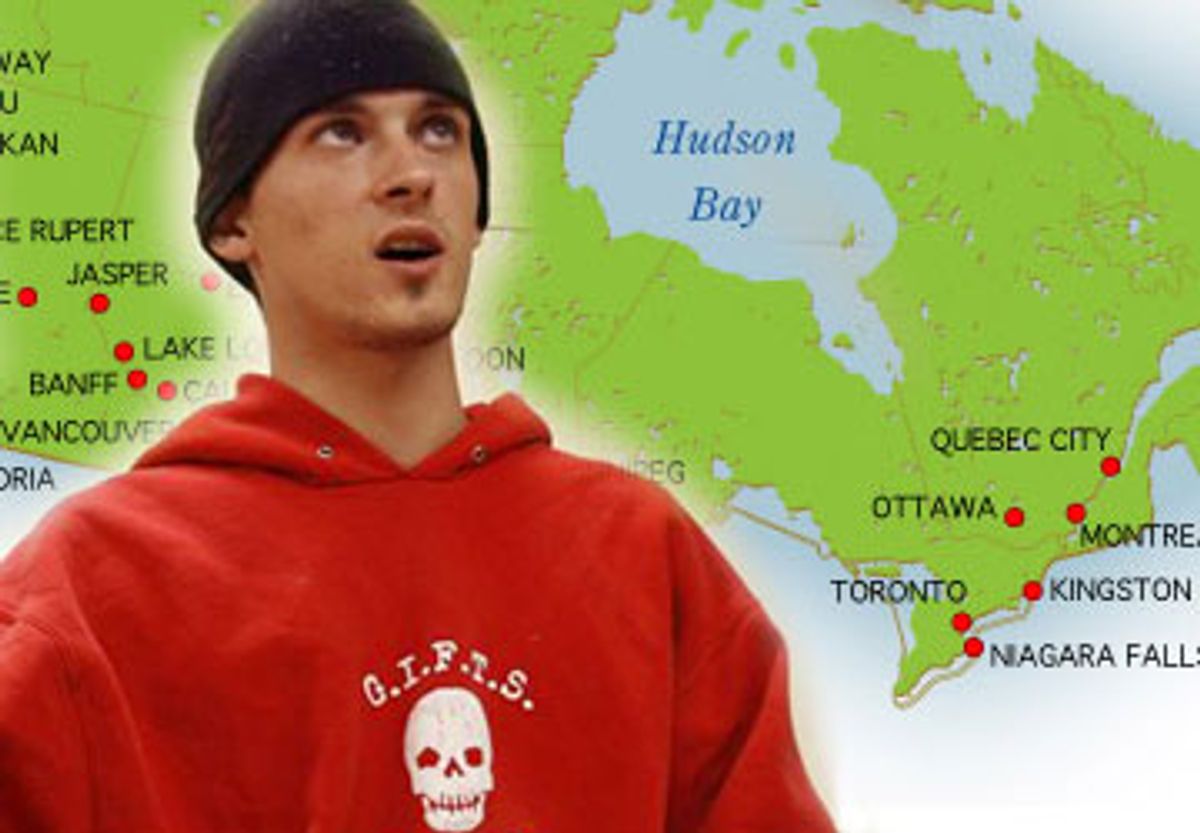
One morning in late February, Canadian police arrived at a house in the small town of Nelson, British Columbia, and arrested Kyle Snyder, a U.S. soldier who had gone AWOL from the Army. Snyder, a former combat engineer who left the United States in April 2005 to avoid deployment for a second tour in Iraq, was detained for several hours but never charged with a crime. It remains unclear why he was arrested.
The local police said they were told to detain Snyder by the Canadian Border Services Agency but acknowledged that the immigration agency was not their "original source" for information on Snyder. In fact, Snyder was released after a Canadian immigration official contacted the local police and informed them there was no basis for Snyder's detention. After he was back home, Snyder said he was told by Josie Perry, the Canadian immigration official who ordered his release, that his arrest had come at the behest of officials from the U.S. Army.
A few weeks later, in Toronto, three men wearing trench coats knocked at the home of Winnie Ng, a Canadian resident who harbored an American soldier named Joshua Key. Key, who'd also been a combat engineer, went AWOL from the Army in 2003 after serving in Iraq. According to Ng, one of the men announced they were Toronto police officers and told her they wanted to speak to Key, though Ng was suspicious about their identities. One of the three was in fact a local police officer, but according to a local news report, a spokesperson for the Toronto police department acknowledged that at least one of the other two men was an official from the U.S. Army's Criminal Investigation Command, or CID.
The incidents have sparked allegations that Canadian law enforcement has been collaborating with U.S. officials to help track down American soldiers who have fled to Canada. Some critics, including a left-leaning member of Parliament who represents Nelson, say they believe it is a campaign of intimidation. "Our concern is that there could be other Kyle Snyders in Canada," Alex Atamanenko, the parliamentarian, said following Snyder's arrest on Feb. 23. "Are there those that are being apprehended now?" In a formal letter of complaint to the Conservative Party Cabinet ministers responsible for public safety and immigration, Atamanenko noted that Snyder was apprehended without a search warrant or permission to enter the residence. "Has Canada ever raised official objection to the U.S. about the operation of U.S. police, security, intelligence or military officials in Canada?" Atamanenko asked, adding, "It is important for Canadian citizens and visitors to our country to know that our Canadian sovereignty is respected."
With the Iraq war in its fifth year, an increasing number of American soldiers have been going AWOL and fleeing to Canada, particularly over the last six months. One lawyer who works on their behalf puts the number of American war resisters currently living in Canada at 250 or more. Advocates for them here talk of a kind of "underground railroad" that has developed south of the border to help war resisters make their way north.
Ever since the Vietnam War, many Americans have viewed Canada as a liberal oasis, ready to welcome those who no longer want to take part in Uncle Sam's wars. But the reality is more complicated these days, especially with the conservative Harper government in power since 2006. Although the Canadian people are still largely welcoming, some war resisters say they have faced hostility here. And all of them who are seeking refugee status to remain in the country face complex legal obstacles, according to experts on Canada's refugee laws. Meanwhile, the alleged cooperation between Canadian and U.S. law enforcement authorities to track them down raises thorny legal questions of its own.
Speaking by phone recently from an undisclosed location in the Canadian prairies, Key told Salon that he generally feels safe in Canada, although he said one person threatened to "put him on a boat and take him back to the U.S." and another told him that his daughter "deserved to be shot in the head." He said that he was unnerved after he heard about Snyder's arrest in B.C. in February. "After what I saw in Iraq," he said, "I know that a snatch-and-grab operation doesn't take long."
It would be illegal under Canadian law for U.S. officials to make an arrest on Canadian soil, according to Audrey Macklin, a professor at the University of Toronto Law School. "U.S. law enforcement officers have no jurisdiction here," she said. The picture gets murkier, however, with the prospect of Canadian police working on behalf of U.S. officials. "Sometimes officials cooperate in cross-border criminal investigations," Macklin said. But the incidents involving Snyder and Key, she said, didn't strike her as typical cross-border cooperation. "It's sheer conjecture on my part, but I do wonder if it is more about intimidation."
While the Canadian police have publicly acknowledged cooperating with Army CID on the search for Key -- who has not committed a crime in Canada -- U.S. officials have remained circumspect. In a recent report in the Globe and Mail, a spokesperson for the CID, which investigates criminal matters for the military, acknowledged only that they were "interested" in talking with Key because of allegations he has made about the conduct of American soldiers in Iraq. Key recently wrote a book called "The Deserter's Tale," published in February by Grove/Atlantic, in which he alleges war crimes by his fellow soldiers. Key wrote, among other things, that he believes American soldiers raped Iraqi women and that he watched soldiers from the 124th Infantry Division playing soccer with the heads of dead Iraqi civilians. (Key also notes in the book that when torture at Abu Ghraib became public in spring 2004, he was not surprised, because it struck him as consistent with the brutality he had witnessed.) Key says he refused to participate in such acts and is now seeking refugee status in Canada.
Requests to CID by Salon for further details about the Army agency's pursuit of Key were not answered.
American war resisters who flee to Canada have no easy options. They might seek legal immigrant status like any other immigrant who comes to Canada (a status difficult to obtain once you're in the country), or they might simply stay quiet and try to remain in the country illegally. But many of them seek refugee status on political grounds. And many of them are now hearing about a group called the War Resisters Support Campaign, which pledges to help them whatever their chosen course of action.
Kevin Lee, a former private in the Army who served in Iraq in 2006, arrived in Canada in March after going AWOL. He told Salon in a phone interview that he hid in an apartment in Florida for several weeks before taking a bus to Toronto. His original plan had been to flee to Mexico, but after using Google to research his options, he came across the Web site of the War Resisters Support Campaign and decided Canada was the best place to go. He is now seeking refugee status here.
It was still a tough choice to flee. "I was sad to leave, but I don't regret it at all," Lee said, "because the war is pointless and we're losing too many troops." He was adamant that even if his effort to gain legal status in Canada fails, he won't go home. "I'll go somewhere else," he said. "As far away as I can get."
Jeffrey House, a Toronto lawyer who works on behalf of numerous war resisters, contends that the war in Iraq contravenes international law and soldiers therefore have a right to refuse to serve in it. It is on that basis that he is fighting for them to be granted refugee status by the Canadian government.
But the argument House is making has not yet definitively been put to the test here. Canada has relatively generous refugee laws, but the situation with U.S. war resisters does not fit neatly under the definition of "refugee." According to Lisa Borsu of Citizenship and Immigration Canada, the official agency that handles refugee claims, "the Government of Canada is committed to protecting refugees who have a well founded fear of persecution" based on "political opinions" or "membership in a particular social group."
But whether facing jail time in the United States for breaking a U.S. military law qualifies as "persecution" is a much stickier point. University of Toronto's Macklin, an expert on refugee law, says that the case House is trying to make is a tough one because past interpretations of Canadian refugee law affirm that "prosecution is different from persecution." Though war resisters are taking a political stand, Macklin says that the Canadian system is more likely to view their plight back home -- facing a judge and potential jail time -- as distinct from that of immigrants fleeing an authoritarian regime, who could be imprisoned or executed for their political or religious leanings if sent back home.
The War Resisters Support Campaign, headquartered in Toronto, is lobbying the Canadian government to make a new provision in the immigration laws to allow the U.S. soldiers to stay in Canada legally. It has helped roughly 40 Americans who have contacted the group from within Canada, according to Lee Zaslofsky, the coordinator of the campaign, and more than a hundred others who have made contact anonymously through lawyers. The group helps find them housing, gives them some financial support, and coordinates legal services needed for the fight to stay. Recently, due to the rising number of resisters, the organization put out a call for housing and received more than 300 responses from people across Canada, including from one former Liberal member of the Canadian Parliament, whose name the group declined to disclose.
The group has also given advice to many other resisters in the United States who are considering darting to Canada, according to Zaslofsky. They have also received responses from people in the United States offering their homes as safe houses for resisters as they make their way to the Canadian border -- what advocates refer to as an "underground railroad." Zaslofsky said that his organization has not worked directly with anyone in the United States, but said that if it necessary, "there are people in the U.S. who I could refer them to."
For the Vietnam generation, all this might sound quite familiar. In fact, the support movement here is led and staffed largely by people who refused to fight the war in Indochina, and is seen by many of them as one generation helping the next. Zaslofsky, himself an Army deserter during Vietnam, acknowledges a generational difference; back then they were fleeing the draft, while many of today's soldiers are fleeing an Army they were driven into by economic struggle. "In my day people went to university to avoid military service," Zaslofsky said. Now they go into the military in order to get the money to go to college, he said, or because low-wage jobs at places like Wal-Mart or McDonald's aren't enough to support their families.
Without a draft, the number of Americans fleeing north is a fraction of what it was four decades ago. More than 30,000 fled to Canada during the late 1960s and early '70s. Only a few thousand have gone AWOL during the current war, and most of them have apparently remained in the United States. Still, as the war in Iraq drags on and disillusionment grows in the ranks of the military, the numbers are rising. While 3,101 soldiers went AWOL between October 2005 and October 2006, more than 1,700 soldiers deserted in the six months between October 2006 and early April, according to figures released recently by the Army. According to the War Resisters Support Campaign, the number of soldiers coming to Canada over the past six months has risen correspondingly.
Corey Glass, a former National Guardsman who worked in military intelligence in Iraq before deserting to Canada in 2006, says he once considered it his duty to serve. But he says that in Iraq, he was directed to "sanitize" intelligence reports. "I was told to pretty much go with the story you're given, take out the real details, and paint a picture for the commander," he told Salon. Eventually Glass came to believe that "they used lies and plays on words to get us over there, and ordered us to commit crimes, in my opinion, against another country."
The growing strain on the U.S. military, manifest in multiple and lengthened tours of duty, is helping to accelerate the desertion rate. According to Zaslofsky, one U.S. soldier now living in Canada had served two tours of duty and was awarded a medal for his service at a party held in his honor on an Army base. It was supposed to be his last day in the Army. Afterward, excited about his imminent freedom, the soldier drove back to his house, where he found an Army official waiting on his driveway with orders for him to return for a third tour. "That's it," the soldier said to himself, according to Zaslofsky. "I'm going to Canada."
Jeffrey House, who represents Joshua Key, Corey Glass and other war resisters, added, "People come to me and say, 'I can't look at one more body' or, 'I can't stand to not be able to pass a car while walking without worrying that it's going to be blown up.' People get beyond tired and you're asking a lot of them, particularly when it's on such a doubtful venture as the war in Iraq."
House, who was himself a Vietnam draft dodger, says 124 American soldiers have come to his Toronto office alone, and he estimates that at least twice that number are now in Canada. He says that it's not uncommon for someone to fly up to Toronto from the northeastern United States just for the day and say to him, "I'm supposed to be back in Iraq in three weeks. What are my options?"
But U.S. soldiers fleeing to Canada today face a Canadian government that may well be less hospitable than the one in power during the Vietnam era. Back then, Prime Minister Pierre Trudeau welcomed war deserters, declaring "Canada should be a refuge from militarism." Richard Nixon called him an "asshole," to which Trudeau allegedly responded, "I have been called worse things by better people."
The government of Conservative Party leader Stephen Harper, by contrast, seems to have something of a reverence for the Bush administration and its worldview. Although this is never expressed openly in the more progressive-minded Canadian political landscape, the Harper government has implicitly echoed many of Bush's policies, values and rhetoric. Harper has regularly spoken of a more muscular foreign policy, created strong ties with evangelical Christians -- including those in the United States -- and sought to curb some of Canada's generous social programs. Some Canadian commentators have suggested that if Harper had been running the country in 2003, there would probably be Canadian troops in Iraq alongside the American ones. (Canadian troops are serving in Afghanistan, but none are in Iraq.) Still, the Harper government so far has not said or done anything to oppose the American war resisters -- at least not publicly.
Of five Toronto-area Conservative members of Parliament contacted for this report, only one responded. "Unfortunately, Minister Van Loan will not be commenting on this issue," Michael White, spokesperson for Peter Van Loan, the leader of the government in the House of Commons and a member of the federal Cabinet, said in an e-mail. "However, if you want to do a story about how the Government is strengthening democracy in Canada, then I'm the guy you want to talk to." Spokespeople for both the Canadian Ministry of Immigration and the ruling Conservative Party refused to say anything that would either support or criticize Canada's providing safe harbor for American war resisters.
Intriguingly, very few leftist Canadian politicians have been willing to openly show their support, either. It is a touchy subject that often provokes an uncomfortable response -- it seems that politicians of all stripes here are torn between upsetting their constituents on one hand, and the U.S. government on the other.
But so long as Canada doesn't deport them, many of the war resisters do not appear to be going elsewhere anytime soon. Joshua Key, for example, says that he stands firmly behind his decision and is determined to stay. Kyle Snyder has recently married a Canadian woman and will gain citizenship, and others are in varying stages of putting down roots.
Corey Glass says that the positive reception he has received from most Canadians has helped make him feel at ease with his difficult decision to flee. Most of the time, he says, Canadians welcome the war resisters, "especially when they find out you were in Iraq and decided to step out, because they're pretty proud of not engaging in the war."
"I know I made the right decision," Glass added. "I just wish I hadn't needed to."
Shares