Battlestar Galactica

Steal this comic

From superheroes to "The Simpsons," ultraviolence to kid stuff, our guide to Free Comic Book Day offers graphic fun for all.

  • more
    • All Share Services

Steal this comic

Five years ago, the weekend that the first Spider-Man movie came out, the American comics industry launched an experiment: Free Comic Book Day, in which thousands of comic book specialty stores around the country gave away comics to readers young and old. It worked out well enough that it’s become an annual tradition, and this Saturday, May 5, is the sixth Free Comic Book Day. Almost every major comics publisher in the country has at least one free title this year, as well as plenty of smaller publishers; the mainstream and indie presses don’t always see eye-to-eye, but they’ve all found that giving away samples is good for business.

This year’s FCBD coincides with National Cartoonists’ Day and the opening of “Spider-Man 3,” and lots of stores are also planning signings and other events. The crop of handouts includes 43 different comics, although most stores will only let you pick out a few of them; some of the free comics are particularly kid-friendly, others aren’t kid-friendly at all, and some are a lot better than others. (This page is a useful resource to find the nearest store that’s participating in the giveaway.) Here’s a quick overview of what’s available this year, sorted by category.

LONG-UNDERWEAR TYPES

The Amazing Spider-Man (Marvel Comics)

Kids obsessed with “Spider-Man 3″ will make a beeline for this one: a self-contained and entertaining, if slightly dopey, story drawn by star artist Phil Jimenez. Writer Dan Slott wisely focuses on the power vs. responsibility struggle at the heart of the character; there’s also a short preview of J. Michael Straczynski’s much-hyped Spider-Man story “One More Day,” due out later this year. B+

Justice League of America No. 0 (DC Comics)

Best-selling novelist Brad Meltzer wrote this story, first published last year, about the history and future of the relationship between Batman, Superman and Wonder Woman. It’s nicely executed, but you won’t get much out of it unless you’ve read at least a few hundred superhero comics in the last decade. B+

Liberty Comics (Heroic Publishing)

Four complete stories about superheroine/pinup girl Liberty Girl’s adventures during World War II. They’re supposed to be in the style of that era’s comics, but they don’t have the requisite nuttiness or verve (the Photoshopped-looking art is a dead giveaway), and the one about the Japanese internment camp is a little embarrassing. C+

Love and Capes (Maerkle Press)

A surprisingly charming tale about a hardworking superhero and his girlfriend — he’s frustrated by all the attention the upstart “Arachnerd” is getting. Thomas F. Zahler’s boldly cartoony artwork recalls “The Incredibles,” and so does his wry, smart dialogue. A-

Marvel Adventures: Iron Man & Hulk (Marvel Comics)

The good news: These three stories are self-contained and entirely kid-friendly. The bad news: The Iron Man and Hulk stories are also entirely dull and unengaging. The backup “Franklin Richards, Son of a Genius” story is cute in a sort of post-”Calvin & Hobbes” way, but you’re still better off spending a few dollars on an issue of Marvel Adventures: Avengers. C+

Nexus (Rude Dude Productions)

The first new issue in a decade of Mike Baron and Steve Rude’s fondly remembered science-fiction series is effectively a “clip show” — brief excerpts of a bunch of old issues, introduced by Baron, to give a sense of the series’ flavor before it relaunches. There’s no real story here, but hot damn, Rude’s got an amazing design sense. B

The Umbrella Academy (Dark Horse Comics)

The debut of a new project written by Gerard Way, singer for My Chemical Romance; despite some stylishly Goth-y artwork by Casanova artist Gabriel Bá, it’s a death-obsessed superhero slug-fest that makes almost no sense at all. The backup features, “Pantheon City” and “Zero Killer,” are even more incoherent. C+

THE HORROR! THE HORROR!

The Astounding Wolf-Man (Image Comics)

Rising star Robert Kirkman (“The Walking Dead,” “Invincible”) is launching his new werewolf series with this freebie, drawn by Jason Howard. It’s a totally straightforward monster-adventure comic, but crisply drawn and smartly executed, with little touches of characterization and coloring and design that enhance its sense of fun. A-

Jack the Lantern: Ghosts (Castle Rain Entertainment)

If you were reading comics in the ’80s, you might remember Tim Vigil’s ultraviolent, hyper-stylized horror series “Faust.” Vigil drew eight pages of this murky, sloppy, incoherent, incomplete horror-fantasy story, which is the only reason anyone might want to look at it. D

Last Blood (Blatant Comics)

This first issue of a miniseries has exactly one clever idea: vampires protecting the last living normal humans — their food supply — from a plague of zombies. Too bad the actual writing is clunky and badly paced, and the scribbly black-and-white artwork is wretched. D+

DO-IT-YOURSELF GUIDES

Activity Book (Drawn & Quarterly)

Lynda Barry, the cartoonist behind “Ernie Pook’s Comeek,” teaches an unusual sort of writing workshop. This excerpt from a forthcoming book is basically her introductory lesson, and it’s a joy in its own right, deliciously drawn (with fragments of collage worked into each page), insightful and bubbling with delight in the process of artistic creation. A+

Comics 101: How-To and History Lessons from the Pros (TwoMorrows Publishing)

If your kid is the type who’d rather draw her own superhero comics than read someone else’s, this is a decent selection of pointers on basic figure-drawing and writing, alongside a brief but solid history of superhero comics’ evolution. If she’s interested in manga, though, it’s not nearly as helpful. B

How to Draw (Wizard)

A word to the wise: You might not want to get your drawing tips from a comic whose cover features a woman with breasts bigger than her head. That said, the cartoonists whose tutorials are included here are all pretty big names in the superhero-comics world. B-

Impact University (Impact)

Yet another batch of drawing tips; this one at least acknowledges the existence of manga, but the tutorial on how to draw an elf is unintentionally hilarious (it boils down to “draw a skinny person with pointed ears”). B-

ANTHOLOGIES

Arcana Studio Presents (Arcana Studio)

Three stories, all of them slightly different flavors of “generic fantasy,” all of them to be continued in comics on sale later this year, and none of them anywhere near interesting enough to seek out the continuations. C-

Choose Your Weapon (Tokyopop)

A squat black-and-white paperback with excerpts from five new manga-style series — all of them Korean or American in origin, rather than Japanese, curiously enough. All five are built around fight scenes, only Dan Hipp’s “Gyakushu!” has much in the way of original style, and not one makes its source seem interesting. C-

Comic Genesis(Comic Genesis)

Several dozen one-to-three-page strips — mostly context-free excerpts from longer stories — by fledgling cartoonists whose Web comics are hosted by comicgenesis.com. Unfortunately, they’re all pretty amateurish. D

Comics Festival (Legion of Evil Press)

Short pieces by a handful of gifted Canadian cartoonists. Grab it for Bryan Lee O’Malley’s two witty tie-ins with his fabulous Scott Pilgrim series; stay for Hope Larson’s charming mini-sequel to her graphic novel “Salamander Dream” and Darwyn Cooke’s bittersweet tribute to the late comics master Alex Toth. A

Comic Spectacular (Ape Entertainment)

Six little vignettes previewing six different series, all of them proving that high production values and a range of artistic approaches can’t cover up for a bankruptcy of inspiration — the “Athena Voltaire” story, in particular, is practically “Raiders of the Lost Ark” fan fiction. C-

Digital Webbing Jam 2007 (Digital Webbing)

Five quick pieces — three of them excerpts, the other two incomprehensible anyway: generic horror, generic superhero stuff, three unamusing pages of the very long-running superhero parody E-Man, and a failed “experimental” piece built out of clip art. D+

Hunter’s Moon/Salvador (Boom! Studios)

Two unfinished, boring fragments of stories whose selling point is that they’re written by movie people: “Hunter’s Moon” by “Ray” screenwriter James L. White, and the wordless “Salvador” by Twin Falls Idaho writer/directors the Polish Brothers. D

Keenspot Spotlight 2007/Wickedpowered (Keenspot)

The thickest giveaway this year: over 100 black-and-white pages, with excerpts of 17 online comics. And the old cliché about cartoonists resorting to the Internet when they’re not quite good enough to make it in print? Almost entirely true in this case — way too many of them are feeble imitations of Scott Kurtz’s “PvP.” D

Viper Comics Presents (Viper Comics)

Even more out-of-context excerpts from prettily drawn, poorly written, digital-effects-ridden comics by unknowns — the first three of them from a forthcoming anthology of short pieces about sasquatches. It’s an angle, anyway. C-

Virgin Comics Special (Virgin Comics)

The four series excerpted here are based on ideas from some big names (Deepak Chopra! Dave Stewart from the Eurythmics!), and they’ve occasionally got sumptuous artwork (especially Abhishek Singh’s work on “Ramayan 3392 A.D.”). Too bad they’re also dopey, incoherent and stuffed with clichés. D+

Worlds of Aspen (Aspen Comics)

There are four baffling fragments from Aspen’s various series plunked together here, but it’s unclear why Michael Turner’s studio doesn’t abandon the pretense of storytelling and just print 32 pages of scantily clad babes, men and women alike, with impossibly long legs, narrow torsos and odd decorative jewelry: That’s what they like to draw, and what their audience pays for when they’re not getting it for free. C-

AS SEEN ON TV

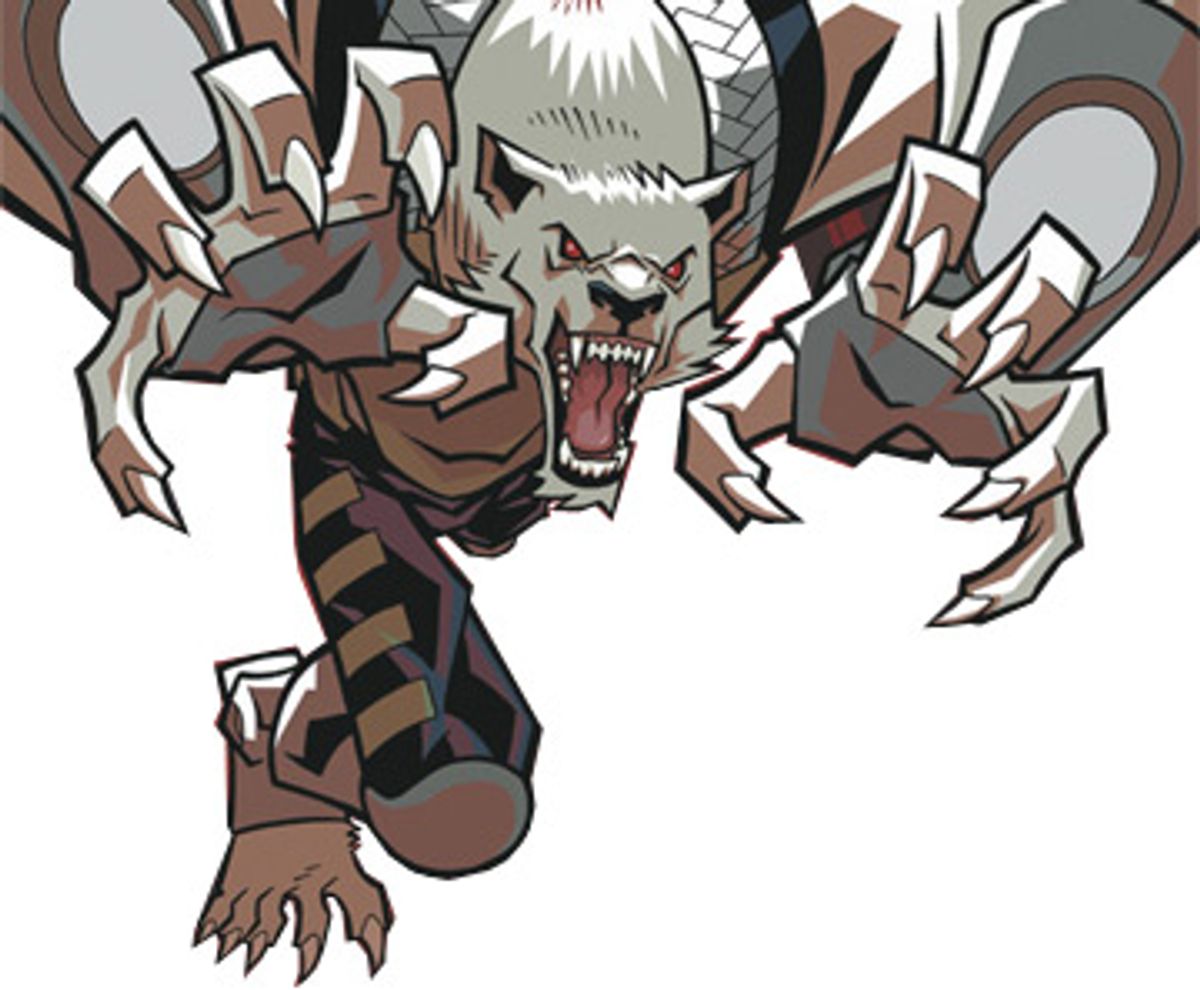
Battlestar Galactica: Season Zero/The Lone Ranger (Dynamite Entertainment)

One side’s got the first chapter of a prequel to the “Galactica” TV series; the other side’s got a sweet but nearly plotless little Lone Ranger story. Both are prettily drawn, and nothing much more than glorified ads for the regular comics. B-

Bongo Comics Free-for-All! 2007 (Bongo Comics)

Evan Dorkin‘s script for the first Bart Simpson story here captures the snarky, anarchic tone of a pretty good “Simpsons” episode. The other “Futurama”- and “Simpsons”-related tales that fill out the issue? Not so much. Did anybody ask for a Ralph Wiggum solo adventure? B

Family Guy/Hack/Slash (Devil’s Due Publishing)

The “Family Guy” side is just like the animated TV show, except that all of its jokes fall flat. Flip the comic over, and you get an excerpt from “Hack/Slash,” a tedious bloodbath of a story about a young woman who supposedly hunts down serial killers but spends this episode being tortured by one. Horrid. D-

Legion of Super-Heroes in the 31st Century (DC Comics)

A valiant stab at adapting the animated series, which is in turn based on a long-running comic book, but writer J. Torres and artist Chynna Clugston (both familiar names from indie comics) spend so much time defining their style and explaining the characters that there’s not much room left for a story. B-

Transformers: Movie Prequel (IDW)

The first part of a four-issue lead-in to the movie (about the ’80s-era plastic toys) that’s coming out this summer is gorgeous to look at, with lush, almost painterly artwork by Don Figueroa. But if you’re not seriously nostalgic for the Transformers comics of 20 years ago, there’s no way to get any pleasure out of the story. C

CURVEBALLS

Pirates vs. Ninjas (Antarctic Press)

The first episode of a longer story, and a good example of a current trend plaguing mainstream comics: cartoonists who mistake stringing together genre clichés for constructing an actual story. Even throwing in some zombies and robots wouldn’t have helped this one. C-

The Train Was Bang on Time (First Second)

The opening sequence of Eddie Campbell’s forthcoming graphic novel “The Black Diamond Detective Agency,” which is based on somebody else’s unproduced screenplay, and it shows. Campbell (who drew “From Hell”) is one of comics’ most gifted stylists, and the 1897 setting is right up his alley; the story’s a mess, though. B-

Wahoo Morris (Too Hip Gotta Go Graphics)

A reprint of the 9-year-old first issue of Craig A. Taillefer’s series (now a Web comic) about a small-time rock band whose singer is a witch and whose guitarist is infatuated with her. As slice-of-life stories go, it’s got a cute concept, but it’s too awkwardly drawn and slowly paced. C

Whiteout (Oni Press)

The first issue of Greg Rucka and Steve Lieber’s ingenious, gritty 1998 thriller about a U.S. marshal investigating a murder in Antarctica, which is currently being adapted into a movie starring Kate Beckinsale. It’s aged well, and this episode ends on a cliffhanger good enough to make you go back for more. A-

FOR THE KIDS

Amelia Rules! (Renaissance Press)

Jimmy Gownley’s little-kids-at-play comic is cute and lovingly drawn — an attempt at a modern-day Little Lulu — but not nearly as funny as it wants to be. The backup feature, Harold Buchholz’s “Apathy Kat,” is an anthropomorphic-animal story that meanders for 11 pages, then abruptly stops. B-

Buzzboy/Roboy Red(Skydog Comics)

Hint: When a character announces twice that “it’s time for super atomic powered boy robot fun,” that means the comic he’s in is trying too hard to convince you that you’re having a good time. Roboy Red is a decent Powerpuff Girls imitation, but this is more about fun for kids than it actually is fun. B-

Gumby (Wildcard Ink)

A story involving Gumby running amok in a museum full of art masterpieces (and popping up in a bunch of them) should be a delight, especially since it’s drawn by a crew including underground-comix veterans Rick Geary and Mark Bode. But it’s sloppy and rushed, and the jokes rarely get off the ground. C+

Little Archie (Archie Comics)

Longtime Archie buffs may be excited to see a new story by Bob Bolling, who drew the first Little Archie comics beginning in 1956. Younger readers, unfortunately, are likely to wonder what the big deal is about this whimsical but slow and flavorless story concerning some campers and a “lost lagoon.” C

Mickey Mouse (Gemstone Publishing)

Reprints of two 1936 newspaper comic strip sequences drawn by Floyd Gottfredson, including one in which Mickey stumbles into a copy of Robin Hood and has an adventure with the Merry Men. It’s very much a period piece, and despite its well-crafted surrealism, kids of today may find it a little dry. B

Owly: Helping Hands (Top Shelf Productions)

A new installment of Andy Runton’s ultra-cute, wordless series about a little owl and his friends is always a fine thing; this one’s main action involves them repotting some flowers. No, seriously. Christian Slade’s backup story, concerning a corgi and a cookie, pushes the cute-ometer into the red, though, and not in a good way. B+

Sonic the Hedgehog (Archie Comics)

A heartless, unamusing issue of a series (based on a video game character) that’s been running since 1993 — how? The ugly airbrushed-looking artwork and stupefying fight scene that makes up most of the story are the sort of thing that could bore an impressionable youth away from comics for good. D

Unseen Peanuts (Fantagraphics Books)

An exquisitely designed sampler of Fantagraphics’ chronological “Peanuts” reprints, here featuring only the early strips that had never been reprinted until the current books, along with explanations of why they didn’t make the cut. Even Charles M. Schulz’s misfires are fascinating, though — it’s neat to see how perfectly decent jokes didn’t really seem “Peanuts”-like — and some of them are hilarious. A

Douglas Wolk is the author of "Reading Comics."

Your guide to day one at Comic-Con

The schedule is set for the opening date of the country's largest collective geek-out. Here's what you need to know

  • more
    • All Share Services

Your guide to day one at Comic-ConGet ready to rock out.

San Diego’s annual Comic-Con can be a very scary place for the uninitiated. With thousands of panels, screenings and artist booths, the four-day entertainment convention is perhaps the only place in the world where you can have a panic attack while staring at six versions of “Sexy Leia.”

In two weeks, nerds will descend en mass to California, and in preparation, the producers of Comic-Con have posted the schedule of events for the kickoff day on July 21. (Technically there is a preview night, but who is counting?)

If you’re still feeling overwhelmed, we’ve prepared a brief guide of the day’s must-sees, as well as what programs to avoid.

Definitely catch: “Game of Thrones” panel

Author George R.R. Martin moderates a panel featuring series executive producers David Benioff and D.B. Weiss as well as cast members Emilia Clarke, Nikolaj Coster-Waldau, Peter Dinklage, Kit Harington and Jason Momoa.

I know this is going to be the hot ticket event of the first day, but I’m not sure if it’s because the show is so popular, or if fans are just going with a bag of rocks to pelt at George R.R. Martin’s head. Either way, it’s not to be missed. Bring your Flip cam.

Definitely avoid: “Battlestar”: So Say We All

Richard Hatch hosts a panel and fan discussion of the “Battlestar Galactica” universe, politics and philosophy with Hatch (Tom Zarek, Capt. Apollo), Michael Taylor (“Battlestar Galactica,” “Caprica,” “Blood and Chrome”), Dr. Kevin Grazier (BG science consultant), and surprise guests for this exciting roundtable and Q&A session.

Guys: “Battlestar” is over. Time to move on. Now, someone show me the way to that Damon Lindelof/”Lost” theory panel.

Definitely catch: “Oh, You Sexy Geek!”

Does displaying the sexiness of fangirls benefit or demean them? When geek girls show off, are they liberating themselves or pandering to men? Do some “fake fangirls” blend sex appeal with nerdiness just to appeal to the growing geek/nerd market, or is that question itself unfair? And what’s up with all the slave Leias? Action flick chick Katrina Hill (ActionFlickChick.com) asks Bonnie Burton (Grrl.com), Adrianne Curry (“America’s Next Top Model”), Clare Grant (Team Unicorn, “G33k & G4m3r Girls”), Kiala Kazebee (Nerdist.com), Clare Kramer (“Buffy the Vampire Slayer”), Nerdy Bird Jill Pantozzi (“Has Boobs, Reads Comics”), Jennifer K. Stuller (Ink-Stained Amazons, GeekGirlCon) and Chris Gore (G4TV’s Attack of the Show!) to discuss whether fans can be sexy and geeky at the same time — and if they should!

I’d say that you could just watch the mashup of hot chicks on late-night shows and save yourself the effort, but since these are actual nerd girls discussing gender issues and not just Mila Kunis talking about World of Warcraft, it’s worth making time for.

Avoid:  TV Guide Magazine: Fan Favorites

TV Guide is back with an all-star panel for the fans! Moderated by editor in chief Debra Birnbaum, Fan Favorites features your favorite talent from your favorite shows — in front of the camera and behind the scenes. Panelists include Nestor Carbonell (“Ringer”), Johnny Galecki (“The Big Bang Theory”), Jorge Garcia (“Alcatraz”), Leslie Hope (“The River”), Zachary Levi (“Chuck”), Joe Manganiello (“True Blood”), Julie Plec (“Vampire Diaries”), Matt Smith (“Doctor Who”), Kevin Williamson (“Vampire Diaries”), Deborah Ann Woll (“True Blood”), and others.

What a clusterfuck … do the same people who want to see Jorge Garcia or Matt Smith really care about what “Chuck” or the guy from “The Big Bang Theory” have to say? I imagine this panel will be the real-life approximation of channel-surfing when you’re bored.

Definitely catch: Entertainment Weekly: The Visionaries: A discussion with Jon Favreau and Guillermo del Toro on the Future of Pop Culture

EW moderates an in-depth conversation with Jon Favreau (“Cowboys & Aliens”) and Guillermo del Toro (“Don’t Be Afraid of the Dark”), two filmmakers at the forefront of bringing geek culture to the masses and making blockbuster art out of pulp fiction. They will discuss their inspirations, their current work, and how they strive to put a personal stamp on blockbuster entertainment. Plus: How is new technology changing the way stories are produced and viewed? And what do they think the pop culture universe will look like a decade from now? Moderated by Jeff “Doc” Jensen.

Comic-Con is one of the first places that “cool” directors will leak spoilers and info about their upcoming features, so get a front seat and turn on your tape recorder in case Guillermo del Toro lets something slip about “Pacific Rim.”

Bonus “Don’t Miss” screenings: Mike Judge hosting the new “Beavis & Butt-Head” episodes, “Archer” viewing and cast discussion, and the exclusive premiere of “Burn Notice: The Fall of Sam Axe.” Just kidding.

This list is far from definitive. What events are you most looking forward to for Comic-Con?

Continue Reading Close

Drew Grant is a staff writer for Salon. Follow her on Twitter at @videodrew.

“Caprica”: Prattlestar melodramatica!

Like the clumsy "Star Wars" prequel, Syfy's "Battlestar" rewind is a pale shadow of the original (remade) series

  • more
    • All Share Services

CAPRICA -- "Pilot" Day 16 -- SCI FI Channel Photo: Carole Segal(Credit: © Sci Fi Channel)

Being a young “Star Wars” fan in the ’70s was awesome, but being an old “Star Wars” fan in the new millennium flatly sucks. Nothing will make you queasier than hearing a young kid refer to “The Empire Strikes Back” simply as “Number Five,”  as if three stunningly bad prequels are even fit to touch the flowing Jedi hem of the original trilogy. Working backward only made the dialogue and plot points of the prequels feel clunkier and more on-the-nose than they would have otherwise: Characters marched around, remarking on Anakin Skywalker’s fierce temper and relentless insecurity, over and over again. “We get it, we get it, he’s going to be seduced by the Dark Side!” we growled at the movie screen, begging George Lucas to stop showing us his character notes. How did a luminous being like Lucas churn out such crude matter?

Likewise “Caprica,” SyFy’s much-anticipated “Battlestar Galactica” prequel, suffers from the awkward starting block of presenting “the burgeoning technology of artificial intelligence and robotics that will eventually lead to the creation of the Cylons,” but it’s also charged with exploring the same looming questions that “Battlestar” did over the course of its run. This means that, not only does every plot point of “Caprica” feel like a big, obvious explanation for the far more compelling original (“So that’s how the Cylons were created to think for themselves!” “Ah, that’s why the Cylons are monotheistic!”), but the whole thing is stuffed with the worst sorts of flashy but skin-deep characters. Here’s a rebellious teenager with delusions of grandeur, an arrogant, heartbroken father turning to technology to cure his grief, a working-class girl hungering for some way to belong, a nurturing nun who’s also a drug addict.

Feeling dizzy yet? Sure, as with the “Star Wars” prequel, there are plenty of provocative scenes to pull you in, whether it’s a Cylon prototype blowing up smaller robots with merciless efficiency (I don’t recall the Centurions from “Battlestar” being such good shots) or two fathers, Daniel Graystone and Joseph Adama, reunited (in a virtual world) with their poor, dead daughters. We know by now that creators Ronald D. Moore and David Eick are skillful at translating their groovy story ideas into compelling, emotionally wrenching snapshots of anguish or ominous portrayals of arrogance and bluster among the ruling elite. We also know that they’ll weave in heavy-handed commentary on class, race, gender, religion, politics and anything else that might lend this soapy robot circus more intellectual flair and street cred.

On “Battlestar Galactica” these elements usually felt organic, like another smart layer to complement an already full plate of suspense, action and the emotional reverberations and post-traumatic shock befitting the wake of a nuclear holocaust. But on “Caprica,” hearing the same echoes of meaning sort of feels like seeing Yoda fly: It’s cool and everything, but it’s also out of step with our understanding of him. Basically, we want Yoda bickering with R2D2 on swampy Dagoba, not leaping through the air or playing preschool teacher to a bunch of saucer-eyed “younglings.”

And just as we knew the damn younglings were going to get slaughtered the second they ambled adorably into the picture, we recognize early on that Zoe (Alessandra Torresani), with her big, pretty Zooey Deschanel look-alike face and her genius brain and her girly, foot-stomping alienation, is going to use her talents for evil rather than good. She hangs out in a virtual club where people virtually slaughter each other for fun and entertainment, after all. Or are we just prejudiced against the sensationalistic hobbies of this younger generation?

See how everything in “Caprica” reverberates with the most irritatingly primitive social commentary? Maybe this kind of button-pushing — Terrorist teens! Sexy murder/dance club! Criminal underworlds! Thoughtful robots! — was present in the “Battlestar” series, and we were just too distracted by the gigantic spaceships and look-alike robot spies to mind. Maybe it was the weight of the nuclear holocaust, looming at the edges of every frame, that legitimized the soapiness of “Battlestar.” All I know is, now that we’re on Caprica, “58 years before the fall,” i.e., the nuclear attack by the Cylons, the story feels like the worst sort of retread: “Caprica” has few of the charms of the original series, and because it’s a prequel, it doesn’t even further the story. We’re forced to rewind to a time that’s less weighty and less intriguing, yet everyone is walking around talking to each other in the same over-the-top heavy tones that made sense within the claustrophobic confines of “Galactica” but just feel unnecessarily melodramatic here. Not only does every line feel too obvious, but it’s tripped up by clumsy back story. It’s as if we’re being treated to some bullet-pointed character profile where key traits are highlighted, circled and underlined three times.

“You have no idea what it means to build something, or to work hard for anything! It’s all just been handed to you, Zoe!” says Zoe’s mom (Polly Walker).

“We come from a long, proud line of Tauron peasants!” Joseph Adama (Esai Morales) tells his son (Sina Najafi). “You’re named after your grandfather, I ever tell you that? William. He was killed after the Tauron uprising.”

“Let’s be clear. I don’t like your boss, I don’t like your planet, and I don’t like your people!” a high-level government official practically spits at Joseph Adama.

“Blood for blood!” Sam (Sasha Roiz) says to his brother, Joseph. “It’s the Tauron way!”

“You mean only the gods have power over death? Well, I reject that notion!” says Daniel Graystone (Eric Stoltz), Zoe’s father and the head of the company that’s working on creating the Cylons.

“When did you ever listen? You and Mom, you knew it all!” Zoe’s avatar says to Daniel. “Your arrogance was killing your daughter!”

It was easy to take issue with those who called “Battlestar” foolish: There was so much suspense and action and political intrigue in the mix that a few dippy scenes where Starbuck and Lee made googoo eyes at each other or Six and Baltar debated the meaning of life for the 50th time were tolerable. Somehow the same clunky philosophizing and heartfelt confessions fall flat in “Caprica.” Although the second and third episodes of the prequel are a little more intriguing and less gummed up with melodrama than the pilot, the overall picture is a world apart from the dynamism and intensity of “Battlestar.”

When grieving daddies first try to reunite virtually with their dead daughters, then become enemies, when monotheist nuns hatch eeevil plans and Cylons all but scribble in their diaries about their no-good very-bad days, it’s hard not to wish that we could pick up in the hopelessly cheesy spot we left “Battlestar” instead, with Bill Adama making a happy little Cro-Magnon family on the planet Earth. As Daniel Graystone and Joseph Adama know all too well, sometimes anything is better than trying to recapture the past. 

Continue Reading Close

Heather Havrilesky is Salon's TV critic and author of the rabbit blog. Her memoir, "Disaster Preparedness," published in 2010.

The Galactica fan tease

Is Ronald Moore's "Virtuality" an incomplete TV movie, a marketing ploy or a great series you'll never see?

  • more
    • All Share Services

The Galactica fan teaseSienna Guillory, left, Jose Pablo Cantillo and Gene Farber in "Virtuality."

Context matters. A really great sitcom can make a horrible play. A fantastic play can make a terrible movie. An excellent movie can make an awful TV miniseries.

Fox’s “Virtuality” (8 p.m. Friday, June 26) proves that a really good pilot for a TV series can make a truly awful TV movie. But don’t be mistaken: This excursion into the far reaches of space, brought to you by “Battlestar Galactica” producers Ronald D. Moore and Michael Taylor, proves far more compelling than most made-for-TV movies – and most TV pilots, for that matter – up until its abrupt, hair-pullingly inconclusive ending.

 ”Virtuality” offers exactly the sort of story that “Galactica” fans will sink their teeth into. As Earth is ravaged by global warming and is rapidly becoming unlivable, a small crew aboard the starship Phaeton begins its 10-year mission to find a habitable planet orbiting a nearby star. Conditions on board the ship are beyond claustrophobic (how Galactican!) after just a few months: Couples bicker, young crew members second-guess themselves, personalities clash, a crew member falls ill, and the commander of the ship begins to lose control. To make matters worse (far worse, in fact), the entire crew is being filmed for a reality show, so they navigate the pressure cooker of ship life knowing that their worst (and most private) moments are being broadcast to viewers back home.

 In order to offer a reprieve from the tireless strain of their mission, crew members are provided with virtual reality devices that allow them to star in their own fantasies. But when some mysterious malevolent force invades this one last respite from the confined drudgery of ship life, interpersonal relations on the Phaeton begin to deteriorate in earnest. We can feel it: Tensions are rising to the point that they’re beginning to endanger everyone on board.

 And then, just when things start to get really interesting, the so-called movie is over. Remember how some of the very best episodes of “Battlestar Galactica” ended with truly breathtaking cliffhangers? Well, “Virtuality” is just like that, only it’s not a series, it’s a stand-alone movie. Guess you’ll have to wait forever to find out what happens next!

 But the fact that there are no real answers to the mysteries set up here is only the tip of the iceberg. We’re presented with stories and characters that are quite clearly meant to be explored over the course of a season, which makes the whole thing feel, very palpably, like an utter waste of time. Essentially, “Virtuality” is a two-hour-long teaser, an extended trip to a really excellent strip bar that ends with a cold shower. Unless you’re a masochist, the flash of credits will make your heart sink.

 Of course, many die-hard “Galactica” fans will be interested in watching in order to advocate that the series get picked up by Fox. And it’s true, as a pilot, “Virtuality” is fantastic. Why wasn’t it picked up in the first place? Cool tricks, heavy drama, clever dialogue, twists and turns — what more could you want from a space soap, anyway?

 Maybe the real question is, why torture us with what might have been? Why air a two-hour pilot that only works as a pilot, with a cliffhanger ending that’s sure to piss off more than a few casual viewers thinking they just tuned in for, well, for an actual movie, with an actual ending? Those who watch without realizing that “Virtuality” is a pilot (that was never conceived as anything but a pilot) will think that they’ve suffered through a TV movie with serious art film delusions of grandeur — in a bad way.

 But then, maybe Fox is airing “Virtuality” to motivate “Galactica” fans to do all the marketing work for them. When asked if Fox will pick up the show, Moore told IESB.net, “I think they want to see what the reaction is going to be … Right now, it doesn’t look like it’s going to series, but if enough people watched and got excited about it, anything is possible.” Is this all just a savvy publicity scheme? Do Fox executives already love this series in secret, and they’re just setting us up to believe that an outpouring of fan support forced them to add it to their schedule? Or has an increasingly manipulative world of viral marketing rendered us hopelessly paranoid?

 Ultimately, airing “Virtuality” will either look like a smart publicity maneuver or a really bad programming choice, depending on how many viewers rally behind the cause. As usual, Fox will let the fans decide.

Continue Reading Close

Heather Havrilesky is Salon's TV critic and author of the rabbit blog. Her memoir, "Disaster Preparedness," published in 2010.

Frak this prequel

"Battlestar Galactica" spinoff "Caprica" has family drama, holographs and a man named Adama. But is there enough action in this pilot to satisfy the show's fans?

  • more
    • All Share Services

Frak this prequel

It’s been a month since “Battlestar Galactica” — the smartest science fiction series in television history — battlestarred into the sunset. Over the course of its four seasons, the SciFi (now SyFy) Channel show about a fleet of space-traveling humans and their robotic pursuers won critical accolades, garnered a rabid cult following, and, most important, made it socially acceptable to talk about evil robots at dinner parties. If you’re one of the many fans left bereft by the end of the show (as movingly dramatized in the recent Onion article “Obama Depressed, Distant Since ‘Battlestar Galactica’ Series Finale”), I’ve got good and bad news. The good news: The spinoff/prequel, “Caprica,” has arrived. The bad news: It’s only the pilot and, well, it’s probably not what you expected.

In an unconventional launch strategy, SyFy has just released the one-and-a-half-hour pilot episode of the show on DVD and digital download (the actual series won’t premiere on television until 2010). Described by blogs as “‘Dallas’ in space,” “Caprica” is, indeed, a very different beast from its mother series. Planet-bound, slow-paced and with hardly any action scenes, the series is primarily a melodrama about two families on the planet Caprica (one of the 12 home planets of the human race in the “Battlestar” universe) as they overcome a personal tragedy. It also, of more interest to science fiction fans, tells the story of the birth of the Cylons, the race of robots who, as we learned in “Battlestar,” eventually become hell-bent on destroying all human life.

The pilot takes place 58 years before the Cylon attacks that kick off “Battlestar,” and begins, promisingly enough, in a raucous nightclub. It’s a provocative scene: In one room, people shoot each other for sport; elsewhere, an orgy takes place in a red-lit room; on a stage, a knife-wielding giant executes a young woman by stabbing her in the head. Meanwhile, a teenage girl, accompanied by her two friends, watches the goings-on from the club’s balcony. The setup raises the intriguing prospect of Caprica as a Gomorrah-slash-’90s-rave planet on the verge of retribution.

Not so fast. In the pilot’s first big disappointment, the club turns out to be a virtual one. The teenage girl is Zoe Graystone (Alessandra Toreson), the daughter of a biotechnology magnate named Daniel Graystone (Eric Stoltz), and she’s accessing the holographic club through a sunglasses-like apparatus in her school’s bathroom.

The real Caprica, as it turns out, is nowhere near as interesting as the opening suggests, though Zoe, at least, is a bit of a delinquent. Not only does she hang out at the virtual orgy-and-knifing club during school hours, she’s fallen in with a monotheistic cult. And thanks to her school-time holographic excursion, she gets herself grounded by her mother, Amanda Graystone (Paula Malcomson, “Deadwood’s” Trixie). So, as rebellious Caprican teenagers tend to do, Zoe decides to run away to another planet with her two monotheistic friends. The plan ends in tragedy when the train whisking her toward Gemenon is destroyed by a suicide bombing.

In the weeks following Zoe’s death, Graystone discovers that his daughter had been busy creating a remarkably detailed holographic copy of herself — a breakthrough in artificial intelligence and a project that, he hopes, may allow him to resurrect his daughter in robotic form. He is aided in his resurrection plans by another grief-stricken father, Joseph Adama (Esai Morales), a lawyer who is himself eager to digitally revive the daughter and wife that he lost in the same train explosion. As “Battlestar” fans know, Adama is the father of Bill Adama, eventual commander of the Battlestar Galactica.

As premises go, “Caprica’s” dead teenager uploaded into battle robot is a promising one (“Terminator” meets “Freaky Friday”?), but the pilot lacks the dramatic heft of its predecessor. It doesn’t have the same sense of scale or tragedy as “Battlestar” and feels considerably more generic, both dramatically and stylistically. The drama builds slowly, and scenes unfold without much, if any, tension. What little tension it has owes to viewers’ knowledge of what will happen 58 years later. There are no hostage crises or food shortages to resolve, since the show’s main concern is the emotional state of its two families. In fact, robot subplot and holographic excursions aside, there really isn’t much that’s science fiction-y about “Caprica.”

Unfortunately, “Caprica” doesn’t make for tremendously engaging melodrama either, largely because it doesn’t have any characters as immediately riveting as Katee Sackhoff’s Starbuck or Mary McDonnell’s President Roslin. Eric Stoltz brings quiet soulfulness to his grieving father, but Esai Morales feels wooden and stilted as Adama, and the rest of the ensemble (especially, it has to be said, the child actors) aren’t a particularly inspiring bunch. As for the show’s visuals — unlike “Battlestar,” “Caprica” is filmed largely with fixed shots (no hand-held cameras), which robs it of much of its flair and immediacy. Its clean urban setting feels antiseptic and cold and a bit dull. Judging by the pilot, the planet Caprica is Vancouver with a fancier train system.

In the spirit of “Battlestar,” “Caprica” also references a number of real-world topical issues: Adama is a member of a disliked immigrant group called the Tauron, and during their investigation of the bombing, the authorities become suspicious of a certain religious minority. But while “Battlestar’s” space-bound setting was strange and destabilizing enough to make its political allusions seem fresh — one of the joys of the series was seeing it fragment and rearrange issues like abortion and terrorism to make provocative arguments — in “Caprica,” they merely feel awkward. It’s obvious that Tauron is a stand-in for Mexico (there’s even a subplot about Tauronese gangs) and monotheism a replacement for Islam — but there’s nothing new to be learned here by renaming things.

When the show premieres on television next year it could take off in some interesting and unexpected directions. The show’s writing is fairly strong (one of the debut episode’s co-writers, Jane Espenson, was responsible for many of “Battlestar’s” best shows), and SyFy clearly has a lot of faith in creator Ronald Moore. But given the high expectations that “Battlestar” fans have for the series, and the tepidness of this initial offering, I wonder how many will come back to find out what happens in 2010.

Continue Reading Close
Thomas Rogers

Thomas Rogers is Salon's Arts Editor.

Goodbye, “Galactica”

Will the cylons triumph? Will Baltar and Roslin survive? All these answers and more as the celebrated science-fiction epic comes to an end.

  • more
    • All Share Services

Goodbye,

It must have been cosmic irony: As the wandering tribes of “Battlestar Galactica” finally arrived on Earth (well, Earth II, but still), the series itself never felt more disconnected from solid ground. Main plots and subplots zeroed in on their resolutions, questions big and small were answered, tantalizing references to “destiny” made in earlier episodes finally paid out, and even God’s plan for Dr. Gaius Baltar — the existence of which always seemed so improbable — was at last made manifest in a crucial showdown on the blood-soaked floor of the CIC. It was all very epic and mystical and tidy and morally straightforward: in other words, not much like the “Battlestar Galactica” we’ve come to know and love.

This year’s half-season began in an existential funk, with humanity’s remnants and their cylon allies poleaxed by the discovery that Earth, the planet they’d spent the whole series chasing, had been rendered a smoldering, toxic wasteland by its previous residents — who, to add insult to injury as far as the humans were concerned, turned out to be cylon skin jobs. You had to sympathize with the show’s writers: No narrative twist could equal the end of Season 2, in which Baltar was elected president, the refugees foolishly settled on New Caprica, and suddenly it was a year later and cylon centurions were striding through the bedraggled little settlement in a scene that was a frank citation of the Nazis marching into Paris. After you’ve dared to flip the premise of your show entirely, what can you do next to upend your audience’s expectations? Allowing the characters to find their ultimate goal and then making it really, really suck was pretty much the only card left to play.

And then where do you go? There was way too much wallowing, weeping and ‘splaining in this season, but things did briefly return to form in the two-episode mutiny arc. That was “Battlestar” at its best: the “good guys” (Roslin and Adama) were compromised by their semi-dictatorial high-handedness while their antagonist, Tom Zarek, was conversely doing the right thing for the wrong reasons. As for his co-conspirator, Felix Gaeta, would he have been driven so relentlessly to the brink if not for a maddeningly shoddy prosthesis and the humiliation of staggering around the Galactica like Captain Ahab without a whale? That peg leg was like the proverbial nail for want of which the war was lost. Exquisitely played by Alessandro Juliani, Gaeta has long been one of the series’ most intriguing minor figures, a man who disastrously combined the best of intentions with the worst possible judgment of character.

Then again, the true colors of Tom Zarek were difficult for anyone but Roslin and Adama to discern — until, that is, he finally went Stalin and massacred the Quorum. “Battlestar Galactica” made itself distinctive with moments just like that one, drawing its events and dilemmas from 20th-century history rather than the moral simplicities of space opera. When Roslin’s swearing-in echoed LBJ’s, when she and Adama hovered on the brink of fixing the election, when Starbuck tortured Leoben and the human insurgency resorted to suicide bombings to resist cylon rule, the show became electrifying, frank about the predicaments of the present in a way that a TV drama about the present could never be.

It wasn’t just that “Battlestar Galactica” dealt with “issues” — “Star Trek” did that, in its own pat, right-thinking liberal way. It wasn’t even that the series was “dark,” in the callow sub-noir fashion of a Zack Snyder movie. What “Battlestar Galactica” showed us over and over again was just how hard it is for real, complicated and contradictory people to find their way in a universe that offers them one impossible choice after another. It refused to provide any easy or obvious solutions. Should Roslin and Adama have fixed that election? If they hadn’t, then the Baltar presidency, the settling of New Caprica and the cylon occupation would never have happened. Hundreds of lives would have been saved. You can understand how the two of them must have lost their faith in democracy and ethical rectitude as the result of the New Caprica debacle. But from that loss of faith, the slow creep toward despotism began. By the end of the series last night, the political legitimacy of the Adama and Roslin regime had almost withered away.

Adama was always the series’ most conventional figure, the old-fashioned, admirable leader-hero that American popular culture typically insists upon. This also made him the least interesting character psychologically, but he was essential all the same; the rest of the survivors needed him as a fixed point, a star to steer by. Understandably enough, in moving their convention-busting story through its endgame, the show’s creators decided to attack that final redoubt of certainty by dismantling Adama himself along with his ship. His best friend was a cylon, Earth was a bust, the woman he loved was dying and even the Galactica itself was crumbling — talk about piling it on! Adama hit the sauce, prowled the corridors peering at cracks with a hunted expression (to the extent that Edward James Olmos exhibits any expression), and spent a lot of time sprawled on the floor, crying. This tactic backfired, making much of the final season feeling labored and maudlin. Take away Adama’s strength, and there didn’t seem to be much left to the guy. There’s something to be said for never getting a glimpse behind a revered leader’s facade.

Friday night’s finale, at least, provided an Adama who’d snapped out of it. The first half of the two-hour conclusion offered a hearty serving of something else the creators of “Battlestar Galactica” supposedly didn’t care about: action. The last-ditch assault on the cylon’s colony by ramming it with the rattletrap Galactica was thrilling and gorgeous, providing a final showcase for the centurions, surely the scariest monsters on television. Then came 40 minutes of speeches about lessons learned and the need to “break the cycle,” the naiveté of which did indeed feel like a break — from the knowing, worldly stoicism that made “Battlestar Galactica” so refreshing to begin with. The last flash of that sensibility came when the corpse of poor Racetrack got knocked against the wrong button and wound up nuking Cavil’s cylons to Kingdom Come just as everyone had decided to get along for a change.

Then we got to Earth, and saw one scene after another of people standing in green fields saying, “But what will you do now?” (And how preposterous was the idea of the survivors splitting up and forsaking all technology to go native? The first case of strep throat would have made short work of that vow.) Laura Roslin died with the heart-rending dignity that Mary McDonnell never failed to bring to the finest role of her career, and most of the other actors (James Callis, Katee Sackhoff, Tricia Helfer, Grace Park, Aaron Douglas, Tahmoh Penikett) got a final chance to remind us of just how good they are. The initially puzzling flashbacks to the pre-attack days on Caprica turned out to depict the key decisions that led all of the series’ characters to the Galactica, and ultimately to the founding of a new human race.

It was the opposite of David Chase’s famous non-ending for “The Sopranos,” and it demonstrated that tying up every loose end also has its pitfalls. Granted, it can’t be easy to cap off a serialized drama this avidly followed. On one hand, the audience craves resolution, answers to all the mysteries and prophecies and visions; on the other, “Battlestar Galactica” isn’t “Lost,” a comic-book epic in which the puzzles and their solutions are the main point.

What made “Battlestar Galactica” great was the uncertainty of its characters’ condition; were they part of a divine plan, or pinging randomly around an empty universe? Was there a reason to be good, to be selfless, or was it every man for himself? How much of our better nature should we be willing to sacrifice in order to survive? How can we tell where our loyalties lie? They didn’t know. We don’t know. They were racing around in a spaceship fleeing killer robots, yes, but the ambiguity of their circumstances made them so much more like us than 99 percent of the people on television. It made them seem so real. When they got their answers, they became finally and irrevocably fictional.

Continue Reading Close
Laura Miller

Laura Miller is a senior writer for Salon. She is the author of "The Magician's Book: A Skeptic's Adventures in Narnia" and has a Web site, magiciansbook.com.

Page 1 of 5 in Battlestar Galactica