I would love to blame outsourcing. I would love to agree with CNN's Lou Dobbs that by exporting jobs to India, greedy American corporations are killing independent businesses. I could say this is exactly what happened to me, that it explains why I lost my father's life savings, my company, $4 million and my entrepreneurial American dream. I could take comfort in the fact that outsourcing swept me away in its capitalistic tide, and that there was nothing I could do about it. But this is not what I believe. And these are not the lessons I learned. The truth about America's small businesses in today's global market is a harder and more indelible one, it contains seeds of hope, and this is the story I want to tell.
Let me begin in 2000. I owned a prosperous typesetting business and employed 200 people. My company, Clarinda, had 100 middle-aged women in "World's Best Grandmother" sweat shirts in two light-industrial brick buildings in the fields of Iowa; 30 young Filipinos in a five-story office tower with windows that looked out at South Super Highway in Manila; and the remaining 70 scattered in small locations about the Northeast.
At the time, I was counting my yet-to-be-hatched-IPO eggs as the company soared to $10 million in annual revenue and $1 million in profit. I was following the American dream as laid out in a radical typeface on the cover of Wired magazine. I would raise venture capital to buy my competitors and form a more perfect typesetter. I would be worth millions. Heck, I felt like I already was. I was an exec-u-tive. I had a plasma TV, two Pottery Barn couches, a custom bicycle as good as Lance Armstrong's and a Cuisinart in its box under the kitchen sink in my four-bedroom condo on the Baltimore waterfront.
I know you are smart and think typesetting is long dead. You are correct. The process of laying bits of lead together to make lines of type has passed away for all but the most remote Jungle Daily. But the need to turn rough manuscript into composed pages using computers and software programs continues. At Clarinda, we did just that. The majority of the pages we laid out were for educational textbooks. Our job was to make the little boxes on the side of the page with the blue tinting, or lay out a pile of equations in "Precalculus for Beginners."
My business partner, Dan, had been in printing and publishing his entire life. He was a gregarious man who wore a houndstooth jacket, had a deep tan, puffed up gray-blond hair and the aura of Conway Twitty. As a young man, he played guitar in strip clubs with his uncle. In the 1970s he worked his way up from ad salesman to president of Waverly Press in Baltimore, where he helped take the company public. Then he went to Penta, an electronic page-layout system that existed long before there was an Apple and a QuarkXPress.
I met Dan in 1994 in Baltimore where he was my boss at a company called Datadata, which did retyping of tax law for CD-ROMs with an army of keyboarders in the Philippines. The owners of Datadata called Dan a throwback because he believed in what he called "benevolent capitalism." By that he meant treating workers with respect, giving corporate profits back to the workers, and mixing low-cost overseas production with American workers. A good company, Dan always said, would not compete solely on price; since it paid its workers better and respected them, its quality would be better.
It was the same philosophy of my father, who worked for IBM for 35 years. My father didn't force me to learn the Old Testament to get bar-mitzvahed, but he did make me read the IBM manual on ethics. "IBM is the greatest and most moral company," I would say to other 6-year-olds during games of "war" with sticks and mud. "You aren't out. You're on probation. You have six months to remedy the situation." (Yes, I really did say that.)
In the 1990s, typesetting was done by several hundred mom-and-pop firms scattered across the country, usually within a few hundred miles of the major publishing centers of New York, Chicago and San Francisco. Dan saw an opportunity to roll up the typesetting industry, send some of the work overseas to remain competitive, increase the quality of service, and through economies of scale become a major public company on a scale equivalent to what the printers had done.
In 1999, Dan and I borrowed $2 million to buy the 50-year-old Clarinda, named for Clarinda, Iowa, a town located in the heart of the country. Most of the money came from Small Business Agency-backed loans, intended to spur American entrepreneurship, but a big chunk of it, $200,000, came from my father's savings. The money was the total of Dad's IBM stock, which he had bought, sometimes in fractions of a share, from the very first day that he had received his IBM-issued punch-card paychecks, which he kept in a fireproof box by his desk.
As the new century dawned, outsourcing, now the cold reality of American business, created the obvious problems for us. A qualified worker in India got paid $1,000 to $2,000 a year compared to the $30,000 to $50,000 we paid Iowans. While we could get an advantage by using technology to work smarter, and produce more pages per hour, we ran up against stubborn Midwestern resistance to change. Some of our employees, rather than learn to use the computer effectively, would lean a stapler on the keyboard to "automate" a task.
But we were making progress. We had a branch office in Manila, where we paid workers $6,000 a year, an upper-middle-class salary. We built a training center in Iowa and brought the greatest minds in typesetting to the plant to get us going with the best software and methods. (OK, the greatest mind in typesetting was a fellow who lived in a cabin in New Hampshire, but he did increase our efficiency by a hundredfold -- and drink whiskey in the back of the cab from the airport.)
Our real problem came from our customers, the publishers. We offered to charge them as little as the Indian firms did, but most of them wouldn't even let us bid, preferring to squeeze as much profit as possible out of typesetting.
In the '90s, publishers had merged and merged and then merged some more. What had been hundreds of educational publishers was now just a few. Harcourt bought Mosby, Saunders, Academic Press and the Psychological Corp. Then Reed Elsevier bought Harcourt. The three top companies represented about 80 percent of our business and the pressures on us to maintain those customers were terrible. If Reed said, "Put an employee on site in our office in Texas," we did it, even though it cost us $100,000 a year, which was just about all of our profits on that account. If we said no, we'd have no business at all. It would have been like saying no to Wal-Mart. And just as it is at Wal-Mart, the mantra of our newly merged customers was: "Lower your prices."
Then it got bad. Under the pressure of trying to lower costs, improve productivity, fix the culture of the company to respect employees and embrace change, fight off competition from overseas and hang onto our existing customers who continually demanded lower prices, Dan cracked. Did I mention that he became an alcoholic? The Maalox he was constantly sipping at meetings had begun to be spiced with whiskey. (Memo to self: Maalox leaves a chalky residue on the lips, whiskey does not.)
Dan agreed to enter rehab, and on the day it was due to end, we got a Fed Ex package from a nice man at Reed. We were no longer a vendor, he informed us in a letter. One-third of our company, $3 million in business, was gone faster than I could say, "But we are the good guys!" Reed had consolidated 40-plus vendors down to three. The majority of its business would go to an Indian firm and a small percentage would go to two American firms that would put pricing pressure on each other. The nice Reed man told us we had "come in fourth."
Less than a day later, Dan started drinking again and we got into an argument about the company for which we had so many dreams. "We'll have to fire people," he was forced to admit. In the following week, I was so angry and desperate with the mess he'd left me that I wouldn't take any of his calls, which came from the hotel room he'd moved to after his wife threw him out. Painful as it was, I had to fire my friend and mentor of eight years. As it turned out, I never saw him again.
But I had no time to think about Dan's problems. I was consumed with having to perform Clarinda's first-ever layoff -- 20 percent of the company in the first round. Then I was told by our chief financial officer that I hadn't cut deep enough. I'd gone from benevolent capitalist to chain-saw management in less than a year and a half.
I turned for help to the only people left, the customers. I asked, begged, pleaded with the vice president at our largest remaining customer, Pearson, to keep giving us business. I was under the hammer of the loans we had taken out to buy the company and struggling to keep our folks employed. If we didn't make our payments, our line of credit would be turned off and we would go out of business.
The Pearson V.P. suggested I talk with our largest Indian competitor about buying Clarinda. The Indian firm had recently bought two of my U.S. competitors. Apparently it was buying typesetters with venture capital money -- exactly our plan! Not only were U.S. publishers outsourcing typesetting jobs to India, but the Indian firms, flush from all the work, were turning around and gobbling up the remaining independent U.S. companies.
I met several times with the Indian executives and was reassured that "they were just about to make an offer." It came down to one phone call where, if they said yes, I would be rid of Clarinda and out of the game of trying to save American industry. I would also get $4 million.
They said no. They had figured out that by planting seeds of concern about Clarinda's future, they could scare away our customers and swoop in and claim them. And that's what they did. Their salespeople told our buyers that "Clarinda is up for sale, you're not safe staying with them." And because we couldn't refute it, customers abandoned us, leaving us no company of value to sell.
The next time I heard from the Pearson V.P., he was telling the employees at our Minnesota plant, "Clarinda is going out of business. But if you want a new job with a company I'm sending all the work to, just send me your résumé."
Then, sure enough, another third of our business left for Asia. I laid off more employees and more customers got spooked. I went out looking for business and found that the whole industry was as lost as we were.
Thomson Publishing held a vendor conference attended by 25 of the largest companies in the industry. It was a two-day event at its new facility in California where it was centralizing production and reducing staff. The company had hired a consultant to entertain us with his thoughts on what we should be doing now that typesetting was dead in America. We got a lecture about how we needed to change our organizations of 50-year-old grandmothers into "knowledge warehouse workers." (OK, he didn't say "knowledge warehouse workers." He said some equally impossible thing that we couldn't have turned ourselves into even if we did have capital.)
Change for my world's best grandmas was a severance package that consisted of a letter with directions to the unemployment office. The lucky few got jobs at the local Wal-Mart. Every other store in town closed down. "I've worked here for 25 years and this is what I get?" was the lament of more than a few.
I met with a bankruptcy attorney, who told me: "I don't see any moving parts." He meant there was nothing left to save or defend in either the company or my bank account. I and the firm would be flat broke just two and a half years after I had begun. He looked me in the eye and asked, "How old are you?" "Thirty-five." "You're a young man," he said, "you'll get over this," and then he looked at his watch: My 30-minute free consultation was up.
A handful of my customers hadn't yet outsourced to India. I called one, offering to cut his price by 30 percent if he paid up all the money he owed us. He responded by saying he had wanted a 50 percent discount or he would start sending his work to India. I accepted the deal, but only to get the money to pay back my lenders. I would be out of business before he got his discounts.
In 2003, after I fired the last employee, I went to Prague, Czechoslovakia, where I knew one college friend and nobody knew me. While I was doing my best to see what I could do with a lot of alcohol and nothing hopeful in my future, I heard that Dan died. I came home to see what I could do about my father.
He and Dan had been so much alike. Both shared the same optimistic business ethic and both were crushed when it came crashing down on them. For my father, the descent began in the '80s when IBM had its first layoff. When the company shut down its plant in Kingston, N.Y., where he had worked since the '50s, he took early retirement in a bottle of Scotch. He never spoke proudly of IBM again. In the end, I couldn't help him either. A month after I came home from Prague, he also died of a heart attack brought on by all the whiskey.
But I am not Dan or my father and I haven't given up. Today, back in New York City, I find myself struggling to understand this lesson I've learned.
Clarinda was a service company. The only way we would present a unique competitive advantage was to give better service. But better service is a myth that disappears when you can get it cheaper by simply clicking the work to plants halfway around the world. The Internet has removed the physical barriers that prevented computer typesetting from going anywhere on the planet.
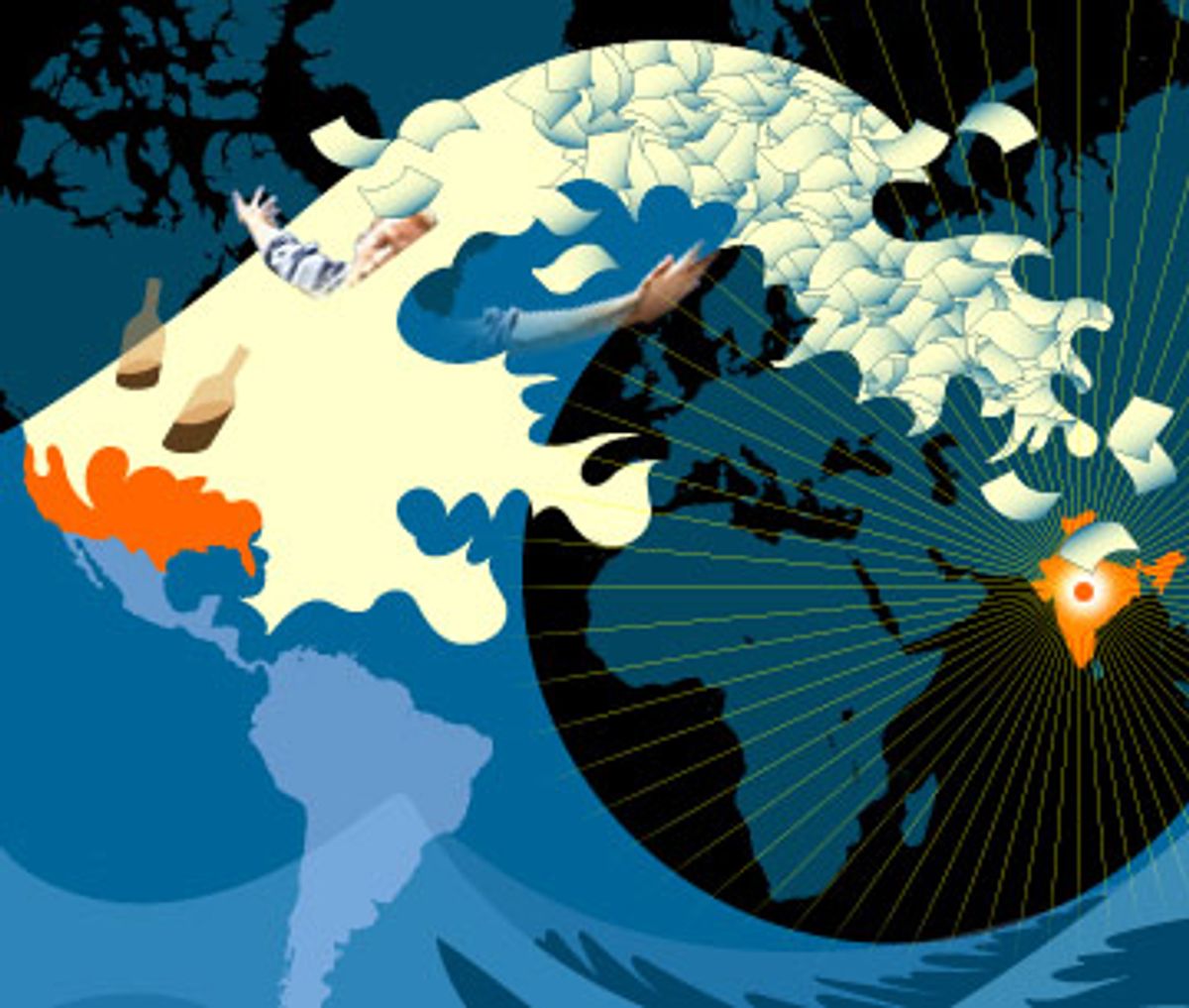
People ask me how I feel about my business being pushed out of existence by companies in India. They ask how I feel about greedy American companies sending the work overseas. They might as well ask me how I feel about deciding to stop a tidal wave with a fork. There's no way to regulate this global issue. It's beyond one person, or many. Dobbs can say anything he wants, but the hourly workers in India are just trying to feed their families and their bosses are using their price advantage to sell like any good businessperson would. The vice president at Pearson was doing what his competitors were doing.
According to Princeton professor Alan Blinder, as many as 40 million jobs may be outsourced over the coming decade or two. The only way to stop that work from flowing to cheaper labor markets would be to force companies to work within their borders and scan their e-mail for illicit projects being sent to people named Pratap. In other words, close down the country. But that's simply unworkable.
The idea of cheap labor is that it makes products cheaper, thereby making them more affordable to all. Maybe textbooks are getting cheaper because of India, or maybe they are not getting as expensive as they would if typesetting stayed in America. I agree that the short-term effect on American jobs can be devastating. Some of my former employees worry they can no longer afford to send their children to college where they would be buying the books.
If the government wants to help small business and the American worker, it could do something to slow the pace of change. It is the speed of outsourcing, more than anything, that dislocates tens of thousands of workers a year and causes shock waves through the economy. The government could slow things down by granting subsidies to American firms to help compete with overseas companies. It could provide them incentives to buy locally. But, in the end, it can't stop the flow of work and money from traveling around the world.
Clarinda was founded in Iowa when it served publishers in New York and Chicago because the technology of the day -- trains and trucks, telephones and fax machines -- allowed Midwestern states to be the outsourcing outposts of their day. At the time, the big cities were mourning the loss of their "printers' rows." Much of the desolation that was SoHo in New York was caused by manufacturing leaving the city for the hinterlands. Only decades later did it rediscover itself as a mecca of art and fashion -- a rebirth that came on the back of the economic growth of the entire country.
The U.S. would do well to stop wishing outsourcing would go away. It could do a lot more good by helping build the economic base of every country in the world. Use technology and investment to make a standard of living in India, where the majority is still waiting for hot and cold running water, as good as it is in Iowa.
As for me, I have said goodbye to the steak dinners, bicycle-mounted global position systems, super-premium ice creams, wicking fabrics and personal trainers. I sold the plasma TV and only watch movies once a week at a friend's place. (My sister who works in film tells me that American studios shoot many of their movies in Canada.) I now work as a writer and consultant, sometimes helping companies be more efficient, sometimes helping them send work overseas, and always reminding everyone I can that blaming someone else for your problems is the only guaranteed way to never solve them.
Shares