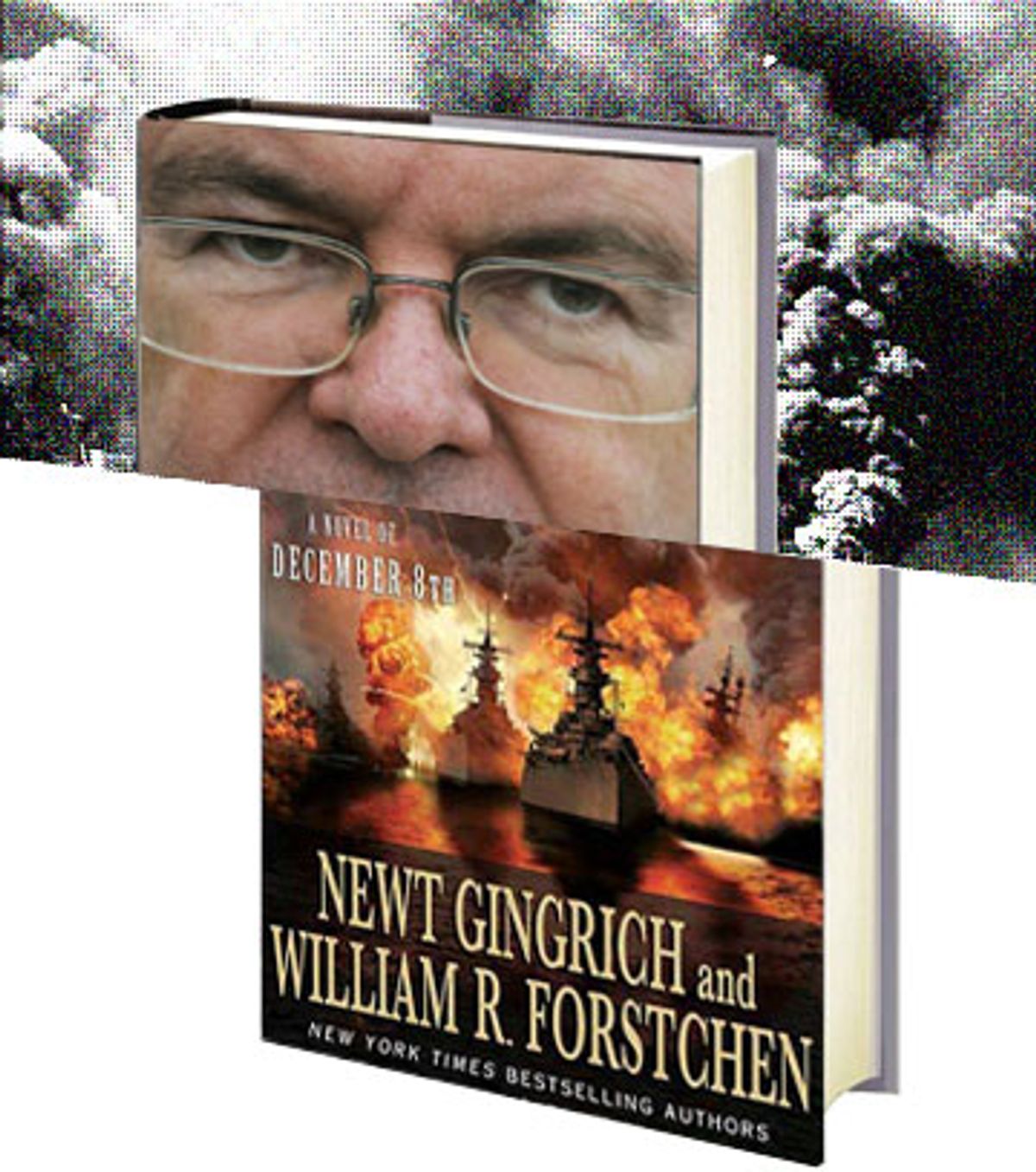
Newt Gingrich

Newt’s novel ideas

Gingrich's new novel is an alternative history of the war -- World War II, that is. But are there contemporary lessons to be learned from rewriting the past?

  • more
    • All Share Services

Newt's novel ideas

When Newt Gingrich appeared on “Meet the Press” a week ago, the conservative heartthrob (for those with strong hearts) strongly hinted at a late-starting presidential bid: “Well, I’m thinking about thinking about running. But I won’t do anything at all about the possibility of running until after Sept. 29,” a date that would coincide with the 13th anniversary celebrations hailing the “Contract With America.”

Promoting his latest book last Monday in New Hampshire — a state better known for its presidential primary than as a way station on author tours — Gingrich rejiggered his decision-2008 timetable and also began invoking the royal “we.” Asked about his presidential plans, the former House speaker said, “If we do anything, we would probably do it on Nov. 6,” precisely a year before the 2008 election.

Despite the verbal flimflam, Gingrich, who relinquished the speaker’s gavel under an ethical cloud after the 1998 elections, unequivocally is running for president. The definitive evidence is embedded in the text of his latest novel, “Pearl Harbor,” a what-if alternative history cobbled together with his longtime novelistic collaborator, William R. Forstchen. (The writing-by-committee style is suggested by the additional presence on the title page of Albert S. Hanser, listed as a “contributing editor.”)

But no matter how many hands were at the computer keyboard, or moving model battleships around a naval map of the Pacific, Gingrich is the one whose reputation is on the line — and we are not talking about the National Book Awards. The 63-year-old former history professor, who is in the midst of a Nixonian comeback attempt, cannot afford to have his plus-size ambitions complicated by embarrassing passages in a novel that presumably he co-authored as something of a lark.

So Gingrich played it safe. Every sentence in “Pearl Harbor” would pass moral muster with the hymn-singing graduates of Liberty University, where Gingrich was the sad-eyed commencement speaker last weekend mourning the death of its founder, Jerry Falwell: “As friends and family gather this week to bid Jerry farewell, let us trust in the Lord that, some glorious day, we shall see him once more.”

As Gingrich juggles the contradictory demands of novelist, putative presidential candidate and Falwell friend, what is notable about “Pearl Harbor” is what is missing. In the novel, there is not a single sex scene nor — to remove all heterosexual temptation — even a single female character. OK, at the very end of the novel, with Battleship Row devastated, a wounded naval officer returns home to his wife: “He was afraid to put his injured arm around her, she was wearing her favorite Sunday dress, ivory colored, close fitting.” Those two words — “close fitting” — are about as hot and heavy as it gets. The Cub Scout Handbook is a racier document.

Before he was seized by the presidential bug, Gingrich wasn’t nearly as circumspect. His initial fictional collaboration with Forstchen (a novel titled “1945,” which envisions a triumphant Hitler dominating postwar Europe) was studded with inadvertently comic sentences like, “Suddenly the pouting sex kitten gave way to Diana the Huntress.” But that unforgettable line (think Jacqueline Susann meets Bulwer-Lytton) was published back in 1995 when Gingrich was the personification of hubris, seemingly convinced that the Republican takeover of the House was a historic transformation on par with the collapse of the Soviet Union.

While Gingrich’s puffed-up persona and tangled marital history are easy to mock, the former speaker has long been the most intellectually intriguing figure on the Republican right. These days, most conservative politicians (Tom DeLay, Mitt Romney, Mitch McConnell) lack ideas; Gingrich suffers from having too many of them. It is important to realize that many Republicans hail Gingrich as a visionary, much as Al Gore is lionized by Democrats. (To be precise, I am not equating Gore and Gingrich as prophets and political leaders, but pointing out that they play analogous roles as “thinkers” within their respective political parties.)

A case in point is Gingrich’s fascination with reimagining history, grappling with the hard-to-accept realization that major events in the past were not foreordained. These thin strands of fate were depicted 250 years ago by Benjamin Franklin when he wrote, “For want of a nail the shoe was lost; for want of a shoe the horse was lost; for want of a horse the rider was lost.” In Gingrich’s hands, this maxim from “Poor Richard’s Almanac” would extend to battles, wars and the fate of civilizations. While Gingrich is a foreign-policy hawk and an unswerving supporter of the Iraq war, his enthusiasm for historical speculation is at odds with the guiding philosophy of the Bush administration, which appears to be built on the bedrock of God-given certainty.

As an event, Pearl Harbor has obvious resonance for our time, evoking both the emotional horror of the Sept. 11 attacks and the last gasp of Greatest Generation nostalgia. But the patriotic sentiment surrounding the “date that will live in infamy” can easily be exploited by conservatives of different stripes.

The Dick Cheneys of this world will perpetually point to Pearl Harbor as proof that America’s enemies are lurking just over the horizon — and the only prudent response is preventive war. For America First isolationists like Pat Buchanan, the Japanese assault on the American fleet can be portrayed as a manifestation of Democrat Franklin Roosevelt’s perfidy. The reigning right-wing conspiracy theory from the 1940s is that FDR deliberately ignored the warning signs of a Japanese move on Pearl Harbor in order to create the cataclysmic event that would needlessly propel America into World War II.

But Gingrich and Forstchen (who also co-authored three Civil War novels) do not manifest this kind of paranoia, xenophobia or the heavy-handed settling of historical scores. Rather, they are enthralled with the Great Man theory of history. A typical episode begins: “‘Franklin, I will miss you when we part today,’ Churchill smiled warmly at his friend and ally. ‘Our new Atlantic Charter sets the moral stage for what we must do.’” This painful passage underscores the authors’ artistic limitations when it comes to replicating realistic dialogue.

As near as I can tell, Gingrich and Forstchen are on far firmer footing when it comes to the details of military history. Had I not consulted a few reference works before reading “Pearl Harbor,” I might have innocently assumed that this so-called novel was merely a lightly fictionalized version of the familiar story, distinguished primarily by its nuanced and sympathetic appreciation of the Japanese navy. Only military history buffs will recognize that the pivotal scene in “Pearl Harbor” is the completely fictionalized decision by Adm. Isoruku Yamamoto, the commander of the entire fleet, to personally direct the attack. By placing the daring Yamamoto on the scene — rather than his cautious subordinate Vice Adm. Chuichi Nagumo, who was in charge in real life — Gingrich and Forstchen give history a strong shove.

The what-if aspect of the novel is built around the premise that the Dec. 7 attack would have been far more militarily devastating if the Japanese had launched a third strike and destroyed Pearl Harbor’s naval-repair facilities and its oil-storage capacity. In reality, such a continuation of the onslaught was proposed by Japanese pilots who returned to their aircraft carriers, only to be rejected as too risky by Nagumo, their commander.

The final 65 pages of the novel — which depict the attack on Pearl Harbor, including the mythical third wave — read like the script for a video game or the instructions for a life-size historical reenactment. Americans witnessing the air raids from the ground stalwartly refrain from uttering a single four-letter word. About the closest anyone comes to losing self-control is the veteran U.S. naval officer who looks up at a Japanese pilot and thinks, “Whoever was in that plane, he hated the bastard and yet he could not help feel some admiration as well … the son of a bitch.” Thanks to Gingrich and Company, we now know that 60 years of war novels and movies (from “The Naked and the Dead” to “Apocalypse Now”) have been completely wrong — soldiers under fire never resort to language that might offend Jerry’s Falwell’s academic heirs at Liberty University.

“Pearl Harbor” is billed as the first installment of a Pacific War Series. The authors do not offer a sense of their larger artistic vision in the text; the novel ends with Adm. Bull Halsey melodramatically intoning, “By the time we are done with them, Japanese will only be spoken in hell.”

But in his “Meet the Press” interview, Gingrich hinted at the contemporary lessons that will be embedded in his ongoing re-creation of the war against Japan. Stressing the need to prevail in Iraq, he said, “I just did a novel on Pearl Harbor and the Second World War. The Second World War was hard. Guadalcanal was hard. If we’d had today’s Congress during Guadalcanal, the number of people who had said, ‘Beating the Japanese is too hard, let’s find a negotiated peace,’ would have been amazing.”

While Gingrich may not have time until he and Forstchen win WWII all over again — and an interlude in the White House would only delay matters further — it is easy to imagine what should be his next big literary project. In the annals of alternative history, nothing could match the inspiring what-if story of how America won the Iraq war.

Walter Shapiro is Salon's Washington bureau chief. A complete listing of his articles is here.

Gingrich Inc: Out of business

Newt stayed in the race too long -- and now even his old private companies are struggling. Will Romney rescue him?

  • more
    • All Share Services

Gingrich Inc: Out of businessNewt Gingrich (Credit: Reuters/Benjamin Myers)

When the House of Representatives censured Newt Gingrich in 1997 for ethics violations — the first time ever for a sitting Speaker in 200 years — the vote was 395 to 28, with 196 Republicans joining. “Newt has done some things that have embarrassed House Republicans and embarrassed the House,” said then-Rep. Peter Hoekstra, R-Mich., who is now running for a Senate seat in Michigan. Gingrich resigned a year later, “in disgrace,” as Mitt Romney said in January.

Gingrich spent the next decade in the wilderness, but in a near-miraculous twist of the classic American redemption story, Gingrich’s quixotic bid for the presidency this year actually succeeded, for a time. For a few brief moments, he actually led the pack and felt confident enough to declare on national TV, “I’m going to be the nominee.” Of course, it all came crashing down eventually, as Gingrich’s rise was more a product of the comic weakness of the GOP field and its real front-runner than Gingrich’s strengths, but he still vastly outperformed all expectations and managed to redeem a badly-tarnished reputation.

But Gingrich just couldn’t help himself, and he stayed in the race long past his sell-by date, scuttling his once-in-a-lifetime shot at reclaiming his political career and, we now learn, potentially destroying his financial well-being.

Before he entered the race last year, Newt Gingrich headed a small empire of business and nonprofits that made more than a $110 million over the past decade. But Reuters reports today that the companies may vanish, along with Gingrich’s political career, because they are facing bankruptcies and debt.

Gingrich left the companies and sold his ownership stakes when he ran for the presidency, which may have pushed the already struggling companies over the edge. The biggest was the Center for Health Transformation, Gingrich’s healthcare consultancy, which advocated for an individual mandate much like Obamacare’s, though he later disavowed that.

CHT declared bankruptcy last month, citing declining membership. “Newt was the attraction,” said Steve Hanser, one of the people to whom Gingrich sold the company. He had “a big, magnetic personality, especially in the board room,” and membership went down when he left, Hanser said.

Gingrich may never see most of the $6.4 million he sold his stake for in 2011, as he was to be paid out in increments over a long period of time. And despite the lucrative companies, Gingrich was never extraordinarily wealthy — his six-figure debt at Tiffany became an early campaign issue — and he’s now also facing nearly $5 million in campaign debt left over from his presidential bid, campaign finance reports released this week show.

So, he’s done the only thing he can do and hitched his ride to Romney, who helped former GOP candidate Tim Pawlenty pay off his outstanding campaign debt. It must be humiliating for Gingrich, whose huge pride seems matched only by his hatred of Mitt Romney during the primary, to have to sycophantically campaign for the presumed nominee and apologize for all of his previous attacks.

One can’t help but think this all could have been avoided if Gingrich had just bowed out sometime in February, when he could have left with his head held high, his reputation miraculously redeemed, and in a position to influence whoever emerged as the nominee. He certainly wouldn’t have as much campaign debt, and he may have been able to save his companies. Instead, he stayed long past the bitter end, after reporters had stopped bothering to cover him and the Secret Service had refused to provide him with protection.

Rick Santorum, who also left Congress under a cloud and managed to salvage his reputation this year, seems to offer the alternative. Santorum has gone from a joke with the Google problem who lost his Senate seat by one of the largest margins in recent memories to a early front-runner for the 2016 presidential race, given Republicans’ habit of nominating the person who came in second last time.

Continue Reading Close

Alex Seitz-Wald is Salon's political reporter. Email him at aseitz-wald@salon.com, and follow him on Twitter @aseitzwald.

SPIN METER: Rivals airbrush anti-Romney words

After the nastiness of the Republican primary race, former candidates have collective amnesia about Romney disses

  • more
    • All Share Services

SPIN METER: Rivals airbrush anti-Romney wordsFILE - In this Jan. 26, 2012 file photo, Republican presidential candidates, former House Speaker Newt Gingrich and former Massachusetts Gov. Mitt Romney talk during a commercial break at the Republican presidential candidates debate in Jacksonville, Fla. Remember Gingrich calling Romney a liar? Michele Bachmann saying Romney's unelectable? Rick Santorum calling Romney "the worst Republican in the country" to run against Obama? They're hoping you don't. And acting like it never happened _ even though most of their words are just clicks away online. (AP Photo/Matt Rourke, File)(Credit: AP)

WASHINGTON (AP) — Remember Newt Gingrich calling Mitt Romney a liar? Michele Bachmann saying Romney’s unelectable? Rick Santorum calling Romney “the worst Republican in the country” to run against President Barack Obama?

They’re hoping you don’t. And acting like it never happened (even though most of their words are just clicks away online.)

One by one — with the exception of holdout Ron Paul — the GOP also-rans have coughed up endorsements of their onetime rival. And as they do, they’re pulling rhetorical backflips to distance themselves from their former harsh assessments of Romney.

Don’t try this at home, folks. It takes a professional politician to pull it off with a straight face.

A sampling of the also-rans’ anti-Romney rhetoric when they were candidates and their obligatory niceness after endorsing Romney.

___

RICK SANTORUM

The former Pennsylvania senator still doesn’t have trouble curbing his enthusiasm for Romney. He waited a month after dropping out of the race to endorse Romney, then emailed his tepid endorsement in the dead of night. He finally got out the E-word in the 13th paragraph of his 16-paragraph statement.

THEN:

—”He is the worst Republican in the country to put up against Barack Obama.” Santorum later said he was referring to Romney’s standing on health care reform.

—”If Mitt Romney’s an economic heavyweight, we’re in trouble, because he was 47th out of 50 in job creation in the state of Massachusetts when he was governor. He may have had some success at making money for himself and his partners at Bain Capital, and I give him a lot of credit for doing so, but that’s a very different thing than going out and creating an atmosphere for people to create — that create jobs.”

NOW:

—”There are many significant areas in which we agree: the need for lower taxes, smaller government and a reduction in out-of-control spending. We certainly agree that abortion is wrong and marriage should be between one man and one woman. I am also comfortable with Gov. Romney on foreign policy matters, and we share the belief that we can never allow Iran to possess nuclear weapons. And while I had concerns about Gov. Romney making a case as a candidate about fighting against Obamacare, I have no doubt if elected he will work with a Republican Congress to repeal it and replace it.” — Endorsement emailed to Santorum supporters.

___

NEWT GINGRICH

Gingrich didn’t formally endorse Romney when he dropped out of the race but spoke well of him and later said that was close enough. The guy who promised not to run down his GOP opponents at the start of the race had some withering things to say about Romney during the heat of the campaign. Gingrich, a former House speaker, would rather you forget that now, though: His anti-Romney videos on YouTube, once public, are now private. The man who repeatedly branded Romney a “Massachusetts moderate” now calls him a “solid conservative.”

THEN:

—”Someone who will lie to you to get to be president will lie to you when he is president.”

—Are you calling Mitt Romney a liar? “Yes.” Questioned about his previous comment.

—”Can we drop a little bit of the pious baloney?” To Romney during a debate.

—”Why would you want to nominate the guy who lost to the guy who lost to Obama?”

—”We are not going to beat Barack Obama with some guy who has Swiss bank accounts, Cayman Island accounts, owns shares of Goldman Sachs while it forecloses on Florida and is himself a stockholder in Fannie Mae and Freddie Mac while he tries to think the rest of us are too stupid to put the dots together and understand what this is all about.”

—”I think that a bold Reagan conservative with a very strong economic plan is a lot more likely to succeed in that campaign than a relatively timid Massachusetts moderate who even The Wall Street Journal said had an economic plan so timid it resembled Obama.”

NOW:

—”I’m going to campaign for him, I favor him over Obama. I went through, like, seven different issues where I favor him. I’ll do everything I can to help elect Romney. … As far as I’m concerned, I’ve endorsed him.”

—”Compared to Barack Obama, Mitt Romney is a solid conservative. And I think you have to come down to, what’s the choice this November? And the choice is the most radical president in American history and a failed president at the economy and somebody who has a solid record on jobs and who, in fact, on basic principles, is conservative. And I think you can get into arguments about who’s how conservative, but compared to Obama, Mitt Romney is a solid conservative.”

___

MICHELE BACHMANN

Bachmann waited four months after dropping out before she endorsed Romney. The congresswoman from Minnesota campaigned with him in Virginia earlier this month but didn’t bring up health care in their joint appearance.

THEN:

—”He can’t beat Obama because his policy is the basis of Obamacare. The signature issue of Obama is Obamacare. You can’t have a candidate who has given the blueprint for Obamacare. It’s too identical. It’s not going to happen.”

—”He’s been very inconsistent on his positions. He’s been on both sides of the abortion issue, on both sides of the issue with same-sex marriage … he was for the TARP bill, the $700 billion bailout and the global warming initiatives.”

NOW:

—”I am endorsing Gov. Mitt Romney for president of the United States, a man who will preserve the American dream of prosperity and liberty.”

—”This is what victory looks like.” Campaigning with Romney in Portsmouth, Va., on the day she endorsed him.

—”He’s very smart. He has a very optimistic message. Women trust him because they see, this is a man who started a business from scratch, for heaven’s sake.”

—”One thing that Mitt Romney has demonstrated, he will repeal Obamacare. That’s a big compare and contrast between Barack Obama. We will never get rid of socialized medicine, which is Obamacare, under Barack Obama. Mitt Romney has committed himself to repealing Obamacare. … A lot of people know Mitt Romney’s positive agenda.”

___

RICK PERRY

If he couldn’t have the GOP nomination himself, Perry still wasn’t about to back Romney. As he dropped out of the race, the Texas governor endorsed Gingrich. He didn’t come around to endorsing Romney until Gingrich announced last month that he was planning to drop out.

THEN:

—”While you were the governor of Massachusetts in that period of time, you were 47th in the nation in job creation. … You failed as the governor of Massachusetts.”

—”If you are a victim of Bain Capital’s downsizing, it’s the ultimate insult for Mitt Romney to come to South Carolina to tell you he feels your pain. Because he caused it.”

—”I have no doubt that Mitt Romney was worried about pink slips — whether he’d have enough of them to hand out.”

NOW:

—”Mitt Romney has earned the Republican presidential nomination through hard work, a strong organization and a disciplined message of restoring America after nearly four years of failed, job-killing policies from President Obama and his administration.”

___

JON HUNTSMAN

The former Utah governor endorsed Romney at the same time he dropped out of the race in January, but there was no joint appearance.

THEN:

—”You can’t be a perfectly lubricated weather vane on the important issues of the day.”

—”Gov. Romney enjoys firing people. I enjoy creating jobs.”

—”When you combine a record of uncertainty — running first as a senator, as a liberal; governor as a moderate; then as a conservative for the presidency, people wonder where your core is.”

—”He’s been on three sides of every major issue of the day. And because of that it’s going to be very tough in the end to be able to make that trust argument to the American people.”

NOW:

—”It is now time for our party to unite around the candidate best equipped to defeat Barack Obama. Despite our differences and the space between us on some of the issues, I believe that candidate is Gov. Mitt Romney.”

—”I think he’s the best equipped by far to deal with the economic issues and challenges that confront us. … He’s grown a lot, he’s learned a lot. He’s probably better prepared to lead.”

___

RON PAUL

The scrappy Texas congressman was the last man standing among Romney’s GOP opponents, and he’s not ready to make nice yet. Paul announced this week that he won’t campaign anymore, but he’s still collecting delegates at state party conventions and could give Romney grief at the national nominating convention in Tampa, Fla., come August. Paul ran some scorching ads against Romney earlier this year but shied away from going after Romney in person.

THEN:

—Narrator in Ron Paul radio ad: “Mitt Romney can’t fight against Obamacare because he supported the same mandates and government takeovers as governor of Massachusetts. Romney can’t stand up against more bailouts because he supported them. He can’t lead the charge to shrink the government because he has grown it. Romney’s record is liberal and putting him up against Obama is a recipe for defeat.”

NOW:

—”Not soon.” Paul’s answer when he asked Tuesday when he’ll endorse Romney.

___

Associated Press writer Jack Gillum contributed to this report.

Continue Reading Close

Goodnight, sweet Newt

The rise and fall, rise and fall, and rise and fall of the Gingrich 2012 campaign

  • more
    • All Share Services

Goodnight, sweet Newt (Credit: AP/David Duprey)

Today is another fine day for Newt Gingrich, although not his best. After months of neglect, he’ll get the political media to pay attention to him for a final 10 or so minutes. “All of us have an obligation, I think,” he said in Tuesday’s video announcing his announcement of his resignation today, which he first announced last week, “to do everything we can to defeat Barack Obama.” For Gingrich, this typically would mean attacking Mitt Romney. But Newt seems serious about dropping out this time, as shameful as that is for the erstwhile “definer of civilization,” as he called himself in some early-1990s doodles.

Tragic! For now we know that Gingrich won’t even reach that steppingstone, the presidency of the United States, to his predetermined world-historical greatness. And yet he came so close: He was briefly viable at three separate points in this race, before, predictably, tossing it all away — or having Mitt Romney’s super PAC attack snatch it away from him. Let’s recall these three Rises and Falls of Would-Be President Gingrich and share in our despair that the funniest possible presidential nominee, Newt Gingrich in 2012, was not selected in a national primary of his peers.

The Dawn

Rise: For whatever reason (name recognition, actually; that was the reason), many considered Newt a “top-tier candidate” when he first entered the race. “He is in the top tier of prospective candidates but ranks below some of the other contenders,” CNN.com wrote in May 2011, when a CNN.com poll showed him trailing aforementioned “other contenders” Sarah Palin, Mitt Romney, Donald Trump and Mike Huckabee. (For more on how all presidential punditry in 2011 was crap, see this.) That same week, Gingrich decided not to participate in the season’s first debate in South Carolina, joining a “batch” of fellow “top-tier Republican prospects — including Mitt Romney, Sarah Palin… Mitch Daniels and Mike Huckabee,” as Politico wrote, who also fancied themselves too prominent to face such lesser candidates as Rick Santorum. Gingrich, a bold-faced name who’d long toyed with a presidential candidacy, had convinced much of the media, without lifting a finger, that he was a Contender.

Fall: Here’s the sort of reception Gingrich would get from his fellow foot soldiers in the Gingrich Revolution after calling Paul Ryan’s Medicare-busting budget “right-wing social engineering” on “Meet the Press,” shortly after entering the race: “”Why don’t you get out before you make a bigger fool of yourself.”

That didn’t help build support from a Republican Party that had just bet its marbles on the purity and truth of all things Paul Ryan. Shortly thereafter, he and Callista went on a cruise through the Greek Islands — not the greatest sign for doubters who thought he lacked the discipline to carry through a presidential campaign. His six-figure debts to jeweler Tiffany & Co., a stupid, private bit of opposition research that didn’t have any relation to soaring federal deficits, still did not sit well with a party fixated on restoring fiscal responsibility. And then, the June Mutiny, when most of his top aides quit en masse — including spokesman (and later top Gingrich super PAC official) Rick Tyler, who a few weeks earlier had testified to Gingrich’s resilience with this glorious, tongue-in-cheek statement to the press:

The literati sent out their minions to do their bidding. Washington cannot tolerate threats from outsiders who might disrupt their comfortable world. The firefight started when the cowardly sensed weakness. They fired timidly at first, then the sheep not wanting to be dropped from the establishment’s cocktail party invite list unloaded their entire clip, firing without taking aim their distortions and falsehoods. Now they are left exposed by their bylines and handles. But surely they had killed him off. This is the way it always worked. A lesser person could not have survived the first few minutes of the onslaught. But out of the billowing smoke and dust of tweets and trivia emerged Gingrich, once again ready to lead those who won’t be intimated by the political elite and are ready to take on the challenges America faces.

And so Gingrich would reemerge at the top, six months later, for a couple of weeks or so.

The Newtening

Rise: Well, all those Herman Cain supporters who wanted a new unhinged screw-up with tons of baggage only had one place to go once Herman Cain left, right? Bachmann was nothing, Perry was nothing, Santorum (at that point) was nothing, and so the party base turned to its former commander, Newt Gingrich, to once more be the grenade that destroyed another Democratic administration’s chance at effective center-left governance. He’d crush Obama in the debates, after all! By mid-December 2011, Gingrich had hit 40 percent in national polls, opening double-digit leads against Mitt Romney both nationwide and in key early states. “I’m going to be the nominee,” he famously predicted that December. “It’s very hard not to look at the recent polls and think that the odds are very high I’m going to be the nominee.”

Fall: By Dec. 19, Newt Gingrich had fallen to the mid-teens in Iowa polls. He finished fourth in the state’s kickoff caucuses and fifth in the following week’s New Hampshire primary. When he had had the lead, see, he had pledged to run on positivity ads only — a promise candidates make when their campaigns have no money. Mitt Romney’s super PAC, Restore Our Future, did have money, though, and proceeded to remind voters of all the terrible things Newt Gingrich did, both personally and publicly, in the 1990s. It worked, and Gingrich was pissed.

The South Carolina Putsch

Rise: When Gingrich went to South Carolina, his goal was mostly just to pulverize Mitt Romney out of electability, to show the masses, the cretins, what a horrible choice they were making — a “Massachusetts Moderate” instead of a “Bold Reagan Conservative,” as he defined the choice in typically comical fashion. Winning Our Future, the super PAC largely funded by casino billionaire Sheldon Adelson, helped him in this regard, by giving him the attack ad money he needed to keep the campaign alive. Romney, to conservatives’ horror, was trashed as a “vulture capitalist” whose record in private equity at Bain Capital saw him buying and “looting” companies that frequently went out of business, while Romney collected fees regardless of the outcome.

But what really worked for Newt was yelling at a couple of debate moderators. No, really, that was it. He first returned fire at black Fox News correspondent Juan Williams, who had asked him whether he thought it could possibly be offensive to label the first black president a “food stamp president” or to suggest that poor, urban youths would need to become janitors at their schools to learn the value of Hard Work. “Only the elites despise earning money,” Gingrich said, to roaring applause from white males. Then, a few days later, he took on highly targetable, wishy-washy CNN anchor John King, who opened a debate by asking him to address his (second) ex-wife’s tell-all appearance on ABC News that same day. Gingrich was ready with his dismissal of both this question and the mainstream media in general:

Every person in here knows personal pain. Every person in here has had someone close to them go through painful things. To take an ex-wife and make it two days before the primary, a significant question in a presidential campaign, is as close to despicable as anything I can imagine.

My two daughters wrote the head of ABC and made the point that it was wrong, that they should pull it, and I am, frankly, astounded that CNN would take trash like that and use it to open a presidential debate.

He would defeat Mitt Romney in the South Carolina primary by double digits. The party, disrespectfully, forced Gingrich to continue campaigning in the 40+ remaining states’ contests, instead of simply crowning him president then and there.

Fall: Oh, you know this — Romney’s campaign and super PAC spent nearly quadruple the amount of money on ads in Florida that Gingrich and Co. did. Money: It works! As for the debates, which Gingrich had begun touting as the No. 1 reason to select him to face President Obama one-on-one — well, Mitt Romney, in a vintage Mitt Romney move, hired a new debate coach to teach him not to lose miserably to Newt goddamn Gingrich, and it worked. Gingrich couldn’t even flatten CNN moderator Wolf Blitzer, who essentially wears a sign saying “FLATTEN ME” at all times, when he tried. Romney won the state, and from there on out his chief not-really-challenging rival became Rick Santorum. Gingrich was done.

– – — – — – — – — – — – — – — – — – — – — – — – –

A shame, really. Not that Gingrich left much of an impact at all on the election, or could have guided America to better days if he’d become president. He was just funny to watch, is all. And some of his choicest attack lines on rival Mitt Romney will live on through November, thanks to the Obama campaign’s ad team.

Will Newt Gingrich run again? It’s hard to say no definitively, since he is insane. Most likely he’ll do the pre-2012 Newt Gingrich presidency routine, where he pretends that he may run for a little while, just long enough to build up enough PAC donations that can then be converted into a comfortable salary for himself for another few years. We’ll see. If he does run again, though, don’t expect him to do things any differently. He is incapable of change. We salute him.

Continue Reading Close

Jim Newell has covered politics for Wonkette and Gawker and is a contributor to the Guardian.

How much gasoline is a GOP primary voter worth?

Gas prices have barely budged compared to the cost of buying votes in the GOP primaries

  • more
    • All Share Services

How much gasoline is a GOP primary voter worth?Republican presidential candidate former House Speaker Newt Gingrich speaks at his primary night election rally with wife Callista on Tuesday, March 13, 2012, in Birmingham, Ala. (Credit: AP/Butch Dill)

The rising price of gas has become a pressing political concern, with Republicans hammering President Obama for not finding some way to bring prices down. Newt Gingrich has promised to bring the cost of gas down to $2.50, using space technology borrowed from native Martians at our Lunar Trading Post, and he has forced his followers to carry large totems featuring “gas pump” icons.

But as gas prices have soared since the beginning of the year, the cost of a Republican primary vote has plummeted. A few months ago, campaigns were spending a fortune in ad buys and organizations in the small early states. In Iowa, Mitt Romney and the PACs affiliated with his campaign spent around $144 for each vote received. By Florida that number was down to $19. On Super Tuesday, only $2.89 was spent by each campaign for each vote cast nationwide.

Is the price of gas correlated to the price of a primary vote? I decided to chart the price fluctuations in gasoline against the price fluctuations of Republican voters since the Iowa caucuses, because the Internet loves charts and campaign finance. If you think filling up your car is expensive, try running for president! (That is probably something Mitt Romney will say on camera at some point this week.)

Here is the average price of a gallon of regular unleaded versus the average amount spent by all the Republican campaigns per vote cast in each primary and caucus so far: (Click all images to enlarge.)

The same chart, without pricey Iowa distorting the scale:

As you can see, the price of gas has actually barely budged and everyone should calm down.

Now, with millions of dollars spent and votes cast, your typical Republican voter is probably asking himself, “How many gallons of gas am I worth, based on what the campaign spent convincing me to vote for them? We’re here to help, typical Republican voter!

I’ve charted how many gallons of gas each campaign could’ve bought with the money spent per vote received so far. (For example: Ron Paul has spent approximately $31.55 for every vote received. This makes each one of his voters worth a whopping 8.24 gallons!)

In primary battles, as in all aspects of life under capitalism, some people are worth more than others. Delegates, for example. While Mitt Romney has spent about $17 per vote received, he has spent $67,000 for each delegate he’s been awarded. So I added Romney delegates to the preceding chart, in order to properly illustrate just how worthless your vote actually is:

A Mitt Romney delegate is worth 1,700 gallons of gas. That is enough to fill 1,000 Cadillacs!

Data from a variety of sources, including the U.S. Department of Energy, AAA, the Associated Press, the Washington Post, and the New York Times.

Continue Reading Close
Alex Pareene

Alex Pareene writes about politics for Salon and is the author of "The Rude Guide to Mitt." Email him at apareene@salon.com and follow him on Twitter @pareene

Will Newt give up if he starts losing the Old South?

He can't keep this up forever, right?

  • more
    • All Share Services

Will Newt give up if he starts losing the Old South?Republican presidential candidate and former U.S. Speaker of the House Newt "Rocket Man" Gingrich is seen during a campaign event in Manchester, New Hampshire December 21, 2011. (Credit: Jessica Rinaldi / Reuters)

Newt Gingrich’s “path to the nomination” is basically a Billy-from-The Family Circus-style dotted line through his rich fantasy life, but he’s remaining in the race for the time being, because he performs well in the Old South, where likely nominee Mitt Romney does not. There is also a weird casino billionaire who keeps funding his campaign, maybe in part because he thinks it aids Mitt Romney by hurting Rick Santorum.

Well, Newt Gingrich remaining in the race might be hurting Rick Santorum, but by no means would Rick Santorum be winning if Gingrich wasn’t around. Give Santorum all of Gingrich’s delegates, he’s still losing to Mitt Romney. More realistically, as Nate Silver wrote earlier this morning, no Newt would mean more delegates for Rick and Mitt.

Still, Newt’s excuse for remaining in the race (besides as a means of confounding the “elite” who are terrified of his multitude of big ideas) is that the GOP nominee needs to win the South, and only he can win the South. He is basically campaigning right now solely to win Mississippi and Alabama next Tuesday.

But polls now show Mitt Romney beating Gingrich in Alabama. Alabama State University’s Center for Leadership and Public Policy has 22.7 percent for Santorum, 18.7 percent for Romney, and 13.8 percent for Gingrich. The Alabama Education Association has Romney winning at 31 percent with Gingrich 10 points back.

I haven’t seen any recent polls in Mississippi, but Rick Santorum’s super PAC is spending big in both states.

Losing either Alabama or Mississippi — or both — would be bad news for what everyone has taken to calling Newt Gingrich’s “Southern Strategy.” (I am guessing half the people mentioning Newt’s “Southern strategy” on Fox every day have no idea what they’re referring to and the other half know perfectly well and think it’s funny.) It would effectively end his campaign, even if for some weird reason Gingrich decided to just keep going for a while longer, because he has some weird point to make.

Gingrich is either exhausted or still enjoying himself, depending on how you read his dancing with his wife to “Rocket Man” last night. (“The song evokes Gingrich’s support for space exploration and desire to develop a colony on the moon,” according to the Post.) He certainly hates Mitt Romney and believes that The People will eventually see the brilliance of Newt Gingrich if only he’s given a national platform. But I’m not sure Gingrich is insane enough to continue past next week. He has already achieved what was arguably his primary goal in running: significantly increasing his earning power.

Continue Reading Close
Alex Pareene

Alex Pareene writes about politics for Salon and is the author of "The Rude Guide to Mitt." Email him at apareene@salon.com and follow him on Twitter @pareene

Page 1 of 55 in Newt Gingrich