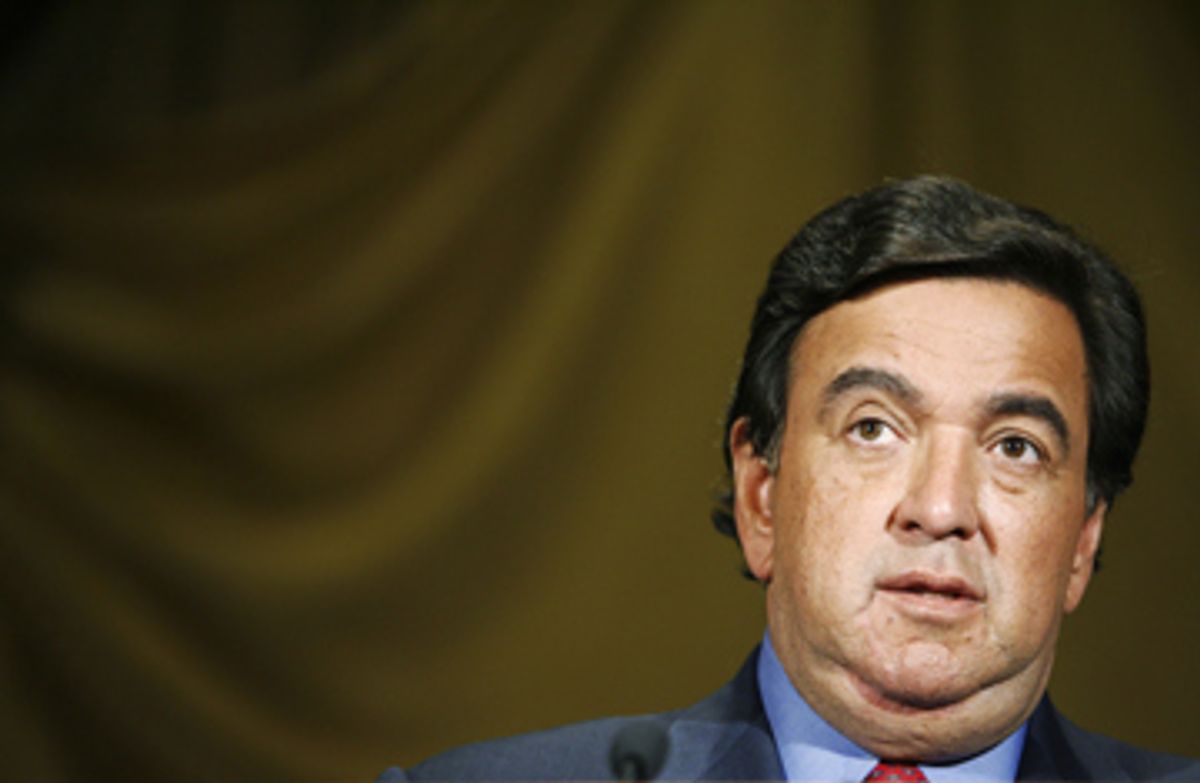
Bill Richardson

The Democratic Don Quixote

Despite his r

  • more
    • All Share Services

The Democratic Don Quixote

New Mexico Gov. Bill Richardson showed up in the spin room minutes after Sunday’s second Democratic presidential debate and announced to reporters, “I think I won.” He was smiling, but a drop of sweat escaped his hairline and trickled down the side of his broad face. “I feel I did very well. I feel I am going to move into the first tier with this performance.”

It may have been an overly optimistic prediction, though he probably would have made it even if he had fallen down on the stage, knocked over the lectern, and called Wolf Blitzer a four-letter word. This is a delicate a time for Richardson’s presidential ambitions. Despite some good television spots and moderately upticking poll numbers in New Hampshire and Iowa, much has been going wrong for his campaign. “It’s an important debate for me to do well,” Richardson had confided on Saturday during a street walk in Manchester. “Because I need to break out.”

Of all the second-tier Democratic candidates, Richardson has been seen as the one most likely to make a move, mainly on the strength of his résumé. He’s Hispanic, a Western governor, a former United Nations ambassador, a former secretary of energy, a former congressman, and a man who has personally negotiated with dictators and tyrants in Sudan, North Korea, Iraq, Afghanistan and Cuba. Plus, he is the only Democrat in the field who can pull off polished cowboy boots. But presidential campaigns are not about résumés as much as they are about performance, and Richardson has had his troubles.

In the first few months of the campaign, he admitted to falsely claiming for decades that he was a 1966 baseball draft pick by the Kansas City A’s. He told a reporter that he supported Attorney General Alberto Gonzales during the U.S. attorneys scandal because he was Hispanic, but then called for Gonzales’ resignation a few days later. He called the compromise immigration bill in the Senate a “good start” but a few days later announced he opposed it. He said his model Supreme Court justice was Byron White but changed his mind when he found out that White wrote the dissent in Roe v. Wade. To top it all off, there is the mother of a fallen Marine in New Mexico accusing him of slighting her dead son’s memory, by repeating on the campaign trail an anecdote she says never happened.

All these missteps came into painful relief a week ago on Sunday, when Richardson was pummeled for an hour by Tim Russert on NBC’s “Meet the Press.” By the end of the show, the candidate seemed to have sunk in his chair. He was looking at the table, not Russert, when he answered questions. At other times his eyes darted around. “I’m not perfect,” he said about backing Gonzales initially because of his ethnicity. “I should not have said that,” he admitted, when asked about his 1999 claim that nuclear weapons secrets were safe despite unfolding security scandals at the Department of Energy. “I got in trouble again,” he said, when Russert pointed out that he claimed to be — gulp, gasp — a fan of both the Red Sox and the Yankees.

Richardson’s political advisors maintain that he did well on the show, but even Steve Murphy, one of his top advisors, acknowledged that it was a rough ordeal: “Lizzie Borden’s dad didn’t do to well during the ax murder either,” he said, comparing his candidate to a 19th-century homicide victim.

The “Meet the Press” appearance left Richardson teed up for the political chattering class, resulting in a string of nasty articles that openly doubted Richardson’s prospects in a cluttered Democratic field. It may also have had an impact among voters, who are still getting to know Richardson. Susan Wolt, a public school food service program director, said she had to turn off the television that previous Sunday morning. “I was thinking very positive and then Tim Russert opened up all these questions and made him seem waffling,” she told me at a house party for Richardson on Saturday. “It was getting too aggressive and too hostile for a Sunday morning, so I turned it off.”

Wolt said she still didn’t know how she would vote, but she had traveled from her home in Plaistow to Manchester to see the candidate speak at 9 a.m. on the front yard of a clapboard home ringed with pink flowers. She said she was drawn to Richardson, in part, because of his television advertisements, which are funny and self-deprecating. They show Richardson facing off with a buffoon employer, who reads off the governor’s résumé while eating a sandwich. The spots are also striking for how little time they allow Richardson to address the camera — relatively unknown candidates more typically use such ads to explicitly introduce themselves to voters.

In person, Richardson’s performance can swing wildly even within a single speech. At his best, he is down-home, confident, folksy and authoritative, a sort of liberal Fred Thompson, the Republican actor-turned-candidate from “Law and Order.” At his worst, he looks tired and disconnected, and his speech is interspersed with awkward pauses and “uhs.” He meanders, adding extra words to his sentences and losing his own train of thought. “Is this heaven? Look at this,” he said, at the house party, which had attracted about 15 voters on a sunny day. “And I don’t just say that in Iowa. You remember ‘Field of Dreams,’ the movie, the baseball movie. Well, I say that in Iowa. I have yet to be in that field yet.” The New Hampshire crowd did not appear impressed.

Richardson’s stump speech consists mostly of a list of issues: six of them, to be exact. He sometimes posits them as his priorities for a metaphorical first six days in office: End the war in Iraq by pulling out all the troops. Achieve energy independence, in part by dramatically strengthening fuel-efficiency standards. Fix education, in part by creating a minimum wage for teachers. Offer health insurance for every American, through tax credits and expanding federal programs. Fix the economy, in part by using the tax code to support small business. And restore America’s respect for civil rights, by closing the prison at Guantánamo Bay, protecting a women’s right to choose, and allowing gays and lesbians to serve openly in the military.

It is a respectable list, and Richardson has briefing papers to back it up. But on the Manchester front lawn, and later on Saturday at the Democratic state convention in Concord, Richardson never sold the contents of that list with any emotional appeal stemming from his individual talents or biography. What he offered instead were issues, on which most of the Democratic field more or less agree.

He has yet to find a way to truly distinguish himself in one of the most crowded fields of Democratic front-runners in recent memory. Hillary Clinton is running as the most competent candidate. Barack Obama is running as the most aspirational. John Edwards is running as the liberal populist. It is not entirely clear where Richardson, the moderate Western governor with foreign policy experience, fits into the storyline. At the convention in Concord, Dennis Kucinich the left-wing gadfly, got louder applause.

An inability to stand out continued to dog Richardson at the second debate, where he struggled for the first hour even to get in a word. Fifteen minutes passed before Richardson got a first question directed to him, and once he started speaking he often found himself cut off by Blitzer, the moderator, for straying off topic. He was never given a chance to meet one of his primary goals: Establish himself as the only major candidate with a plan to withdraw all troops from Iraq in 2007 — a reversal of his previous support for the war and a policy that notably puts him to the left of Edwards. “Wolf, frankly, shut him off of this,” complained Murphy, the consultant. “John Edwards has endorsed leaving a large number of troops in Iraq.” (Edwards has endorsed a deadline for troop withdrawal, saying he wants all troops out of Iraq within about a year, except for an “embassy protection force.”)

In the second half of the debate, Richardson performed better, appearing more comfortable and taking strong stands on both education and pressuring China over the Sudanese genocide. The night clearly ended as an improvement over his performance in the first debate in South Carolina, where Richardson had struggled to hear the questions and scowled at the television cameras. “I wish the time had been more proportionate, especially on the Iraq issue,” Richardson said, maintaining the positive spin in the spin room. “But I think I had a strong performance.”

Richardson’s opinion, of course, is not the one that matters in the end. On Saturday, after the house party and the convention, Richardson walked down Union Street, in a largely Hispanic section of Manchester. He chatted with a car mechanic in Spanish and attracted a small crowd of children. He stopped in at several corner stores, and then spoke to a small crowd of diners at the Don Quijote Restaurant. The place is a New Hampshire institution of sorts for Spanish-speaking residents. Unless Richardson steadies his campaign performance in the coming months, its name could also become a symbol of his presidential ambitions.

Michael Scherer is Salon's Washington correspondent. Read his other articles here.

Richardson — not charged, but not exonerated

A U.S. attorney pours cold water on the New Mexico governor's celebration

  • more
    • All Share Services

The cloud that’s been hanging over New Mexico Gov. Bill Richardson recently, and cost him his shot at being Commerce secretary, appeared to be lifted yesterday. That’s when the Associated Press broke the news that Richardson won’t face charges stemming from a federal probe of pay-to-play allegations. Now, the cloud is back.

On Thursday, a Richardson spokesman, Gilbert Gallegos, took a little victory lap, saying in a statement that the governor is “gratified that this yearlong investigation has ended with the vindication of his administration.”

That’s not the way the U.S. attorney sees it, though. Greg Fouratt sent a letter to defense attorneys, the AP reports, in which he said the fact that no charges were filed “is not to be interpreted as an exoneration of any party’s conduct.” He also said the investigation “revealed that pressure from the governor’s office resulted in the corruption of the procurement process.”

It’s not great form for a prosecutor to be talking guilt out of court when there weren’t even any indictments, but that’s not likely to matter politically. Rather than being able to go on from here free and clear, Richardson will have to deal with that letter hanging around his neck for some time.

In another statement, this one released Friday, Gallegos said Fouratt’s letter “is wrong on the facts and appears to be nothing more than sour grapes.”

Continue Reading Close

Alex Koppelman is a staff writer for Salon.

Richardson won’t face charges in federal probe

The New Mexico governor was part of an investigation into a pay-to-play scheme

  • more
    • All Share Services

New Mexico Gov. Bill Richardson appears to have successfully weathered the federal investigation that cost him a spot as secretary of Commerce. The Associated Press reports that Richardson and former top aides will not be charged in the investigation, which was looking into an alleged pay-for-play scheme.

Decisions about charging high-ranking political figures are generally made in consultation with main Justice back in Washington, D.C., which typically has final say. That appears to be what happened here, as the AP reports the decision “was made by top Justice Department officials.” The AP’s source doesn’t appear to be happy about it, saying, “It’s over. There’s nothing. It was killed in Washington.”

Alex Koppelman is a staff writer for Salon.

Bill Clinton to the rescue

The former president's trip may be successful in securing the release of two American journalists

  • more
    • All Share Services

Update: Clinton’s mission was successful, and Kim Jong Il has pardoned the two journalists. See this post for more.

In a surprise visit, former President Bill Clinton arrived Tuesday in Pyongyang, North Korea, to meet with the isolated nation’s leader, Kim Jong Il. While North Korea’s nuclear program and recent spate of missile tests have caused growing consternation around the world, the main purpose of Clinton’s trip was to negotiate for the release of two U.S. journalists currently imprisoned there.

ABC News is now reporting that Clinton also met with the jailed reporters, Laura Ling and Euna Lee. A government source described the meeting as highly emotional but told ABC that those on Clinton’s team in North Korea are hopeful the journalists could be released as early as tomorrow.

Clinton has a loose connection to the jailed reporters. Both work for Current TV, a news and media venture headed by Clinton’s former vice-president, Al Gore. Ling and Lee were arrested on the border between North Korea and China in March. In June, they were sentenced to 12 years of hard labor for what North Korea said was their illegal entry into the country, as well as engaging in undefined actions deemed hostile to the communist country.

The White House has thus far remained reserved when discussing Clinton’s trip. North Korean media said Clinton shared a message from President Obama, but White House Press Secretary Robert Gibbs released a statement in which he said, “While this solely private mission to secure the release of the two Americans is on the ground, we will have no comment … We do not want to jeopardize the success of former President Clinton’s mission.”

However, Sen. Lindsey Graham, R-S.C., seemed somewhat confused by the decision to send Clinton. On the “Today” show this morning, he said of Clinton’s visit that “I don’t know what this is,” though he expressed hope that the visit could lead to progress on limiting North Korea’s nuclear arsenal.


There is a long history in the U.S. of notable political emissaries traveling across the globe to try to free hostages.

Perhaps the most memorable diplomatic mission was the Rev. Jesse Jackson’s 1999 trip to Belgrade to ask for the release of three U.S. soldiers held as prisoners of war by then Yugoslav president (and war criminal) Slobodan Milosevic. The trip was controversial because Jackson made the journey without the blessing of the Clinton White House. That he actually convinced Milosevic to release the soldiers after the Clinton administration had been unable to do so made Jackson’s fame as a hostage-release negotiator grow. The civil rights leader has worked as a diplomat in similar circumstances numerous times over his career: He was able to get hostages released from Syria in 1984, from Cuba in 1987 and from Kuwait and Iraq in 1990 — all without official presidential or congressional approval.

New Mexico Gov. Bill Richardson, who had been discussed as a possible liaison to negotiate the return of Lee and Ling, brokered the release of U.S. hostages from North Korea in the 1990s. Richardson has also helped secure the release of hostages from Iraq, Cuba and Sudan and most recently met with Venezuelan President Hugo Chavez to seek his support in getting a Colombian Marxist guerrilla group to release three U.S. contractors they’ve detained since 2003. Colombian commandos eventually freed the hostages, along with Ingrid Betancourt, in June 2008.

And in one of the most embarrassing hostage situations the U.S. ever faced, President Jimmy Carter proved unable to negotiate with Iran for the release of 52 Americans held after the overthrow of the shah during the Iranian revolution. A daring military operation to free the hostages also failed. Iran eventually released the hostages once President Ronald Reagan took office. Later in his presidency, Reagan suffered a major political scandal when it was revealed that his administration had sold arms to Iran in an attempt to gain the release of seven American hostages being held in Lebanon by Iranian terrorists.

Continue Reading Close

Vincent Rossmeier is an editorial assistant at Salon.

Will third time be the charm at Commerce?

Former Washington Gov. Gary Locke is reportedly President Obama's new choice to head the department.

  • more
    • All Share Services

President Obama struck out with his first two picks for Commerce secretary, as both New Mexico Gov. Bill Richardson and Sen. Judd Gregg (R-N.H.) withdrew their nominations for the post. Now, he’s reportedly hoping to do better with a fairly obscure choice — former Washington Gov. Gary Locke.

Locke, who left in office in 2005, served two terms and opted not to run for a third; he was the first Chinese-American governor in U.S. history.

Alex Koppelman is a staff writer for Salon.

Richardson speaks

The New Mexico governor explains his decision to drop out of the running to be commerce secretary, and says his political career isn't over.

  • more
    • All Share Services

One day after the sudden announcement that New Mexico Gov. Bill Richardson’s nomination to be commerce secretary was being withdrawn, Richardson offered additional details during a press conference. It did not go off without a hitch.

Richardson maintained that the decision to withdraw was his, and said he came to make that choice because an investigation into state contracts given to CDR Financial Products Inc., whose president is a Richardson donor, had gone on longer than he expected it to — he’d hoped it would be done in December, removing the cloud from over his head before confirmation hearings were to begin. The governor said, as he had in a statement on Sunday, that the country couldn’t afford any delay in confirming a new head for the department. “Sometimes your own dreams and plans must take a back seat to what is best for the nation,” he told reporters.

Still, Richardson made clear that he doesn’t believe this is the end of his political career. Referencing a statement from Barack Obama in which the president-elect said he “look[s] forward to his future service to our country and in my administration,” Richardson said, “I still believe I have a future in public service.”

There was one odd note Monday afternoon. When one reporter asked Richardson — who’d previously said he would not take any questions related to the CDR investigation — whether he had a lawyer, the governor responded, brusquely, “I am not getting into any more questions,” and the press conference was over.

Continue Reading Close

Alex Koppelman is a staff writer for Salon.

Page 1 of 12 in Bill Richardson