Did Facebook give Obama a secret advantage?
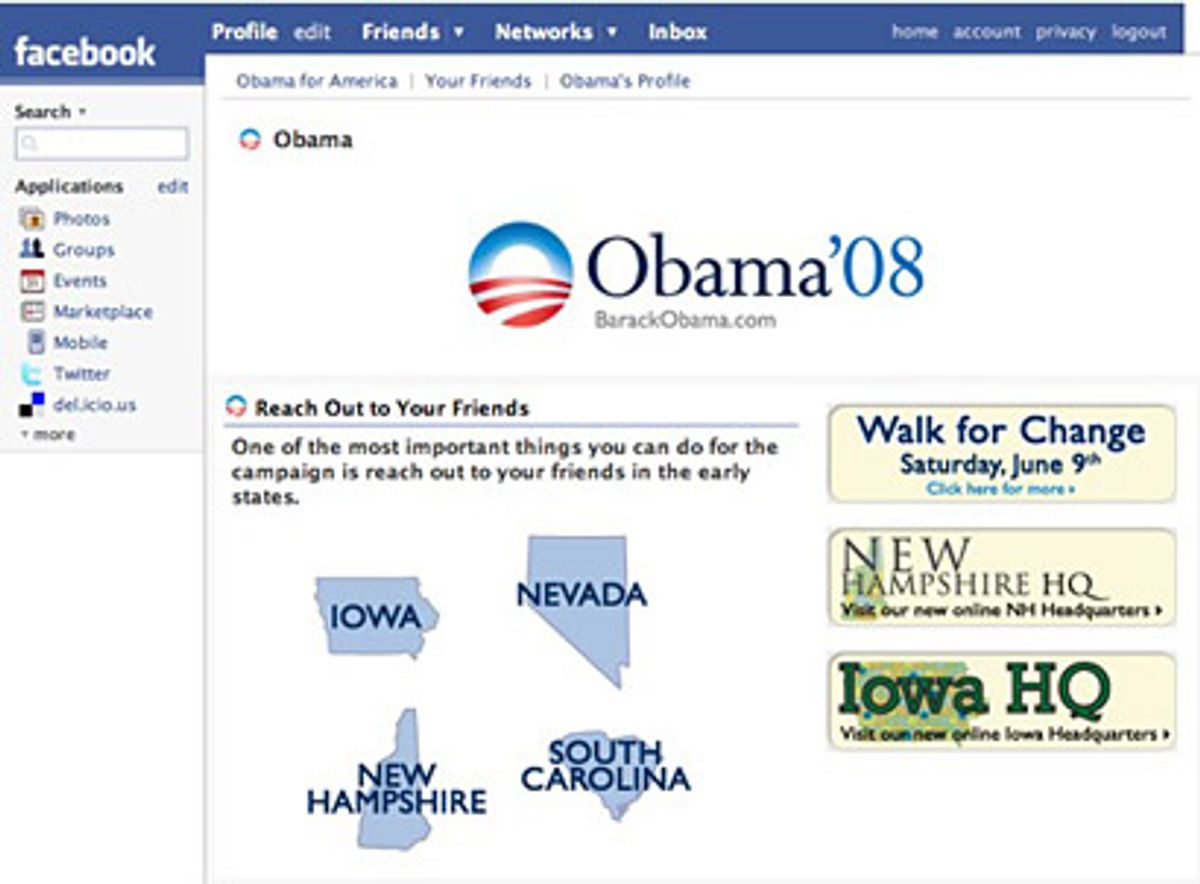
The Obama campaign released a new Facebook tool quickly after the site upgraded its system. Could that be because one of Facebook's founders now works for him?
At the techPresident blog, Joshua Levy and Micah Sifry charge that Barack Obama’s campaign has received an unfair upper hand from the online social networking site Facebook. And not only that, but Facebook may have violated campaign finance rules in helping the candidate out. While their story is a bit murky, with neither Facebook nor Obama’s campaign giving any firm answers, it is bolstered by an eyebrow-raising connection — Chris Hughes, one of Facebook’s founders, now works for the Obama campaign.
The alleged bit of favoritism concerns the Facebook Platform, a system that the company unveiled on May 24. The Platform lets independent developers create applications that can easily plug in to people’s Facebook pages. The applications do all sorts of things — Flixster lets people share movie reviews, iLike shows off Facebookers’ music ratings, and so on. While Facebook was developing the system, it allowed several companies — including Microsoft, the Washington Post, Digg and others — to access it, and many unveiled applications as soon as the Platform launched. Levy and Sifry say that Facebook also gave special access to the Obama campaign. The campaign released its own Facebook app just hours after the company launched the developer platform; although all of Obama’s major rivals maintain Facebook pages, none have yet created their own Facebook applications.
Obama’s Facebook application is a high-class production. As the blogger Rick Klau points out, the app lets Facebook users add Obama’s information to their own pages with a single click — kind of like an audio-and-video bumper sticker for the Web. The app has been a hit, too; more than 13,000 people have added it so far (and these things grow geometrically — the more pages the app is on, the more people see it, the more people add it, and on and on until the whole planet’s got Obama on their pages). Clearly, argue Levy and Sifry, the app was a long-planned thing; Facebook programs aren’t something “a coder puts together in an afternoon,” so to have built something so good so fast, the Obama camp must have been tipped off to Facebook’s Platform before its public launch.
Chris Kelly, Facebook’s chief privacy officer, offers Levy and Sifry a vague explanation, neither confirming nor denying, apparently, that the company gave Obama an assist. Kelly says instead that parts of Facebook’s Platform have been available since last September, and “we’ve had a number of conversations with many campaigns over the intervening months about how they can use the developer API and Facebook Platform.” But Levy and Sifry say that they spoke to Obama’s rivals and determined that no one else knew about the Facebook Platform before it launched. Obama’s campaign gave Levy and Sifry a non-answer: “The Obama campaign produced the tools ourselves, followed the guidelines set out by Facebook and look forward to welcoming more friends to our network.”
What makes this story more than an odd mystery is Facebook’s link to Obama. Chris Hughes was a sophomore at Harvard when he helped his roommates, Mark Zuckerberg and Dustin Moskovitz, set the site up, and last year, after graduating, he went to work for the company full-time. “But five months ago,” as the Wall Street Journal reported in a recent admiring profile, Hughes “put his career on hold to move to Chicago, in the dead of winter, for a ‘significant’ pay cut, in favor of a 14-hour-a-day job with Mr. Obama’s campaign. His goal: to transfer the same magic that transformed the way college students interact to a presidential campaign.”
Is it possible that Hughes brought too much of the Facebook magic with him — including even inside knowledge of an upcoming feature? Levy and Sifry say that if this did occur, Facebook “may have made an illegal in-kind donation to Obama.” It’s not clear yet that it did. But it doesn’t smell too good.
Farhad Manjoo is a Salon staff writer and the author of True Enough: Learning to Live in a Post-Fact Society. More Farhad Manjoo.
Private equity’s evil twin
The Facebook IPO debacle exposed venture capital as just as problematic as the industry that gave us Romney
Facebook founder, Chairman and CEO Mark Zuckerberg, center, rings the Nasdaq opening bell from Facebook headquarters in Menlo Park, Calif on May 18, 2012 (Credit: AP/Zef Nikolla) A funny thing happened on the way to the Facebook IPO. The clash of competing economic ideologies at play in the 2012 presidential campaign got a lot more complicated.
With our first-ever private equity honcho running for president in an era of high unemployment and slow economic growth, it was always a foregone conclusion that this year’s election campaign would include an appraisal of whether Mitt Romney’s version of capitalism is good for America. It’s a debate the culture has been passionately engaged in at least as far back as Oliver Stone’s “Wall Street,” and the battle lines are well-drawn. Is Bain Capital a parasitic corporate raider or an engine for lean-and-mean capitalist renewal? You get to make the call, and then you can go vote.
Continue Reading Close
Andrew Leonard is a staff writer at Salon. On Twitter, @koxinga21. More Andrew Leonard.
Wall St. ruins Facebook
The social network's debacle of a public offering exposes, once again, the rotten heart of finance
Mark Zuckerberg (Credit: Reuters/Brian Snyder) Could there be a bigger public relations debacle for an aspiring technology colossus than the Facebook IPO? It’s bad enough when the stock price doesn’t “pop” at all on the first day of trading, but it gets a lot worse when the financial press spends the following week debating whether the machinations behind the scenes leading up to the botched public offering constitute outright evidence of securities fraud or merely a toxic mixture of greed and incompetence.
Continue Reading Close
Andrew Leonard is a staff writer at Salon. On Twitter, @koxinga21. More Andrew Leonard.
When the school is the bully
A middle-school family gets a lesson in Facebook privacy
(Credit: Goodluz via Shutterstock) In a world that still asks women if they’re “mom enough” and debates our “obsession” with our children, Pam Broviak this week showed us what an awesome mom looks like.
Last fall, Broviak says, her 13-year-old daughter’s suburban Chicago school forced her to let them access her Facebook account and scour her private information, a policy Broviak says is commonplace in the Geneva Middle School South. In a blog post in April, Broviak added that when the incident happened, “the vice principal called me to demand I come to the school immediately to read through [my daughter's] private messages.”
Continue Reading Close
Mary Elizabeth Williams is a staff writer for Salon and the author of "Gimme Shelter: My Three Years Searching for the American Dream." Follow her on Twitter: @embeedub. More Mary Elizabeth Williams.
As Facebook grows, millions say, ‘no, thanks’
Meet the resisters -- people who, unbelievably, don't want or need Facebook
FILE - In this Feb. 29, 2012 file photo, a graphic display of a Facebook network is shown at a Facebook event for marketing professionals in New York, where the social networking giant demonstrated new advertising opportunities as a prelude to its initial public offering of stock. Insiders and early Facebook investors are taking advantage of increasing investor demand and selling more of their stock in the companys IPO, which is set for Thursday, May 17, 2012. But plans for the IPO were unfolding amid a debate over the effectiveness of Facebook advertising. (AP Photo/Mark Lennihan, File)(Credit: AP) NEW YORK (AP) — Don’t try to friend MaLi Arwood on Facebook. You won’t find her there.
You won’t find Thomas Chin, either. Or Kariann Goldschmitt. Or Jake Edelstein.
More than 900 million people worldwide check their Facebook accounts at least once a month, but millions more are Facebook holdouts.
They say they don’t want Facebook. They insist they don’t need Facebook. They say they’re living life just fine without the long-forgotten acquaintances that the world’s largest social network sometimes resurrects.
Continue Reading CloseObama goes viral, wins Twitter
The president's endorsement of gay marriage becomes a cleverly -- and intensely -- choreographed meme
When Barack Obama blew America’s mind by declaring his support for same-sex marriage Wednesday, he explained that his views on the subject had long been “evolving.” But while evolution is a process that can take millennia, social media moves with considerably more swiftness. However long it took the White House (nudged though it was by Joe Biden’s Sunday blurt that he was “absolutely comfortable” with marriage equality) to get to that place, it took no time at all for Obama’s sentiments to become a meme.
Continue Reading Close
Mary Elizabeth Williams is a staff writer for Salon and the author of "Gimme Shelter: My Three Years Searching for the American Dream." Follow her on Twitter: @embeedub. More Mary Elizabeth Williams.
Page 1 of 30 in Facebook