In private, Bush administration sub-Cabinet officials who have been instrumental in formulating and sustaining the legal "war paradigm" acknowledge that their efforts to create a system for detainees separate from due process, criminal justice and law enforcement have failed. One of the key framers of the war paradigm (in which the president in his wartime capacity as commander in chief makes and enforces laws as he sees fit, overriding the constitutional system of checks and balances), who a year ago was arguing vehemently for pushing its boundaries, confesses that he has abandoned his belief in the whole doctrine, though he refuses to say so publicly. If he were to speak up, given his seminal role in formulating the policy and his stature among the Federalist Society cadres that run it, his rejection would have a shattering impact, far more than political philosopher Francis Fukuyama's denunciation of the neoconservatism he formerly embraced. But this figure remains careful to disclose his disillusionment with his own handiwork only in off-the-record conversations. Yet another Bush legal official, even now at the commanding heights of power, admits that the administration's policies are largely discredited. In its defense, he says without a hint of irony or sarcasm, "Not everything we've done has been illegal." He adds, "Not everything has been ultra vires" -- a legal term referring to actions beyond the law.
The resistance within the administration to Bush's torture policy, the ultimate expression of the war paradigm, has come to an end through attrition and exhaustion. More than two years ago, Vice President Dick Cheney's then chief of staff I. Lewis "Scooter" Libby and then general counsel David Addington physically cornered one of the few internal opponents, subjecting him to threats, intimidation and isolation. About that time, the tiny band of opponents within approached Karen Hughes, newly named undersecretary of state for public diplomacy, hoping that the longtime confidante of President Bush, now assigned responsibility for the U.S. image in the world, might be willing to hear them out on the damage done by continuation of the torture policy. But she rebuffed them.
Two weeks ago, Hughes unveiled her major report, extolling "our commitment to freedom, human rights and the dignity and equality of every human being," but making no mention of detainee policy. The action part consists of another of her campaign-oriented rapid-response schemes, this one a Counterterrorism Communications Center, staffed by military and intelligence officers, to rebut the false claims of terrorists. Asked whether the administration's policies might be a factor contributing to the problem, Sean McCormack, the State Department spokesman, replied, "You're always going to get people criticizing policy."
Gen. David Petraeus' declaration on May 10 against torture reflected less the ringing authority of an order than the impotence of a personal credo. "Beyond the basic fact that such actions are illegal, history shows that they also are frequently neither useful nor necessary," he said. But his moral sentiment had been dismissed long before he had uttered it. The commander's strongly worded statement, putting him by implication in the category of "people criticizing policy," had no effect on the elaborate system of "enhanced interrogation techniques," black site prisons, maintenance of Guantánamo, or the 20,000 Iraqi prisoners incarcerated on U.S. military bases without due process. Petraeus has no more influence over the president who says he listens to his military commanders than the commanders who have opposed the policy since its inception.
In the year since the Supreme Court ruled (on June 29, 2006) in Hamdan v. Rumsfeld that the Bush administration's military commissions for detainees violated the Uniform Code of Military Justice and the Geneva Conventions -- and Bush promptly got the Republican-led Congress to legislate approval of the illegal commissions as well as suspend habeas corpus -- further court decisions have thrown his "war paradigm" into a legal twilight zone.
In February, a Cheney protégé, Susan J. Crawford, was appointed as the convening authority for military commissions. An armed forces appeals court judge, she had been Cheney's special counsel when he was secretary of defense under the elder Bush and had become a family friend. She has long been close to Libby and Addington. She facilitated the unusual transfer of David Hicks, a former kangaroo skinner from Australia, captured in Afghanistan as a fighter with the Taliban and held at Guantánamo. Charged with a host of crimes, including murder, Hicks filed an affidavit alleging torture. When the Hamdan decision was handed down, the charges against him were dropped, but after passage of the Military Commissions Act he was newly charged with providing material aid to terrorism. His five-year detention in Guantánamo provoked a public outcry in Australia. Cheney flew there to confer with Prime Minister John Howard, who wanted to defuse the issue. Soon afterward, a deal was worked out: Hicks pleaded guilty to the lesser charge of providing material aid, he was released to Australian authorities, and he is serving a reduced nine-month sentence.
Crawford's appointment, however, did not prevent military commission judges at Guantánamo from ruling on June 4 that the commissions had no jurisdiction over enemy combatants who were not designated as "unlawful." In effect, this decision threw the commissions into a void. According to the judges' decision two prisoners, Omar Kadhr, captured as a 15-year-old child soldier and accused of killing a U.S. Special Forces medic on the battlefield, and Salim Hamdan, one of Osama bin Laden's former drivers, did not fall under the category that would enable them to be tried by the commissions.
On June 11, the U.S. Court of Appeals for the 4th Circuit, the most conservative in the country, issued a decision striking at the heart of Bush's conception of the presidency. In al-Marri v. Wright, the court ruled that Ali Saleh Kahlah al-Marri, a resident of Qatar, arrested as a student at Bradley University in the United States, accused of aiding al-Qaida, could not be held in indefinite detention as an "enemy combatant" and must be remanded to the civilian criminal court system. (Al-Marri, in an affidavit, claimed to have been tortured.) The decision acknowledged that al-Marri might have committed serious crimes. But the government's assertion that the president has "inherent constitutional authority," rooted in his "war-making powers," is a "breathtaking claim" contrary to U.S. constitutional law and history.
"The President," the court said, "claims power that far exceeds that granted him by the Constitution." This extraordinary decision, citing the Framers, declared Bush's actions -- and his imperial presidency -- null and void. It is worth quoting at some length:
Put simply, the Constitution does not allow the President to order the military to seize civilians residing within the United States and detain them indefinitely without criminal process, and this is so even if he calls them "enemy combatants" ... Of course, this does not mean that the President lacks power to protect our national interests and defend our people, only that in doing so he must abide by the Constitution. We understand and do not in any way minimize the grave threat international terrorism poses to our country and our national security ... The Court has specifically cautioned against "break[ing] faith with this Nation's tradition" -- "firmly embodied in the Constitution" -- "of keeping military power subservient to civilian authority." Reid, 354 U.S. at 40. When the Court wrote these words in 1957, it explained that "[t]he country ha[d] remained true to that faith for almost one hundred seventy years." Id. Another half century has passed but the necessity of "remain[ing] true to that faith" remains as important today as it was at our founding.
Then, the court delivered the coup de grâce to Bush's "war paradigm." Having cited the Framers, it now cited the example of Abraham Lincoln.
In an address to Congress at the outset of the Civil War, President Lincoln defended his emergency suspension of the writ of habeas corpus to protect Union troops moving to defend the Capital. Lincoln famously asked: "[A]re all the laws, but one, to go unexecuted, and the government itself to go to pieces, lest that one be violated?" Abraham Lincoln, Message to Congress in Special Session (July 4, 1861), in Abraham Lincoln: Speeches and Writings 1859-1865 at 246, 254 (Don E. Fehrenbacher ed., 1989). The authority the President seeks here turns Lincoln's formulation on its head. For the President does not acknowledge that the extraordinary power he seeks would result in the suspension of even one law and he does not contend that this power should be limited to dire emergencies that threaten the nation. Rather, he maintains that the authority to order the military to seize and detain certain civilians is an inherent power of the Presidency, which he and his successors may exercise as they please. To sanction such presidential authority to order the military to seize and indefinitely detain civilians, even if the President calls them "enemy combatants," would have disastrous consequences for the Constitution -- and the country. For a court to uphold a claim to such extraordinary power would do more than render lifeless the Suspension Clause, the Due Process Clause, and the rights to criminal process in the Fourth, Fifth, Sixth, and Eighth Amendments; it would effectively undermine all of the freedoms guaranteed by the Constitution. It is that power -- were a court to recognize it -- that could lead all our laws "to go unexecuted, and the government itself to go to pieces." We refuse to recognize a claim to power that would so alter the constitutional foundations of our Republic.
Few, if any, presidents have ever been the subject of such a devastating legal decision. While presidential actions have been ruled illegal or unconstitutional in the past, they were individual acts. But in the case of Bush, the al-Marri decision not only discredits Bush's position but denies his idea of his presidential legitimacy in the American tradition. The decision also declares that Bush's idea is a mortal threat to the Constitution. And this ruling was issued by the most conservative court in the land.
And yet, nothing changes. After such a stinging rebuke as the decision handed down by the 4th Circuit a reasonable president might well contemplate changing his approach. Instead, Bush digs in, doubles down, surges. As with his other discredited policies, Bush attempts to salvage them through willpower and extra effort, throwing more resources down black holes. Ultimately, his position is losing its cloak of legality. Piece by piece, case by case, the courts are exposing it as ultra vires.
The impulse for supporting the policy, on one level, remains visceral and virulent. Stephen Holmes, professor at the NYU School of Law, describes the concept of "mirror imaging" in his new book, "The Matador's Cape: America's Reckless Response to Terror": "If our enemies have renounced the laws of civilization, so will we. If they organized a sneak attack, then we will respond with a dirty war. If they terrorized us, we will terrorize them."
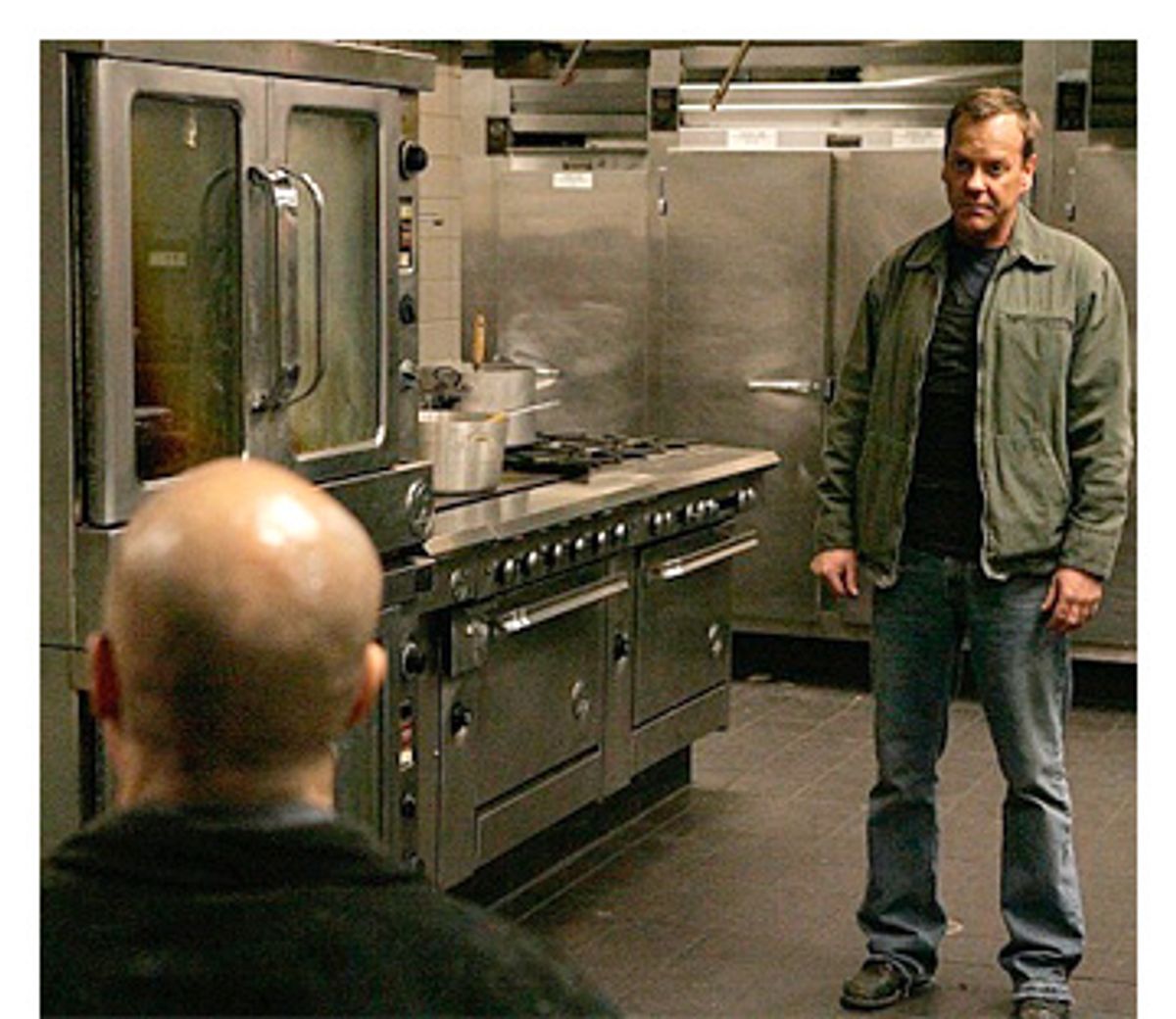
For some, this vengeance -- "We need to humiliate them," according to Henry Kissinger -- requires something more; it involves upholding faith that transcends law. On June 16, Associate Justice Antonin Scalia of the Supreme Court, at an international conference on torture and terrorism in Ottawa, Ontario, sought to resolve the question on a moral basis. His disquisition consisted of a defense of Jack Bauer, the fictional hero of the torture-porn Fox TV series "24." "Are you going to convict Jack Bauer? Say that criminal law is against him? 'You have the right to a jury trial?' Is any jury going to convict Jack Bauer? I don't think so. So the question is really whether we believe in these absolutes. And ought we believe in these absolutes." Thus, for this conservative jurist, torture, dramatized through popular entertainment, remained the same obsession with "absolutes" as it had been during the Inquisition, which after all developed the enhanced coercive techniques used today.
By contrast, Bush's stance is merely political, a raw assertion of unaccountable and unlimited power. Yet the political idea he seeks to defend -- a presidency operating by fiat above the rule of law -- finds itself increasingly in conflict with the American system of justice, and not only on the question of detainees and torture.
Shares