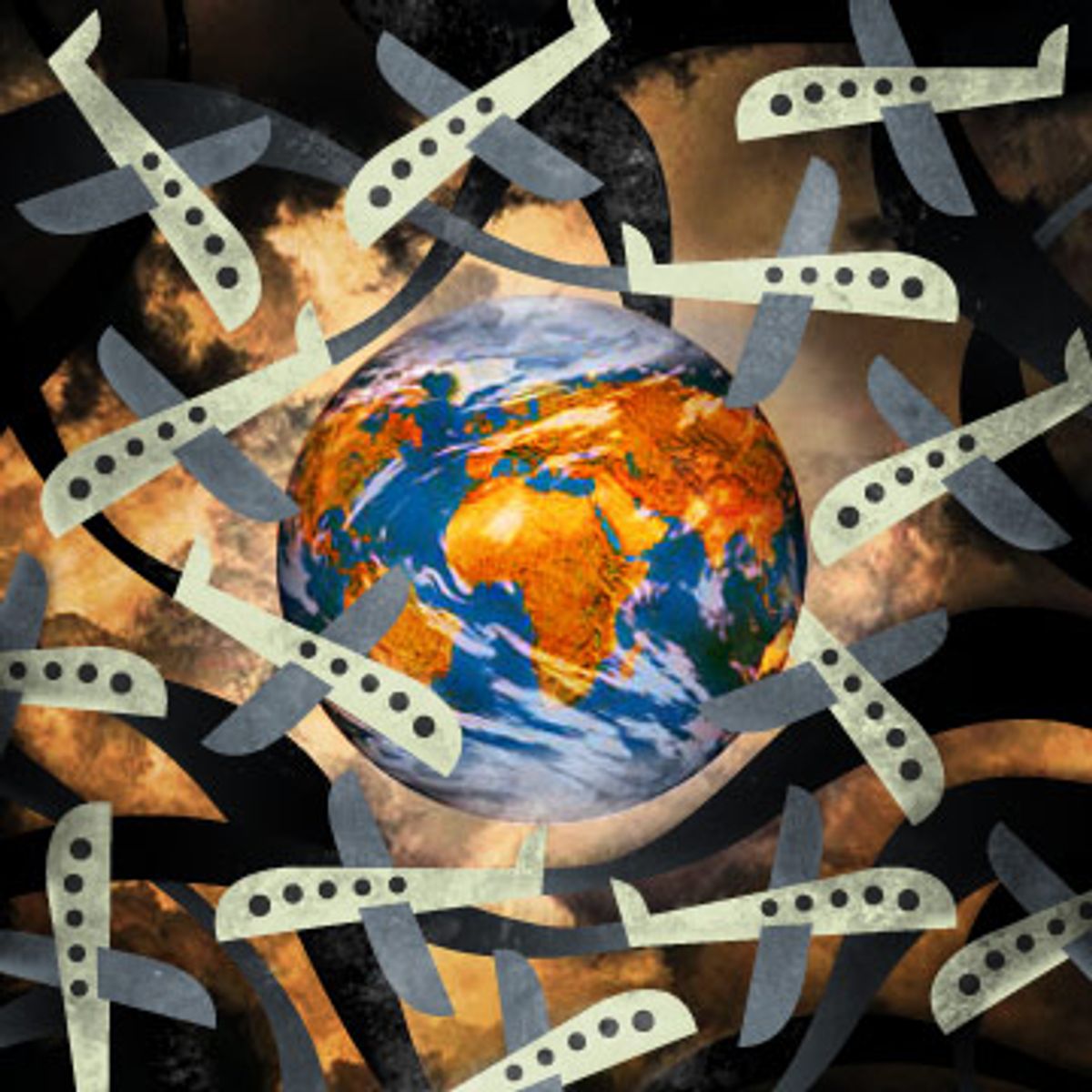
Air Travel

You are now free to pollute about the country

Air travel is the latest guilt trip for the environmentally conscious consumer. Here's how flying contributes to global warming and what is being done to cool the jets.

  • more
    • All Share Services

You are now free to pollute about the country

This spring, meteorologist Robert Henson was thrilled to be one of the six finalists for the prestigious Royal Society Prize for Science Books for “The Rough Guide to Climate Change.” There was only one problem: All finalists were required to appear at the awards ceremony. Henson lives in Boulder, Colo. The ceremony was in London.

The irony of jetting halfway around the globe and back — merrily spewing the greenhouse gases that contribute to global warming — to honor a book about the pressing dangers of the warming planet was not lost on the meteorologist. “I wanted to be there, and I had agreed I would be there by entering the contest,” says Henson. “But I wanted to do it in the most greenhouse-friendly way that I could.”

So Henson resolved to make the flight entirely during daylight hours, when greenhouse emissions from jets are reportedly less harmful. That meant flying from Denver to Washington, D.C., staying overnight in a hotel, and then catching another flight the next day to London.

Worry about air travel’s contribution to global warming is taking off. In England, grass-roots activists have locked horns with the airline industry over its increasing number of flights and plans for airport expansion. One group, Plane Stupid, blocked a runway, delaying flights in Nottingham, and disrupted a meeting of airline executives by releasing a bunch of helium balloons with screeching alarms. One Plane Stupid protester went so far as to Super Glue herself to the door of the corporate offices of Lastminute.com, an online travel agency. Not to be outdone, in June Greenpeace activists dressed up as stewardesses, set up booths called “climate ticket exchanges” at four airports, including Heathrow, and handed out free train tickets to passengers willing to skip their short flights and go by rail instead. The goal: to stress train travel as a climate-friendly alternative to flying, especially for that short hop to Paris.

The climate clamor over flying doesn’t stop with environmental activists. One British bishop denounced flying on a vacation as a “sin.” Even publishers of travel books lament the climate impact of their wanderlust guides and are advising travelers to “fly less and stay longer.” Mark Ellingham, founder of Rough Guides, and Tony Wheeler, founder of Lonely Planet, have decried the growth of what they call “binge flying,” and urged air travelers to take to the skies less often. “In Europe, and especially Britain, we have become addicted to cheap flights, heading off to Rome for the day or Prague for the weekend,” writes Ellingham in e-mail. “Many people buy these as casually as booking a restaurant. I consider this ‘binge flying’ and I don’t think it’s sustainable behavior.”

How worried should air travelers be about contributing to global warming? Flying still makes up a very small percentage of greenhouse gas emissions. Globally, just 1.5 percent of greenhouse gas emissions caused by human activity each year come from air travel, according to Tim Herzog, a climate policy analyst for the World Resources Institute. In the U.S., that number’s about 3.5 percent. Yet those numbers are projected to rise sharply, making air travel one of the fastest growing contributors to global warming, while the world is struggling to reduce emissions. Over the next 20 years, more than 27,000 new aircraft will take flight, and the number of air travelers will double to 9 billion during the same period, according to the Hodgkinson Group, an aviation consulting firm. Here in the United States in the next two decades, demand for air travel will grow 150 percent, according to the Department of Energy.

Some governments are stepping in to curb the rising tide of emissions. By 2011, airplanes traveling within the European Union will be subject to a carbon trading scheme. But debate about such regulations inspired the unrepentant boss of one low-cost airline, Ryanair, to pledge to increase his company’s carbon emissions, saying if his customers are worried about the environment, he had some advice for them: “Sell your car and walk.”

Hopping a commercial flight sure feels like an airborne form of carpooling, especially when the blowhard sitting next to you won’t close his yapping trap for six hours. And, sure, fine, it’s unquestionably better for the environment than owning a private jet, which one horrified activist compared to buying a whole coal-fired power plant to power a single mobile phone. Yet even on today’s full flights with passengers crammed into small seats, flying packs a big climate punch. For a long trip, like a transatlantic flight on an average-size plane, each passenger is responsible for sending .39 pounds of CO2 per mile into the atmosphere, according to the World Resources Institute’s Greenhouse Gas Protocol Initiative. By that measure, flying direct from Denver to London and back puts about 3,600 pounds of CO2 into the atmosphere, equivalent to driving a Toyota Prius hybrid 10,000 miles.

While most Americans still emit more by driving than flying, simply because they spend so many hours in the car, frequent fliers can spew a lot more emissions than daily commuters. Take the doting grandmother, recently profiled in the New York Times, who flies 500 miles a week, jetting from her home in Houston to Dallas and back to care for her grandkids, a tale the paper dubbed “The Incredible Flying Granny Nanny.” A year of this high-flying childcare arrangement will pump almost 16,500 pounds of C02 into the atmosphere, more than the average driver of a four-wheel-drive Ford Ranger emits in a year.

It may be a short flight from Houston to Dallas, but shorter flights have a larger impact per mile than longer ones, since the takeoff and landing are the most fuel-hungry part of the journey. “These regional flights are not efficient because they don’t have time to get up into the atmosphere and cruise, where jets are most efficient,” says Luke Tonachel, a vehicles and fuels analyst for the Natural Resources Defense Council. That means the Incredible Flying Granny emits .63 pounds per mile every time she jumps on a jet to see the grandkids. She could reduce her emissions by hopping behind the wheel of a Honda Civic by herself and driving from Houston to Dallas and back.

But why pick on one grandma, when business travel accounts for 65 percent of all flights in the United States, according to PhoCusWright, a travel research firm. It’s the management consultants jetting from New York to Kansas City, and the tech executives winging it from Silicon Valley to the Bangalore outpost, who are really racking up those airborne emissions. Just ask Tom Arnold, chief environmental officer for TerraPass, a Silicon Valley company that sells carbon offsets: “The overwhelming majority of my personal carbon footprint is flights,” he says. Arnold says he cuts down by consolidating trips, and staying four or five days when he goes on a cross-country trip to New York, instead of just flying in for a meeting or two.

Flying also has another warming effect, beyond the greenhouse gas emissions. Planes leave behind contrails, thin wisps of condensation in their wake, which act like high, thin ice clouds producing an effect called “radiative forcing.” The contrails trap heat that’s radiating off the earth’s surface, contributing to global warming. During the day, they also reflect sunlight, which has a counterbalancing cooling effect. At night, and during the winter, when its darker, there’s less sunlight for the clouds to block. “The warming effect goes on 24 hours,” says Don Wuebbles, a professor of atmospheric science and director of the School of Earth, Society and Environment at the University of Illinois. “It’s generally thought that the warming effect wins out. The cooling effect is only during the day.” Right after 9/11, when most planes were grounded in the United States for days, scientists were able to measure a change in the temperature.

A purist might argue that if you’re really worried about global warming, any recreational flying is unsustainable. As with so much else with global warming, the emissions math is not that straightforward. Deforestation is a major contributor to global warming — second only to power generation as a source around the world — accounting for some 18 percent of annual human-induced greenhouse gas emissions. Tourism is one of the key industries that makes it economically viable for poorer countries to avoid clear-cutting rain forests for cattle ranching or agriculture. If visitors from richer countries suddenly stopped flying, more rain forests would fall, creating more emissions.

“I don’t think it would be a great thing for the world — and the developing world especially — if we all stopped flying entirely,” writes Ellingham from Rough Guides. “What is crucial, however, is that aviation doesn’t continue to grow at present rates — 10 percent in the U.K. and more than 5 percent globally. We don’t have a God-given right to cheap flights that overrides our responsibility to the planet and its people, most of whom, of course, never get on an aeroplane.”

It may come as a surprise to learn the airline industry itself is talking green. In June, Giovanni Bisignani, director general and CEO of the International Air Transport Association, threw down the gauntlet to his colleagues in the airline industry at their annual meeting. “Air transport must become an industry that does not pollute. Zero emissions,” he said. How to get there? “I don’t have all the answers, but our industry started with a vision that we could fly. The Wright brothers turned that dream into reality and look at where we are now.b

The association issued a challenge to its members to replace 10 percent of their polluting fossil fuel with low-carbon alternatives within the decade, and called on the airline manufacturers to build a zero-emissions aircraft within the next 50 years. The U.S. Air Force has set an even more ambitious goal, challenging fuel refiners and alternative energy companies to move the Air Force’s entire fleet to fuel that’s only 50 percent petroleum-based within the next decade. In the meantime, there’s an air travel industry-based Web site to soothe public fears about climate change and flying.

Richard Branson, maverick founder of Virgin Atlantic, has pledged $3 billion to search for alternative fuels. Biofuels don’t pack as much energy per unit as fossil fuels, which makes it challenging to use them aloft. There’s also some concern about them freezing or gumming up at high altitudes. Nevertheless, Virgin claims that it will be ready to test an alternative fuel on a commercial jet in 2008. In the meantime, the race is on to be more efficient with conventional fuels. Boeing boasts that its forthcoming 787 Dreamliner will use 20 percent less fuel than similar-size planes flying today. And one low-cost carrier, EasyJet, has a prototype for a short-haul jet that will reduce CO2 emissions by half.

To conserve fuel, Virgin Airways has experimented with towing airplanes to the runway to avoid turning their engines on until the last possible second. In fact, many planes now taxi with just one engine on, instead of using both, according to Steve Lott, a spokesman for the International Air Transport Association. Better air traffic management to ensure that planes take the shortest routes to their destinations and spend less time circling above airports waiting to land could also yield significant efficiency savings, according to Lott.

Yet these glimmers of conservation don’t appease Joel Makower, executive editor of Greenbiz.com, an environmental consultant to Fortune 500 companies. He recently mused on his blog about whether air travel will ever be green. “I don’t see anything that’s being done by the industry that suggests that airplane travel is going to be climate-friendly within my lifetime,” says Makower, who flew 51 times in the first half of 2007. He argues that the projected growth of the industry and current state of technology mean that airline emissions simply will get worse before they get better.

Still, without an obvious technology fix for air travel, inspiring passengers to give up flying is like trying to toss a paper airplane through a hurricane. Sure, a business traveler can replace a shuttle flight from New York to Boston with a more efficient train ride, but most trips, at least in the U.S., don’t offer such an obvious, efficient and convenient alternative to flying. “If you’re traveling on business between Atlanta and Chicago, what else are you going to do?” asks Herzog from the World Resources Institute. Makower says he hasn’t seen companies voluntarily replacing far-flung meetings with videoconferencing to curtail flying. “Some companies recognize that air travel is the biggest part of their carbon footprint, and the typical response is to offset it, not to reduce it,” he says. Even Ellingham from Rough Guides admits that asking people to cut back on flying won’t achieve much. “I think that a lot of people are moderating their flying habits, and many more will do so as the facts and urgency of acting on climate change become clear. But, no, I don’t think that it will be enough unless governments intervene.” Currently, the European Union’s plans to implement a carbon emissions trading scheme for airlines in 2011 is the only such action.

If you’re trying to figure out the impact of your own flight, you can use many online calculators, mostly presented by companies selling carbon offsets. Be forewarned that the results represent rough approximations. Also, each calculator makes somewhat different assumptions about how big the average plane is, how efficient it is and how full of passengers it is, and so your results will vary. Most online calculators don’t attempt to include the added impact of contrails.

The best way to reduce air travel emissions is, of course, not to fly. If a train is available and efficient, it’s always a better option, according to Jennifer Hattam, green lifestyles expert for the Sierra Club. She also recommends limiting shorter vacations to spots close to home, while saving flying for longer journeys. Another tip: Horde all your vacation days to take one long holiday instead of several shorter vacations throughout the year, involving flying.

Although you won’t catch anyone at the Sierra Club telling you to jump in a car, driving can produce fewer emissions per passenger mile than flying, especially if you have a fuel-efficient car. Trying to decide if you should drive or fly from, say, San Francisco to Los Angeles, adding people to your car who would have flown can easily tip the scales in favor of driving. Flying in the summer, when there’s more light, is also better for the atmosphere than flying in the winter, when it’s darker. And now that you know it’s better to fly in the day, you have a perfect excuse, should your eco-savvy boss want you to be in your transcontinental office the next morning, not to take the red-eye.

Behind the underwear bomb

The latest airplane terror plot wouldn't have been foiled without airport security -- but not the kind we all know

  • more
    • All Share Services

Behind the underwear bombTravelers line up at a TSA checkpoint at Los Angeles International Airport. (Credit: Reuters/Danny Moloshok)

Another deadly plot taken down in the planning stages. This time, thanks to the work of a CIA double agent, officials were able to infiltrate a Yemen-based al-Qaida plot to destroy a U.S.-bound jetliner using a nearly undetectable underwear bomb.The moral of the story: Airport security works!Am I being facetious?  Not necessarily.  It depends on your definition of airport security.

In my mind, the key to keeping airplanes safe is, and always has been, stopping acts of sabotage while they are still in the planning stages. Here in the age of the TSA checkpoint, with its toothpaste confiscations and obsession with pointy objects, we tend not to think this way, preoccupied instead with a kind of airport Kabuki — the tedious, fanatical screening of passengers and their carry-ons. Real airport security takes place offstage, as it were. It is the job of the folks at the CIA and the FBI, working together with foreign authorities. And while TSA has an important role here too, we can do without the spectacle of airport guards rifling through innocent people’s bags in a pathological hunt for what are effectively harmless items.

The concourse checkpoint needs to be there.  Just the same, chances are good that once an adversary has made it to the airport, he or she has engineered a way to outwit the system.  And spend as we might, there will always be a way to outwit the system.  ”Even if our technology is good enough to spot it,” said California Rep. Adam Schiff, commenting on the news of the latest underwear plot, “technology is still in human hands and we are inherently fallible.”

That’s one of the smartest things I’ve heard a politician utter in some time.

Getting a handle on this takes us all the way back to Sept. 11, 2001, the day that everything, and yet really nothing, changed.  I’ve said this before, but it bears repeating: Conventional wisdom holds that the 19 hijackers exploited a weakness in airport security by smuggling box cutters onto four Boeing jetliners. But conventional wisdom is wrong. What the men actually exploited was a weakness in our mind-set — a set of presumptions based on the decades-long track record of hijackings and how they were expected to unfold. (In prior years, a hijacking meant a diversion, perhaps to Havana or Beirut, with hostage negotiations and standoffs; crews were accordingly trained in the concept of “passive resistance.”) The presence of box cutters on 9/11 was merely incidental. The men could have used almost anything — a deadly sharp can be fashioned from a broken first-class dinner plate or a ballpoint pen — particularly when coupled with the bluff of having a bomb. The success of their plan relied not on hardware but on the element of surprise. It wasn’t a failure of airport security that allowed those men to hatch their takeover scheme. It was a failure of national security — a breakdown of communication and oversight at the FBI and CIA level.

To put it succinctly: The success of the 9/11 attacks had almost nothing to do with airport security at all — a great and painful irony, of course, to any passenger forced to endure the checkpoint rigmarole in 2012.

Not that frontline guards don’t play a deterrent role.  And, in the opinions of some, the plot uncovered in Yemen underscores the value of full-body scanners — those controversial walk-through machines that allow guards to look beneath a passenger’s clothing. It’s a compelling argument, but the way in which these scanners have — and have not — been deployed is apt to make some of us cynical. For instance, the vast majority of body scanners are found at U.S. domestic airports. Overseas, where a bomb is far likelier to originate, they are rare. Is this really about safety, we wonder, or is it about billions of dollars going into the coffers of the companies contracted to build these machines?

And although the scanners are effective, where does the arms race end?  Not long ago, the idea that passengers would be marched through body scanners and photographed naked before being allowed to board an airplane, would have seemed outrageous. Yet here we are. What might be next?  The stubborn truth is, we can turn airports into fortresses if we want (in some respects we’re well along that path), yet we’ll never be entirely safe. Airport screening alone, no matter how thorough, how expensive, and how technologically advanced, will never defeat a relentless enough, resourceful enough adversary intent on downing a plane.

That isn’t capitulation, it’s reality.  And acknowledging this reality would go a long way toward warding off panic and overreaction when the next successful attack occurs.

Regrettably, too, we often forget that commercial air travel has long been a target of terrorist extremists.  The 1970s and 1980s in particular were, as I like to describe them, a Golden Age of Air Crimes, comparatively rife with bombings, hijackings and other deadly assaults against airplanes and airports. Over one five-year span between 1985 and 1989 we can count at least six high-profile terrorist attacks, including the horrific bombings of Pan Am 103 and UTA 772; the bombing of an Air India 747 over the North Atlantic that killed 329 people; and the incredible saga of TWA Flight 847.  And let’s not forget what might have been, such as the so-called “Project Bojinka,” the 1994 scheme masterminded by Ramzi Yousef (nephew of Kalid Sheikh Mohammad), in which impossible-to-detect (at the time) liquid explosives were to be used to simultaneously destroy a dozen U.S. airliners over the Pacific Ocean. Fortunately the plot unraveled and Yousef was arrested.

While we can argue, quite persuasively, that many of the current-day security measures have done little if anything to make us safer, we’ve nevertheless introduced measures that have been useful and effective, from explosives screening of checked luggage to the sorts of trans-border partnerships that broke up the most recent plot from Yemen. Whether in spite of, or because of, the attention we’ve lavished on All Things Terrorism, the past decade has seen fewer attacks against commercial air travel than any since the 1950s.What we need to remember, though, is that our success has had more to do with the security measures we don’t see than those taking place in plain view. And if our luck is to hold, we need to better rationalize and streamline our entire approach to airport security. For instance, if we’re going to have those body scanners, let’s put them where they’re needed. If this requires negotiating with foreign authorities whose airports are beyond TSA’s jurisdiction, so be it. Meanwhile, here at home, TSA’s one-size-fits-all approach, in which every single person who flies is seen as a potential threat, is simply unsustainable in a country where close to 2 million people fly daily. Things like taking snow globes from children, haggling over tiny container sizes, or confiscating a dessert fork from a uniformed, on-duty airline pilot (it happened to me) serve no useful purpose whatsoever. On the contrary, they divert valuable time and resources away from the things that could make us safer.  Let’s scale back that concourse Kabuki and retrain guards in the finer points of a more sensible, risk-based assessment of passengers and their belongings.

And lastly, if only as an aside, let’s behold for a moment the term “underwear bomb.”  That was the operative phrase in literally hundreds of articles and broadcasts over the past several days, and nowhere did it raise a snicker.  What does it say about our country, I wonder, that such a preposterous expression is instantly understood and effectively taken for granted?

Strange times indeed.

Continue Reading Close

How the rich took over airport security

Security checks were one of America's most democratic places -- until rich passengers got their own speedy lines

  • more
    • All Share Services

How the rich took over airport security (Credit: Reuters/Salon)

The other day at Bergstrom Airport in Austin, Texas, I witnessed a striking manifestation of the new American plutocracy. Along with getting a photo at the Department of Motor Vehicles and sitting in a jury pool, standing in line at airport security with a mob of other people, miserable though it is, remains one of the few examples of civic equality in our increasingly oligarchic republic. Much airport security, of course, is theater, designed to provide alibis for bureaucrats and politicians in the event of a terrorist attack. But while we can debate what a rational airport security system would look like, no rational system would discriminate among passengers on the basis of ability to pay.

That is what makes the policy of Delta Airlines so shockingly un-American.  In Austin, Delta had not one but two lines that fed into the Transportation Security Administration checkpoint area. One line was mixed race, mixed class and mixed age. The other line was usually empty. Now and then a white, middle-aged man would appear in the second line and the first line would be halted as he went directly into the TSA checkpoint.

“Who are those guys?” I asked a TSA officer, when I reached the front of the second-class citizen line.

“Delta has total control over the passenger line all the way up to here,” the officer answered. “They’ve decided to let priority passengers as well as pilots and steward staff go through ahead of others.”

“So that’s the rich white guy line?” I asked.

The TSA officer laughed. “On our side of the line, everybody is equal.”

Now I would be the first to concede that what Delta and other airlines do beyond the government security checkpoint at the gates that lead to airplanes is their business. At the moment, the model of America’s pathetic, predatory, deteriorating airline industry seems to be eking out nickels and dimes by playing crudely on the snobbery of their customers, with the use of two separate lines at the terminal gates, one for priority passengers — labelled, by various airlines, Gold, Platinum, Elite and so on.

The priority line, needless to say, goes to exactly the same door and entry ramp and does not get the “elite” to its destination one second earlier. Neither de Toqueville, who commented on the contrast between the status obsessions of Americans and their professed democratic egalitarianism, nor Veblen, who coined the term “conspicuous consumption,” would have been surprised by this method of showing off. Such silliness is a matter for satire, not lawsuits or protest marches.

But going through airline security is different. It is not a choice, like belonging to an airline’s frequent flier points club. Security screening is an onerous civic duty. Like other civic duties, it should be shared equally by rich and poor alike. Remember the motto of Jacksonian populism? “Equal rights for all, special privileges for none.”

Nearly all the airlines now allow well-heeled passengers to pay for the privilege of cutting ahead of the rest of us at the TSA checkpoint. At many airline checkpoints there are two lines. The long line looks like America; the short line is made up mostly of affluent white men.

Is this the future we Americans want: two lines at all airline security checkpoints, one for the privileged 1 percent and the other for the 99 percent, who have to stand aside to let the people with lots of money pass?  Alas, it appears that making economic apartheid formal in U.S. civil aviation is a bad idea whose time has come. The TSA is experimenting with a “precheck” program with built-in class discrimination, including the government’s crony-capitalist invitation of frequent fliers from private U.S. airline programs, but not other American citizens, to participate:

If you are a United States citizen and are currently a member of CBP’s eligible Trusted Traveler programs (Global Entry, SENTRI, NEXUS), you are automatically qualified to participate in the TSA Pre ™ pilot as long as you are flying on a participating airline at a participating airport. (If you’re a more frequent flyer with Delta or American, you must opt in to the program by responding to the communication sent to you, which is why it’s important to find that email and follow the directions in it.)

In other words, if you do not fly frequently — and most low-income and middle-income Americans cannot afford to — you would not be allowed to take part in this public government program.  In true crony capitalist fashion, the precheck program blurs the line between the government’s security function and the airlines’ purely commercial frequent flier programs.

The precheck program is advertised as an experimental program, holding out the possibility that after a period in which they are subject to more scrutiny than affluent business travelers, low-income grandmothers traveling to visit their grandchildren at last will be able to take part.  More likely, the precheck program would never be extended to the masses rather than the classes.  It would simply become another permanent perk of the elite, whose members would have no incentive to lobby for democratizing the program — rather the contrary.

But wouldn’t it help an overburdened airport security system to reduce the number of people to be rigorously screened by TSA?  Not if it means more screening for low-income grandmothers and less for frequent business travelers.  Indeed, as anti-terrorist measures, trusted traveler programs allowing affluent people who are frequent international travelers to be subjected to fewer security procedures might well backfire. Osama bin Laden and Mohamad Atta were members of the affluent social and educational elites in their countries who lived abroad and traveled frequently.

These “trusted traveler” systems will not make America safer. Their unacknowledged purpose is to create yet another area of American society that is privatized and segregated by class, to the benefit of the mostly white economic overclass.

Very well then. Why don’t we just make the new class-based discrimination official? Instead of leaving it to airlines and other corporations to construct the new apartheid piecemeal and informally, let the government issue a Premium Elite Citizen Card, valid for multiple purposes. For the right price, a price carefully calculated to be unaffordable by the majority of Americans, those willing and able to pay would be allowed to cut in line, not only at airports, but everywhere: at taxi stands, movie theaters, restaurants. All they would have to do is flash their Premium Elite Citizen Card to force the rabble to step aside and make way.  The degeneration of America’s democracy into a banana republic would be complete, once the Land of the Free became the Land of the Free Points With Membership.

Continue Reading Close

Michael Lind’s new book, "Land of Promise: An Economic History of the United States", will be published in April and can be pre-ordered at Amazon.com.

When parents drug their kids

Antihistamines can knock out even the loudest child on a plane. Is it safe -- or just bad parenting?

  • more
    • All Share Services

When parents drug their kids (Credit: Ilya Andriyanov and KAMONRAT via Shutterstock)

When I wrote last week about the 2-year-old girl who, along with her whole family, was kicked off a JetBlue flight for having a tantrum, I expected an outpouring of responses. What I hadn’t imagined was how much of it would be in favor of sedating kids as a practical means of getting them from point A to point B. “You know how I traveled with toddlers?” the stay-at-home mother of two tweeted to me. “Benadryl. Works like a charm.”

I’ll admit that I was initially stunned to see how apparently commonplace the practice is. I’d never given my two daughters Benadryl or anything else to calm them down when they were young travelers, and the thought of doing so seemed wrong to me. It would have felt like a violation of their trust, a willful introduction of something unnecessary into their bodies for my own convenience.

In fairness, though, my kids have barely ever flown, and when they have, they’ve been reasonably chill. And after getting an earful from other parents both on Twitter and via email, I began to wonder if doing something that could make a child comfortable — and one’s fellow travelers considerably less inconvenienced – was such a big deal.

“I’ve totally given Benadryl as a way to get the kids to go to sleep when they were littler,” says my friend Collette, whose sons are now tweens like mine. “I think I did it about a month ago even. I would do it on a flight if I thought it would make them less freaked out.” But, she admits, “I’ve never made it a habit.”

And my friend Ted, who has two school-age daughters, regaled me with the story of flying to Florida a few years ago, “crouched down behind the row of seats in the departure lounge, feeding my perfectly healthy kids cough syrup so they will sleep, and looking guiltily around to see if I am going to be caught. Down at the other end of the long row of benches, I catch the eye of another parent doing the same thing to her daughter. All our kids rack out and we sit and laugh about it — and other kid realities — for the whole flight.”

It’s not as if this generation’s parents invented the idea of taking the edge off for our kids. We learned from the masters – our own parents. Ted says, “My parents did the same to us when we were on long road trips. We had a VW van with the back seat removed and a platform put in covered with mattresses and sleeping bags and we drove everywhere — out to the Midwest, down to Florida, New Mexico. My mother fed the three of us cough meds as we left a few times and after that it was Pavlovian — we’d all get in the car and immediately crash. I still fall asleep if I’m not driving.” Collette says that her mother used to give her whiskey in hot milk. And Monica, a mom in the Bay Area, recalls a cross-country trip with her brothers in the ’70s, when the kids “made little beds in the back of my parent’s Buick LaSabre and slept constantly.”

“It was strange to wake up and two states had gone by, or it was afternoon and suddenly it was midnight and we were checking into a hotel,” she says. “My mom was always giving us ‘vitamins’ from a tincture. I remember us all standing in the entry of our hotel room while she gave us little drops — like little birds getting a worm. Years later my mom told me what she did. She had gone to the doctor before the trip and gotten some kind of sleep aid/tranquilizer for us.”

But nothing in life, not even relaxing, over-the-counter allergy medication, is a sure thing, recalls Melissa, a mom who learned that the hard way. “We gave our newly adopted 14-month-old a dose on a flight home from China. She wound up climbing the walls, hyper-awake and restless. Never touched the stuff again.”

And Darshak Sanghavi, a pediatrician and author of “A Map of the Child: A Pediatrician’s Tour of the Body,” says, “According to a good randomized trial of Benadryl to promote sleep in infants, the drug didn’t really work any better than a placebo. So I first tell parents that it’s not really clear that Benadryl really works like many parents might think. Second, there are occasional case reports of Benadryl poisoning. Granted, those are highly unlikely, but my opinion is that parents traveling with infants should generally stay away from trying to sedate them with Benadryl, and instead focus on comforting them with feeding during takeoff and landing (may improve ear pressure equalization). Flying with infants is almost always torture,” he admits, “and unfortunately, medicating an infant isn’t going to change that.”

Yet when you’re facing a cross-country flight and a cranky kid, sometimes you’re willing to try anything. My own former pediatrician, Brooklyn’s Dr. Philippa Gordon, advises parents to be guided by equal measures of caution and instinct. “It’s a question that toggles between the pragmatic and what we find uncomfortable,” she says. “Is it a kid who has a known disorder or you know is going to have a terrible time on a flight? Or is it really more for the control of their symptoms than the comfort of other passengers? Are you medicating them for behaving like normal, developmentally appropriate children? We shouldn’t use medications just for the comfort of adults. Remember that Benadryl is an antihistamine. I try not to use over-the-counter drugs for children and toddlers, and certainly not for unintended results.” But she adds that it’s “a judgment call,” and ultimately “a relatively benign intervention.”

But my friend Helen, an advanced practice nurse specializing in maternal addiction in Philadelphia, sees it differently. “I think putting a chemical into your child’s brain in lieu of substituting appropriate comforting parenting behaviors is shameful,” she says. “Whatever happened to games, singing, soothing? I work with addicts for a living and this is the disease to its core: Can’t cope? Head for the dope! If other people on the plane get annoyed at a fussy child, then dose THEM.”

Even those of us who’ve never sedated our kids can cop to moments when we’ve considering it. I’ve certainly enjoyed a few of my children’s drowsier afternoons after they’ve had vaccinations or medication. And my friend Ava recalls a pediatrician handing her two bottles of medicine, “with instructions to be careful to give the one at night, as it would make my 8-month-old baby sleepy,” and wondering, “Just at night? When I’ve considered the tension and fighting and probable bad mothering that took place in a carful of kids on a 12-hour road trip, I’ve wondered more than once just how bad it would have been if I’d given them that night-time cold medicine. I didn’t, but I wouldn’t judge a mother who did.”

I’m still glad I got out of my children’s meltdown years without dosing them – because that feels like the right and consistent approach for our family. I still shudder at the automatic “Haven’t you ever heard of Benadryl?” response from callous adults who think any child out in public should be silent and sleepy. There’s also a world of difference when you’re dealing with a colicky baby, a tantrum-tossing toddler or a bored kindergartner, and you need to consider your options in age-appropriate ways. But in the past few days, I’ve been reminded that parenting is very much a make-it-up-as-we-go-along adventure, and that most of us really are endeavoring to do right by our children and the innocent bystanders who have to put up with them. As my writer-friend Stella says, “There are so many things you say you’ll never do/say to your kids. But any parent will tell you that raising children is all about doing the best you can with what’s at hand. Excepting actual physical injury or emotional trauma, I would never deign to judge the parental decisions someone else makes. Parenting is hard. Full stop. And you do what you can.”

Continue Reading Close
Mary Elizabeth Williams

Mary Elizabeth Williams is a staff writer for Salon and the author of "Gimme Shelter: My Three Years Searching for the American Dream." Follow her on Twitter: @embeedub.

When a flight becomes “pre-schoolers gone wild”

A family with toddlers is ejected from a JetBlue plane -- and kicks up a storm about kids and travel

  • more
    • All Share Services

When a flight becomes (Credit: Kenneth Man via Shutterstock)

Very few venues in this world — especially ones that invlove confined spaces — are thrilled to welcome a 2-year-old. Unless you’re at a Wiggles reunion show, the most common response is a lot of rolled eyes, anticipatory grimacing and the question “Can we change our seats?” So when JetBlue staff noticed young Natalie Vieau boarding a flight from Turks and Caicos with her parents and her 3-year-old sister last month, it’s possible they were already steeling themselves for Natalie to behave exactly like, well, a 2-year-old. When young Miss Vieau complied, pitching a fit that would have made Chris Brown proud, the crew kicked her and her family off the plane. Discuss.

The problem, the family says, arose when Natalie – and apparently her sister as well — didn’t appreciate the notion of sitting still and being buckled in. Natalie wanted to fly on her mother’s lap, but federal regulations require children over the age of 2 to fly in their own seats. “We were holding them down with all of our might, seat belt on,” their mother, Dr. Colette Vieau, told a Rhode Island TV station this week. “And I said, ‘We have them seated. Can we go now?’” Instead, the pilot made the decision to ground the  family and have them escorted off the flight. They wound up having to book a hotel for the night and then find another flight home, to the tune of $2,000.

The very fact that Dr. Vieau describes the scene with the phrase having to use “all of our might” certainly suggests that little Natalie might be a handful. And her squirmtastic appearance on the “Today” show Monday doesn’t do much to suggest she’d have settled down for a peaceful ride back to Boston. So it’s unsurprising that when “Today” polled its viewers, “71 percent of more than 60,000 voters” agreed with the airline’s decision to kick the family off the flight.

Modern flying is horrible enough – on top of all the usual indignities, nobody wants to be trapped in the air with a pair of freaked-out toddlers. This mortified family, however, just wanted to get home, and they remain confused about just how quickly the incident escalated. As Dr. Vieau says, “We did what we were asked to do. We weren’t belligerent, drunk, angry or screaming. We were just having a hard time struggling with our children. Just some consideration, a little bit of humanity in the situation was really all I was looking for.”

What stories like this illustrate is how often that “little bit of humanity” goes wanting. And the predictably vocal response shows how badly we’ve all been burned by other people’s senses of entitlement. For their part, the Vieaus — with their Caribbean vacation, their plea that they’ve flown with their very young brood an impressive 15 times before, and their sob story of having to lay out two grand for an extra night on a tropical island — come off sounding exactly like the kind of spoiled, swaggering parents who make you avoid the playground. They may be lovely people whose kid had an off day – and if you’re a parent, you’ve likely seen plenty of those – but their story can’t engender too much sympathy. Too many of us have endured the nightmare of the family that just does not understand why little Finnegan’s meltdown is not what everyone in earshot signed up for. We’ve all seen preschoolers gone wild and parents who blithely stood by. When we hear a story about a toddler freaking out, we immediately think, fairly or not, “Spoiled parents, spoiled kids.”

That’s why the story is hard from the other side, too. Sometimes all a family has to do is go somewhere other than a Chuck E. Cheese to rile up a whole lot of tantrums – and not from the 2-year olds. You need only look as far as the frothing comments about “yuppie larvae” with “unbearable brats,” and observations that “kids just suck up oxygen and subway space anyways” to see that there’s a whole mess of preemptive rage toward children and families. And even if a child is tantruming up a storm, it’s still a stretch for an airline to claim, as the Vieaus assert, that she was “a risk to the safety and security of the aircraft in general.”

We all have to navigate a pretty crowded planet together. As Dr. Vieau herself admits, “I don’t know that I could blame JetBlue, to be totally fair. I just feel like it’s airplane travel today in general.” Kids don’t make it easy – they are volatile, difficult and often really annoying beings, it’s true. But they can’t stay home until they learn not to scream and poop in their pants. Sometimes they have to travel for family reasons, and frankly, they’re entitled to for recreational ones. They’re people, and as such, they can be jerks just like everybody else. A parent doesn’t always know, on the morning of a flight, whether she’s going to get Quiet Little Napping Girl or Hellspawn Baby for the day. The best all of us can do with other people’s kids is not be hostile just because they’re kids. And the best we can do as parents is to know when to exit gracefully.

Continue Reading Close
Mary Elizabeth Williams

Mary Elizabeth Williams is a staff writer for Salon and the author of "Gimme Shelter: My Three Years Searching for the American Dream." Follow her on Twitter: @embeedub.

The things I carry

All those gadgets, chargers, adapters and cords are supposed to make my life easier. I'm not so sure

  • more
    • All Share Services

The things I carry (Credit: Patrick Smith)

The scourges of modern-day air travel.

I can think of a few: TSA, delayed flights, garbage in your seat pocket. Screaming kids and misdirected luggage. “CNN Airport News.”

Or, how about the blizzard of cardboard placards that hotel chains insist on littering their rooms with? I spend a quarter of my life in hotel rooms, and I resent having to spend the first five minutes of every stay gathering up an armful of this diabolical detritus and heaving it into a corner where it belongs. Attention, innkeepers: This is fundamentally bad business. One’s first moments in a hotel room should be relaxing. The room itself should impart a sense of welcome. It shouldn’t put you to work.

And here’s another one: the ever-expanding collection of electronic cords, adapters, chargers and gadgets I’m obliged to haul around with me. You know what I’m talking about. Anybody who travels regularly knows what I’m talking about. All of this, supposedly, to keep us “connected.” To make our lives easier and more productive.

Does it?

Don’t get me wrong. Riding the subway out to Logan, I love being able to pop in my earbuds and catch a few cuts from the Wedding Present, the Jazz Butcher or the Velvet Underground. And my MacBook Air is as essential for travel as a change of socks. But there is, or was, something to be said for that unplugged, disconnected age of not so long ago. If nothing else, our carry-ons were lighter, with more room for clothes.

The photo above shows the assortment of electronic gadget and gizmos I take with me pretty much every time I hit the road, be it for work or pleasure. As recently as a decade ago I owned none of this. I didn’t even have a cellphone until 2006.

Clockwise-ish, from upper left:

– That black case contains the camera that I used to take this picture. I currently use a Panasonic DMC-LX3. It’s a decent point-and-shoot with a Leica lens and super-long battery life. (The more recent pictures in my Flickr archives were taken with this camera.) I bring it with me on most, though not all, of my layovers and holidays.

– Earbuds. I recently upgraded to a pair of Klipsch and retired this Apple set.

– 32GB flash drive. For my backup files, and for transferring to and from my “master” computer at home.

– USB connector for camera (optional).

– Ethernet cord. Useful in those (too many) hotels where Wi-Fi is weak and a wired connection runs more robustly. Hotel-supplied Ethernet cords are often broken.

– Power adapter for laptop.

– AC adapter set. Essential when traveling overseas. One problem is, if I’m assigned to reserve status I often don’t know if I’ll be heading overseas until the last minute, so I’ve always got this with me.

– iPhone 4. Product unplug: Am I the only person who despises — and I mean really despises — the iPhone’s messaging keypad? Because the special function keys — caps, space bar, backspace and return — are so close to the normal character keys, I’m constantly capitalizing, spacing and backspacing when I don’t mean to. This happens in either the vertical or horizontal layout, and it’s especially annoying for those of us with fat fingers. It takes me five attempts to complete the simplest sentence.

– USB charger for iPhone.

– USB-to-AC connector thing for iPhone (optional, but a good thing to have).

– USB-to-Ethernet adapter (see Ethernet cord above).

And, in the middle of it all, my beloved MacBook Air.

All together, we’re looking at roughly five pounds of technology that, for all intents and purposes, is mandatory carry-on. Sometimes it’s slightly less, other times slightly more. Not shown, for instance, is my Flip video camera, which I bring on longer trips. ( Flip brought you this, among other works of directorial art.)

Thus the real must-have gadget is a decent case or container in which to consolidate all of this crap. For me, most of the more wiry components above fit nicely into an old business class amenities kit, which keeps them out of the way and avoids tangles. (How frustrating is it, meanwhile, that so many electronic devices require their own proprietary charging cord or adapter? Imagine if every lamp took a different kind of light bulb.)

The amenities case, together with the laptop, camera and phone, fit snugly into either of my larger carry-ons. Now that my flight case has been retired — a milestone previously detailed here — I typically go to work with two pieces of luggage:

The first is a custom crew roll-aboard from Luggage Works. At the moment I use the 26-inch LW with the plastic frame, which is much lighter than the more popular metal frame version. To make it even lighter, I’ve retrofitted the stainless steel retractable handle with an aluminum one.

I don’t know what “custom crew” means. I just thought it sounded cool. Over 95 percent of LW users are airline crew members, but anybody can order one.

A number of my colleagues use Travelpro bags (I’ve owned a couple of Travelpros over the years), but on the whole that brand is more popular with flight attendants than with pilots.

For a long time pilots resisted using roll-aboards at all. The thinking was that rolling your belongings was, like, too effeminate for the macho pilot (take me, for example). And so pilots would hand-haul their 40-odd pounds of personal luggage and pilot gear through the airport, toning their tough-guy biceps and making many a chiropractor happy.

By the way, have you ever heard somebody refer to roll-aboard bags as “roller board” bags? I was on a plane a few weeks ago and the flight attendant made an announcement reminding people to stow their “roller boards” handle-first into the bins.

My smaller bag, hung from my roller board using a hook that I designed myself, is a $300 Tumi briefcase that I bought about six months ago and quickly learned to hate, with its useless, miniature exterior pockets that I can barely squeeze my fingers into.

I’m something of a pro when it comes to short-notice, multi-climate packing. Here’s a tip: Go with lightweight clothing. What a concept, I know, but I’m amazed by how many people travel with heavy cotton jeans — even to hot climates. I own a lot of fast-dry synthetics. They’re not stylish, but when have I ever been? On the other hand I can launder a pair of pants in the hotel room bathtub and they’re dry before morning.

- – - – - – - – - – - -

GO-AROUNDS

Re: The Funniest Thing Ever Written

Several readers emailed demanding that I immediately scan and post copies of the 1988 “Guide to Harvard University Dining Services” booklet that I wrote about last week. A great idea, but the thing is 38 double-sided pages long. Tell you what: I’ll do it, but not for free. My price is $5, sent to my PayPal account. I figure if 20 people are interested, that’s $100, which makes it worth my trouble. Once I hit a hundred bucks I’ll send scans of every page to anybody who wants to see them, or else I’ll post them somewhere on my home site. If I don’t hit the $100 mark within the next 10 days I’ll refund your donations. (I really don’t expect to bring in much beyond that, as people will be waiting for the early birds to cover the cost.)

- – - – - – - – - – - -

Join the Ask the Pilot mailing list. Keep abreast of changes, the newest articles and other info. To sign up, send a message to patricksmith@askthepilot.com with the word “subscribe” in the title.

Continue Reading Close

Page 1 of 122 in Air Travel