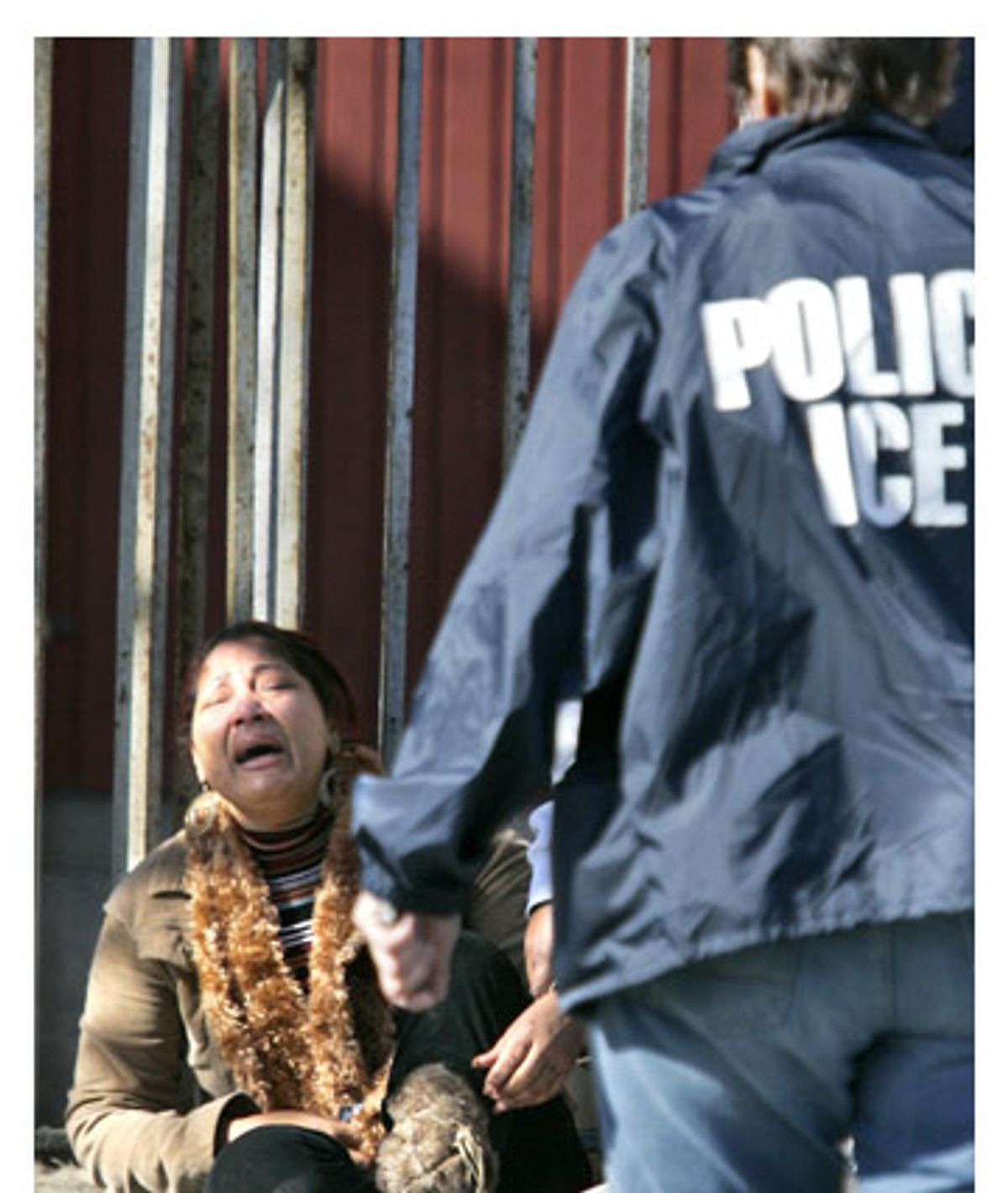
On the morning of March 6, 2007, swarms of armed federal agents from Immigration and Customs Enforcement, or ICE, gathered in the blistering cold outside the Michael Bianco Inc. leather goods factory in New Bedford, Mass. At about 8 a.m., as a helicopter circled overhead and police kept watch in Coast Guard boats in the nearby harbor, the agents rushed the building military-style, blocked the exits, and ordered the employees to turn off their sewing machines, where most were busy stitching backpacks and vests for the U.S. military. By evening, 361 workers -- mostly from Guatemala and El Salvador -- had been taken into custody after they were unable to prove they had legal status to work in the United States The factory owner and three managers were also arrested and charged in connection with hiring illegal aliens.
Over the last several months, as immigration reform has been debated on Capitol Hill, massive arrest and deportation operations like this have become a key component in the enforcement of existing laws. In the first five months of 2007, 3,226 undocumented workers were arrested on the job, compared with just 485 in all of 2002. Recent raids have included an operation that netted 62 sanitation workers at an Illinois pork plant, 21 employees of a Mexican restaurant chain in Arkansas, and 31 workers at a Dallas factory that repairs Fossil watches.
Government officials says that these operations are designed to pursue employers who knowingly hire undocumented workers, and to "reverse the tolerance of illegal employment and illegal immigration to the United States." But a growing number of critics on both sides of the immigration issue argue otherwise. They view the raids -- which have proven especially costly in terms of taxpayer dollars and human suffering -- as a political maneuver designed primarily to make the administration appear tough on enforcement, in hopes of mollifying Republicans opposed to Bush's recent immigration reform plan.
The bipartisan legislation favored by Bush, which eventually collapsed in the Senate in late June, included a path to citizenship for the estimated 12 million illegal immigrants currently residing in the United States. This idea of granting what critics came to refer to as "amnesty" was opposed by many Republicans and was sharply, and unrelentingly, attacked by right-wing talk show radio hosts, who viewed it as a means of rewarding scofflaws. So many people opposed to the idea of amnesty sent e-mails to their representatives in Washington that the Senate's server was twice shut down, and the phone system was flooded beyond capacity. Capturing the grass-roots GOP concern, Sen. Tom Coburn, R-Okla., declared, "Rewarding illegal immigrants with amnesty without taking adequate steps to secure our borders is the wrong way to address this problem." It now appears doubtful that any comprehensive reform measure will be attempted prior to the 2008 elections.
It light of these sentiments, some critics argue, workplace raids became a convenient (and headline-capturing) means of appeasing critics within the Republican Party. "President Bush was at odds with his own people and had to appear as if he was doing something," says Joe Garcia, director of the Hispanic Strategy Center of the New Democratic Network. But, he points out, it's unrealistic to believe that such raids could ever begin to make a dent in fixing the problem. "What are they going to do? Bust into every workplace and eventually arrest 12 million people? [These raids] were, and are, pure and simple grandstanding and prove nothing except that this administration is a master of propaganda."
"A lot of people on our side are saying the same thing," says Roy Beck, director of NumbersUSA, an "immigrant reduction" organization opposed to granting citizenship to illegal immigrants, which processed more than 2 million faxes to Congress in opposition to the Senate bill. "We believe these very public and dramatic raids were designed to create a situation where we'd come to believe President Bush will carry out enforcement, so that we would support his amnesty plan. It obviously didn't work."
But whatever the political motivation behind the raids, few can deny that they are coming at a great cost to immigrant communities, in more ways than one. Rarely has an operation been conducted without serious problems and mistakes, due primarily to clumsy coordination among government agencies that some find reminiscent of the handling of Hurricane Katrina, with similar repercussions on the communities affected. The New Bedford raid -- where the federal government was storming the factory with one hand while writing checks to it with the other -- is a prime example. Although the raid captured headlines across the country, the administration has come under fire not only because of the way it handled the workers' detention but also because least two federal agencies had opportunities to deal with the problem of undocumented workers at Michael Bianco Inc. years earlier, and in a far less extreme manner.
MBI was founded in 1985 by Francesco Insolia. Located in a nondescript four-story building along the water in this old whaling town, the factory manufactured leather goods for brand names like Timberland and Coach. But beginning in 2002, the Social Security Administration began to notice a problem. That year, the agency sent a letter to MBI alerting it that nearly 25 percent of the payroll records they filed included Social Security numbers that were fraudulent or invalid -- they belonged to people who were dead, for example, or to those who were too young to be employed. Similar letters were sent each consecutive year and by 2006, more than half of all the MBI Social Security numbers were found to be problematic. The only time the company responded was in 2005, when it resubmitted 326 records. Of those, 142 were still found to be fake or fraudulent.
Not only did the Social Security Administration not share the information with other federal agencies, due to privacy laws, but no enforcement measures were taken either. Nor did the information stop the Department of Defense from awarding the company tens of millions of dollars in lucrative government contracts. Beginning in 2002 -- about the time the SSA sent the first letter -- MBI was contracted to manufacture body armor and tactical gear for the U.S. military, totaling, through 2006, more than $92 million. To fill the contracts, the company's workforce grew to six times what was in 2001: from 85 people to more than 500 in 2007. To train and hire additional employees, the company owner won approval for $111,150 in state grants.
What's more, to manage quality control of the DoD contracts, a Pentagon official visited the factory as often as four times a week and even had an office on-site. "We'd see him all the time," said Juan Tum, a Guatemalan who, along with his wife and brother, was arrested and detained during the raid. "He'd come and tell us we shouldn't complain about the work because it was better than being in Iraq." Pentagon representatives were a regular presence in the factory during a long period when the majority of workers were illegal and the factory itself was like a sweatshop. After the raid, ICE officials described the "severe workplace conditions" at MBI and the "mistreatment" of workers: from being fined for spending more than two minutes in the restrooms, which were found to be unsanitary, to talking while working.
The Defense Department and the Social Security Administration also failed to notice that the owners of MBI had created a phantom company called Front Line Defense, which they used to avoid paying their employees -- many of whom, like Tum and his wife, worked 78 hours a week -- overtime wages. Workers would receive one check from Front Line and one from MBI, meaning they technically never worked overtime for either firm.
ICE, a branch of the Department of Homeland Security, finally became aware of the problem in May 2006, when an MBI employee turned informant and placed a call to the agency. Four months later, an undercover ICE agent was hired to work at the factory. When she told the owner and several managers that she was from Mexico and didn't have legal working papers, she was directed to a local record store, where she purchased fake documents for $120. Still, in August 2006, one month after the official ICE investigation began, the Army awarded MBI another contract, this time for a whopping $138 million.
Given the opportunities to deal with the problem earlier, the costs to conduct this raid seem unnecessary and exorbitant to some. "It doesn't matter where you stand on the issue of immigration," says Ali Noorani, whose agency, the Massachusetts Immigrant and Refugee Advocacy Coalition, was involved in efforts to assist people detained at MBI. "Everyone should be concerned with the amount of tax dollars being spent conducting these raids."
Nobody at ICE would disclose the costs required to fund any of their workplace raids, but the New Bedford raid was typical. Approximately 600 agents took part in the operation, which was 11 months in the planning, and after the arrests, the detained workers were bused nearly 100 miles away to Fort Devens, Mass., a military base where ICE set up a short-term detention facility. Over the next few days, more than half of the detainees were flown via government aircraft to one of two detention centers in Texas, where removal proceedings began. When it was determined that 33 detainees were sole or primary caregivers to children, they were then flown back to Massachusetts, all at the government's expense. "In exchange for this, U.S. taxpayers were given the peace of mind that about 300 tailors are behind bars and may be forced out of the country," says Noorani. In fact, to date, just 42 people detained in New Bedford have been deported.
And despite the significant resources committed to these efforts, people question whether ICE is capable of handling mass arrests and deportations in a safe and humanitarian manner. Tum and others interviewed by Salon describe the scene at MBI that day as one of horror and confusion. "When the agents entered, people started screaming, and I thought there was a fire," he said recently. "The secretary announced over the P.A. system that nobody was to move ... but I saw people running toward the back exit, and it was like a stampede. Some fell and people got hurt." Those unable to prove legal status were shackled and kept inside the factory for nine hours, during which time they were given no food and, because the factory was considered a crime scene, no way to contact their family.
Amid the commotion, some of the workers were unable -- or perhaps unwilling -- to let ICE agents know that they had children at home, and local activists and attorneys report that nearly 100 children were left stranded with baby sitters or in schools and daycare centers after one or both of their parents were detained. Community groups and relatives scrambled to locate children, and a local church put out a call for donations of diapers and food. That evening, a breast-feeding infant whose mother had been detained ended up in the E.R. with pneumonia and possible dehydration.
Harry Spence, the commissioner of the Massachusetts Department of Social Services at the time, testified at a state hearing that those problems could have been avoided if federal authorities had better coordinated the raid with state officials. His agency did not learn about the location of the raid until the morning it occurred, and state child welfare workers were initially denied immediate access to Fort Devens. When they were allowed into the military facility the following evening with a list of people they had identified as having childcare issues, they discovered that more than half of the detainees had already been flown to Texas. "Children were placed in significant jeopardy as a result of the decision not to allow us access," Spence testified. "All we were asking was that the law be enforced in a way that ensured the safety of the children."
The workers and their attorneys say that in Texas many people were denied due process -- to which even illegal immigrants have the right under the U.S. Constitution. Lawyers who flew to Texas to interview detainees found that 54 people who had signed a waiver saying they would not appeal their deportation did not understand what they had signed. Some believed it was a request to speak to an attorney. One man who had won an order from a federal court temporarily blocking his deportation was deported anyway. An ICE official later said it was a case of mistaken identify.
Afterwards, Massachusetts Gov. Deval Patrick described the situation in New Bedford as a "humanitarian crisis" and U.S. Sen. Ted Kennedy compared the devastation to the aftermath of Hurricane Katrina.
"I believe that [ICE] conducts these raids in a way that people are purposefully unable to exercise their rights," says Laura Rotolo, an attorney with the ACLU of Massachusetts who interviewed some detainees at Fort Devens. "They transfer people across the country before they can speak to anybody, and then when they are given a bond hearing in Texas, asking to be released before trial, they must prove they are not a flight risk and that they have ties to the community. Of course they have no ties to the community in Texas."
DHS officials, however, argue that the criticism of the raid is unwarranted and emphasize that 36 people were released from the factory, and 24 from Fort Devens, after agents determined them to have credible family issues. "I strongly reject the argument that we did not make extraordinary efforts on the humanitarian side," says ICE spokesman Marc Raimondi, who declined to provide other ICE officials for interviews. "We take great care in conducting enforcement operations with dignity and respect for those detained." The only way any child would have been left without reasonable adult supervision, he says, while refuting claims that any instances of that occurred in New Bedford, was if a detainee had lied to agents during questioning and denied having children at home.
He also says that his agency worked closely with the Department of Social Services and other state officials prior to the raid, and accuses the DSS of engaging in revisionist history. Plus, he adds, ICE is not concerned about the costs of such raids, though he would not disclose them. "This is about stopping employers from helping to break the laws and holding accountable those that do."
But the owner, Francesco Insolia, never spent a night in jail, and the factory was back in operation the following day. In the weeks that followed, more than 200 workers remained in detention, yet Insolia returned to work and was granted permission to travel to Puerto Rico and Panama. Insolia, who did not return calls from Salon, faces $45,000 in fines for workplace safety violations and a federal charge of conspiring to hire illegal aliens, but he continues to draw profits from his military contracts.
While some elements of Bush's immigration reform plan will come before Congress as individual bills or amendments to other measures, the consensus in Washington is that Congress will probably not consider anything as comprehensive prior to the 2008 election. A question on some people's minds, therefore, is whether the raids will persist. "It'll be interesting to see what happens," says Roy Beck of NumbersUSA. "If the president decides to give up on his efforts to pass amnesty, will the raids continue?"
According to immigration officials, the answer is yes. In 2005, President Bush signed a bill doubling the resources for such measures, and the 2007 fiscal year budget includes funding for more than 20,000 additional prison beds to hold undocumented workers awaiting deportation. "We're going to continue to be tough," says Raimondi. "Worksite enforcement measures are here to stay."
Kennedy, a key proponent of Bush's immigration reform plan, points to the increased number of raids as another example of why Congress needs to continue to rethink our nation's policy. "The raids in New Bedford and elsewhere are merely a stopgap solution that unfairly penalizes vulnerable workers in an already flawed system," Kennedy said in a statement. "There are 12 million undocumented immigrants in the United States. Arresting 300 of them may generate some headlines for DHS, but such raids do not begin to solve the immigration issue."
For people like Juan Tum, the recent collapse of the immigration reform bill was a crushing, and highly personal, defeat. He and 145 others detained at MBI have been released on bail, awaiting their immigration court dates as 137 others -- including Tum's wife -- remain in federal detention centers. But the possibility they will avoid deportation is increasingly dim.
"The thing that everyone is waiting for is immigration reform," Tum says. "We came here to escape poverty, to allow our children to study and become educated ... We are not hiding. We are not trying to not pay our taxes. We are willing to do whatever it takes to comply with the law if we are given the opportunity to do that."
Shares