Obesity

Why I pick lettuce for the Black Panthers

I worry that Alice Waters' crusade for local, seasonal food isn't reaching the people who really need it.

  • more
    • All Share Services

Why I pick lettuce for the Black Panthers

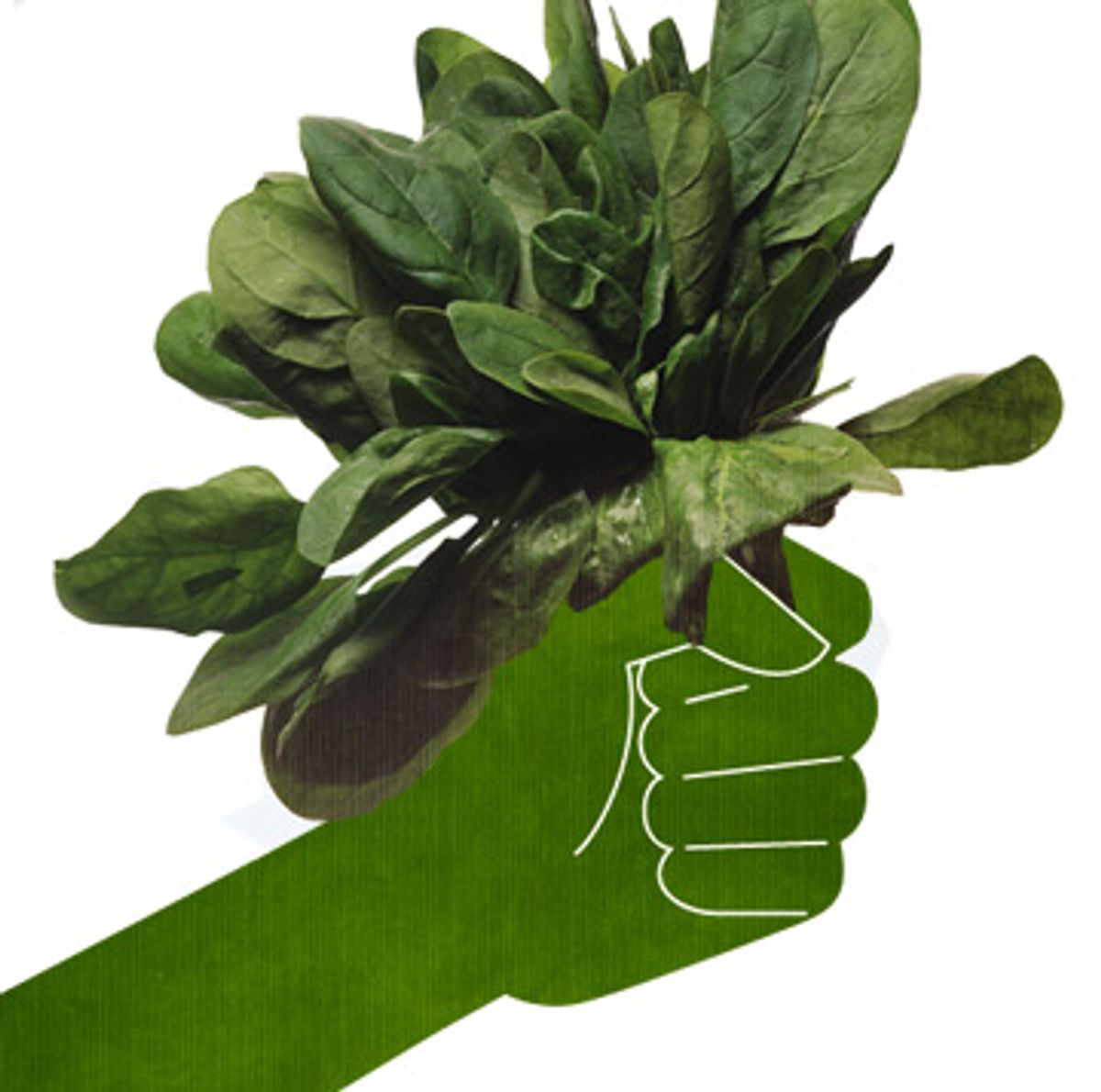
Thursday’s my harvest day for the Black Panthers. I begin in West Oakland, Calif., at an urban garden run by the not-for-profit City Slicker Farms. The beds are chock-full of roaming squash plants, beets and collard greens. I’m here for the lettuce. I might choose the red frilly Outredgeous, or the chartreuse black-seeded Simpson, or the Bronze Arrow; whichever looks the largest and healthiest, I pick five heads. Then I bike back to my own backyard plot 20 blocks away, in a run-down area of Oakland called Ghost Town, where I pick basil, marjoram, mint, wild arugula and edible flowers (nasturtiums and borage) to add to the mix.

I want the Panthers to enjoy a gourmet salad, you see.

In the Bay Area, home of Alice Waters, the high priestess of seasonal food, and slow food’s ground zero, boutique grocery stores evangelize about eating fresh and local. Browse around one of these sedate shops and you’ll find local hand-molded goat cheeses, fresh bundles of escarole and rustic bottles of cold-pressed olive oil from Napa Valley. All organic, all regional and all expensive.

“For any salad greens, you’re looking for the ones that have just been picked,” Waters is quoted as saying in a new biography by Thomas McNamee. “Ones that have an aliveness about them. Ones that don’t have any little discolored ends. I don’t mind the ones that have a little dirt on them because they just came out of the field.”

I think about Waters’ words while I triple-wash my lettuce and herbs, then pack them into plastic bags. She’s right that when you eat a salad fresh from the garden, it tastes vital and truly nourishing. But the kids in my neighborhood eat Cup-a-Soup for breakfast and Cheetos for lunch. Eldridge Cleaver once said, “Black children who go to school hungry each morning have been organized into their poverty.” The chances of my neighbors encountering a salad that has “an aliveness” to it are slim.


When most people think of the Panthers, they think of black men wearing leather jackets and carrying guns, or the famous photo of founder Huey Newton sitting in a wicker throne with a spear in one hand, a shotgun in the other. What have been forgotten are the free medical clinics, the bus service for visiting prisons, the breakfast programs for kids and the thousands of bags of food handed out to needy folks. David Hilliard‘s photographic history of the party, “The Legacy of the Panthers,” quotes a Black Panther newspaper: “It is a beautiful sight to see our children eat in the mornings after remembering the times when our stomachs were not full, and even the teachers in the schools say that there is a great improvement in the academic skills of the children that do get the breakfast.” In the 1970s, a school run by the Panthers called the Oakland Community Learning Center served breakfast, lunch and dinner to all of its students.

I first met the Panthers six months ago on the UC-Berkeley campus, where I attended graduate school. A young guy with cornrows yelled from his booth, “Support the Panther Party!” My mom was active in the civil rights movement, so I went over to have a look. “So I can help?” I cautiously asked the other man at the booth, Melvin Johnson — all the while remembering a scene from the Malcolm X movie where a blond lady’s help is rejected.

“Yes, we aren’t segregationist anymore,” Johnson answered, handing me a copy of the Black Panther Party “Ten-Point Program.”

“Well, I don’t have time or money, but how about vegetables?” I asked.

“Sure,” he answered.

I wrote down my name and number and in a few days Johnson called me back. Turns out Melvin Johnson is a very tenacious fellow. A writer friend of mine said he gave Melvin his number in order to volunteer, and every week for a year, Melvin called. I was glad I hadn’t made my offer of vegetables without having something to back it up.

Willow Rosenthal, the founder of City Slicker Farms, and a dear friend, grows tons of vegetables (literally) on her urban farms. With her organization’s help, once a week I can deliver enough salad for the entire Panther literacy program. When I first told her about the project, she admitted that the Panthers were one of her great inspirations. “Hell,” she said, “we’ll plant a Li’l Bobby Hutton memorial plot of lettuce!”

Before noon on delivery day, as I whiz up Martin Luther King Way on my ten-speed, a bag of salad greens gently rocks on the handlebars. I spot Johnny, the watermelon man, tending to his produce stand. A bit farther on, a man sleeps in an overturned refrigerator box, arms flung out like a baby. Invariably there’s another man or woman with a shopping cart filled with recyclables headed to the transfer station down the street. On a few stretches of MLK, lumbering Magnolia grandifloras grow overhead, their leathery leaves and giant white blossoms so pungent you can smell them even under the stench of Highways 980 and 24.

Acts from people’s lives play out on the streets and sidewalks like Shakespearean drama. Whole families sit near the curb, chairs placed just so, to take in — or be part of — the day’s events. A person on a bike gets to be part of this sidewalk theater. Usually I get a sweet “Hello, good morning”; sometimes I witness a hot dice game, whose rules, once explained to me but never practiced, I’ve now forgotten. The previous night, I listened to a woman demanding money from the father of her son. While she ranted (from the seat of a Hummer) his friends recorded the performance on their cellphones. “You’re acting like some kinda Michael Jackson,” she growled, and the Hummer screeched away. The man and his friends cried out at this dis, slapped street signs and groaned.

After 30 flat blocks, the landscape changes. I’m in Berkeley. There’s a Nuclear-Free Zone sign and then the gleaming giant words “THERE” and “HERE” — a piece of public sculpture that has always rubbed me the wrong way. “There is no there there,” Gertrude Stein famously said of Oakland, her hometown. Seventy years later, does Berkeley, land of Priuses and million-dollar bungalows, really have to remind us?

At Alcatraz, I turn east for half a block, and I’ve arrived. A gold embossed sign above the door reads: “The Commemorator.” A quarterly published by the Commemoration Committee for the Black Panther Party, the newspaper has a circulation of 10,000 and specializes in stories for the black community. It was started in 1990, a year after founding Panther Huey Newton was shot in Oakland in August 1989. The remaining members of the party feared the positive legacy of the Panthers would be lost.

I ring the bell and Johnson lets me in. He’s tall and handsome, but seems bogged down by his formidable tasks, which include coordinating his all-volunteer organization, managing the office and, when I saw him last, holding a picnic for 300. The office smells of sandalwood incense, and on the wall are drawings of Black Panther all-stars. There’s Al “Bunchy” Prentice and Mumia Abu-Jamal and an oil pastel of a Black Panther youth group — all hand-painted directly onto the wall.

Johnson takes me back to the kitchen to do the lettuce handoff. Sometimes I bring shredded beets, which he loves. The lettuce goes into a salad that is served at the youth literacy programs run by the group. These programs, along with the paper, are the last vestige of the Black Panthers’ legacy.

A stocky, muscular man with kind eyes spots me and says, “Hey, is that the salad lady?” He’s the other Melvin. Melvin Dickson was an original Panther, in charge of all things culinary for the Bay Area Panthers from 1972 to 1982. I was curious to hear about the food programs from Dickson, so we sat down for a chat. Before joining the group, he was a cook in the Navy, but he then realized he could help the Panthers more by serving healthy food.

“One thing we imparted was a nutritious diet. That’s why we fed them three meals. And for a while we were not serving red meat — only chicken and fish,” Dickson chuckled. “Tofu. I learned to cook tofu. I cooked with brown rice. It was new and I learned to like it.”

I confess to Dickson that one reason I want to donate the salad is because I see the kids in my neighborhood eating junk food. “Kids are hyper on that junk food,” Dickson said. “You’ve got to challenge them, educate them, get them to try new things.”

To her credit, the Panthers’ neighbor, Alice Waters, has also turned her focus to schoolchildren and food. In 1995 she started the much-lauded Edible Schoolyard Program at the Martin Luther King Middle Jr. Middle School in Berkeley. Children there are encouraged to learn by growing, harvesting and cooking their own food. Folks like Waters and activist chef Ann Cooper are also trying to change the way school kids eat lunch, motivated by the frightening upward trend of juvenile diabetes cases and the possible link to carbohydrate- and fat-packed school lunches. A Paul Cézanne quote on the home page of the Edible Schoolyard Web site declares: “The day is coming when a single carrot, freshly observed, will set off a revolution.”

The Panthers’ Ten-Point Program lists demands regarding employment, an end to police brutality, education and healthcare for “our black and oppressed communities.” The final program point reads: “We want land, bread, housing, education, clothing, justice, peace and people’s community control of modern technology.” It is followed by the first two paragraphs of the Declaration of Independence, the document that embodied the ideas of the American Revolution. It’s more badass than some white lady’s “delicious revolution,” but rooted in the same concept. “We have a saying in the Black Panthers,” says Dickson: “It’s the blacks today, but it’s you tomorrow.”

This is why I bring lettuce to the Panthers every week. I know that one salad on one day isn’t going to save a life or a city. But I worry that Waters’ message about local food isn’t reaching the very people who need it the most, that maybe the person who most needs to try a real salad, picked that morning, isn’t a customer at Chez Panisse or a kid at a Berkeley middle school but a young, poor black kid trying to learn how to read.

Maybe if all of us made a gesture toward sharing the good food of the earth, it would truly start a revolution.

Beating back obesity

America's weight problem is only getting worse. Here's how we can fix it

  • more
    • All Share Services

Beating back obesity

If Benjamin Franklin was writing his famous letter to Jean-Baptiste Leroy today, his famous aphorism might read: “In this world nothing can be said to be certain, except death, taxes and the obesity crisis.” It seems no matter the year or the season, that crisis inexorably continues, with experts now saying 42 percent of Americans will be obese by 2030. And whether you are one of the 42 percent or not, that trend is going to affect you, because it is expected to cost the country roughly half a trillion (yes, trillion) in additional healthcare costs.

And yet, as relentless as the obesity crisis appears to be, its expansion doesn’t have to be a foregone conclusion. That’s because, unlike a naturally occurring epidemic, it’s almost completely human created — a reality that allows for the possibility of a human-directed reversal.

What does such a reversal require in practice? First and foremost, awareness, and thanks to everything from Michelle Obama’s fitness campaign to HBO’s new documentary “The Weight of a Nation,” that prerequisite is finally starting to be met. But then what? As GI Joe said, “knowing is half the battle” — but it’s only half. Once more of us are aware of the emergency at hand, what will be the most reliable way to address the problem?

In an instant gratification culture obsessed with extreme makeovers and get-thin-quick diet schemes, it’s easy to feel confused about a path forward. But a tranche of new science, data and public policy proposals that cut through the fog of misinformation suggests that path is there — if we’re willing to take it. Here are five of the most promising ways forward.

1. Tax Junk Food

Over the last four decades, we went from spending $3 billion a year on fast food to $110 billion a year on fast food. At the same time, there’s been an explosion in the amount of chemically enhanced, calorie-packed processed foods Americans eat at home, at work and in the school cafeteria. Not surprisingly, in predictable cause-and-effect fashion, this has all happened as obesity became a public health epidemic.

The response from some policymakers has been to champion junk-food taxes, initiatives whose supreme press-release-worthiness can make them seem a bit gimmicky, but whose merits are nonetheless rooted in substance. Indeed, a bevy of new studies show that such levies, when structured properly, can disincentivize junk food consumption on a large scale.

In one University of North Carolina study, ABC News reports that “Patients got significantly less of their calories from soda or pizza when there was a 10 percent increase in the price of either.” In another study of college-age adults, “researchers found that the students generally bought fewer lunchtime calories when sugary, high-fat fare came with a tax of 25 percent or more.” In yet another study, this one from the University of Buffalo, it was much the same result: Higher taxes meant more healthy consumer choices.

New York Times food columnist Mark Bittman has noted that while taxes alone won’t solve the obesity crisis, they are an important part of a multifaceted attack on the problem — and they will also raise much-needed public revenues at a time of crushing deficits:

A study by Y. Claire Wang, an assistant professor at Columbia’s Mailman School of Public Health, predicted that a penny tax per ounce on sugar-sweetened beverages in New York State would save $3 billion in health care costs over the course of a decade, prevent something like 37,000 cases of diabetes and bring in $1 billion annually. Another study shows that a two-cent tax per ounce in Illinois would reduce obesity in youth by 18 percent, save nearly $350 million and bring in over $800 million taxes annually. Scaled nationally, as it should be, the projected benefits are even more impressive; one study suggests that a national penny-per-ounce tax on sugar-sweetened beverages would generate at least $13 billion a year in income while cutting consumption by 24 percent…A 20 percent increase in the price of sugary drinks nationally could result in about a 20 percent decrease in consumption, which in the next decade could prevent 1.5 million Americans from becoming obese and 400,000 cases of diabetes, saving about $30 billion.

Put it all together, and junk food taxes should be about as close to a no-brainer as you’ll find in the public policy arena.

2. Stop Subsidizing Junk Food

There’s no scientific reason junk food should cost less than whole grains, fruits and vegetables. After all, the former are the product of a mechanized process relying on an entire industrial system, while the later can be grown directly out of the ground by almost anyone.

Yet, junk food consistently beats natural foods in the price competition. Why? It’s all about the subsidies.

As a the U.S. Public Interest Research Group’s “Apples to Twinkies” report shows, your taxpayer dollars subsidize junk food and artificially deflate the cost of that junk food so that it undersells everything else. “Between 1995 and 2010, $16.9 billion in tax dollars subsidized four common food additives—corn syrup, high fructose corn syrup, corn starch, and soy oils.” At the same time, PIRG points out that “taxpayers spent only $262 million subsidizing apples, which is the only significant federal subsidy of fresh fruits or vegetables.” To put those numbers into real-world terms, “if these agricultural subsidies went directly to consumers to allow them to purchase food, each of America’s 144 million taxpayers would be given $7.36 to spend on junk food and 11 cents with which to buy apples each year — enough to buy 19 Twinkies but less than a quarter of one Red Delicious apple apiece.”

While studies show that changing this subsidy structure would be no cure-all for obesity, there’s no evidence to suggest that keeping it in place does anything but make the obesity crisis worse — and there is evidence that changing the subsidies would make things better. This isn’t surprising; it’s basic economics.

Think about it: If subsidies for commodity crops that create junk food were redirected into subsidies for natural foods, it would radically change the market incentives for healthful eating. Sans the subsidies, industrial food corporations would no longer be able to price processed foods at artificially lower prices than their natural competitors. Instead, healthful foods would have the price advantage — and, quite likely, bigger market share.

3. Ban Junk Food in Schools

The Obama administration has been trying to reduce the amount of obesogenic foods in school cafeterias, under the theory that stopping obesity-inducing eating habits at an early age might stop the obesity crisis in its tracks. It’s been an uphill fight. According to the Associated Press in February, “Junk food remains plentiful at the nation’s elementary schools,” with “nearly half of public and private schools surveyed sold sweet or salty snack foods in vending machines or other places.”

Nonetheless, new data proves the administration’s efforts, in conjunction with local school districts, are indeed worthwhile. As the New York Times recently reported:

Five years after California started cracking down on junk food in school cafeterias, a new report shows that high school students there consume fewer calories and less fat and sugar at school than students in other states…The study found that California high school students consumed on average nearly 160 calories fewer per day than students in other states, the equivalent of cutting out a small bag of potato chips. That difference came largely from reduced calorie consumption at school, and there was no evidence that students were compensating for their limited access to junk food at school by eating more at home…

To study the effect of this policy, the researchers examined data from the Centers for Disease Control and Prevention on the eating habits of high school students in California, comparing it with data on students from 14 states that did not have nutrition standards for vending machine snacks and other foods sold outside of school lunches and other meal plans…California students had the lowest daily intake of calories, fat and, especially, added sugars.

In light of this, it’s hard to imagine anyone still defending the American school system’s role as glorified junk food machines.

4. Stop Glorifying Unhealthy Eating Habits

In his endorsement of the campaign to legalize gay marriage, Vice President Joe Biden said that “when things really began to change is when the social culture changes … I think Will & Grace probably did more to educate the American public than almost anybody’s ever done so far.” It was an acknowledgment that televisual images often play as big a role in our society as ironclad policies — and the same truism relates to the obesity crisis.

Today, our political culture regularly equates unhealthy eating habits to Americanness and authenticity. As evidence, recall that the party nomination fights have become a kind of televised eating contest, with candidates trying to one-up their competitors with photo ops stuffing corn dogs and cheesesteaks.

The committee now has a White House petition calling on the president to stop undermining his wife’s crusade against obesity and end such photo ops. It’s the least the administration can do.

5. Start Broadening Our Understanding of Obesity

Conventional wisdom holds that a calorie is a calorie, and that if Americans simply take in fewer calories and use more via exercise, obesity can be stopped. But journalist Gary Taubes reports that science now suggests that this formula may be fundamentally flawed — that obesity is a product of specific kinds of calories from sucrose and fructose:

There is an alternative theory, one that has also been around for decades but that the establishment has largely ignored. This theory implicates specific foods—refined sugars and grains—because of their effect on the hormone insulin, which regulates fat accumulation. If this hormonal-defect hypothesis is true, not all calories are created equal…

Sucrose and high-fructose corn syrup have a unique chemical composition, a near 50-50 combination of two different carbohydrates: glucose and fructose. And while glucose is metabolized by virtually every cell in the body, the fructose is metabolized mostly by liver cells. From there, the chain of metabolic events has been worked out by biochemists over 50 years: some of the fructose is converted into fat, the fat accumulates in the liver cells, which become resistant to the action of insulin, and so more insulin is secreted to compensate. The end results are elevated levels of insulin, which is the hallmark of type 2 diabetes, and the steady accumulation of fat in our fat tissue—a few tens of calories worth per day, leading to pounds per year, and obesity over the course of a few decades.

He goes on to note that “back in the 1980s, the FDA gave sugar a free pass based on the idea that the evidence wasn’t conclusive” — but that now, the evidence can’t be ignored.

This isn’t to say that the theories about sugar are 100 percent correct; it is only to point out that if we are going to reduce our consumption of junk food in order to stop the obesity epidemic, we need a better understanding of exactly what junk food is. That means broadening our understanding of obesity’s roots and rejecting the reductionism that says simply that “a calorie is a calorie.”

Continue Reading Close
David Sirota

David Sirota is a best-selling author of the new book "Back to Our Future: How the 1980s Explain the World We Live In Now." He hosts the morning show on AM760 in Colorado. E-mail him at ds@davidsirota.com, follow him on Twitter @davidsirota or visit his website at www.davidsirota.com.

Our guns and butter economy

America has two favorite new exports: Firearms and obesity

  • more
    • All Share Services

Our guns and butter economy (Credit: ChinellatoPhoto via Shutterstock)

With the economy still struggling and the debates over how to fix the problem more intense than ever, one word still evokes bipartisan consensus: exports. “I want us to sell stuff,” said President Obama, summing up the bipartisan sentiment.

That nebulous word “stuff” is significant. It asks us to see all exports as the same and to refrain from making nuanced value judgments about what exactly we’re shipping overseas. In this coldblooded view, a job-creating export is a job-creating export, and that’s as far as any conversation should go.

At first glance, such reductionism seems logical, rational, even boringly uncontroversial. But two recent news items highlight how in a globalized economy, there are troubling consequences that come from the particular kind of export economy we’re building.

The first bit of news came from the Washington Post, which this week reported that “the Obama administration is crafting a proposal that could make it easier to export firearms and other weapons.” Though the Homeland Security and Justice Departments say the new rules could make it easier for terrorist and drug cartels to further arm themselves, the White House is nonetheless citing the “stuff” theory of exports to ignore the objections.

This is part of a larger pattern since President Obama took office. During Obama’s first year in the White House, he began to gut the Pentagon’s approval process for arms exports, weakening controls on what could and could not be sold. Later, diplomatic cables uncovered by WikiLeaks showed, as Fortune magazine put it, “American officials act(ing) as de facto pitchmen for U.S.-made weapons.”

The result is that America has become the true “Lord of War,” as the arms dealer motto goes. We are the leading arms supplier to the developing world and we are responsible for the majority of all weapons sales across the globe. Yes, we are so committed to selling instruments of death to the rest of the planet that military industries have almost tripled their share of the U.S. economy in just a decade.

The second bit of news came from the Institute for Agriculture and Trade Policy, whose new study shows that America is exporting our obesity crisis to Mexico. Coupling health statistics with U.S. export data since the North American Free Trade Agreement tore down Mexico’s agriculture trade barriers, researchers found that the Mexican market was flooded by American agribusinesses’ taxpayer subsidized commodities (corn, soybeans) and their processed derivatives. According to the report, that quickly wiped out Mexico’s local food economy, leaving its food system exactly “like the industrialized food system of the United States — characterized by the overabundance of obesogenic foods.” Not surprisingly, Mexican obesity rates have consequently skyrocketed.

Taken together, these export booms represent what could be called America’s new Guns and Butter economy. We are so desperate to export any “stuff” we can, we are now fattening up the world and arming it for permanent bloodshed.

Seeking to short-circuit any objections to this trend, President Obama has said simply that “we’re at a moment where necessity has tempered the old debates” over exports and economic policy. In terms of history, he’s not wrong — during the previous century, America witnessed fevered fights over what constitutes a moral farm policy, and in the 1930s the U.S. Senate’s Nye Committee held almost 100 hearings into “greedy munitions interests” that were unduly influencing public policy. Sadly, Obama is correct – those debates have been silenced.

But should they be? Should we simply say that any exports — no matter their moral, ethical, environmental or health implications — are inherently good? Does “necessity” really mean that “stuff” for stuff’s sake must be the basis of our export economy?

Washington and profit-at-all-cost industries certainly say yes — but that doesn’t mean it’s the right answer.

Continue Reading Close
David Sirota

David Sirota is a best-selling author of the new book "Back to Our Future: How the 1980s Explain the World We Live In Now." He hosts the morning show on AM760 in Colorado. E-mail him at ds@davidsirota.com, follow him on Twitter @davidsirota or visit his website at www.davidsirota.com.

The real key to good health

Don't fear resolutions or dread the January fitness crunch. Just make yourself one simple promise in 2012

  • more
    • All Share Services

The real key to good health (Credit: Shannon Stapleton / Reuters)

January sucks. Every magazine cover is festooned with the image of a celebrity in a bikini, promising you the secrets of a BETTER BODY for the new year. Your friends are all going on juice fasts. And the answer to “Feel like going for a bike ride today?” is “Maybe sometime when it’s not 11 degrees out.”

So here’s a crazy idea. This time, let’s not use the beginning of the year as an excuse to hate on our bodies. Let’s not swear to get a tinier butt by Memorial Day, or even Labor Day. No 21-day “action plans.” No master cleanse. Nothing, in fact, that sounds like an enema from a dominatrix. Instead, let’s do something radical. Let’s do something small.

In just the time it takes to realize that “Work It” is the worst thing that ever happened to television, you could change your life. Thirty minutes a day. That’s the minimum amount of physical activity the CDC recommends to stay fit. Yet approximately 30 percent of Americans get no weekly activity at all. Zero. Not even candy-ass pastimes like gardening. And many more of us aren’t exactly wearing out the gym membership cards. Right now, the only thing moving at a fast pace in our country is the obesity rate – 30 percent and climbing.

In an already over-saturated life full of work and family and errands and commuting, it’s often grueling to find 30 minutes to do anything at all. There are days when carving out a window of opportunity to grab a shower feels like a big deal. But I promise, a half-hour is not a lot of time. Treated seriously and honored consistently, it’ll do a lot more for your health and well-being than that spinning class across town you go to once a month. And don’t you deserve as much loving attention as you’d give your car or your iPad?

Here’s what you need. Sneakers. A mix of cardio and strength training. An understanding that you can’t fool your body by not making an effort. A casual saunter on the treadmill while tweeting isn’t going to do jack. You know that lady in the Apple Siri ad, the one who wants to be reminded to call Chris while she’s going for a run? Yeah, don’t be her. No talking on the phone. No checking the weather. And no excuses. Thirty minutes to put in real work, whatever work feels like for your fitness level. (Here’s the inevitable reminder that this isn’t medical advice, and you should talk to your doctor about a plan that’s realistic for you.) Here’s the payoff. Research says that you can build bone density and ease the symptoms of arthritis, high blood pressure and even depression. If this stuff came in a pill, it’d be hotter than Viagra and Effexor put together.

Like a lot of people, I spend most of my days on my butt. Yet I have a beautiful heartbeat. When I see my doctor for my weekly health monitoring, he smiles appreciatively as he presses the stethoscope to my sternum, praising my “slow, steady, runner’s rate.” And last summer, shortly before my lung surgery, the respiratory technician was similarly complimentary. “Look at that pulmonary function,” he said encouragingly as I puffed into a tube. “I can always spot the yoga people.”

Now here’s what you need to know about me. I was always chosen last in gym class. I can’t open a jar of pickles without assistance. I don’t train for marathons. I will never be on the cover of a magazine, Valerie Bertinelli-style, flaunting my abs. I have a body that’s over 40 and has birthed two children, and looks it. And many days, I don’t want to get out of bed. But I put in three and a half hours of exercise a week – mostly running, mixed with the use of a pair of five-pound dumbbells and a yoga app on my phone. I breathe hard. I stretch muscles. I resist gravity. Then I’m back on my butt, possibly holding a beer. That’s it.

Good health should not be reserved for the perky sporty types. Screw the jocks. Almost everybody, of every age and fitness level, can afford a half-hour a day. You can. Why am I telling you this? Because when the surgeon had to cut some cancer out of my lung last August, I was pretty happy I could breathe unassisted afterward. And because I hope that if you’re ever in a similar situation, you are likewise prepared.

This year, it’s not about fitting into those jeans that linger accusatorily in the back of the closet. It’s not about the scale. It’s about getting in touch with what we humans were meant to do – move around. It’s about taking the stairs. It’s about being able to play with your kids. It’s about those sweet, sweet endorphins. And it’s about knowing that though we’re all different, we’re all capable of greater wellness. Is it hard sometimes? Does it get boring at times, day in and day out? Sure. Is it achievable, and is it worth it? Always. But don’t listen to me. Listen to my beautiful heartbeat. Now get out there and thump along. And tell me about your progress — I’ll be right alongside, cheering you on.

Continue Reading Close
Mary Elizabeth Williams

Mary Elizabeth Williams is a staff writer for Salon and the author of "Gimme Shelter: My Three Years Searching for the American Dream." Follow her on Twitter: @embeedub.

Is childhood obesity abusive?

A 200-pound third-grader is removed from home for neglect. Should the government take custody of overweight kids?

  • more
    • All Share Services

Is childhood obesity abusive? (Credit: iStockphoto/tibor5)

Is childhood obesity child abuse? Child services officials in Cleveland seem to think so. They recently removed an 8-year-old boy from his mother and placed him in foster care — because the child tips the scales at over 200 pounds. Department of Children and Family Services spokeswoman Mary Louise Madigan told the Cleveland Plain Dealer that the boy’s condition constituted “a form of medical neglect.”

“This child’s problem was so severe that we had to take custody,” Madigan said, adding that her office had worked with the boy’s mother for over a year before removing him. The boy first caught the attention of child services when his mother brought him to the hospital last year with breathing issues. He was diagnosed with sleep apnea, and now uses a machine to assist his breathing while he sleeps.

Was the boy’s mother, in fact, neglectful? That’s something the state still appears to be determining. The boy’s mother told the Plain Dealer that “They are trying to make it seem like I am unfit, like I don’t love my child. Of course I love him. Of course I want him to lose weight. It’s a lifestyle change, and they are trying to make it seem like I am not embracing that. It is very hard, but I am trying.”

But how do you undo deeply ingrained patterns, combined with a damming family history? Both of the boy’s parents are overweight. (His teenage brother is not.) For her part, the mother says she enrolled the boy in a local Healthy Kids, Healthy Weight program at a local hospital. She got him a bike. She says she tried to talk to him about what foods to eat. And for a while, he lost weight. Then he gained it back — and then the county intervened. He was taken from his school last month, and now his mother sees him once a week for two hours. Reps for the county say he has, in the past few weeks, lost “a few pounds.”

Was his removal an overreaction or a necessary intervention? In a July piece for JAMA, the Journal of the American Medical Association, Lindsey Murtagh of the Harvard School of Public Health and David S. Ludwig of the Children’s Hospital in Boston recommended “State Intervention in Life-Threatening Childhood Obesity.” In the article, they noted, “Improper feeding practices, causing undernourishment and failure to thrive, have long been addressed through the child abuse and neglect framework.” If we consider it a social responsibility to step in when a child is being starved, should the same imperative apply if he’s overfed? Aren’t both forms of malnourishment?

Deprivation, however, has a very different connotation. The notion of being harmed by having too much has generally been too unusual to consider seriously. Now, however, 20 percent of American children between the ages of 6 and 11 are obese — and approximately 2 million of them are extremely obese.

Public defender Sam Amata said Monday the removal of the Cleveland boy would be challenged on the grounds that he was never “in imminent danger.” It should, however, be uncontroversial to say that a 200-pound child – well over triple the average third-grader’s weight — is a child whose health is severely at risk. He needs help, and so does his family. Not diets, not restrictions, but help. Help shopping. Help cooking. Help embracing physical activity.

Yes, parents are responsible for their children. And extreme obesity may be a sign of deeper, more severe issues at home. But it is nonetheless seriously disgusting to see children wrenched from their parents when, at the highest levels, we are represented by a government that has made it abundantly clear it would prefer to pander to the interests of the frozen food industry than reform childhood nutrition. One in which presidential candidates mock children’s health initiatives as “nannying.” Even the authors of that provocative JAMA story recommended governmental “investments in the social infrastructure and policies to improve diet and promote physical activity among children.” It takes a village to raise a child without a body-mass index number in the danger level.

Imagine if you were a little boy, perhaps without the best body image, and you knew that seeing your mom was contingent upon losing weight. Now imagine the over 12 percent of third-graders in Ohio who are severely obese and may now be facing a similar fate. Whatever you think of parental accountability for childhood obesity, ask yourself this: If one child can be removed, what happens to the rest? Who’s going to decide which parents of obese kids are neglectful? And who will take care of their health when neither their government nor their families seem to know how?

Continue Reading Close
Mary Elizabeth Williams

Mary Elizabeth Williams is a staff writer for Salon and the author of "Gimme Shelter: My Three Years Searching for the American Dream." Follow her on Twitter: @embeedub.

Should I blame my parents because I’m fat?

A new study has unleashed more hatred on people like my folks. Were my mom and dad wrong to raise me like they did?

  • more
    • All Share Services

Should I blame my parents because I'm fat?

I was channel surfing mindlessly, avoiding some household chore, when I landed on a cable talk show discussing child abuse. The guests were talking about horrible things: parents who starve children, beat them or sexually abuse them. Parents who let their children get fat. This last one, one woman leveled, was the same as any other form of abuse and deserved the same unequivocal response: Remove the kids from the parents.

I had happened upon yet another media debate in response to the controversial JAMA article that came out a few weeks ago. This study looked at whether intervention was ever warranted when parents allow their children to become dangerously obese. The study itself was balanced in its approach, but the talking-head response was anything but. This particular pundit — shoulder-shrugging with a clear look of disgust on her face — talked about taking fat kids away from their parents as if it were nothing more than trading in a car. I had to turn the TV off, my stomach in knots.

I wondered what this woman would say if she met my own parents. Would she blame them for the way I turned out? For that matter: Should I?

Let me back up a bit. I’m fat and have been since I was a toddler. Not “trapped in my trailer” fat, or “have to use an extra-wide electric wheelchair at the grocery store” fat, but medically, technically, morbidly obese. I confess that whenever I hear that term — morbidly obese — I giggle, because I picture chubby Goths with back nail polish and dog collars. That is not to say I do not take it seriously, because I do. It is the first thing I think about when I wake up in the morning, the last thing on my mind when I go to bed at night. And I will never be a member of the “fat acceptance movement,” because I don’t accept it. I have been fighting my weight for over 35 years.

But I don’t believe I deserve to be hated, and hate is what I feel every single day as a fat woman. I feel it in the stares from strangers’ children, and when someone screams “fat ass” as I walk my dogs. I feel it when I get a flawless performance review, but my boss asks if I have considered weight loss surgery — as if that has something to do with my professional skills. I feel it in the constant stream of media images about what women should look like, in the tired fat jokes from comedians (come on, stop phoning it in — get creative!), and in the constant articles about the doom that is The Obesity Epidemic. Fat people are taxing the healthcare system, they make other people uncomfortable on planes and trains, they use more fossil fuels because it takes more gas to haul their big butts around thus causing global warming, and they suck up the world’s food resources while others starve.

And yet, I understand: These arguments aren’t without merit, and it is after all human nature that some people express their points with meanness and derision. I don’t take it personally.

But even at my most open-minded, I could not bear the debate that erupted in response to the JAMA article (and the derisive online comments). While the study, by Dr. David Ludwig and Lindsey Murtagh, did suggest that obese children — in some extreme circumstances — should be taken away from their parents, coverage of the article focused on the most sensational elements of the argument. It resulted in a cascade of hate on cable news and morning shows that was packaged as concern for children, like that disgusted-looking pundit who made me sick to my stomach.

Did my parents make me fat? Probably. They fed my siblings and me meals of bologna on white bread, hot dogs and potato chips. They let us have four of those Oreo-knock-off cookies-that-don’t-quite-taste-right in a sitting, rather than one or two. They used fast food as a reward and eating in general as a form of entertainment. If I was upset, I might be offered a tasty snack as a pick-me-up. Even if nothing got done all day, not the dishes, not the vacuuming, not mowing the lawn, by god dinner would get done and there wouldn’t be any leftovers to pack up and put away. I suppose to some people it is a portrait of failed parenting.

But my parents are also a success story. They were teen parents. They had me — the eldest — at age 16. It was not a mistake but a planned pregnancy. My mother grew up in a household where she faced daily abuse at the hands of people she trusted. There were challenging finances and in a family with eight children, food could sometimes be scarce. My father grew up in a slightly more stable financial situation, but where violence was the primary outlet for anger, or disappointment, as well as for discipline of children. When these two wounded, but hopeful souls met they made a forever pact in heart-shaped doodles on their class notebooks. They crafted an escape plan: Create their own family where they would make different rules. That is just what they did.

And they did it all on their own. My dad worked two jobs while finishing high school. My mom went back to night school after I was born. Dad worked double night shifts and Mom cut coupons and raised the kids while balancing work at McDonald’s. They never got welfare. They never received food stamps. They modeled hard work and commitment and most of all, love. They are still married — still go out on date nights and still laugh and look longingly in each other’s eyes — almost 40 years later.

Doctors did warn them about the children’s weight, and these problems were not ignored. My mom worried. She ached for me when I came home crying after schoolmates teased me all day long. She was my biggest cheerleader when, in the fifth grade, I became the youngest member of the local Weight Watchers group to reach the 50-pound weight loss mark. She saved money we didn’t have to buy weight-loss shakes and exercise equipment. She went without sleep sewing cute clothes that actually fit well, unlike the pricey crap in the husky department. Dad did his best when he wasn’t working.

But once the fat is on, it is hard to get it off. When you get it off, it comes back with a vengeance. My parents could never quite bridge the gap between what was recommended and what we could afford, between what they went without and what they would never allow us to miss. And who’s to say what part their parenting played in all this, really — which part was simple genetics and which part of was the learned behavior of emotional eating; which part overindulgence and which part the negative side effects of yo-yo dieting; which part was uncooperative children and which part plain lack of knowledge and time. To think of that pundit giving such a disgusted look to my parents, crushes me. They tried so hard. They, in fact, did way more than so many. From troubled beginnings, they created a family where the cycle of violence was broken, where their children had access to more education and opportunity than they had. Did they make mistakes with food? Yes. But there was nobody better to raise my siblings and me than the two people who sacrificed so much to make sure we grew up happier and healthier than they had.

That’s the real point here: We are healthier for their efforts. No matter our size.

Stacey R. Hall lives and works in southwest Ohio, where she regularly walks her dogs, despite the rude yelling, and works with her siblings to educate the next generation on healthy eating, exercise and the importance of family.

Continue Reading Close

Page 1 of 19 in Obesity