Apple
Apple’s fantastic new iMac
Steve Jobs unveils a snazzy new all-in-one computer, plus a redesigned suite of applications.
If you’ve never been to Cupertino, Calif., don’t. A sunny suburban wonderland of wide boulevards and well-groomed, well-heeled folks, the town’s nice enough, if you’re into that sort of thing — but remarkable or memorable it is not, and one strains to imagine anything special coming out of here. This is wrong, of course. Heading south from San Francisco, you pull off Highway 280 onto De Anza Blvd., hang a left on Mariana Ave. and another on Infinite Loop Drive, and you come to Apple Inc.’s HQ. Just inside Building 4 is a space the company calls Town Hall. Chief executive Steve Jobs held a low-key event for the media here this morning; it was the sort of thing that reminds you why Cupertino’s on the map.
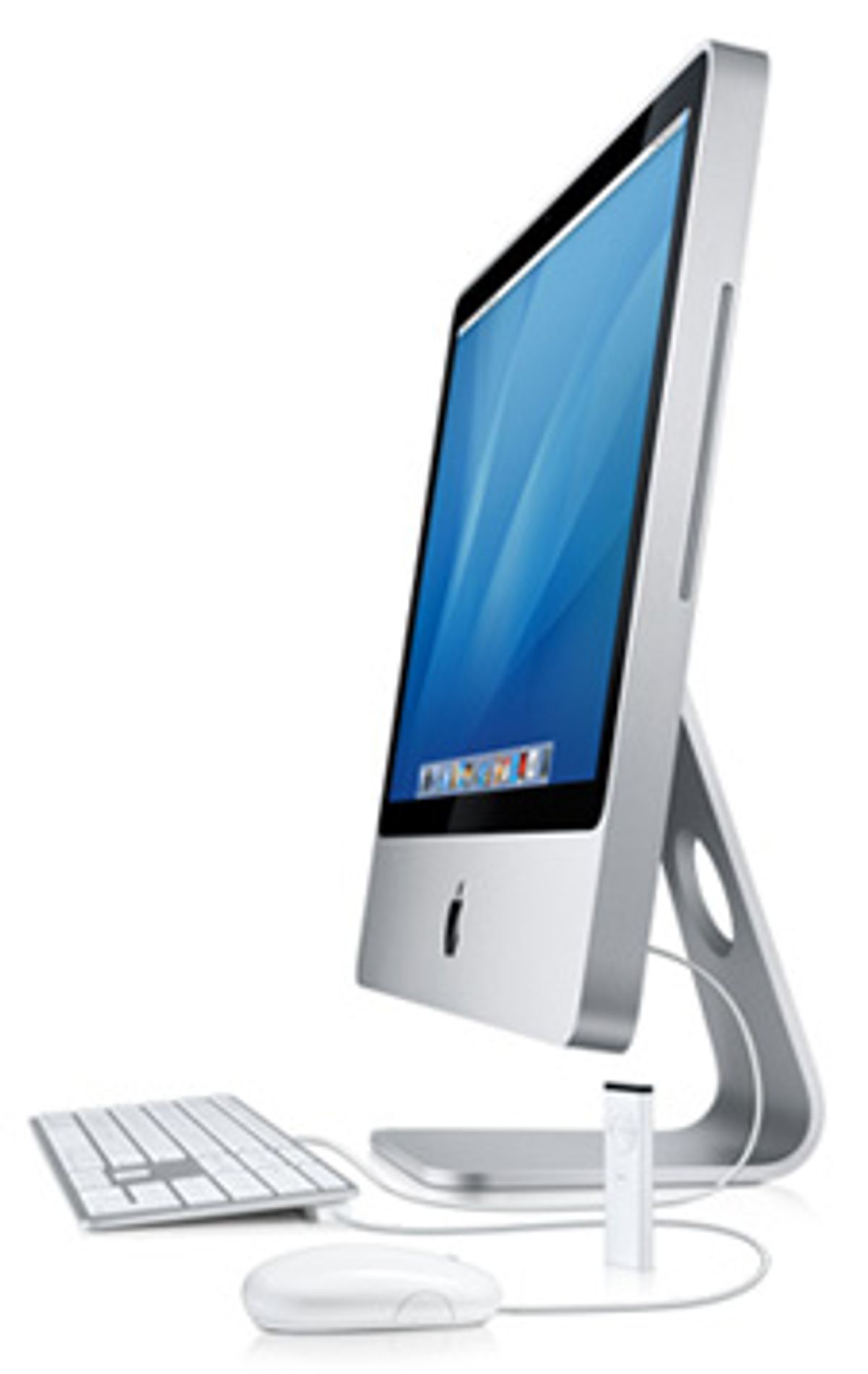
This was a Mac event. Jobs’ biggest news concerned a redesign of the iMac, the company’s all-in-one desktop computer system — now the machine will be clad in aluminum rather than iPod-white plastic. Its screen is also made of scratch-resistant glass that Apple has coated for an extra glossy shine.
The effect is beautiful; when you get up close to it the system looks something like a grown-up iPhone, more sophisticated and elegant than the previous design. Apple set up several hands-on units for us gadget-hungry reporters to play with, and what I liked best was the curvy, compact wireless keyboard that you can buy as an add-on for your iMac. The keyboard, also in brushed-aluminum, and with inset keys like those Apple first put out in its notebooks, is small enough, Jobs pointed out, to bandy it about on your lap or your knees as you stretch back away from your screen.
While sharpening the design, the company has also lowered its iMac prices. Apple’s previous iMac lineup comprised a 17-inch screen version for $1,199, a 20-inch model for $1,499, and a 24-inch system for $1,999. Now Apple will offer only two screen sizes, 20 and 24 inches. Twelve hundred dollars now gets you a 20-inch model rather than the old 17-inch version. There’s another, more powerful 20-inch version for $1499. The old top-of-the-line 24-inch model is now $1,799, $200 cheaper than yesterday’s 24-inch. And Apple now has one more iMac flavor — a 2.8 GHz high-performance 24-inch system for $2,299. (That wireless keyboard, by the way, is $79.) All this stuff goes on sale online and in Apple Stores today.
The brushed-metal iMacs, nice as they look, didn’t surprise anyone, mind you. Rumors of a coming iMac redesign had in recent months attained the status of truth; we knew that new models would come, we just didn’t know when. (Snapshots of the keyboard had even leaked online.)
What was a surprise was the thorough changes the company has made to one of the iMac’s signature software applications, the iLife suite of digital media programs. Jobs was especially excited about iMovie, which has been remade from the ground up.
An Apple employee whom Jobs identified as “one of our most brilliant video engineers” took a vacation recently to the Caribbean and, when he came back, tried to make a movie of his trip in a half-hour. “He couldn’t do it,” Jobs said. The old iMovie — not to mention Final Cut Pro, the company’s professional video-editing program — just didn’t have the tools to do a good movie so fast. So the fellow created his own program. “We were so blown away that we decided to use it,” Jobs said.
The new iMovie has a fresher interface and a few smart tools to more quickly pick through digital clips. The program now includes a library that keeps track of all of your Mac’s video clips, in much the same way iTunes houses all your songs and iPhoto keeps your pictures.
Another brilliant feature called “skimming” — “We’ve applied for patents on it,” Jobs said — lets you scan through a video clip much faster than was possible before. Say you’ve got a 10-second clip of a birthday party, but you only want a 2-second section of it for your film. On most movie-editing programs, you’ve got to play the clip (in real time) to find the bit you want. In the new iMovie, the clip is represented by a thumbnail picture of the first bit of it. You can find the section you want in faster than real time just by dragging your mouse horizontally across the thumbnail — as you do so, the picture is updated to match where you are in the clip. Another click selects the section within the thumbnail, which you can then drag into your movie in much the same way you’d move text in a word processor. (See a visual demonstration of this trick here.)
The company has also updated its .Mac Web service to more tightly fit with iLife. For $99 a year, you now get 10 GB of online storage space (rather than 1 GB), and there’s a sharp new Web gallery that syncs with iPhoto and iMovie. iMovie also includes one-button uploading to YouTube.
I understand this column’s a bit gushing; my e-mail pal Jack Shafer, the Slate press critic who’s long lambasted us tech writers for hanging on Apple’s every word, is sure to call me a card-carrying member of the cult after this.
But honestly, the iMac looks, now, like the best home machine you can buy. There’s nothing else so pretty and so functional for the price. I’ll soon have a more thorough review of the system and its apps, but for now, let me leave you with Jobs’ answer to a question from one of the reporters here. Someone asked if Apple wants to merely attract a small group of elite users — or does it intend to take aim at the masses, to crack into the PC’s market share?
Apple’s goal, said Jobs, is to make the best PCs in the world. The company could make cheaper machines that did less and didn’t look as good. “But there is some stuff in our industry that we wouldn’t be proud to ship,” he said. “We can’t ship junk.”
For less money, you could buy junk; but for not very much more, you can, now, buy a stellar machine.
Farhad Manjoo is a Salon staff writer and the author of True Enough: Learning to Live in a Post-Fact Society. More Farhad Manjoo.
America’s great divergence
The new innovation economy is making some cities richer, many cities poorer -- and it's transforming our country
(Credit: karamysh via Shutterstock) Menlo Park is a lively community in the heart of Silicon Valley, just minutes from Stanford University’s manicured campus and many of the Valley’s most dynamic high-tech companies. Surrounded by some of the wealthiest zip codes in California, its streets are lined with an eclectic mix of midcentury ranch houses side by side with newly built mini-mansions and low-rise apartment buildings. In 1969, David Breedlove was a young engineer with a beautiful wife and a house in Menlo Park. They were expecting their first child. Breedlove liked his job and had even turned down an offer from Hewlett-Packard, the iconic high-tech giant in the Valley. Nevertheless, he was considering leaving Menlo Park to move to a medium-sized town called Visalia. About a three-hour drive from Menlo Park, Visalia sits on a flat, dry plain in the heart of the agricultural San Joaquin Valley. Its residential neighborhoods have the typical feel of many Southern California communities, with wide streets lined with one-story houses, lawns with shrubs and palm trees, and the occasional backyard pool. It’s hot in the summer, with a typical maximum temperature in July of ninety-four degrees, and cold in the winter.
Continue Reading CloseEnrico Moretti is a professor of economics at the University of California, Berkeley, whose research has been supported by the National Science Foundation, the National Institutes of Health and has been featured in the New York Times, the Wall Street Journal and Slate, among other publications. More Enrico Moretti.
The Foxconn raise paradox
The Apple manufacturer's decision to increase wages in China isn't necessarily good news for its workers there
In this May 26, 2010 file photo, staff members work on the production line at the Foxconn complex in the southern Chinese city of Shenzhen, southern China (Credit: AP Photo/Kin Cheung) TAIPEI, Taiwan — Guilt-ridden iPad users were ready to rejoice last weekend, after Foxconn announced that it would bump up pay, reduce overtime and improve living conditions and safety protocols for its legions of Chinese workers producing Apple products in the coastal boomtown of Shenzhen.
For years, the Taiwanese electronics giant has been dodging accusations of bad labor practices, charges that have tarnished the reputation of the world’s hottest gadget retailer.
The trial of Mike Daisey
Salon writers debate the backlash around "This American Life's" retraction scandal
Mike Daisey and Ira Glass (Credit: mikedaisey.blogspot.com/AP/Seth Wenig) Laura Miller: The retraction by the radio program “This American Life” of an episode based on Mike Daisey’s stage show, “The Agony and the Ecstasy of Steve Jobs,” raises (once more) the question of how much fiction we’re getting in our nonfiction. “This American Life” found that several incidents and facts in Daisey’s account of his firsthand investigation of working conditions in the Chinese factories where Apple devices are made were fabricated or otherwise inaccurate.
Continue Reading Close
Mary Elizabeth Williams is a staff writer for Salon and the author of "Gimme Shelter: My Three Years Searching for the American Dream." Follow her on Twitter: @embeedub. More Mary Elizabeth Williams.
Laura Miller is a senior writer for Salon. She is the author of "The Magician's Book: A Skeptic's Adventures in Narnia" and has a Web site, magiciansbook.com. More Laura Miller.
Mike Daisey and the inconvenient truth
When storytellers exaggerate facts -- as a "This American Life" episode about Apple did -- the audience loses
In this undated image released by The Public Theater, Mike Daisey is shown in a scene from "The Agony and The Ecstasy of Steve Jobs," in New York. Daisey, whose latest show has been being credited with sparking probes into how Apple's high-tech devices are made, is finding himself under fire for distorting the truth. The public radio show This American Life retracted a story Friday, March 16, 2012, that it broadcast in January about what Daisey said he saw while visiting a factory in China where iPads and iPhones are made. (AP Photo/The Public Theater, Stan Barouh) (Credit: AP) I can’t be the only listener who thought this past weekend’s edition of “This American Life,” the public-radio show, was among the most compelling work Ira Glass and his team of producers had ever done. As I sat in my rental car stuck in Los Angeles gridlock listening to the radio, I felt certain I was part of a community of people across the country listening to the radio thinking Unbelievable.
Episode 460, “Retraction,” was an hour-long correction to Episode 454, “Mr. Daisey and the Apple Factory,” which aired January 6. That episode was a special hour-long condensation of Mike Daisey’s one-man show, “The Agony and the Ecstasy of Steve Jobs.” In that show, which ended Sunday in New York and heads next to Washington, D.C., Daisey recounts his trip to China to interview workers in the Foxconn factory, which makes Apple products. And in fact that episode — in which Daisey describes meeting workers who had to sleep in prison-like barracks; whose hands shook from the neurotoxins in cleaning solutions that Apple forced them to handle; whose arms were mangled from industrial accidents for which they were not compensated — had also been among the most compelling hours of radio I had ever heard. It launched Daisey into a role as a nationally prominent critic of Apple, appearing on MSNBC and elsewhere.
Continue Reading CloseMark Oppenheimer writes the Beliefs column for The New York Times. He can be followed on Twitter @markopp1. His website is www.MarkOppenheimer.com More Mark Oppenheimer.
Scott Turow on why we should fear Amazon
The feds might sue Apple and publishers over pricing. But a top author suggests the e-retailer's playing monopoly
(Credit: AP/Ben Margot) Late last week, the Justice Department warned Apple and five of the nation’s largest publishers that it was planning to sue them for price fixing. At issue is the agency model, a method of wholesaling e-books in which the publisher sets the retail price and the retailer takes a 30 percent cut. Most print and many e-books are sold under the traditional wholesale model, in which publishers sell books at a discounted price, and the retailer can resell them for whatever price it likes.
The unnamed player in this drama is Amazon, which had been selling e-books at a loss until two years ago, when the iPad came along and publishers used the emergence of the new device to pressure the online megaretailer into adopting the agency model, too. If Amazon wanted to sell e-books from the Big Six (as the six largest book publishers are called), it could no longer sell those titles for $9.99.
Continue Reading Close
Laura Miller is a senior writer for Salon. She is the author of "The Magician's Book: A Skeptic's Adventures in Narnia" and has a Web site, magiciansbook.com. More Laura Miller.
Page 1 of 51 in Apple