Republican Party

What’s wrong with Alaska?

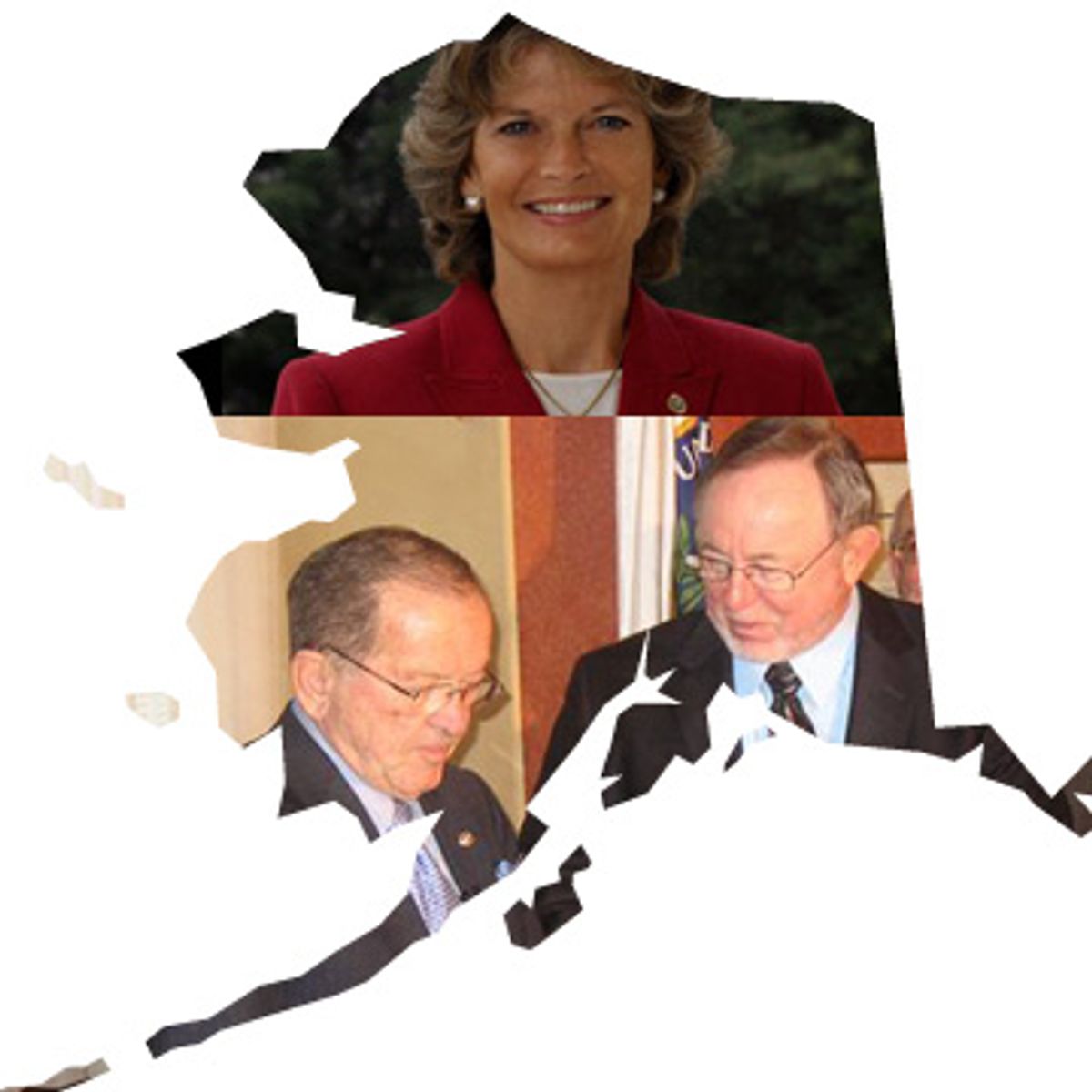
Every member of Alaska's all-GOP congressional delegation is embroiled in scandal.

  • more
    • All Share Services

What's wrong with Alaska?

It is difficult now — it has always been difficult — to visit Alaska and not depart with the feeling that you have witnessed something experimental and anomalous. The state seems less an extension of America proper than a distilled counterfactual, a pioneer’s idea of what the country could have become. There is the magnificent landscape, of course, the rough survivalist feel, the intimacy with the natural world and the disorienting, ever present gender imbalance. Where women outnumber men in the rest of the country, the proportion is reversed in Alaska, the most male of all 50 states. There is the state’s unique transience, too, the notion that with more than 60 percent of Alaska’s population born elsewhere, the state’s very existence depends on hundreds of thousands of decisions to pick up stakes and leave the Lower 48, and on an equal number of individual commitments to live not only differently but apart. And then, perhaps even more vividly, there is the politics.

The political anomalies of the far Northwest are on view right now in a scandal that looks likely to bring down much of the state’s Republican establishment, threatening the careers of oil executives, lobbyists and all three of Alaska’s representatives in Washington. The alleged improprieties are as crass as they get — lobbyists handing out bribes on the floor of the state Legislature, federal money directed by Alaska’s U.S. senators to those companies, and lobbyists who granted politicians personal favors. The taint has spread so far that it has become a crisis not just for those politicians who have been directly implicated, and not just for the Republican Party, but for the state itself. The Associated Press was recently moved to call the few living statesmen who had signed the state’s first constitution, in 1956, and ask them what had become of their creation. ” Greed is rampant,” one of them, Vic Fischer, told the AP. “I’m very disgusted. It’s not a matter of betrayal. It’s more a matter of sadness and concern. But most of all disgust.”

What’s wrong with Alaska? The state’s politics can seem an accident of its own isolation, and dependence. There are few states that seem as ripe for scandal as this one, with its history of single-party rule and an economy, based on the extraction of wealth from public lands. But there may also be another, deeper truth: Alaska’s strange, enticing political culture may equally be a legacy of the state’s senior senator, Republican Ted Stevens.

It is perhaps unsurprising that such a scandal should have erupted in Alaska. The state’s economy, more than any other in the nation, is based on making money from government land — fishing, oil exploration and tourism are among the state’s biggest industries — which means that just about anyone in the state who wants to make a buck needs to get close to legislators, in Juneau and in Washington. The state’s often outsized dependence on the federal government was highlighted in 2005, when its congressional delegation won $223 million to help build a bridge to Gravina Island, Alaska (pop. 50). When other senators tried to cut the appropriation, Stevens threatened to quit, and if the bill did not pass, he said, “they’ll have to take me out of here on a stretcher.”

But the relationship between pork and prosperity in Alaska has been long-lasting. Beginning in 1969, politicians in Juneau and Washington cut a series of deals that leased public lands to oil developers and built a pipeline to speed the product to market. In 1976, voters in Alaska passed a constitutional amendment requiring that a portion of the development revenues be paid into a state-run fund, which in turn cuts each Alaskan a check that has ranged as high as $1,963. By the time Stevens stepped down as chair of the Senate Appropriations Committee in 2005, Alaska was snaring federal pork at a rate 30 times the per capita national average. The New Republic’s Franklin Foer, in a 2002 essay, called Alaska the archetypal conservative welfare state. “Stevens and his fellow Alaskans like to think of themselves as embodying a kind of rugged, frontier libertarianism,” Foer noted. “If only it were all true.”

Stevens, like most of the state’s residents, wasn’t born in Alaska but came when he spotted opportunity. Stevens had been a young, Harvard-trained environmental lawyer in Washington who helped staff the Eisenhower campaign; when a job in the administration didn’t come through, he borrowed $600, piled his wife and belongings into a Buick, and got off the highway in Fairbanks in 1953. Alaska was not yet a state. The conservative establishment in Alaska in those days was tiny, and Stevens quickly became the province’s U.S. attorney and a statehood advocate. By 1970, he’d worked his way up through the state’s Republican establishment and got himself elected U.S. senator. At the time, vast wedges of the state, the Alaska political leader Willie Hensley has said, were still in “the twilight of the Stone Age.”

Stevens’ politics were for the most part those of a doctrinaire conservative, but at key moments they approached something more basic: an old-fashioned, ward-heeler-style grab for public cash and advantage, in which the constituency is served and ideology is irrelevant. In a state where the U.S. government still owned 60 percent of the land, and the population was settled too sparsely to develop viable creative industries, this dependence on federal assistance was of a certain grudging necessity. But under Stevens’ powerful hand the relationship between the state, the Republican Party, and federal cash was formalized and extended. Early in his career, the senator helped push what had been a Democratic stronghold into Republican control. And when he won for Alaskan-native-owned firms a unique legal exception that allowed them to garner millions of dollars in federal contracting during the 1970s, he not only ensured prosperity for villages that still ran mostly on subsistence hunting, but he also moved some of the state’s large native population into the Republican column, cutting into a key Democratic constituency and helping cement Alaska’s status as a one-party state.

By 1997, he’d made himself into the head of the Senate Appropriations Committee, a perch he used to bring home an unprecedented amount of federal spending. “Almost every institution, region and segment of the population in the state has benefited from Stevens’ efforts, from its schools and social programs to its transportation system, its urban areas and the far-flung villages of Alaska’s Native peoples,” the Los Angeles Times concluded in 2003. The most striking thing about Ted Stevens may not be his cartoonish grandeur, that when this 84-year-old pipsqueak swaggers down to the Senate floor for appropriations fights he wears an Incredible Hulk tie. The most striking thing may be that he has earned it.

But Stevens had also made Alaska into his own version of a political machine, one in which taxpayers from the Lower 48 were footing the bill. As his profile increased, so too did public scrutiny. A 2003 investigation by the Los Angeles Times found that Stevens had funneled millions of dollars in single-source contracts to clients of his brother-in-law, the lobbyist William Bittner. In 2006, investigators from the federal government started probing the senator’s relationship with a former aide, Trevor McCabe, who represented companies that had won nearly $700,000 in contracts thanks to a project Stevens had written into legislation. The structure Stevens set up replicated itself in Juneau, Alaska’s capital, where his son, the former state Sen. Ben Stevens, has been fingered as a recipient of political bribes. The Stevens machine in some ways mirrored the one run by Tom DeLay and Jack Abramoff in Washington, where ex-aides to powerful politicians set up shop as lobbyists and directed their clients to send campaign cash to their former bosses in exchange for federal contracts. But in Juneau, with public scrutiny far less intense, things had become far more brazen.

The mess that now threatens Stevens and the rest of the state’s congressional delegation began, as is so often true in Alaska, with oil. On Aug. 30, 2006, teams of investigators from the FBI, IRS and Justice Department, probing allegations of bribes paid by an oil services and engineering company called Veco, raided the offices of six state legislators, shutting the blinds, picking through files with rubber gloves. They uncovered a practice that had never been terribly well hidden: State legislators were allegedly taking bribes from Veco and associated companies in return for sending government contracts their way — for building state prisons, promoting state fish products, and servicing state-run oil fields.

Stevens himself was implicated when it emerged that Veco had helped manage the construction of an extension that doubled the size of his Alaska home; investigators are trying to determine if Stevens paid full value for the construction. The state’s junior senator, Lisa Murkowski (who was appointed by her own father, Frank Murkowski, to replace him when he left the Senate to become governor in 2002), got in trouble for buying a lot of land from a real estate developer friend that a watchdog group charged had been sold to her below market value. She has since sold back the land. Alaska’s lone representative in the U.S. House, Don Young, is in hot water for directing earmarks to two companies that contributed to his campaigns. To date, one state legislator has been convicted of taking bribes, and four lobbyists and executives have been indicted for giving them. Bribes were blatant, and floor votes in Juneau were being directed by lobbyists over the telephone. In the state Senate, lobbyists were caught handing voting instructions across the banister meant to separate legislators from the public.

When the details finally began to emerge this year, the Democrats, a meek and politically sidelined force in Juneau, started issuing a collective cri de coeur, urging the state’s representatives to take back the Capitol from the lobbyists. “This is our floor. Our floor,” the House’s minority leader, Ethan Berkowitz, announced to the chamber last fall. “No telephone call’s supposed to change what we’re doing.” (Some of the implicated Republicans, meanwhile, had hats printed up that read “CBC,” for “Corrupt Bastards Club.”) But reform hasn’t arisen from partisan competition, as it did in Washington. In a neat symbolic fit, the agent responsible for Alaska’s current moment of reform and modernization is a woman, a breed once nearly as rare in far Northwest politics as a Democrat. Sarah Palin, a libertarian and hockey mom from the fast-growing suburbs of Anchorage, began her political career — as an appointed member of the state’s Oil and Gas Commission — by hacking into the computer of another commissioner, Randy Ruedrich, chairman of the Alaska Republican Party. Palin was seeking the evidence that she would eventually use to charge him with an improper relationship with lobbyists. (Ruedrich would later settle state ethics charges against him by paying a $12,000 fine.)

It is difficult not to see Palin’s ascendance not just as a challenge to the state’s establishment but also as presenting a crudely cut choice between the state’s cronyist, resource-economy past and its future. She beat Frank Murkowski, the incumbent, in the GOP primary; voters began to sour on Murkowski as soon as he picked his daughter to replace him in the Senate, and then grew angrier over his grubbing for a private jet and other perceived ethical lapses. He left office the least popular governor in the country. Since her election as governor last November, Palin has made a public point of cutting down on Alaska’s excesses, and challenging the easy habits of its past — getting the state to put Murkowski’s infamous jet up for sale on eBay, canceling pork projects and firing patronage appointees. By early this summer, with the scandals plaguing the rest of the Republican Party, Alaska Democrats had made some headway in the polls. But Palin’s approval ratings are over 90 percent. Whether in the long term Alaska’s economy can modernize and the state can wean itself from government welfare remains to be seen. But as Stevens hits back at the FBI through press releases, the senator’s old legislative aides plead guilty, and his son endures a federal investigation, the moment is beginning to look like a pivotal point in Alaska’s history. Perhaps the rough edges are being ushered out and something more modern and nationally acceptable has begun to move in.

What is happening in Alaska is not simply the collapse of one ancient Republican power and the rise of another, in Palin, that is more fragile and conditional. It is the assertion that for all of the country’s divisions into red and blue, the national culture does exert a crude centrifugal tug, a tendency to iron out protruding regional discrepancies. The plaintive, humbled sounds coming from Alaska right now are those that always emerge when the exception succumbs to the rule.

Benjamin Wallace-Wells writes about national affairs for Rolling Stone.

How to cure the crazy

The return of Donald Trump forces the question: Is there anything the GOP can do to recover from insanity?

  • more
    • All Share Services

How to cure the crazyDonald Trump (Credit: Reuters/David Moir)

One thing when writing about the Republican Party and the crazy – you can always be certain that it’ll generate new examples. So just when the news that a member of the House accused dozens of Democrats in Congress of being Communists seemed to be going stale, along comes Donald Trump – who is scheduled to appear at a fundraiser with Mitt Romney next week – to spout birther nonsense.

For those of us who believe that there’s something seriously wrong with the Republican Party (and see Tom Mann and Norm Ornstein’s new book; see also my argument that the problem is not about how “conservative” they are, but about their radical style), the big question is whether anything can be done about it. American democracy needs two strong, solid political parties, but currently one of the parties is just a mess – incapable of making coherent policy when it’s in office, and dangerously obstructionist when it’s out of office.

So how can a party recover? I think there are three ways, but two are unfortunately quite unlikely, and the third is at best uncertain.

Some talk about the possibility that the electorate will punish Republicans for their radicalism. Unfortunately, I think that’s unlikely. Note that consecutive blowouts in 2006 and 2008 certainly didn’t make things better. Part of the problem here, too, is that elections generally don’t work that way. It’s true that the impression of ideological extremism can be costly, as Barry Goldwater and George McGovern learned the hard way, but we’re talking here about 2 or 3 percentage points in a presidential election. Direct action by the voters just isn’t enough to do it. After all, as voters, they can only choose between the nominees that they’ve been offered, and if anything voters are more partisan than ever; they’re not likely to defect just because a candidate embraces the crazy, even if they don’t like it, because they would still have a strong preference for that candidate otherwise.

A second possibility is that they’ll wind up with a successful president who sets a strong example of sane conservativism and who is strong enough within the party that he or she can push a lot of the crazies to the fringes and beyond. That could work. Presidents have limited influence in general, but one thing that a popular president can do is to define normality for his or her own party. They can reward some and punish — or at least avoid rewarding — others, creating real and meaningful incentives that can be very different from what came before. The obvious analogy is Dwight Eisenhower’s maneuverings against Joe McCarthy. The problem is that for this strategy to work it takes a skilled and popular president who decides to try it, but Republicans might have to wait a long time before they get another Ike.

So the first method probably can’t work, and the second one is unlikely to happen. That leaves one other possibility: that the Republican coalition itself might demand change. Specifically, that Republican-aligned interest groups – perhaps business, national security or others – might become upset enough with the crazy, or worried enough that the crazy will impede their ability to get things done, that they’ll push to end it. After all, part of the problem with the crazy is that it truly is random; you really never know what nonsense Limbaugh or the Breitbart sites are going to be up to next, and there’s every possibility that it could interfere with groups within the party pursuing their interests. Even worse: Politicians who believe they were elected because their most valuable allies convinced the electorate that the president was a radicalized foreigner are going to be responsive to those supporters, and not to organized party groups. Those groups have enough troubles as it is, since in the current free-for-all campaign finance environment they have to compete with random billionaires who might have all sorts of unorthodox policy preferences.

We’ve seen a little bit of this already. During the healthcare debate, many normally Republican-leaning groups chose to work with the Obama administration and cut their best deal, rather than sticking with the rejectionist GOP. Several companies quit the conservative state lobbying organization ALEC when it became controversial by lobbying for ideological and partisan goals. On the national security side, a break has emerged between the Department of Defense and movement conservatives; both conservatives who care about national security and (on some issues) businesses might choose to stick with the Pentagon. And it’s not quite the same thing, but there’s been a small but steady stream of defectors from the movement.

Nevertheless, something like this would likely play out in nomination politics, with party-aligned groups insisting on candidates who are willing to fight for their interests while rejecting the crazy, and there certainly isn’t any sign of that yet. Will it in 2014 and 2016 if Romney falls short this fall and the crazy gets even worse? I have no idea – but that’s the only path out of this that I can imagine.

Continue Reading Close

Jonathan Bernstein writes at a Plain Blog About Politics. Follow him at @jbplainblog

GOP to modernity: Stop

For House Republicans, the less we know about our country and our planet, the better

  • more
    • All Share Services

GOP to modernity: Stop House of Representatives Republican leadership (Credit: AP)

Watching the antics of the House GOP, you get the very strong sense that if the class of Republicans elected in 2010 were offered a chance to repeal the Enlightenment, they would leap at the opportunity. The great flowering of science and philosophy that reached critical mass in the 17th century employed human reason to batter away at the dogmas of blind faith. But as far as the Tea Party seems to be concerned, that was just one big wrong turn.

The most recent evidence that the current incarnation of the Republican Party just can’t handle the truth arrived this month when House Republicans voted to get rid of the American Community Survey. The ACS is an annual information-gathering effort that’s part of the U.S. Census. Every year, a randomized sample of 3 million Americans is surveyed for data on “demographic, housing, social and economic characteristics.” In one form or another, the U.S. government has been carrying out similar surveys since 1850 — the current version is the fourth major iteration.

Most sensible people consider the ACS to be extremely useful, the kind of thing that government is really well equipped to carry out. That is not, or at least did not used to be, a partisan statement. Both private and public sector policymakers use ACS data to make important decisions. The federal government allocates $450 billion annually according, in part, to information derived from the ACS. Businesses also consider the ACS vital, which explains why the U.S. Chamber of Commerce, rarely a fan of government spending, is opposed to the House action.

Even conservative economists are leery: The clearest evidence that the House GOP has gone completely beyond the pale can be seen in a Businessweek article reporting that representatives of the American Enterprise Institute, Heritage Foundation and Cato Institute all declared their support for government data gathering. If you don’t understand what’s going on in the U.S. economy on a granular level, you’re flying blind. This should not be a controversial statement.

Even the Wall Street Journal is appalled — although the lead sentence of its editorial criticizing the funding cuts required some remarkable calisthenics before reaching the point of disapproval.

With the contempt of the Washington establishment raining down on House Republicans for voting on principle, every now and then the GOP does something that feeds the otherwise false narrative of political extremism.

Marvelous! In one sentence, the Journal’s editorial writer manages to deny, not once, but twice, the self-evident fact that the current crop of House Republicans occupies the nethermost regions of right-wing extremism, while at the same time admitting that, yeah, well, in this one case they are indeed bonkers.

There’s been no end of media chatter focusing on the importance of the data gathered by the ACS. We’ve also heard how the Constitution specifically enjoins Congress to gather demographic information “in such a manner as they shall by law direct.” And, in fact, the current form of the ACS follows the mandate set forth by a Republican Congress in 2005.

The sponsor of the House measure, the freshman Florida Republican Daniel Webster, claims that ACS questions are too “intrusive” and “the very picture of what’s wrong in D.C.” He seems to be projecting. The very picture of what’s wrong with D.C. is exquisitely captured by daily demonstration that one of our leading political parties is dedicated to the proposition that the less we know about what is going on in our economy or on our planet, the better. If science tells us that one of the consequences of human activity is an overheated planet, then the answer is to defund climate research. If data gathered by the ACS gives us a better understanding of where poverty may be growing as a result of economic policies put into place over the past few decades, best to just to close our eyes and ignore it.

Which brings us back to the 17th century. It’s no stretch to argue that both representative democracy and the Industrial Revolution flourished in large part through the application of Enlightenment principles. The founders of the United States were very much a product of Enlightenment ideals. Looking for an Enlightenment avatar? Think Ben Franklin. Progress is built on the accumulation of knowledge, and ideological rigidity shouldn’t be able to compete against the truth that derives from a better understanding of our universe. And yet that’s where we are today — watching as one of the two major political parties in our country becomes not just more and more distrustful of science, but also opposed to the very notion of information-gathering — and governs accordingly.

Continue Reading Close
Andrew Leonard

Andrew Leonard is a staff writer at Salon. On Twitter, @koxinga21.

Mitt’s favorite new dodge

Romney and the GOP insist the economy is more important than social issues. Why can't we address both?

  • more
    • All Share Services

Mitt's favorite new dodgeMitt Romney (Credit: AP/Carlos Osorio)

One of the most overused metaphors in a writer’s arsenal is the one about “walking and chewing gum at the same time.” As a hiker and Big League Chew enthusiast, I particularly hate this cliché. Nonetheless, I feel it is fitting right now because it so perfectly summarizes the argument being made by Republicans. They now insist that America cannot simultaneously walk the walk on equal rights and also chew economic gum.

In the last week, Colorado was the testing ground for this talking point. At the presidential level, Republican nominee Mitt Romney criticized a Denver television reporter for daring to ask about his position on, among other issues, same-sex marriage. Before restating his opposition, he scoffed at the question, asking: “Aren’t there issues of significance that you’d like to talk about [like] the economy? The growth of jobs? The need to put people back to work?”

At the same time, Colorado’s Republican House Speaker Frank McNulty twice blocked a vote on a bill to legalize civil unions. His rationale? “We should not be spending time on divisive social issues when unemployment remains far too high and [when] far too many Coloradans remain out of work,” he said. Echoing that sentiment, the shadowy Republican front group Compass Colorado financed an automated telephone call telling thousands of voters that the push for civil unions was unacceptable because it is “promoting [a] divisive social agenda over Colorado job creation.”

Obviously, it’s perplexing to see the Republican Party allege that social issues are insignificant and “divisive.” This is, after all, the party whose most recent presidential nominating contest was dominated by attacks on contraception — the same GOP whose politicians have made an art out of riding a “guns, god and gays”-focused agenda to electoral victory.

But while such naked hypocrisy is enraging, the substance of the Republican rhetoric about gay rights is downright offensive. Essentially, conservatives are asserting that we cannot extend equal rights to all Americans and fix the economy. In the process, they are deliberately insinuating that the twin goals are somehow contradictory.

Well, you might ask, do they have a point? History says no. Our country’s story is the story of multitasking — a tale of extending the franchise to women while passing progressive legislation to deal with crushing economic inequality, a tale of both passing civil rights legislation and creating Medicare.

In light of such achievements, would anyone retroactively argue that America should have opposed the campaign to let women vote because the economy was so bad in the early 20th century? Would anyone insist that lawmakers should have halted civil rights legislation in the 1960s because there was a simultaneous need for a War on Poverty? Probably not, because most of us recognize such arguments for what they are: diversionary non sequiturs whose real goal is to preserve institutional bigotry and prejudice.

That’s the same objective of today’s GOP when it comes to rights for same-sex couples. For proof, just consider the abruptness of the shift: the Republican Party that spent the last decade insisting that we should simultaneously cut taxes, prosecute foreign wars and fight to limit a woman’s right to choose an abortion now suddenly says we can’t even discuss equal rights because of a recession.

The language changed not because the new “can’t walk and chew gum” mantra makes sense (seriously — would any sane person really claim that a bad economy justifies continued persecution of lesbians, gay, bisexual and transgender people?). It changed because the cause of equal rights is involved. And, clearly, that cause is what today’s Republicans are now most committed to stopping — no matter how much their flawed logic indicts their credibility.

Continue Reading Close
David Sirota

David Sirota is a best-selling author of the new book "Back to Our Future: How the 1980s Explain the World We Live In Now." He hosts the morning show on AM760 in Colorado. E-mail him at ds@davidsirota.com, follow him on Twitter @davidsirota or visit his website at www.davidsirota.com.

Jon Huntsman for New York City mayor?

Yes, please. It would be very funny to see him lose

  • more
    • All Share Services

Jon Huntsman for New York City mayor?

Yes, Jon Huntsman should definitely run for mayor of New York, because I never tire of watching Jon Huntsman get rejected by voters. The best part of a Jon Huntsman campaign is when his well-heeled supporters very sincerely and tragically argue that the fact that no one wants to vote for Jon Huntsman is a sign that the Republic itself is in peril. They would get so sad and melodramatic when he got 10 percent of the vote.

Now, there is no evidence that Jon Huntsman is planning for run for mayor of New York City, but one of his annoying daughters tossed this one out there last night:

Why not? I mean sure he has never lived in New York and has no connection to the city, but why not?

Of course, now that this idea is floating around, very rich and well-connected morons just might set about trying very hard to make it a reality. Jon Huntsman is a creature of the sort of oblivious center-right rich folk who bankrolled the hilarious failed New York campaigns of Harold Ford Jr. and Reshma Saujani. They would like very much to see another one of their class be the mayor of their city, after Bloomberg ends his term (if he ends his term). The Republicans have essentially no candidate. (I still wouldn’t put it past Police Commissioner and professional harasser-of-minorities Ray Kelly to mount a run, but at the moment he’s sounding disinclined to.) And Jon Huntsman is the sort of nationally prominent “independent” candidate all three major New York newspapers would love (the Daily News would love him the most, obviously, but the Post would love him because he is secretly not actually that moderate).

Jon Huntsman — whose tax plan called for the complete elimination of taxes on capital gains and dividends, as well as the elimination of the Earned Income Tax Credit, the Reagan-era tax benefit for poor people that used to be the sole form of welfare that conservatives supported, and who also wholeheartedly supported the Paul Ryan plan to fix the deficit by eliminating Medicare and not making rich people pay taxes — was of course beloved by the press and labeled a reasonable moderate when he ran for the 2012 Republican presidential nomination. He was mistaken for a political moderate primarily because he does not believe that God created cavemen and dinosaurs at the same time, roughly 4,000 years ago. Huntsman, who supports the complete repeal of Dodd-Frank and is strictly antiabortion and anti-gay marriage and anti-healthcare reform and pro-gun, is now essentially a symbol of the dignity and sagacity of the “radical center,” even though he is a conservative Republican.

So obviously New Yorkers would be thrilled to vote for this guy. I endorse this.

Continue Reading Close
Alex Pareene

Alex Pareene writes about politics for Salon and is the author of "The Rude Guide to Mitt." Email him at apareene@salon.com and follow him on Twitter @pareene

Ron Paul sets up Rand for 2016

The cult libertarian hero keeps his campaign alive, barely, as he prepares to hand the reins to his son

  • more
    • All Share Services

Ron Paul sets up Rand for 2016Ron Paul and Rand Paul (Credit: AP/Charles Dharapak)

So Ron Paul says he is going to stop actively campaigning, but his supporters will continue to rack up delegates by storming state conventions. What will he do with these delegates? That is still unclear. (Barter them for gold?) What is the point of this strategy, exactly? Also unclear, but the Daily Beast’s Ben Jacobs today says it’s part of a “sneaky maneuver” to help his son Rand out. Ron will continue to consolidate power but will not appear to be actively sabotaging the party’s nominee. Dave Weigel says the maneuver is less sneaky and barely a maneuver: He doesn’t want it to be a huge embarrassment when he loses Kentucky, the state his son represents in the Senate.

Interestingly, though perhaps not surprisingly, Paul declined to endorse Libertarian Party nominee Gary Johnson, the former New Mexico governor who endorsed Paul in 2008. Johnson was, formerly, the Republican presidential candidate all those young “liberal” college stoner Ron Paul supporters should have gone with if they’d wanted to support a candidate who believed strongly in liberty but who wasn’t a racist Alex Jonesian conspiracy-mongering goldbug loon. But Johnson had “extensive executive experience” instead of a blimp and a sweet logo, so he did not win over many Paul fanatics.

Ron Paul’s strategy seems to be a gradual takeover of the Republican Party itself, instead of attempting to build a Libertarian alternative to the GOP. I think he’ll find that he can get the party to happily sign on, at least rhetorically, to his fiscal message, as they continue to ignore his popular and populist isolationism and his eminently agreeable but politically untenable positions on criminal justice and civil liberties, forever. The party, in other words, will continue to co-opt whatever they find electorally useful about the Paul phenomenon, as the Tea Party movement stole his iconography and messaging wholesale while attaching it to the same religious-right/nativist sentiment that has driven the party’s activist base for decades.

But Paul thinks the future lies with his son Rand, who shares many of his father’s enthusiasms and beliefs while also appearing to be more acceptable to the mainstream. Various Paul allies and a few other Republicans strongly suggest that Rand is gearing up for a 2016 run; which would mean, of course, that they expect Romney to lose, but that they need to not appear to be rooting for Romney to lose.

The problem is that what makes Rand Paul more acceptable to the mainstream of the Republican Party is what makes him more repellent than his father. Take, for example, Rand Paul’s funny joke this last weekend about Barack Obama and gay marriage.

The president recently weighed in on marriage. And, you know, he said his views were evolving on marriage. Call me cynical but I wasn’t sure that his views on marriage could get any gayer. Now it did kind of bother me, though, that he used the justification for it in a biblical reference. He said the biblical Golden Rule caused him to be for gay marriage …

And I’m like: What version of the Bible is he reading? It’s not the King James version. It’s not the New American Standard. It’s not the New Revised version. I don’t know what version he is getting it from.

Haha Barack Obama is so gay, he should read a Bible for once. Libertarianism!

Nick Gillespie, of the libertarian Reason Magazine, does not get this joke. The crowd, at the Iowa Faith and Freedom Coalition, did seem to get it, or at least they appreciated it. But Rand sounds very different when he speaks to Iowa conservatives than he does when interviewed by Gillespie and Matt Welch. (His address received a nice notice from Robert Costa of the National Review, who did not mention his funny joke.)

While Rand Paul may be, as Gillespie says, the most libertarian senator, he is also not an actual libertarian, as demonstrated by his support for anti-constitutional anti-immigrant legislation and his very vocal antiabortion position. He is also a dumb lout, and I tend to think that having the Senate’s most libertarian member be a dumb lout is not actually that good for the Libertarian movement. When he makes explicitly libertarian arguments, he makes them dumbly. When he goes all anti-gay talk-radio bigot culture warrior, which he does increasingly frequently, he does so dumbly. (If he wants to be a mainstream politician and presidential contender, it was certainly dumb to appear — more than once — on the radio program of Truther/Birther/New World Orderer/every-other-conspiracy promoter Alex Jones, but for some reason he almost entirely escaped mainstream press scrutiny for these appearances.) While I don’t feel much affection for Ron Paul, he seems both significantly smarter and leagues more principled than his son the senator.

If the “electable” face of libertarianism is a fratty anti-gay, anti-choice nitwit like Rand Paul, I will stick with socialism, thank you. And I wonder if the Paul family’s plan is to promote “liberty” or to promote the Paul family.

Continue Reading Close
Alex Pareene

Alex Pareene writes about politics for Salon and is the author of "The Rude Guide to Mitt." Email him at apareene@salon.com and follow him on Twitter @pareene

Page 1 of 284 in Republican Party