Last July, Chief Justice John Roberts — one of four votes on the “conservative” wing of our closely divided Supreme Court — was rushed to the hospital following a seizure. At a human level, the news was gripping: a young man, the father of small children, forcefully reminded of his mortality.
But Roberts’ private trauma has much wider implications for the country, which we can only dimly foresee. A uniquely powerful, uniquely American institution made up of unelected lawyers, the Supreme Court is dependent on the unpredictable fortunes of the nine ordinary mortals who make it up.
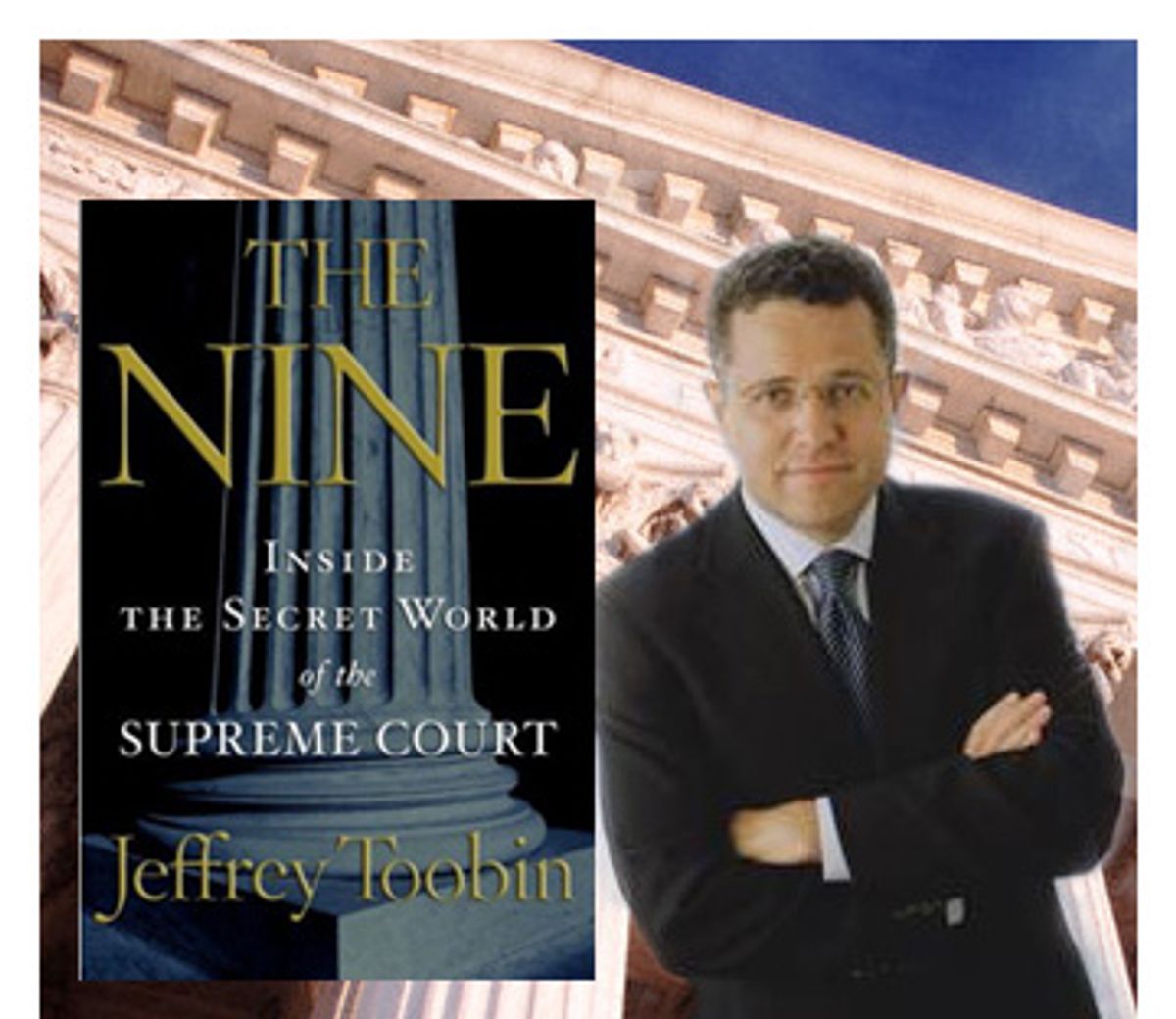
“The Nine,” the latest book from the indefatigable New Yorker legal correspondent Jeffrey Toobin, provides fascinating glimpses into the humanity of these mortals. But in the end, Toobin falls prey to the temptation to reduce them to “conservative” or “liberal” votes. That temptation is widespread in media coverage of the court, and often obscures the real process of change that takes place inside its closed chambers.
Sheltered by life tenure, and surrounded by deference and flattery, the justices live in an airless bubble even harder to penetrate than the one surrounding stubborn presidents. Events outside can seem distorted or far away; developments inside — many invisible to the larger public — can take on outsize importance. Each justice influences the others in ways that are hard even for those involved to understand. One may be alienated by his nominal allies; another may find himself unexpectedly beguiled by the “enemy.” Justices sometimes migrate permanently (Harry Blackmun was a rock-ribbed conservative when named to the court) or move back and forth depending on events inside and outside the court (as Justice Anthony Kennedy sometimes seemed to do on the Rehnquist Court between his appointment in 1987 and the chief justice’s death in 2005). The result is an institution that has often defied the predictions of seasoned analysts and observers. Present appearances to the contrary, it may do so again.
- – - – - – - – - – - -
A generation ago, the financial writer Burton Malkiel suggested that the motions of the stock market, though in broad outline reflective of economic trends, were random and unpredictable from day to day. A similar case, it seems to me, can be made for the Supreme Court. Courts move in broad directions as a result of the political leanings of new justices; but in individual cases they can be quirky and unpredictable.
Being one of the nine is different from being an advocate on the outside, or even from being one of the nearly 180 appellate judges on the federal courts. A justice’s vote can shift history, and that responsibility can change the way he or she looks at issues. “When you put on the black robe, the experience is sobering,” Justice Lewis F. Powell once said. “It makes you more thoughtful.” The justices, in fact, may sometimes take their own importance a bit too seriously. Toobin quotes the more histrionic Justice Kennedy, moments before going into court to announce a key ruling, as saying to a reporter, “Sometimes you don’t know if you’re Caesar about to cross the Rubicon or Captain Queeg cutting your own tow line.”
Kennedy occupies the swing-vote position on this court that Powell occupied during the ’70s and ’80s. Summarizing the 2006-07 term, Toobin writes, “No justice in history had had a term like his; in the twenty-four cases decided by votes of five-to-four, Kennedy was in the majority in every single one.” The justice in the center can have an outsize influence — and not just when the votes are counted. Other justices know they must win the swing vote, and they often tailor their constitutional arguments in an attempt to read his or her mind. But of course the reverse is also true — the justice who seeks the center will very often find him- or herself moving right or left according to the pull of the opposing wings.
The story of the court’s swing votes — from Powell in the ’80s to Sandra Day O’Connor until her retirement in 2005 to Kennedy today — maps a fairly steady pilgrimage to the right. But that pilgrimage has included detours that defied nose-counting projections. The Rehnquist Court refused to overturn Roe v. Wade or Miranda v. Arizona, pulled away from rigid limits on federal power, and even reaffirmed a limited role for racial preferences in higher education — all disappointments to the conservative presidents who nominated six of the current nine. It also extended the right of privacy to cover the choice of consenting adults to have sex — gay or straight — in their own homes.
To Toobin, these detours, not the overall conservative trend, truly define the meaning of the Rehnquist Court. After Bush v. Gore, he argues, the court set off “in its most liberal direction in years.” But he warns that those days are over. The appointments of Roberts and Samuel Alito, he says, mark the ascendancy of the “movement conservatives,” prepared to use their power of judicial review to block political initiatives to protect civil rights, free speech and the environment. Long frustrated by the unpredictability of Republican appointees like O’Connor and David Souter, Toobin says, the members of the legal hard right “are very close to total control.”
“The Nine” generates its story arc by overemphasizing the liberal detour after 2000 to set up a coming violent swing to the right. It covers much of the same ground as “Supreme Conflict” by ABC News correspondent Jan Crawford Greenberg. Greenberg got deeper inside the court’s bubble, with background interviews with nine justices and extensive on-the-record comment from Justice O’Connor. Toobin is a tireless reporter, but his beat at the New Yorker is much wider than the Supreme Court, and he is at his best covering volatile stories like the O.J. Simpson case or the Florida recount. He has a less sure feel than Greenberg for the constitutional issues that dominate the Supreme Court’s agenda.
Within these limits, though, “The Nine” is entertaining and illuminating. Toobin draws a vivid and irreverent picture of the justices; it’s best summarized in his estimation of seven justices’ performance in Bush v. Gore. In his account, Chief Justice Rehnquist is slapdash and result-oriented; O’Connor, image-conscious; Kennedy, bloviated and incoherent; Antonin Scalia a self-righteous bully; Clarence Thomas, withdrawn and rigid. The two Clinton appointees, Ruth Bader Ginsburg and Stephen Breyer, are portrayed as timid and flabby. Only Justice John Paul Stevens emerges as an admirable jurist, though any personal picture of Stevens is largely absent from “The Nine.” By contrast, Toobin draws a moving portrait of David Souter, whose faith in moderate-conservative judging was nearly shattered by the haste and fatuousness of the court’s interference in the election. “There were times when David Souter thought of Bush v. Gore and wept,” he writes.
His portrait of swing-vote Kennedy is particularly merciless. “More than any of the other justices, Kennedy loved drama and what he called ‘the poetry of the law.’ Kennedy’s vanity was generally harmless, almost charming — sort of like the carpet in his office.” But Toobin suggests that it was Kennedy’s grandiosity and love of excitement that drove the court’s disastrous involvement in Bush v. Gore, a decision in which, he notes, the court disgraced itself by the “inept and unsavory manner that the justices exercised their power.”
Some readers may question whether these portraits do full justice to their subjects. Greenberg’s book draws a more subtle portrait of the complex interaction among the justices. Toobin writes that Clarence Thomas has been “ideologically isolated, strategically marginal, and, in oral argument, embarrassingly silent.” Greenburg shows that Thomas in fact has influenced his conservative colleagues, and suggests that it is Scalia who tends to march in step with Thomas rather than vice-versa, as many commentators suggest.
As for Rehnquist, the latter years of his court seem to me more suggestive of the random day-to-day fluctuations Burton Malkiel saw in the stock market than of any kind of concerted lurch to the left. To support his liberal-detour thesis, Toobin de-emphasizes or blurs the real hard-right aspects of that court’s jurisprudence. Of the court’s federalism and civil-rights cases, he writes, “the Court limited Congress’s right to pass laws that gave citizens the opportunity to sue state officials; similarly, they interpreted federal statutes so that they did not give citizens the right to sue states. These were important, but hardly revolutionary, limitations on federal power, with little practical impact on the lives of most people.” And he states offhandedly that the Rehnquist years saw “real, but also modest, movement to the right on church-state issues.”
In fact, the civil-rights cutbacks are of great practical importance. Congress has repeatedly passed civil rights statutes to protect racial minorities, women and the disabled; time and time again, the right wing of the Rehnquist Court threw the supposed beneficiaries out of court. In church-state relations, the court was not modest, but revolutionary: it has now cleared the way for direct payments of tax funds to religious institutions. (Read properly, the Roberts Court’s decision last June closing the courthouse doors to most future challenges under the Establishment Clause is just an extension of that revolution.) In this analysis, milestones like Lawrence v. Texas, striking down laws against gay sex, are outliers on a curve that bends to the right side of the graph.
Toobin’s idea of the Rehnquist Court as a moderate court that sometimes reached liberal results reflects lack of a larger context. In fact, there hasn’t been a real judicial liberal among the nine since Justice Blackmun retired in 1994. Even Bill Clinton’s two appointees, Ruth Bader Ginsburg and Stephen Breyer, are at best cautious moderates who often fold their cards under pressure from their brethren.
The so-called liberal wing of the court — John Paul Stevens, David Souter, Ginsburg and Breyer — is actually made up of old-style judicial conservatives. They respect precedent and view the court’s role as modestly building on and explaining the work it has done before. Not a one of them shows any enthusiasm for interpreting the Bill of Rights and the Fourteenth Amendment in radical new ways, as former justices like William Brennan and William O. Douglas did brilliantly.
The real energy in the current court resides in the conservative wing — Roberts, Antonin Scalia, Clarence Thomas and Samuel Alito. To them, precedent means little or nothing if it does not fit with conservative ideology, and the court’s job is to drive the law — and the nation — far to the right.
The Roberts Court will continue its move to the right. Its most important recent decisions give a hint of the route the court is mostly likely to follow. In cases involving “partial-birth” abortion, church-state relations, school integration and free speech in public schools, the new majority proclaims its fidelity to uncongenial precedent — and then reinterprets the previous cases until literally nothing is left of them.
If the current trend continues, this court could be the radical anchor conservatives have dreamed of, taking on the role of guarding (as did the now-discredited conservative court of the early New Deal era) against social and political change favored by political majorities.
But will it continue? This brings us back to John Roberts’ moment of vulnerability. Toobin correctly notes that the true nature of the Roberts Court will depend powerfully on the outcome of the presidential election next year. Justice Stevens is 87, though hale; Justice Kennedy is 71; Justice Ginsburg is 74 and has suffered from colon cancer; Justice Scalia is 70 and, it must be said, acting very strangely. Each new nominee will not just affect the vote total, but the thinking of their fellow residents of the bubble.
The unpredictable dynamics among the nine — and the personalities of those named to join them — may matter, in the long run, more than any agenda they brought with them from outside. Bill Clinton persistently wooed Mario Cuomo for the seat that eventually went to Ruth Ginsburg; one can only imagine how Cuomo’s force of personality and charm might have changed the mix in the last decade. A Democratic president who could put even one bold, persuasive liberal on the court might see more change than raw nose-counting would suggest.
Progressives have despaired of the court over and over since Richard Nixon was elected in 1968. And yet the court has surprised us repeatedly before. Toobin suggests that the surprises are over; but despair is not the true lesson of “The Nine.” Sober realism is, to be sure — but hope as well.
While Mitt Romney is catching plenty of flak for standing by Donald Trump as he tells anyone who will listen that Barack Obama was born in Kenya, the presumed GOP nominee is hardly the only candidate who has benefited from Trump’s starpower and deep pockets.
In fact, even though virtually every Republican presidential candidate kissed Trump’s ring, it’s further down the ballot where he has had the biggest financial impact. He gave $5,000 to Connecticut GOP Senate nominee Linda McMahon last year and $30,800 to the National Republican Senatorial Committee (NRSC), the campaign arm of Senate Republicans, which did not return a request for comment.
On the House side, he gave $2,500 to Rep. Ed Royce’s, R-Cal., reelection effort; another $1,000 to Tea Party favorite Rep. Allen West, R-Fla.; and $2,000 to Rep. Peter King, R-NY. And while he’s given to Democrats in the past, including Senate Majority Leader Harry Reid, all of Trump’s donations in this year’s election cycle were to Republicans, including Romney ($2,500) and disgraced former New York Rep. Chris Lee, who resigned after being caught looking for sex on Craigslist. (Trump gave $500, which appears to have been returned.)
Trump has been especially involved with West, whose campaign did not return a request for comment. The “Apprentice” star appeared with the congressman at a Tea Party rally in Florida last April, and West even said he was open to being Trump’s vice presidential pick if the real estate mogul somehow won the GOP nomination. West told Newsmax at the time that he hoped Trump was “very serious” about his presidential bid. West also accepted $2,500 from Joseph Farah, the birther editor of World Net Daily, in 2008. (It’s Farah’s only political donation the past three cycles.)
But perhaps no candidate has closer or deeper ties to Trump than McMahon, who also did not immediately respond to a request for comment. McMahon made her money through the WWE professional wrestling league, which her husband founded.
Trump has been involved in the sport for years, which suits his flamboyant and phony image. Wrestlemania IV and V were both held at Trump Plaza, and a video that made the rounds on Twitter yesterday shows Trump tackling Vince McMahon at Wrestlemania 23. Trump and two beefy wrestlers hold down and restrain McMahon before shaving his head to wild cheers from the packed arena.
Trump’s ties to Linda McMahon became a campaign issue earlier this year when Democrat Chris Murphy slammed his opponent for taking Trump’s money. “That’s right, the man who led the charge to see President Obama’s birth certificate, report cards and test scores has set his sights on Connecticut’s Senate seat,” Murphy campaign manager Kenny Curran said in a fundraising email to supporters in February. The Connecticut Democratic Party even cut a web ad attacking McMahon that featured Trump.
Continue Reading
Close
Apparently it is a great big lie — an “utter fabrication with malice and forethought” — to say that the Democrats lost their longtime hold over the old Confederacy because their support for civil rights legislation drove white Southerners away. That’s according to the National Review’s Kevin Williamson, who wrote a big National Review piece about how mad this lie makes him, when the secret truth is that Republicans have always been, and will always be, the single most pro-civil rights party ever.
The piece is largely an attempt to add a patina of respectability to the ancient, brainless comment thread talking point about how Robert Byrd was in the Klan, but lots of Republicans voted for the Civil Rights Act, so therefore Democrats are the real racists. (In this respect, the piece is an homage to Jonah Goldberg’s “Liberal Fascism,” which attempted to expand “Nazi stands for National Socialist” to book length, without pictures.) The only problem is that the “lie” he’s arguing against is 100 percent true, except when he states it in such a way that it no longer resembles what anyone has ever actually claimed.
So: It’s true, and no one denies this, that Republicans used to be very good on civil rights and Democrats used to be super racist. It’s true that Woodrow Wilson was a bigot and (Northern, liberal) Republican senators were better than (Southern, conservative) Democratic senators on civil rights in the 1940s, 1950s and 1960s. Williamson’s argument seems to be that Republicans couldn’t have taken advantage of a Democratic split over civil rights by appealing to racist white Southern voters because Republicans were too uniformly pro-civil rights, themselves. (This great big lie he’s debunking is one that Nixon and Lee Atwater and Ronald Reagan happily signed on to — they were thrilled when the Democrats fractured the New Deal coalition by eventually embracing civil rights!)
Williamson would, I guess, call it revisionist history, but he has revised all of the history out of it.
Even if the Republicans’ rise in the South had happened suddenly in the 1960s (it didn’t) and even if there were no competing explanation (there is), racism — or, more precisely, white southern resentment over the political successes of the civil-rights movement — would be an implausible explanation for the dissolution of the Democratic bloc in the old Confederacy and the emergence of a Republican stronghold there. That is because those southerners who defected from the Democratic party in the 1960s and thereafter did so to join a Republican party that was far more enlightened on racial issues than were the Democrats of the era, and had been for a century.
Oh, did they? It’s dubious to argue that the party that nominated Barry Goldwater for president was “far more enlightened” than the one that nominated Kennedy, but Johnson was a big ol’ Texas racist, so sure, fine, pretend Nelson Rockefeller cancels out Barry. But the segregationists didn’t all wake up and decide to vote for Republicans starting in 1965 — they revolted. George Wallace started a third party. They continued fighting for racism within the party, and they eventually lost. But it wasn’t until the conservative movement had finished fully taking over the Republican Party that the great shift finished.
After devoting a lot of words to LBJ’s very real history of being a loud-mouthed racist, Williamson explains that Johnson’s dumb, loud-mouthed racism was just a reflection of the whole of Democratic Party philosophy and belief since time immemorial.
Johnson did not spring up from the Democratic soil ex nihilo. Not one Democrat in Congress voted for the Fourteenth Amendment. Not one Democrat in Congress voted for the Fifteenth Amendment. Not one voted for the Civil Rights Act of 1875. Eisenhower, as a general, began the process of desegregating the military, and Truman, as president, formalized it, but the main reason either had to act was that President Wilson, the personification of Democratic progressivism, had resegregated previously integrated federal facilities. (“If the colored people made a mistake in voting for me, they ought to correct it,” he declared.) Klansmen from Senator Robert Byrd to Justice Hugo Black held prominent positions in the Democratic Party — and President Wilson chose the Klan epic Birth of a Nation to be the first film ever shown at the White House.
Johnson himself denounced an earlier attempt at civil-rights reform as the “nigger bill.” So what happened in 1964 to change Democrats’ minds? In fact, nothing.
What is the funniest part of this: How it basically makes one brief stop in between 1875 and the mid-20th century in its exhaustive history of Democratic racism? Or how Williamson is clearly annoyed at having to even slightly, obliquely credit Harry Truman (Democrat!) for desegregating the armed forces, a thing (Democrat) Harry Truman did? Like, maybe what happened in 1964 was the eventual result of an intraparty battle that was happening in 1948 when Democrat Harry Truman desegregated the armed forces (and Strom Thurmond, future Republican, threw a big fit about it)?
The 1964 Civil Rights Act, and Lyndon Johnson’s role in ensuring its passage, was one major victory in a years-long effort by the party’s liberals to make the Democratic Party the civil rights party, and it worked so well that the racists were effectively no longer welcome. They responded by changing their positions or changing sides. It wasn’t an overnight change, because politics is slow, but it happened: Robert Byrd and even George Wallace changed their positions on black civil rights and apologized. Those who couldn’t adapt, or those for whom bigotry was more genuine belief than political opportunism, left the party. Strom Thurmond became a Republican. Lester Maddox launched a third-party presidential bid against Jimmy Carter and eventually endorsed Republican Pat Buchanan in 1992. Maddox was also a charter member of the Council of Conservative Citizens, the white supremacist paleoconservative group that once counted Trent Lott, Thurmond and Jesse Helms as members. These guys are the heirs to the conservative white Southern Democrat tradition. I’m not really sure they themselves would consider it a pernicious lie to say as much.
What would have been much, much more entertaining would have been if, instead of writing this piece about “Democrats” and “Republicans,” Williamson had written it about liberals and conservatives. Barry Goldwater and George Wallace both used conservative rhetoric to justify their segregationist beliefs — and so did William F. Buckley. Both parties at the time had liberal and conservative wings, and in each of those parties it was the liberal wing that was right on civil rights.
There was really only one American political party with a solid record on civil rights in the first half of the 20th century, and it was the American Communist Party. But “in praise of the liberal Northeastern Republicans who stood with the communists on civil rights and who were eventually driven from the party by conservatives like the ones who founded this magazine” would not go over well in the National Review, I imagine.
Williamson goes on to argue that the white South didn’t go Republican because of civil rights, it went Republican because of … the New Deal. So while the change happened too slowly and gradually to be ascribed to racism, it can happily be pinned on a series of popular economic programs that had been enacted 30 years prior to 1964. (Programs so popular that Southern racists and blacks joined together in a political coalition that lasted until liberals began … winning civil rights victories.)
But let’s not also forget to blame hippies and welfare:
The Republican ascendancy in Dixie is associated with the rise of the southern middle class, the increasingly trenchant conservative critique of Communism and the welfare state, the Vietnam controversy and the rise of the counterculture, law-and-order concerns rooted in the urban chaos that ran rampant from the late 1960s to the late 1980s, and the incorporation of the radical Left into the Democratic Party. Individual events, especially the freak show that was the 1968 Democratic convention, helped solidify conservatives’ affiliation with the Republican Party.
In other words, it was literally everything that was going on in the 1960s besides civil rights issues that made white Southerners eventually fully embrace the Republican Party. (And blacks continue to support the Democrats because Democrats lied about what happened in the 1960s and because Johnson promised them free government money forever, apparently.)
I mean it’s obviously true that the shift didn’t happen purely because of the Civil Rights Act of 1964, but it’s just as obviously true that it’s a hilarious and deeply stupid misreading of history to pretend that the Republican Party has always and will always be the champion of civil rights.
[Thanks to, and please also read: Adam Serwer, Jonathan Chait, Mark Schmitt, Clay Risen, and Jonathan Bernstein.]
Continue Reading
Close
One thing when writing about the Republican Party and the crazy – you can always be certain that it’ll generate new examples. So just when the news that a member of the House accused dozens of Democrats in Congress of being Communists seemed to be going stale, along comes Donald Trump – who is scheduled to appear at a fundraiser with Mitt Romney next week – to spout birther nonsense.
For those of us who believe that there’s something seriously wrong with the Republican Party (and see Tom Mann and Norm Ornstein’s new book; see also my argument that the problem is not about how “conservative” they are, but about their radical style), the big question is whether anything can be done about it. American democracy needs two strong, solid political parties, but currently one of the parties is just a mess – incapable of making coherent policy when it’s in office, and dangerously obstructionist when it’s out of office.
So how can a party recover? I think there are three ways, but two are unfortunately quite unlikely, and the third is at best uncertain.
Some talk about the possibility that the electorate will punish Republicans for their radicalism. Unfortunately, I think that’s unlikely. Note that consecutive blowouts in 2006 and 2008 certainly didn’t make things better. Part of the problem here, too, is that elections generally don’t work that way. It’s true that the impression of ideological extremism can be costly, as Barry Goldwater and George McGovern learned the hard way, but we’re talking here about 2 or 3 percentage points in a presidential election. Direct action by the voters just isn’t enough to do it. After all, as voters, they can only choose between the nominees that they’ve been offered, and if anything voters are more partisan than ever; they’re not likely to defect just because a candidate embraces the crazy, even if they don’t like it, because they would still have a strong preference for that candidate otherwise.
A second possibility is that they’ll wind up with a successful president who sets a strong example of sane conservativism and who is strong enough within the party that he or she can push a lot of the crazies to the fringes and beyond. That could work. Presidents have limited influence in general, but one thing that a popular president can do is to define normality for his or her own party. They can reward some and punish — or at least avoid rewarding — others, creating real and meaningful incentives that can be very different from what came before. The obvious analogy is Dwight Eisenhower’s maneuverings against Joe McCarthy. The problem is that for this strategy to work it takes a skilled and popular president who decides to try it, but Republicans might have to wait a long time before they get another Ike.
So the first method probably can’t work, and the second one is unlikely to happen. That leaves one other possibility: that the Republican coalition itself might demand change. Specifically, that Republican-aligned interest groups – perhaps business, national security or others – might become upset enough with the crazy, or worried enough that the crazy will impede their ability to get things done, that they’ll push to end it. After all, part of the problem with the crazy is that it truly is random; you really never know what nonsense Limbaugh or the Breitbart sites are going to be up to next, and there’s every possibility that it could interfere with groups within the party pursuing their interests. Even worse: Politicians who believe they were elected because their most valuable allies convinced the electorate that the president was a radicalized foreigner are going to be responsive to those supporters, and not to organized party groups. Those groups have enough troubles as it is, since in the current free-for-all campaign finance environment they have to compete with random billionaires who might have all sorts of unorthodox policy preferences.
We’ve seen a little bit of this already. During the healthcare debate, many normally Republican-leaning groups chose to work with the Obama administration and cut their best deal, rather than sticking with the rejectionist GOP. Several companies quit the conservative state lobbying organization ALEC when it became controversial by lobbying for ideological and partisan goals. On the national security side, a break has emerged between the Department of Defense and movement conservatives; both conservatives who care about national security and (on some issues) businesses might choose to stick with the Pentagon. And it’s not quite the same thing, but there’s been a small but steady stream of defectors from the movement.
Nevertheless, something like this would likely play out in nomination politics, with party-aligned groups insisting on candidates who are willing to fight for their interests while rejecting the crazy, and there certainly isn’t any sign of that yet. Will it in 2014 and 2016 if Romney falls short this fall and the crazy gets even worse? I have no idea – but that’s the only path out of this that I can imagine.
Continue Reading
Close
Watching the antics of the House GOP, you get the very strong sense that if the class of Republicans elected in 2010 were offered a chance to repeal the Enlightenment, they would leap at the opportunity. The great flowering of science and philosophy that reached critical mass in the 17th century employed human reason to batter away at the dogmas of blind faith. But as far as the Tea Party seems to be concerned, that was just one big wrong turn.
The most recent evidence that the current incarnation of the Republican Party just can’t handle the truth arrived this month when House Republicans voted to get rid of the American Community Survey. The ACS is an annual information-gathering effort that’s part of the U.S. Census. Every year, a randomized sample of 3 million Americans is surveyed for data on “demographic, housing, social and economic characteristics.” In one form or another, the U.S. government has been carrying out similar surveys since 1850 — the current version is the fourth major iteration.
Most sensible people consider the ACS to be extremely useful, the kind of thing that government is really well equipped to carry out. That is not, or at least did not used to be, a partisan statement. Both private and public sector policymakers use ACS data to make important decisions. The federal government allocates $450 billion annually according, in part, to information derived from the ACS. Businesses also consider the ACS vital, which explains why the U.S. Chamber of Commerce, rarely a fan of government spending, is opposed to the House action.
Even conservative economists are leery: The clearest evidence that the House GOP has gone completely beyond the pale can be seen in a Businessweek article reporting that representatives of the American Enterprise Institute, Heritage Foundation and Cato Institute all declared their support for government data gathering. If you don’t understand what’s going on in the U.S. economy on a granular level, you’re flying blind. This should not be a controversial statement.
Even the Wall Street Journal is appalled — although the lead sentence of its editorial criticizing the funding cuts required some remarkable calisthenics before reaching the point of disapproval.
With the contempt of the Washington establishment raining down on House Republicans for voting on principle, every now and then the GOP does something that feeds the otherwise false narrative of political extremism.
Marvelous! In one sentence, the Journal’s editorial writer manages to deny, not once, but twice, the self-evident fact that the current crop of House Republicans occupies the nethermost regions of right-wing extremism, while at the same time admitting that, yeah, well, in this one case they are indeed bonkers.
There’s been no end of media chatter focusing on the importance of the data gathered by the ACS. We’ve also heard how the Constitution specifically enjoins Congress to gather demographic information “in such a manner as they shall by law direct.” And, in fact, the current form of the ACS follows the mandate set forth by a Republican Congress in 2005.
The sponsor of the House measure, the freshman Florida Republican Daniel Webster, claims that ACS questions are too “intrusive” and “the very picture of what’s wrong in D.C.” He seems to be projecting. The very picture of what’s wrong with D.C. is exquisitely captured by daily demonstration that one of our leading political parties is dedicated to the proposition that the less we know about what is going on in our economy or on our planet, the better. If science tells us that one of the consequences of human activity is an overheated planet, then the answer is to defund climate research. If data gathered by the ACS gives us a better understanding of where poverty may be growing as a result of economic policies put into place over the past few decades, best to just to close our eyes and ignore it.
Which brings us back to the 17th century. It’s no stretch to argue that both representative democracy and the Industrial Revolution flourished in large part through the application of Enlightenment principles. The founders of the United States were very much a product of Enlightenment ideals. Looking for an Enlightenment avatar? Think Ben Franklin. Progress is built on the accumulation of knowledge, and ideological rigidity shouldn’t be able to compete against the truth that derives from a better understanding of our universe. And yet that’s where we are today — watching as one of the two major political parties in our country becomes not just more and more distrustful of science, but also opposed to the very notion of information-gathering — and governs accordingly.
Continue Reading
Close
One of the most overused metaphors in a writer’s arsenal is the one about “walking and chewing gum at the same time.” As a hiker and Big League Chew enthusiast, I particularly hate this cliché. Nonetheless, I feel it is fitting right now because it so perfectly summarizes the argument being made by Republicans. They now insist that America cannot simultaneously walk the walk on equal rights and also chew economic gum.
In the last week, Colorado was the testing ground for this talking point. At the presidential level, Republican nominee Mitt Romney criticized a Denver television reporter for daring to ask about his position on, among other issues, same-sex marriage. Before restating his opposition, he scoffed at the question, asking: “Aren’t there issues of significance that you’d like to talk about [like] the economy? The growth of jobs? The need to put people back to work?”
At the same time, Colorado’s Republican House Speaker Frank McNulty twice blocked a vote on a bill to legalize civil unions. His rationale? “We should not be spending time on divisive social issues when unemployment remains far too high and [when] far too many Coloradans remain out of work,” he said. Echoing that sentiment, the shadowy Republican front group Compass Colorado financed an automated telephone call telling thousands of voters that the push for civil unions was unacceptable because it is “promoting [a] divisive social agenda over Colorado job creation.”
Obviously, it’s perplexing to see the Republican Party allege that social issues are insignificant and “divisive.” This is, after all, the party whose most recent presidential nominating contest was dominated by attacks on contraception — the same GOP whose politicians have made an art out of riding a “guns, god and gays”-focused agenda to electoral victory.
But while such naked hypocrisy is enraging, the substance of the Republican rhetoric about gay rights is downright offensive. Essentially, conservatives are asserting that we cannot extend equal rights to all Americans and fix the economy. In the process, they are deliberately insinuating that the twin goals are somehow contradictory.
Well, you might ask, do they have a point? History says no. Our country’s story is the story of multitasking — a tale of extending the franchise to women while passing progressive legislation to deal with crushing economic inequality, a tale of both passing civil rights legislation and creating Medicare.
In light of such achievements, would anyone retroactively argue that America should have opposed the campaign to let women vote because the economy was so bad in the early 20th century? Would anyone insist that lawmakers should have halted civil rights legislation in the 1960s because there was a simultaneous need for a War on Poverty? Probably not, because most of us recognize such arguments for what they are: diversionary non sequiturs whose real goal is to preserve institutional bigotry and prejudice.
That’s the same objective of today’s GOP when it comes to rights for same-sex couples. For proof, just consider the abruptness of the shift: the Republican Party that spent the last decade insisting that we should simultaneously cut taxes, prosecute foreign wars and fight to limit a woman’s right to choose an abortion now suddenly says we can’t even discuss equal rights because of a recession.
The language changed not because the new “can’t walk and chew gum” mantra makes sense (seriously — would any sane person really claim that a bad economy justifies continued persecution of lesbians, gay, bisexual and transgender people?). It changed because the cause of equal rights is involved. And, clearly, that cause is what today’s Republicans are now most committed to stopping — no matter how much their flawed logic indicts their credibility.
Continue Reading
Close