Bicycling

The bicycle thief

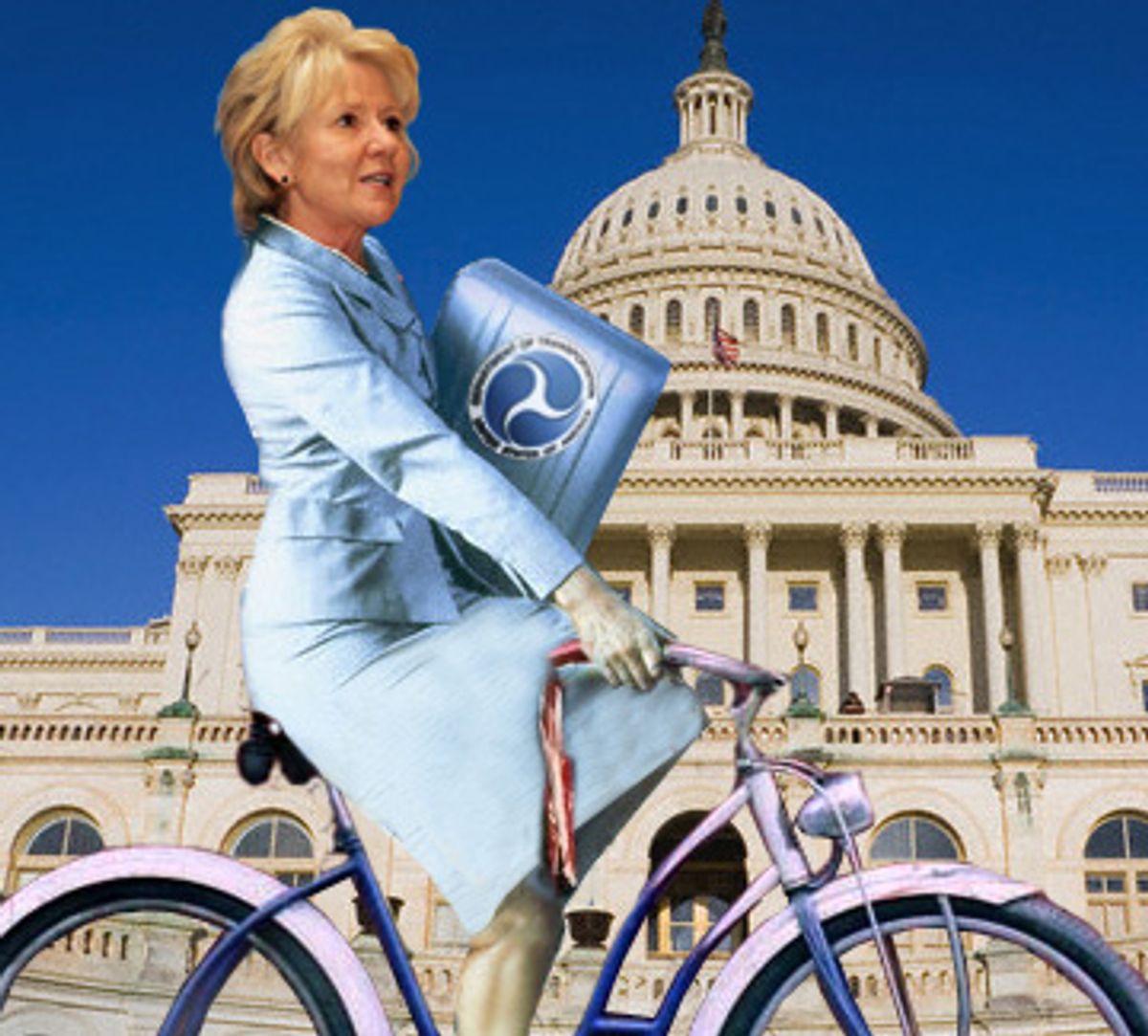
Bike activists face an uphill climb against Transportation Secretary Mary Peters, who claims bike paths are not transportation and are stealing tax money from bridges and roads.

  • more
    • All Share Services

The bicycle thief

Imagine you’re the federal official in the Bush administration charged with overseeing the nation’s transportation infrastructure. A major bridge collapses on an interstate highway during rush hour, killing 13 people and injuring an additional 100. Whom to blame? How about the nation’s bicyclists and pedestrians!

The Minneapolis bridge collapse on Aug. 1 led Secretary of Transportation Mary Peters to publicly reflect on federal transportation spending priorities and conclude that those greedy bicyclists and pedestrians, not to mention museumgoers and historic preservationists, hog too much of the billions of federal dollars raised by the gas tax, money that should go to pave highways and bridges. Better still, Peters, a 2006 Bush appointee, apparently doesn’t see biking and walking paths as part of transportation infrastructure at all.

In an Aug. 15 appearance on PBS’s “NewsHour With Jim Lehrer,” Peters spoke against a proposal to raise gas taxes to shore up the nation’s aging infrastructure. The real problem, the secretary argued, is that only 60 percent of the current money raised by gas taxes goes to highways and bridges. She conveniently neglected to mention that about 30 percent of the money goes to public transit. She then went on to blast congressional earmarks, which dedicate 10 percent of the gas tax to some 6,000 other projects around the country. “There are museums that are being built with that money, bike paths, trails, repairing lighthouses. Those are some of the kind of things that that money is being spent on, as opposed to our infrastructure,” she said. The secretary added that projects like bike paths and trails “are really not transportation.”

Peters’ comments set off an eruption of blogging, e-mailing and letter-writing among bike riders and activists, incensed that no matter how many times they burn calories instead of fossil fuels with the words “One Less Car” or “We’re Not Holding Up the Traffic, We Are the Traffic” plastered on their helmets, their pedal pushing is not taken seriously as a form of transportation by the honchos in Washington, D.C.

Bike paths are not infrastructure? “There are hundreds of thousands of people who ride to work, and millions who walk to work every day, and the idea [that] that isn’t transportation is ludicrous,” says Andy Clarke, executive director of the League of American Bicyclists, who has biked to work for almost 20 years on a path paid for with federal dollars. Clarke fired off an angry letter to Peters, and invited the 25,000 members of his organization around the country to do the same. “The guy in his Humvee taking his videos back to the video store isn’t any more legitimate a trip than the guy on the Raleigh taking his videos back,” says Andy Thornley, program director for the San Francisco Bicycle Coalition.

In fact, only about 1.5 percent of federal transportation dollars go to fund bike paths and walking trails. In the meantime, 10 percent of all U.S. trips to work, school and the store occur on bike or foot, and bicyclists and pedestrians account for about 12 percent of annual traffic fatalities, according to the Federal Highway Administration. “We represent a disproportionate share of the injuries, and we get a minuscule share of the funds,” says Robert Raburn, executive director of the East Bay Bike Coalition in the San Francisco Bay Area, who calls the Peters’ comments “outrageous.” Plus, he notes, with problems like global warming, the obesity epidemic and energy independence, shouldn’t the U.S. secretary of transportation be praising biking, not complaining about it?

What really drives cyclists around the bend is that while they’re doing their part to burn less fossil fuel — cue slogan: “No Iraqis Died to Fuel This Bike” — they’re getting grief for being expensive from a profligate administration. “War spending, tax cuts for the rich, and gas taxes are all big sources of funding. Bike spending is not,” fumes Michael Bluejay, an Austin, Texas, bike activist, in an e-mail. “The few pennies we toss toward bike projects is not enough to fix our nation’s bridges, not by a freaking long shot.”

One of the many communities that benefit from federal dollars for bicyclists and pedestrians is the very one where the bridge collapsed. For the St. Paul, Minn., program Bike/Walk Twin Cities, administered by Transit for Livable Communities, $21.5 million of federal dough is being spent to create bike lanes, connect existing walking and biking trails with one another, and install signage to alert drivers of the presence of bicyclists and walkers. Despite the cold winters, Minneapolis is something of a biking Mecca, with 2.4 percent of all trips to work made by bike, significantly higher than the national average of 0.4 percent, according to Joan Pasiuk, program director of Bike/Walk Twin Cities.

It’s hard to argue that walking paths and bike trails are robbing federal coffers when states can’t even spend all the federal money they’ve received to repair bridges in the first place. In 2006, state departments of transportation sent back $1 billion in unspent bridge funds to the federal government, according to the Federal Highway Administration. “The fact that there is a billion dollars of bridge repair money sloshing around in the system not being spent suggests that it’s not the fault of bike trails,” says Clarke.

Congressional Democrats agree. “It’s a red herring to point to bike paths and even imply that if we didn’t build another bike path we’d have all the money we need to fix our highways and bridges,” says Jim Berard, communications director for the House Committee on Transportation and Infrastructure. “You can’t build very many bridges with the amount of money that you would save if you didn’t build any bike paths.”

So why is Peters suddenly taking on bikes and pedestrians? Her comments are especially odd since she sang the praises of bikes as transportation in a speech at the National Bike Summit in Washington, in March 2002. Has she simply forgotten the glory of two wheels? One theory: Peters is on a campaign to quash the idea of raising the gas tax, as she editorialized recently in the Washington Post. A key proponent of raising the gas tax to fund bridge restorations in the wake of the Minneapolis bridge collapse is Democratic Rep. Jim Oberstar of Minnesota, who has advocated for bike and pedestrian paths in his district. By putting a culture-war spin on the bridge collapse, Peters is hoping to run his gas tax proposal off the road.

Does Peters herself buy this theory? Does she really think that bike paths do not qualify as transportation infrastructure? Why does she say that things like bike paths steal money from bridge repairs when states have more than enough money to fix bridges? The secretary would not respond, but Jennifer Hing, a spokesperson for the Department of Transportation’s Office of Public Affairs in the Office of the Secretary, would. She answered all the specific questions with one resoundingly uninformative e-mail: “The federal government should set high standards for and invest in the ongoing safety, reliability and interconnection of the nation’s transportation network. State and local communities should have the flexibility to then set local transportation priorities.”

For their part, cyclists have been weaving through political land mines for decades. In the perennial struggle to gain public support for bike paths, they remain philosophical. Says Thornley of the San Francisco Bicycle Coalition: “Before there were automobiles, and after there will be automobiles, there will be bicycles moving people around for transportation.”

Daily Caller genius: I don’t feel bad for black people anymore because I think a black person stole my bike

Man assumes black person stole his bike, decides to write long column about it, Tucker Carlson's site runs it

  • more
    • All Share Services

Daily Caller genius: I don't feel bad for black people anymore because I think a black person stole my bike

Mark Judge would like the world to know that he no longer has any “white guilt” because his bike got stolen and the perpetrator may have been a black person, or possibly (the culprit is still at large!) black people in general.

Who is Mark Judge? He is some guy writing an opinion column for Tucker Carlson’s online magazine, “Assumption of Trayvon Martin’s Guilt Illustrated.” (He is also the author of some awful-sounding book about being a right-wing Catholic who likes rock ‘n’ roll music, and he once wrote an unintentionally funny review of John McWhorter’s book about hip-hop.)

What happened is, he had his bike locked to his car while he went to services on Good Friday, and when he came back, his bike was gone, and he doesn’t think a nun stole it so basically his parents lied to him when they said “we are all the same” and his favorite movie is no longer “In the Heat of the Night.” (The deductive reasoning on display is staggering: It couldn’t have been monks, must have been black people.)

When I got home I vented to my friends. I told them I was going to scour those neighborhoods until I found the bike. In reply, a liberal friend gave me a lecture about profiling and told me to just forget about the bike. “That person needs our prayers and help,” she said. “They haven’t had the advantages we have.”

That’s when I lost it. I had been carefully educated by liberal parents that we are all, black and white, the same. My favorite movie growing up was “In the Heat of the Night.” Yet that often meant not treating everyone the same. It meant treating blacks with a mixture of patronizing condescension and obsequious genuflecting to their Absolute Moral Authority gained from centuries of suffering. It meant not treating everyone the same.

It meant leaving valuable things like a bike in a vulnerable position in a black part of town because you didn’t want to admit that the crime is worse in poor black neighborhoods.

Stupid strawman liberal friend! If we’re all “the same,” why did a (probably) black person (possibly) steal Mark Judge’s bike?

It actually gets dumber from there — on Page 2 he excitedly recounts the time universally loathed asshole Piers Morgan totally told off Toure — but long story short Mr. Judge has decided that “black pain is no different than white pain” and so therefore Soledad O’Brien (??) should stop complaining. After all, the black person who may have stolen his bike may also have “a car, a nice apartment, a hot girlfriend and good health.”

I mean, sure! That’s possible! It’s definitely within the realm of possibility that the hypothetical black person you assume stole your bike because you were near a “poor black neighborhood” when it disappeared has a really sweet life, sure.

Wise up, White Americans. Your liberal parents lied to you when they said “this country’s centuries-old tradition of state-sponsored discrimination and institutional racism means a black person would never steal your bike, so just park that shit wherever.” Or like maybe your “white guilt” is just weird curdled racial resentment (“even though I try super hard not to be incredibly racist black people still won’t forgive me!”) which caused you to go in a really weird direction with your otherwise totally normal anger about being the victim of some random crime of opportunity.

Continue Reading Close
Alex Pareene

Alex Pareene writes about politics for Salon and is the author of "The Rude Guide to Mitt." Email him at apareene@salon.com and follow him on Twitter @pareene

Armstrong’s lawyers want apology from “60 Minutes”

Attorney: "Your story was either extraordinarily shoddy ... or a vicious hit-and-run job"

  • more
    • All Share Services

Armstrong's lawyers want apology from FILE - In this July 6, 2010, file photo, Lance Armstrong grimacing prior to the start of the third stage of the Tour de France cycling race in Wanze, Belgium. Tyler Hamilton, a former teammate of Armstrong, has told CBS News that he used performance-enhancing drugs with the seven-time Tour de France winner to cheat in cycling races, including the tour. Armstrong has steadfastly denied doping and has never failed a drug test. (AP Photo/Christophe Ena, File)(Credit: AP)

Attorneys for Lance Armstrong have demanded an on-air apology from “60 Minutes” after the head of Switzerland’s anti-doping laboratory denied allegations the seven-time Tour de France winner tested positive for performance-enhancing drugs at the 2001 Tour de Suisse.

In a letter sent Wednesday to CBS News Chairman and “60 Minutes” executive producer Jeff Fager, lawyer Elliot Peters said the May 22 segment about Armstrong was built on a series of falsehoods, and he accused the reputable CBS show of sloppy journalism.

“In the cold light of morning your story was either extraordinarily shoddy, to the point of being reckless and unprofessional, or a vicious hit-and-run job,” Peters wrote. “In either case, a categorical on-air apology is required.”

CBS News spokesman Kevin Tedesco said Wednesday he couldn’t immediately comment on the letter, but said: “We consider this the most thorough investigation into doping in the sport of cycling ever done.”

Former teammate Tyler Hamilton alleged in the piece that Armstrong talked about using the banned blood-booster EPO to prepare for his third Tour de France in 2001 and cycling’s governing body, the International Cycling Union, helped him hide a positive test at the Swiss event.

Last week, the head of Switzerland’s anti-doping laboratory, Martial Saugy, denied allegations Armstrong tested positive for performing-enhancing drugs during the 2001 Tour de Suisse.

Saugy said his lab did find suspicious levels of EPO in four urine samples from the race Armstrong won, but he didn’t know if any belonged to the seven-time Tour de France winner.

Armstrong has repeatedly denied doping and has never tested positive. Federal prosecutors in Los Angeles are investigating an alleged doping program in Armstrong’s teams.

“60 Minutes” also reported ICU officials brokered a meeting involving Armstrong and Saugy’s World Anti-Doping Agency-accredited lab, which tested the Swiss race samples.

Saugy told the Swiss daily Neue Zurcher Zeitung last week that he met with Armstrong and then-U.S. Postal team manager Johan Bruyneel, but not in Lausanne as Hamilton claimed and unconnected to a suspicious test result.

Peters added the show’s producers were alerted by Armstrong’s camp prior to the show’s airing that the Swiss-related allegations were false and provided evidence to refute them.

“What is particularly disturbing is that ’60 Minutes’ had access to the true facts, could easily have verified them, and apparently chose instead to broadcast untruths and then layer innuendo on top of the falsehoods,” Peters said.

Continue Reading Close

One more reason to ride a bike

Interactions between drivers and cyclists are often no fun for anybody. But not always!

  • more
    • All Share Services

Despite tired legs and a sore butt after riding my bicycle a hundred miles in the fog and cold of West Marin on Saturday, I dragged my ass off the couch to return a DVD to the rental store on Sunday afternoon. It’s only a three-mile ride, but requires negotiating some mildly gnarly traffic between Berkeley and Oakland, so you have to keep your wits about you.

I was about halfway there and needed to make a left turn that required first cutting through a lane of quickly moving cars. I looked behind me, and saw a white sedan far enough back that I had room to cross over. I signaled my intention, and then looked back again to make sure the sedan had noticed me. The sedan slowed and I took the lane. While waiting for the light to change, I noticed the sedan was also turning left, but thought nothing more of it.

I made it to the store, returned my DVD, and was unlocking my bike to ride back home when a tall stranger called out to me.

“I want you to know that you have convinced me to buy a bike.”

My brow furrowed. What new scam was this?

Then I noticed he too was holding a DVD in his hands.

He continued — “I was behind you back on Shattuck…”

I interrupted. “You were driving the white car!”

Yeah, he said. And then, noting that we had arrived at the rental store about the same time, he said that watching me zip through traffic had convinced him he needed to get his own bicycle. He talked about getting in shape — he even mentioned the magic words “carbon footprint.” I told him about my favorite bike shop — which happened to be just a block away from the rental place. He gave me his name, Joel, and I gave him mine. We discussed the always delicate intersection between cyclists and car drivers out on the open road: My moment of tension, wondering if the white sedan driver would get aggro when I took the lane; his moment of impatience wondering whether I was just going to sit in the lane and slow him down.

“I hope I see you out on the road, Joel,” I told him as I headed home. He smiled.

You may be wondering why I decided to share this tiny urban cycling vignette. In the big scheme of things it’s not all that important. But it brightened up my day like a ray of afternoon sunshine breaking through a blanket of San Francisco Bay Area fog and I just had to share the glee. Real human contact with a complete stranger is much rarer in our lives than it should be. And any time someone decides to ride a bike instead of driving a car is good for them and does the world a favor. And might even be good for someone else too, who isn’t riding a bike … yet.

On my 100-mile ride in West Marin yesterday, I signaled for a left turn on a rural highway, and I got yelled at by a woman who was irritated at having to slow down to accommodate me. A blasting headwind for the last 20 miles of the ride did not improve my mood after that all too familiar demonstration of our ability not to get along. This morning I woke up sore, and not really crazy about the idea of getting back on the bike at all.

But I did, and lo and behold, the fog lifted! Today is a good day. Go ride a bike.

Continue Reading Close
Andrew Leonard

Andrew Leonard is a staff writer at Salon. On Twitter, @koxinga21.

This week in crazy: Dan Maes

Meet the Republican gubernatorial nominee too crazy for the Colorado Republican Party

  • more
    • All Share Services

This week in crazy: Dan MaesDan Maes addresses delegates after he earned a spot in a runoff primary election against Scott McInnis to run as Republicans' candidate fro Colorado's governorship at the Colorado Republican State Assembly in Loveland, Colo., on Saturday, May 22, 2010. (AP Photo/David Zalubowski)(Credit: David Zalubowski)

It seems scarcely possible to be too crazy for a state Republican Party in 2010, but the Colorado GOP is now trying to muscle gubernatorial nominee Dan Maes off the ticket.

And what did Maes do to deserve such treatment, after his stirring come-from-behind victory over establishment hack Scott McInnis? Well, for one, he argued last week that a Denver bike-sharing program is part of a “well-disguised” U.N. plot to take away our sovereignty.

Maes is running against Denver Mayor John Hickenlooper, so it’s understandable that he’d attack Hickenlooper’s record. And, obviously, Hickenlooper’s weakest point is his apparent desire to tear up the Constitution and replace it with a U.N. treaty, as evidenced by his support for bicycling more.

Maes knows that sounds “kooky,” but:

Maes acknowledged that some might find his theories “kooky,” but he said there are valid reasons to be worried.

“At first, I thought, ‘Gosh, public transportation, what’s wrong with that, and what’s wrong with people parking their cars and riding their bikes? And what’s wrong with incentives for green cars?’ But if you do your homework and research, you realize [the International Council for Local Environmental Initiatives] is part of a greater strategy to rein in American cities under a United Nations treaty,” Maes said.

Gosh! Four hundred red bikes available for rent, funded by donors and grants, does seem innocuous. But now that you mention it, it is probably the first step toward complete United Nations control of Denver.

After this delightfully Jack D. Ripper-esque bit of nonsense made its way around the national blogosphere, the campaign scrambled to “clarify” the bike statements. And, to its credit, Maes’ spokesman did clarify that the candidate really thinks a bike-sharing program means that the mayor of Denver is “taking orders from the U.N.”

“Those quotes were taken widely out of context,” he maintains. “In the echo chamber that is the blogosphere, they’ve reached almost legendary status as a huge political gaffe. But it was really an off-the-cuff comment used as an example to illustrate a larger point — which, of course, was completely thrown to the wind in the coverage.”

What was that larger point? According to Strauch, “it was that a mayor or a governor shouldn’t be taking orders from the UN. Using the B-Cycle program to illustrate that may not have been the best example, but that wasn’t the focus of Dan’s comments at all. He’s not anti-bicycle, which is the way it’s been made out — that riding a bicycle is tantamount to bowing down in UN headquarters. He was talking about a very specific program Denver is enrolled in, and that’s only one example of how that program is entering Colorado through Denver.”

So, his point was not that a bicycle-sharing program represented an unconstitutional “strategy to rein in American cities under a United Nations treaty.” His point was that … the bicycle program wasn’t the best example of said unconstitutional strategy to sign away our sovereignty to the U.N. Maes has nothing against bikes! He just thinks that sharing them brings us one step closer to One World Government.

(The candidate himself appeared on MSNBC on Monday: “The bike program in and of itself is fine,” he said. Then, he said: “When the mayor signs on to a program that’s sponsored by the United Nations, that should bring concern to people as to how that program may or may not be compatible with our state constitution.”)

It’s a credit to the craziness of Maes that Tom Tancredo — no stranger to nuttiness — has now inserted himself into the governor’s race as an independent, almost certainly throwing the election to Democrat and international velocipede plot co-conspirator John Hickenlooper.

Of course, Maes is positive he’ll win. He knows the real reason Republicans have had a nasty couple of election cycles, too: They’ve been too moderate.

“We don’t have to pander to the middle anymore,” he said to the Denver Post on Wednesday. “We’ve done it in the past, and we’ve lost doing that, and it’s time to stop doing that.”

And on Friday, the Post reported that Maes — whose finances have been a mess — asked an 83-year-old Republican activist for “more than $300″ to help him pay his mortgage. Maes’ brilliant response was to say that “he met Poundstone at her bank and she gave him $300 in cash as a campaign contribution.” Which, sure, that makes sense. (The “contribution” does not appear in any of his campaign-finance reports.)

The problem is that you are not supposed to take more than $100 of campaign contributions in cash. A couple of hours later, appearing on a radio program, Maes said he couldn’t remember if the $300 cash was a campaign contribution or a personal gift.

As for getting Maes out of the race? The Colorado Republicans know they don’t have a shot at winning the race — they just don’t want Maes’ craziness to sink all the rest of their candidates.

Continue Reading Close
Alex Pareene

Alex Pareene writes about politics for Salon and is the author of "The Rude Guide to Mitt." Email him at apareene@salon.com and follow him on Twitter @pareene

The new, bike-friendly Google

Delighted cyclists will embrace the search engine's shiny new tool, and their relentless criticism will improve it

  • more
    • All Share Services

The new, bike-friendly Google

The guy at my new favorite bike shop handed me a packet of papers, pointed to the one with the serial number of my new bicycle written on it, and told me that the shop would keep its own copy, “in case some other bastard steals your bike again.”

I told him I wouldn’t let that happen. “I will be sleeping with this bicycle,” I said.

He nodded, deadpan. “Not a bad idea at all.”

And then I sped away, riding a wave of shiny new bicycle euphoria, along with my beautiful steel-framed Bianchi. Two months ago, my home was broken into and my laptop, bicycle, and the leather jacket I inherited from my father were stolen. It is a stab in the gut to lose a bike that I had ridden ten thousand miles on in the last ten years, a sucker-punch that just kept on giving. But nothing heals such wounds like a new bicycle.

I got the bike last night. Then, this morning, I woke up and learned that Google has added a layer of biking directions to Google Maps. The bike gods, truly, are smiling. Because adding a layer of biking goodness to Google Maps is an unadulteratedly fine thing.

This is something that cyclists have been hoping for and working towards for a long time. Oh sure, I know there will be bugs in Google’s routing algorithm, which is designed to automatically suggest the most bike-friendly route to get you from point to point. It’s a lot trickier to figure out the best bike route for a trip than the speediest, most direct route for a car. Bikers will go out of their away to avoid high traffic streets or will purposely seek out especially scenic routes. And, if the alpha bike geeks who swarm in the Bay Area are any example, they will not be shy about exposing Google’s failures and trumpeting them to the heavens. But Google’s representatives are taking pains to stress that they will be welcoming user feedback to correct any errors or add additional info: My hope is that a properly designed and administered system will marry Google’s algorithmic-fu with localized human intelligence and, over time, we will get a platform of bike-rich geography that just keeps improving. That, more or less, is how the distributed knowledge-base that is the Internet keeps evolving.

However, I did think that Google’s geeks, especially those based in Seattle, were made of tougher stuff than this:

Uphill slopes: l don’t know anyone who enjoys biking up a hill, especially when you’re trying to get somewhere you need to be. Going uphill is worse than simply being much slower; it’s also exhausting and can take a toll on the rest of your ride. Our biking directions are based on a physical model of the amount of power your body has to exert given the slope of the road you’re biking on. Assuming typical values for mass and for wind resistance, we compute the effort you’ll require and the speed you’ll achieve while going uphill. We take this speed into account when determining the time estimate for your journey, and we also try hard to avoid routes that will require an unreasonable degree of exertion. Sometimes the model will determine that it’s far more efficient to make you ride several extra blocks than to have to deal with a massive hill. My teammates in San Francisco were relieved to see that this does indeed work!

He doesn’t know anyone who enjoys biking up a hill, in Seattle?! I respectfully suggest that these cyclists are not living in the right city. OK, maybe “enjoy” isn’t quite the right word to capture the exhilaration of burning quads and an aching back and black existential despair as you struggle in your lowest gear to get up an endless 15 percent grade. But there’s no downhill joy without that uphill pain, and how else are you going to get stronger?

I fully expect that the next iteration of Google Maps will include a feature that allows me to seek the hilliest route between two points. But I’ll be patient while I wait. Because I have a new bike, and now the whole world is a lot more shiny.

Continue Reading Close
Andrew Leonard

Andrew Leonard is a staff writer at Salon. On Twitter, @koxinga21.

Page 1 of 4 in Bicycling