World War II

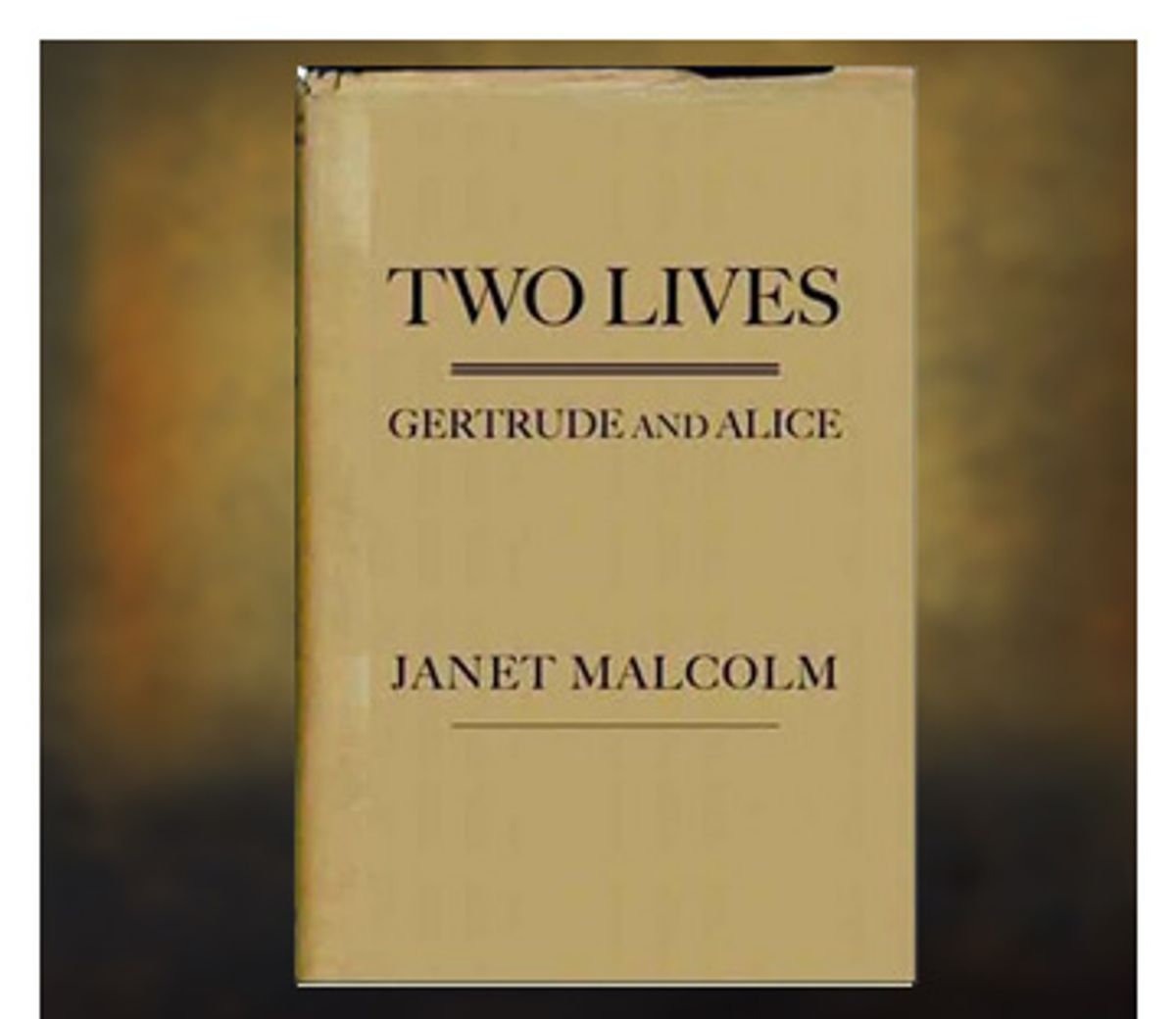
Uncovering Gertrude and Alice

Janet Malcolm's search for the real Gertrude Stein and Alice B. Toklas exposes some hard truths about the duo and biography itself.

  • more
    • All Share Services

Uncovering Gertrude and Alice

Gertrude Stein has a much deserved reputation as a great American writer whom no one reads. This is considerably different from being an obscure experimental filmmaker because, in the end, a difficult filmmaker will always have more fans than a difficult writer — not because one is a greater or lesser art form, but simply because it takes less time to watch a difficult movie than it does to read a hard book. I have absolutely no evidence to this effect, but my gut tells me — and it’s a strong gut — that there are probably more people who have sat through six hours of slow tracking shots across a desolate Hungarian farming collective in Bela Tarr’s “Satantango” than have slogged through the 900 pages of Gertrude Stein’s “Making of the Americans.” Six hours? Six hours won’t get you through Stein’s first chapter.

Even if you love the hard, repetitive machinations of Stein’s sentences, which draw on the same small pool of words turning over phrases until they are more or less meaningless concrete things — “This one was not really owning the one this one needed for his loving. This one could only own one this one needed for loving by getting rid of the one this one needed for loving” — even if you really love this, you will have to read each line over and over again. (John Ashbery read each sentence four times.) It will require more than devotion; it will require commitment.

To the extent that Stein is familiar to the reading public, it is as the voice behind “a rose is a rose is a rose”; as coiner of the term “Lost Generation”; as the host of a fabulous salon on the Rue de Fleurus where she hosted Picasso, among others; and as the fat Buddha with the giant Roman head who had a lifelong love affair with wiry, pursed-mouth Alice Toklas.

She cuts a striking figure. So it is that those who know Stein only by way of “The Autobiography of Alice B. Toklas,” or even those who know absolutely nothing of her many poems, plays, vignettes, speeches and novels, will find Janet Malcolm’s “Two Lives: Gertrude and Alice” hard to put down. The book combines three essays about Stein and Toklas that Malcolm published in the New Yorker in 2003, 2005 and 2006. (Some minor editing has been done, but there is no significant new material to be found in its pages.) Like the best New Yorker writing, which can make the average lay reader momentarily obsessed with the habits of bonobos, it requires no preparation.

The first section deals largely with how it was that Stein and Toklas, two Jews who almost never wrote about, spoke about or otherwise acknowledged their Jewishness, survived World War II while hidden in plain view in the French countryside. The somewhat distressing answer is that their political ignorance spared them from mental anguish and their friendship with a high-level Vichy collaborator, one Bernard Faÿ, spared their lives. It seems that Stein and Toklas were unaware of Faÿ’s crimes; after he was sentenced to prison following the war, Toklas lobbied for his release (which proved a little awkward for some of her friends). Helping Malcolm to unravel the story of Stein and Toklas’ relationship with Faÿ is a trio of Stein academics who warmly share their enthusiasm for her while taking pity on Malcolm for preferring the “audience”-friendly Stein to the “real” work.

In the second essay, Malcolm writes about “The Making of Americans,” the humongous novel whose central project seems to be creating “truly a new way of writing a novel, a novel where the author withholds the characters from the reader.” The book is a “text of magisterial disorder,” a tug of war between characters that Stein cannot bring to life and a narrator “aware of the incommunicability of her maddeningly complex thoughts.” Malcolm’s visits with the Stein oracles yield the story of one mysterious scholar, Leon Katz, who famously interviewed Toklas for many hours in the 1950s about the making of “The Making of Americans” and unpublished notes Stein made during the drafting of the book. Katz’s dissertation is a kind of “cult classic” in academia, and yet he has been remarkably slow to deliver (that is, publish) all the goods from the interview, which frustrates the Steinophiles to no end. Malcolm tries to meet him, and he cancels their meeting, afraid she will steal his narrative for her own.

The relationship between Toklas and Stein that emerges in “Two Lives” indicates that the two “did not set out on their walk through life quite as decisively and serenely as the legend has it.” Katz confronts Toklas with unflattering notes Stein wrote about her when they first met; Malcolm highlights passages from Toklas’ “What Is Remembered” that paper over a mysterious argument; a letter reveals the resentment Toklas carried against Stein because while Nazi looters ignored Stein’s precious modern paintings, they ransacked the pretty things — candlesticks, a petit-point footstool — that this “wife of a willful genius” cherished.

In one of the book’s most startling episodes, Ulla E. Dydo, one of Malcolm’s posse of professors, shares the discovery she made while painstakingly comparing Stein’s published texts to the manuscripts. In the book-length poem “Stanzas in Meditation,” Dydo found that every instance of the word “may” or “May” had been crossed out, replaced with “can” or “day” or “today.” The change was not an improvement — on the contrary, it made the difficult work even more awkward and, at times, nonsensical — and Dydo puzzled over why Stein would have made this revision.

In a dream, the answer came to her. Alice Toklas, according to “The Autobiography of Alice B. Toklas,” had come across a “forgotten” Stein novel, presumably “Q.E.D.,” which features May Bookstaver — a stand-in for a woman that Stein had loved before she met Toklas. Toklas became enraged, jealous, paranoid. According to Dydo, there are no “mays” in “Stanzas” because Stein was forced to eradicate them.

“The manuscript tells a terrible story,” another of the Stein scholars says to Malcolm. “The force with which these words are crossed out. The anger with which this was done. Some of the slashes go right through the paper.”

Craig Seligman once argued in Salon that the criticism that plagues Malcolm and her analyses of journalism and biography misunderstands her work. “She wasn’t attacking the biographer’s art any more than she had earlier been attacking the journalist’s,” Seligman writes in reference to “The Silent Woman,” Malcolm’s book about Sylvia Plath and Ted Hughes. “What she was doing, in fact, was engaging in it.”

This newest installment of what is very much an ongoing investigation into narrative — how a story is built, how facts are marshaled and how “truth” is agreed on — is likely to trouble readers who would rather not know certain facts about Stein and Toklas. But it powerfully demonstrates how their images have been built and passed down to us. And so while Toklas emerges from “Two Lives” as a pinched, unpleasant woman, at once enabler and destroyer of Stein’s art, Malcolm puts it into context. “Confessions of not really liking Alice are a leitmotiv of the Stein/Toklas memoir literature.” And yet, she continually emphasizes, it is impossible to know for certain what passed between the two. Biography is merely a tool, and like all tools, is limited.

In one instance, Malcolm learns from a source that Stein advised a friend to not adopt a Jewish orphan in 1943, effectively sentencing him to death. Yet when she digs a little deeper, she finds the incident actually occurred in 1944, four months before France’s liberation. There was never any question of putting the child in harm’s way, or of his leaving the household until it was safe. The source “had not realized that her laconic account could be read as a condemnation of Stein. She assumed that we knew what she knew.”

“Almost everything we know we know incompletely at best,” Malcolm continues. “And almost nothing we are told remains the same when retold.” Malcolm conjures up the figures of Stein and Toklas in flashes, temporarily igniting the letters and texts she makes such good use of. The biographer’s game is a kind of treasure hunt, and “Two Lives” lays bare its rules.

Christine Smallwood is on the editorial staff of the Nation and co-editor of the Crier magazine.

The face of genocide

It's apt that John Demjanjuk's death ends the Nazi atrocity-trial era. Foot soldiers made the Holocaust possible

  • more
    • All Share Services

The face of genocideJohn Demjanjuk waits in a courtroom in Munich. He was charged with 28,060 counts of accessory to murder and convicted of serving as a Nazi death camp guard. (Credit: AP Photo/Matthias Schrader)

The death of John Demjanjuk in a Bavarian nursing home brings to an end the most convoluted and lengthy case to arise from the crimes of the Holocaust. Demjanjuk’s legal odyssey began in 1977, when American prosecutors filed a motion to strip the Ukrainian-born émigré of his U.S. citizenship. It reached a conclusion of sorts last May, when a German court convicted the 91-year-old defendant of assisting the SS in the murder of 28,060 Jews at Sobibor, a death camp in eastern Poland.

The court’s verdict — Demjanjuk was sentenced to five years imprisonment only to be released pending appeal — aroused controversy, more here than abroad. Rabbi Marvin Hier, head of the Simon Wiesenthal Center in Los Angeles called Demjanjuk’s release “an insult to his victims and the survivors.” Yet the survivors and relatives of victims I spoke to generally expressed satisfaction with the Solomonic verdict. Little was to be gained by jailing the nonagenarian as his appeals wended through the court system. More important was the conviction itself, the fact that a German court had finally managed — nearly seven decades after the fact — to condemn one of the thousands of auxiliaries who served as the foot soldiers of genocide.

Germany rightfully enjoys the reputation as having succeeded in the difficult collective task known as Vergangenhetstbewältigung – confronting the past. While Turkey and Japan continue vehemently to dispute any responsibility for crimes of genocidal sweep, while Spain brings criminal charges against a local magistrate who dares to investigate Franco-era crimes, Germany has emerged as the poster boy for national self-reckoning, the land willing to face down its monstrous past. The casual tourist in Berlin cannot escape the public memorials to atrocity that dot the urban landscape with a mushroom-like plentitude. And when all else fails, German law serves as the muscle of memory, stepping in to prosecute those who would deny the Holocaust.

And yet when it came to bringing Nazi perpetrators to the bar of justice, the German legal system managed to amass a record of impressive failure that stretched back to its founding days. Hans Globke, the jurist who penned the law forcing all Jews to adopt Sarah or Israel as a middle name, enjoyed a stellar postwar career as Konrad Adenauer’s closest advisor. In early 1960, Fritz Bauer, the famous German-Jewish prosecutor, passed intelligence concerning Adolf Eichmann’s Argentine whereabouts to Mossad and not to his own intelligence office out of fears that Germany would botch or sabotage any trial.

More to the point, the vast majority of those who participated in the extermination process never faced criminal charges, and those unlucky few who found themselves indicted were either acquitted outright or received minor punishment. This was largely the consequence of a calamitous holding by postwar German courts that mere service as a concentration camp guard didn’t constitute a crime. Only if one had engaged in some value-added act of violence — such as the unauthorized killing of an inmate — could a former guard be found guilty of a crime. This calculus essentially used Nazi standards of legality in assessing the guilt of camp guards; or to put it another way, postwar German courts condemned only those former functionaries who could have been condemned by the SS’s own tribunals.

In this regard, Demjanjuk’s conviction in Munich represented an important corrective — though admittedly one long in coming. The Munich court accepted a novel theory of criminal responsibility specifically tailored to the realities of genocide. Sobibor, it needs to be recalled, was a pure extermination facility; its sole purpose was the killing of Jews. According to the prosecution, this meant that all Sobibor guards by necessity had been involved in the killing process. That the prosecution couldn’t prove Demjanjuk had beaten to death an inmate or shot another was immaterial; Demjanjuk had to have been an accessory to murder because as a Sobibor guard, that was his job. Once the prosecution was able to prove that Demjanjuk had served at Sobibor — which, despite the persistence of claims to the contrary, it was able to do beyond any reasonable doubt — its case was over. The theory was simple, irresistible in its logic, and yet no court in the Federal Republic had managed to embrace it — that is, before the court in Munich this past May.

It is, of course, regrettable that the German court system took more than a half-century to self-correct. Clearly there is something ironic about a precedent so late it coming that it will furnish no legal legacy.  Yet such is the fate of the Demjanjuk case. In the weeks after the conviction, German prosecutors announced their intention to use the novel holding to reopen long-moldering cases, but whether any of these will go to trial remains doubtful. Actuarial realities certainly make this less than likely.

Those inclined to cynicism may also find significance in the fact that this belated self-correction came in a case involving a non-German who served invisibly at the very bottom of the SS’s exterminatory hierarchy. True, Demjanjuk was no Eichmann; he was not even a Nazi, and never would have found service as a death camp guard had the former soldier in the Red Army not been taken as a POW by the Wehrmacht. But what does this prove? The fact that other, more senior functionaries in the exterminatory process lived out their lives unruffled by prosecutors conferred no immunity on an underling in genocide. And without the Demjanjuks of the world, the death camp system could not have functioned.

Few if any rue Demjanjuk’s death. Had his conviction been upheld on appeal, the nonagenarian would have faced imprisonment, a result his lawyers dreaded. And yet the prosecution also feared the appellate process, as the high court might have proved less receptive to its novel theory of responsibility than the trial chamber. In any case, his death brings us one step closer to the day when the Holocaust will pass from the memory of those who lived it and become an artifact of history. And it certainly brings to a close the era of galvanic Nazi atrocity trials that stretches back to Nuremberg. That this era should end not with a Goering or an Eichmann or even a Barbie in the dock is less ironic than it is fitting. The Holocaust was not accomplished through the acts of Nazi statesmen, SS bureaucrats and Gestapo henchmen alone. It was made possible by the Demjanjuks of the world, the thousands of lowly foot soldiers of genocide.

Continue Reading Close

Lawrence Douglas is James J. Grosfeld Professor of Law, Jurisprudence & Social Thought at Amherst College. He covered the Munich trial of John Demjanjuk for Harper’s magazine. His most recent book, "The Vices," was a finalist for the 2011 National Jewish Book Award.

Why did so many Nazis get away with murder?

The documentary "Elusive Justice" reminds us that only a fraction of German war criminals were ever punished

  • more
    • All Share Services

Why did so many Nazis get away with murder?Tuviah Friedman (23 January 1922 -- 13 January 2011) was a Nazi hunter and director of the Institute for the Documentation of Nazi War Crimes in Haifa, Israel. (Credit: Courtesy of Jonathan Silvers/Saybrook Productions)

Simon Weisenthal’s greatest contribution to the world was his dogged pursuit of Nazi criminals who escaped punishment at the end of World War II. His second greatest contribution was his reminder that despite being described as “the Good War” or “a just war,” not enough good was ultimately done, and comparatively little justice was meted out. Some of the most prominent and heinous architects of mass murder simply got on with their lives, and some were the recipients of largesse — jobs, travel assistance, even money and government protection — that was denied to the people who endured their cruelty. And we tend to forget that for every high-ranking sadist or mass murderer who was imprisoned or executed after the war, thousands more who assisted them directly (through action) or indirectly (through silence) were never even called to account.

This grim fact is the jumping-off point for “Elusive Justice” (Tuesday, PBS; check local listings), a documentary by Jonathan Silvers about Holocaust survivors (and victims) and the German war criminals that still weigh on their minds nearly 70 years after the end of the war. Narrated by Candice Bergen, the movie hits some of the expected topics and people, including the Nuremberg Trials and the efforts of Weisenthal (who disliked being called a “Nazi hunter” because so much of his work consisted of sifting through documents) and Asher Ben Natan, who funded and organized ex-Nazi-tracking operations in Europe.

But for the most part, the movie loiters around the edges of the best-known events, delving into stories that we haven’t heard before, and philosophies and feelings we rarely hear articulated in a documentary like this one. And it pays special attention to the mid-level officers, party officials and anonymous citizens who carried out orders from the top. Some of these people fled to other countries after 1945, but most returned to their pre-war lives. One survivor asks, “Why the hell should they sleep like babies while I have nightmares?”

The film contains much unresolved discussion of the difference between justice and vengeance, and how the Nuremberg tribunal was created in order to head off an international wave of vigilante mayhem. A couple of once-persecuted Jews who killed Nazis during and after the war offer a spirited defense of vengeance. At one point the film suggests that despite the noble intent behind the Nuremberg Trials, they might have inadvertently hurt the long-term cause of justice, by making most of the world subconsciously believe that it was all over and the good guys won and there was no need to trouble our minds with any of it.

One of the movie’s subjects is an elderly Viennese man who narrowly survived being euthanized at the notorious Am Spielgelgrund clinic, where children deemed “undesirable” by the government were experimented on or killed and then dissected. In 1997, when the filmmaker was an ABC News producer, he managed to track down Dr. Heinrich Gross, who once ran the clinic, and interviewed him on a public street. “If you didn’t do what you were told, you would have been killed by the Nazis,” the elderly doctor said at the time — the justification of so many mid-level participants in war crimes. Three years after the ABC report aired, the doctor was charged with complicity in mass murder. The trial ended four days after it started when the presiding judge declared Gross medically unfit to stand trial. He died in his home in 2005. “And that was our so-called justice,” says one of the doctor’s victims.

Continue Reading Close

Inside “Maus”

25 years later, Art Spiegelman gives us a behind-the-scenes look at his seminal Holocaust graphic novel

  • more
    • All Share Services

Inside
This article appears courtesy of the Barnes & Noble Review.

Among those of a certain age, is there a soul who doesn’t remember how brilliantly “Maus” lit up the night when it burst upon the scene in 1986? A deeply serious comic strip of the Holocaust before the category of graphic novel was common coin, with Jews depicted as timorous mice and Nazis as bestial cats, “Maus” was scandalous in concept, jaw-dropping in execution, and, beneath its transgressive exterior, humbling in its rigorous yet gentle understanding of the victims of one of the seismic events of the 20th century.

Barnes & Noble Review
Lest you’ve forgotten any part of this, “Maus” mastermind Art Spiegelman is publishing “MetaMaus” to mark the 25th anniversary of the original. And after a quarter of a century, the work still provokes spellbound fascination and anguish in equal measure.

As a fellow member of the so-called Second Generation, or children of survivors, who’ve written books on the subject so central to our lives, let me attest to how handily the original “Maus” beat us all to the punch. Spiegelman’s first version was actually published 14 years earlier as a three-page underground strip in 1972. To put it in the proper time frame, this was during an era when the word “Holocaust” was scarcely spoken in polite society. The general public was locked in ignorance. Survivors were choked by a sort of guilt-by-association shamefulness. The Eichmann trial was only 11 years in the past; the taboo-breaking Holocaust TV miniseries six years in the future. As a measure of how traumatic the events of World War II were, the American Jewish community as a whole remained so shell-shocked that they had barely begun the supernatural task of processing it. Along came Spiegelman’s distinctly un-Disney-like hordes of mice to jolt us from our complacence, its first volume (“My Father Bleeds History”) in 1986 and its second (“And Here My Troubles Began”) five years later.

Like a director’s commentary track, the new “MetaMaus” provides a kind of behind-the-scenes “Inside ‘Maus’” that rewards us with insights this reviewer, for one, was too blown away to perceive the first time around. It’s built on a very distilled and definitive four-year-long interview with “associate editor” Hilary Chute, who deserves more credit than she receives (she’s not even listed on the front or back covers) for posing exactly the right questions, such as this one: “Were there times when you felt that perhaps comics wasn’t the best medium for your father’s story?”

Answer: “I came up against things in ‘Maus’ that involved imparting general information, and those were the moments when I would despair and think: Well, maybe I should just do something that’s a combination of prose and comics, use comics when it’s appropriate, and just typeset pages of prose when that seemed appropriate. But that would have been a real cop-out.”

And this: “Aside from Expressionism, what aspects of visual or literary modernism have you found productive?”

Answer: “I was interested in the fact that us low artists [i.e.. cartoonists] were the only artists still interested in drawing the human figure when all of modernism was moving away from that.”

The book is filled with similar revelations, such as the eccentric nature of Spiegelman’s influences. These embrace not only the German-born American artist Josef Albers (his “concern with retinal information rather than drawing per se”), but also “Little Orphan Annie” (which “offered me a more direct validation that comics could actually carry emotional resonance despite, or probably because of, the abstraction of the language and visuals”), as well as Mad magazine pioneer Harvey Kurtzman, whose sensibility Spiegelman credits with radicalizing “what we now think of as humor.”

Along the way, Spiegelman provides a glimpse into his years of apprenticeship, as well as a graduate-level course in comics semiotics: not only how eye movement works on the page, frame by frame, but how the graphic architecture serves in specific cases to deliver the narrative. As such, it is nothing less than a treatise on the rhythm and grammar of comics storytelling. The visual vocabulary he utilizes turns out to be more ingenious than you (or I, at least) ever suspected. Who knew, for instance, that on one page the smoke from the narrator’s cigarette was meant to be subconsciously seen as smoke from the crematorium in the panel below? (Another throwaway revelation: “I do believe that the self-destructiveness of my smoking is not totally unrelated to the secondhand memories of secondhand smoke” his parents breathed from the crematoria.)

In fact, Spiegelman doesn’t so much rapid-fire his replies as he chain-smokes them, one after the other, torching one eye-opener from the spark of the previous. On how he managed to condense such encyclopedic information into two volumes: “‘Maus’ could have been ten times longer if I’d just not tried to pack it as tightly.” On why he chose this most daunting of topics to begin with: “My work life has mostly consisted of finding the hardest thing I’m capable of doing to placate the Hanging Judge within. I wanted a challenge worth meeting as I turned thirty, and ‘Maus’ qualified.”

(More about that Hanging Judge: “Drawing doesn’t come easily to me — maybe I’m lazy like my father always told me I was.”)

Most important, he manages to explore the fluidity of the fiction/nonfiction divide that inevitably plagues historic narrative, and to confirm that they are not as easily segregated as naive commentators would have us believe. Acknowledging that “memory is a very fugitive thing,” he cobbles a workable reply to those who insist on its rigidity. “I still puzzle over what fiction and nonfiction really are. Reality is too complex to be threaded out into the narrow channels and confines of narrative and ‘Maus,’ like all other narrative work including memoir, biography, and history presented in narrative form, is streamlined and, at least on that level, a fiction.” To flesh out his point he shares the delicious anecdote of how, before the New York Times Book Review saw the light and acceded to putting the book on the nonfiction side of the bestseller ledger, one benighted editor argued, “Well look, let’s go out to Spiegelman’s house and if a giant mouse answers the door, we’ll move it to the nonfiction side of the list!”

Fortunately, more enlightened minds prevailed. The result has forever helped redefine our attitudes toward history and the art that attends it.

Continue Reading Close

Daniel Asa Rose is the author, most recently, of "Larry's Kidney: Being the True Story of How I Found Myself in China With My Black-Sheep Cousin and His Mail-Order Bride, Skirting the Law to Get Him a Transplant ... and Save His Life" – named one of the top books of the year by Publishers Weekly.

“Death in the City of Light”: A serial killer in Paris

A new masterpiece of true crime writing explores the quest for truth and justice in an immoral society

  • more
    • All Share Services

At its worst, the true crime genre offers its readers a wallow in lurid sensationalism, but at its best it provides an opportunity to scrutinize the ways a society establishes truth and justice on the ground. For all its masterful storytelling, Eric Larson’s bestselling “The Devil in the White City” — which grafted a portrait of the architect who designed the Chicago World’s Fair in 1893 to the grisly dish on a serial killer who preyed on tourists drawn to the exhibition — never quite managed the latter. Dave King’s absorbing new book, “Death in the City of Light,” does it better, landing just shy of setting a new standard for the form.

“Death in the City of Light” recounts the infamous case of Marcel Petiot, a physician believed to have killed over 60 people in Paris between 1942 and 1944, under the Nazi occupation of the city. King presents the story as a procedural, beginning with the day in March 1944 when residents in the chic 16th arrondissement complained of a foul smoke billowing out of a neighboring townhouse. When attempts to rouse the house’s inhabitants proved fruitless, the fire department was called. In the basement, they found a coal stove with the “charred remains of a human hand” sticking out of it. Body parts and bones littered the floor. Further police investigations discovered a pit in which numerous corpses in various stages of decay had been covered with quicklime. In total, over 11 pounds of human hair would be gathered from the remains.

If King’s book has a protagonist, it’s police detective Victor Massu (an inspiration for Georges Simenon’s Inspector Maigret), who picked up the case at the beginning. Determining, capturing and convicting the culprit, however, would prove supremely challenging in a city whose civil institutions were hopelessly compromised under Nazi rule. It was difficult for anyone to sort out wrong from right. For example, the patrolmen initially dispatched to the scene allowed a man claiming to be the brother of the owner to enter the building and take away some undetermined piece of evidence. Why? Because he assured them that the house was a Resistance outpost and that the bodies inside it were the remains of “Germans and traitors to our country.” Later, they learned that the man was in fact Petiot, the house’s owner and the prime suspect.

People were disappearing from Nazi-occupied Paris in droves. Some escaped to Spain and beyond via clandestine networks. Others vanished into the prisons of the Gestapo; you could be arrested for something as simple as wearing red, white and blue on Bastille Day. Above all, the city’s Jewish population was subject to raids and deportations, plucked from their homes or off the streets and loaded into trains destined for death camps, never to be seen again. This made identifying the dismembered and mutilated remains in Petiot’s charnel house extremely difficult, especially given that the parts of the bodies most useful to this process were missing.

King sketches this background in brisk, workmanly prose. At first it seems a bit too workmanly, but as the case evolves into a bizarre farrago of false identities, paranoia, wild goose chases, rumors, secret agendas and outright delusion — all liberally sprinkled with Gallic histrionics — the choice makes perfect sense. Authorial flourishes would be superfluous in a story already replete with penny-dreadful details: a mysterious femme fatale, a coffin stuffed with treasure just before it was interred, a crime boss who “obsessively collected” rare dahlias and orchids and entertained socialites in his lavish townhouse while members of the Resistance were tortured in the cellars beneath, and so on.

The authorities finally caught Petiot after a seven-month search. By then, Paris had been liberated — an event described with crisp brio by King — and Massu had been charged with collaboration, losing his job. (He was later fully exonerated.) The doctor was deliberately goaded into revealing himself by a newspaper that ran the wild testimony of a witness (who later disappeared), alleging that Petiot was a cocaine smuggler who hired prostitutes to have sex with other men while he watched and who wore German uniforms to hunt down Resistance fighters. Outraged, Petiot sent the paper a long, handwritten note filled with clues that led to his apprehension. He was working under a false identity as a captain in the counterespionage service, where he participated in the investigation of his own crimes.

Petiot’s trial gave him further occasion to display his almost superhuman brazenness. He was accused of operating a false “escape agency,” promising to spirit people out of France, then killing them and stealing their valuables. Petiot maintained that he had worked for a Resistance operation, called “Fly-Tox,” that “liquidated” collaborators and informants. He painted his victims — including several Jews fleeing Nazi persecution — as Gestapo agents. He admitted to killing scores of people, just not the ones found in the townhouse. Those corpses, he insisted, had been planted there by the Gestapo in order to frame him.

The trial quickly became a three-ring circus — a situation exacerbated by the French judicial process, which allows civil attorneys hired by victims’ families as well as prosecutors to question witnesses and permits the participants (including the defendant) to interrupt testimony and statements. The quick-witted Petiot lambasted his enemies with barbed jokes and accusations of collaboration, capitalizing on the uneasiness everyone felt in the aftermath of the war. He nearly came to blows with one attorney while on the stand.

Petiot was not the only one to misbehave. Incredibly, the presiding magistrate was quoted describing the accused as “an unbelievable demon” and “an appalling murderer” in the press while the trial was in process and yet no mistrial was declared. The public fought over spots in the overflowing courtroom, then camped out, munching on sausages and sandwiches and shouting remarks like spectators at a sporting match. It was the best show in town. The writer Colette turned up to report on the trial, and such luminaries as Prince Rainier of Monaco and the duke of Windsor requested seats.

King has unearthed new evidence (a first-person account of the early days of the investigation written by Massu not long after the trial) to counter the widespread assumption that Petiot killed his victims via lethal injections. He also suspects that Petiot had powerful protectors in the Occupation regime and presents a convincing case for those suspicions. But the most startling impression left by “Death in the City of Light,” is of Paris itself, confronting the bestiality lurking behind its supremely civilized facade, and of the handful of Parisiennes who tried to serve justice in spite of it.

Continue Reading Close
Laura Miller

Laura Miller is a senior writer for Salon. She is the author of "The Magician's Book: A Skeptic's Adventures in Narnia" and has a Web site, magiciansbook.com.

Birthers: You know who else wasn’t eligible for the presidency? Hitler!

World Net Daily finally asks to see der Fuhrer's birth certificate

  • more
    • All Share Services

Birthers: You know who else wasn't eligible for the presidency? Hitler!Adolf Hitler and Joseph Farah

Joseph Farah, founder of WorldNetDaily, the Internet’s dumbest news organization, has posted a very compelling and serious editorial today at his silly website of nonsense and post-apocalyptic seed advertisements. To sum it up: Barack Obama is ineligible to be president because Hitler.

The American political and media elite have determined, for whatever reason, that the Constitution’s eligibility requirements for the presidency are not important.

That is the only conclusion one can draw from the misinformation, disinformation and disinterest they have shown to the serious questions swirling around not only the unique case of Barack Obama but also to the definition of “natural born citizen” in future presidential elections.

It’s not unprecedented that failing republics dumb down eligibility requirements for the presidency. It’s not unprecedented that failing republics ignore or obscure eligibility requirements for the presidency. It’s not unprecedented that failing republics make tragic mistakes in permitting non-qualified candidates to serve in the presidency.

It happened in 1932 in Germany with a candidate named Adolf Hitler.

“Failing republics”! Why does Joseph Farah not believe in American exceptionalism?

Also, I know this is entirely beside the point, but: Hitler wasn’t ever elected president. He was appointed chancellor by German President Paul von Hindenburg. (The “loophole” that allowed Hitler to assume that office was that he legally obtained German citizenship.) When Hindenburg died, Hitler left the presidency vacant and (illegally) assumed the power of the office, but not the title. In other words: Hitler, who was legally eligible to be the president of Germany, was never the president of Germany.

Joseph Farah can’t even competently compare Obama to Hitler. This is basic wingnut stuff!

Continue Reading Close
Alex Pareene

Alex Pareene writes about politics for Salon and is the author of "The Rude Guide to Mitt." Email him at apareene@salon.com and follow him on Twitter @pareene

Page 1 of 20 in World War II