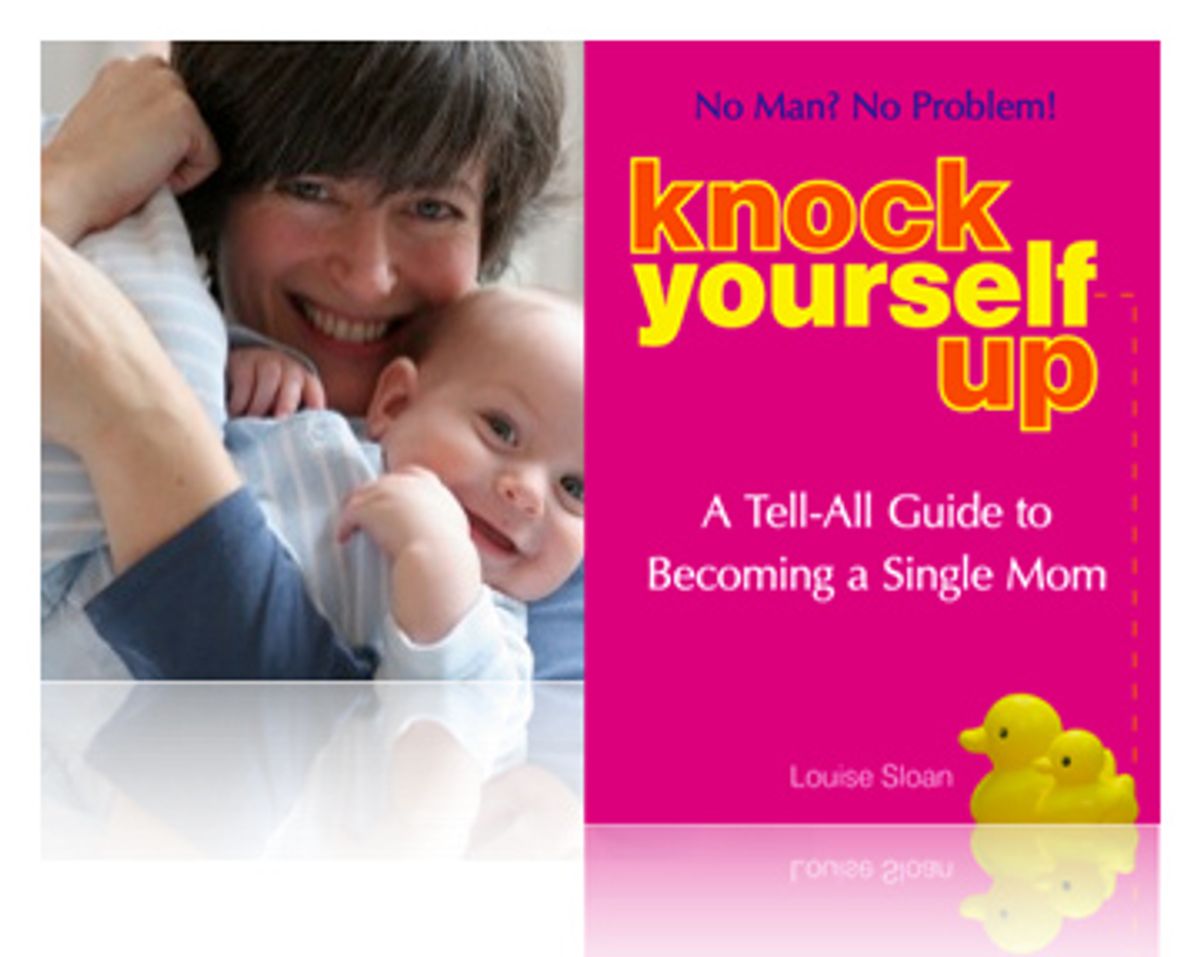
"Knock Yourself Up" author Louise Sloan explains that becoming a single mother isn't always easy but ultimately defies every right-wing stereotype.
To listen to a podcast of the interview, click here.
To subscribe: Click here to add Conversations to iTunes or cut and paste the URL into your podcasting software:

On Labor Day weekend, a midwife’s favorite holiday, Louise Sloan, a 41-year-old lesbian, had semen Fed Exed to her mother’s summer place in Kennebunkport, Maine. Sloan, a magazine writer and editor, had always imagined she’d become a mother as part of a couple. Instead, here she was, a single woman accepting delivery of a stranger’s sperm at the summer home of her 70-year-old Republican Southern mother, then informing the prospective grandmother that she was headed upstairs by herself to “baste.” (Think: turkey baster.)
Sloan interviewed dozens of self-described “single mothers by choice” — both straight and gay — for her new book, “Knock Yourself Up: A Tell-All Guide to Becoming a Single Mom.” Like many of them, for Sloan, fulfilling the dream of having a child meant more than holding out to find a life partner to start that family with. In her early 40s, she writes, her biological clock had begun to sound like a “car alarm.” So she decided to try to have a baby, while it was still a possibility for her, and hope to meet the love of her life later on.
In the book, Sloan weaves together the experiences of other mothers who made the same choice she did, ranging from a Navy officer stationed in Georgia to a Manhattan nonprofit manager who has twins. She briefly surveys the limited research on how such children fare, but mostly she dishes up advice to potential single mothers on everything from cyber-stalking your sperm donor — not recommended — to deciding if you should list your child in the Donor Sibling Registry, where kids can meet their biological half-siblings on the father’s side.
Of course, a book with the cheeky slogan “No man? No problem!” emblazoned on its pink cover above a rubber ducky is bound to raise the ire of social conservatives. Remember the Dan Quayle vs. “Murphy Brown” imbroglio, in which the vice president sanctimoniously scolded the TV character for bearing a child alone? Yet, ripping on the moral character of such moms did not go out of fashion with the Bush-Quayle administration. In 2006, syndicated columnist Kathleen Parker accused such mothers of treating men as “only as good as their sperm count” and children “as accessories to adult lives.” In 2007, columnist Mark Davis wrote that any justification for purposefully bringing a child into the world without a father amounts to so much “selfish twaddle.”
But what’s most heartening about the women’s stories in “Knock Yourself Up” is how often disapproving ideology melts away when doubting family members, friends and acquaintances encounter a happy, thriving child. Sloan’s own blue-blooded mother spent eight weeks with her daughter and then newborn grandson, Scott, teaching Sloan all the words to “Tea for Two,” and offering a grandmotherly heap of unsolicited parenting advice. What could be more traditional?
Salon spoke with Sloan, now 44, by phone from her home office in Brooklyn, N.Y., where she lives with her 15-month-old son, about what single motherhood by choice means for the moms and their kids. (Listen to the interview here.)
How did you decide to have a baby on your own?
I wanted kids when I was 28. I had a partner, and I was very seriously planning on having kids in the next year or two. And I kept on being put off by my partner for two more years, two more years, two more years. Then we broke up after an eight-year relationship. And in every relationship since then the idea of kids has been a big part of the discussions, but those relationships did not survive either.
What did you have to go through to get pregnant on your own?
I ended up having really bad luck with a sperm bank. It turns out that the first donor that I used had sperm that just wasn’t working for anybody, and I used that donor for eight tries. I ended up getting pregnant with the second donor on the second try.
That was actually try No. 10, and I had a miscarriage. Then I got pregnant with my son, Scott, on the second or third try after the miscarriage.
In what form did you receive the sperm?
Mostly I did inseminations at the doctor’s office, because an intrauterine insemination is more successful statistically than using frozen sperm at home. But there were times when my doctor’s office was closed for a holiday, and I did home inseminations.
The sperm comes in a liquid nitrogen tank that kind of looks like a bomb. I had one experience where I had to go pick it up from a Fed Ex office, and the woman there starts lugging the tank back from behind the counter, and saying, “It’s always you semen people who have late deliveries.” She was used to getting shipments to veterinarians and animal breeders, and so she assumed I was breeding animals, not myself.
Do most single mothers by choice use a sperm bank, or do most use a so-called known donor, like a friend?
Most use a sperm bank, and the reason is that using a known donor is much more legally and emotionally risky. It’s actually what I wanted to do. I wanted to have a father figure for my child. I did ask a couple of close friends, but they didn’t agree to it. They felt like they would be creating a distant father experience for the child. One of my friends felt like he would feel responsible if I fell on hard times with the baby.
How much were you able to find out about the donor you did use, and how much did you want to know?
I wanted to know everything. I would have wanted to meet him. There are some egg donors with whom you can arrange a coffee interview before you sign up to use their egg. That’s not the case with sperm donors, although I just heard that somebody is talking about doing a bank that has identity-release donors, where you have their adult picture.
What identity release means is the donor has agreed in advance to have his identity released should the child request it at age 18. I wanted that option for my child, and at the time that I was looking at sperm banks that was not at all standard. There were only a few sperm banks in the country; most of them were pretty small sperm banks that offered the open-identity option. Those sperm banks happened to be ones that had fewer other products. With some sperm banks you can get an audio interview with the donor. You can get a long essay that he’s written. You can get various adult photos, childhood photos. I didn’t have access to most of that kind of information.
I had a two-page form that he had filled out with really only two lines for each question. And then I had a rather lengthy family health history that he had filled out with the help of someone at the sperm bank. And I also had two photos of him when he was probably 7 or 8, so that was great.
But I felt like I knew hardly anything about this guy, and it was very difficult to make the decision to go ahead and to have a child who would be 50 percent from the genes of someone that I hadn’t met, and that I knew so very little about. I had a conversation once with one of the women who worked at the sperm bank, who happened to run into him in the coffee break room the day before, which she recounted, and he sounded very charming. That was one of the most valuable pieces of information.
How many different women can a single sperm donor give to?
It’s not regulated, so it depends on which sperm bank you use as to what their policy is. The sperm bank I used allowed 15 families.
In an open-identity donor situation isn’t there some concern that when your child calls the donor at age 18, the donor will have already heard from many, many other children?
Absolutely. I don’t know how these guys are really going to emotionally deal with that. Having kids knock on your door or call you up 18 years later must be pretty overwhelming.
I wanted to use a donor who had not had a lot of pregnancies result yet, because I wanted my kid to be one of the first in line. Of course, it turns out the first donor I used, one of the reasons he didn’t have pregnancies is that he wasn’t getting anyone pregnant.
What’s your response to people who wonder why you didn’t just adopt?
I would ask: Why doesn’t anybody just adopt? I think that adoption is in many ways a better thing to do for anyone, single or married. But, like many women, I really wanted the experience of being pregnant, of having a biological link to my child. It’s just the way that I always dreamed of doing it, so that was my choice.
Do you think that single mothers who actively choose to have a baby face more or less social stigma than women who just happen to be single mothers?
I expected to find outside of places like New York City or Los Angeles or San Francisco that women were really struggling socially. I expected to hear tales of discrimination and woe, and I really didn’t. Even speaking to people in the South and in the Midwest in fairly conservative communities, I found that the communities around those people were really quite supportive. Even when they were fairly conservative religious families, they may have been shocked at first, but since they knew the woman involved, and knew that she’d make a great mom, and knew that she had thought really carefully about it, they were surprisingly supportive of her choice to become a single mom.
Why do you think that it’s important to “come out” as a single mother by choice?
I think that if you have reservations or shame around having become a single mother and having chosen to be an alternative family in that way, that shame is going to be transmitted to the people you speak to about it, and it’s also going to come through to your child.
I think that it’s really important to make sure that your child feels that the way that she or he came into this world was a positive and happy thing. And so you need to have that attitude yourself. Also, in speaking to other people, if you present it as a weird, questionable thing, you’re more likely to get a negative reaction.
I’m sure that you read the recent news story about a 60-year-old, single Japanese woman who is pregnant with a donated egg.
Oh my goodness. Yeah.
I just wondered what you thought when you read that.
I don’t know that I want to necessarily be quoted as criticizing other women for their reproductive choices, but certainly at age 60 I would have serious concerns about my longevity and my ability to be around for that kid. It’s not a choice that I would have made, but I don’t know the specific circumstances of her and her life. And I probably have the same knee-jerk response as most people do. I was worried about being too old at age 40, so let’s just leave it at that.
Since your son is so young, what have you learned from the experiences of other women who have older children about how being a single mother has impacted their children?
I agonized before having my son about his only having one parent, and not knowing his father. Things like that seemed very painful to me, because I experienced that kind of pain growing up without a father myself; he died when I was not quite 2. It was often painful and sad for me not to have a father, and I did experience a longing to know a father that I would say I still have to this day.
It’s not that it’s not an issue at all for the kids of single moms, but it’s not an issue in the same way as it is for someone like me who actually had a dad and lost him. And that’s reassuring, because that was really my biggest worry. It seems to be by and large good news that if you create a healthy, loving home environment for a child, the child will flourish.
And has there been much psychological research on children conceived this way and raised in single-mother homes since infancy?
There’s been some. The research that has been done shows basically that if there is strife in the home the child will suffer, but if there is a supportive, loving environment the child does pretty well.
One study showed that the kids who had just a single mother tended to have more arguments with the mother when they were teenagers. The suggestion there was that in the families that had fathers it was the father who was the disciplinarian, and so it was natural that the mothers in the families that didn’t have a father would end up having a few more of those disciplinarian arguments with their teenagers.
So you have a few teenage fights to look forward to?
Exactly! Maybe so. I hope not.
What do you think is the biggest public misconception about women who decide to have a child on their own?
You know, I don’t know what the biggest public misconception is, but I can tell you what the biggest misconception is according to me.
I just went and filled in for someone teaching a workshop on choosing single motherhood. Even though the women I know who have done it are attractive, successful, great women, even though I hope that I fit into that description as well, and I don’t feel like there is anything wrong with me, I went into that workshop expecting to see a bunch of losers. And I was surprised to see a bunch of really attractive, articulate, educated, successful women. And when I realized I was surprised, I thought: “What is the matter with you?”
Obviously, even though I’ve talked to a million great women on the phone, I still have this assumption that something went wrong somewhere for someone considering this course of action. And I think that what went wrong somewhere is really nothing. We’re living in a different world, where women are pursuing careers and not getting married in their 20s as they used to. Also, women are not accepting and staying in bad relationships just to have kids.
What’s one piece of advice you would give a woman who is thinking about doing this?
Well, my first piece of advice is be really, really sure you want kids. I think that there is way too much pressure on women to have kids — pressure from society, pressure from prospective grandparents.
Go out and talk to women who have done it. Join a support group, which I didn’t really do. I think it would have made it a lot easier to clarify my feelings about it, and to get past some of my fears. For some women, talking to women who have done it clarifies their decision not to do it.
Do you feel like you are personally Dan Quayle’s worst nightmare?
If Dan Quayle met me and met my son, Scott, and saw our happy family and saw us in the context of my extended Republican family — I certainly didn’t vote for him, but probably most of my family did — I think he would be pretty supportive of it.
When you take something like this down to the level of one-on-one interaction, I think it’s a lot harder to demonize.
Bring it on, Dan!
I’m smoking too much pot
I know I'm going to have to quit once I get pregnant, but I need it for the stress relief
(Credit: Zach Trenholm/Salon)
Dear Cary,
I’m a 25-year-old female, I work two jobs, I’m engaged to a great guy.
Right now, both of our full-time jobs suck. We’re stuck with bosses who don’t appreciate us, even though we are both inherently hard workers. So we are trying to support each other and have jointly decided to move 2,000 miles away to another city where there are more jobs, and where we both have some family.
We like the city we’re going to move to no more than the one we are in, except for more opportunities, cheaper taxes, and great access to the mountains. I have moved cities several times in my life and I enjoy the thrill of the change, and this move does feel right. So, hopefully our job issues will be resolved in a few months in a new setting.
I am very eager to have babies with the man I love. With us now moving, kids are on the back burner because we won’t have health insurance until one of us lands a job with benefits. We had been trying to get pregnant until the decision to move was made because I have decent benefits with my current hateful job. (One of the reasons I haven’t quit, the other main one being that I’m trying to hold this job out till we can move.) I really want kids soon; I have wanted to be a mother since I was 5. But the stress of life and my failing body seem to want other things for me. I had injured my back at work and now am in physiotherapy to heal it, yet I’m still obligated to work my full shifts. Those eight-hour shifts literally drain me. I haven’t had a period in 3.5 months (my doctor insists it’s stress-related). And most recently, my pap test came back with abnormal cells on my cervix. No further tests have been done, but my doctor thinks my back, lack of period and abnormal cells are at least partly because of too much stress. Hard not to be stressed when all these symptoms have made me worry and fret even more about never being able to have children! The more that I worry, the more stressed my body becomes. The more symptoms of the stress I experience, the more I worry. (A huge catch-22.) One of my worst fears is to end up being barren.
On to my other issue. My fiancé and I both smoke marijuana regularly. I will note here that we do not smoke cigarettes at all, nor do we drink alcohol very often. Although I have heard that it can prevent couples from conceiving, I only “slowed it down” when we were trying to get pregnant. My fiancé seems to have his usage under control. He is able to use on a part-time basis and not every evening and every weekend. I am a different story altogether. I use (abuse) marijuana for stress. I rush to get home after work to have the bad memories of the day dissolve into higher thoughts. I am not high at work, but evenings and weekends are full of my usage. It’s the way I’ve taught myself to deal. Although I don’t think marijuana is an “evil drug” that “leads to other drug usage,” I know that I am misusing it. I have never felt the need to try any other drug (besides alcohol and caffeine). But I barely even notice the effects any more. Despite that, I can’t imagine quitting it altogether. I know that if I were pregnant I would not smoke at all, because there is another human being involved who would be affected by it.
But without marijuana, how would I deal with life’s stress? Plus there is some part of me that feels like marijuana is not bad. You ought to know that in my family, a few other people smoke marijuana. My aunt and cousin probably use it once daily, and my mom and brother once or twice a week, and my dad on occasion. While they never permitted any drug usage as a teenager, I found out and smoked with family after turning 19. Obviously this is a huge part of the reason why I can’t seem to convince myself that marijuana is “bad.”
This new city will not have any marijuana contacts for my fiancé and me, and it is my plan to stop smoking when we move. But really, I don’t want to stop at all, and I feel like I’m lying to myself by thinking that a new city will stop me from finding a way to do it. Plus, my fiancé is moving first, and we will be apart for a month (we’ve never been apart for longer than 10 days in the past four years). I know that with him gone, I will want to smoke even more. Especially because I feel like I want to get as much smoking in before I “can’t” anymore.
I know several people who use marijuana more than I do and who firmly believe that no one can get addicted to it. I guess I’m not so sure about this, but I would like to believe it because then I’m just a hippie and not an addict. I worry about the usage affecting the physiotherapy on my back, but since we aren’t trying to get pregnant, I still smoke whenever I want to. My fiancé knows that I smoke too much, he knows that I KNOW that I smoke too much too. But month after month he still brings it home for us. I have tried to quit before, asking him to keep it all hidden and out of sight. This always fails, because I will find it and sneak some or bug and bug him to get it out of hiding for me.
I don’t think I can stop until he stops bringing it into the house and we get rid of all the marijuana paraphernalia that is around our place. If my fiancé doesn’t want to quit with me, I would be disappointed. But as long as he kept everything out of our house and cars, I think I could do it. I really do want children in the long run and better physiotherapy results in the short term. What do I do?
Moving and Shaking
Dear Moving and Shaking,
You are using marijuana to relieve stress.
Stress is your problem. Whether you stop smoking marijuana or not, you need to learn more and better ways to relieve stress.
Start doing tai chi; start doing yoga; meditate; take naps; breathe deeply a lot; do biofeedback. If you are doing any of these activities already, don’t conclude that since you’re doing it a little it must not work. Instead, do it more.
You may need higher doses of yoga to get relief. Also, if you are consuming lots of caffeine, see about cutting back. Try substituting some herbal teas for caffeinated beverages now and then. Notice the difference. Especially in the afternoon, cut out the caffeine so you can get a better night’s sleep.
You will notice things about yourself this way. You will notice the different qualities of consciousness that arise from various techniques. It will be entertaining and interesting. You will notice a gradual improvement in your ability to go through life in a relaxed, worry-free way. Unpleasant activities like work and dealing with power-hungry blockheads will go more smoothly.
During this time, you might want to experiment with not smoking for a time. Pick an occasional time when you are stressed out, and instead of smoking, do 15 minutes of meditation, or some tai chi or yoga.
Don’t try to quit all at once, especially not on your own. Just learn some better relaxation techniques. Take it easy. Look for gradual improvement.
Once you’ve found other ways to relieve stress, you may not feel so fearful about the idea of quitting marijuana for good. Try going without for a few days at a time and see how that goes. You can always smoke. But experience what it’s like to handle life without it. Try to get accustomed to that feeling. You may feel slightly on edge, but take a deep breath of fresh air instead of a hit of weed.
The thing is, whether you call yourself an addict or not, changing habitual behavior is hard, and it’s especially hard to do alone. It’s hard to do without a program. It takes time, effort and support, and there are ups and downs. So I wouldn’t recommend trying to stop smoking marijuana on your own, or just with your fiancé.
As you say, for a variety of reasons, you are going to want to quit. So what I’m suggesting is that you prepare, in these ways, for the day when you will need to quit. I’m sure marijuana gives you other things besides stress relief; it probably gives you a heightened sense of the beauty of life, of tastes and sounds, and of general well-being. These things you may need to seek out in life; I find that there are other ways to feel these momentary highs. Seek them out.
For quitting things, as you probably know, I favor the 12-step method because it has added benefits: It helps you get your life together and is a lasting program of living. It is a community. It works for a lot of things.
When and how you quit is up to you. I can say that based on experience, it is definitely possible. You can quit and lead a normal, happy life, when you’re ready to. My bottom line is just that A) You should acquire new stress-relief methods first, before trying to quit, and B) what was B? Oh yeah, B) Don’t try to quit on your own. If and when you do decide to quit, do it with a group or a program behind you.
And, hey: Good luck. You sound like really nice people and I wish you the best in life. And say hello to the kids when they come. And say hello to the mountains.
Was I selfish to have fertility treatments?
As the mother of twins, I know people suspect I had help getting pregnant. But why am I so self-conscious about it?
(Credit: Franz Pfluegl via Shutterstock)
When I found out I was pregnant with twins, one of my first thoughts was, “Great. Now everyone’s going to wonder if I had fertility treatments.”
And they do: People ask all kinds of probing questions — from the sometimes innocent, “Do twins run in your family?” to the blatant, “Was it natural?”
And it wasn’t. Our twins were the result of ovulation stimulation drugs and an IUI (intrauterine insemination).
But the question I started asking myself was: Why should I care if people suspected or knew I needed “help” getting pregnant? Especially in an age in which so many women seek medical intervention when they have trouble conceiving. And especially at a time when twins are becoming the new normal: Recently, the CDC reported that 1 in every 30 babies born in the United States today is a twin.
Part of my self-consciousness came from the fact that infertility treatments are an intimate affair. Your private parts are prodded, your internal organs scrutinized, and your bodily fluids drawn. Nobody looks at one little baby and thinks, “Gee, wonder how that thing got made?” whereas multiples beg the question: How exactly did that happen? I wasn’t crazy about my reproductive process being speculated upon or, more to the point, given any thought at all.
But there was more to it than that.
Was I simply ashamed that I couldn’t get pregnant on my own? Did I feel inadequate or even “broken,” as a friend of mine who recently had IVF said she did? Not really. There were times when my husband and I felt frustrated and angry at our inability to conceive, but I never worried that other people would judge me for something beyond my control. Nor do I have any religious or ethical qualms about responsibly administered fertility treatments (i.e., the kind carefully monitored so as to avoid higher-order multiples). No one has ever scolded me for going against “God’s plan,” but if they did, I would politely tell them I disagree. To me, assisted fertility is no more “playing God” than administering CPR.
It is, however, a choice. And in the eyes of many people it’s a selfish one. Just read the comments thread under any story on this topic. And this, I realized, was at the heart of my reluctance to let people know how my twin daughters came to be. I worried they would think I’d acted selfishly. On some level, I wondered if they were right.
Having infertility treatments is selfish, the argument typically goes, because the world population is burgeoning. Meanwhile, there are thousands of children out there in need of good homes. So why don’t infertile couples (or “these women,” as it’s more typically put, as if their partners are merely being dragged along for the ride) just adopt?
Back when we were in our 20s, my husband and I always said we’d adopt if we weren’t able to get pregnant on our own. If it wasn’t meant to be, it wasn’t meant to be. But when I was just shy of 30, the desire to have a baby kicked in, and it kicked in hard. I wanted to experience pregnancy, and both of us wanted the experience of creating and nurturing a person who was genetically linked to us. It was a primal and surprisingly powerful urge.
By that time we’d learned that “just adopting” is anything but simple. Fees and expenses can run anywhere from $5K-$50K and whether you adopt domestically or internationally, the process can take years, and can be a roller coaster of anticipation, disappointment and complex legal issues. In addition, adopted children are more likely to have special healthcare needs, developmental delays and mental health issues.
So when making a baby on our own proved challenging, we didn’t say, “Guess we’ll just adopt.” We went to a fertility clinic, got tested, and talked over our options with the doctor. They were confident that they could help us, and we agreed to give it a shot. This was what we wanted.
Our insurance required that we try the least invasive approach first: ovulation stimulation drugs, with careful monitoring to try to prevent a multiple pregnancy. We were fortunate that our route to conception was a relatively simple one. On our third attempt, I was pregnant. And we were thrilled — in spite of being taken aback by the fact that there were two babies on the way.
Now, our daughters are 5 years old, and we can’t imagine life without them. These days, I don’t much care if people think I was selfish to have undergone treatment to help conceive them. I honestly don’t think my choice was any more selfish than anyone’s choice to have a child.
One woman I spoke to recently on this topic put it perfectly. Like many women who struggle with infertility, she was asked by friends if she considered adoption before getting infertility treatments. She said to me, “I always wanted to ask them, the ones who were parents, in particular: Did you consider adopting before you went and tried to have a baby on your own? And if you didn’t, why should I?’”
Why, indeed, should infertile couples be automatically expected to adopt? Why should the onus be on them to make this noble and unselfish choice, when the desire for a biological child is something shared equally by fertile and infertile couples?
Yes, my husband and I would probably have pursued adoption if we had exhausted the possibilities for having our own children, provided we could muster the financial and emotional resources to do so. Adoption is a wonderful avenue for building a family. But the technology was there for us to conceive a child — and, as it turned out, children — of our own. We had every right to use it.
What do you mean, I’m giving birth the wrong way?
My friends arrogantly insist I should have my next child at home
(Credit: Zach Trenholm/Salon)
Dear Cary,
A sort of continental drift between my friends and me over parenting suffered an earthquake last month, and now the chasm between us seems impossibly wide. I need advice about friendship and forgiveness, or maybe I need advice about staying strong and letting “friends” go, at least until the kids are grown. All I know is that I’m sad and resentful, and possibly overreacting.
The drift: 10 years ago, my now-husband and I lived across the street from one of my best college friends and his now-wife. Then we got married within two months of each other, had our first children within nine months of each other, and generally supported each other through these two very big and wonderful experiences. Then the last four years happened.
My friends moved to a progressive, Midwestern college town so he could complete his Ph.D. and she could have two more wonderful children in quick succession. She had uncomplicated pregnancies, had those babies at home, breast-fed like a champ, and is now interested in private (Waldorf) schooling for the children as they enter the preschool years. All the while they’ve had the financial support of retired, secure grandparents to make some of these things possible that wouldn’t be on a graduate student stipend alone.
My husband and I had our delightful daughter in a hospital setting, I went back to work when she was 11 weeks old (also breast-feeding and pumping for a year plus), we pieced together childcare from the generosity of my sister, neighborhood baby sitters, and finally a daycare close to work and now a great preschool. None of those events happened without difficulty — financial and emotional – but we passed through them and have a loving, happy little family.
It’s been four hard and wonderful years — interspersed with a significant illness on my part that delayed trying for a second baby (and trying, and trying) until — yes! — I was finally pregnant and ready to share the news with my good friends (who had since moved only an hour away when my friend secured a professorship at a nearby college).
The earthquake: We go up to their house for the weekend, our kids go off to play, I share that I’m pregnant and then … well. Questions about how my daughter was born (didn’t they know? I thought I told them?) turned into a strong push for my husband and me to consider having a home birth for this new baby. And they weren’t particularly nice about it. They made it clear that the birth of my daughter was an awful experience (if only I would recognize it) and that I clearly hadn’t done my research (I did). When it was evident from my shaking voice and tearing eyes that I was upset, and as I attempted feebly to defend my goddamn “birth experience” and my intelligence, they (sort of) dropped it and we all played a game of Balderdash. I so desperately wanted things to be OK that I pretend that they were.
But they’re not, obviously. One game of Balderdash does not restore a friendship. Neither does my friend’s post-earthquake attempts to “like” everything I post on Facebook. I never told them how much they hurt me, but I also have no desire right now to see them. I would rather lick my wounds alone, grow fat with a new baby, give birth in the big bad hospital, and check in with them once the kids are done with college and our early “parenting choices” fade into perspective.
Worse, that one earthquake event made me revisit the slow drift, so now I’m resentful of how “easy” they’ve had things when before that fateful weekend I didn’t give anything a second thought — I was just happy to spend time with them and their kids. Aren’t we just lucky to even have kids? And jobs? And old friends?
If I don’t try to save this friendship now, do you think I can save it later? Should I save it? Can I come to a place of forgiveness without a discussion with them? Or do I have to discuss it with them? What can I learn from this experience about myself that’s positive, or things about myself that I can/should change so this type of thing doesn’t eat me up so much? I feed off resentment sometimes. How can I stop?
Sad Mama-to-be
Dear Sad Mama-to-be,
There are certain topics in the discussion of which otherwise decent, thoughtful people behave like tyrannical bores. One such topic is “the good of the children.” Apparently “for the good of the children” no remark is too tasteless or insensitive or intrusive. When “the good of the children” is concerned, your feelings as parents and friends no longer matter.
Your friends would never so ham-handedly advise you on proper techniques and apparatus for sexual intercourse with your husband. They would never suggest that in your bathroom habits you’re doing it all wrong. That stuff is private! It’s taboo! That would seem weird and offensive. But no offense is too great when it comes to “the good of the children.”
It might be different if the children in question were in danger of dying from unsanitary conditions or suffering brain damage. But just who are these children about whose good we are so deeply concerned, and what is the peril? They are, on the whole, extremely fortunate children, children of wise and loving parents, about to be born in sophisticated modern hospitals where the greatest possible medical advances ensure nearly flawless safety for mother and child in an event that throughout history has involved peril of death for both.
So I join you in your high dudgeon; I am in solidarity with you. Your friends were out of line.
At the same time, I have to tell you: Let it go.
Your friends love you. They are simply flawed people, like all of us.
Birth at home, birth in water, birth in the silent, peaceful dark, that sounds great. I wish I could have been born that way. That would have been great.
But who chooses the manner in which the birth is to be had? Friends? Strangers? Doctors? The state? The church?
You choose. The mother chooses. And the rest of us step back and respect that.
Still, you have to let it go.
Now here’s where it gets interesting. Just precisely exactly in what manner on earth are you to just simply “let it go”? How, pray tell, is that supposed to happen?
Me, I am, imperfectly but fairly determinedly, a practitioner of the 12 steps. And one thing we learn in practicing the 12 steps is to concern ourselves with the phenomenon of the disturbance itself. We put aside questions of who was right and ask, Why am I disturbed? In your case, you are uncomfortable with something someone has said to you. Regardless of the content, it is you who must adjust your outlook to accommodate this phenomenon. Sure, someone has been rude. But people can be rude to us with no consequence to us if we are, shall I say, spiritually fit.
It takes practice, of course. But the 12 steps lead us to a place where we are not disturbed greatly if at all by such intrusive boorishness. We shrug it off. We lovingly let it go. For help in learning to practice the 12 steps you might look into something like Al-Anon or codependents anonymous, groups that use the 12 steps to tackle problems other than substance abuse and addiction.
Now, abandoning the notion of who is right and who is wrong is a huge shift for people who consider themselves thinking individuals, problem solvers, rational, decent people. But that is what the 12 steps call for; that is what is required when all reasonable, commonsense solutions have come up short. When you are driven to the 12 steps, usually your reasonableness has indeed been exhausted. You have seen your situation to be absolutely hopeless.
So. Well then. The only thing that stands in your way seems to be the absence of absolute hopelessness!
Perhaps absolute hopelessness is present in some form. Let’s hope so.
(Please forgive my nerdy attempt at dark, 12-step humor.)
Good luck. I hope you can go back to these friends of yours and admit that you were hurt in that conversation but you value them and love them and want to save the friendship. They sound like good people. You all sound like good people. I hope you can remain friends for a long time, and raise these kids together.
Help, I’m too blissed out to move!
After 10 years of yoga, I can't get up off the floor. Where'd my worldly ambition go?
(Credit: Zach Trenholm/Salon)
Dear Cary
I used to be a very ambitious person. As a child, I dreamed of being famous (an actress) and felt sure that I was destined for a golden life of magnificent fortune. I pursued this goal with some tenacity (and varying degrees of success) through my 20s and early 30s. Now I find myself (at 35) questioning the nature and value of the “entertainment industry” and struggling to find the motivation or inspiration to continue in this field.
I lead a lucky life in many ways. I have fallen into the voice-over industry, which is highly lucrative and affords me the great luxury of time. I have a wonderful (new) marriage and our first baby is on the way. I live in Sydney, Australia, to many considered the land of milk and honey. The sun shines, a sparkling ocean is on my doorstep and my days are filled with many moments of ease and relaxation.
The other path that I have been on is one of self-discovery, mainly through yoga and meditation, which have been a daily part of my life for over a decade now. What these practices have afforded me is an appreciation of “the moment” and an increasing ability to escape the tyranny of the mind. It’s quite easy for me now to drift away into a state of bliss, to allow my body and mind to unwind and to fall into the peaceful abyss that lies beyond the intellectual mind. But this practice has also meant a gradual shriveling of my ambitious self. The passion that I once felt for storytelling (acting, writing, filmmaking — all a part of my working life) seems to have dissipated. I would rather lie on the floor than sit down at my computer and work on my screenplay.
What is the point? I seem to say. We are all nothing, we all return to nothing, why spend time and energy pursuing and achieving when we are here simply to exist and to experience? Pursuit and ambition have a lot to answer for. And the cult of individual success is, I believe, the source of much unhappiness in our society. And yet I understand that our pursuits and achievements are an important part of our existence and I fear that my ability to be “in the moment” is actually preventing me from being all that I can be in this lifetime.
I am so much happier now than when I was full of ambitious determination, and yet I long for my previous motivation. How do I take the lessons that I have learned from my spiritual practice and put them to good use? Me sitting blissfully in my lounge room is not going to help the world. But it’s such a lovely place to be, I am finding it difficult to leave.
Yours,
One-Time Wannabe
Dear One-Time Wannabe,
Perhaps you are waiting for the ambition to return. Perhaps you are forming a new idea.
It wouldn’t be the first time. Nor would it be the first time a woman got pregnant and found her priorities shifting.
I had a really great therapist who got pregnant. I had to move over and let the baby come in. She still sounds a little bewildered about the change; well, not bewildered; I don’t imagine a therapist that brilliant is every completely bewildered; let’s just say that totality of motherhood took her by surprise, as the totality of love or illness can take us by surprise. We think our plans are what it’s all about. Then we allow ourselves to fall in love, or get pregnant, or form a business, or write a novel, and the thing we thought was our project takes over. We become its project.
Then we’re all like, hey, what’s this? Who’s in charge?
Indeed.
You have allowed life to take charge. So when will you be back in charge? Just as soon as … the stroller years are over, or … she’s finally a teenager or … she graduates from college or … she’s finally married off to a swell guy at Pixar? Who knows?
Here’s the other part. You do still have plans. You’re still a creative artist. You’re still ambitious. Your plans may not be clear. They may seem on hold. But there will be a next step.
Wait for that next step to appear. Don’t worry right now about not having a plan. You don’t need a plan until you have a clear goal. Resist the temptation to have a plan, any plan; resist the danger of wasting time in meaningless activity, a fruitless simulacrum of purpose. If you have no purpose then rest. That’s fine. Rest and wait for the baby.
This will give you the time to fully envision that next step. It could take a while. So prepare the bed for it. Wait for it.
Maybe your purpose will be hidden at first.
Then you may find yourself driving to an orphanage or a sick bay or clinic. You may find yourself drawn to the sea to rescue turtles. You may find you want nothing more than to go up in the mountains. Wait for the signal. It might not look like one. That’s the interesting part: The signal to reengage may not look like a signal to reengage. It may come in the form of coincidence or comic mishap. More darkly, it may arrive as an accident or misfortune, an opportunity to help.
Wait for it. It will come. When it comes, meditate first. You’ll know what to do. And soon, when the baby comes, you won’t have to think about what to do next. There will be too much to do and not enough time to do it and you, for once, will have no choice and will be sort of glad not to have a choice. I suspect it will be a kind of surrender that your meditation has prepared you for — that your current strange, listless waiting is also preparing for.
So wait for it. It will come. Be ready.
Secrets of the sperm bank
What do we want from a donor? An expert explains the hidden dynamics of the fertility industry
(Credit: iStockphoto/ignasi_martn/Salon)
Since the economic downturn, a growing number of Americans have begun making money off their bodies. Since the recession began, the number of aspiring sperm and egg donors has surged dramatically in the United States. In 2009, some sperm banks saw a 15 to 20 percent increase in applicants, while, in 2008, egg agencies reported a similar rise — including, at one company, a 40 percent increase in wannabe egg providers. At a time when other industries are collapsing, the sex cell business seems to be doing well for itself. But what is it actually selling?
“Sex Cells,” a new book by Rene Almeling, an assistant professor of sociology at Yale University, pulls back the curtain on the egg and sperm market. She looks at the ways our cultural assumptions about gender roles influence not only the egg and sperm donation industry but also the people within it. As it turns out, egg and sperm donors have remarkably different experiences of the process. “Sex Cells” explains how this unique industry shapes the way we think about gender and parenthood.
Salon spoke to Rene Almeling over the phone about the strange rhetoric of the sex cell industry, which donors are most valued and what this says about the American family.
Egg and sperm donors are essentially providing the same thing, so why are they treated differently by sperm banks and egg agencies?
Egg agencies and sperm banks are both in the business of recruiting sellable donors who will attract recipient clients. But the details of how they go about doing this reveal the importance of gendered stereotypes in their day-to-day operations. For example, drawing on the stereotype of women as nurturing caregivers, egg agencies emphasize the plight of infertile couples so that women will want to “help” people by giving the “gift of life.” In contrast, sperm banks rarely mention recipients, and they encourage men to think of donation like a job.
One cheeky ad calls on them to “Get paid for what you’re already doing!” So the market for sex cells is structured both by traditional economic forces, such as supply and demand, and also by cultural expectations of women and men that are associated with reproduction and the family.
Are there biological explanations for the differences?
For most people, the first thing that comes to mind when I talk about comparing egg and sperm donation are biological sex differences. Women who provide eggs must self-inject fertility medications for several weeks before undergoing outpatient surgery. Sperm donors do not face any such physical risks, to say the least. But many people do not realize that sperm banks require men to donate on a regular basis, usually once a week, for at least a year. It costs a lot of money to screen donors, so sperm banks have to make sure that the tiny fraction of men who are accepted as donors will produce enough samples to make the investment worth it.
All that is to say that there are biological differences between women and men and there are technological differences between egg and sperm donation, but neither biology nor technology explains why producing eggs for money is a “gift” and producing sperm for money is a “job.”
How does the screening process differ between men and women?
Egg agencies and sperm banks require extensive medical evaluations of all donors, including a family health history that goes back three generations, but that is where the similarity ends. Many of the screening standards are driven by social concerns. Sperm banks usually require that men be at least 5 feet 8 inches tall. Egg agencies don’t set height minimums. Most sperm banks require that men be enrolled in college or have a college degree. Egg agencies do not. Most egg agencies require psychological evaluations to assess how women feel about having children out in the world. Sperm banks don’t require that men discuss this possibility with a mental health professional.
But that carries an illogical assumption that the sex of the child will be the same as the sex of the donor. So why might a donor be rejected?
The largest egg agencies in the country receive hundreds of applications every month, so they can afford to be picky. Some differences are driven by medical guidelines to optimize fertility. For example, egg donors must conform to rigorous height and weight ratios, but sperm donors do not. And women over 30 are unlikely to be accepted as donors while sperm donors can donate until they are 40.
Even though most of the egg and sperm donors I interviewed reported that they were motivated by the money they could make, being honest about that would result in a woman’s application being thrown in the trash. Egg agencies prefer women who are motivated by altruism, or at least say they are motivated by altruism, because otherwise they violate the cultural framing of egg donation as a gift from one woman to another. Sperm banks are just the opposite: They expect men to be motivated by the money.
Who are the most valuable donors for agencies?
There were really interesting differences by gender and race. Egg agencies and sperm banks post “donor catalogs” on their websites, and they strive for diversity of various kinds — racial, ethnic, religious, and even donors’ hobbies — to appeal to a diverse recipient population. In all of the donation programs where I did research, staffers complained about the difficulty they had recruiting African-Americans and Asian-Americans, so these donors were considered particularly “valuable.” In a given sperm bank, all men are paid the same rate, usually around $75 or $100 per deposit. In contrast, some egg agencies will adjust a donor’s compensation based on her personal characteristics, including race. As a result, sometimes African-American and Asian-American egg donors are paid a few thousand dollars more than white donors.
It seems silly that this is referred to as a “donation” when people are getting paid.
Fertility is a multi-billion dollar industry in the United States. However, the idea of selling body parts makes people very uncomfortable, so the euphemistic language of donation suffuses the market for eggs and sperm. Staffers at egg agencies and sperm banks consistently use this rhetoric, even as they make profits on the sale of sex cells. Egg and sperm donors use it, even as they earn thousands of dollars for their genetic material. And recipients of sex cells use it, even as they purchase eggs and sperm in the hopes of conceiving children.
Do male and female donors react differently to their experience?
Framing paid donation as a gift or a job has profound implications for egg and sperm donors. Egg agencies are constantly thanking women for the wonderful difference they are making in the lives of recipients, so egg donors spoke with a great deal of pride about helping people have children. Some egg donors even described the money they received as a “gift” for the gift they had given. Sperm banks treat men more like employees who are expected to clock in on a regular basis, and sperm donors respond by calling the money “income” or “wages.” More importantly, several of the sperm donors said they felt like “assets” or “resources” for the sperm bank, which reveals a sense of self-objectification. I didn’t hear that kind of language from the egg donors, even though they are making much more money than sperm donors. These kinds of differences demonstrate the power that fertility agencies have in shaping donors’ views. Framing donation as a gift or a job is not just a matter of rhetorical flourish. There are actual effects on how women and men experience the exchange of sex cells for money.
How is sex cell donation changing our ideas about family?
Donors are often asked, “How does it feel to have children running around out there?” The truth is that women and men will answer this question in different ways, but not because biology is dictating their responses. Not only are donors responding to how fertility agencies organize the process of selling sex cells, they are also drawing on a longstanding cultural assumption that the male contribution to reproduction is primary. Sperm donors think of their seed as essential to the child, downplaying the role of the recipients in conceiving, gestating, and rearing the baby. Egg donors do just the opposite, de-emphasizing the egg and pointing to the recipient’s nurturance in pregnancy and beyond. So along with all those who rely on reproductive technologies to have children, egg and sperm donors are building on old stereotypes to craft new definitions of motherhood, fatherhood and, ultimately, what it means to be a member of a family.
One of the most interesting aspects of your research is that egg donors do not see themselves as mothers while sperm donors do identify as fathers.
It is interesting because egg and sperm donors each provide half the genetic material needed to create an embryo, so they have the same biological connection to the children who result. Yet sperm donors have a straightforward view of themselves as fathers, while egg donors insist they are not mothers. This is the opposite of what many people would expect, given the greater physical commitment of egg donation and our beliefs about maternal instinct. But it begins to make sense when you take into account the emphasis that egg agencies place on recipients.
Egg donors consider the recipient to be the “real mother,” because she is the one who will carry the pregnancy, give birth and raise the child. Women can make this distinction because, thanks to technology, maternity is more easily separated into different parts than paternity. One woman can provide the egg, another can carry the pregnancy and a third (or more) can raise the child. All of these women can lay claim (or not) to the label of “mother.” Fatherhood is more often reduced to a cultural equation in which sperm equals dad. Sperm donors rely on just this definition of fatherhood, particularly because they are not asked to think much about the people who use their donations to become parents.
Page 1 of 42 in Pregnancy
A passport to utopia
“The Fault in Our Stars” and “There Is No Dog”: Not kids’ stuff
Ricky Gervais: My conscience never takes a day off
Lessons of a very sexy pirate costume
America’s failed promise of equal opportunity
Is gay literature over?
A voice that touched us all
Whitney Houston dies at 48
Didn’t she almost have it all?
Porn’s taboo transsexual stars 

