Fiction
How hard is it to write honestly about war?
A haunting, minimalist portrait of modern warfare by former soldier Matthew Eck.
Recently, a critic in the Guardian lamented the lack of serious fiction concerned with modern warfare. Where, he wondered, was the great modern war novel?
He was wrong. There are tons of books dealing with the “war on terror,” 9/11, and the new American engagement with the world. I edited two anthologies of fiction dealing with those very issues.
Or maybe he wasn’t wrong. Maybe we just haven’t seen the right book. As Norman Mailer wrote in “Advertisements for Myself,” “Major war novels are not difficult to write — it is just difficult to find writers of sizable talent who come close to war.”
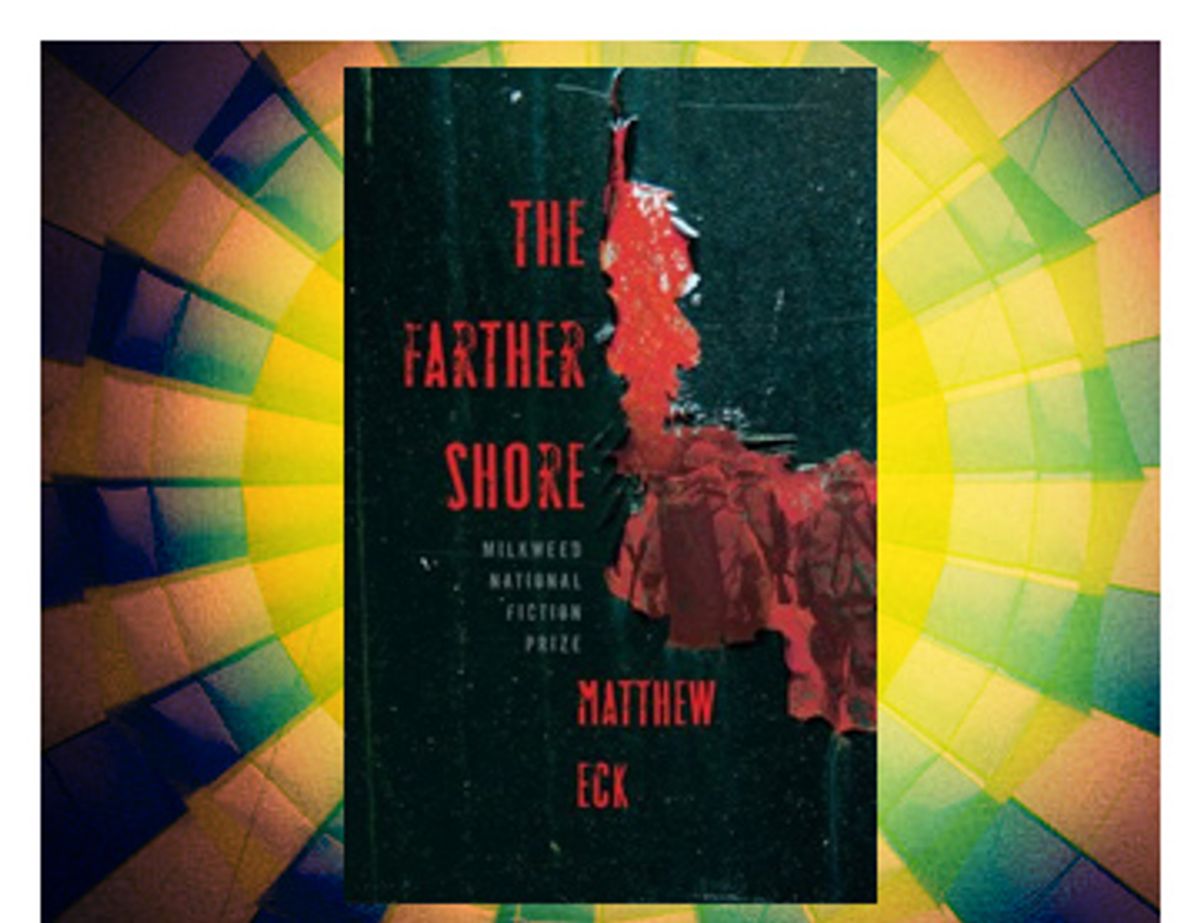
I just finished reading a truly great war novel by a writer of sizable talent who has come close to war. The writer is Matthew Eck, a soldier who served in Haiti and Somalia. His novel, “The Farther Shore,” is a haunting portrait of modern warfare set in an African city governed by warlords robbing the population of international aid. The war Eck writes about is conducted in covert missions — small groups of soldiers guiding bombs from a hidden rooftop — rather than full-scale engagements between uniformed forces.
The old war novels concerned soldiers surrounded by hundreds, thousands, of other soldiers who represented nations fully aware of the engagements and the sacrifices required. Those books were often set in occupied countries, or they climaxed when one large group of men outmaneuvered another large group of men. But war no longer follows those rules. There is no draft. In response to the attacks of 9/11, our president urged the population to keep shopping. Meanwhile, the battlefield has shifted. It has become increasingly difficult to separate friend from enemy. The target is often a sect, a small group within a much larger population. Some of these conflicts are so small they hardly make the news, and we remain blissfully unaware of the men and women that taste blood and fight battles in our name.
Narrated by Joshua Stantz (an average boy becoming a man who was simply looking for college money when he enlisted), “The Farther Shore” opens on a rooftop in a strange city seemingly modeled on Mogadishu in the 1990s. Six soldiers guide bombs down on the city, the plan being to awe the population into surrender, or something like that. The soldiers don’t seem sure. They’re just doing their job.
Josh didn’t mean to find himself half a world away in a hostile city, but that’s where he ends up. When some children trip the booby traps in a stairwell, the soldiers have to get out of the city. However, their van has been stolen and thing go wrong with the extraction, the way things in war so often do. The difficulty is not in getting in, it’s in getting out. The parallels to the quagmire in Iraq are so obvious they defy mention. The result is a haunting, minimalist work painted in surreal shades of desert brown. It echoes “A Farewell to Arms” and “Dog Soldiers” yet remains unique to the new millennium. Eck writes:
The Humvee’s engine finally cut off and the vehicle slowed until we rolled to a stop.
“He’s dead,” said Santiago.
“I know.” I stepped out of the Humvee.
I saw two adults and a child approaching us in the distance. It must have been a family.
I tossed my helmet into the driver’s seat and picked up my 9mm. Sand was blowing in off the desert. I stood there leaning against the hood of the Humvee, the 9mm at my side.
None of the soldiers are heroes, but they’re not villains either. They are not always sure of their targets and they make bad decisions, more circumstantial than not. Some of them don’t make it out, but their death is as random as their cause.
The writing is often beautiful. And modern war has probably never been so fully explored as in this small, relentless novel. Eck never panders. We are not asked to cry, only to go quietly along for the ride.
The army was out there too, massing to the southwest and the northeast, along the main road that ran down the coast and through the city. We were to gauge the show of force against the level of resistance and report on whether the city was awed enough to accept help in forming some kind of government.
This near-perfect book is published by Milkweed Press Editions, a small publisher in Minnesota. Possibly the first great war novel of our generation, “The Farther Shore” will easily be one of the best novels of the year. But the question is, does anybody care? Thirty-five years ago, Nick Ut took a picture of a naked girl burned by napalm running crying down the street in Vietnam. That picture helped end a war. Now Nick Ut is taking pictures of Paris Hilton, crying in the police car as she’s driven back to jail. Novels, photography and art used to be part of the conversation when contemplating murder and death a world away.
The question of the moment is not why American fiction isn’t engaging with the world. It is. The question is why we aren’t paying attention.
Stephen Elliott is the author of six books, including "Happy Baby." His next book, "The Adderall Diaries: A Memoir of Moods, Masochism, and Murder," is forthcoming from Graywolf Press. More Stephen Elliott.
50 shades of Shutterstock
Slide show: Everyone's favorite light-bondage bestseller illustrated by inexplicable stock photography SLIDE SHOW
This week, for roughly the millionth time, E.L. James’ romance-bondage trilogy “50 Shades” nabs the No. 1, 2 and 3 spots on the New York Times bestseller lists. We don’t get it either. Every page of that book, which famously began as “Twilight” fan fiction, elicits a sigh of confusion and weird secondary embarrassment. The question is: Who would read this? (The answer is: Apparently everyone.) It’s the same baffled, helpless feeling we get when we sort through stock photos on a daily basis. Stock photos – which have been the subject of recent outstanding Internet satire – are used by this site, and many others, to illustrate our flood of content. Many are plain and simple, but a good portion are flat-out mind-blowing. Why did anyone think that photo was a good idea? It only made sense to join these forces. And so, we present to you passages from the most head-scratching bestseller of our time, illustrated with the assistance of inexplicable stock photography.
Megaphone by Natalie Bakopoulos
Miracles happen, even in an Athens crippled by a garbage strike, to a young mother unsure of her ability to love
(Credit: iStockphoto/caracterdesign) It’s the third week of the garbage strike and Athens has begun to smell. Bright-colored trash bags fill the curbs and alleyways, and we have learned to step over the rubbish and avoid the blocks that had become unnavigable. We know which stretches are particularly foul — a stretch along Mavili Square, or the entire top end of Monastiraki. Odos Athinas is a sea of trash, and Omonia is ghastly but we don’t go there anyway. May has gone from unseasonably cool to raging hot, and the garbage seems to be melting. In front of the museum it’s like yet another installation project. When I arrive each morning I want to wretch.
Continue Reading CloseNatalie Bakopoulos's first novel, "The Green Shore," will be published by Simon & Schuster in June 2012. Her work has appeared in Tin House, Ninth Letter, Granta Online, and The O. Henry Prize Stories 2010, and she is a contributing editor for the online journal Fiction Writers Review. More Natalie Bakopoulos.
Almost by Chris Pavone
She never thought of herself as ambitious, until motherhood and career collided in one horrifying hospital ride
(Credit: iStockphoto/caracterdesign) It’s just before dawn when Isabel puts the final page down on the fat stack of paper that sits on the rumpled bedspread, next to an overflowing crystal ashtray and a crumpled soft-pack of cigarettes. She’d tried Wellbutrin and Xanax; she’d used patches and gum. In the end, the only thing that made her quit smoking was being pregnant.
But then, after everything, she couldn’t help but start up again. At first it was just a single cigarette per day, or two. Then it became a few, and within months she was back to full-throttle. Over the past couple of years, she’s tried to quit a few times, but not seriously. She anticipates — she accepts — failure. Because she doesn’t want to quit, not really. She wants instead to try, and fail.
Continue Reading CloseMemorial Day fiction: Are we there yet?
Salon exclusive: At the start of the summer fiction season, new stories from Chris Pavone and Natalie Bakopoulos
(Credit: iStockphoto/caracterdesign) “Are we there yet?”
It’s a dreaded sentence. When it’s spoken by an anxious child from the back seat, it’s enough to make stressed-out parents wish they’d never taken a family vacation in the first place. And even if it’s delivered as a sing-songy punch line, from an impatient partner or spouse on a long road trip, it’s an irritating eye-roller of a joke.
So this Memorial Day weekend — the unofficial start of the summer vacation season, and therefore the summer fiction season — we asked two novelists to reclaim the sentence in a new and adult context. For our latest fiction project, there was only one simple rule: Each story had to include the line “Are we there yet?” in a fresh and surprising way.
Continue Reading CloseDavid Daley is the senior culture editor of Salon. More David Daley.
“Frankenstein” remixed
This masterful new adaptation of Mary Shelley's classic novel may be the best interactive fiction yet
Whatever interactive fiction is (and we’re still figuring that out) it suffers from all the problems of traditional fiction and then some. The vast majority of novels and short stories aren’t much good, but when a branching fiction — along the lines of the old “Choose Your Own Adventure” children’s books — fails to engage, the first impulse is to blame the form rather than the content. Let “Frankenstein,” just released by Inkle Studios and Profile Books, serve as a reproach to that reflex. The app is a creative, subtle and sensitive adaptation of Mary Shelley’s classic novella, and it has singlehandedly renewed this critic’s hopes for interactive fiction.
Laura Miller is a senior writer for Salon. She is the author of "The Magician's Book: A Skeptic's Adventures in Narnia" and has a Web site, magiciansbook.com. More Laura Miller.
Page 1 of 130 in Fiction


