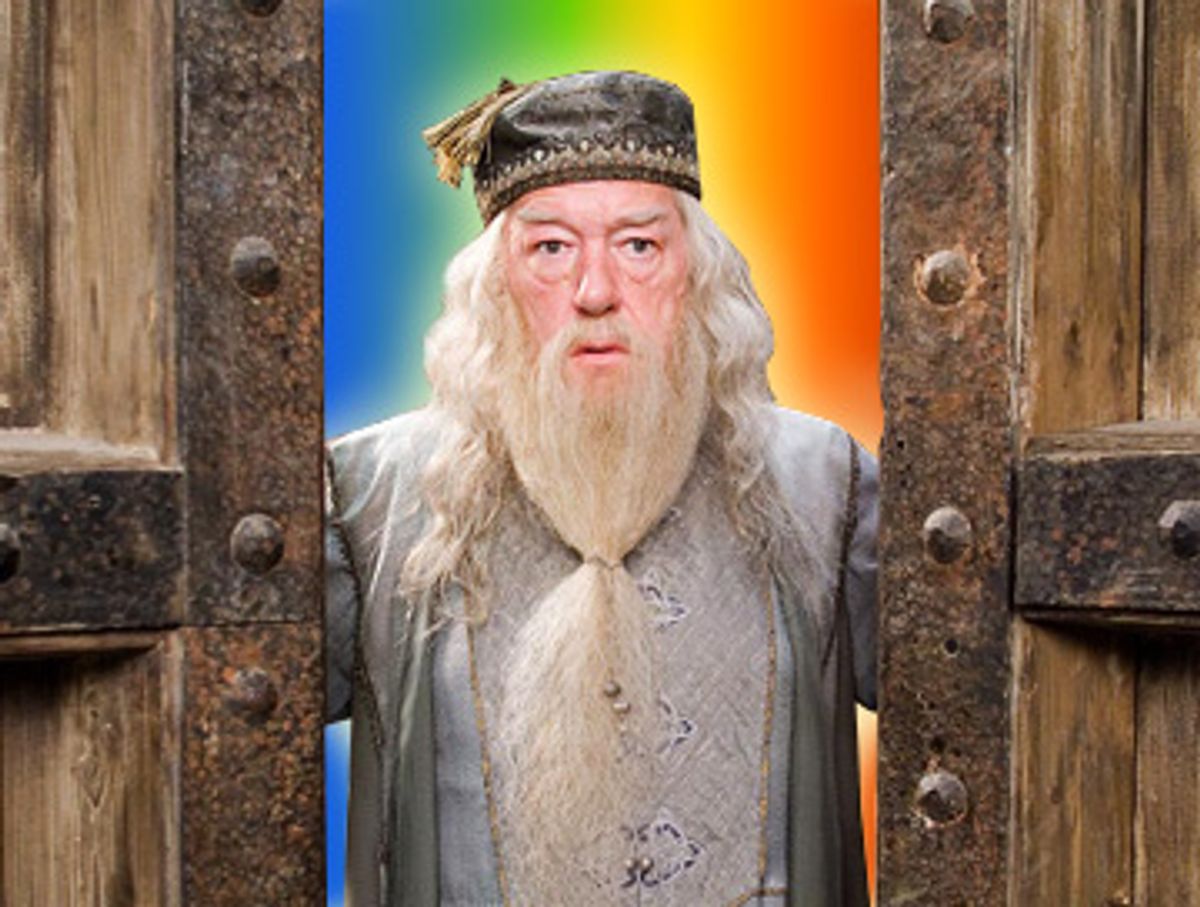
You've probably heard the news by now, since it's been splattered everywhere from the New York Times to Entertainment Weekly to the Associated Press: Albus Dumbledore, the late, great headmaster of Hogwarts School of Witchcraft and Wizardry, was gay.
If you find it curious that this news would make the headline ticker on CNN, you're not crazy, given that Dumbledore is a 150-something wizard who is not, in fact, real. It is also true that the Harry Potter series, in which Dumbledore is a hero, ended with the publication of its final book more than three months ago. How could there be an October surprise about a character whose tale concluded -– supposedly definitively -– in late July?
We have this revelation thanks to Harry Potter author J.K. Rowling, currently on a reading tour of the United States. Dumbledore's gayness is one of the pieces of bonus information about her characters that she's been dispensing steadily since the publication of her magical swan song, "Harry Potter and the Deathly Hallows." Thanks to Rowling's loose lips, the Potter universe continues to make news even after its end. In her desire to control and describe it, she's turning a modern assumption about what authorship means inside out. Whoever said the author was dead sure hadn't meant Joanne Rowling.
Rowling outed Dumbledore at Carnegie Hall on Oct. 19, in response to a fan who asked her if Potter's powerful mentor, who believed so mightily in the power of love, had ever been in love himself. "My truthful answer to you," Rowling said, was that "I always thought of Dumbledore as gay." According to reports, this sentence drew an immediate ovation from the crowd. Rowling continued by explaining that Albus had, as a young man, fallen for the talented wand-wielder Gellert Grindelwald. Rowling's discussion of their bond, an important plot point in her last Harry Potter novel, was incisive and moving; she told the audience that Dumbledore's youthful passion for Grindelwald blinded him, as it does so many of us mere muggles, to Grindelwald's flaws, leaving him shattered when he discovered Grindelwald to be seriously evil. Rowling further revealed that at a recent read-through of the script for the sixth Harry Potter movie, she'd had to nix a line of dialogue about Dumbledore's affection for a young woman. She said she'd passed the screenwriter a note reading "Dumbledore's gay!"
Perhaps Rowling's decision to make Dumbledore's sexuality explicit was born out of her frustration that few readers, screenwriters included, picked up on her hints, which were particularly heavy in the final volume. The clues were subtle enough, or maybe our expectations heteronormative enough, that -- although it was a question I talked about extensively with fellow readers this summer -- the topic did not seem to get a lot of national critical attention in the weeks after the book's release.
But a close reading would reveal that "The Deathly Hallows" was shot through with intimations about the headmaster's sexuality, and not just in reference to his love for Grindelwald, which Rowling describes as a teenage passion that makes the otherwise responsible young wizard forget his family and go uncharacteristically batty. The book kicks off with an obituary by Dumbledore's school chum Elphias Doge, who describes his first meeting with the teenaged Dumbledore as a moment of "mutual attraction" and who later tells Harry that he knew the wizard "as well as anyone." Then there is the lurid language of a scurrilous postmortem biography of Dumbledore, in which writer Rita Skeeter wonders about the close relationship between the headmaster and his young pupil: "It's been called unhealthy, even sinister ... there is no question that Dumbledore took an unnatural interest in Potter." Here Rowling is aping the leering, speculative tone of news stories about gay priests, Cub Scout leaders, and teachers accused of inappropriate relationships with their charges.
When she gets to the Grindelwald relationship, Rowling is clear from the moment Harry spots a photo of young Dumbledore with a "handsome companion." In the shot, the boys are "laughing immoderately with their arms around each other's shoulders." A neighbor describes the relationship between Albus and Gellert: "The boys took to each other at once ... even after they'd spent all day in discussion -- both such brilliant young boys, they got on like a cauldron on fire -- I'd sometimes hear an owl tapping at Gellert's bedroom window, delivering a letter from Albus."
And then there is the publication of an original letter from Dumbledore to Grindelwald, in which the wizard chides his friend for getting kicked out of his foreign school, concluding, "But I do not complain, because if you had not been expelled, we would never have met." When Harry has a chance to chat with the deceased headmaster toward the end of the book, Dumbledore tells him his version of the story: "Then, of course, he came ... Grindelwald. You cannot imagine how his ideas caught me, Harry, inflamed me ... Did I know, in my heart of hearts, what Gellert Grindelwald was? I think I did, but I closed my eyes."
There's a very cheerful side to Rowling's decision to directly address Dumbledore's homosexuality. Throughout the series, she has been diligent not only in her narrative exploration of bigotry and intolerance, but also in her commitment to the inclusion of characters of different races, cultures, classes and degrees of physical beauty. It would, in fact, have been a glaring omission had none of the inhabitants of her world been homosexual.
It's great to see the nonchalance and joy with which her news is being received in many sectors. Perhaps getting an ovation at Carnegie Hall wasn't a surprise, but I first heard about the revelation from a 9-year-old friend at a wedding I was attending, who exuberantly announced, "Dumbledore is gay!" without a hint of complaint. When I asked whether the information surprised her, she said, "Well, I always thought he loved [Minerva] McGonagall, but I guess he only loved her like a sister."
But while it's all well and good to see kids giddy at the news of their hero's homosexuality, Rowling's interest in making things perfectly clear (or queer, to borrow queer theorist Alex Doty's pun), not only about Dumbledore but also about the future and livelihood of all of her characters, provokes thorny questions about the role and responsibilities of an author once she has concluded her text.
Since "Deathly Hallows" was published, Rowling has shared with everyone who would listen details about the unwritten fate of her characters: that Harry and Ron are aurors at the Ministry of Magic; that Hermione is "pretty high up" at the Department of Magical Law Enforcement; that Luna Lovegood is a naturalist who marries Rolf Scamander; that Ginny Weasley plays Seeker for the Holyhead Harpies before becoming a sports writer at the Daily Prophet.
At Carnegie Hall, Rowling told the crowd that Neville Longbottom, Hogwarts herbology professor, marries former Hufflepuff Hannah Abbott, who becomes the landlady of the wizarding watering hole Leaky Cauldron, and that Hagrid never gets married. Perhaps most disconcerting was Rowling's assertion that what Harry's conflicted aunt Petunia would have said to him at their parting, at which Rowling wrote this tantalizing passage –- "for a moment Harry had the strangest feeling that she wanted to say something to him: She gave him an odd, tremulous look and seemed to teeter on the edge of speech, but then, with a little jerk of her head, she bustled out of the room..." –- was, "I do know what you're up against, and I hope it's OK."
Oh. That's too bad. Because in my imagination, Petunia was going to say something much more exciting than that.
I am a devoted reader and admirer of J.K. Rowling, and it honestly pains me a bit to say this, but from a literary perspective, she's out of control here. Her abundant generosity with information is surely a response to a vast, insatiable fan base that does not have a high tolerance for never-ending suspense, ambiguity or nuance. As she told the "Today" show's Meredith Vieira back in July, "I'm dealing with a level of obsession in some of my fans that will not rest until they know the middle names of Harry's great-great-grandparents."
Rowling naturally wants to provide answers for these heartbroken obsessives who perhaps are too young to know the satisfying pleasures of perpetual yearning and feel that they must must must know how much money Harry makes and whether Luna has kids.
It would also be understandable if, after more than a decade of telling stories about this world and these characters, Rowling is unable to stop. She has been a great and comprehensive builder of a fictional universe, and she's famous for keeping reams of folders containing the back stories and astrological signs of every major and minor character ever to appear in her pages. One of the things that made the Potter books so good was the sense that Rowling had utter mastery over every corner of her realm. Who could blame her for wanting to keep the kids happy by doling out bits of it? It's not as though Rowling would be setting a precedent: J.R.R. Tolkien spent much of his post-Middle-earth life tinkering with the details of the world he created, and delighting and gratifying his adherents by providing them with additional information about it.
But when too much of the back story (and, more disconcertingly, the future story) gets revealed –- especially in an age in which an author is not simply sending letters to readers as Tolkien did, but making utterances that will be disseminated and analyzed by a global network of Web sites -- it seems to have not so much a gratifying effect as a deadening one.
My brother, an adult reader who has been irritated by Rowling's loquaciousness and was sent over the edge by this latest round of fortune-telling, said to me this weekend, "If she wants to tell us what happens, I wish she would write it in a book, because until she does, then as far as I'm concerned, she's just describing what's showing on the teeny TV screen inside her head, and that's not playing fair."
Given the ample -- somewhere north of 5,000 pages -- text that Rowling has already provided, from which her diligent and enthusiastic readers can mine theories and opinions of their own, her pronouncements are robbing us of the chance to let our imagination take over where she left off, one of the great treats of engaging with fictional narrative.
Would we be better off if Sofia Coppola had held a news conference after the 2003 premiere of "Lost in Translation" to announce that Bill Murray had whispered to Scarlett Johansson at the end of the movie that he'd had a great time with her in Tokyo? Perhaps Shakespeare could have stepped onstage after the conclusion of "Measure for Measure" and informed his audience, "Isabella accepts the Duke's proposal and they marry a few weeks later."
Salon book critic Laura Miller argues that the plot-driven, perpetually unfolding nature of Rowling's series makes it seem reasonable that she would continue to spin tales from it. That events in the Potter universe would continue to unfold makes more sense than the good-versus-evil climax with which she ended the last book. Miller says, "It doesn't surprise me that she secretly thinks of it as going on and on ... because that's the kind of material it is. It is not, say, 'Crime and Punishment,' where the very underpinnings of the story demand closure."
It's true that one of the strong draws of so much fantasy literature is the fluid, on-and-on quality that allows readers to believe that we've stumbled upon a world and that it continues without us, right next to us, perhaps -- that we might one day wander through a closet and meet Mr. Tumnus, or that the weirdo on the subway in the purple cape might simply be out celebrating the demise of another evil wizard. In this context, it's natural to feel that the future of the Weasley-Potters plays ceaselessly on Rowling's internal TV screen and that she's just sharing it with us.
But it's precisely the fans' feverish speculation about what happens to Rowling's characters, and what she might have meant by X or Y, that makes her behavior so surprising. Rowling's books were great in part because of their insistence on an ambiguity that was more sophisticated than her younger readers were used to (Severus Snape: good or bad? Albus Dumbledore: wise or gullible? Petunia Dursley: wizard hater or wizard lover?) and which readers have argued over for years. Why would she choose now to quash further imaginative and critical speculation by administering massive doses of Authorial Intent?
I suppose it's nice to know that in Rowling's mind, Harry is a successful auror. But in my mind, based on the seven books I devoured, Harry, whose greatest gifts were as a teacher, is the Defense Against the Dark Arts professor and eventually the Hogwarts headmaster. I suppose in the minds of other readers, Harry might manage a Quidditch team, or work for his uncle Vernon at Grunnings or something. I'd love to have that conversation with those other readers; I'd also love to have it with Rowling, in a Tolkien-style exchange. But when Rowling declares to an international audience what Harry's adult job is, then the possibility for such an exchange is over. Speculation over what Rowling might have wanted us to surmise about her hero's future is over. Bully for Harry, boo for the notion that fictional characters take on lives of their own in their readers' minds.
Rowling is a brilliant lady, one of the people whose work and intentions appear nearly pristine. She created a world in which many readers happily dwelt for more than a decade. In fact, perhaps the root of my frustration with her soothsaying is my sadness that she's running around talking about the books rather than writing us another one! I, like so many others, miss these people, and part of me can't help but wish that if she had so much more to say about them, she'd put her thoughts in writing. But I also understand that that is one of those wishes probably better left unfulfilled. One of Rowling's greatest authorial virtues is that she knew when to quit.
If only she would remember that now, because as she herself clearly understands, leaving us mysteries to unravel is such a critical part of the fun. At the same Carnegie Hall event at which she outed Albus, Rowling told the crowd, "I went onto a fan site ... [and] I was so heartened to see that people on the message boards were still arguing about Snape. The book was out, and they were still arguing whether Snape was a good guy. That was really wonderful to me, because there's a question here: Was Snape a good guy or not?"
Oh please, Jo, don't tell us!
Shares