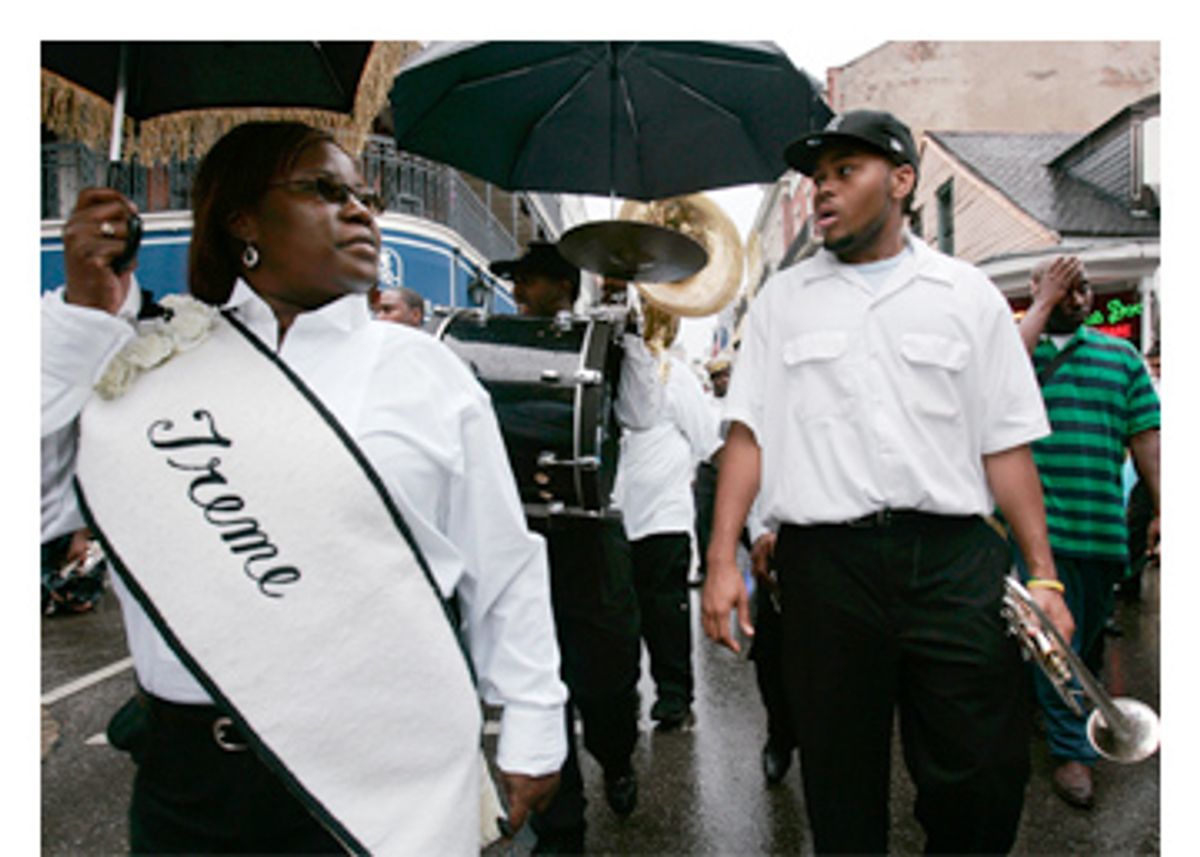
Treme

Band on the run in New Orleans

Police have cracked down on funeral processions, a time-honored cultural tradition in the historic black neighborhood of Treme. But musicians vow to play on.

On the evening of Oct. 1, some two dozen of New Orleans’ top brass-band players and roughly a hundred followers began a series of nightly processions for Kerwin James, a tuba player with the New Birth Brass Band who had passed away on Sept. 26. They were “bringing him down,” as it’s called, until his Saturday burial. But the bittersweet tradition that Monday night ended more bitterly than anything else — with snare drummer Derrick Tabb and his brother, trombonist Glen David Andrews, led away in handcuffs after some 20 police cars had arrived near the corner of North Robertson and St. Philip streets in New Orleans’ historic Tremé neighborhood. In the end, it looked more like the scene of a murder than misdemeanors.

“The police told us, ‘If we hear one more note, we’ll arrest the whole band,’” said Tabb a few days later, at a fundraiser to help defray the costs of James’ burial. “Well, we did stop playing,” said Andrews. “We were singing, lifting our voices to God. You gonna tell me that’s wrong too?” Drummer Ellis Joseph of the Free Agents Brass band, who was also in the procession, said, “They came in a swarm, like we had AK-47s. But we only had instruments.”

The musicians were no longer playing but instead singing “I’ll Fly Away” when the cops converged and the cuffs came out. A New Orleans police spokesman claimed the department was simply acting on a neighborhood resident’s phoned-in complaint. And the department maintains that such processions require permits.

But when they busted up the memorial procession for a beloved tuba player, arresting the two musicians for parading without a permit and disturbing the peace, they didn’t just cut short a familiar hymn — they stomped on something sacred and turned up the volume in the fight over the city’s culture, which continues amid the long struggle to rebuild New Orleans.

In that fight, Tremé is ground zero. Funeral processions are an essential element of New Orleans culture, and the impromptu variety in particular — honoring the passing of someone of distinction, especially a musician — are a time-honored tradition in neighborhoods like Tremé, which some consider the oldest black neighborhood in America. For black New Orleans residents who have returned to the city, these and other street-culture traditions — second-line parades and Mardi Gras Indian assemblies — offer perhaps the only semblance of normalcy, continuity and community organization left. In a changing Tremé, within a city still in troubled limbo and racked by violent crime, long-held tensions regarding the iconic street culture have intensified. The neighborhood, the breeding ground for much of this culture, has a history of embattlement. And now more of that history is being written.

“I’ve been parading in the Tremé for more than 25 years, and I’ve never had to deal with anything like this,” said tuba player Phil Frazier, who leads the popular Rebirth Brass Band. He’s brother to James, who died of complications of a stroke at 34. “I told the cops it was my brother we were playing for, and they just didn’t seem to care. He’s a musician and he contributed a lot to this city in his short life.”

Katy Reckdahl, a reporter for the New Orleans Times-Picayune, had rushed to catch up with the Monday-evening procession when her 2-year-old son Hector heard tubas in the distance. What she didn’t expect was a sudden flood of patrol cars, sirens blaring. Her front-page, full-banner-headline report two days later described police running into the crowd, grabbing at horn players’ mouthpieces, and trying to seize drumsticks out of hands. “The confrontations spurred cries in the neighborhood about over-reaction and disproportionate enforcement by the police, who had often turned a blind eye to the traditional memorial ceremonies,” she wrote. “Still others say the incident is a sign of a greater attack on the cultural history of the old city neighborhood by well-heeled newcomers attracted to Tremé by the very history they seem to threaten.”

It’s unclear who called the police that night. But it’s easy to sense the difference, longtime residents say, between North Robertson Street before and after the storm. With its proximity to the French Quarter and historic architecture, Tremé, which was not flooded, is newly attractive to home buyers within the city’s shrunken post-Hurricane Katrina housing stock. Meanwhile, as in most of New Orleans, rents have sharply increased. Derrick Jettridge, who was born and raised in the Tremé, now lives in the Mid City section. “I’d never find something in Tremé for the $500 I was paying before,” he says. On her New Orleans Renovation blog, Laureen Lentz wrote recently, “Since Katrina, the Historic Faubourg Tremé Association has gathered a lot of steam. Our neighborhood is changing as people have begun to realize that this area is prime, non-flooded real estate … So much is happening in Tremé, it’s hard to convince people that aren’t here. You have to see it to believe it.”

Home prices in Tremé rose nearly 20 percent immediately following the flood, settling at approximately 12 percent above pre-Katrina rates, according to Al Palumbo, branch manager for the historic districts office of Latter & Blum Realty. “Tremé, especially the area around North Robertson and St. Peter, would certainly be among my first choices for return on investment in New Orleans,” he says.

But what might such development in the neighborhood ultimately cost? The intensity of the police response during the Kerwin James procession prompted a second-line of print voices, so to speak, in the Times-Picayune’s pages.

“If somebody is blowing a horn in Tremé and somebody else is calling the police,” wrote columnist Jarvis DeBerry, “only one of those people is disturbing the peace, and it isn’t the one playing the music.”

Nick Spitzer, creator of the public-radio program “American Routes,” wrote in an Op-Ed piece, “in a city where serious crime often goes unprosecuted and unpunished, jazz funerals make the streets momentarily sacred and safer.”

“New Orleans Police Department declared a resumption of its war against our city’s culture,” declared columnist Lolis Eric Elie.

The day following the skirmish, discussions between community leaders and 1st District police Capt. Louis Colin yielded a temporary agreement. The evening after the arrests, Andrews, Tabb and other musicians were back on those same streets, leading another procession, this time protected by a permit, which some residents viewed as a disappointing compromise. “We don’t need anyone’s approval to live our lives,” one resident told me.

Efforts to curtail these neighborhood processions as well as the more formal Sunday afternoon second lines hosted by social aid and pleasure clubs, who apply for official permits, continue to threaten traditions already weakened by the loss of residents in Katrina’s aftermath. Participants view this as deeply hypocritical, given that so much promotion of tourism for New Orleans includes images of brass-band musicians and second-line dancers.

In April, a federal lawsuit on behalf of a consortium of social aid and pleasure clubs, aided by the American Civil Liberties Union, protested the city’s hiking of police security fees — triple or more from pre-Katrina rates — for second-line parades held September through May. The suit invoked the First Amendment right to freedom of speech and expression, claiming that parade permit schemes “effectively tax” such expression. “Should the law not be enjoined,” the complaint stated, “there is very little doubt that plaintiff’s cultural tradition will cease to exist.”

At a street-corner press conference a few days after the musicians’ arrests, Jerome Smith, who runs the Treme Community Center just a block from that scene, recounted the history of an embattled neighborhood. He invoked the memory of heavy-handed police intimidation at the 2005 St. Joseph’s night gathering of Mardi Gras Indians, after which Allison “Tootie” Montana, the “chief of chiefs,” famously collapsed and fell dead of a heart attack while testifying at a city council meeting. He referenced the “open scar” of nearby Louis Armstrong Park, for which the city demolished 13 square blocks of the Tremé. He spoke of how, in 1969, the creation of Interstate 10 replaced the stately oak trees of Claiborne Avenue, the neighborhood’s main thoroughfare, with concrete pillars.

On the Sunday following the arrests, Councilman James Carter held a meeting with residents at Smith’s center. One neighborhood activist, Al Harris, brought an enlarged copy of a photo, mounted on posterboard, of a Tremé second line in 1925. “We’ve been doing this a very long time,” he said. Carter said that “under no circumstances is it acceptable for police to violate our cultural traditions.” He announced plans for a task force organized through his Criminal Justice Committee to propose new city ordinances protecting the cultural practices under fire, and to initiate education and sensitivity training for officers and new residents of Tremé.

Such education could have easily been found in some documentaries screened last week during the city’s 18th annual film festival. “Faubourg Tremé: The Untold Story Of Black New Orleans,” created by filmmaker Dawn Logsdon and Elie, the Times-Picayune columnist, offered a powerful reflection of Tremé as a place of creative ferment and political resistance for some 300 years, which included Paul Trevigne’s Civil War-era founding of the country’s first black newspaper, and the unsuccessful 1896 Supreme Court challenge, in Plessy v. Ferguson, to racial segregation. At one point Elie wondered in the film’s narration, “How can our past help us survive this time?” Glen David Andrews, one of the men arrested Oct. 1, was featured playing his horn and as an interview subject.

Andrews also figured in “Shake the Devil Off,” filmmaker Peter Entell’s chronicle of a particularly cruel twist in modern Tremé history: Six months after Katrina, the Archdiocese of New Orleans decided to close the neighborhood’s St. Augustine church and to remove its pastor. The historic church was founded in 1841 by slaves and free people of color. After a 19-day rectory sit-in, the parish was restored, provisionally, though its long-term fate remains in question. Near the film’s climax, after footage of Jerome Harris and Jesse Jackson speaking to a crowd, the camera moved in on Andrews, who launched into “I”ll Fly Away,” offered as call-to-arms rather than memorial.

A question-and-answer session following a screening of “Tootie’s Last Suit” — filmmaker Lisa Katzman’s gloriously insightful look at the world of Mardi Gras Indians through the story of Tootie Montana’s final days — drew some discussion of the recent Tremé arrests.

“We won’t bow down,” said Sabrina Montana, daughter-in-law of the film’s main character, quoting a familiar Indian-song lyric. “This has nothing to do with our disrespect for authority and everything to do with our self-respect. Until what we do is on the city charter, second-line and Mardi Gras Indian assemblies will continue to be threatened by the whims of those who are in authority.”

Following the public outcry, Sgt. Ronald Dassel of the New Orleans Police Department was quoted in the Times-Picayune saying, “We don’t change laws for neighborhoods.” But in fact the city does and always has. Special legislation protects the tourist-rich French Quarter, for example. The mostly white Mardi Gras carnival parades command a long list of specific ordinances (including much lower permit fees than for second lines). And a recent judge’s order, which some critics consider unconstitutional, delineated police arrest and release protocols for municipal offenses specifically by neighborhood — with the Tremé among the neighborhoods subject to the sternest treatment.

Recently, I was walking along the bayou with Andrews when he ran into a friend. “Did you hear what they’re calling you two?” his friend asked, referring to Andrews and Tabb. “The Tremé 2! We’re making T-shirts.”

Andrews winced. “I’m not looking to be somebody’s martyr,” he said.

Sure enough, a couple of T-shirts emblazoned with “Free the Tremé 2″ could be seen at Vaughn’s bar during a Saturday fundraiser for attorney Carol Kolinchak, to support her pro bono work for Mychal Bell, one of the defendants in the Jena 6 case. Kolinchak is also representing Andrews and Tabb, who are due to appear in court in early December.

“Of course, I wouldn’t compare the situation they are facing to Mychal Bell’s,” said Kolinchak. “However, the discretionary decisions by law enforcement and prosecutors — on how and when to enforce the law — require attention in both situations. And those issues lie at the heart of the problems surrounding culture in New Orleans.”

Tabb, the drummer who plays in the Rebirth Brass Band and is raising money to create a nonprofit music school, recoils at the thought of children watching musicians hauled off by police for making music. And he says he thinks Andrews may have been singled out by authorities; in addition to leading his Lazy Six band, Andrews is a ubiquitous presence not only at second lines, but also at civic rallies.

New Orleans after Katrina may never fully return without its iconic street culture. And its renewal — financial as well as spiritual — may be more closely tied to those traditions than city officials grasp. But those who practice the traditions know it. On Friday, Oct. 5, the nightly memorial procession for Kerwin James wove through the neighborhood, culminating on the very spot of the arrests prior that week. Andrews put down his trombone and sang “I’ll Fly Away,” as Tabb snapped out beats on his snare. A tight circle surrounded the musicians, as a middle-aged black woman turned to the man next to her. “They say they want to stop this?” she asked softly. “They will never stop this.”

Larry Blumenfeld has worked for the past year as a Katrina Media Fellow with the Open Society Institute; he is writing a book about cultural crisis and recovery in New Orleans. His work has appeared in the Wall Street Journal and Village Voice, and he contributed a chapter to the book "Music in the Post-9/11 World" (Routledge). He is editor-at-large of Jazziz magazine.

TV’s eerie new race-less world

In an Obama age, shows like "Parenthood" flatter us into believing race no longer matters -- and avoid hard truth

Joy Bryant and Dax Shephard in "Parenthood"

NBC’s “Parenthood” is a trick show that people tuckered out by life are eager to believe in. I am one of these tired people. Its bustling mornings, carefully disheveled interiors, and impromptu kitchen dance-parties create the illusion of safe chaos. “Parenthood” knows that for the modern television viewer,  controlled disorder is better than none, for safe chaos tricks you into believing that what you’re watching isn’t totally sanitized. Strategically placed ad-libbing, background chatter and overlapping dialogue combine to slyly convince you of its authenticity — that not only does “Parenthood” belong to an age of realism and daring and diversity, but it’s helping create it.

It reminds me very much of my eighth-grade teacher who so desperately hoped to be the mythic sage who made a difference, but failed to realize his well-meaning musings about why “black families can’t stay together these days” did little to raise our awareness of anything other than his own desire to seem good. And this is what “Parenthood” does in its broad-stroke coverage of everything that could happen in the life of a modern American family. Since we’re all terrified of being different, there is some point in airing things we might still regard with shame: infidelity, moving back with your parents, not going to college, raising an autistic child, and, finally, interracial dating. As the end product of an interracial date, I find this last theme most interesting. On the show, it’s explored in two story lines.

In one, Crosby Braverman (Dax Shephard), the youngest son in the Braverman clan, is reunited with Jasmine (Joy Bryant), an old one-night stand who surprises Crosby with his half-black 5-year-old son, Jabbar. Crosby and Jasmine rekindle their old romance but eventually split apart.

And in the second story line, teenager Haddie Braverman (Sarah Ramos) falls in love with Alex (Michael B. Jordan), a boy so beyond her in sexual energy that a more forced union could hardly be imagined by anyone who spent two seconds in high school. But in “Parenthood,” love is blind — as is a white middle-class family, who, save for one or two lines by characters denying their ability to ever be racist, makes no real reference to the black paramour’s blackness. And here is the point that many of us still have difficulty understanding: Pretending to not see race ignores the experiences of people of color and the racism they do sometimes experience. Race-blindness is a well-meaning assertion of a white worldview, one where race is never an issue.

Comedian Franchesca Ramsey’s recent parody video “Shit White Girls Say to Black Girls” is an excellent example of how segregated these realities are. Many black female friends and family members posted a link to the video on Facebook pointing to its hilarious accuracy and mentioning additional comments commonly received — for example “You’re so smart for a black girl.” Many whites, however, found the video offensive, and Ramsey even appeared on Anderson Cooper’s show, “Anderson,” in defense of it.

With its black characters’ curiously race-less existence, “Parenthood” believes it’s nurturing a helpful attitude. Instead, it supports the kind of backlash that Ramsey faced — and this is where things get tricky. How does a television show address race in a real way without alienating those who need to hear the discussion the most? (The people enraged by Ramsey’s video, for example.) Those who point out the continuing existence of inequalities, especially about race, will be attacked. In the age of Obama, where few whites witness blatant discrimination, accusations of racism feel like a betrayal. We’re all supposed to be on the same team now, and a prime-time show, naturally, would rather play it safe and flatter viewers rather than risk ostracizing them. Especially this show, built entirely around stroking its audience to sleep.

The best recent example of a show that handled race well is the first season of Louis C.K.’s “Louie.” It directly addressed white entitlement, smartly cushioning it within self-deprecating comedy. Every serious observation on race was followed by the most absurd and unsophisticated (and funny) joke. Because Louie was the one who made the mistakes, he could tell you about white male privilege. We would listen because we didn’t feel threatened … and then he would make a joke about having sex with a fat woman. In this strategic way, “Louie” escaped preachiness.

“All I want to do with these scenes is talk about these things. Air them out,” Louis C.K. told me. “I very much doubt if the show will please enough people consistently enough to be a great success. It occurs to me that you yourself may see things in upcoming episodes that you won’t like, because I’m playing on every side of the line …

“I think that what’s on TV today has left people too divided, inebriated and expecting only to see shows that agree with them and soothe them. The vast majority will find it too hard to watch something that takes no clear position and satisfies nothing, only opens sores and stirs curiosity.”

The complexity of race in America can even be addressed in two lines from the second season of “Treme.” Harley, a white street musician in a post-Katrina New Orleans, is robbed at gunpoint by a black teenager. As the teen flees, Harley says, “You’re making a bad choice, son.” The boy stops, turns around, replies, “I ain’t your … son” — and shoots Harley in the face. In under a minute we’re confronted with the history of white American paternalism and its many consequences.

“Parenthood’s” silence about its black characters’ blackness reflects our genuine desire for things to be different, but also our willingness to ignore the reality of the experiences of people of color in an eagerness to move ahead to post-racialism. This underlines two things: Things have changed, in that there’s a collective desire for equality. But the main problem remains: It is still a white playing field, with white main characters who want to enjoy a world without racism. They’re the ones who have decided to move on.

In a clumsy effort to avoid racist portrayals, many TV shows and films have decided to make all black characters superhumanly virtuous or placed them in positions of authority. David Estes, as director of the CIA’s counter-terrorism center and Claire Danes’ boss in “Homeland,” is one of the latest. In “Parenthood,” Alex is a high school dropout, in AA and a volunteer at a homeless shelter. He is a positive influence on Haddie’s life to the point of corniness. Meanwhile, career-minded Jasmine, nicely embodying the “strong, independent black woman” role and dancing for Alvin Ailey, no less, is cheated on by Crosby.

This virtue, they think, will distract us from the fact that all the main characters, the ones allowed to be truly human with successes and faults and a range of emotion, are still white. TV is still a white world, one where racism exists, but in small amounts that allow us all to sleep easily.

And in this day and age, even some of the gains black people have made on TV are at risk. As “30 Rock’s” black male characters Toofer, Tracy, Grizz and Dot Com pointed out in Season 4:

Toofer: You will not believe what just happened to me. A guy on the subway just called me a ”biggledeeboo.”

Grizz: What’s a ”biggledeeboo”?

Tracy: It’s an 18th-century word for dark-skinned Moor. I’ve learned the word ”black” in every language, just so I know when to be offended.

Dot Com: Well, I’m sure it was just an isolated incident.

Tracy: I’m telling you, Dot Com, old-school racism is back.

Toofer: How can racism be back when we elected a black president?

Tracy: Barry Obama is the one who brought it back!

Toofer: So you’re saying that racism is back because white people no longer feel sorry for us?

Tracy: Hey, something’s going on. You know what I saw last night? A Slomin’s Shield commercial with a black burglar!

Dot Com: That’s not good.

Grizz: Come to think of it, I saw a white judge on “Law and Order” last night.

Continue Reading Close

Hot seat: David Simon explains “Treme”

The show's creator defends some surprising choices, and explains how it's "a story of fundamental patriotism"

A man of characters: "Treme" co-creator David Simon (left) with one of the show's major characters, Albert Lambreaux (Clarke Peters).

Writer-producer David Simon didn’t want to do this interview about “Treme,” the New Orleans drama that just wrapped up its second season. When I put in a request to HBO, the initial response that came back through a publicist was, and I quote: “Oy, what can I tell that isn’t self-evident?”

But I asked again, promising that this wouldn’t be a nit-picky discussion of plot and character, but hopefully an interview that talked about larger issues: the style and architecture of the show, its storytelling philosophy, its view of art and culture, and the ways in which it is similar to or different from Simon’s previous series, “The Wire,” “The Corner” and “Generation Kill.” And he said yes. The conversation ranged over nearly two hours. Excerpts follow.

Salon: What sort of philosophy — or what sort of messages, if any — are you trying to convey on “Treme,” about New Orleans after Hurricane Katrina? And how do you respond to critics who have contended that this series, like “The Wire” before it, conveys a pessimistic vision of city life, and the United States generally? Especially season two of “Treme,” which was dominated by crime, the threat of random violence, and local government’s culture of corruption and indifference to individual suffering?

David Simon: In New Orleans, people from the post-Katrina world really startle [at the show] and say, “You people are grafting your politics onto what happened.” But [what you see on the show] are their politics, the politics of citizens in New Orleans, the politics of the last five or six years in that city. The reporting is still very careful.

And I don’t know what to say about the notion that I’m misanthropic. You can still have great affection for people, and for Americans, and for people in New Orleans, for artists and musicians and cops and drug dealers, and think that we’re all going to hell politically and economically. It’s possible to hold those two disparate ideas in your head at the same time. It’s actually relatively easy to do.

Salon: What are the special problems, the special challenges, that a series like this poses? On every other series you’ve been involved with, maybe with the exception of “The Corner,” you had a sort of a spine that was just there, and very much visible, whether it was the investigations on “The Wire” or the mission on “Generation Kill”….

Simon: [On "Treme"] we have a spine, too, which is what happened in New Orleans over the last six years. You come into the writer’s office. It’s not a bunch of dilettantes deciding what songs from their record collection they want heard on the show, and what this character could do that is really fun or interesting. When you come into the writer’s office on “Treme,” what you see is bulletin board after bulletin board of color-coded cards listing what happened in New Orleans politics, what happens in terms of crime culture, what happens in terms of redevelopment, city hall, the education system. What happened when. When did New Orleans experience this? When did people become aware of this? When did people start learning about the mid-cities recovery zone?

Sometimes it’s a little funny to read reviews where the writer says, “Why’d they do this?” Or, “Oh, my goodness, they’re using crime now to make the story more interesting.” No! There was no crime the first year after Katrina. I don’t know how many different ways to say it.

The spine is there. And it’s rooted in the actual events that occurred in New Orleans, beginning in August of 2005.

Salon: All I meant by that is that you had previously used the word “delicate” to describe what is being done on the show. And I meant that–

Simon: Oh, yeah, well, as you know from your own life, major political events in your community and in the world by and large impact you intellectually. And maybe to a lesser extent, in a muted way, they might influence you economically. Or they might have a positive or negative effect, if you have a particular interest. But most of what passes for current events in the world, we experience intellectually. Our lives are about the day-to-day.

And these are ordinary people. We’re not doing a show about mayors and police chiefs and recon Marines who are invading a country. We’re doing a show about people who are trying to reconstitute their city or their culture just as a means of getting through the day, not because they’re on a mission. Most of them are not on a mission. Some of them are politicized, to an extent. But for most of them, life is about the day-to-day. [Series co-creator] Eric [Overmyer] and I do not want to make a show where it’s Season 3, and these two people are trapped in a drainage ditch and the water’s rising. Fuck it. I hate that. That’s television.

So, you’re right. We’re locked into ordinary people experiencing ordinary life in a place that is a little bit extraordinary.

Salon: Right.

Simon: That’s it! That’s all the story is about. But how they experience it, how they come to terms with it — and by the way, they are getting NO help from the greater society, from city government, from state government. At every point that they look to anybody above them for help, for guidance, for leadership, it’s not there. That’s thematic.

Salon: It’s interesting how all of your shows, all of your series, touch on this to a degree — the extent to which individuals can be rightly very angry with their treatment by, or their neglect at the hands of, the system… and yet the system barely registers them because they’re just individual people.

Simon: Yes.

Salon: And there are no villains.

Simon: Right. And people who are expecting resolution in the classic TV sense … Look, American television has been a juvenile medium for most of its existence. This is true. Because of the commercials, because of the need to placate the maximum number of eyeballs, happy endings abound, redemption abounds, perfect revenge is often achieved in an action sequence. It’s very much unlike life as I have experienced it, and as most people have experienced.

Life is glorious and vibrant and joyous at points, but it is essentially tragic. That’s not a unique David Simon perspective. That’s the perspective of anyone who contemplates anything as simple as mortality. You’re gonna die, and everyone you love and care about is gonna die. Life is finite. Some of them are gonna die too soon, and some of them are gonna die with things unsaid and things unfinished. And if you look at life in a fair and accurate context, you see that it is often deeply tragic, regardless of how well or poorly you live portions of your life — and certainly some people get luckier than others.

Television, by and large, has not dealt with that–

Salon: No–

Simon: –because first of all, there’s no money in it. And second of all, because they’re scared of distracting you for a moment from what you have to do, which is buy Lexuses, or buy iPods, or buy bluejeans, or buy feminine hygiene products. Every few minutes, they need you reassured enough that you’re gonna pay attention to the ads.

There’s been this wonderful, relatively brief window on premium cable where they haven’t had to worry about that, so you can tell a grownup story. A little bit, I think. You can try. That’s the challenge.

Salon: There were a number of threads this season that dealt very specifically with mentors, and the mentor-student relationship: Antoine Batiste teaching those kids at his school, Harley teaching Annie about being an artist and musician, Eric Ripert playing himself in those restaurant scenes with Janette, Delmond learning from his father Albert about music while making the album, and so many others. Were there any mentors that you’ve had who came to mind, or who kind of hovered over this season, throughout the writing process?

Simon: The people who mentored me in my own professions are always foremost in my mind. [As a journalist] I had great editors. At the Baltimore Sun, I had Rebecca Corbett and Steve Luxenberg, who are two really fine journalists and who made me better every time out. And then when I went to write books, [former Broadway Books editor and later Henry Holt & Co. president and publisher] John Sterling. It would be nice if I gave him a book in the next decade! [Sterling] made my books better than I could have made them on my own, and helped me understand long-form narrative in ways I couldn’t have understood when I started the projects.

And then ["Homicide: Life on the Street" writer-producer] Tom Fontana took me on when I was looking at television as kind of a lark, as something I might do for a couple of years for money as I finished my second book. I had no intention of making a home in that medium. It was years before I looked up and realized that I had. Tom was incredibly gracious and open about sharing everything he knew about how to make television shows. Those are the four people I would mention as mentors.

Salon: How do they relate to the characters on “Treme”?

Simon: I would say — well, it’s not just me on the show. There’s Eric Overmyer, and George Pelecanos especially. When it comes to the theme of men working with boys, nobody does that better than George Pelecanos. And George has a lot to say about that. He grafted the [Dennis] “Cutty” [Wise] story onto “The Wire.” I don’t think it’s ever been done better. If he has a primary cause, it’s that — it’s the idea of mentoring, and what it means to have strong role models. With George it’s a particularly male thing.

But in any event, there were a lot of people kicking in on [the mentoring theme] on “Treme.” It was appropriate to the year, you’re correct. It’s hard for me to gauge what I feel about the people who mentored me, and how I’m shoving those experiences onto Antoine Batiste or Eric Ripert or anybody. You know, in some ways the Ripert side is a question for Anthony Bourdain, if anybody. [Bourdain was a writer on Season 2 of "Treme," contributing to the restaurant storylines.] It’s a collective, if anything.

Salon: There is kind of a hive-mind thing that happens when you’re writing a show, isn’t there? I appreciate your taking great pains to separate yourself from the people you collaborate with, because you’re not all the same person, but …

Simon: I’m a little tired of it being ‘The David Simon Show.”

Salon: But you all are on the same page, though, in the sense of….

Simon: In the sense that we’re all in there talking it out, oh yeah, sure. I don’t think there was ever a moment where any one person said, “In season 2, we’re gonna have this mentor theme, and we’re gonna touch on it here, here and here.” We pursued the stories organically. For example, Antoine Batiste was going to go in the schools and teach because he was ready to experience something outside of his own margins. And by that I mean we very purposefully made him a very knockaround, workaday musician in the first season.

Salon: Yeah.

Simon: But then we gave him two competing ambitions: Fronting his own band, and giving something back to the musical community that gave so much to him. We played with the idea of those two being in competition. There was never a moment where we said, ‘Oh, this will dovetail nicely with Janette’s journey through the New York kitchens and what she will bring back to New Orleans.” Nobody ever said that. We were dealing with each story organically. If there was a moment later on where we realized one was echoing the other, we probably remarked on it. But things begin organically, they begin with story and character and what you want to say.

Salon: That dynamic, though comes up, too in…Well, let me back up a second and admit that intentionality is a tricky thing when you’re talking about making a TV series, or engaging in any kind of creative process. I mean, you know this: Sometimes as a writer you mean to do things, even if you weren’t consciously thinking about it when you did it.

Simon: Sure! You’re still planning a theme around actual plot events. So it is intentional. Maybe more so on “The Wire,” because on “The Wire” we were making certain arguments about public education, for instance, so certain things had to happen, or fail to happen. We were making arguments about the inability to reform the political structure. So we knew certain endings. And we might have known certain endings here.

But it’s a little bit more organic on “Treme,” because it’s a way more delicate, way more nuanced show in terms of individuals — in terms of men and women in the context of culture, and their contributions to culture, and what they gain from culture, and why it matters that we live in cities, and why it matters that we live compacted in these cities and we’re so different, and what the potentialities are and where the problems are. That’s a little more delicate than the question of where they’re going to find the $62 million to fund the school deficit [in Season 4 of "The Wire"].

We’re not trying to set up those kinds of problems here. We’re not trying to do the same show twice.

Salon: Let’s return for a moment to the idea of a city and her culture. New Orleans is obviously a special case, because the art and the music are so much foregrounded. They’re so much a part of the city’s identity.

Simon: They’re visual. And they’re aural, with an “au.” And you can catch them on film.

Salon: It seems to me that the issues you examined on “The Wire” were applicable to any large city to a certain degree. But it’s a little different with the question of the arts in New Orleans, the state of the arts in New Orleans, because so many cities in the United States don’t give a damn about the arts at all. In New Orleans, some people there care more about the arts than others. But they all have to care, sort of, because it’s New Orleans.

Simon: There are, actually, some people in New Orleans who don’t care at all, and who actually resent the culture of the perpetual party. A lot of them life in Jefferson Parish, it seems to me, judging from the comments that we get.

Salon: What can other cities learn from what New Orleans has gone through, with regard to the arts — with regard to recognizing the importance of the arts?

Simon: Listen, they don’t teach the melting pot in school anymore. They don’t like the analogy. They teach “the salad bowl.” That’s what my kid was taught — the idea that there are all these different ingredients, and they mix together and it makes a great taste, but they don’t actually melt together and become homogeneous. Why whatever metaphor, though, that’s something I actually believe in.

Salon: In the salad bowl, or in the melting pot?

Simon: In whatever they’re calling it this week. This is, to me, a story of fundamental patriotism. This is as patriotic a story as I can imagine myself telling. I’m not proud to be an American in every respect, but I’m exceptionally proud when I see New Orleans reconstituting itself after that storm, and doing it by lifting its own bootstraps, and with some genuine indifference from the rest of the country.

Salon: I was gonna say, they would have been glad to accept help, if more had been offered.

Simon: Well, it’s hard to say. There’s that whole Bobby Jindal, “I’m not taking federal aid” nonsense. But you’re right, they would have been happy to accept more genuine help, as opposed to disaster capitalism, which is where a lot of the money went. See Halliburton, and people like it.

But in any event, not to get into the politics of it, I do feel genuinely patriotic about certain things as an American. They’re not the things that a lot of people genuinely associate with patriotism: Flag waving, or a sort of miltaristic pride, or that sense of, “Goddamn it, our country is the best country in the world, and our shitty health care system is not socialist, no matter what you say.”

Salon: Right.

Simon: There’s a lot that I’m obviously content to critique about the country, and that I am not particularly proud about. But there are things about the American spirit that I admire very much, and that make me think that I do not belong anywhere else in the world but here.

Salon: It sounds that you’ve got more of a Frank Sinatra, “The House I Live In” sort of patriotism.

Simon: Well, what I was gonna say was, my patriotism is around the city-state.

If you talk to a lot of people in New Orleans, they’ll tell you they live in the Third World. They’ll tell you, “You’ve left America, you’re in New Orleans now.” They’ll say that! They mean it as a joke. They know they’re part of the United States. But in many ways, they feel otherwise. On The Soul Rebels Brass Band album that came out a few years ago, there was a spoken word essay at the beginning where they say, “When I go to other countries, I don’t tell them I’m from the United States, I tell them I’m from New Orleans.”

And what is wonderful about the city, and what works when nothing else seems to work, is the idea that people are experiencing urban life, which is the only life that America is going to have going forward. I mean, we’re not going back to small-town values. Sorry! Y’know? Regardless of the rhetoric of any given politician at any moment, it’s big-city values that are going to save us or thwart us. Small town values are irrelevant. Eighty-three percent of us live in metropolitan areas now, or areas that are at least oriented toward cities, and the health of those cities determine the health of metro areas. Get it straight. Jefferson lost that argument, Hamilton won.

Until we find some affection for who we are and who we’re going to be, and until we become inclusive about it — “inclusive” being the important word here — the future is either gonna be gated communities and a lot of poor people, or we’re gonna figure out how the city works. And that’s going to be the new America.

And so what interests me about New Orleans, and what I find stirring, is a certain patriotism for community, and for the city-state.

Salon: Right.

Simon: I don’t know if that made any sense. But you asked what can other cities learn from New Orleans? The answer is, pay attention to the art that comes out of there. Because it doesn’t happen without everybody kicking in. Right down to that seminal moment in Congo Square where the pentatonic scale and West African rhythm met European instrumentation and arrangement.

Salon: Which is a moment that you kind of, in a coded way, replay in Season 2 — in the Mardis Gras episode.

Simon: Did we? I don’t even remember.

Salon: [Laughs] Delmond’s moment, the moment that inspires the creation of the album that his dad will eventually sing lead vocals on.

Simon. Oh, yeah. That moment is sort of a deep New Orleans folkway mixed in with modern jazz. But I see what you’re saying.

Salon: The intersection of different kinds of music, is what I’m getting at.

Simon: Oh, absolutely. I once was at — I’m trying to remember what bar it was, it was about fifteen years ago, some bar in New Orleans. Tuba Fats was playing with The New Orleans Klezmer All-Stars. The Klezmer All-Stars were playing Eastern European Jewish klezmer music. And Tuba Fats was one of the fundamental forces behind sustaining the brass band culture there for many years. And, they’re jamming. I remember this incredible, twelve-minute, tour-de-force, with everybody soloing. And they finished. They concluded so abruptly and so perfectly that there was a moment where people weren’t sure whether to clap. Tuba Fats just leaned into his mic and said, “Yeah…We know this music.”

Salon: [Laughs]

Simon: [Laughs] it was like, y’know: Only in New Orleans!

But there is something demonstrable in New Orleans that people can take to heart. I’m not saying we should all form brass bands and bury our dead above the ground in Kansas City. That ain’t happening! But by way of metaphor and allegory, there are things you can learn from this city about living together — about the value of the city, about the fact that we are either going to figure this out or we are going to fail as a society. That’s what the show is about.

Salon: “Treme” definitely gets into the political, social and creative issues you’re talking about. But I wonder, how do you balance the need to address these issues, these big subjects, against the need to be….well, entertaining. I almost hate to use that word, because it’s such a loaded word, but…

Simon: Oh, sure, I know what you’re saying, but you have to use that word! It’s our job to be entertaining. If we’re not entertaining, nobody’s going to watch us. I worry less about Sunday night ratings than I worry about this thing eventually finding an audience on all platforms eventually. If the show can’t do that, then it’s failing.

Salon: I’m thinking about scenes like the one between Harley and Annie about the John Hiatt song, where Harley’s talking about how that song was written 25 years ago and had nothing to do with Katrina, but that’s Annie reads it now, and ironically the reason Annie is able to read it that way now, and kind of project herself onto it, is because the song was a personal but politically nonspecific expression of whatever the songwriter was feeling at that moment. And then you’ve got all the issues surrounding Davis’ band, where Davis wants to be aggressively, stridently, ripped-from-the-headlines political, yet what the audience is really, truly responding to is the power of Calliope as a rapper.

These issues come up when you’re creating art. How do you deal with them in the writers’ room?

Simon: You’re asking what we know about how art and politics mix. Or don’t mix.

Salon: Yes.

Simon: They mix very delicately. When the politics becomes too didactic, the art ceases to be artful. It also ceases to be effective as political propaganda, or as political art. It ends up preaching to the choir. When people are watching “Treme,” what they’re getting are legitimate arguments that we are straining from arguments made by New Orleanians.

That’s different from “The Wire,” where Ed Burns, myself and the other writers — George Pelecanos especially — arguing what they thought about the condition of the city, what was important. We were the editorial board. And we were making our arguments as best we could, utilizing narrative drama.

On “Treme,” as on “Generation Kill,” I feel a greater fealty to people we’ve talked to. On this show, that means the opinions of the New Orleanians on the writing staff who are there. They’re very influential.

But it also means information that we’ve gleaned from reading virtually everything that there is to read, from periodicals and the newspaper in town, to all the books that have been written, to all the essayists who have weighed in, to all the people who have told us about their experiences post-Katrina. We get to have our say here and there. But it’s a much more expansive and much more subtle view.

And even then, you must stay within the context of character! Wendell Pierce’s character Antoine Batiste is never going to carry his trombone down to a city council meeting and and make a statement. That’s not gonna happen to him. He would never do it. He would never waste an afternoon doing such a thing. It’s not who he is.

Salon: No, it’s not.

Simon: He might get up off his ass and go to an anti-crime march if everybody around him was finally fed up. He’ll march for the day, and he’ll take the baby carriage out, he and Desiree. And he’d do it thinking, “Okay, if the weather’s right, and if the kid cooperates, then yeah, I’ll kick in that much.” He’s the average musician. He’s the average guy in New Orleans. We can’t force that sort of thing further than it will go, even if you’re trying to have a political message. If we did, we’d lose a lot of the people who like the show, and they’d be right to leave us.

Salon: I want to talk to you about the structure of the show, the structure of the episodes. As you know, I like the series a lot, and one of the reasons I like it so much is that it’s so much more ambitious than most shows. And for that reason, I’m hard on it at times — maybe too hard on it, by some people’s reckoning. I get some comments that amount to, “This is a great show, ‘The Wire’ was a great show, David Simon and his people know what they’re doing, stop nitpicking it.”

But it seems to me that the virtues of a show like this are tied up with a potential pitfall, which is the danger of being so committed to what I’ve termed a “democratic” style of storytelling that you deny yourself the great advantage of TV series storytelling, which is the privilege of being somewhat elastic, and being able to focus in on one or two characters for a while and let the other characters’ stories not disappear entirely, but recede temporarily. There were times this season where the emphasis felt off to me — where the audience’s attention naturally piques around certain moments and subplots, but you have to cut those short because you have committed to check in with all the other characters.

Simon: Well, the individual stories of the characters do progress over a season, and we have an idea of where they’re going and what we want to say about them. But we don’t feel the need to detail every single moment, or even every significant moment, that happens with any one of the characters.

Take the investigation into the homicide this season [which had two parallel subplots, those of attorney Antoinette 'Toni' Bernette and cop Terry Colson]. Maybe you’ve got a scene where Toni has advanced her part of the story a bit, and now we don’t need that much on the investigation. She’s waiting for some documents to come back, so we think, okay, there’s nothing else to progress in this episode, so let’s just do one scene that says — as part of the whole, if this makes sense — “time is progressing, there are gradations of what she feels, so that when we return to her it will feel as though she’s made a greater leap, it will not feel improbable, it will not feel so perfectly linear in the way that life never is.”

The measure that I care about is not the episodic. I just don’t care about evaluating these things by episodes. It’s like I’m building a house, and you’re telling me, “I really like the stairwell, but I don’t like the balustrade.” Well, great, thanks, y’know? What do you think of the house? When you get to the end [of a season], did it feel like she got where she was supposed to go, and that she really experienced these eight months as an ordinary human being would? That’s the real challenge, because film is a shorthand for everything.

Salon: That makes it difficult to write about on a weekly basis.

Simon: It’s hard to write about any of the modern shows that way. I said this to Alan Sepinwall, your former writing partner [at the Star-Ledger]. I have no sense of disrespect toward Alan. We go back a long way, we were both friends with [writer-producer] David Mills. But I said to him [about weekly recaps], “There’s a flaw here, in terms of what we’re making.” If you watch ‘Treme” — and if you don’t watch it, you don’t watch it, fine — but if you watch “Treme,” four months after it ends, you’re still thinking about those characters, to the point where you’re thinking about what it meant for those people to go through what they went through.

And I want that to be resonant. I don’t care about the thrills you get in every episode. I want it to be resonant at the end, in a cumulative way. Eric feels the same way. We feel we’re writing a singular, elemental thing.

Somebody pointed out to me that you had real concerns about the rape of LaDonna.

Salon: I did, yeah.

Simon: I saw that one of the things you argued for was that you wanted to see her fight back, you wanted to see some resistance, it was so hard to see such a strong character brought low so quickly, and not have it immediately addressed.

Salon: Well, I think that was misunderstood, actually, David, to be fair. And in all honesty, I probably didn’t express myself as clearly as I should have. It happens. I was thinking about the rape within the context of that particular episode. Here we have this incident which is immensely powerful and important — and yes, I understand, you have to make decisions of when to cut away and so forth. But some stories are inherently more interesting than others. When you have material that powerful, and you kind of abbreviate it or jump away from it, whatever philosophical reason you have for doing it, it’s jarring, and it’s not unreasonable to expect some viewers to go, “Whoa, wait a second, what? Go back to that other thing.”

What I’m saying is, I wouldn’t have minded a few more scenes with her character that episode, and maybe less of Sonny or some other character.

Simon: Well, okay. I’m not gonna argue with you about the merits of our choices, because honestly, an episode is never finished. It’s abandoned. We run out of time. We shoot the film we have, we look at it, we make some choices, y’know. Nothing’s perfect.

Salon: Sure.

Simon: But I would make the point in retrospect, that if you go back and read your argument, in a way, having her be so powerless, having her be voiceless, having her stew on it emotionally to the degree that she must — and I don’t think it ends with this year, what she went through was profound, it’ll go on, to the extent that the show will go on — when you get to the last episode, and she sees the guy, and she has him locked up, and when he’s on the ground, the kick that she delivers, and the emotional release that happens then, if you see her fight back in episode three and see her get a lick or two in, you’ve diminished that last scene. You’ve diminished the journey already. You’ve cheated the journey already.

Plus — and this is a secondary point, because you can’t write shows for the wrong people — for the handful of people who look upon raping a woman as a fantasy, seeing a woman fight and lose and then be reduced is part of the allure. It’s a crime of violence, not of sex. I didn’t want anyone watching that scene for the wrong reasons and getting off on it. It’s different than the violence of “The Wire.”

But we had these conversations about violence on “The Wire” as well. You could count on one hand the number of times that we embraced in any way the act of murder.

Salon: Yes.

Simon: Most of what passed for violence on “The Wire” was an abrupt economic transition. It was, “You’re no longer necessary, you are a liability politically or legally or economically, therefore you get a bullet.” In the head, usually. Take it, fall down, be dead. “You were alive a moment ago. Now you’re dead.” Those times that we lingered on violence on “The Wire” was when it was not an economic transition. Like when it was Chris Partlow beating Michael’s stepfather to death.

Salon: Yeah.

Simon: …and the audience is getting a sudden realization that Chris had been sexually abused as well.

Salon: When it comes to the depiction of violence, you and your collaborators have been on the side of the angels far more often than the creators of some HBO shows.

Simon: Look, I love Sam Peckinpah as much as the next guy. But there’s a reason why Peckinpah is doing violence as ballet in “The Wild Bunch,” and it’s because the movie really is a celebration of these men of violence and their departure from the world. Thematically, it’s what he’s saying. He can’t help it. It’s appropriate in that film. To the extent that we were making the statements that we were making on “The Wire,” it would have been inappropriate to prolong the violence. We weren’t going to prolong the violence for any other reason than those that had to do with character and plot.

Salon: Can we return to the subject of seriality?

Simon: Sure.

Salon: Writing about a show like this weekly in a really satisfying way is almost impossible for me, which is why I don’t do it. I’ve gotten grief from readers because I will sometimes recap a show like “The Killing” almost every week, but not “Treme.” The reason for that is very simple. With a series like “The Killing,” it’s goal-directed, and there is an easily identifiable thing to write about every week, a logical and orderly narrative progression that one can judge and say “Yes, this is working,” or “No, this is not working at all.”

With “Treme,” on the other hand, I’ve written a lot of columns, but for the most part they’ve been built around certain motifs, themes or ideas, ones that are expressed by the series as a whole over time. I wrote a couple of columns that questioned the narrative approach of the series, and columns about its depiction of art and artists, and another about trauma, mining certain episodes for examples to illustrate whatever I was trying to get at. It seems to me that writing about this show every single week mainly in terms of what happened and where the characters are doesn’t suit the kind of show that it is.

Simon: I don’t envy anyone who’s trying to write about “Treme” in a critical way on a weekly basis. I don’t know how you can do it accurately and substantively. You have to write with such caution that the exercise becomes problematic.

And I’ve sat on the other side of this and said, “Tell yourself the truth, Simon. You’re happy when people discuss the show. You need the show to be in the zeitgeist. You need viewers to hear about it. You don’t want people not to hear about it. But accept that you’re writing the show for people who have a complete season DVD set in front of them, or who are watching the show via HBO On Demand, or who can otherwise absorb it all as a piece, and watch [the episodes] all in a row.”

Salon: Is it frustrating for you in some ways that “Treme” is truly a long-form story — it’s ten, eleven, twelve hours, a novel really — and you’re doling it out in chapters? The architecture is subtle. People can’t always see the architecture. Sometimes it’s impossible for them to see the architecture. And so there are times when a viewer may say, to return to your house-building metaphor, “Hey, that’s unsatisfying, why did they spend so much time on that banister as opposed to that stoop of the house that they’re building?” God knows I don’t want to discourage people from tuning into “Treme” each week as it airs new episode, but do you see what I’m saying?

Simon: Believe me, by the time I get done with one episode, I never want to see it again!

Salon: [Laughs]

Simon: But I have been told that — that if you can watch two episodes a night, or a bunch of them in a week, it’s more satisfying, and things that maybe might have been problematic or unsatisfying become less so, because you can see the whole thing laid out. I’ve been told that. But I am writing it as if I care about the totality of it.

Let’s take Sonny. After the first season, a lot of the people said, “What’s the point of Sonny?” Well, then you might want to ask, “What’s the point of Bubbles on ‘The Wire’?” Bubbles was a drug addict who we eventually let get clean over the course of five seasons on “The Wire.” But Bubbles was an extraordinary drug addict.

Salon: He was.

Simon: A selfless drug addict. Of which there are very few.

Salon: And as a character, Sonny doesn’t give you as much as a viewer as Bubbles did. He just doesn’t.

Simon: Nor did we want him to. Sonny is more of an accurate depiction of somebody who has a drug habit and ergo behaves selfishly and insecurely, and whose inner addict is dominating his behavior. Bubbles was an addict, but his inner addict wasn’t dominating his behavior. Bubbles was epic. And of all the people I’ve ever met who had drug problems dating back to the days of “The Corner,” Garry McCullough [the real-life inspiration for Bubbles] was a unique creature. Not to disrespect the character, because we loved writing the character, he was a great character, and there was a lot of Gary McCullough in Bubbles. But we understood that we were cheating a little bit, that we were giving you the best possible drug addict. We were not giving him many of the attributes that make addicts behave the way they do. If you’ve had an addict in your family, you know what I’m talking about.

Sonny is a guy to whom we’ve given the honest attributes of addiction. For me, his journey back requires more time, and it’s more of a journey. I know that when he slaps Annie that viewers are going to hate him. I don’t care. I’m more interested in characters who don’t gratify people in that way that television so often rushes to gratify people.

Remember Henry David Thoreau’s line about how the mass of men lead lives of quiet desperation? He wasn’t talking about the 21st century. In the 21st century, the mass of men lead lives of quiet masturbation. Television is the optimum tool for that.

What I am really interested in are characters who are flawed. I really love what Wendell Pierce did in this final episode of season two, where, in the midst of taking this kid out on his first paying gig, he leers at the mother!

Salon: I love that.

Simon: It’s who he is! He’s not gonna learn, in the TV sense of “eventually he’ll be the person you want him to be, because it’s television,”

Salon: “ I’m a scorpion. It’s what I do. It’s in my nature .”

Simon: Right. It doesn’t necessarily make him evil.

Salon: It’s who he is as a character.

Simon: And I couldn’t exactly rush out and say to every single person who has a problem with Sonny or doesn’t find him interesting, “Look, I promise you, this guy has a journey ahead of him that’s worthwhile, and that’s why we’re keeping him around. I’m already thinking about next year. I got a renewal for next year. They gave us eleven episodes. Trust me!” I can’t say that!

Salon: No, you can’t.

Simon: There’s no reason for viewers to trust anybody! It’s television!

Salon: I admit I did find myself coming around just a little bit on Sonny in this final episode, in those reflective, contemplative images of him on the new fishing boat.

Simon: I really hope you did. And if you didn’t, well, it means we didn’t execute them well enough.

All I’m saying is, it’s so hard to look at these shows on an episode-by-episode basis and say, “I don’t like that they did this, I don’t understand why they did this.” It may be that you get to the end of a season and find that the reasons that we had for doing whatever we did don’t justify anything. But if you care about the whole, there is no way we can do anything but write the whole. Wherever the pieces lay in the individual chapters, that’s where they lay.

Continue Reading Close

Dear “Treme”: Why are you in such a hurry?

As Season 2 winds down, HBO's New Orleans drama dazzles with its breadth, but frustrates with its impatient rhythms

HBO's : "Treme"- Season II 2011 Cast: Melissa Leo- Toni Bernette Jon Seda- Nelson Hidalgo India Ennenga- Sofia Bernette Venida Evans- Mrs. Brooks Jeffrey Carisalez- Arnie Reyes Steve Zahn- Davis McAlary Clarke Peters- Albert Lambreaux Khandi Alexander- LaDonna Batiste-Williams Phyllis Montana-LeBlanc- Desiree Wendell Pierce- Antoine Batiste Rob Brown- Delmond Lambreaux Lucia Micarelli- Annie Michiel Huisman- Sonny Danai Gurira- Jill Hudson Kim Dickens- Janette Desautel Davi Jay- Robinette Dan Ziskie- CJ Liguori David Morse- Lt. Colson Lance E. Nichols- Larry Williams Darien Sills-Evans- Darnell Nichols Jennifer Kober- Andrea Cazayoux Otto DeJean- George Cotrell Ntara Guma Mbaho Mwine- Jacques Steve Earle- Harley Watts(Credit: Paul Schiraldi)

[Spoilers galore, as always.]

The opening scene of last night’s “Treme” showcased the HBO drama at its finest — and most frustrating. A group of musicians gathered to remember Steve Earle’s character, Harley, the street troubadour and mentor to Annie (Lucia Micarelli) who was slain last week after a robbery. As directed by Agnieszka Holland and written by series co-creater Eric Overmyer, the moment was “Treme” at its finest. Like the films of Robert Altman (“Short Cuts”) — a director the “Treme” team often invokes — it brought major and minor characters together in a gathering to honor an ideal as well as a person. A few characters spoke briefly and tenderly about their late friend and launched into a spontaneous, heartbreaking version of “Will the Circle Be Unbroken.” And then came the moment we were waiting for: Poor Annie, who had flowered under Harley’s attention, raised her fiddle and started to play.

And then …

The episode cut away to the opening credits.

Aaarghhhh!

Yes, granted, it’s important to keep things moving along. This is a show with a lot of characters and subplots. But would it have killed “Treme” to stick with Annie for another 30 seconds or a minute? Especially considering that the show is supposed to be a celebration of music, and this was a memorial for a slain musician?

Let’s back up for a moment and establish a few things:

First, this New Orleans drama by Overmyer and David Simon (“The Wire”) is one of the finest things on TV — so heady and heartfelt that even its worst episode is better than all but a handful of the best episodes of any series on any channel, HBO included. (I’ve said so in Salon’s TV section. More than once or twice, actually.)

Second, ”Treme” embraces what we’ll call, for lack of a better phrase, a democratic approach to drama, by which I mean it decided in its first season that it was about particular characters — some of whom were likable and some of whom were not, some of whom were interesting and some of whom were not — and gave their stories more or less equal screen time from that point forward. It would give certain characters an extra scene or two during certain episodes, more than they might usually get. And it added new characters in Season 2 — notably Nelson Hidalgo (Jon Seda), the Dallas developer buying property and greasing palms all over the Big Easy — and killed off others; besides Harley, who caught a bullet for trying to be a surrogate dad to the punk that just robbed him, we’ve witnessed the suicide of John Goodman’s Creighton Burnette, who is still being mourned by his wife, Toni (Melissa Leo), and daughter, Sofia (India Ennenga).

But “Treme” has remained intractably dedicated to the proposition that every character should get a comparable slice of the screen-time pie, regardless of whether they’re charismatic and fascinating (most) or shallow and irritating (Nelson still seems like just a megawatt smile attached to a fat wallet; Sonny the guitarist is still basically a drug habit plus long hair plus smug, sullen doucheyness, even though he’s gotten clean and gone looking for love).

In case you’re wondering, no, I do not want or expect the series to put its ensemble structure on hold every other week and do “bottle” episodes devoted to one or two characters, or “very special episodes” about urgent social issues.  And yes, the timing of the cuts is often great as is –  dramatically apt as well as economical (the two qualities aren’t always one and the same). Consider the scene in last night’s episode where Antoine’s student says that he and his friends want to hone their chops by playing on the street for money and asks Antoine, “Can you help us?” As soon as Antoine looks to his left and grins — like a little kid checking to see if the coast is clear before he swipes a cookie — the scene ends. As well it should; there’s nothing to add dramatically, nor is there splendid atmosphere to drink in or music to absorb. It’s a scene that’s all about dialogue and reactions.  One of the greatest scenes in the entire run of the show was the final moment of last night’s episode: LaDonna and her husband lying in bed after their first, failed attempt to make love in the aftermath of her rape. The whole thing was done in two shots, rack, focusing between the characters’ faces in profile. It lasted about a minute. It was flawless. 

But dialogue and reactions isn’t all “Treme” is supposed to be about; as established in Season 1, the series is also (theoretically) about the feeling of a great city, the slowpoke rhythms, the vibe of the place and its people. I miss the first season’s willingness to linger on a dramatic moment, or a musical moment, and let us bask in it.

I realize that on a David Simon series, the word “linger” is relative; “lingering” for Simon means staying with a character or characters for longer than a minute without cutting away. That’s how “The Wire” worked, and for the most part it worked very well, with even short and choppy scenes boasting an egg-like perfection. But remember, “The Wire” had a forward-driving plot to sustain each season and an assortment of specific goals that characters were trying to reach, that lent seemingly sprawling, disparate, season-long stories a sense of unity and coherence. Bear in mind also that “Treme” didn’t always do the cut-cut-cut thing. In Season 1, it did linger — or, if you prefer, “linger” — more often than it does now, especially during musical sequences.

This year we’ve almost never gotten to see a musical number play out from start to finish. More often “Treme” gives us just the end of a song, or shows the start of a song and then cuts away to another location and gives us, say, 20 or 30 seconds of some other musical performer, or 45 seconds to a minute of dialogue between some other characters in a separate location, then cuts back to the original number just as it’s finishing up.

When a musical scene is just OK, not spectacular, the reflexive cutaways do no damage, and probably help the show. But the cut away from Annie was deeply frustrating and (I believe) counterproductive. And cutting away from Dr. John in mid-performance — as “Treme” has done this year — strikes me as sacrilegious. You might as well cut away from an atom bomb exploding before the mushroom cloud takes shape! What other dramatic business on the show is so incredibly important that it can’t be truncated or put on hold until next week so that we can hear another 60 seconds from one of New Orleans’ greatest live performers, and now a major “Treme” character with lines, bona fide relationships with other characters, the whole nine yards? Is this series about the creative spirit and creative performance, or isn’t it? And does it really think that all of its characters are not just equal as (fictional) people, but equally interesting to the viewer, and equally worthy of the close scrutiny that is the privilege and purpose of drama?

My friend Ed Copeland is even more vexed by this tendency than I am. He has spent whole sections of his “Treme” articles clocking individual scenes and listing their running times and contents, including cutaways. He blames exorbitant music licensing fees. But I don’t think that’s the culprit. “Treme” hopscotches from moment to moment and beat to beat no matter what’s happening on-screen, often for no discernible reason other than apparent fear that viewers might get bored and switch channels. It seems to be an aesthetic choice — one that “Treme” made between seasons 1 and 2 and decided to stick with no matter what, and apply to musical and nonmusical scenes alike.

Believe me, I recognize that “Treme” is a terrific show, and I do appreciate it. But I also think that any momentum it gains by fracturing its scenes and subplots is counteracted by its lurching, at times ungainly rhythm. And I think “Treme” could stand to avail itself of the greatest creative freedom afforded to series storytelling — the freedom to be elastic in its attentions and linger. Doing so wouldn’t make it any less special.

It’s New Orleans. What’s the hurry?

[UPDATE 6/27/11, 11:34 PST: An earlier version of this piece mistakenly said that Dr. John's character had been given a fictional name. He is actually being addressed by his given first name, "Mac"(Rebennack). ]

Continue Reading Close

Casting HBO’s adaptation of “American Gods”

The Neil Gaiman novel has been bought by the network for a possible six-series show. But who should play Shadow?

"American Gods" coming soon to HBO

Here is something to excite the fantasy/nerd contingent not content to just watch “Game of Thrones” on repeat for the next several months: Neil Gaiman’s “American Gods” novel (and subsequent stories) has been picked up by HBO through Tom Hanks’ Playtone Productions.  The series is going forward as an “open-ended” six-season adaptation, and Gaiman himself said that this will spur him to write a second book of “American Gods.”

Which is all very exciting. I love “American Gods” and “The Sandman” series, and have always wondered why the latter seems to be the one graphic novel that never gets a film adaptation like Frank Miller’s or Alan Moore’s do. Maybe it’s because Gaiman’s stories are sprawling epics, a much better fit for television than the big screen, where character traits and subplots would have to be boiled down to their coarsest elements in order to keep the pace of the story going.

I can’t help myself: I already want to start casting “American Gods.” And luckily, I have some help, in the form of the new ESPN-backed website Grantland (no relation), which created this nifty little flowchart of all the actors who move from HBO series to HBO series.

From this chart I can deduce that someone like Paul-Ben Victor, Michael Kenneth Williams or Steve Buscemi would probably get the role of Mr. Wednesday, playing against Jim True-Frost as Loki. Michael Shannon has the weight (and the bulk) to pull off the main character, Shadow, as long as his corpse-bride Laura is played by “Deadwood’s” Cynthia Ettinger. Maybe we’d even see Tom Hanks’ own son Chet Haze as one of the New Gods of technology … Twitter perhaps?

The great thing about “American Gods” is how many characters it has, which allows for the type of character-actor cameos that HBO so loves to throw into its shows. If you can think of any other brilliant casting choices for the show, let me hear them in the comments!

Continue Reading Close

Drew Grant is a staff writer for Salon. Follow her on Twitter at @videodrew.

Musicians and cooks talk shop on “Treme”

HBO's drama is about post-Katrina life in New Orleans -- but it also brilliantly captures the creative process

HBO's : "Treme"- Season II 2011 Cast: Melissa Leo- Toni Bernette Jon Seda- Nelson Hidalgo India Ennenga- Sofia Bernette Venida Evans- Mrs. Brooks Jeffrey Carisalez- Arnie Reyes Steve Zahn- Davis McAlary Clarke Peters- Albert Lambreaux Khandi Alexander- LaDonna Batiste-Williams Phyllis Montana-LeBlanc- Desiree Walter Harris Jr.- Franklin Tim Bellow- Riley Wendell Pierce- Antoine Batiste Rob Brown- Delmond Lambreaux Lucia Micarelli- Annie Michiel Huisman- Sonny Danai Gurira- Jill Hudson Kim Dickens- Janette Desautel Davi Jay- Robinette Dan Ziskie- CJ Liguori David Morse- Lt. Colson Lance E. Nichols- Larry Williams Victor Slezak- Enrico Brulard Paul Fitzgerald- Poissonier Alon Shaya- Grill Man Adrienne Eiser- Saucier Emanuel January- Young cook Darien Sills-Evans- Darnell Nichols Jennifer Kober- Andrea Cazayoux Marc Menchaca- Officer James Distel Otto DeJean- George Cotrell Ntara Guma Mbaho Mwine- Jacques Steve Earle- Harley Watts Chris Muller- Himself Chef Ripert- Himself Dinnerall Jevone Shavers, Sr.- Darren LeCoeur- Keith Hart Shawn Colvin- Herself(Credit: Paul Schiraldi)

David Simon’s New Orleans drama “Treme” is very good at many different things, but it has a special knack for showing how artists make art, and what it actually means to make a living from creative work. It’s not easy; in fact it’s often infuriating, because society at large tends to see creative work as somehow “easier” than other kinds, and because artists themselves tend to be somewhat more eccentric or even volatile than other kinds of people, and more likely to be disconnected from mundane reality. 

To say that “Treme” gets all this would be an understatement. In fact, the creative process is often the glue holding the show’s other disparate elements together.  The most recent episode, “Feels Like Rain,” moved this element into the foreground to such a degree that it practically subsumed everything else. It showed the similar thought processes that connect chefs and musicians, and then went further, illustrating how all of life is a creative act, one that’s ultimately about creating newness and joy (if we’re lucky) and connecting the lessons (and creative achievements) of the past to the present. I was struck by how many of Janette Desautel’s lines echoed conversations occurring among the show’s many musicians, and how Albert Lambreaux’s discussions of sewing mirrored his son Delmond’s struggles this season with finding his own voice as a jazz man, a composer-performer trying to reconcile a modern sound with his New Orleans roots. There was a sense that it was all connected, all of a piece. “Treme” always insists on this, of course, but “Feels Like Rain” (written by Tom Piazza and series co-creator Eric Ovrermyer, and directed by Roxann Dawson) put a spotlight on it.

A stray voice overheard during a school marching band rehearsal warned, “We cannot be as good as…You must be better than…” Davis McAlary sounded almost like a restaurant critic reviewing a dish when he said his new band was “Brass funk hip-hop with a bounce twist, heavy on the bass.” There was a wonderful bit with Janette very carefully arranging capers on a very thin salmon fillet — the capers faintly reminding us of the beads that Delmond needed but could not get for his sewing — and saying, “I think I finally, I don’t know, hit my groove with this one.” Janette ate what looked like a fabulous meal with Delmond (every meal on “Treme” looks fabulous!) and explicitly connected food and music — how could she not, with a chef and a musician sitting across each other at the same table? Delmond said, with a touch of wonderment, ”I don’t think you get to pick to do what you like.” 

The Dallas developer Nelson Hildalgo had lunch with one of his main connections in town while Annie performed with a trio onstage, and Hildalgo’s contact, who’s New Orleans to the bone, singled out the clarinet player and said that he reminded him of another clarinet player. (It wasn’t dismissive, but complimentary; he was just making an observation.) Antoine decided to hire somebody else to handle the unpleasant administrative grunt work of his band after firing the perpetually tardy Sonny and getting cursed out by him in Dutch; the scene was staged in a way that made us aware that Antoine was hiring a right hand man, or a “straw boss,” and this in turn connected that scene with the subplot about Janette returning to New Orleans from New York to help her longtime sous chef, who’d ended up in jail for lack of papers.  (The straw boss = the sous chef.)

There was also a wonderful thread running through the whole episode that dealt with the intent behind creating art, and the effect it has on the art itself and on audience response. How political do you want your art to be? How explicitly should the political aspects be expressed? Does getting too political make the art less universal, or more dated? Is art more effective when it makes you think, or when it makes you feel? If you have to choose just one, which should it be?

Davis’ “Brass funk hip-hop with a bounce twist, heavy on the bass” described the sound of his new band, but not its purpose, which was to call attention to the plight of New Orleans citizens post-Katrina; he even cited Public Enemy and the Clash as primary inspirations. But will the music that results from this new venture prove inherently more worthy, more important, than the music of John Hiatt, whose performance of his classic “Feels Like Rain“ gave the episode its title? 

“Treme” itself seemed to have doubts, and they were expressed in the sequence where Annie and her mentor Harley (played by the great singer-songwriter Steve Earle, one of the show’s many refugees from “The Wire”) watched Hiatt perform the song and then discussed it afterward. Annie’s struggle to become a songwriter rather than “just” a player gave this installment — indeed, much of season 2 — a through-line, and that really came through in these bits. As she talked about Hiatt, and about that song in particular, you could sense her working through her own purpose as an artist, and asking, in so many words, “What am I about? What do I want to express?” 

She thought the song perfectly captured what it was like to be alive in New Orleans in the years following the flood. But then Harley pointed out that Hiatt “…wrote that song 20 years ago, darling, when you had training wheels on your bike and nobody had even heard of Katrina.” In other words, it was the perfect song for that moment in New Orleans history, and that point in Annie’s own personal history, because it wasn’t trying to be anything but an expression of whatever the songwriter happened to be feeling when he wrote it. (The song Annie was heard working on near the end of the episode sounded much more natural and affecting than the one she was working on last week; whatever lesson she learned must have stuck.)

Has there ever been a dramatic series that talked about art in such a nitty-gritty way? If so, it’s not springing to mind. The talk about music and art and food and the creative process generally reminds me of being a kid and hearing my jazz musician parents talk about music, and writing and performing, while playing records for each other on the family turntable. That brilliant early scene with Antoine telling his students about jazz, and pointing out that jazz improvisation is essentially writing music in real time, reminded me of something that my dad, a jazz pianist and composer, told me years ago: “Most people don’t realize that improvisation and composition are different versions of the same thing. Improvisation is composition speeded up. Composition is improvisation slowed down.”

“Treme” is valuable for a lot of reasons, but one of its subtle, at times almost secret values is its ability to demystify the artistic process and show that it’s slightly mysterious in its heart but ultimately practical in its details. It’s like any other pursuit: you just keep working at it and working at it until it feels right, and if you’re experienced and are paying attention, you realize you’ve made your point, and know when to stop.

Continue Reading Close

Page 1 of 3 in Treme