George W. Bush

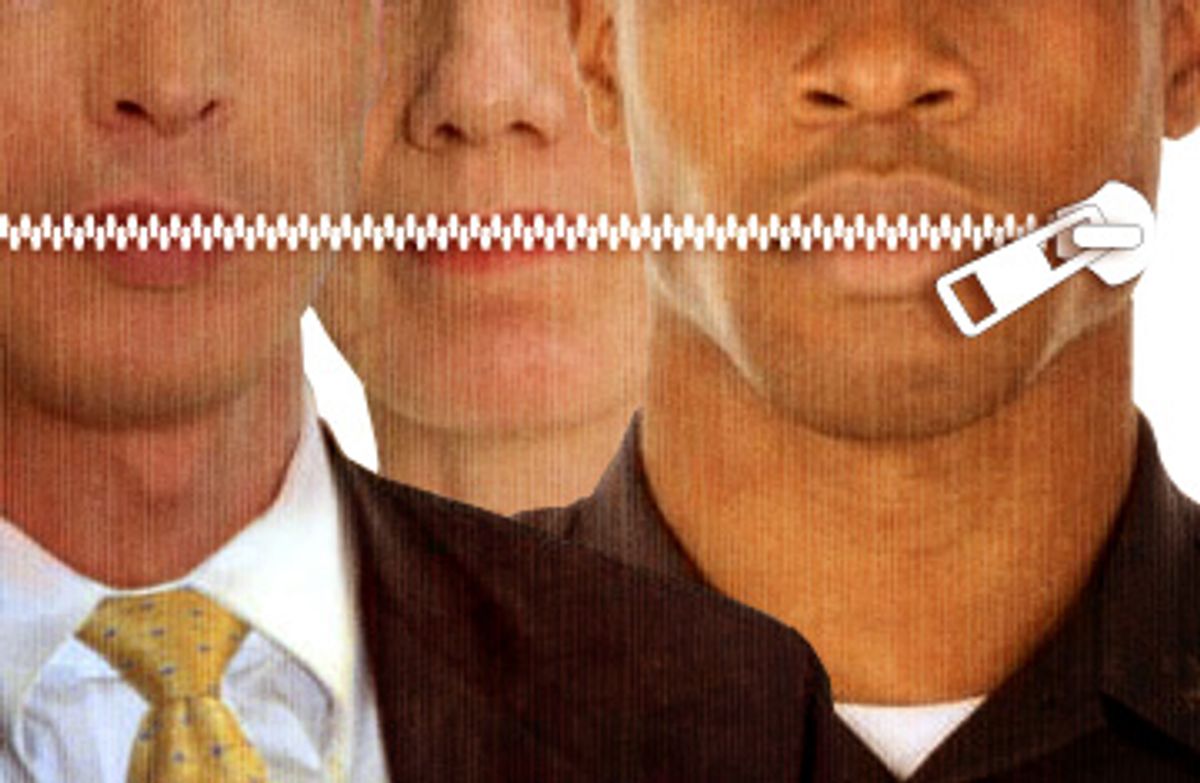
The war on whistle-blowers

U.S. officials have long retaliated against employees who speak out, burying the dangers they expose. Now, Congress wants to give whistle-blowers greater protection -- but President Bush vows to stop it.

  • more
    • All Share Services

The war on whistle-blowers

If there is any doubt about how the Bush administration treats government whistle-blowers, consider the case of Teresa Chambers. She was hired in early 2002, with impeccable law enforcement credentials, to become chief of the United States Park Police. But after Chambers raised concerns publicly that crime was up in the nation’s parks, she was rebuked by superiors and fired. When Chambers fought to regain her job through the legal system meant to protect whistle-blowers, government lawyers fought back, and associated her with terrorists. Despite a multiyear legal struggle, she is still fighting for her job.

Whistle-blowers have faced hostility not only under Republican administrations. During President Clinton’s tenure, Bogdan Dzakovic, an undercover security agent with the Federal Aviation Administration, suffered retribution for speaking out about weak airport security — three years before Sept. 11, 2001. Dzakovic was passed up for promotion time and again, and today, he says, he remains consigned to data entry duties for the Transportation Security Administration.

Every year, hundreds of federal workers sound the alarm about corruption, fraud or dangers to public safety that are caused or overlooked — or even covered up — by U.S. government agencies. These whistle-blowers are supposed to be guaranteed protection by law from retaliation for speaking out in the public’s interest.

But a six-month investigation by the Center for Investigative Reporting, in collaboration with Salon, has found that federal whistle-blowers almost never receive legal protection after they take action. Instead, they often face agency managers and White House appointees intent upon silencing them rather than addressing the problems they raise. They are left fighting for their jobs in a special administrative court system, little known to the American public, that is mired in bureaucracy and vulnerable to partisan politics. The CIR/Salon investigation reveals that the whistle-blower system — first created by Congress decades ago and proclaimed as a cornerstone of government transparency and accountability — has in reality enabled the punishment of employees who speak out. It has had a chilling effect, dissuading others from coming forward. The investigation examined nearly 3,600 whistle-blower cases since 1994, and included dozens of interviews and a review of confidential court documents. Whistle-blowers lose their cases, the investigation shows, nearly 97 percent of the time. Most limp away from the experience with their careers, reputations and finances in tatters.

Legal experts and lawmakers say the system is badly in need of reform. In fact, new legislation to strengthen whistle-blower protections has been moving through Congress this year, with strong bipartisan support, and is expected to come before the Senate this session. But in the latest setback to the system, the Bush White House has vowed to veto the legislation, citing among its criticisms a risk to national security.

“Whistle-blowers are treated like a skunk at a picnic, and there’s no excuse for it,” Sen. Charles Grassley, the Iowa Republican, said after being provided with details of the CIR/Salon investigation. Grassley has long sought stronger whistle-blower protections and is backing the new legislation toward reform. “It’s whistle-blowers who can help us truly understand problems at government agencies. They stick their necks out to speak the truth. They don’t take the easy way out.”

“It’s imperative that there are whistle-blower protections for civil servants when they see something that is wrong,” said Lynn Jennings, an attorney who served during the Clinton administration as general counsel for the special whistle-blower court, known as the Merit Systems Protection Board. “They need to know that if they speak out they are going to be protected. Ultimately, it is to save lives, to save money, to save the integrity of the federal government.”

To be sure, some cases brought by whistle-blowers are frivolous. Recent cases included one in which an employee sought protection after reporting missing candy bars at a government commissary. In another case, a worker complained about colleagues using a drinking fountain as a spittoon. One government worker was discovered by investigators to have fabricated his entire complaint. Most such cases, however, are weeded out of the system.

But the apparently legitimate cases — some involving serious issues such as aviation security or tainted meat in the U.S. food supply — have long been undermined by a lack of resources and case backlogs. And legal precedents created by the Federal Circuit Court of Appeals in Washington — the sole appeals court that hears and interprets the law for the special whistle-blower system — have made it virtually impossible in recent years for whistle-blowers to win their cases.

The beginnings of modern whistle-blower protections can be traced to the U.S. Senate floor in April 1951, when the junior senator from California proposed a new law, telling his fellow lawmakers that “it is essential to the security of the nation and the very lives of the people” that employees do not become “a parade of yes-men for administration policies.” The senator was Richard Nixon, and his proposed law eventually stalled. It might have faded away forever, if not for the scandal that shook public confidence in the federal government under Nixon’s own administration two decades later.

In the wake of Watergate, Congress passed the Civil Service Reform Act of 1978. It established the Office of Special Counsel, with a staff of investigators to look into complaints of retaliation against employees who spoke out. The new law also created the Merit Systems Protection Board, the administrative court with a bipartisan panel of three judges, and it assigned a special federal appeals court to interpret the law in the most complex cases.

But year after year, whistle-blowers complaining of retaliation lost their cases. Some faced insidious tactics by their co-workers and superiors.

Joseph D. Whitson Jr. was a civilian chemist in the Air Force who spoke out about superiors falsifying drug test results. His desk was moved to a room in the basement and his job duties stripped.

Vernie Gee Sr. was an agricultural inspector who sounded the alarm about tainted meat in the U.S. food supply and inspectors taking bribes from slaughterhouses. Gee was beaten up by a plant worker during an inspection — and then reprimanded by superiors for fighting.

George Randall Taylor, a chief of police at a Navy base in Bermuda, exposed coverups of rapes on the base. He was then forced into a psychiatric hospital.

Before Teresa Chambers was fired from the Park Police, she found used condoms on her car, and someone pepper-sprayed her office door.

“One of the great tricks in whistle-blowing is to get rid of someone for a reason that doesn’t seem like it was for whistle-blowing,” said Fred Alford, a professor of government at the University of Maryland. “You do all the things you can to get someone to quit, to get them enraged, to get them to act out. Then you can fire them.”

Government managers and attorneys almost always argue that measures taken against whistle-blowers were justified because of bad behavior or poor performance by the employee.

“It is usually not that hard for [agencies] to build up a case against somebody if they want to,” said Elaine Kaplan, who headed the Office of Special Counsel under President Clinton. “They start looking at your e-mails, they start nitpicking you … It is difficult to prove whistle-blower retaliation.”

Details of Chambers’ case reflect that struggle.

Prior to becoming chief of the Park Police, Chambers had a distinguished 28-year career in law enforcement. She was a Republican, was eager to serve the nation in the wake of the 9/11 terrorist attacks, and would be the first woman to lead the force. But her pedigree apparently would no longer matter once her public comments created political embarrassment for the Bush administration.

After 9/11, the administration feared terrorist attacks on high-profile U.S. landmarks, and ordered Chambers to double the number of officers standing guard at icons like the Statue of Liberty and those on the National Mall in Washington. But the Park Police force already faced staffing shortages, and Chambers was forced to pull officers who were patrolling other national parks, leaving those areas vulnerable. Drug dealers soon moved in, and rapes more than tripled. In August 2002, when one of Chambers’ patrolmen was handling a traffic accident with insufficient backup, he was run over and killed.

In the fall of 2003, when a Washington Post reporter contacted Chambers for a story about the growing peril in the parks, she responded candidly. The Park Police, she told the Post, needed twice as many officers and millions of dollars to cover overtime expenses. She said officers had been working grueling 12-hour shifts, and department morale was plummeting. “My greatest fear is that harm or death will come to a visitor or employee at one of our parks,” she said.

Retaliation against her began almost immediately. Chambers’ supervisor, Donald W. Murphy, then the deputy director of the National Park Service, ordered her in an e-mail to never again “reference the President’s ’05 budget under any circumstances” and summoned her to his office. In court documents later filed by Chambers she described how armed federal agents suddenly appeared and surrounded her in Murphy’s reception area, and took away her gun and badge. She was then paraded in front of media when escorted to another building to collect her belongings.

During the course of her case, Bush officials and attorneys attacked Chambers from multiple angles, documents show. One high-ranking official at the Interior Department, which oversees the Park Police, said Chambers was no longer “trustworthy” and that she “potentially endangered large numbers of citizens” by speaking to the media. Murphy, her former boss, said Chambers had been “communicating to the criminal elements,” signaling to them that national parks had become their “free territory to exploit.” A lawyer for the Bush administration asserted that Chambers had made reconnaissance operations easier for “America’s enemies in the world.”

In a recent interview, Chambers questioned whether raising concerns about an understaffed force angered Bush officials who were talking up policies for securing the U.S. homeland. “Was it just a bad day at the White House where I said we needed more officers, when somebody else was standing at a podium saying we’ve never been safer?” asked Chambers, who now teaches part-time at Johns Hopkins University and maintains a Web site documenting her case. “I don’t know.”

One advocacy group that assists whistle-blowers, the Government Accountability Project in Washington, has scrutinized past rulings to determine how whistle-blowers fare. GAP’s pioneering work showed that whistle-blowers seldom win. But until now, no comprehensive study has been done on whistle-blower cases. The Merit Systems Protection Board does not specifically keep track of cases, but using records obtained through the Freedom of Information Act, the CIR/Salon investigation reviewed 3,561 whistle-blower cases filed since 1994, when the Whistleblower Protection Act was last revised by Congress. The cases often traversed a costly and drawn-out series of legal steps prior to a decision. During the Clinton administration, in cases from 1994 to 2000, whistle-blowers won only 3.5 percent of the time. During President Bush’s tenure, from 2001 through June 2007, 3.3 percent of whistle-blowers won. Most whistle-blowers spent several years fighting in court.

“Whistle-blowers are overly confident in the law, but in most cases there is no recourse,” said University of Maryland’s Alford, who has studied the issue. “We have this idea of whistle-blowers from television — from ’60 Minutes,’ from Time magazine. But most whistle-blowers live and die in anonymity.”

“If you are looking at that record and advising [a whistle-blower], I would suggest seeking out a different venue,” said Robert G. Vaughn, a law professor at American University who has written extensively about the Merit Systems Protection Board.

Beth Slavet, a former judge on the Merit Systems Protection Board during the Clinton and Bush administrations, said of the court’s record: “It has a chilling effect. Why would you bring a case that you don’t think you can win?”

The system’s track record has left some whistle-blowers wondering whether their cases were tainted by partisan politics. In the 2003 case of Craig F. Johns, a former special agent for the Department of Veterans Affairs, confidential court documents obtained by CIR and Salon reveal such meddling — by a Republican judge on the court itself.

Johns’ case, which alleged forged training records and anti-gay harassment inside his agency, had crawled through the whistle-blower courts for seven years. In 2003, his case reached its final appeal at the Merit Systems Protection Board. At the time there was a vacancy on the bipartisan three-judge court. Johns’ case was being heard by a Democrat and a Republican — two judges with sharply different interpretations of the whistle-blower law. Beth Slavet, the Democrat, was a former staffer for Sen. Ted Kennedy and had an extensive career practicing labor law. Her Republican colleague, Susanne T. Marshall, had never been an attorney or even graduated college, but had been appointed to the court after a long career as a Republican staffer on the Senate committee for governmental affairs.

The two judges had in fact battled for more than three years over the Johns case, the court documents show, clashing over, among other things, how to address Johns’ claims of anti-homosexual harassment. Discrimination laws do not cover sexual orientation, but Slavet felt Johns’ case underscored such a need and drafted a decision that would grant Johns’ case a new hearing. But Marshall disagreed, and she used a procedural tactic to stall the case until an incoming Bush-appointed judge arrived to replace Slavet, whose term was almost over.

Slavet wrote a scathing memorandum to Marshall in response: “It is fundamentally unfair to the parties and destructive of the process to hold up these cases pending my departure and Mr. McPhie’s confirmation,” Slavet wrote in the memo dated Feb. 25, 2003, referring to the incoming Bush appointee, Neil McPhie. Soon after, McPhie joined the court and Slavet’s term ended. Marshall and McPhie decided the Johns case that August: “Corrective Action Denied.”

It was not the only case that Marshall stalled, documents show. There was the case of Lori A. Sutton, a Department of Justice secretary who alleged retaliation after filing an equal opportunity complaint; and the case of Valerie E. Johnson, a Department of Defense commissary worker who alleged retaliation after exposing the reselling of food items that had been picked at by rats. Marshall and McPhie also ruled against these whistle-blowers.

Marshall is no longer with the court and could not be reached for comment. But the current general counsel of the Merit Systems Protection Board, Chad Bungard, disputed that Marshall’s stalling of whistle-blower cases should be chalked up to partisan politics. “This could be totally innocuous,” Bungard said. “I can’t speculate on what Marshall’s intent was.”

Craig Johns has since left government work and opened a rescue ranch for injured animals in Texas, naming it the Ranch of Last Resort. “It’s very disturbing, to learn about this political interference,” he said recently. “This is why I prefer the company of animals to people.”

Johns’ case, like many others, never made it to the Federal Circuit Court in Washington, the only court that can preside over appeals of whistle-blower cases beyond the Merit Systems Protection Board. Through a series of precedent-setting rulings — which are binding for the entire whistle-blower legal system — the judges on the Federal Circuit Court have interpreted the law in recent years to the point where, as one investigator from the Office of Special Counsel put it, whistle-blowers must “utter magic words” to get protection.

Whistle-blowers are often employees who, during the course of their jobs, notice violations of rules or laws; before going public, they may casually mention the wrongdoing to a boss, or write a memo expressing the need to address a danger to public safety. Teresa Chambers is one example of a person who first raised concerns within her department, to no avail. But legal precedents created by the Federal Circuit Court have rigged the odds heavily against such employees.

One ruling determined that employees will not be protected if the nature of what they disclose is “debatable” by others. Another precedent says whistle-blowers won’t be protected if the coverup they disclose is common knowledge in the office. Another precedent strips protections for whistle-blowers who complain only to their direct boss but to no one higher up the chain. Perhaps the most notorious precedent, known as “Huffman,” says whistle-blowers will not be protected if it is their job to scrutinize safety issues or mismanagement, and they speak out about a coverup — like meat inspectors who discover a coverup of tainted beef in the food supply, or law enforcement officials who speak out about dangers to public safety.

In other words, these legal precedents have made the law more beholden to murky workplace protocols than to the substance of the allegations, even when those allegations concern serious public safety issues and are proven to be true.

“The problem is that no whistle-blower knows a damn thing about whistle-blowing before they do it. You can’t go back and repackage the disclosure to meet the requirements of the law,” said a senior Pentagon official who specializes in employment law. The official spoke on the condition of anonymity, fearing that he would not be protected from retaliation if he were openly critical of whistle-blower protections. “Never have your name in print,” he said.

Another government lawyer, who insisted on anonymity for the same reason, characterized the Federal Circuit Court’s view of whistle-blowers as juvenile. “No one likes a tattletale,” he said. “It’s that simple.”

The Federal Circuit Court’s longest sitting jurist, Haldane Robert Mayer, was appointed by Ronald Reagan. Prior to his appointment, Mayer had been the acting U.S. special counsel — the chief whistle-blower investigator. But Mayer resigned from that position in 1982 after the Office of Special Counsel was accused of holding seminars for political appointees and agency managers — to teach them how to fire whistle-blowers effectively within the confines of the law. The scandal led Congress to strengthen the whistle-blower law, but it did not stop Reagan from appointing Mayer to the bench.

“Judge Mayer is one of the most significant people in the legal system to translate the whistle-blower law passed in response to his own [alleged] abuses of power,” said Tom Devine, legal director for the Government Accountability Project.

Judge Mayer did not respond to an interview request.

In fact, many whistle-blower cases never even make it to the court. They first go to the U.S. Office of Special Counsel, the agency charged with investigating whistle-blower complaints. But the agency has long been considered a failure, due to a chronic backlog of cases, lack of resources and poor leadership. Year after year, the special counsel attempts to justify the existence of the agency by publicizing a handful of whistle-blower cases. “You make examples of high-level and mid-level officials to let them know that they are not going to get away with it,” explained Scott Bloch, the current special counsel, during an interview in September.

But in reality, only 5 percent of employees said they were satisfied with the treatment their case received from the Office of Special Counsel, according to an agency survey released last year. Whistle-blowers find themselves waiting in line behind hundreds of other employees who file complaints each year.

Elaine Kaplan, the Clinton-era special counsel, left office with more than 1,000 cases backlogged. “We received a tremendous amount of complaints there,” she said. “To tell you the truth, we were starting to move cases more quickly toward the end, but no one wants their case to move quickly to a bad conclusion.”

Since Bloch’s appointment by President Bush in 2003, the office has been fighting critics from both political parties, going round and round over allegations of everything from purging backlogged cases to discriminating against gay whistle-blowers. Bloch himself has for two years been under investigation for retaliating against his own employees.

“People have the right to file complaints if they want to and lawyers can say anything they want,” Bloch said when asked about the whistle-blower complaint against him. “But it’s all fiction — all the stuff is made up!”

The new whistle-blower law making its way through Congress, called the Whistleblower Protection Enhancement Act of 2007, is no panacea. But crucially, say its backers, it would allow whistle-blowers to appeal their cases in other U.S. circuit courts, whose judges may have a different interpretation of the law than those on the Federal Circuit Court. And prior to that stage, if the Merit Systems Protections Board didn’t act on a case in a timely manner, whistle-blowers would be able to get a jury trial at a federal district court. Moreover, the legislation would seek to include whistle-blowers in the national security realm, instead of having to rely on more secretive internal procedures at the FBI or other law enforcement and intelligence agencies for recourse.

“These changes would help whistle-blowers appeal negative decisions and hopefully increase the likelihood their complaints of retaliation would be heard,” said Sen. Grassley, who is co-sponsoring the legislation.

Briefed on the results of the CIR/Salon investigation, Democratic Sen. Daniel Akaka of Hawaii, who introduced the legislation, said: “What these statistics show is a real need to strengthen protections for federal whistle-blowers and close loopholes in the law created by judicial decisions that are inconsistent with congressional intent. It is important for our laws to protect the rights of these individuals who come forward with legitimate claims.”

But the Bush administration has vigorously opposed stronger whistle-blower protections. In a confidential e-mail from 2006, obtained by CIR and Salon, the White House registered strong objections to a congressional committee that was reviewing a similar law to protect whistle-blowers drawn up last year, saying the “excessively overbroad definition of whistleblowing … forbids using any common sense.” And President Bush has said he will veto the new legislation moving through Congress, saying in a two-page Statement of Administration Policy that the new law would “increase the number of frivolous complaints and waste resources” and could “compromise national security.”

Sean Kevelighan, a spokesman for the Bush administration, declined to elaborate on the administration’s position. “There is a policy that we let the Statements of Administration Policies speak for themselves,” said Kevelighan.

But for the thousands of federal employees who have descended into the bewildering world of whistle-blowing, there is only deep frustration or bitter resolve.

“My only regret is the stress that it placed on my family, my wife, myself,” said Craig F. Johns, the Veterans Affairs special agent whose appeal was blocked by Marshall, the Republican judge. “I’m still suffering the economic and psychological consequences, but I will never regret speaking the truth.”

“I grew up believing that federal service was an honorable profession,” said Bogdan Dzakovic, the former undercover FAA investigator, who remains a federal employee, unhappily waiting for his pension. “I realized that [blowing the whistle about security problems] was a totally pointless exercise.”

Teresa Chambers, the former Park Police chief, is still trying to appeal her case to the Federal Circuit Court, nearly four years after her firing. “Growing up in municipal policing, it was the expectation that we would be candid with the community that we served,” Chambers said. “I was aghast to find out that [in the federal workforce] candor was not only not expected, it was in this case forbidden.”

Guess who’s coming to dinner?

George and Laura Bush dine with the Obamas

  • more
    • All Share Services

Judy Gold

Emmy Award-winning actress and comedian Judy Gold is best known as the star of her two critically acclaimed off-Broadway shows, "The Judy Show - My Life As A Sitcom," and "25 Questions For A Jewish Mother." Judy has had her own comedy specials on HBO, Comedy Central and Logo. She appears regularly on Tru TV's World"s Dumbest. Check out www.JudyGold.com and follow her on Twitter at @JewdyGold.

Using Bush’s playbook

"Karl Rove politics" aren't quite dead: Obama's strategy in 2012 will mirror W's in 2004

  • more
    • All Share Services

Using Bush's playbookGeorge W. Bush and Barack Obama (Credit: Reuters/Larry Downing)

Barack Obama’s presidency was born from nothing so much as his repudiation of George W. Bush’s administration — its policies and politics, its style and tone. One of Obama’s most effective 2008 stump speech refrains was his promise to end the era of “Scooter Libby justice, ‘Brownie’ incompetence and Karl Rove politics.”

But the political dynamics for winning a second presidential term often differ markedly from winning the first. So don’t be surprised by many eerie parallels between Obama’s 2012 reelection bid and Bush’s 2004 campaign. The president may not rely upon “Karl Rove politics” in the strictest sense, and nobody would confuse David Axelrod with Rove. But Obama’s reelection route and rhetoric may bear more than a few Rovian hallmarks.

Now that Mitt Romney has won the Republican nomination, two key features prevail over the 2012 campaign — and both were also plainly evident in 2004. First, the incumbent president’s reelection fortunes are far from certain; and, second, the incumbent faces a decent but nevertheless weak challenger who is further hampered by internal problems within his party’s coalition.

Because incumbents can’t run for reelection promising “change,” and because “hope” during a lingering recession was also off the menu, the Obama campaign’s 2012 theme of  “forward” — a word that often follows “plow,” mind you — was the best available alternative. That said, and substituting the economy for terrorism, Obama is implicitly if not explicitly advancing the same theme Bush did in 2004: America suffered a tough blow, but the situation could have been worse and, more to the point, under my stewardship the nation is steadily regaining its footing.

This counterfactual campaign theme — vote for me not because of what happened, but what might have but didn’t — is a common thread for Bush and Obama. It’s not an uplifting message, but it sufficed in 2004 and Obama is counting on it working again in 2012.

Politics 101 further dictates that when an incumbent’s reelection is in doubt, he must go negative against the challenger. Obama political operatives in the White House and at the Democratic National Committee long ago made it abundantly clear they were willing to do just that. Team Obama may not go negative against Romney to the degree the Bush camp did against John Kerry in 2004. (By mid-summer 2004, 75 percent of Bush’s TV ads were negative attacks on Kerry.) But don’t be surprised if attacks on Romney’s record and even character are plentiful, harsh and relentless. In 2008, America saw candidate Obama’s toothy grin; four years later, expect to see President Obama’s fangs.

Expect the Obama camp to emphasize two major critiques of Romney: that he is a flip-flopper willing to say anything or reverse any position to win; and that he is an economic royalist whose personal and public life suggest a person incapable of understanding the lives and struggles of average Americans. Again — note the unusual parallels with 2004.

Although Romney is a Republican former governor and Kerry was at the time his state’s Democratic junior U.S. senator, the two Massachusetts pols make for similar targets. Each man is an extraordinarily rich preppie and Ivy Leaguer. Each represents the liberal wing of his respective party. Each has shown a propensity for ruining an otherwise valid point with sloppy, backfiring language. And each has a reputation for lacking political spine.

The flip-flop frame is candidate character assassination of the first order. Like the lone negative number in a string of multiplied positives, the critique that nobody can trust any statement or claim made by a politician has the potential to negate every accomplishment or promise. If it sticks, it can be fatal, as Kerry learned in 2004.

Obama and the Democratic National Committee know their electoral history and, sure enough, last November — a year before the election and two full months before a single Iowan had caucused — the DNC released a four-minute “Mitt vs. Mitt” ad and its accompanying website with the damning tag line, “the story of two men trapped in one body.” The site is a brilliant homage to the Bush campaign’s 2004 windsurfer attack ad and the devastating, 11-minute ad the Republican National Committee produced chronicling Kerry’s “evolution” on Iraq.

And then there is what might be called “the Willard factor”: Romney as Richy Rich, the Monopoly Guy with the Bain Capital background and the Swiss bank account. His bio would be political gold to Romney’s opponent any election cycle, but it’s gold-plated platinum in the first full presidential campaign following the biggest economic crisis since the Great Depression, the rise of the Occupy Wall Street movement, and the long overdue national debate over income inequality.

Again, the wealth-personified line of attack mirrors the out-of-touch, Martha’s Vineyard yoke the Bush team put around Kerry’s neck in 2004. Right on cue, in the first public event of his reelection campaign, last week Obama attacked Romney by name and invoked the economic disconnect card with relish. “He sincerely believes that if CEOs and wealthy investors like him make money the rest of us will automatically prosper as well,” said Obama of Romney, adding that “corporations aren’t people – -people are people.” (For the record, Kerry is actually wealthier than Romney, who would become one of the richest men ever to occupy the White House, should he win.)

Obama will also try to shift the national debate toward areas of strength, as Bush did. Historically, this meant the same strategy, but with inverse implications for each party: The so-called mommy party Democrats would encourage voters to focus on more favorable kitchen-table economy issues — healthcare, jobs, education — and away from less favorable “daddy party” Republican issues surrounding foreign wars abroad and culture wars. Because Obama is net-positive in foreign policy approval and net-negative on the economy, rather than mirroring by inversion, Obama will try to duplicate Bush’s shift-in-emphasis in 2004. GOP complaints that Obama is politicizing the killing of Osama bin Laden reveal Republican fears that Obama is going to play the terrorism card in 2012 just like Bush did eight years ago.

The 2004 parallels extend beyond message. Obama will be amply resourced and enjoy a field technology by virtue of his campaign’s state-of-the-art Web, donor, volunteer and social media innovations. Remember the Bush reelection campaign’s vaunted “72-hour” voter turnout model? That seems like an Edsel compared to the Ferrari the Obama team will be sporting this summer and fall. Among the perquisites modern presidential incumbents enjoy is the option to test-drive the best mobilization machines before anyone else.

Finally, what most connects Obama 2012 to Bush 2004 is the stability of the electoral map itself. Only three states — two net to Bush — flipped from one party to the other between 2000 and 2004; only nine states flipped between 2004 and 2008. Split the difference and a good, back-of-the-napkin over-under for number of states likely to flip between 2008 and 2012 is six. And thus, like the lead sailboat during a windless race, Obama doesn’t need or want conditions to change much from 2008: He merely has to replicate the map that swept him into office, with the burden of figuring out how to shake up the Electoral College falling to Romney, just as it did for Kerry against Bush. Even Karl Rove’s mapping of the 2012 election concedes this reality.

The 2008 election was memorable; to borrow the title of one best-selling chronicle, it was a “game changer.” But 2012 will not be. In many respects, it will be a game repeater, with Obama playing Bush to Romney’s Kerry of 2004. The president may be asking Americans to look “forward” in 2012, but the best preview of his reelection campaign can be found by looking backward eight years.

Continue Reading Close

The Bushies are back

Missed the neocons? Don't worry: Mitt Romney's getting the band together again

  • more
    • All Share Services

The Bushies are back (Credit: Reuters/Win McNamee)

There was good reason for Republicans to cry foul over the Obama campaign’s advertisement highlighting the president’s killing of Osama bin Laden; the GOP has lost its decades-long edge on national security. According to a Washington Post poll, “By a margin of more than 2 to 1, Americans say the president’s handling of terrorism is a major reason to support rather than oppose his bid for reelection.”

Republicans lost their popularity on security issues for one reason: George W. Bush’s foreign policy was a disaster. And yet, the party’s nominee, Mitt Romney, has assembled a foreign-policy team composed almost exclusively of individuals with the same war-always mentality and ideology that served Bush — and the United States — so poorly. In some cases, the exact same men responsible for Bush’s catastrophic national security policies are advising Romney. The former Massachusetts governor could have included some of the pragmatists and realists from the George H.W. Bush administration. Instead, a Romney presidency seems like it would be Bush 43 all over again.

Richard Grenell, who served as United Nations spokesman under Bush, may be gone from the Romney campaign after an uproar over his sexuality, but there are plenty more former Bushies. First off, there are Romney’s “special advisors.” There’s Michael Chertoff, W.’s Homeland Security director. Chertoff oversaw DHS’s failures during Hurricane Katrina, and amassed unprecedented powers of secrecy. Next up is Eliot Cohen, counselor to the State Department for Bush’s last two years and on the Defense Policy Advisory Board for the president’s entire term. Cohen was an adamant supporter of the Iraq War and advised Bush directly on the issue. Or take Cofer Black, the man who infamously said to Bush in September 2011 about al-Qaida that “When we’re through with them they will have flies walking across their eyeballs.” Black went on to become chairman of Blackwater, where he resigned after the company illegally bribed Iraqi officials.

Then there are the 13 “working groups” composed of equally worrisome individuals. The Middle East and North Africa Working Group is co-chaired by Bush’s Assistant Secretary of Defense Mary Beth Long, and Meghan O’Sullivan, Bush’s special assistant and deputy national security advisor for Iraq and Afghanistan. The remaining co-chair is Walid Phares, who never worked for Bush but advised Lebanese warlords in the 1980s. Romney has reportedly promised Phares a top job in his administration, despite his virulently anti-Islamic views.

All told, Romney lists 37 holdovers from the George W. Bush administration — the very same administration he and all other Republican candidates barely referenced during their many debates because it was so discredited and toxic, even to the Republican base.

It didn’t have to be this way. There are, in fact, people in Republican circles who are sensible on international affairs. The Cato Institute, in particular, has experts that could dramatically change the direction of American foreign policy. Men like Justin Logan and Christopher Preble were prescient on Iraq and a host of other issues. Similarly, the Center for the National Interest (formerly the Nixon Center) has a host of solid scholars, including ones like Dimitri Simes and Geoffrey Kemp, who have valuable government experience in the Nixon and Reagan administrations, respectively, and a history of perceptive analysis. Richard Haass, president of the Council on Foreign Relations, would have been another good pick.

So why aren’t guys like this being tapped? Why is the GOP sticking with a discredited foreign-policy approach rather that looking to its own past for wiser counsel? “Most of the realists and pragmatists have simply been driven out of the Republican Party,” says Stephen Walt, who writes a blog at Foreign Policy and teaches at Harvard. “The neoconservatives have been driving the agenda since Bush was elected and they remain well-entrenched.”

Another factor is that the Republican Party’s base remains strongly militaristic and reluctant to recognize limits on American power. Jon Huntsman’s failed presidential campaign illustrated that problem. The good news is that nobody seems to be calling for nation-building and occupying foreign countries in the mold of Iraq and Afghanistan. But that’s the only lesson that seems to have been learned from the last decade of foreign-policy debacles.

Finally, it may just be that the United States has too much power to change course. While the Unites States has undoubtedly made disastrous decisions in the last decades, it is so powerful that it is largely insulated from the consequences of them. If Romney’s foreign-policy advisor list is anything to go by, a Romney administration would have to teach the U.S. all over again about the problems with trying to police the world. Prepare for Bush redux.

Continue Reading Close

Jordan Michael Smith writes about U.S. foreign policy for Salon. He has written for the New York Times, Boston Globe and Washington Post.

Bush aide blasts torture

Philip Zelikow tried to warn Bush on interrogations. Now he's penned an authoritative article on how he was ignored

  • more
    • All Share Services

Bush aide blasts torture (Credit: Reuters/Jim Young)

The Bush administration hasn’t heard the last from Philip Zelikow. After the rediscovery last week of his long lost 2006 anti-torture memo, Zelikow, a former State Department official, has written arguably the most damning article yet about U.S. government’s interrogation policies from 2001 to 2009. The article, called “Codes of Conduct for a Twilight War,” will be released in a forthcoming issue of the Houston Law Journal, and was obtained exclusively by Salon. Says Zelikow in an email: “I’m not aware of other accounts that combine historical, policy and legal approaches to” the subject of the Bush administration’s interrogation methods.

Based on published histories and his firsthand observations, and adapted from a lecture delivered in November, the article calls the administration’s rationale for its use of torture — which he nonetheless insists only on calling “extreme interrogation” and “coercive methods” — “radical,” “an amazing contention,” “untenable and extreme,” “unsustainable,” “an unprecedented program of coolly calculated dehumanizing abuse and physical torment,” and, finally, simply a “mistake.” He concludes: “This was a collective failure of American public leadership, in which a number of officials and members of Congress (and staffers) of both parties played a part, endorsing a CIA program of physical coercion without any precedent in U.S. history.”  In fact, “The only defense against criminal prosecution would be that officials acted in good faith reliance on the advice of their government lawyers.”

Part of what makes Zelikow’s analysis so damning and definitive is its judiciousness. The article is deeply empathetic of the uniquely fearful situation under which the Bush administration was initially operating. Zelikow calls the Sept. 11 attacks a “collective trauma” and a “shoc[k] to mass beliefs.” He notes that Bush and others spent time in burn units, morgues and with survivors of the attacks. One traumatic experienced often overlooked — overlooked because it appeared in Stephen Hayes’ stenographic biography of Dick Cheney — was that the vice-president’s daughter was (falsely, it turns out) told that her house with her children in it had tested positive for anthrax. Similarly, Cheney and National Security Advisor Condoleezza Rice were told that they and others had been exposed to an extremely lethal toxin in a particular area of the White House — and might soon die as a result. “The alarms did not stop and they too were not abstract … The pressure on Bush and his senior advisers was so direct because so much of the response had to be invented and improvised,” the article reads.

An additional factor in the power of the article is Zelikow’s credibility and history. Before entering government, he was a civil rights lawyer in Texas battling the Ku Klux Klan and then a highly esteemed Harvard historian specializing in U.S. foreign policy — he co-authored one book with Rice. He then served on the National Security Council under President George H.W. Bush and directed the 9/11 Commission before becoming counselor to Rice at the State Department from 2005 to 2007. He currently volunteers part-time on the President’s Intelligence Advisory Board under President Obama.

Such bipartisan, establishment credentials render the breakdown and conclusion of this article all the more damning. He believes that what should have been a political and moral question — should the United States torture captives? — became strictly a legal matter left up to government lawyers, few of whom had any experience with these issues, and who had to take the necessity of extreme measures as a given. “These lawyers then became secular priests, granting absolution to the supplicant policymakers,” Zelikow writes.

The problems began when the Office of the Vice President and the CIA took central roles in policymaking. Cheney felt himself above the rest of the National Security Council, bypassing Rice and other traditional channels of national security policymaking. Ad-hoc decision-making and improvisation became “a habit of thought,” which seemed initially to pay off in the security of the nation, as well as in Bush’s political standing and self-confidence.

With Cheney and CIA head George Tenet “the key entrepreneurs in setting codes of conduct for the War on Terror,” it was essentially left to their obsequious lawyers to decide, in secret, on the interrogation methods America should employ. Bush even told the Senate’s Intelligence Committee chairman that “the vice president should be your point of contact … [He] has the portfolio for intelligence activities.” Decisions were made to jettison international treaties. By December 2001, the CIA was already interested in reverse-engineering methods “heretofore used only to treat Americans to resist enemy torture.” When a senior al-Qaida member was captured in March 2002, the prototype for the administration’s torture policies was already developed. “So, for the first time in American history, leaders of the U.S. government carefully devised ways and means to torment enemy captives.”

Zelikow notes that “None of the policy or moral issues connected with these choices appear to have been analyzed in any noticeable way.” Perhaps worst of all, no serious consideration was given to weighing the costs of benefits of the torture program, with reference to relevant historical precedents and/or examinations of the respective French, British and Israeli experiences in dealing with captured terrorists. “Bush and Rice should have insisted on this,” Zelikow writes.

The 52-page article observes the successes of Obama’s counterterrorism policies after repudiating the use of torture. On the basis of the empirical evidence then, “[t]here is no evident correlations between intelligence success and the available of extreme interrogation methods,” no matter what Bush and Cheney claim. Finally, “The program’s costs — which include the high-level effort expended in order to establish, maintain, and defense the program — appear on the evidence so far to have well outweighed any unique value the program might have had as a method of counterterrorism intelligence collection.” This is apart from the damage to America’s international standing and corrosion of its traditional values.

Zelikow concludes his analysis by arguing that, although the Obama administration has the right to wage war and use extralegal methods to defeat al-Qaida, its claim of that authority to defeat “associated forces” is unwarranted. “The U.S. government should publish and explain any overarching policy and legal documents that guide and confine the conduct of deadly operation against its foreign enemies … the executive branch of the U.S. government has a duty to articulate the scope of its warfare to the Congress and the public.” The Bush administration’s unprecedented elevation of torture to national policy may be history, but the job to get U.S. foreign policy in line with its constitutional and moral obligations is far from over.

Continue Reading Close

Jordan Michael Smith writes about U.S. foreign policy for Salon. He has written for the New York Times, Boston Globe and Washington Post.

Thomas Kinkade, the George W. Bush of art

The rise and fall of Thomas Kinkade, the Painter of Light™ in a decade of bad faith

  • more
    • All Share Services

Thomas Kinkade, the George W. Bush of art

News of Thomas Kinkade’s death arrived on the same day I received in the mail a vintage teacup on which I had spent a ridiculous amount of money. It has a cottage painted on it. Kinkade, whose work has long exerted a morbid fascination for me (to the concern of all my friends), specialized in cottages. So some part of me understands the appeal, I guess, but, damn: Those paintings make my corneas hurt. And yet, I could barely stop looking at them.

Kinkade was only 54, and his family told the media that he died of “natural causes.” This comes after years of reports of drunken public misbehavior: cursing at people who tried to save him from falling off bar stools, heckling Siegfried & Roy, grabbing a woman’s breasts at a publicity event and, most memorably, urinating on a Winnie the Pooh statue at the Disneyland Hotel while proclaiming, “This one’s for you, Walt!” There were DUI arrests. Also, his manufacturing company declared bankruptcy two years ago, and former franchisees of the once-ubiquitous Thomas Kinkade Signature Galleries won settlements against him for fraud.

That’s quite a fall for a man who frequently spoke of his Christian faith and family values when asked to comment on the mammoth success of his brand in the early 2000s. “When I got saved, God became my art agent,” Kinkade explained in a 2004 video. He went from a childhood in Placerville, Calif. (invariably characterized as “hard-scrabble”) to an apprenticeship selling his work in supermarket parking lots to his apotheosis as the nation’s “most profitable” artist, the Painter of Light™, and multimillionaire. He was profiled in the New Yorker by Susan Orlean.

I first learned about the dark side of the Painter of Light™ — sorry, couldn’t resist that one — when I reviewed “his” novel, “Cape Light,” in 2002. The novel, first in a series, was produced much as his paintings are: by a semi-industrial process in which low-level apprentices embellish a prefab base provided by Kinkade. He wasn’t the only artist to work in this way; he wasn’t even the only novelist. To the best of my knowledge, his novels — heartwarming, fuzzily pious tales of small-town life — have been coming out ever since, one more facet of a lifestyle brand that, at its most ambitious, included an entire Thomas Kinkade-themed housing development.

My review was just a goof intended to amuse Salon’s readers, but after it appeared, I began to receive emails from people who had sunk their life savings in Thomas Kinkade Signature Galleries (essentially, mall and shopping-district outlets for his prints) and been fleeced. I didn’t really understand how the financial architecture of Kinkade’s gallery empire worked, and I sure didn’t share their taste in wall art, but these people struck me as decent and sincere. They’d believed in Thomas Kinkade — not just in the man or the company, but in the ethos supposedly represented by his work, one in which (to quote Kinkade’s introduction to “Cape Light”) “people have the time to savor life’s simple pleasures” and lead “deep, satisfying lives.”

My conversations with these victims made me uneasy. Was there some relationship between the franchisees’ naivete, perhaps even their willful self-delusion, and their terrible taste? Was it hopelessly snobby to wonder that? What about Kinkade himself? He seemed to be at best a hypocrite and at worst a crook. Was there a meaningful connection between his bad conscience and his bad art? German thinkers of the 1930s would have said so, and they had plenty of opportunity to observe bad fascist art up close. Hermann Broch maintained that someone who chooses to make kitsch is “ethically depraved, a criminal willing radical evil.” The novelist Milan Kundera believes kitsch to be the natural expression of totalitarianism. That’s a lot of moral weight to place on a bunch of garish cottage paintings, but Kinkade was always the first to present his work as a form of ideology.

I felt compassion for the ripped-off gallery operators, and at the same time I was aware that quite a few of them had probably also fallen for the similarly sanctimonious, bogus folksiness of George W. Bush, thereby subjecting our nation to one of the worst presidents in its history. Kinkade and Bush struck me as of a piece, probably because they had both borrowed from Ronald Reagan in promising that we could get back to a better way of life that never existed in the first place. In nearly every encounter with the press, Kinkade delivered a diatribe against the art-world “establishment” that had shut him out. They were “elites” touting unfathomable, downer junk to hardworking people who needed uplift instead. Art snobs were the aesthetic counterparts of the so-called liberal elites, a group that surely included me.

At the same time, I must admit that I, too, like a cottage. Granted, I like the stylized, art-deco kind painted on bone china, rather than the insanely detailed and phosphorescently lit specimens in Kinkade’s pictures. And I’m in little danger of equating my new teacup with a Brancusi just because it’s cheerier. Nevertheless, I suspect that my idea of what’s pleasing about a cottage isn’t too different from that of Kinkade’s fans: an aura of harmless coziness, of modest domestic beauty and comfort not too cut off from the past. It’s as if we’re speaking the same word, but in different languages.

I suspect this is why Kinkade’s paintings have exerted their weird, hypnotic effect on me. They are so preposterous (especially the stream-side ones; he really needed to sit down with an architect and go over the basics of drainage), so awful. And yet I can still detect — beneath that cacophony of hollyhocks and cobblestones and snapdragons — the whisper of something intelligible. I’m pretty sure I know why the hordes of Kinkade collectors love his work, even if I don’t like it myself. Kinkade’s paintings are irredeemably false, like all kitsch, but through them you can just barely glimpse the honest desires they seek to exploit, sinking under the dreck.

Kundera defined kitsch as “the absolute denial of shit,” meaning it offers an airbrushed, sterilized, sentimentalized view of the world. From that, it doesn’t necessarily follow that art wallows in shit, but art doesn’t exist for the primary purpose of denying it, either. Kitsch is, first and foremost, a lie; its very existence is founded on bad faith.

Kinkade, like Bush, peddled a falsely simplified image of the world — one without mildew or flooded basements, for one thing — which, no surprise, turned out to be plastered over a whole lot of stinky stuff. The true believers, the ones who bought into these men the most during the 2000s, ended up paying some of the highest prices, from the Kinkade acolytes who invested in his gallery Ponzi scheme to the working-class red-staters who sent off their kids to die in a pointless war. Bad taste, harmless as it may seem, can end up costing you a lot.

Further reading

Los Angeles Times obituary for Thomas Kinkade

Susan Orlean’s 2001 profile of Thomas Kinkade for the New Yorker

A 2006 Los Angeles Times story documenting Kinkade’s business problems

Salon’s Janelle Brown visits Hiddenbrooke, a Kinkade-theme housing development in Northern California

Laura Miller reviews “Cape Light,” a novel by Thomas Kinkade and Katherine Spencer

Continue Reading Close
Laura Miller

Laura Miller is a senior writer for Salon. She is the author of "The Magician's Book: A Skeptic's Adventures in Narnia" and has a Web site, magiciansbook.com.

Page 1 of 436 in George W. Bush