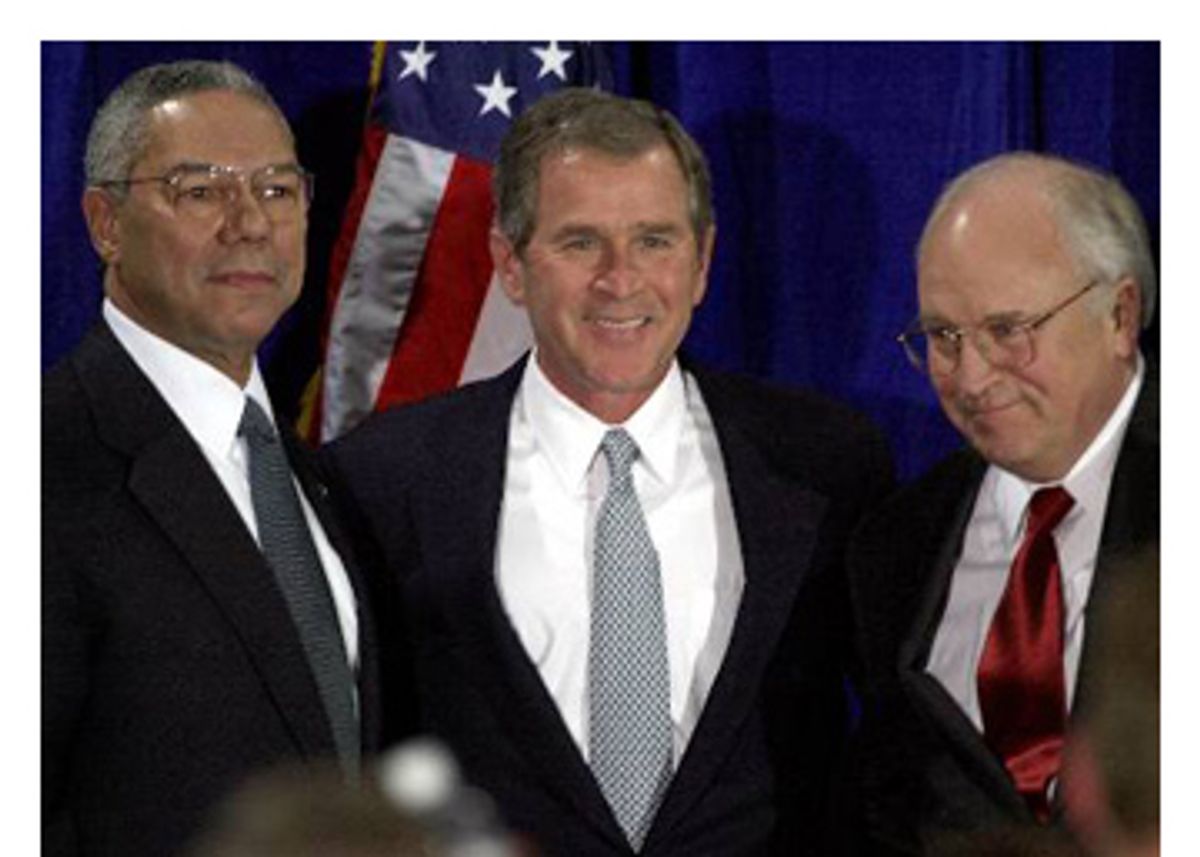
Much as he loathed Colin Powell, Vice President-elect Dick Cheney realized that the immensely popular general — the most trusted man in America — was essential to the political perception of the incoming Bush administration’s foreign policy decisions. As former speaker of the house Newt Gingrich put it, “If you’re George Bush, and the biggest weakness you have is foreign policy, and you can have Cheney on one flank and Powell on the other, it virtually eliminated the competence issue.”
As a result, on December 16, 2000, three days after Al Gore conceded defeat, Colin Powell was flown to Bush’s ranch in Crawford, Texas, where the president-elect announced his first cabinet appointment: Colin Powell as secretary of state. “He is a tower of strength and common sense,” said Bush. “You find somebody like that, you have to hang on to them. I have found such a man.”
Tears filled Bush’s eyes. “I so admire Colin Powell,” he later explained. “I love his story.”
Unlike other designated cabinet appointees, Powell had not been vetted by Cheney or other campaign officials. Nor, according to “Soldier: The Life of Colin Powell,” Karen DeYoung’s comprehensive biography of him, was Powell even asked any serious foreign policy questions. Such discussions were not necessary. According to a former Pentagon official who had worked with Cheney during the first Gulf War, “Cheney’s distrust and dislike for Mr. Powell were unbounded.” In other words, Powell was only there for show. Cheney immediately took measures to undermine him. The chess game began.
At the Crawford press conference on December 16, Powell was dazzling — too dazzling for his own good. As he proceeded with his lengthy discourse about the state of the world, Bush’s admiring expression gradually turned to one of sour irritation. Afterward, Richard Armitage, Powell’s close friend and longtime colleague, told the secretary of state-designate that he had been so comfortable in front of the cameras compared to the president-elect, that it was somewhat disturbing. “It’s about domination,” Armitage advised Powell. “Be careful in appearances with the president.”
Armitage wasn’t the only one to notice. “Powell seemed to dominate the President-elect … both physically and in the confidence he projected,” reported the Washington Post. New York Times foreign affairs columnist Thomas Friedman concluded that Powell “so towered over the president-elect, who let him answer every question on foreign policy, that it was impossible to imagine Mr. Bush ever challenging or overruling Mr. Powell on any issue.”
None of this was lost on Cheney. Initially, Bush and he had decided that the new secretary of defense would be former Indiana senator Dan Coats, a Christian fundamentalist on the Senate Armed Services Committee who had won over the Christian Right thanks to his undiluted antipathy toward gays in the military. But now it was abundantly clear to Cheney that Coats would be no match for Powell. When Coats added that he did not consider missile defense an urgent priority, Bush and Cheney dumped him immediately.
Meanwhile, Bush proceeded to pick other key cabinet officials. On December 22, he announced that his attorney general would be John Ashcroft, who had just been defeated in a bid for reelection as senator from Missouri. Ashcroft, who had preached at Jerry Falwell’s Thomas Road Baptist Church, was a member of the Assemblies of God church, the denomination of Jimmy Swaggart, Jim and Tammy Faye Bakker, and Elvis Presley, which was known for charismatic practices such as faith healing and speaking in tongues.
As secretary of commerce, Bush picked Don Evans, an evangelical oil man friend from Texas who had introduced Bush to the Community Bible Studies program in Midland. As chief White House speechwriter, Bush picked Michael Gerson, a graduate of Wheaton College, the so-called Harvard of evangelical colleges. These were the very people whom Neil Bush had scorned as “cockroaches” issuing “from the baseboards of the Bible-belt,” and whom Bush 41 had derided as the “extra-chromosome set.”
As the cabinet began to take shape in late December, Colin Powell still presented the biggest potential obstacle to the ambitions of Cheney and the neocons. There was less than a month before the inauguration. Time was running out. They had to find a way to neutralize him.
According to the former Pentagon official, Cheney was convinced that even though Powell’s presence was essential to the Bush administration, he “would have to be cornered bureaucratically and repeatedly reminded (even in ways involving public humiliation) that foreign policy was not something over which he presided.” To accomplish that task, the official continued, Cheney “recruited Donald Rumsfeld and the neoconservatives to hammer Secretary of State Powell bureaucratically while Mr. Cheney took upon himself the task of managing the President of the United States.”
On December 28, Donald Rumsfeld met Bush in his temporary headquarters in the Madison Hotel in Washington. To Washington cognoscenti, to Bush insiders, the idea that Rumsfeld might be invited to join a Bush administration was stunning. Rumsfeld’s enmity with Bush 41 included attempts to keep Bush off the Republican ticket in 1976 and 1980 and the Team B battle with Bush’s CIA. Rumsfeld openly made fun of Bush at Chicago dinner parties. And when Bob Dole challenged Bush 41 for the presidential nomination in 1988, Rumsfeld had been on Dole’s team. At the time, George W. Bush was the enforcer on his father’s campaign. “Without question, [George W.] would have known about his father’s problems with Rumsfeld,” said Pete Teeley, former press secretary to Bush 41. “Everybody knew.”
“Real bitterness there,” said another friend of Bush 41. “Makes you wonder what was going through Bush 43′s mind when he made him secretary of defense.”
James Baker even interceded. According to Robert Draper’s “Dead Certain,” he told the president-elect, “All I’m going to say is, you know what he did to your daddy.” But Bush didn’t listen. After all, Rumsfeld’s success came from being a great courtier. Fourteen years older than his patron, vastly more experienced, Rumsfeld reportedly played to Bush’s insecurity about his lack of experience, and reassured him that he was fit for command. That reassurance became crucial to their relationship over the next six years.
Rumsfeld’s relationship with Cheney had cooled somewhat since he and his protégé had been in the Ford White House. In 1986, Rumsfeld had made a futile stab at getting the 1988 Republican presidential nomination, and had pleaded with Cheney, unsuccessfully, for his support. When George H.W. Bush won the presidency, Cheney ultimately became secretary of defense but Rumsfeld was left out in the cold.
Now that they were reunited, Cheney had a more powerful role in their partnership than before. In contrast to President-elect Bush, who had little knowledge of Washington, the two men had an unsurpassed mastery of the intricacies of the federal bureaucracy, thanks to three decades of shared experience at the highest levels of the executive branch. They knew the White House, the Pentagon, and Congress — inside and out. They knew how to make these institutions turn on a dime, when to accelerate and when to put on the brakes. Less neocon ideologues than authoritarian nationalists, they believed in an executive branch so powerful — “the imperial presidency,” “the unitary executive” — that the constitutionally mandated system of checks and balances was all but negated. It was a philosophy that many neocons shared.
But in order to realize his ambitions, Cheney knew his team needed control of the entire national security apparatus. By this time, Paul Wolfowitz, a Cheney hand whose name had been widely bandied about as a potential secretary of defense, was now being touted as a possible pick to replace George Tenet as the next CIA director. If that happened, Cheney would have an ideal team in place.
Then dean of the School of Advanced International Studies (SAIS) at Johns Hopkins University — a position he had held for seven years — Wolfowitz, always intent upon proving he was the smartest guy in the room, had a cerebral style that didn’t mix particularly well with Bush’s frat-boy disposition. In Dick Cheney, however, he had a patron who was the most powerful voice in the new administration next to the president himself. And, during his trips to Austin, Wolfowitz had played a key role in formulating an intellectual framework through which the president-elect could craft foreign policy.
There was another problem, however, that threatened Wolfowitz’s position in the new administration. His marriage was on the rocks. Worse, according to an article in the Daily Mail (London) by Sharon Churcher and Annette Witheridge, Wolfowitz was allegedly having an affair with a staffer at the School of Advanced International Studies. Clare Wolfowitz, his wife of more than thirty years and mother of his three children, was said to be so angry that she was taking actions that might jeopardize his career.
The episode at SAIS was not the only alleged indiscretion reported about Wolfowitz. The fifty-seven-year-old Pentagon veteran had also become smitten with Shaha Ali Riza, a secular Muslim then in her forties, who had made her way through Washington’s neocon network while working at the Free Iraq Foundation, a group that supported the overthrow of Saddam Hussein in the early 1990s, and the National Endowment for Democracy, a congressionally funded foundation that makes grants to promote democracy throughout the world. Born in Libya and raised in Saudi Arabia, Riza had been educated at the London School of Economics and Oxford, and had obtained British citizenship. According to the London Sunday Times, Riza shared “Wolfowitz’s passion for spreading democracy in the Arab world” and “is said to have reinforced his determination to remove Saddam Hussein’s oppressive regime.”
According to a former State Department official, Wolfowitz was quite taken with the notion that he, a secular Jew, was dating a Muslim. Their relationship put a heady, modern, and romantic face on the entire neocon project of democratizing the Middle East. As the Bush-Cheney team prepared to take office, Wolfowitz and Riza, not his wife Clare, took in the neocon social circuit together. Riza was known to Cheney. She moved in the same circles with and was admired by Ahmed Chalabi, the Iraqi exile Wolfowitz backed as a successor to Saddam. “Shaha was the embodiment of the outcome of the modern Arab political system as the neocons saw it,” said the State Department source. “She was the personification of the outcome they hoped for in Iraq. She was not theoretical. She was not in a burka. She was a modern Arab feminist.”
Wolfowitz’s critics who knew about the affair delighted in referring to Shaha Riza as “his neoconcubine.” But more significant than the prurient aspects of his alleged dalliances were the questions of national security they might raise. After all, federal officials have been denied national security clearances not because of extramarital activities but because of the possibility of blackmail stemming from their nondisclosure. And if one of the women in question was a foreign national — as was Shaha Ali Riza — that raised additional serious issues about security clearances.
What hung in the balance was not merely the marriage of Paul and Clare Wolfowitz — or the sales of British tabloid newspapers. Nor was it just whether or not Paul Wolfowitz would reach the apex of his career by becoming director of the CIA. Unwittingly, Clare Wolfowitz may have put at risk Dick Cheney’s dreams of the entire neocon project to remake the Middle East. After all, if Cheney, Rumsfeld, and the neocons were to outflank centrists such as Colin Powell, it was essential that they control America’s intelligence apparatus. As Cheney saw it, Wolfowitz was just the man for the job. Cheney was getting all his ducks in a row — or at least trying to.
Meanwhile, just as Wolfowitz’s name was being bandied about for the top job at Langley, George Tenet, the Clinton appointee who still served as CIA director, got called to a private meeting with President-elect Bush. Tenet had hoped to make it at least partway through the next administration, but the papers had been full of speculation about who might succeed him. “I guess this is the end,” Tenet told a colleague as he went to meet the next president.
When Tenet returned, however, he was pleasantly surprised. “[Bush] wants me to stay until he can find someone better,” he said. It was not until six years later that The Nelson Report, a highly regarded newsletter for Washington foreign policy insiders, finally reported why Tenet had not been replaced by Wolfowitz. “A certain Ms. Riza was even then Wolfowitz’s true love,” the newsletter said. “The problem for the CIA wasn’t just that she was a foreign national, although that was and is today an issue for anyone interested in CIA employment. The problem was that Wolfowitz was married to someone else, and that someone was really angry about it, and she found a way to bring her complaint directly to the President.
“So when we, with our characteristic innocence, put Wolfowitz on our short-list for CIA, we were instantly told, by a very, very, very senior Republican foreign policy operative, ‘I don’t think so.’ It was then gently explained why, purely on background, of course.”
More specifically, the Daily Mail, citing a Bush administration source, reported that Clare Wolfowitz was so incensed by her husband’s sexual behavior that she wrote Bush a letter suggesting that because of his infidelity her husband posed a potential national security risk. According to a memo by the former State Department official on the Washington Note website, Clare’s letter “detailed her husband’s extramarital affairs at SAIS and with Shaha Ali Riza. … Clare pointed out that her husband had a sexual relationship with a non-American citizen and that he was seeking to keep these relationships ‘non-disclosed.’”
Wolfowitz was now damaged goods. If Cheney and the neocons were to have control over the national security apparatus, it would not come from the CIA. They would have to turn to Plan B and find another way to take charge of America’s multibillion-dollar intelligence machine.
The hit Palestinian TV satire show “Watan ala Watar” began its Aug. 14 episode with a sketch featuring Palestinian Attorney General Ahmad Mughani getting besieged by Palestinians filing lawsuits over “Watan ala Watar” making fun of them. One woman says in Arabic that the TV show hadn’t parodied her yet, but she’s sure it’s going to, so she wants to file suit preemptively. In the middle of the commotion, the frazzled Mughani, played by “Watan ala Watar” co-creator Imad Farajin, gets a phone call: “Watan ala Watar,” it turns out, just made fun of him, too.
The sketch ends by showing Farajin and his “Watan ala Watar” colleagues one year later, silently clowning around, suggesting that even if Mughani and his government cohorts muzzle them, that won’t stop the comedy crew’s high jinks.
Those high jinks have been a runaway success since “Watan ala Watar,” aka “Homeland on a String,” hit the airwaves in 2009, the first political satire show ever broadcast on Palestinian TV. The weekly 15-minute show’s three creators became local celebrities in the West Bank capitol of Ramallah, where they live and work, and episodes became a must-watch phenomenon, especially during Ramadan, when the show ratchets up to a nightly schedule. The holy month is akin to a U.S. “sweeps” period, with everybody at home by the TV. Last year, a local polling organization found that 60 percent of those in the West Bank and Gaza who’d seen “Watan ala Watar” actively approved of it — far higher approval ratings than those of either Fatah or Hamas, the two major political parties.
From the start, the show enjoyed a surprising amount of editorial freedom, considering that it aired on state-run television in the Middle East. “We told officials there would be one condition: no censorship,” says the show’s 30-something co-creator Manal Awad, who dresses in stylish, modern clothes and speaks English with a heavy British accent, courtesy of her time in London where she got a master’s degree in theater directing.
Palestinian officialdom agreed, allowing the show to air a sketch in which progress on an Israeli peace deal is announced by Fatah leader and Palestinian Authority President Mahmoud Abbas — that is, Mahmoud Abbas the 13th, at a time 500 years in the future. Hamas, the Islamist party governing the Gaza Strip, received its share of knocks, too. One skit featured an Islamist judge making eyes at a male courtroom reporter. While Hamas’ Ministry of Information has called “Watan ala Watar” “an example of black propaganda,” the show has long enjoyed the blessing of the Palestinian Authority. Yasser Abed Rabbo, one of President Abbas’ closest advisors and head of Palestine TV, even played himself on the show.
Most promising of all, during this year’s Ramadan, “Watan ala Watar” had competition: “EscotChat,” a new sketch comedy show that aired 20 minutes later. “Five years from now, you will find comedy clubs and comedy series here, and not just ‘EscotChat’ and ‘Watan ala Watar,’”says Ihab Al-Jarere, “EscotChat’s” creator.
“Watan ala Watar,” it seemed, was helping Palestinians ascend the Middle Eastern comedy ladder, the unofficial scale in which Egyptians are considered to be the funniest of the funny and the Jordanians the exact opposite. (As one Palestinian joke goes, “Have you heard the one about the Jordanian businessman? Every morning before work he puts on his shirt, tie and angry face.”)
But then, two days after “Watan ala Watar’s” skit about the attorney general sketch aired, Palestine dropped a few comedy rungs closer to Jordan. Mughani, in a move reminiscent of the skit itself, pulled the show off the air.
It had told one controversial joke too many — and Mughani and his cronies weren’t the only ones not laughing. Recently, the show had diversified its subject matter, turning its satirical gaze upon Palestinian society itself. “We criticize all the governments, Hamas and Fatah, but they haven’t changed since we started,”says Awad. “We needed new figures to criticize.”
That’s why in one recent sketch, the show took on the local medical industry’s outdated practice of settling malpractice issues outside of court with informal payoffs, depicting a doctor and a grieving mother bargaining over a dead baby as if haggling over prices at the market. Another episode satirized the shabbiness of Palestinian Authority police. In the skit, officers on the lookout for drunk drivers couldn’t afford breathalyzers, so they’re forced to smell the scofflaws’ breath — and get drunk themselves off the fumes.
Those jokes didn’t go over so well. While local politicians had been fair game (maybe because in territories still controlled by Israel, the Palestinian Authority doesn’t have much authority at all), the Palestinian elite apparently was not. The local police and the physicians’ union filed grievances, and “Watan ala Watar’s” creators say that for the first time ever, officials censored them. Meanwhile, newspaper opinion pieces called the show a disgrace, and somebody hacked the TV show’s Facebook page, causing it to lose 40,000-plus fans.
Then, on Aug. 16, the attorney general, noting the complaints, pulled the plug. “Watan ala Watar” hasn’t been on since, with “EscotChat” moving into its time slot. “I thought this season was going to be a really, really huge success,” sighs Awad between puffs of an ever-present cigarette. “I didn’t expect this really aggressive reaction against us.”
This wasn’t the only recent aggressive reaction to artistic rabble rousing in Palestine. In April, a masked gunman shot and killed Juliano Mer-Khamis, founder of the Freedom Theatre in the Jenin refugee camp in the northern West Bank, a murder that’s still unsolved. While Palestinians mourned his death as a national tragedy, some weren’t surprised: Mer-Khamis was a half-Jewish artist and activist who was always pushing the cultural envelope, staging versions of Animal Farm that featured boys and girls onstage together, wearing pig masks and criticizing the revolution. As Awad says of Mer-Khamis’ murder, “You can’t force new thoughts on people. Bit by bit, you have to work with them.” Maybe Awad and her colleagues had been guilty of the same mistake.
Do such developments suggest the people here aren’t yet ready to laugh at themselves? Is comedy in Palestine as stagnant as the peace process?
Far from it, in fact. There has always been humor in Palestine,” says Sharif Kanaana, a Palestinian folklore professor who’s been collecting local jokes since 1989, from the jubilant highs of the two intifadas (where many zingers involved street kids getting the better of Israeli soldiers) to the disillusioned lows in between. (A typical post-intifada joke goes, “Several heads of state meet with God and make requests for their people. To each, God says, “Not in your lifetime.” Then Yasser Arafat asks for his people’s freedom and God says, “Not in my lifetime.”) “It’s not just fun and entertainment,”says Kanaana. “It is a pan-human way of people expressing themselves.”
And in a place defined by absurdity — where the beach is a few miles away but people in the West Bank have to hopscotch though Jordan and Cyprus to get there — if Palestinians aren’t allowed to express themselves through laughter, what else do they have left?
That’s why the people haven’t taken “Watan ala Watar’s” shutdown lightly. Hundreds have signed on to Facebook campaigns such as “People against the decision to stop broadcasting Watan ala Watar,”and “People want Watan ala Watar,” and in Bethlehem, protesters marched against the decision.
Many officials agree with them. “This decision of the attorney general is bad news and, in my opinion, is wrong,” says Palestinian Authority spokesman Ghassan Khatib. “I think I speak for Prime Minister Salam Fayyad as well.” Politicians such as Fayyad are savvy enough to know that in a period where Middle Eastern dictators are falling left and right, now is not the time to crack down on free speech.
While “Watan ala Watar’s” shutdown could be bad news for the Palestinian Authority, it could end up being good news for the comedians behind the show. Headline-grabbing controversies, after all, are a comedian’s bread and butter. Awad hints that Watan ala Watar is already fielding offers from other media outlets, and the hubbub may even score the show attention in Israel. “I haven’t heard of them, but it’s a shame that they were shut down,” says David Kilimnick, an Israeli comic who owns the Off the Wall Comedy Basement club in Jerusalem. “I wouldn’t be against giving them a stage here.”
In the meantime, Palestinians can catch a glimpse of “Watan ala Watar” at the three comedians’ weekly live show at an upscale open-air restaurant in Ramallah. Two days after being pulled off the air, the trio took the stage there armed with timely material. As television news cameras rolled, the three apologized for being late. They said they had been detained at Attorney General Mughani’s house. “Watan ala Watar” may be muzzled by the authorities, but that’s not going to stop them from clowning around.
Joel Warner, who blogs for Wired.com and Psychology Today, is co-authoring a book about traveling around the world with a humor professor in search of what makes things funny. Find out more at Humorcode.com and on Twitter @HumorCode.
Continue Reading
Close
I need a break from the rhetorical outrage beat. I was going to write about the Newsmax columnist who all but advocated a military coup to bring down Obama, then I was pondering a post about Rep. Alan Grayson’s claim that the GOP health reform plan amounts to if you get sick, “die quickly.” But I’m tired of overheated rhetoric right now, (plus the indefatiguable Alex Koppelman got to both stories first!) so I took refuge in Taylor Branch’s new book, “The Clinton Tapes.” I had planned to review it, but it’s almost 700 pages, and I have a day job. If I took the time to read it and then write about the whole thing, it would be weeks before I’d get it done — and I think the book has insights that are supremely relevant to today.
So I thought I’d try to blog my review, over several days, and ask for your help, if you’re reading the book. Every few days I’ll write about what I am learning, and anyone who’s reading, or curious, can participate in comments. (We could do the same thing with “Going Rogue” next month, but it would probably take us about an hour.)
I have to start by saying Taylor Branch’s trilogy, “America in the King Years,” is my favorite work of history. He brought the Rev. Dr. Martin Luther King Jr. alive for me. And to see my favorite civil rights historian — so far, there are some up-and-comers that deserve a look, too! — grappling with the president who, until Obama, thought and did more about civil rights than any president before him, well, it’s a thrilling combination. The book opens with the pair believing they are fulfilling the movement they’d worked for as young men, convinced Clinton can do so much to advance King’s goals, though we know that eventually politics got in the way. Still, it’s important to remember that civil rights was the mission that animated Clinton’s, and Branch’s, passion for politics.
One hundred pages in, here’s what’s fascinating. First: Serendipitously, Branch started his private, taped talks with Clinton nine months into the Clinton presidency, in October, roughly where Obama is now, the better to focus you on the parallels and differences in their first year. I am not privy to the secrets of the Obama White House, but Branch brings the reader directly into the rooms where a red-eyed, exhausted Clinton sits talking late into the night about the challenges he faced in Mogadishu, Bosnia, Haiti and Iraq (remember how he bombed a weapons facility to retaliate for an attempt on President Bush’s life, so W. wouldn’t have to start a war!); the disappointment of “Don’t Ask Don’t Tell” and the thrill of the short-lived Israeli-Palestinian peace accords, signed just eight months into his presidency; his failure to get a stimulus bill passed (thanks to Democratic turncoats and Republican opponents); the early work on healthcare reform (and that 1,342 page bill) and the controversial NAFTA.
Reading it all, your head and heart hurt for Obama. We know our presidents have to juggle multiple crises, that’s the job, but the way Branch depicts the pace of it, and the toll it took on Clinton (who still found time to help Chelsea with her math homework), well, it made it real. I got tired just thinking about it. I am probably going to be a little easier on Obama in the weeks to come.
There are some wonderful windows on policy triumph and disappointment: He depicts a stormy but funny meeting of Democratic senators to tell Clinton why they’ll block any liberalization of policy on gays in the military. Robert Byrd leads off fulminating about the immorality of homosexuality, and Clinton tries to head him off by noting that adultery is immoral (ahem) but we don’t dismiss military folks for cheating on their spouses. Sam Nunn raised the unit cohesion argument (there was a lot of discussion of those close quarters, especially on Navy ships!). Clinton observes Sen. Ted Kennedy on the sidelines: “I couldn’t tell if Teddy was going to start giggling or jump out the window” as the talk turned to the bawdy, omnisexual practices of ancient Greek and Roman warriors.
But at the end of the day, Clinton said, he was surprised by the fact that he couldn’t tell which of the opponents truly believed it was bad to have gays in the military (or anywhere else); all they discussed was the politics of the proposal. That theme would recur. Clinton was the consummate horse-trader, no steely ideologue, but even he was surprised at the extent to which politics trumped policy, or even the silly idea of what’s right or what’s best for the country, in every single debate.
There are also eerie parallels with some of Obama’s battles this year. Clinton lost the stimulus battle that Obama (after compromising) won, doomed by zero Republican support and duplicitous Dems like Oklahoma’s Chuck Boren, who kept insisting he needed the bill to be bipartisan. (Hello, Max Baucus!) The utter hypocrisy of the GOP is well traced back to 1993, when they fought an anti-deficit bill that would have cut spending and raised some taxes. They’ve been the party of no for 16 years, even switching sides to say no, cynically, to completely opposite ideas: They were against shrinking the deficit when the Dems were for it; now they’re suddenly worried about deficit spending (after eight years of Bush budget-busting) when Dems are trying to spend money on the economy and healthcare, and not merely war and bailing out Wall Street and banks.
Branch is mystified by Clinton’s strange passivity with the press — he just accepted that they’re against him, and he put none of his considerable charm and charisma behind the task of courting them, unlike the young president he so admired, John Kennedy. The funniest scene in the first four chapters comes during an interview with Rolling Stone editor Jann Wenner and political correspondent William Greider. Greider comes in with a photo of a destitute American (who’d apparenty been in Clinton’s “Faces of Hope” campaign materials), and began guilt-tripping Clinton. Branch paraphrases:
Here is one of the countless poor people who looked to you for leadership; you were their last hope! Now they feel utterly disillusioned and abandoned. Can you look into this face and name one thing that you have done to help? Or one principle you won’t compromise? One cause you will uphold? One belief you would die for ? [In fact, the R.S. interview transcript shows that Greider said the man told him: "Ask him what he’s willing to stand up for and die on."]
Clinton “kind of went off on him,” he told Greider.
He told Greider he had done things already that no other president would do. He had raised taxes on the rich and lowered them for the working poor. He introduced the AmeriCorps service program, which Rolling Stone campaigned for … He was taking on the gun lobby and the tobacco industry. He had proposed fair treatment for gay soldiers. He was fighting for national health care coverage, and more, but liberals paid very little attention to any of these things because they were bitchy and cynical about politics. They resented Clinton for respecting the votes of conservatives and opinions of moderates. They wanted him to behave like a dictator because they didn’t really care about results in the world … He said he had pointed at Greider to tell him the problem is you, Bill Greider. You are a faulty citizen. You don’t mobilize or persuade, because you only worry about being doctrinaire and proud. You are betraying your own principles with self-righteousness.”
Clinton took a breath. “I did everything but take a fart in his face.”
In fact, the president was much more eloquent on tape than in his memory (although he might have misremembered what he said directly to Greider, or else Greider cut it). You can read, and listen to, the actual exchange on the Rolling Stone site. It’s fun.
Here’s Clinton’s retort, verbatim, with some narration from R.S.:
The president, standing a foot away from Greider, turned and glared at him. Clinton’s face reddened, and his voice rose to a furious pitch as he delivered a scalding rebuke — an angry, emotional presidential encounter, the kind of which few have ever witnessed.
“But that is the press’s fault, too, damn it. I have fought more damn battles here for more things than any president has in 20 years, with the possible exception of Reagan’s first budget, and not gotten one damn bit of credit from the knee-jerk liberal press, and I am sick and tired of it, and you can put that in the damn article.
“I have fought and fought and fought and fought. I get up here every day, and I work till late at night on everything from national service to family leave to the budget to the crime bill and all this stuff, and you guys take it and you say, ‘Fine, go on to something else, what else can I hit him about?’ So if you convince them I don’t have any conviction, that’s fine, but it’s a damn lie. It’s a lie.
“Look what I did. I said that the wealthy would have to pay their fair share, and look what we did to the tax system. I said that I’d give working families a break, and I did. People with modest incomes, look what’s going to happen. Did I get any credit for it, from you or anybody else? Do I care if I get credit? No.
“But I do care that that man has a false impression of me because of the way this administration has been covered. It is wrong. That’s my answer. It is wrong. I have fought my guts out for that guy, and if he doesn’t know it, it’s not all my fault. And you get no credit around here for fighting and bleeding. And that’s why the know-nothings and the do-nothings and the negative people and the right-wingers always win. Because of the way people like you put questions to people like me. Now, that’s the truth, Bill.”
[At this point the president started to walk away but changed his mind and came back, still mad as hell.]
“That’s why they always win. And they’re going to keep winning until somebody tells them the truth, that this administration is killing itself every day to help people like them and making some progress. And if you hold me to an impossible standard and never give us any credit when we’re moving forward, then that’s exactly what will happen, guys like that will think that. But it ain’t all my fault, because we have fought our guts out for ‘em. And the bad guys win because they have no objective other than to win. They shift the blame, they never take responsibility. And they play on the cynicism of the media.
“That’s not what I do. I come to work here every day, and I try to help that guy. And I’m sorry if I’m not very good at communicating, but I haven’t gotten a hell of a lot of help since I’ve been here.”
Let me make you read one part of that quote again, because you could be talking about the Obama administration’s dilemma in 2009:
“That’s why they always win. And they’re going to keep winning until somebody tells them the truth, that this administration is killing itself every day to help people like them and making some progress. And if you hold me to an impossible standard and never give us any credit when we’re moving forward, then that’s exactly what will happen, guys like that will think that. But it ain’t all my fault, because we have fought our guts out for ‘em. And the bad guys win because they have no objective other than to win. They shift the blame, they never take responsibility. And they play on the cynicism of the media.”
The bad guys win because they have no objective other than to win. Sixteen years later, it’s just as true. After opposing efforts to censure Rep. Joe “You lie!” Wilson, Republicans are trying to censure Rep. Adam Grayson (whose rant maybe went over the top,) even though Rachel Maddow assembled a string of video clips showing at least a half-dozen Republicans depicting Democratic healthcare plans as an effort to get Americans to die, drop dead, be killed, you name it, by any means necessary. A lot of my liberal Twitter friends were over the moon about Grayson’s string of bold remarks, and while part of me enjoyed turning the tables on the lying ideologues, part of me thinks Democrats win when they stick to facts and focus. And part of me is laughing at that naive part of me right now.
Wait, I said I was going AWOL on the rhetoric war. I tried. It’s going to be a fun book. Stay tuned. Tell me what you think.
Continue Reading
Close
Dear Cary,
The past few years my personal life has taken a nosedive. I think the biggest factor is this anger I’ve got inside, which frequently prevents me from socializing and meeting new people (or just having a good time with people). Basically I’ve become a very grumpy middle-aged man.
This all basically started after the 2000 election. By now, I feel justifiably disgusted by the Bush administration and his supporters of course, but it’s bigger than this. I also feel my fellow Americans the past two decades or so have been awash in gleefully/mindlessly practicing the seven deadly sins, of which I believe ignorance should be added as the eighth.
Anyway, I know some people go to anger management therapy but I’m not sure that is for me. You associate that type of therapy with people who have snapped, people who have abused people physically as well as verbally. My anger is merely my own; I don’t lash out; I just despair, because I know lashing out would cost me (my job, family, friends).
BTW, I have been on Prozac for about 15 years for mild chronic depression. Normally I feel like Prozac has been good for me, keeping away the blue days and making my skin thicker. I also exercise a lot, running three times a week and playing soccer, but lately I’m pissed off even after a good workout! I eat pretty well and drink moderately. But lately I’m thinking my chemistry is not right (though dropping the antidepressant sounds very risky).
Can you or Salon readers offer any advice? I fear I am on a path to becoming an urban hermit, joylessly working toward retirement, and maybe not giving a toss when I get there.
Anger Issues
Dear Anger Issues,
Some of us who think of ourselves as liberal, rational, freethinking, freedom-loving patriots have a special problem with anger. We are deeply affected by what we see going on in our country. We see a symphony of outrage heaped upon outrage; we see the brazenness of it, its roots in years of secret plotting; we perceive intricate patterns in its serpentine, many-tentacled, conspiratorial vastness; we see our sacred precepts violated, sacred vows trashed; we jeer the garishly painted faces of evil as they trot onstage, and our jeers do not seem to be heard and this compounds our outrage; we join our compatriots in outrage, and our righteous anger grows.
We think our anger is justified. The abuses are so obvious, the perpetrators so shameless, the crimes so awful and historic. Who would not be angry? How could anger be our problem?
But our anger is our problem. At historic moments like this, we are called to come up with something better than anger.
If you are not sure whether anger management classes are for you, then the intelligent thing to do is to go to a few sessions and see what methods are being used. Fearlessly investigate and make an honest assessment. If it appears that others have benefited from these methods, consider how you might adapt those methods to your own situation. Your situation may not be as dire as theirs. Use what is useful. Leave the rest. Participants in the workshop are likely to be at different stages in their anger. Some may have lashed out physically. Some may have suffered legal and financial consequences. Others may just be curious, or feel that they are not skillful enough in their management of anger. You may learn from all of them. And you may have things to teach them as well.
By beginning in this individual way, we have a chance to demonstrate the collective superiority of another approach. The country’s response to 9/11 was a response of anger, as if anger would suffice. The country responded to a cunning, devastating blow with brute anger and was led into a trap. We responded as the enemy expected, with blind, misguided, disproportionate violence, like the one-eyed Cyclops stumbling with rage, outwitted in the cave by a nimble Ulysses. If Enlightenment ideals are to prevail over religious tyranny once again, anger will not suffice. We must be more cunning, more devastating, wiser, more full of resolve, better controlled, more far-thinking, more strategic. We must be better statesmen, better orators, better historians.
When angry we cling to what we feel will shield us and we drop what we sense is a burden or an encumbrance. Collectively, as a nation, in response to the 9/11 attacks, it could be said that we clung to our pride, our feelings of masculine superiority and our addiction to ease and consumption; we held on to our simplicity of feeling, our belief in our goodness, our woundedness. And we dropped our love of ideas, our belief in ideas, our faith in a future of law and reason, our reliance on intelligent pragmatism, our unshakable reliance on constitutional principle.
We dropped what we needed and clung to what was useless. Now we are in a pickle.
Those of us who saw this happen feel a sputtering rage. But we must not fall into the trap again. We must work as individuals to let go of our anger so that collectively we can think more clearly and see what is before us.
Letting go of anger is hard. It’s like letting go of money. We give up, we pay, we sacrifice what we have held dear, but we bring home peace of mind in a big shiny box with a bow on it. What could be more American than that?
But seriously, in seeking peace of mind, it can be most difficult to let go of the anger we think is justified.
So I do hope you will look into these anger management sessions. But you can go far beyond that. You have much to gain by working with your anger. It may be the doorway to a new way of thinking and living.
Get on the mailing list for Cary Tennis Books.
“Since You Asked,” on sale now at Cary Tennis Books: Buy now and get an autographed first edition.
What? You want more advice?
Read more Cary Tennis in the Since You Asked directory.
See what others are saying and/or join the conversation in the Table Talk forum.
Ask for advice. Letter writers: Please think carefully! By sending a letter to advice@salon.com, you are giving Salon permission to publish it. Once you submit it, it may not be possible to rescind it. So be sure. If you are not sure, sleep on it. You can always send tomorrow. Ready? OK, Submit your letter for publication.
Or, just make a comment to Cary Tennis not for publication.
Or, send a letter to Salon’s editors not for publication.
Continue Reading
Close