Farhad Manjoo

“Love and Sex With Robots”

Is that a hard drive in your pocket, or are you just happy to see me?

  • more
    • All Share Services

Mignon Khargie/Salon

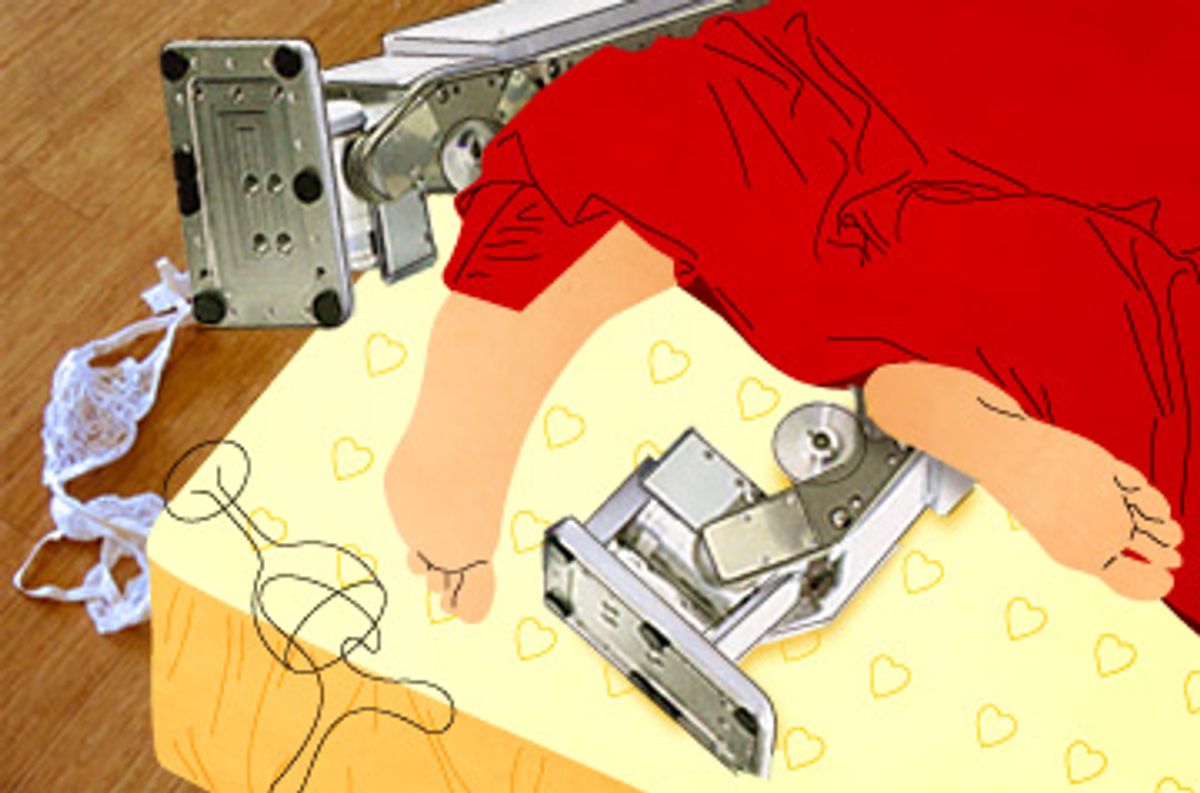
On his résumé, David Levy may be a chess master and an expert in artificial intelligence, but somewhere deeper — in his heart, or what I suspect he might call his CPU — the man is a professional dreamer of robot love.

We’ve let machines trespass into nearly every corner of our lives, Levy points out. Robots are making our cars and our computer chips, they’re fighting our wars, they’re cleaning our floors and our rain gutters and our pools. So why can’t we let them into our hearts? Do not scoff, reader: One day you too will cuddle up with a bot, you’ll whisper sweet nothings into its voice-recognition module, and you’ll crank up its pleasure unit — and it will crank yours.

In a new book, “Love and Sex With Robots: The Evolution of Human-Robot Relationships,” Levy argues that as machines advance, our consideration for them will grow inevitably more tender. Today, you watch your Roomba scurrying around your filthy floor, digging its nose into your grime, and you hardly pause to consider its soul; the robot vacuum is a slave, and you are its master.

But by pulling off the splendid computational trick of anticipating and fulfilling your every psychic and emotional need, machines will eventually capture your love — and indeed could prove more deserving objects of our affection than the pets, children and spouses who currently fly about our lives. Someday people may even walk arm-in-arm down the aisle with descendants of today’s robo-vacuums. In the same way they’ve conquered our factories, Levy says, robots will conquer our hearts.

Levy’s book is adapted from a Ph.D. thesis, and it reads that way: maddeningly dense and in stretches unpardonably dull, the writing unfortunately makes a slop of what is actually a fascinating topic. Fascinating because the prospect of human-robot love is, though self-evidently insane, also undeniably attractive, and certainly not implausible.

If machines improve at their current pace, in a few decades’ time we’ll likely see robots that can mimic human language, thought, appearances and emotions well enough to get us in the mood. (Levy predicts we’ll see the first human-robot marriages by around 2035.) It seems crazy — doesn’t it? — to think that people would choose to love robots rather than other people.

But doesn’t it seem pretty likely, too? If you could abandon the storms of human love, if you could forget the random unpredictability of the heart and simply design a being — a person — who loves you unconditionally, convincingly, forever, well, wouldn’t you do it?

You’re thinking, Computer geeks, they’ll go for it, but not me. You’re thinking you’ll be glad to have a robot as a butler, but love? You can’t love a thing that isn’t a person. What’s love got to do with robots?

Well, what’s love got to do with pets? Levy points out that like robots, cats and dogs first pushed into human lives by providing services to our ancestors — cats kept homes free of rats, dogs were guards and hunting partners and herders. Love was only a side benefit of such relationships, a feeling cooked up in human brains and exploited by the animals, who got shelter and food and safety from the deal.

But none of that matters anymore. The situation’s evolved. Now we think of our pets as extensions of our family, as beings roughly on our level — they’re not adults, but for many of us, they’re comparable to children. We no longer put our pets to work, of course; their only purpose is love.

Why did our feelings for animals evolve? The human brain is unrelenting in its tendency to anthropomorphize, to subconsciously ascribe human feelings and thoughts to animals and inanimate objects. We began to treat our pets as people because we’re given to thinking of them as people — see the Onion’s “Vacationing Woman Thinks Cats Miss Her.” But it won’t end at cats and dogs: Levy cites several psychological studies showing that we tend to anthropomorphize machines, too.

One of the most interesting such experiments involves what’s known as “reciprocal self-disclosure.” We’re usually reluctant to divulge our innermost feelings to strangers, but we often open up when the stranger discloses something about himself first. Would we treat computers the same way — if a computer tells you something about itself, would you respond with something about yourself?

Researchers Clifford Nass and Youngme Moon carried out an experiment to find out. Test subjects were made to chat with a machine that was either dishy or reticent about itself. Reserved machines asked straightforward questions, things like, “What has been your biggest disappointment in life?” or “What have you done in your life that you feel most guilty about?”

The more chatty machine posed queries like this:

This computer has been configured to run at speeds up to 266 MHz. But 90% of computer users don’t use applications that require these speeds. So this computer rarely gets used to its full potential. What has been your biggest disappointment in life?

and

There are times when this computer crashes for reasons that are not apparent to its user. It usually does this at the most inopportune time, causing great inconvenience to the user. What have you done in your life that you feel most guilty about?

Guess what? People who chatted with the confessional computer became confessional themselves. They didn’t do it on purpose; these folks knew they were talking to a mere machine. But they treated a device they knew was not human as being just slightly so, discussing their guilts and regrets as they would have with another person.

Levy points to evidence that we’ll even preserve our stereotypes in dealing with machines. People generally regard dominant men positively — they’re assertive, they’re confident! — and dominant women negatively (rhymes with witch). Same thing for computers. In an experiment Levy cites, people who were made to work with a computer with a female voice thought the machine was rude; the male-voiced computer, even though it said the same things as the lady machine, was considered friendly.

OK, so humans are prone to treating computers as if they’re other people. But that doesn’t mean we’ll fall in love with them, you say. Well, but if you’re already treating today’s computers as people, how could you ever resist a vastly more sophisticated, humanlike machine that attempted to seduce you?

Because, right, computers may well master that art. During the last few decades psychologists have uncovered a great deal about romance and what makes two people fall for each other. Computers, Levy says, can use these findings in their efforts to get you to love them.

Here’s the rundown of some of the major reasons why two people fall in love: Propinquity — people in close physical proximity are more likely to become involved than people farther away; what psychologists call “repeated exposure” is a powerful inducement to romance. Similarity is also important: People who are like each other like each other. Then there’s “reciprocal liking” — knowing that the other person likes you makes you like them more. The other person’s desirability — appearance, personality — also obviously plays a role. And a final big one is “filling a need” — part of why we pursue love is that we need love and its attendant pleasures (sex, intimacy, closeness, children).

Robots could make hay of these ideas. Propinquity, desirability, similarity and reciprocal liking are all taken care of — you’d order up a robot that shared your interests, that liked you, and that, in appearance and personality, would conform exactly to what floats your boat.

And it would fill your needs. In the sack, your robot would be a tiger or a lamb, however you like to roll. It could be programmed to fly into fits of rage — because maybe you like some spice in your life? — and/or to love to cuddle, it could be made to share your sexual interest in pie throwing, or your love of hippie jam bands, or, like Woody Allen’s whores of Mensa, it could spend all night discussing Proust and Yeats.

Such a situation prompts a raft of questions about the very nature of love and the dilemmas we’ll face in accepting robot romance, but Levy, alas, breezes by many of these.

Your robot, for starters, would be immortal; all its data would be backed up somewhere, so even if a too-raucous pie fight caused it to go on the fritz, it would be easily replicable. But how will immortality affect your relationship? Doesn’t mortality deepen love — isn’t the preciousness of your love, its susceptibility to diseases and deprivation, part of what makes the feeling so wonderful? Could you love a thing that didn’t die?

That hints at something larger: Part of what makes love so grand is how lucky it feels, its very lack of design, the fact that, despite the odds, you two found each other anyway. Doesn’t ordering up love cheapen it? How would loving a robot you designed be any different from loving a prostitute you chose from a menu?

And besides, is a perfect love really love at all, even if it feels like it? Isn’t love, like all life, by definition complicated; if you’re loving a robot, are you really loving — are you really living? — or is the whole thing a simulation, like a very real video game?

On the other hand, it’d be a pretty great video game. The possibility of easy sex with robots, Levy points out, will likely reduce the incidence of infidelity between human couples (infidelity with other humans, that is; Levy thinks that people will come to think of having sex with a robot as not constituting cheating, though he says we’ll take some time to adjust to this view).

More important, many people who, for whatever reason, can’t find people to love them will find salvation in robots — and how can this be anything but salutary?

“Almost everyone wants to love someone, but many people have no one,” Levy writes. “If this natural human desire can be satisfied for everyone who is capable of loving, surely the world will be a much happier place.”

The thinking man’s action hero

Using paper clips, chewing gum, chocolate and down-home ingenuity, MacGyver always saved the day. Let's bring him back -- and give him a girl!

  • more
    • All Share Services

The thinking man's action hero

It isn’t necessary to explain how, in the pilot episode of “MacGyver,” our mulleted, Midwestern hero gets himself trapped inside a top-secret research bunker overflowing with sulfuric acid. Suffice it to say, he needs to find a way out, and probably soon (because government agents are fixing to fire a missile at the bunker to prevent the acid from spilling into a nearby aquifer). Plus, he has to save the people he has found inside (among them a gun-wielding climate scientist who wants destroy the bunker in an effort to set back research into an ozone-layer-ruining weapon of mass destruction). Fortunately, MacGyver has a few chocolate bars, a scrap of sodium metal, a cold capsule, a pair of binoculars and cigarettes.

He uses the chocolate to plug up the leaking tank of acid — sulfuric acid reacts with sugar to form a kind of glue. The sodium, scraped into the shell of the cold capsule and splashed into a sealed bottle of water, makes for a handy time-delay bomb, which proves useful for blowing through a wall that blocks the group’s escape. The smoke from the cigarettes illuminates the bunker’s laser-beam security system that he has to get through to move through the bunker (no secret underground research lab is complete without lasers); MacGyver uses the binocular lens to aim the laser at its own control unit, shutting down the security system.

But how does he get out of the bunker? Oh, that’s the easy part: MacGyver finds a switch that controls the lights in an above-ground control tower. He flashes the lights on and off to send an SOS message in Morse code. The guys in the tower, realizing Mac’s in the bunker, alive, call off the missile — and for the first of 139 times during the show’s seven-year run from 1985 to 1992, MacGyver saves the day.

This first episode is nearly perfect. It neatly telegraphs MacGyver’s soul: A laid-back fellow oozing can-do heartland ingenuity, MacGyver is handsome but dorky, charming but self-effacing, a friend to orphans and children with disabilities, tolerant of people from foreign lands, and though he has every opportunity for indiscretion, he’s always a gentleman around women. MacGyver, played by the affable Richard Dean Anderson, works as a secret agent for a vaguely defined defense contractor whose intentions are always of the best sort. His gigs are of the usual action-hero variety — find stolen missiles, escape assassins, rescue civilians, humiliate dictators. But his near chastity, along with his staunch opposition to guns and capacity to solve every problem through the judicious application of chemistry and physics, sets him apart from other action stars. MacGyver is the thinking man’s hero.

Though, actually, when you go back to watch his adventures two decades after they first aired, you discover Mac’s target audience probably consisted mainly of boys, not men. I started watching the 139-episode DVD boxed set a few weeks ago, shortly after gadget blogs gleefully reported that Lee David Zlotoff, the series’ creator, said he was thinking of making a “MacGyver” movie. This jogged in me memories of boyhood, especially of how, after watching each MacGyver trick, I’d feel a bit invincible: I was small, but I was clever. Like MacGyver, I could take them.

But to adult eyes “MacGyver” is often too goofy by half. It’s not just that his tricks are improbable. At times — like when he interprets a deaf friend’s dreams to find clues to an impending missile theft — they seem to violate the show’s premise, that science beats brawn. In these instances, MacGyver doesn’t use science; he uses magic.

Then there are the children he befriends and the liberal orthodoxies he defends — tendencies that bump the show’s preachiness dial. Mac’s always popping up in foreign countries — Afghanistan, Myanmar — and running into kids and peasants who are oppressed by unsmiling overlords. In just about every second episode, he’s teaching kids about the dangers of guns, a position that, we learn in one episode, he came to as a boy, when a friend of his was killed by a gun. The antigun thing is a little specious, though: MacGyver’s got nothing but nothing but love for explosives, painful booby traps, fire extinguishers rigged up as projectiles, and enormous boulders that he sets up to fall on villains. The real reason he doesn’t use guns is obvious — he’d be able to shoot his way out of most traps, and that would be too easy.

I don’t mean to get down on “MacGyver.” There’s something in its flaws worthy of re-viewing, a particular moment in America preserved on TV. MacGyver is meant to exemplify a certain noble strain of American power. He doesn’t take the easy way out, and when in a jam, he uses what he finds around him to ingenious effect. If you strain you see a greater American story here too — that his ingenuity is frequently too good to be true, and leads to pat, uncomplicated endings that call for no greater reflection.

There’s also something striking about “MacGyver’s” moment in TV. Watch this show as a yardstick to measure how far we’ve come. Even the simplest dramas today — I’m looking at you, “CSI” — are complex and multilayered next to “MacGyver,” which underlines and explains everything, gums up all dialogue with exposition and introduces new, throwaway characters in each episode. There’s much hand-holding here: Even in foreign countries, everyone speaks English, every villain is one-dimensionally evil, and every tender moment is helped along by a swelling score.

But that’s why I hope someone makes a “MacGyver” movie. Mac needs a makeover. Lift him up to big-budget action standards — give him a story line that can span a couple of hours; give him a girl to love, but who may also cross him; give him a more complex mission (maybe to find out who’s putting all the salmonella in our salads?); and give the whole package fast, Paul Greengrass-style editing. Also, make sure one of his crazy solutions involves Mentos — people online go crazy for tricks with Mentos. Do all that and we might yet have a lasting American hero.

* * * * *

Read more of Salon’s Re-Viewed, offering a fresh look at great TV shows available on DVD.

Continue Reading Close

Goodbye to Machinist

Yo, I'm out.

  • more
    • All Share Services

Goodbye to Machinist

Today much of the tech world is sad that the iPhone 3G’s launch is going so miserably. But I’m sad that it’s my last day at Salon.

I’ve accepted a job at Slate, where, starting next week, I’ll be writing a twice-weekly technology column. Machinist will go on a break for a week, after which a guest blogger will bring you the latest tech dish.

I joined Salon in 2002, and since then I’ve written about, among other things, Smart Cars, robotic vacuum cleaners, muffin toasters, voting machines, architecture and 9/11, Tower Seven, Bill Clinton, Terri Schiavo, Florida’s elections, “The Wisdom of Crowds,” Malcolm Gladwell, Linux, Daniel Levitin, the copyright industries, Lawrence Lessig, The New York Times, Martha Stewart, a mnemonic to remember the Solar System’s planets, Google, garlic, stem cells, Comcast, Apple, Speedo, taxes, Social Security, Antonin Scalia, Barack Obama, the robots’ plan to take over the Earth, Howard Stern, Stringer Bell, Current TV, campaign finance reform, MoveOn, Howard Dean, Nintendo, Total Information Awareness, Java, Alice Waters, “The West Wing,” Robert F. Kennedy, Jr., the Washington Post, Judy Miller, and Hurricane Katrina.

I’m pretty sure there’s no other news outlet on the planet which would have given me such latitude, and I thank everyone here at Salon for that. I also want to thank all the readers who’ve read my work, not to mention praised me, hounded me, kept me up late at night swearing at the screen. Don’t ever change.

Continue Reading Close

“True Enough” at Google, and in San Francisco

A YouTubey presentation of my book.

  • more
    • All Share Services

As I mentioned in the comments yesterday, I’m getting ready to depart this space; I’ll have a fuller explanation tomorrow, sometime before or after I get in line to buy the new iPhone.

In the meantime, I thought I’d add a note about one of the more fun events related to my book’s release — the opportunity I had, in May, to speak at Google’s headquarters in Mountain View.

It was thrilling not only for the splendor of the place — even their commodes are computerized — and the welcoming attitude of my hosts at the Authors@ program (the company buys your books and hands them out to employees for free), but also because Googlers seemed to intuitively grasp my argument and posed many penetrating questions.

Google records these things and posts them up on YouTube, so if you’re looking for something to watch while eating a sandwich at your desk, have at it:

Another thing on the book: I’ll be reading and signing at Book Passage in the San Francisco Ferry Building next week — 6 p.m. on Thursday, July 17.

If you’d like to talk about facts, rumors, conspiracy theories, and spin in the digital age, do stop by.

Continue Reading Close

The iPhone 3G reviews are in: It’s pretty good

But battery life suffers, and the GPS isn't as great as you hoped.

  • more
    • All Share Services

Walt Mossberg (WSJ), David Pogue (NYT) and Edward Baig (USA Today) have been using the new iPhone 3G for a couple of weeks now, and today they all dish on their experiences.

They were all fans of the first model, and they’re pretty happy about the new model’s new features. The reviewers say the phone’s 3G network access leads to a much zippier Internet experience, that its audio quality has been dramatically improved, and that it cozies up to Microsoft’s corporate e-mail system.

But there are some drawbacks, too: Mossberg finds the battery life lacking, and Pogue says that that the phone’s GPS antenna is too puny to be of much use.

Here’s Mossberg on the battery life:

More important, in daily use, I found the battery indicator on the new 3G model slipping below 20 percent by early afternoon or midafternoon on some days, and it entirely ran out of juice on one day. I overcame this problem by learning to use Wi-Fi instead of 3G whenever possible, turning down the screen brightness and even turning off 3G altogether, which the phone permits.

The iPhone 3G’s battery life is comparable to, or better than, that of some other 3G competitors. But they have replaceable batteries. The iPhone doesn’t.

And Pogue on GPS:

Unfortunately, there’s not much you can do with the G.P.S. According to Apple, the iPhone’s G.P.S. antenna is much too small to emulate the turn-by-turn navigation of a G.P.S. unit for a vehicle, for example.

Instead, all it can do at this point is track your position as you drive along, representing you as a blue dot sliding along the roads of the map. Even then, the metal of a car or the buildings of Manhattan are often enough to block the iPhone’s view of the sky, leaving it just as confused as you are.

None of the reviewers were provided with applications that third-party developers are creating for the iPhone (these will go on sale at Apple’s online App Store). Mossberg, though, writes that he tried out some of these apps on an older phone, and was pleased with the results:

I tested a game that used the phone’s motion sensors to control the action, and I tested several programs from America Online (TWX), including AOL Instant Messenger; AOL Radio, which streams music from the Internet; and AOL’s Truveo video search engine. All worked very well.

These apps will also work on old iPhones as well as on the iPod Touch.

The iPhone 3G goes on sale Friday at 8 a.m. But some enterprising folks have gotten a hold of them already — check out the Boy Genius Report blog’s unboxing photos.

I talked about how to get an iPhone in my video for Current TV this week:

Continue Reading Close

Scary! YouTube ordered to hand your viewing history to Viacom

But there's a silver lining to one of the most bone-headed legal decisions in recent times.

  • more
    • All Share Services

Update: This post has been updated with comments from Viacom.

In the fall of 1987, a freelance reporter named Michael Dolan learned that judge Robert Bork kept an account at Potomac Video, a D.C. rental shop. This was at the height of the contentious and ultimately failed Senate confirmation hearings for Bork’s nomination to the Supreme Court — so naturally, Dolan thought there was a story here, and he went to work on getting a peek at Bork’s video rental history.

It wasn’t hard work. Dolan popped into Potomac Video one afternoon and asked if he could look at Bork’s movie file. “There sure are a lot of them,” the assistant manager replied. “Is it OK if I make a Xerox copy?”

That was OK with Dolan; weeks later, he published Bork’s rental history in the D.C. alt-weekly the Washington City Paper.

Bork’s taste in movies was itself unremarkable (“First off, despite what all you pervs were hoping, there’s not an X in the bunch, and hardly an R,” Dolan wrote). But the publication sparked outrage from groups on the right and the left — including the ACLU and People for the American Way, which had vehemently opposed Bork’s nomination.

In 1988, Congress, spurred by the fear that the press might now easily unearth all politicians’ movie habits, passed the Video Privacy Protection Act, which remains one of the strongest privacy laws in the nation. The law prohibits stores from disclosing video histories unless ordered to do so by a court — and even then, customers must be given “the opportunity to appear and contest the claim” of any party seeking to learn what you watched.

I tell you all this as a historical wind-up to yesterday’s shocking news: In the ongoing copyright battle between Viacom and Google, a judge ordered Google’s subsidiary YouTube to hand over an enormous trove of data identifying who watched what and when on the video-sharing site.

Viacom’s lawyers argued that they needed this data to prove that “infringing” videos — e.g., clips of “The Daily Show” and “The Colbert Report” — were more popular than non-infringing user-generated videos. Presumably, if it proves this, Viacom might prevail in its argument that YouTube’s bread-and-butter was illegal videos, and thus owes some of its success — and billions of dollars — to media companies.

The database in question is astonishingly broad: Viacom asked for 12 terabytes of logs (approximately 12,000 GB) that detail each instance in which someone pressed Play on a YouTube video, plus the YouTube username of the viewer who watched it, the date and time at which the user pressed Play, and the IP address of the viewer’s computer. The database covers videos seen both on YouTube as well as those embedded on other pages: If you’ve never visited YouTube but have clicked on a YouTube video from your daily newspaper’s Web site, you’re in the database.

Google objected to Viacom’s request on the grounds that producing the database would be expensive, time-consuming, and would invade YouTube users’ privacy. The judge — Louis Stanton of the Southern District of New York — Judge Stanton dismissed all Google’s arguments. The company’s “privacy concerns are speculative,” he wrote. (PDF here.)

Such pat reasoning should give you a general sense of the depth of bone-headedness in Stanton’s ruling. As Kurt Opsahl of the Electronic Frontier Foundation points out, the Robert Bork-inspired Video Privacy Protection Act applies not just to video cassettes but to “audio visual material” in general. Clearly it should apply here, and clearly, millions of YouTube users ought to have been given a chance to fight this invasion of our privacy.

But the real villain here isn’t Judge Stanton — it’s Viacom. I’ve previously raked the company over the coals for suing, rather than enjoying the fruits of, YouTube’s success (for instance last year, when it sacrificed potentially millions in ad dollars by pulling down the popular MTV clip of Britney Spears’ poor performance at the Video Music Awards).

But now Viacom’s sinking lower: Not content to fight just Google, the company looks to be manning the deck against us all. Sure, Judge Stanton might call this “speculative,” but think on it a bit: If Viacom’s willing to take on Google, what qualms will it have in suing you or me, recording industry-style, now that it knows what we did on YouTube? (Update: Viacom says it can’t use this data to sue you.)

All’s not lost. Google might manage to reverse this decision on appeal, and Viacom, gauging the outrage, could decide to withdraw or limit its request.

But our real hope here is legislative or regulatory action. Indeed, optimistic sorts might see a silver lining here.

As privacy scholar Jeffrey Rosen has written, “The politics of privacy tends to be largely reactive, fired by heartstring-tugging anecdotes that capture the public imagination.” Just as the airing of Robert Bork’s video history was the kick-start Congress needed to fix a clear privacy hole born out of then-new technology, this ruling might backfire on copyright holders, pushing lawmakers, finally, to curb the privacy-invading reach of copyright fights.

What we watch on YouTube is every bit as personal as what one rents from a store like Potomac Video. Indeed, it might be more private, and more salacious — imagine the fun you’d have if you were looking for unsavory data about a future Supreme Court nominee in 12 terabytes of YouTube logs!

In his floor speech in favor of the Video Privacy Protection Act, Vermont Sen. Pat Leahy argued that new database technologies capable of tracking private behavior called for new privacy regulations. That was two decades ago — and it remains true, still.

——

Update: A representative for Viacom e-mailed me to say that I’m overreacting. “We have no ability (and absolutely no desire) to use this data to sue end-users,” he argued, pointing out that all discovery documents in the case are bound by this confidentiality agreement.

Under this agreement, no one at Viacom will get to see these YouTube logs — only Viacom’s outside lawyers and experts, as well as court personnel, will have access to the data. The agreement also restricts the data to this case alone, which would seem to prevent the company from using the logs to sue users individually.

Michael Fricklas, Viacom’s counsel, told the New York Times, “I can unequivocally state that we will not use any of this information to enforce rights against end users.” He added that the company is looking into ways to “anonymize” the logs “to enhance the security of information that will be produced.”

Continue Reading Close

Page 1 of 143 in Farhad Manjoo