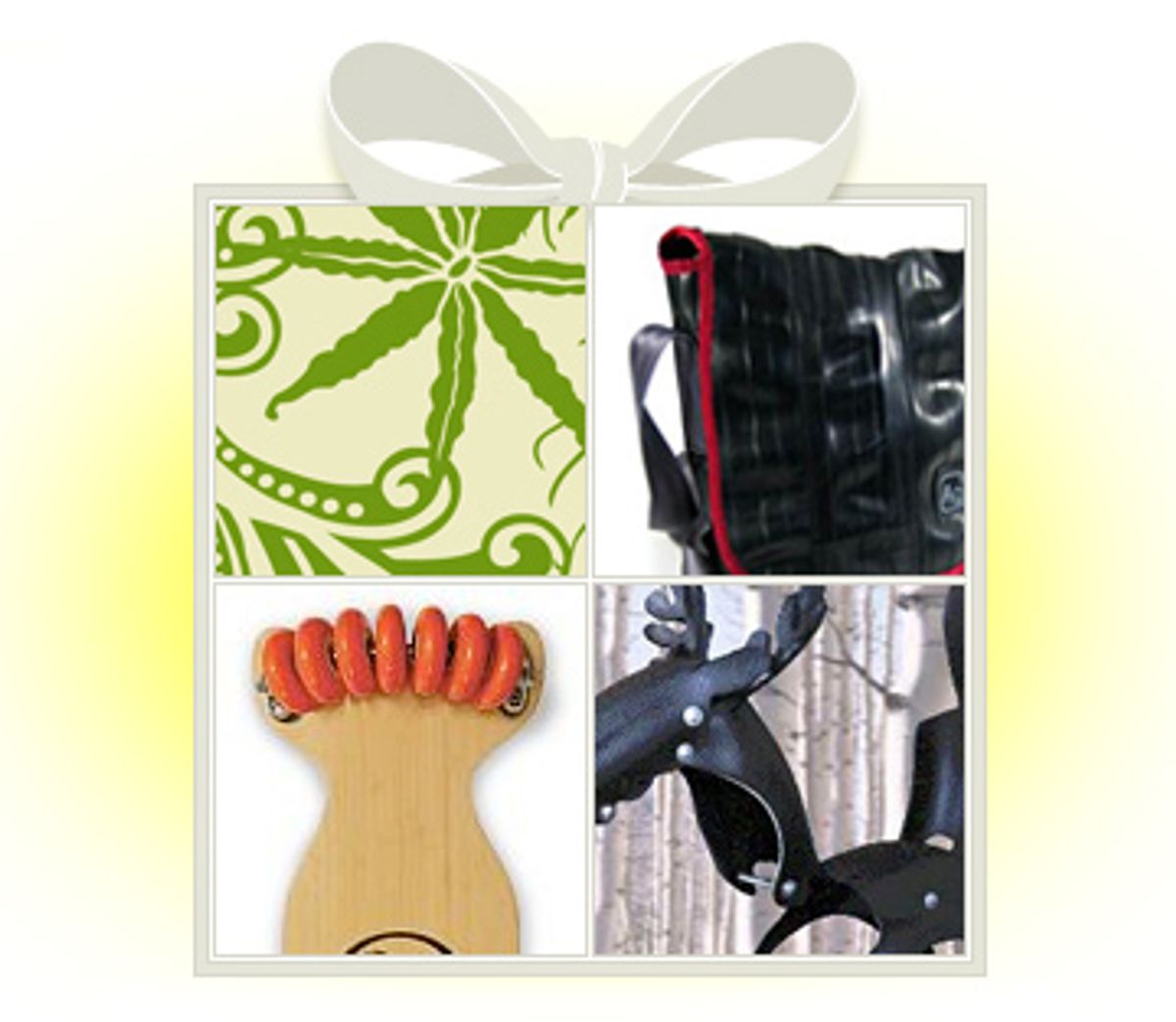
We all know people who love to complain the holidays are no more than a display of idol worship at the altar of consumerism. Yet most of us like to give gifts -- it's the giving that fills us with love and cheer. And I bet even the grinches among your family and friends won't mind a thoughtful present made in the U.S. from recycled goods or sustainable materials. Here's an offering of Earth-friendly gifts.
Messenger bags
 Alchemy Goods turns old bike tire tubes and seat belt straps into hip messenger bags. Eli Reich, a former mechanical engineer, started the company in 2003 after his messenger bag was stolen and he noticed a bunch of old bike tubes collecting dust in his apartment. He now collects old tire tubes from bike shops along the West Coast. Waterproof and stylish, his bags come in three sizes. The Messenger ($148) is good for bike commuting or trips to the gym, the Urban ($138), a bit smaller, is better for carrying laptops, and the Haversack ($88) is a good unisex purse, big enough for a book and your lunch, and it has a handy front-zippered pocket for a wallet or iPod. (Memo to my friends and family: I really want one.) Look for a new line of men's wallets ($32), made from recycled billboard banners and, of course, old bike tires.
Kid swings
 When I was young, my dad followed instructions from Sunset magazine and turned old car tires into bucket swings. Don't get me wrong, they were the best; but, sorry, Dad, these handcrafted tire swings, made from recycled tires, are the Porsches of the playground. Works of art, they're crafted in the shape of a horse with a mane or a longhorn steer or even a motorcycle. If I had one of these -- even now -- I'd never come inside for dinner. Compatible with swing sets, they can also be hung inside on a ceiling beam or from a strong tree limb; they hold up to 200 pounds. The swings, made by the Palumbo family in Kunkletown, Penn., are constructed without glue, and every nut and bolt is covered with a smooth, spoon-shaped surface so they're safe for kids. Lab tested, they follow home playground equipment safety standards. Prices range from $90 to $200.
Wool mittens
 From the base of the West Elk Mountains in tiny Paonia, Colo., Elisabeth Delehaunty turns vintage wool sweaters into unique and colorful mittens. Washed in hot water to felt the wool and make the materials denser, these mittens don't unravel like most handmade knitwear. No two pair are alike, making them great for those who likes their clothes to convey their individual and arty nature. Delahaunty and her four employees sew everything themselves at their studio, a former livery stable built in the early 1900s. The mittens ($56) come in one size that fits men with average hands and most women.
Local food deliveries
 For foodies, Michael Pollan fans and people committed to buying local, a regular delivery from a nearby farm is a fantastic present. An increasing number of farms throughout the country offer weekly or monthly subscriptions where members receive baskets of vegetables, flowers, fruit, eggs or milk. Community Supported Agriculture keeps farms local, decreasing the distance food travels from the field to your plate. It also sustains small family farms instead of the agribusiness giants that stock most grocery stores. To find a local farm near you that delivers, visit Local Harvest.
Bamboo skateboards
 Ever been in a bamboo stand during a fierce storm? The woody grass doesn't easily snap -- it bends with the wind. This flexibility and strength make it a great material for skateboards. Loaded Boards from Los Angeles transitioned its entire line of long boards to bamboo in January of 2007. Loaded gets its bamboo from China, but manufactures its boards in Southern California, using a glue that has doesn't emit formaldehyde and an epoxy that emits no volatile organic compounds. Their five models all come in different flexes, meaning they have boards for lighter riders like women and kids. Expect to spend between $250 and $300.
Women's purses and wallets
 Ever wonder who's wearing that Michael Jackson-style red leather jacket you used to sport in the early '80s? If Ashley Watson's found it, that old coat may now be one of the hippest new handbags on the market. Watson, 28, scours charity thrift stores for leather jackets -- the more pleats and zippers, the better -- from which she makes purses of all sizes, wallets and daily planners. Her bags, named after birds like the thrush or plover, are one-of-a-kind, with varying dimensions, details and colors. Steeped in a do-it-yourself mentality, Watson, a former art student, and her two seamstresses make every bag themselves from her apartment. Available at Beklina.com, Shopfatal.com or in 30 stores throughout the U.S. Check out Watson's Web site. Wallets and clutches cost around $100; purses start at $280.
Organic textiles
 Twin sisters Dawn Oliveira and Deborah Olson have great eyes for pattern and color. Their debut line of textiles, the Ocean Collection, is made from a blend of organic cotton and hemp, which makes the fabric incredibly strong, says Oliveira, a former designer for Ralph Lauren and Emanuel Ungaro. The sisters import the hemp from China and Romania because American drug laws prohibit it from being grown here. The mill where they print their fabric is based near their home in Bristol, R.I. Great for upholstery, pillows or draperies, these textiles are gorgeous but not cheap. Prices start at $120 per yard.
Chain bracelets
 These tough-looking bracelets ($12), made from old bike chains, appeal to urban hipsters and bike enthusiasts. Made by the guys at Resource Revival, based in rural Oregon, the bracelets come in both men's and women's sizes. The chains are cleaned with mild detergents, so you don't have to worry about hurting the environment or greasy wrists.
Eco-groovy wrapping paper
 For some greens, wrapping paper is a call to arms. (What a waste! Why didn't you use newsprint?) But if you enjoy the aesthetic of a well-packaged gift, check out Fish Lips Paper Designs. Made from a coated 100 percent post-consumer recycled content, Fish Lips prints its luxurious papers in Southern California with soy-based inks, which it claims emit vastly less volatile organic compounds than petroleum-based inks during the drying process. The $4 oversize sheets come in a collection of groovy holiday prints and can be shipped to your door within two or three days.
Shares