
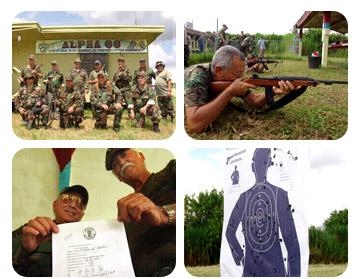

On a hot subtropical Sunday, deep in the humid brush bordering the Everglades west of Miami, Osiel Gonzalez squints down the worn barrel of an AK-47 rifle and squeezes the trigger. With a crack and kick the bullet whizzes over a field of neatly trimmed grass and hits a human silhouette on a paper target 40 yards away.
Gonzalez wipes the sweat off his brow and smiles. Perspiration stains the neck and armpits of his camouflage jacket. All around him are men in fatigues, some flat-bellied on the grass shooting rounds, others cleaning their weapons or picking through ammunition boxes. The air is thick with cigar smoke. At age 71, Gonzalez is still one of the best marksmen at this training camp for Alpha 66, the paramilitary Cuban exile group formed in 1961 “with the intention of making commando type attacks on Cuba,” as the organization’s Web site baldly puts it. Gonzalez hopes to put his skills to use when the second revolution comes, the one that will tear his homeland free from the grip of communist dictator Fidel Castro. At that point Gonzalez hopes to have a Cuban soldier in his sights, not a paper silhouette.
Plans to attack Cuba are constantly being hatched in South Florida. Over the years militant exiles have been linked to everything from downing airliners to hit-and-run commando raids on the Cuban coast to hotel bombings in Havana. They’ve killed Cuban diplomats and made numerous attempts on Castro’s life.
But, other than an occasional federal gun charge, nothing much seems to happen to most of these would-be revolutionaries. They are allowed to train nearly unimpeded despite making explicit plans to violate the 70-year-old U.S. Neutrality Act and overthrow a sovereign country’s government. Though separate anti-terror laws passed in 1994 and 1996 would seem to apply directly to their activities, no one has ever been charged for anti-Cuban terrorism under those laws. And 9/11 seems to have changed nothing. In the past few years in South Florida, a newly created local terrorism task force has investigated Jose Padilla and the hapless Seas of David cult, and juries have delivered mixed reviews, but no terrorism charges have been brought against anti-Castro militants. The federal government has even failed to extradite to other countries militants who are credibly accused of acts of murder. Among the most notorious is Luis Posada Carriles, wanted for bombing a Cuban jet in 1976 and Havana hotels in 1997. It is, perhaps, a testament to the power of South Florida’s crucial Cuban-American voting bloc — and the political allegiances of the current president.
In Greater Miami, home to the majority of the nation’s 1.5 million Cuban-Americans, the presence of what could credibly be described as a terrorist training camp has become an accepted norm during the half-century of the anti-Castro Cuban diaspora. Alpha 66 and numerous other paramilitary groups — Comandos F4, Brigade 2506, Accion Cubana — are so common they’ve taken on the benign patina of Rotary Clubs with weapons.
But Alpha 66 members are eager to remind you that even if they are graying and prosperous they are not toothless old tigers. Their Web site boasts that “in recent years” they’ve sabotaged Cuba’s tourist economy by attacking hotels in the beach resort of Caya Coco. At the group’s headquarters in the Little Havana neighborhood of Miami, the walls are hung with the portraits of dozens of men who have died on Alpha 66 missions.
To reach Alpha 66’s South Florida camp you have to drive to the farmlands west of Miami’s sprawl, then wait for a guide. You follow the guide down a winding, pitted dirt road for a few miles until you get to a gate and a yellow watchtower hung with an old-fashioned school bell. Behind a wall of trees and shrubs is a compound that looks like a hunting lodge. A low-slung wood-plank bunker with a deck and awning provides refuge from the sun.
Before hitting the range, the men — there are no women here today — had done maneuvers, marching in double file around the field, while a short, barrel-chested former Cuban army officer named Ivan Ayala barked directions: “Columna izquierda!” Many of the aging, uniformed men laboring to make it around the field are veterans of the failed CIA-backed Bay of Pigs invasion of 1961 and alumni of Castro’s jails. Some, like Osiel Gonzalez, even fought alongside Castro against Cuban dictator Fulgencio Batista, before Castro’s turn toward communism. Most, if you believe them, have a “commando” mission or two with Alpha under their belts — landing on a remote beach and burning sugar cane fields, or strafing a shoreline with machine-gun fire. In other words, they’ve walked the walk of counterrevolutionary violence, even if it’s now reduced to a shuffle.
They deny they have anything in common with the militants hiding in the caves of Afghanistan and Pakistan. “No, we are not terrorists,” says Gonzalez, the second-in-command and a co-founder of the group who, when he is not donning fatigues and shouldering a rifle, is a financial consultant. “We don’t want to kill civilians.”
“Our goal is to free our country for our children and grandchildren,” drawls Al Bacallao, who has already retreated to the porch’s shade behind Gonzalez and the shooting range. The 61-year-old Bacallao was raised in Georgia after arriving from Cuba at age 8, and is the rare Cuban exile with a Southern twang. “The United States fought for its liberty, why can’t we?”
But Alpha members may have a fluid definition of what a civilian is. Raking the coast with .50-caliber machine-gun fire certainly does not exclude civilian casualties, nor does attacking tourist spots. By his own admission, Bacallao, who joined Alpha 66 23 years ago, has gone on several missions to Cuba. In 1993 U.S. authorities arrested him and a boatload of other men setting out for the island.
“Our plan was to land and make a hit and run — those are the best actions, you know,” recounts Bacallao, as rifle shots punctuate the air. “And we had everything on board; a .50 caliber gun, hand grenades, AK-47s, plastic explosives. We had enough to blow up Florida, Georgia and Alabama!” He lands hard on the “bam” in Alabama. Then he laughs. “But we broke down. The motor started failing and the currents were strong. Eventually we were picked up.”
“Let me tell you, we were treated like animals,” he says. “And all we were trying to do was liberate our country.”
But if he was treated like an animal, he is not in a cage. Federal prosecutors charged him and his companions with illegal weapons possession but a judge dismissed the case against most of the men, and a jury found the rest not guilty. Like other anti-Castro exiles before him, despite violent acts he is free to continue reporting to the training camp, and free to continue preparing for counter-revolution.
Video: Photos and audio from Alpha 66’s training camp
When it comes to South Florida and terror, the official line from current and former federal law enforcement officials is that the law is enforced without fear or favor. The U.S. attorney for the Southern District of Florida, R. Alexander Acosta, declined comment for this story, but several of his predecessors insisted to Salon that the law is applied objectively and without regard to local or national politics.
“I don’t think there has ever been or is presently a refusal to consider more aggressive charges if the evidence truly sustains them,” asserts Kendall Coffey, who was the Southern District’s U.S. attorney from 1993 to 1996 and is now a prominent defense lawyer. Coffey adds that he never experienced pressure from his bosses in Washington regarding Cuban militants. “Not at all,” he says.
“The politics of a case simply do not come into play,” states Guy Lewis, U.S. attorney in South Florida from 2000 to 2002.
Judy Orihuela, spokeswoman for the FBI’s Miami office, insists the agency will investigate any group that intends to violate U.S. law and poses a violent threat. At the Department of Justice in Washington, Dean Boyd, a spokesman for the national security division, rejects the notion that federal law enforcement shows leniency toward exile militants. Boyd maintains the DOJ would never attempt to influence a local case for political reasons and is blind to community or political pressure. “We pursue charges based on the evidence, not on other considerations,” he says.
“That’s sheer bullshit,” counters Wayne Smith, who was chief of mission at the U.S. Interests Section in Cuba under Presidents Carter and Reagan from 1979 to 1982, making him the de facto U.S. ambassador to Havana. Smith, who now runs the Cuba Program at the D.C.-based Center for International Policy, invokes the names of two of the most notorious Cuban exiles to argue that the U.S. does, in fact, play favorites. “We are certainly not applying these laws objectively in the case of Luis Posada Carriles, Orlando Bosch and a whole lot of others who have been involved in terrorist activities. We say that countries must take action against terrorists, but we’re clearly not. And I think it’s because we’re sympathetic to their actions.”
At the beginning of Castro’s reign, the U.S. was more than sympathetic to the militant exiles. In the 1960s, the U.S. government actively encouraged and supported anti-Castro violence, including the ill-fated Bay of Pigs invasion. “Throughout most of the 1960s, rolling back the Cuban revolution through violent exile surrogates remained a top U.S. priority,” says Peter Kornbluh, director of the Cuba Documentation Project at the National Security Archive and a specialist on U.S. policy toward Cuba. With exile involvement, the U.S. government made numerous attempts to assassinate Fidel Castro between 1961 and 1975, though the number cited in the title of the British documentary “638 Ways to Kill Castro” may be an exaggeration. Many anti-Castro Cubans went to work for U.S. intelligence and compiled long résumés of covert activity. In the 1980s, some assisted with the Reagan administration’s covert effort to arm the Contra rebels in Nicaragua.
Cuban-American entanglement with the CIA eventually bled into U.S. politics; two of the five “plumbers” who broke into the Democratic Party’s national headquarters at the Watergate in 1972 were Cuban-American. Tolerance for anti-Castro militancy, meanwhile, also had domestic consequences. Throughout the ’60s and ’70s and into the ’80s, exiles carried out dozens of bombings and assassinations in Miami and other American cities, targeting people they deemed too accommodating to the Castro government.
Over time, as Kornbluh notes, the exiles seemed to change their approach somewhat as they aged and as they prospered economically — and as the CIA backed away. By the 1980s, says Kornbluh, support for militancy “shifted from official funding to private backing from wealthy Cuban-Americans.” Much of the anti-Castro activism among Cuban-Americans was directed by a Miami businessman named Jorge Mas Canosa, head of the Cuban American National Foundation. Cuban intelligence, and even anti-Castro militants, have linked CANF to violent plots targeting Cuba.
Still, however, the militants continued to train within the borders of the U.S., and to amass weaponry. Retired Army Col. Larry Wilkerson remembers attending briefings during Caribbean war game exercises from 1992 to 1997 where he learned of the exiles’ capabilities. “We would always be fed this intelligence and I was astounded at how many suspected caches of arms they had access to not just in Florida, but in California, New Jersey and other places; light machine guns, grenades, C4, dynamite, all manner of side arms and long arms,” recalls Wilkerson, who was former Secretary of State Colin Powell’s chief of staff from 2002 to 2005. “It was a veritable terrorist haven. This is Hezbollah in Florida, if you’re looking at it through Havana’s eyes.”
In general, it would be hard to deny that the U.S. government has at least created the appearance that it is willing to tolerate a great deal of legally questionable behavior. But to be fair, even if federal prosecutors want to be objective, they are part of a political culture where such decorous sentiments aren’t always honored. Juries, judges — even the prosecutor’s families — are liable to feel the tug of local anti-Castro feeling. “I welcome the opportunity of having anyone assassinate Castro,” Republican Rep. Ileana Ros-Lehtinen of Miami recently told a British documentary crew. Ros-Lehtinen, who has also publicly expressed support for famed militant Orlando Bosch, is married to Dexter Lehtinen, former U.S. attorney for the Southern District of Florida.
Even outside South Florida, juries can balk at convicting anti-Castro exiles. In 1997, the U.S. Attorney in Puerto Rico charged seven Cuban exiles with attempted murder of a foreign official after authorities searched a boat in Puerto Rico and found sniper rifles and night vision goggles, and interviewed a defendant who revealed a plan to whack Castro in Venezuela. The defendants tried to get a change of venue to South Florida and failed, but still succeeded in finding a sympathetic panel. A Puerto Rican jury acquitted the men of the attempted murder charges.
In perhaps the highest-profile criminal case involving Cuban exiles, federal prosecutors in Washington, D.C., were unable to keep suspects in the assassination of former Chilean diplomat Orlando Letelier behind bars. Five Cuban-Americans were alleged to have played roles in the murder of Letelier and his American aide by car-bomb in D.C. in 1976. Three years later, Alvin Ross Diaz and Guillermo Novo Sampoll were convicted of murder and conspiracy to murder a foreign official and sentenced to life. Novo Sampoll’s brother Ignacio was convicted on lesser charges.
Ross Diaz and Guillermo Novo Sampoll ended up serving less than five years, however, after winning a new trial and then acquittals. Ignacio Novo Sampoll, whose initial sentence was only three years, also had his conviction overturned on appeal. The last two defendants, Virgilio Paz Romero and Jose Dionisio Suarez Esquivel, eluded capture for 15 years, and then cut deals allowing them to serve less than a dozen years apiece. After his release, Guillermo Novo Sampoll would be arrested in Panama for plotting to murder Fidel Castro.
Today, federal law enforcement’s de facto approach toward militant exiles seems to be to infiltrate and monitor them and attempt to disrupt their “missions” as they’re launched. The Cuban government would maintain that the U.S. does not show sufficient interest in this limited task.
In 1997, Cuban intelligence agents discovered an exile plot to blow up airplanes carrying tourists to and from Cuba, according to a report released by the Cuban Interests Section in Washington, Havana’s diplomatic post in the U.S. Castro himself wrote a letter to then-President Clinton asking for help investigating the plot, given the potential impact on both countries.
On June 15, 1998, a delegation of FBI agents went to Havana. The Cubans say they gave the agents documents, surveillance videos and samples from a defused bomb found in one of the hotels. The Cubans alleged the evidence led back to individuals in Miami. But when the FBI left, the Cubans claim they never heard anything more about the matter. Instead, three months after returning stateside, FBI agents arrested a network of 10 Cuban intelligence agents — the source of much of the shared bombing information. Five of them pleaded guilty and received minimal sentences. Five others are serving terms ranging from 15 years to life. Havana has waged a prolonged propaganda campaign to free them.
One former law enforcement official dismisses the Cuban government’s version of events. “They gave the FBI manila folders with a bunch of newspaper articles in them,” the official scoffs, pointing out that the spy network had been under investigation for more than a year before the arrests.
When the feds do disrupt a mission and federal prosecutors do follow up criminally, they often charge the exiles with illegal weapons possession, a crime that carries a five-year prison sentence, rather than more serious offenses. Prosecutors have proven willing to accept lenient plea bargains and ask for lenient sentences. They have done so despite the fact that in 1994 and 1996, Congress passed laws that would give them far greater latitude to crack down on violent anti-Castro militants.
The 1994 Violent Crime and Control and Law Enforcement Act, an anti-terrorism measure passed after the first attack on New York’s World Trade Center, made it illegal to knowingly provide material assistance for terrorist activity. The Antiterrorism and Effective Death Penalty Act of 1996 was also intended to deter terrorism. The section titled “Conspiracy to Harm People and Property Overseas” states that anyone within the jurisdiction of the U.S. who conspires to commit “an act that would constitute the offense of murder, kidnapping, or maiming” abroad faces punishment up to life in prison.
During the Clinton administration, no anti-Castro militants were prosecuted under those laws. And then came the Bush administration, and 9/11.
In 2001, George Bush was inaugurated as president on the strength of Florida’s 25 electoral votes. One reason he got close enough in the state’s popular vote for the U.S. Supreme Court to hand him the victory was because Florida’s Cuban voters supported him by a lopsided ratio of 4 to 1. His brother, Florida Gov. Jeb Bush, had already established ties to the state’s Cuban community, which had supported him by a similar margin in the gubernatorial election two years earlier. Jeb had also served as a campaign manager for Cuban-American Rep. Ileana Ros-Lehtinen in 1988, and during that campaign had called his father, George, then the vice president and a candidate for president, to enlist his help in blocking the deportation of militant Orlando Bosch.
All three Bushes have relied on Cuban-American money and support to carry Florida. In 2004, President George W. Bush placed new restrictions on U.S. citizens and Cuban residents in the U.S. who want to visit relatives on the island, and increased enforcement of the embargo against Cuba. To date, his administration has not invoked the 1994 and 1996 anti-terror laws against any anti-Castro militants.
The support of unsavory characters simply because they were fighting our fight was more understandable when we were engaged in a global war on communism. But given the Bush administration’s “war on terror,” some experts think our government’s approach to Cuban militants within our own borders harms our credibility. “There’s always some discretion allowed prosecutors, but generally the goal is to apply the laws equitably,” explains Peter Margulies, a law professor at Roger Williams University School of Law, who has written about anti-terrorist laws and formerly taught at St. Thomas University in Miami. “If you don’t, you undermine the legitimacy not only of U.S. law, but our standing in the world. Governments in Latin America now profoundly distrust us because we don’t apply the same rules when dealing with Cuba that we do to the Middle East.”
Under Bush, the FBI continues to monitor Cuban groups, but Miami spokeswoman Judy Orihuela says the agency considers the militants to be of “diminished capacity.” The administration has its own ideas about who is and isn’t a terrorist.
In August 2007, less than 30 miles from the Alpha 66 training camp, a federal jury in downtown Miami convicted a Brooklyn-born Muslim convert named Jose Padilla of conspiracy to kidnap, maim or kill people abroad. His sentencing hearing began last Wednesday; he faces up to life in prison. Although the military originally alleged he planned to detonate a dirty bomb in the U.S., the criminal case finally brought against him charged he plotted overseas attacks and plotted to provide support to terrorists as part of a U.S.-based terrorist cell. Prosecutors used the 1996 terrorism law in this case.
In December 2007, a federal jury failed to convict any of seven adherents of the Seas of David group of terror-related charges. The members of the tiny religious sect, who were also charged under the 1996 law, had allegedly conspired to purchase weapons from an informant they believed to be a representative of al-Qaida, and were supposedly plotting to bomb the Sears Tower in Chicago and a federal building in Florida. When the FBI raided the group’s headquarters, the most serious weapons agents found were three machetes and some handgun bullets. They never found any plans for a terrorist plot. The jury acquitted one man on all charges and could not agree on verdicts for the other six defendants. The judge declared a mistrial; the U.S. Attorney’s office plans to retry the men in 2008.
The 1994 and 1996 anti-terror laws have been invoked more than 40 times since 9/11, but never against anti-Castro militants. If authorities in South Florida wanted to apply the same scrutiny to Cuban-Americans that they applied to Padilla, who is Puerto Rican, and the Seas of David group, which was largely Haitian-American, they could surely find some suspects who have both a training camp and more weaponry than machetes. Among the South Florida residents who might bear some scrutiny:
Santiago Alvarez and Osvaldo Mitat — Cuban authorities allege that Alvarez, a founder of Alpha 66 who is now a Miami developer, was on board a motorboat that strafed the shoreline of a Cuban fishing village in 1971 killing two men and wounding four others, including two young girls.
Alvarez is known to have provided financial and other material support to Luis Posada Carriles and other militants. In April of 2001 Cuban authorities reported capturing three Miami area residents after they clambered ashore with AK-47 assault rifles, an M-3 carbine fitted with a silencer and three semi-automatic Makarov pistols. While in custody, one of the men phoned Alvarez, while Cuban agents recorded the call. “The other day, when you told me about the Tropicana, do you want me to do something there?” Ihosvani Suris de la Torre asked, referring to a popular nightclub. Alvarez responded: “If you want to do that there, so much the better. Makes no difference to me.” Cuba asked the FBI to do a voice analysis to prove it was Alvarez. The FBI has never acknowledged opening an investigation. The Cuban government released a transcript of the call to foreign journalists and broadcast audio of it on national television.
Through his lawyer, former U.S. attorney for the Southern District of Florida Kendall Coffey, Alvarez told Salon he was not involved in the operation and was only trying to help Suris; he knew the call was being recorded, and that Suris faced the firing squad, so he wanted to say something that would make Suris appear to be providing valuable assistance to his captors.
But Alvarez sounded supportive in a 2001 interview with the Miami New Times. “My first connection with them is that we all believe that in order to fight Castro we have to fight in Cuba,” he said in a previously unpublished portion of the interview, adding, “We’re not terrorists.”
In 2005 federal agents searched an apartment Alvarez kept north of Miami in Broward County and found a store of military hardware including an M-11 A1 machine gun, two Colt AR-15 assault rifles, a silencer, and a Heckler & Koch grenade launcher. Agents arrested Alvarez and his assistant, Osvaldo Mitat.
According to Peter Margulies, prosecutors could have considered charging Alvarez with providing material support for terrorist activity, which carries a sentence of 15 years to life. Instead, they charged Alvarez and Mitat with seven counts of illegal weapons possession.
Both pleaded guilty to one of the counts. The judge sentenced Mitat to about three years and Alvarez to just under four years. “While I have always been passionately interested in a free and democratic Cuba, I recognize that any conduct of mine must occur within the bounds of the law,” Alvarez stated at his sentencing. After the plea, Alvarez supporters, who were able to remain anonymous, brokered a deal with prosecutors through a lawyer. In exchange for even more weapons, including 200 pounds of dynamite, 14 pounds of C-4 explosives and 30 assault weapons, the judge further reduced Alvarez’s sentence to 30 months.
“Alvarez and Mitat are the paradigm of Miami justice,” Miguel Alvarez, chief advisor to Ricardo Alarcón, president of Cuba’s National Assembly of the People’s Power, says wryly. “They confiscate a cache of arms from them, they try them, and when they turn over another cache of arms, they reduce their sentences. It’s amazing.”
Wonders Peter Kornbluh of the National Security Archive: “What was all that hardware for? Why did they let him plea bargain without getting the story on what he planned to do with all those weapons?”
“You can bet your bottom dollar,” says Jose Pertierra, the Washington, D.C., attorney hired by the Venezuelan government to press for the extradition of militant Luis Posada, “if their names were Mohammed they wouldn’t be as lenient and they’d certainly be looking for the rest of the arms.”
Gaspar Jimenez — Jimenez was indicted in the 1976 car bombing of Cuban-American radio commentator and critic of exile violence Emilio Milian in Miami. The U.S. attorney dropped the charges. In 1977 Mexican authorities arrested Jimenez and two others for attempting to kidnap the Cuban consul and killing the consul’s bodyguard. Jimenez escaped and was rearrested in Miami in 1978. He was deported to Mexico and served less than three years. In 2000, he was jailed in Panama for attempting to assassinate Castro, as were Guillermo Novo, Pedro Remon and Luis Posada Carriles. All four were pardoned by the Panamanian president in 2004.
Pedro Remon — One of the four exiles arrested in Panama for the Castro assassination plot, Remon was also arrested in 1985 in the United States for a bombing at the Cuban mission to the United Nations in New York. He was indicted for the murder of Cuban diplomat Felix Garcia-Rodriguez in New York and the attempted murder of the Cuban ambassador. He was sentenced to 10 years on reduced charges.
And then there’s Luis Posada Carriles. With Orlando Bosch, he is a suspect in the 1976 bombing of a Cubana Airlines flight that killed 73 people. Posada is perhaps the most wanted of all of Miami’s militants. “Certainly what Posada is accused of fits [the] standard [of the terrorism acts],” says Margulies.
“The Santiago and Posada cases create some real questions about whether we are applying the law in this matter in an objective manner. The premise of the anti-terrorism laws, including providing material support, is that people who are in this country shouldn’t plan violence in another country, because 1) it is inherently wrong, particularly if it involves civilians, and 2) it can entangle the U.S. in complications, including war.”
But the idea of indicting Posada as a terrorist would prompt laughter in many Cuban exile circles, if not a few bomb threats.
It’s a warm night in Westchester, a largely Cuban suburb southwest of Miami. Shade trees sway outside the folksy Miami Havana restaurant; inside waiters pour sangria in the rear dining room, which is packed with heavily perfumed women draped in gold jewelry and men in starched guayaberas. Alpha 66 is hosting this fundraiser to repair storm damage at its training camp, but it is also a pep rally for “the struggle,” la lucha.
Shortly after the American and Cuban national anthems play over a scratchy sound system but before the chicken and rice is served, an old man with neatly combed white hair enters through the French doors. He is barely visible behind a scrum of men who quickly surround him. Diners crane to see. They begin to whisper. Then clap. Soon there is a standing ovation. Luis Posada Carriles, the hero of the counter-revolution, is making his way to the head table.
“Bambi” Posada, 79, is wearing a light gray suit, white shirt and dark tie. As he sits down, the crowd asks him to speak. Talking publicly is not his strong suit after an assassination attempt in 1990 took out a chunk of his tongue. Nonetheless he mumbles a thanks to the crowd for their support, then sits down. During dinner a 9 mm Beretta pistol is raffled. The winner is a young mother.
The Cuban government has implicated Posada in a series of 1997 Havana hotel bombings, which killed an Italian tourist and injured 11 people. In 1998 Posada, a former CIA and Venezuelan intelligence operative, told the New York Times that he was responsible for the bombings. The Venezuelan government wants Posada for the 1976 bombing of a Cuban jetliner, which killed 73 people. Although Havana-bound Cubana Flight 455 originated in Trinidad and Tobago, the plot was allegedly hatched by Posada in Caracas. Two men who worked for Posada admitted to the crime, but Posada has repeatedly denied any involvement in that attack.
Venezuelan authorities arrested Posada and Orlando Bosch in 1976 for planning the bombing. Posada escaped from a Venezuelan prison in 1985, in an operation allegedly funded by Jorge Mas Canosa, and fled to El Salvador. He then began working for a CIA-led gun-running operation. Posada was paid $3,000 per month by Oliver North deputy Maj. Gen. Richard Secord to funnel guns to the Nicaraguan Contras. After the Iran-Contra debacle, he remained in Central America as an advisor to the Guatemalan government.
In 2000 Panamanian authorities arrested Posada and three Miami Cubans for a plot to bomb a Panamanian auditorium where Castro was scheduled to give a speech. Posada was in possession of a gym bag full of C4 explosives. The four men were convicted on related charges in 2004; one was a CANF employee, another was Pedro Remon. Panamanian President Mireya Moscoso, a close U.S. ally, pardoned all four men that same year just before she left office. All of them returned to Miami except Posada.
In 2005 Posada entered the U.S illegally; he was later arrested with a false passport and jailed. He requested political asylum in April and the Venezuelan government requested his extradition in May. A U.S. immigration judge in Texas rejected Venezuela’s request when prosecutors did not challenge Posada’s assertion he’d be tortured if sent back. Assistant Secretary of State Roger Noriega said publicly in 2005 that the Cuban and Venezuelan charges against Posada “may be a completely manufactured issue.” Posada was held by U.S. immigration authorities from May 2005 to April 2007, when he was released on bail. In May 2007, a U.S. district judge tossed out all charges of immigration fraud against him.
Venezuelan President Hugo Chavez, a Castro ally, has vowed to do all he can to prosecute Posada. “They have wanted to stonewall the extradition by giving the appearance of criminal prosecution on lesser matters,” says Jose Pertierra, Venezuela’s Washington attorney. “They use that at diplomatic meetings. They tell government officials from Venezuela, ‘We’re taking care of the Posada matter. We have a criminal investigation going on.'”
Whatever authorities might be investigating, whether it is Posada’s role in the Havana bombings or his fake passport, “doesn’t even compare with an extradition involving 73 counts of first-degree murder,” Pertierra says. “Can you imagine Osama bin Laden [entering] Pakistan on a camel,” he adds, “and Pakistani immigration authorities telling the White House that they don’t want to extradite Osama bin Laden for murder because they’ve got him on an immigration charge?”
Eduardo Soto, Posada’s lawyer in the immigration case, asserts that the international convention against torture prohibits his client’s extradition to Venezuela. “You could be a convicted mass murderer, you could be Adolf Hitler, it matters not, if there is a possibility that he would be tortured in countries that would [otherwise] be entitled to take him,” Soto says. It helped Posada’s case that federal prosecutors didn’t contest this claim.
There is another option. “Either extradite him to the country that is demanding him, Venezuela, or try him as if the act, the bombing of the Cubana plane, had been committed in U.S. territory,” says Cuba’s Miguel Alvarez, citing agreements hammered out at the Montreal Convention of 1991 on explosives, one of a series of international conventions meant to spell out the obligations of national governments when terrorism occurs.
Back at the Miami Havana restaurant, Posada has been joined at the front table by an old comrade in arms. Sitting next to Posada is Pedro Remon, who shared a cell with Posada in Panama. Remon stands up to speak. “It’s an honor to have gathered here tonight for a just cause,” he tells the crowd. “To cooperate with an organization that has been the vanguard over so many years of struggle against communism in Cuba.”
Remon’s years behind bars give him, like Posada, a kind of elder statesman status among the exiles, and prison has hardly diminished his resolve. Athletic with a thick mustache, he still believes in groups like Alpha 66. “The organization has been strengthened,” he tells Salon in an interview at the restaurant. “They have very good new people who are dedicated to the cause of Cuba.” And he laments the absence at the fundraising dinner of comrade-in-arms Santiago Alvarez. “I’m very hopeful he’ll be with us soon,” he says.
Posada is less talkative with strangers. “I’m sorry, I still have a legal matter.” After dessert he politely waves goodbye to his supporters and heads for the door escorted by Alpha 66’s jefe militar Reinol Rodriguez.
Rodriguez, a towering man with white hair and mustache, returns to the dining room and stands with a group of men in a half-circle, including Al Bacallao, who back at the training camp talked about his 1993 arrest on a weapons-laden boat headed for Cuba. They’ve loosened their collars, rolled up their sleeves, and are talking hopefully about the hot summer in Havana and how the heat might fuel discontent. “We’re waiting for the spark,” Rodriguez says. “We’re ready to go when the moment comes.”
“We have what it takes,” Bacallao adds, extending his hands as if he were holding a couple of melons. “Cojones.”
