Television

TV Daily

Friday/weekend: Will "Oprah's Big Give" make the world a better place? Plus: What did you think of "Celebrity Rehab With Dr. Drew" on Thursday?

  • more
    • All Share Services

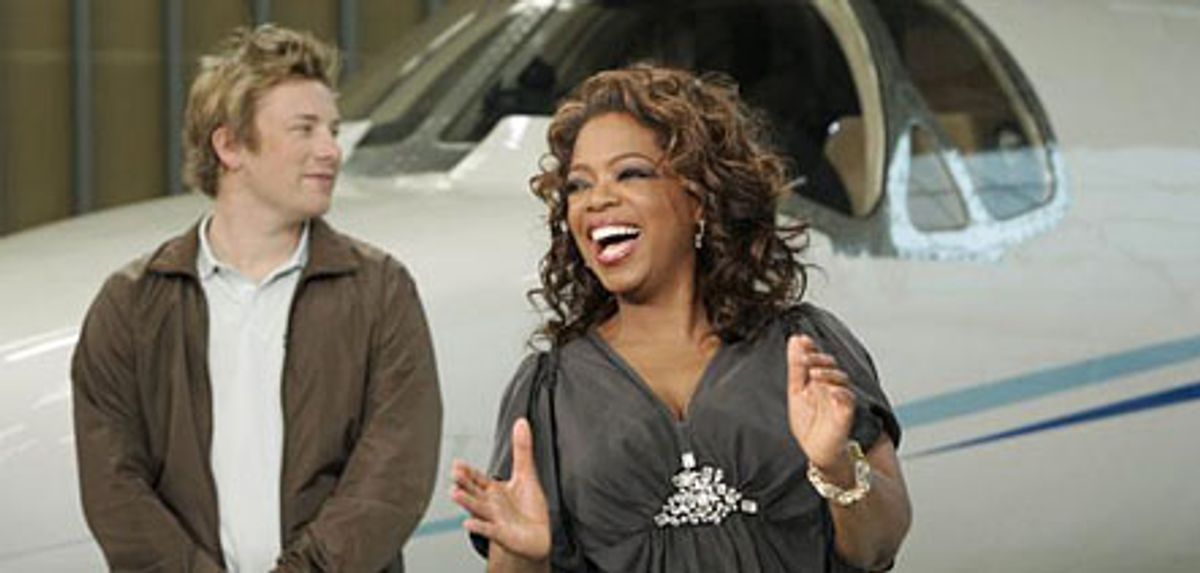
TV DailyOPRAH'S BIG GIVE™ - "Oprah's Big Give," the exciting and much-anticipated new primetime series that defies television convention with the bold idea of people competing to give rather than get, will premiere SUNDAY, MARCH 2 (9:00-10:02 p.m., ET) on the ABC Television Network. The series premiere, "Episode 101," kicks off in Los Angeles, where Oprah hands ten contestants sealed envelopes with only a picture and the name of a complete stranger. Under intense pressure, they must give big to change this person's life in just five days. The contestants must use their creativity and resources to generate the most powerful and sensational ways to make a real difference, and with the clock ticking, the competition, drama and emotion mount and the contestants' stamina, creativity and drive are tested. This first dramatic challenge will send one person packing. (ABC/MITCH HADDAD) JAMIE OLIVER, OPRAH WINFREY

Weekend Pick

ABC / Mitch Haddad

If you think Oprah Winfrey can’t turn water into wine, watch her turn the typically crass genre of reality TV into a place where warm fuzzies can flourish safely. “Oprah’s Big Give” (9 p.m. EST Sunday on ABC) challenges contestants to make the world a better place by improving other people’s lives. In the first episode, this includes finding shelter for a homeless family, paying off part of a mortgage for a grieving widow, and helping a pure-intentioned doctor to pay down his student loans so he can offer his services to needy families in his community. Hosted by Oprah’s spunky sidekick Nate Berkus and featuring “Naked Chef” Jamie Oliver, Chris Rock’s wife, Malaak Compton-Rock, and pro football star Tony Gonzalez, “Oprah’s Big Give” is entertaining and surprisingly heartwarming, and best of all, it demonstrates clearly what a huge difference one person can make … Um, particularly if that person’s name is Oprah.

Also…

On Friday, “Tender Mercies airs at 12:20 p.m. EST on FLIX, dancers and their parents team up for the latest dance contest on “Your Mama Don’t Dance” (premieres at 9 p.m. EST on Lifetime), Kate comes to therapy with Paul on “In Treatment” (9:30 p.m. EST on HBO), and the tactics and weaponry involved in famous battles are examined on “Battle 360″ (premieres at 10 p.m. EST on History). On Saturday, “Seabiscuit” airs at 8 p.m. EST on ABC, while “Napoleon Dynamite” airs at 8 p.m. EST on Comedy Central. “Torchwood” continues at 9 p.m. EST on BBC America, the Dixie Chicks perform in a repeat of “Austin City Limits” (9 p.m. EST on PBS, check listings), and George Carlin performs live from Santa Rosa, Calif., in “George Carlin: It’s Bad for Ya” (10 p.m. EST on HBO). On Sunday, 20-something angstfest “Quarterlife” continues at 9 p.m. EST on NBC, the second-to-last episode of “The Wire” (9 p.m. EST on HBO) finds creative reporter Scott Templeton called into question by his editor, and on “Breaking Bad” (10 p.m. EST on AMC), cancer man Walter returns to his meth lab.

Thursday night

What did you think of “Celebrity Rehab With Dr. Drew” on Thursday? Go here to discuss.

On the talk shows

Regis and Kelly

ABC, 9 a.m. EST

Courteney Cox, Josh Kelley

The View

ABC, 11 a.m. EST

Woody Harrelson, Sarah Bareilles

Ellen DeGeneres

Syndicated, check local listings

Janet Jackson, Dr. Wayne Dyer

Oprah Winfrey

Syndicated, check local listings

“Oprah’s Big Give” kickoff party

Charlie Rose

PBS, check local listings

TBA

Larry King

CNN, 9 p.m. EST

TBA

David Letterman

CBS, 11:30 p.m. EST

Woody Harrelson, Tommy Tiernan

Jay Leno

NBC, 11:35 p.m. EST

David Salmoni with animals, Patricia Arquette, Punch Brothers

Tavis Smiley

PBS, check local listings

Samantha Power, Eric Bana

Jimmy Kimmel

ABC, 12:05 a.m. EST

TBA

Conan O’Brien

NBC, 12:35 a.m. EST

Christina Ricci, Jason Sudeikis, Shooter Jennings

Craig Ferguson

CBS, 12:35 a.m. EST

Coolio, Dweezil Zappa, Jason Randal

Contributors: Molly Eichel, Heather Havrilesky, Amy Reiter, Charly Wilder

Ernest Hemingway made silly

HBO's unintentionally hilarious "Hemingway & Gellhorn" gets everything disastrously wrong

  • more
    • All Share Services

Ernest Hemingway made silly Nicole Kidman and Clive Owen in "Hemingway & Gellhorn"

Here’s something you should consider doing before watching HBO’s inadvertent comedy “Hemingway & Gellhorn,” a disastrous two-and-a-half-hour CliffsNotes on the passionate, dysfunctional love affair between Ernest Hemingway (Clive Owen) and his third wife, the war correspondent Martha Gellhorn (Nicole Kidman), which airs Monday night. Find some Hemingway — take it off the shelf, download it to a Kindle, load a page of “The Sun Also Rises” onto your computer via Google books — and leave it within arm’s reach. You are going to want to read from it at fairly regular intervals to remind yourself that though he may have been a drunk, a brute and a womanizer, Ernest Hemingway was not a complete and total idiot. And then you can also use it to shield your eyes from the movie’s myriad crimes against sepia, its extensive use of what appear to be Instagram photo effects, the hot pink blood, Metallica’s Lars Ulrich in a beret, and the scene toward the end of the film in which Kidman’s face is superimposed over real footage of emaciated bodies at Auschwitz and Dachau.

Hemingway and Gellhorn met in Florida in 1936, when she was 28 and he was 37, already famous and married to his second wife. The two covered the Spanish Civil War together, then lived with each other for a few years, married in 1940 and were divorced by 1945. Despite the fact that Gellhorn covered every major conflict between the Spanish Civil War and Vietnam, she is best known as Ernest Hemingway’s third wife, a designation she bridled at both in real life and in the film. “Hemingway & Gellhorn” purports to rectify this. She, not Hemingway, is the movie’s protagonist and narrator. It begins on a close-up of Kidman, in old-age makeup — she looks good wearing all those wrinkles she’s fought so tirelessly to erase — speaking to a documentary crew in a smoky, deep contralto about her life. But though the film pays lip service to making Gellhorn more than, as she put it, “a footnote to someone else’s life,” it chooses to do so by focusing only on the period of time in which … she was that footnote. With friends like these, better they not be filmmakers.

At least Gellhorn does not come across quite as badly as Hemingway, who brays and screams and generally behaves like an overgrown child. When we first see him, he is drinking, smoking and cackling maniacally while reeling in a marlin, the Not That Old Man and the Hunter S. Thompson Outtake. It gets more Gonzo from there, as in when he and Robert Duvall, playing a USSR general, clench a red scarf between their teeth and threaten to play Russian roulette before Tony Shaloub calms them down with vodka.

Clive Owen has been stripped of all sex appeal — future directors take heed: Wire frames and a mustache are Clive Owen’s sexual kryptonite — despite having lots of sex. (I can imagine Corey Stoll’s incredibly dashing Hemingway, from last year’s “Midnight in Paris,” pointing at this version of Hem and cackling.) As for his writing, though he is occasionally seen standing up, typing away, and floating his pages into the trash, of the two lines of writing we hear, one is plagiarized from an earlier conversation and the other is “If a man can stand he can fight” — the sort of stereotypical stinker of a Hemingway line that makes people hate Hemingway.

But the disaster of “Hemingway & Gellhorn” isn’t on Owen, who gives this silliness his all, or Kidman, who devotes herself and even, occasionally makes it work. In almost every instance, the script and direction settle for the simplest, dullest explanation of its main characters’ behavior, even when that’s in direct contradiction of something mentioned earlier. (Philip Kaufman, who in an earlier life made “The Unbearable Lightness of Being,” is the director here, and he keeps insisting on inserting Kidman and Owen into real historical footage like he’s Forrest Gump with access to iMovie.)  In the very first scene, the older Gellhorn narrates that she never liked sex, a comment she made in real life as well. But every time she and Hemingway bang in this movie — in one endless sequence, they screw while actual bombs are going off on the street outside — she seems as into it as the most gifted porn star.

In this movie, when Gellhorn saddles up to Hemingway at a bar in Key West, all sass and ass, it can’t be because he cuts such a dashing figure — after all, he’s drunk, covered in blood, and a dead ringer for Groucho Marx — but because he’s Ernest-effing-Hemingway. Martha Gellhorn was a major, ballsy, charismatic operator, a woman driven and brave enough to crash a boys club and go to war, time and time again, but the movie ignores all the hundreds of spiky, complicated, difficult, even selfish reasons that a person as interesting, intense and ambitious as Gellhorn might want to be with someone of Hemingway’s stature. (When Gellhorn insists on leaving Hem to go cover the end of WWII, Hemingway cheats on her. In real life, Gellhorn cheated too, but that detail didn’t make the cut.) Instead, Gellhorn loves Hemingway, but she can not shirk her duty to bear witness to world events. Hemingway loves Gellhorn, but he needs to be the center of attention.

At the end of the movie, the documentarian asks an older Gellhorn about her relationship with Hemingway, and she bristles. The man has been dead for nearly 40 years, she’s moved past him, and she’s lived a plenty interesting life on her own terms, she says. Then the crew leaves and she goes directly to her desk to read a letter from Hem, because, whatever the movie pretends, it doesn’t believe her.

Continue Reading Close
Willa Paskin

Willa Paskin is Salon's staff TV writer.

“American Idol”: Riveting despite itself

We all knew Phillip Phillips would win. Yes, the judges are nuts. So why did I feel real emotion anyway?

  • more
    • All Share Services

The final episode of any season of “American Idol” is always a smiling show of force, a confetti-laden massacre of time. After a nearly 40-episode season, along comes the gargantuan finale, an enormous spectacle that contains exactly one minute of real content — when the winners are announced — and two-plus hours of filler. Last night’s episode was nominally about who would be declared the winner of the 11thseason of “Idol” — Phillip Phillips, the humorously named yet handsome guitarist with a twang in his voice and shirts cut to display exactly the appropriate sliver of chest hair, or the huge-voiced, personality-less 16-year old Jessica Sanchez. But sleepily good-looking white guys (and Scotty McCreery) have won the last four seasons of “Idol,” and Phillips was pretty much a lock before the night even began. And so it is a commendation to the near-military professionalism of “Idol” that somehow, for the last half-hour or so, I was riveted to the screen.

The beginning went by in a busy, boring blur. Ryan Seacrest in his tuxedo informed the crowd that 132 million votes had been cast this year (the number of votes cast in the last presidential election: 129 million. Though that doesn’t count teenage girls voting over and over and over again for a guy named Phillip Phillips.) John Fogerty and his mop top of dyed dark hair clanked his voice against Phillips for a while. One of this year’s contestants kept distracting me from the group numbers with her uncanny resemblance to Florence Henderson. Chaka Kahn flirted dangerously with camel toe. Steven Tyler was filmed playing with a three-toed sloth, revealing that he and a three-toed sloth have the exact same hairdo. Jennifer Lopez performed a medley in a sparkly dhoti.

And then Ryan Seacrest invited former contestants Diana Degarmo, who was 16 when she was the runner-up in Season 3, and the long-haired Ace Young, a contestant in Season 5, up onstage. They waved hello, and Young said, “This has always been home to us, and I felt this was the perfect place to ask a simple question.” Ryan chirped, “Dim the lights!” And then Young proposed to a surprised-looking Degarmo — with the help of David Webb jewelry. (Never forget your sponsors.) “I love you to death, you’re my best friend, and I will do anything in my power to have the most unimaginable, amazing life together, if you’ll have me. Diana Nicole DeGarmo … will you … marry … me?” he asked on bended knee. She nodded yes, the “Idol” theme music swelled, and these two newly engaged people, having significantly boosted their chances of getting some reality show company to pay for their wedding, embraced onstage as the show hurried mercilessly, ceaselessly on, this time to the thematically appropriate duet  “You’ll Never Walk Alone.”

A wave of emotions crashed over me. I realized I had been screaming at the television. (“Nooooarghhhahaahaeeeee” or something like that.) While this was, on a human level, so ill-advised — what is wrong with doing private things in private???— it was also undeniably entrancing television. The “Idol” machine had struck again. What if these two kids had chosen to get engaged off camera? In the relative privacy of, say, a Cheesecake Factory? Would we, the audience, have been forced to watch a supercut of Steven Tyler’s most lascivious comments instead? One of Jennifer Lopez saying sweetie over and over again? Or just more commercials? When I thought of it this way, I could almost appreciate the utilitarian sacrifice of Degarmo and Young’s privacy and dignity: The entertainment of the many outweighs the needs of the few.

But this engagement was not the highlight of this episode. No, the ever crafty “Idol” had waiting in the wings a tactical tour de force: Jennifer Holliday, the Tony Award-winning actress who originated the role of Effie in the Broadway production of “Dreamgirls,” and so is the ur-performer of “I’m Telling You I’m Not Going,” that canonical musical competition song and a number the teenage Jessica Sanchez  has been singing for nearly her whole life. Holliday and Sanchez came onstage to do a nominal duet of the song, which turned into an extended solo. (Sanchez’s willingness to let Holliday steal this number right out from under her is the most likable thing she’s done all season.) Holliday, who looks like she can dislocate her jaw on command, and at various points seemed poised to inhale Sanchez with no need for chewing, absolutely destroyed this song, and did so in such joyful, reckless disregard for what she looked like while doing so  — here are some gifs of her in the act — that it almost wiped out the sourness of the engagement sequence. Here was a public act, one that was meant to be public, performed with such passion, it felt private: Who can possibly know what is going on inside of a person’s body or mind when they are as possessed by anything as Holliday was by this song?

When Ryan Seacrest finally told Phillip Phillips he had won, after 10 o’clock at night, he picked up his guitar and began to sing. Ever since Kelly Clarkson cried her way through “A Moment Like This” in the show’s first season, the winner is expected to perform their new single at the end of the show.  But halfway through “Home,” Phillips broke off, to sob. The background singers kept singing, and the confetti kept falling, but Phillips didn’t even try to get back on the mic. For about a minute, he stood on stage, quiet music playing in the background, trying to pull himself together, to do what was expected of him. He couldn’t. He didn’t sing again. Instead, he walked offstage to his family, who pulled him into a big group hug, inadvertently hiding his face from the cameras. At which point, I think that I got something in my eye.

Continue Reading Close
Willa Paskin

Willa Paskin is Salon's staff TV writer.

More sex and disasters, please

TV season finales used to be about crazy couplings and exciting explosions. Where did the fun go?

  • more
    • All Share Services

More sex and disasters, pleaseGabriel Mann and Emily VanCamp in "Revenge"

There are a few times of year when network television can typically be relied upon to be as interesting as cable: The fall, when the networks vomit out dozens of new programs; February, when the networks cough up a dozen or so more; and May, when all the series that have survived the year try to end in spectacular fashion. During this last period, season-finale time, couples couple, get married and have babies; characters quit, get fired and die; disasters occur; buildings explode; guns blaze; hatches are discovered and protagonists are left dangling off cliffs, both actual and metaphorical. It’s the TV equivalent of blockbuster season, and like blockbuster season, it can and should be fun. Though in recent years cable shows have been responsible for a disproportionate number of the “Holy crap, did that just happen?!” finales (hello, Gus Fring and his brand-new face!), network shows are usually good for at least some insanity, some drama, some transcendent event that will get people talking around the storied watercooler. Not this year. Nope, this year, season finale season has been a bust.

The dearth of enjoyably over-the-top finales both is, and is not, a coincidence. Some of the shows that went big in the past opted to take a more low-key approach this May. Last year “The Good Wife” ended with Alicia and Will finally smooching outside a hotel room; this year it ended with Kalinda sitting in her apartment, gun in hand, waiting for her front door to open. Last year, “Community” wrapped up with its balls-to-the-wall, two-part spaghetti-western paintball extravaganza; this year it ended with a relatively understated episode about Evil Abed, leaving everyone to talk about Dan Harmon’s firing instead.

What isn’t a coincidence, is that there are very few good, tentpole network dramas, and it’s those dramas that usually provide the crazy come finale time. The two long-running series that ended this year, “Desperate Housewives”  and “House,” both ended quietly, which is to say in exactly the mediocre fashion they’ve been plodding along in for years. For either of these shows to have had must-see finales, they would have had to wrap up seasons ago, before they got creatively stale. Meanwhile, many of the new shows that started the season with the sort of mythologies that tend to make for the most memorable finales flamed out in one way or another:  The mediocre “Alcatraz” and “Terra Nova” were canceled, “Person of Interest” exists in the CBS procedural ghetto, and very few people watch “Awake.” The only show left that could plausibly deliver a juicy season-ending event is ABC’s super-soap “Revenge,” which finishes tonight. Its creator has promised someone “important” will die. My fingers and toes are all crossed.

Even the shows that have heeded the command of finale time — go big — have felt flat. On “Castle,” the show’s longtime will-they-won’t-they couple finally fornicated, following a very by-the-numbers “here I am on your doorstep all wet from the rain, at long last ready to have sex with you” moment. Last year had an equivalent event, when “Bones’s” longtime will-they-won’t-they couple Dr. Brennan and Booth paired off, but in a stranger and therefore more interesting way. Without so much as an on-screen kiss, Brennan told Booth she was pregnant with his baby. As far as twists go, surprise baby trumps emo sex against a wall.

One show that did bring its A-schlock game to its finale was “Grey’s Anatomy,” which stranded six major characters and a pilot in the woods after a serious plane crash, and crushed one to death underneath the fuselage. (At the time the episode was written, the cast members had yet to re-sign their contracts. Presumably, had they failed to sign, there would have been more fatalities.) This amount of carnage would have been a lot more stupendous if extreme violence wasn’t a staple of “Grey’s,” which had a grieved and crazed gunman shoot up the hospital and its staff two finales ago. The characters have long since taken to calling their workplace “Seattle Grace Mercy Death,” a joke about the number of horrible coincidences that have befallen them there (car accidents, fatal bus crashes, shootings, suicide attempts, exploding bombs, etc.). At this point, I wouldn’t bet against a dirty bomb showing up in next year’s finale. Which, come to think of it, sounds just insane enough to be spectacular.

Continue Reading Close
Willa Paskin

Willa Paskin is Salon's staff TV writer.

As Kristen Wiig departs “SNL,” what’s next for women?

"Saturday Night Live" says goodbye to a star -- and leaves late night without a queen

  • more
    • All Share Services

As Kristen Wiig departs Mick Jagger and Kristen Wiig during the season finale of "Saturday Night Live"

What, you didn’t get to dance with Mick Jagger, hug Jon Hamm and be serenaded by Arcade Fire the last time you left a job? I guess you’re not Kristen Wiig.

After seven years on “SNL,” Wiig said goodbye on Saturday night’s season finale that will go down as one of the sweetest, most choked-up moments on the show since Steve Martin said goodbye to Gilda Radner on the day of her death almost exactly 23 years earlier.

Even without an official announcement, Wiig’s twirly, teary departure is enough to make even the most casual fans of the show crank up the Adele and mainline a tub of Edy’s Grand. It doesn’t matter that fellow castmates Andy Samberg and Jason Sudeikis have reportedly moved on from the show as well. They leave behind established male cast members like Seth Meyers, Fred Armisen and Bill Hader. Wiig, on the other hand, blows a gaping hole in the show’s female lineup. The 24-year-old Abby Elliott, who moves up the rung to the show’s senior lady cast member, is now its biggest female star. But she’s yet to display that versatility or command the clout that Wiig has. Kate McKinnon may yet bust out into full-blown “SNL” stardom, but she’s only been on the show for five minutes.

And so, after years of cultivating a stunning roster of formidable female talent — Tina Fey, Maya Rudolph, Amy Poehler and Wiig — the show is, for the moment anyway, back to a state of relative desolation it hasn’t seen since the ’90s, an era that reached its nadir when Janeane Garofalo bailed midseason. It’s a strange, disconnected moment for “SNL,” right as women are making grand enough strides in television and film comedy that we’ve magically attained “labia saturation.” And though Wiig will no doubt continue to dominate in movies as a writer and performer, it’s sad that she leaves behind no true heirs on a show that, especially in an election year, remains so influential.

Visibly emotional and flanked by current cast members as well as the likes of Chris Kattan, Rachel Dratch, Steve Martin and Chris Parnell, and an especially rollicking Amy Poehler, new alumna Wiig didn’t depart “SNL” alone. She took with her Gilly,  the tiny-handed Judice,  Target Lady, Suze Orman and even Tan Mom. Why were so many people red-eyed on Saturday? Because on the stage that night stood a woman with incredibly big shoes to fill – and one very small hat.

Continue Reading Close
Mary Elizabeth Williams

Mary Elizabeth Williams is a staff writer for Salon and the author of "Gimme Shelter: My Three Years Searching for the American Dream." Follow her on Twitter: @embeedub.

What’s “Community” without Dan Harmon?

Less ambitious shows might survive losing a creator. But firing the prickly showrunner bodes poorly for next season

  • more
    • All Share Services

What's Dan Harmon (Credit: AP/Matt Sayles)

A recent episode of NBC’s “Community” floated the possibility — debunked by episode’s end — that the seven main characters had not spent the previous three years navigating life, each other and paintball fights at Greendale Community College, but instead, had only been imagining them. In the episode, the recently expelled Greendale Seven found themselves in a group therapy session with a nefarious shrink, keen to keep them away from their college using any psychological means necessary. The therapist temporarily convinced them they had spent the previous years in a mental institution and that everything they remembered happening at school, except their friendship, had been a collective fantasy, a “shared psychosis” dreamed up in the asylum.

As I was watching this episode, “Curriculum Unavailable,” I remember calmly thinking something like, “Huh. That would really explain Leonard.” The possibility that “Community” might be about to “St. Elsewhere” its audience (“St. Elsewhere” ended on the reveal that everything that had happened in the series had all taken place inside the mind of an autistic boy) was not particularly alarming to me. Group psychosis explained a lot about the show’s extremely dark psychology, and, anyway, on “Community,” stranger things had happened.

As of late Friday evening, when “Community’s” creator and showrunner Dan Harmon was abruptly fired by Sony from the show he obsessively oversaw, I’ve realized that the real reason I was unphased by “Curriculum Unavailable” was because I was already very comfortable with thinking about “Community” as the figment of someone’s feverish imagination. That someone was just Dan Harmon.

Writing about “2 Broke Girls” recently, I noted that there is a fault line running through television where art rubs up against commerce. I should have saved that metaphor, because this “Community” situation is like an 8.0 on the art-commerce Richter scale. Consider the aftershocks: The perpetually low-rated, but fanatically beloved “Community” was just renewed by NBC for a fourth, 13-episode season. Why renew it just to fire the guy responsible for it? To escape the bad press of canceling a critically acclaimed series? Or is it the opposite impulse — to make enough episodes to get the show into syndication?

Harmon is an infamously — and self-proclaimed — difficult guy to work for and with. Earlier this year, he got into a public fight with “Community’s” Chevy Chase after Harmon played an incensed voice mail from Chase at a public event. Harmon apologized, though not to Chase, and a few weeks later was back to calling him a jerk on Twitter. If Harmon’s behavior was bad enough to get him fired, it was also the same crazy mentality that made “Community” one of the strangest shows to ever air on network television. How badly behaved does a great artist have to be to get kicked off his own creation without so much as a phone call?

Speaking about “Community” last week, before the news about Harmon was public, Bob Greenblatt, the head of NBC, said “Shows lose showrunners all the time and do well.” This is and isn’t true. Workaday TV shows, procedurals, sitcoms, long-running dramas, change showrunners all the time. But for the growing number of auteurist series driven largely by one personality — everything from “The Sopranos” and ‘The Wire” to “Louie” and, yes, “Community” — a showrunner change is not common, and is usually about as imaginable or advisable as Matt Weiner getting fired from “Mad Men” and that show soldiering on without him. It happens — Aaron Sorkin left “The West Wing” after four years, for example — but the shows are never the same.

“Community” seems to me particularly poorly designed to continue without Harmon. If “Community” were a more standard comedy, the new showrunners — two writers from “Happy Endings” — would just have to take the seven characters and make them funny. But causing belly laughs seems secondary to “Community’s” précis, which emphasizes being exhilaratingly clever, formalistically inventive and impressively bonkers over being laugh-out-loud hilarious. Harmon’s approach to television has always been almost athletic: With each episode, he sets out to break his previous record for genre bending, to outdo what everyone else has done before. To make “Community” “Community” then, the new writers don’t just have to tell jokes, they have to maintain its outdo spirit. They have to outrun or at least keep pace with Dan Harmon’s brain.

And because of his “let’s boldly go where no TV show has ever gone before!” ethos, Harmon has long since made his brain a major, off-screen character on “Community.” More than most other showrunners, even the great ones, one can feel Harmon in each episode, egging the show on to new heights, exposing the mechanics of the genre. I could watch Troy and Abed do their secret handshake 1,000 times a day, but I don’t watch “Community” for Troy and Abed, adorable besties that they are. I watch for the episodes with multiple timelines, for Dungeons & Dragons games come to life, for claymation Christmas specials, and for “My Dinner With Andre” and “Die Hard” spoofs. I watch for Dan Harmon’s unmatched and, now it seems, unsustainable ambition. Oh, damn it. I guess I mean watched.

Continue Reading Close
Willa Paskin

Willa Paskin is Salon's staff TV writer.

Page 1 of 499 in Television