The days of the great American newspaper drama appear to be gone for good. Perhaps it’s the public’s ambivalence about the media, so easy to malign for giving us the dirt we hate ourselves for loving. The noble, crusading reporters of “All the President’s Men” seem more than a generation away from us in terms of naiveté. (Today they’d just be accused of promoting a liberal agenda.) Besides, by now most people realize that the best journos don’t really prioritize “saving the children” or “making a difference” or whatever platitude we intone when genuflecting to the conventional virtues of the day. Real journalists just want to get at the truth, and the truth can be a very nasty thing indeed.
The newspaper reporters at the center of Paul Abbott’s tense, serpentine thriller, “State of Play” — originally broadcast as a six-part miniseries on BBC in 2003, and now out on DVD — are not especially nice people. They’re crafty and pushy, full of sneaky tricks like setting off a car alarm to flush out a source, or pretending to be a bike messenger to snag a handwriting sample. They lie to and flirt with and browbeat their sources, and when that fails to get results (which is often) they do something likely to shock their top-drawer American counterparts: hand over fat envelopes of cash. (Equally transgressive on this side of the pond is their propensity for secretly tape-recording just about every conversation they have.)
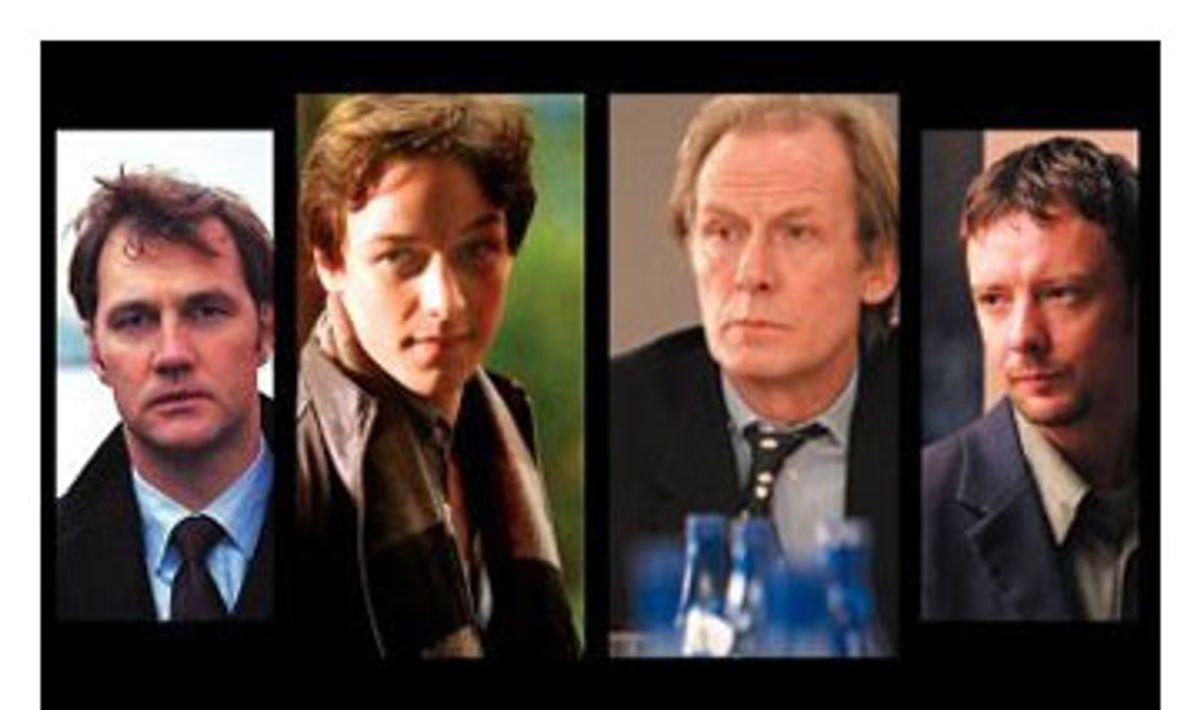
Still, they root out the truth, and when they’re hot on its trail, they get a certain wild light in their eyes that’s unmistakable. It’s the hot gleam of reportorial lust, an essential passion in any good journalist and an undersung but crucial resource in any free society. These reporters are played by some of the best British actors around, not just James McAvoy, in a supporting role ideally suited to his clammy schoolboy prettiness, but also a sublimely dissolute-looking Bill Nighy as the editor in chief of the Recorder, the series’ fictional broadsheet, the luminous Kelly Macdonald and, finally, John Simm (“Life on Mars”), all nervy, resentful intelligence as the story’s hero, Cal MacAffrey.
The story begins with two deaths in London: One is the seemingly drug-related shooting of a teenage boy and the other the apparent suicide of a young woman who worked as a researcher for up-and-coming Labor M.P. Stephen Collins (David Morrissey). Stephen breaks down during the otherwise routine news conference announcing Sonia Baker’s death, and the tabloids are all over him. He confesses to having had an adulterous affair with her, and turns to Cal, who was his campaign manager nine years earlier, seeking a more sympathetic outlet in the press.
Cal’s friendship with Stephen, though slightly cooled in recent years, complicates his job, and those complications multiply as it becomes clear that he has long been carrying a torch for Stephen’s wife, Anne (Polly Walker, familiar to followers of HBO’s “Rome” as Atia of the Julii). At different points, both members of the estranged couple seek refuge in his flat, and eventually his personal life is almost as big a mess as theirs.
Meanwhile, Cal and his colleagues discover records indicating that just before she went under a train in a Tube station, Sonia got a phone call from the dead boy, who may not have been a crackhead after all. Nighy’s character, Cameron Foster, assembles a team of reporters to chase down the story. McAvoy plays a late addition to the group, a freelancer who has been banished from the Recorder for personal reasons, but whose ingenious sleuthing finally wins him a spot on the assignment over Cameron’s objections.
The situation is an ethical morass for Cal, but the rest of the crew is hardly a standards handbook in action, either. They exercise an impressive moral creativity as they follow the trail leading back to the larger forces lying behind Sonia’s death. They deceive and dicker with the police, who are usually one step behind them, and mount an elaborate charade to fan the paranoia of a particularly reluctant source. You can see why the other characters often dislike them: They land on doorsteps and perch by parked cars like the proverbial birds of ill omen, undeniable signs that the shit has hit the fan.
One question leads to another: What was the real nature of Sonia’s relationship with Stephen Collins? What did the dead boy tell her that upset her so much, and why was the first person she called afterward a foppish management consultant instead of her lover or her best friend? You’ll have to watch closely and listen hard to catch all the intricacies of the plot (and turn on the subtitles if you have difficulty with some of the actors’ Northern and Scottish accents) — “State of Play” places as rigorous a demand on the viewer’s attention as “The Wire.”
Nighy’s Cameron Foster is the series’ crypto-hero, but it isn’t until the final episodes that genuine courage begins to break through his façade of jaded weariness. Until then, he has the funniest lines, sighing, “Hands up anyone who’s never screwed a source!” when he discovers how many of his employees have chased the story all the way to bed, and shooing a reporter out of his office with, “Why don’t you go and type something lovely?” Still, when the moment of truth arrives, he orders one of the most stirring stop-the-presses scenes I’ve ever seen.
“State of Play” ran on BBC America in 2004, but has only just become widely available to American audiences on disc. In the interim, the series became something of an object of fascination among American television creators for its expert blending of complex story with headlong velocity. (The first shot is of a pair of running feet, and things don’t slow down much from there.) A movie adaptation, with Russell Crowe and Helen Mirren in the Simm and Nighy roles, respectively, is currently in the works, but “State of Play” can only be diminished in the process. This is television at its best, taking full advantage of its length without introducing a speck of fat, unostentatiously blending traditional camera setups with jittery hand-held sequences to orchestrate the emotions of the viewer, and offering a vision of the truth as an endless unfolding of character and power, pursued by people who are no less precious for being deeply flawed.
“West. James West.”
That three-word introduction in the pilot episode nicely spells out the Ian-Fleming-on-the-range conception behind “The Wild Wild West.” The show — which ran on CBS from 1965 to 1969 — melded the then declining western form to the ascendant spy thriller, and then added some buddy-movie dynamics, a healthy dose of political intrigue and generous helpings of science fiction. The result was … well, a mess sometimes, to judge from the DVD release of the show’s fourth and final season. But at its best — which is to say, in its earlier seasons — “The Wild Wild West” stands as one of the most intriguing and literate actioners of ’60s TV.
And one of the most baroque. At the behest of President Ulysses S. Grant, secret agents Jim West (Robert Conrad) and Artemus Gordon (Ross Martin) travel the Western territories in a souped-up private locomotive, foiling Blofeld-scale plots to assassinate world leaders, blow up cities and generate massive tidal waves. Yes, our nation’s history might have turned out quite differently if Jim and Artie hadn’t quashed all that evil post-Civil War R&D: steam-powered robots, disintegration force fields, miniaturizing potions, primitive tanks and TVs, paintings that serve as gateways to other dimensions. And don’t forget the surgically implanted crystals that drive men to crime. And the special liquid distilled from burning diamonds that generates superhuman speed. And the jars that extract thoughts from disembodied brains.
Nobody took any of this very seriously, least of all the writers, but the show did require guest-actors who could walk the thin line between high and low camp: people like Harvey Korman, Agnes Moorehead, the now-forgotten Nehemiah Persoff and the never-to-be-forgotten Victor Buono (who played both the recurring baddie Count Manzeppi and, in the pilot episode, a Mexican revolutionary disguised as a Chinese grocer — please don’t ask).
The villain fans recall best is Dr. Miguelito Loveless, a dwarf-size inventor given to extensive monologues about truth, beauty and his own genius. As played by the great Michael Dunn, Loveless is perversely sensitive and strangely seductive, a thwarted artist (Dunn himself had a lovely tenor) who is as drawn to Jim West’s glamour as he is threatened by it. In best Holmes-and-Moriarty fashion, the antagonists can never fully destroy the other: Every encounter ends with Jim spoiling Loveless’ latest venture and Loveless slipping free of the law’s grip. (After one foiled caper, he escapes by shooting himself from a cannon.) Dunn has avid eyes and a smile that lingers just two seconds past benignity, and whenever he’s on-screen, “The Wild Wild West” rises to something greater than itself: a pop-Shakespearean study of character bent by biological destiny.
Beyond that, the show boasts a fine Elmer Bernstein-ish score by Richard Markowitz and a clever animated credit sequence that shows Jim West (shockingly, for that day) cold-cocking a knife-wielding damsel. But there’s something else that comes through in repeat viewings. In fact, it’s the same element most conspicuously missing from the 1999 big-screen remake starring Will Smith and Kevin Kline: a warm and delicate rapport between the two leads. The kind of homosocial bond, I mean, that suggests feelings a little beyond the homosocial.
Oh, let me come right out and say it. To a kid of the late 1960s, “The Wild Wild West” was as gay as a show could get. Like “I Spy,” like “Batman,” it was a portrait of two men in domestic partnership. Jim and Artie didn’t just work together; they lived together, rode together, celebrated together. Of course, the show’s creators took care to give Jim a vigorous and straight lifestyle. Virtually every episode finds him seducing — and, in the same hot breath, reforming — some busty blond minion. But more than heterosexual, Jim West is truly sexual, in a way heroes of westerns usually weren’t. See how snugly his clothes are tailored to his form — the bolero jacket, the extra-tight trousers (not to mention Season 4′s leather chaps, which would not be out of place in a gay pride parade). And see how readily he takes those garments off at the slightest incentive. See how he carries that fine body of his. Jim West is a man who enjoys being desired.
And who is in a better position to appreciate that effort than Artie? Ross Martin has a rip-roaring time playing the character “in character” — Artie’s a master of disguise and dialect — but in his scenes with Conrad, he becomes softer and more tranquil. Watching them together, you realize that while Jim is often focused inward, Artie is always looking at his partner. Where else would he look? He has no girlfriends to speak of (a fact he sometimes complains about). Then again, he doesn’t seem to need them. It’s a token of the two men’s understanding that Jim can go off on his amorous rampages, safe in the knowledge that Artie’s waiting back at the train, with the champagne magnum and the freshly chalked billiard cues.
I didn’t quite grasp it as a kid, but “The Wild Wild West” showed me how two men could live together and love each other without forfeiting any of society’s prerogatives. Which makes the show even more of a fantasy — and even more of a pleasure. Long live Jim and Artie, in their train bound for trouble.
* * * * *
Read more of Salon’s Re-Viewed, offering a fresh look at great TV shows available on DVD.
Continue Reading
Close
Watching television these days can give you a somewhat skewed impression of our country’s economic well-being. While Blair Waldorf jets around the world and the “The Real Housewives of New York City” stroke their cashmere shawls, the working class has mostly disappeared from our screens — relegated to “America’s Next Top Model” and Tila Tequila’s pool house. Maybe that’s why George W. Bush is so optimistic about the economy: He’s been watching too much prime-time TV.
Across the pond, however, the British continue to churn out smart and literate television, like “EastEnders” and “Clocking Off,” about the lives and struggles of the working poor. So if you’re tired of watching suburban wife swapping, and you’d like to bring some economic diversity to your TV screen, Channel 4′s “Shameless,” a comedy about a dysfunctional and poor Manchester family, is worth a look — not only because it’s one of the best comedies ever made about urban poverty (ha!) but also because it’s terrific, naughty fun. And if the economy goes down the tubes you might as well have something to laugh about.
Some episodes of the show, which just finished its fifth season in the U.K., have aired on BBC America and the Sundance Channel. But only its first season is available on DVD in the United States, and, bizarrely, “Shameless,” has yet to attract a large American following. It’s surprising, partly because unlike many other British comedies, its humor is broad enough for us non-Brits to understand, and partly because of its dreamboat factor: The show’s first two seasons feature James McAvoy (“Atonement,” “Wanted”) in his breakout role as a middle-class car thief.
Each episode of “Shameless” begins with a boastful voice-over by Frank Gallagher (David Threlfall) in which he drunkenly introduces his children and the show’s main characters. These include, from oldest to youngest, 20-year-old Fiona (Anne-Marie Duff), “a massive help”; teenager Lip (Jody Latham), “a bit of a gobshite”; Ian (Gerard Kearns), “a lot like his mom”; Carl (Elliott/Luke Tittensor); Debbie (Rebecca Ryan); and toddler Liam (Joseph Furnace). All seven live together in a cramped home in the Chatsworth Estates in Manchester. Like many British housing projects, Chatsworth is ripe with criminality and monotonous fashion (track pants, baseball caps, sneakers), but, as Frank points out, at least his neighbors know how to party.
And, as it turns out, so does Frank. Despite his bragging voice-over in the opening credits, he’s both a drunk and an absentee father, and his children spend much of their time trying to get his attention or inquiring about his whereabouts. (When Frank disappears on a drunken binge, Debbie mistakes a sleeping bag for him and brings it a cup of tea.) The children, as a result, have learned to fend for themselves. Fiona takes care of her younger siblings. Ian works at the corner store (and screws his male boss). But mostly the family survives on government support and mild criminal behavior.
In the first season’s overarching story line, Frank leaves his family and shacks up with Sheila Jackson (Maggie O’Neill), a severe agoraphobic with generous state benefits and a penchant for sadomasochistic sex: When he first arrives at Sheila’s prim and tidy house she promptly handcuffs him to the bed and pulls out a rubber dildo. But his departure is offset at home by the arrival of Fiona’s new boyfriend, Steve (McAvoy). Fiona and Steve meet drunkenly in a nightclub, and, after a one-night stand, he becomes enamored with her and her siblings. He then uses his street smarts to, among other good deeds, buy them a new washing machine and deport their father to France.
For a comedy, “Shameless” takes a surprisingly unvarnished look at urban poverty. It isn’t bashful about sex or drug use: The family kids get stoned together on the living room floor, and their neighbor makes extra cash by ironing naked on a webcam. The show’s actors also look like people you might encounter on a housing estate, with pale skin, bad teeth and unchiseled physiques. Threlfall, in particular, gives a finely tuned (and often naked) performance as Frank, who — despite his alcoholism and exceedingly poor parenting skills — manages to be a surprisingly likable asshole.
What makes “Shameless” brilliant and unconventional television is the way that it proudly and unabashedly flouts clichéd TV moralism. When’s the last time you saw a show in which children save the day by vandalizing phone booths, or stealing from the milkman for their morning cereal? The characters aren’t always interested in making an honest living or doing the right thing; they’re interested in survival, even if that means petty theft or welfare fraud. And implicit in their behavior is a trenchant critique of Blair’s New Labour government. They view most figures of authority, from the police to social workers to teachers, with apathy or outright contempt.
When the estate’s housing officer, for example, inspects the Gallagher home — and Frank comes up missing — the family members resort to extreme methods to save their benefits: They fake Frank’s death. Before long, the family is carrying a wobbly coffin toward the neighborhood pub, a solution as cynical as it is loaded with symbolism.
And while “Shameless” suggests the demise of traditional family values, it also celebrates a more amorphous and postmodern conception of family. The Gallaghers’ neighbors are tightly involved in the family’s affairs, Steve is a brilliant surrogate father, and when the Gallaghers are threatened by a duo of bullying debt collectors, the occupants at the local bar rally around their cause.
Creator Paul Abbott based much of the show on his own experiences growing up in a housing estate. Although it seems considerably quirkier than one might expect estate living to be, it still rings with the authenticity of hard-lived experience. “Shameless” combines humor, drama and satire with a deftness that few American shows have been able to master, and it’s written and acted with such warmth and tenderness that its tough subject matter rarely descends into pathos.
With our money woes worsening, it’s tragic that more seasons of “Shameless” aren’t available on DVD. Here’s hoping more make their way stateside — and fast: I can’t imagine a family I’d rather spend my recession with.
* * * * *
Read more of Salon’s Re-Viewed, offering a fresh look at great TV shows available on DVD.
Continue Reading
Close
It isn’t necessary to explain how, in the pilot episode of “MacGyver,” our mulleted, Midwestern hero gets himself trapped inside a top-secret research bunker overflowing with sulfuric acid. Suffice it to say, he needs to find a way out, and probably soon (because government agents are fixing to fire a missile at the bunker to prevent the acid from spilling into a nearby aquifer). Plus, he has to save the people he has found inside (among them a gun-wielding climate scientist who wants destroy the bunker in an effort to set back research into an ozone-layer-ruining weapon of mass destruction). Fortunately, MacGyver has a few chocolate bars, a scrap of sodium metal, a cold capsule, a pair of binoculars and cigarettes.
He uses the chocolate to plug up the leaking tank of acid — sulfuric acid reacts with sugar to form a kind of glue. The sodium, scraped into the shell of the cold capsule and splashed into a sealed bottle of water, makes for a handy time-delay bomb, which proves useful for blowing through a wall that blocks the group’s escape. The smoke from the cigarettes illuminates the bunker’s laser-beam security system that he has to get through to move through the bunker (no secret underground research lab is complete without lasers); MacGyver uses the binocular lens to aim the laser at its own control unit, shutting down the security system.
But how does he get out of the bunker? Oh, that’s the easy part: MacGyver finds a switch that controls the lights in an above-ground control tower. He flashes the lights on and off to send an SOS message in Morse code. The guys in the tower, realizing Mac’s in the bunker, alive, call off the missile — and for the first of 139 times during the show’s seven-year run from 1985 to 1992, MacGyver saves the day.
This first episode is nearly perfect. It neatly telegraphs MacGyver’s soul: A laid-back fellow oozing can-do heartland ingenuity, MacGyver is handsome but dorky, charming but self-effacing, a friend to orphans and children with disabilities, tolerant of people from foreign lands, and though he has every opportunity for indiscretion, he’s always a gentleman around women. MacGyver, played by the affable Richard Dean Anderson, works as a secret agent for a vaguely defined defense contractor whose intentions are always of the best sort. His gigs are of the usual action-hero variety — find stolen missiles, escape assassins, rescue civilians, humiliate dictators. But his near chastity, along with his staunch opposition to guns and capacity to solve every problem through the judicious application of chemistry and physics, sets him apart from other action stars. MacGyver is the thinking man’s hero.
Though, actually, when you go back to watch his adventures two decades after they first aired, you discover Mac’s target audience probably consisted mainly of boys, not men. I started watching the 139-episode DVD boxed set a few weeks ago, shortly after gadget blogs gleefully reported that Lee David Zlotoff, the series’ creator, said he was thinking of making a “MacGyver” movie. This jogged in me memories of boyhood, especially of how, after watching each MacGyver trick, I’d feel a bit invincible: I was small, but I was clever. Like MacGyver, I could take them.
But to adult eyes “MacGyver” is often too goofy by half. It’s not just that his tricks are improbable. At times — like when he interprets a deaf friend’s dreams to find clues to an impending missile theft — they seem to violate the show’s premise, that science beats brawn. In these instances, MacGyver doesn’t use science; he uses magic.
Then there are the children he befriends and the liberal orthodoxies he defends — tendencies that bump the show’s preachiness dial. Mac’s always popping up in foreign countries — Afghanistan, Myanmar — and running into kids and peasants who are oppressed by unsmiling overlords. In just about every second episode, he’s teaching kids about the dangers of guns, a position that, we learn in one episode, he came to as a boy, when a friend of his was killed by a gun. The antigun thing is a little specious, though: MacGyver’s got nothing but nothing but love for explosives, painful booby traps, fire extinguishers rigged up as projectiles, and enormous boulders that he sets up to fall on villains. The real reason he doesn’t use guns is obvious — he’d be able to shoot his way out of most traps, and that would be too easy.
I don’t mean to get down on “MacGyver.” There’s something in its flaws worthy of re-viewing, a particular moment in America preserved on TV. MacGyver is meant to exemplify a certain noble strain of American power. He doesn’t take the easy way out, and when in a jam, he uses what he finds around him to ingenious effect. If you strain you see a greater American story here too — that his ingenuity is frequently too good to be true, and leads to pat, uncomplicated endings that call for no greater reflection.
There’s also something striking about “MacGyver’s” moment in TV. Watch this show as a yardstick to measure how far we’ve come. Even the simplest dramas today — I’m looking at you, “CSI” — are complex and multilayered next to “MacGyver,” which underlines and explains everything, gums up all dialogue with exposition and introduces new, throwaway characters in each episode. There’s much hand-holding here: Even in foreign countries, everyone speaks English, every villain is one-dimensionally evil, and every tender moment is helped along by a swelling score.
But that’s why I hope someone makes a “MacGyver” movie. Mac needs a makeover. Lift him up to big-budget action standards — give him a story line that can span a couple of hours; give him a girl to love, but who may also cross him; give him a more complex mission (maybe to find out who’s putting all the salmonella in our salads?); and give the whole package fast, Paul Greengrass-style editing. Also, make sure one of his crazy solutions involves Mentos — people online go crazy for tricks with Mentos. Do all that and we might yet have a lasting American hero.
* * * * *
Read more of Salon’s Re-Viewed, offering a fresh look at great TV shows available on DVD.
Continue Reading
Close
High-profile anchor firings, “terrorist fist bumps,” late-night Central Park meth busts: You’d think that a TV show set in a newsroom would write itself. But American television has been strangely lacking in scripted shows about the nightly news. Thank goodness for Canada, because in the mid-’90s and the early part of this decade, the Canadian Broadcasting Corp. aired “The Newsroom,” probably the best and funniest television show ever made about the news business — and the perfect highbrow satirical payback for people who are tired of listening to Fox News talking heads.
“The Newsroom” ran for three seasons, garnering critical acclaim (including an International Emmy for best comedy series), a small but loyal following north of the border, and a re-airing on PBS. It’s not entirely surprising that the show didn’t find a larger audience; when it first aired in 1996, it was, in many ways, ahead of its time. Long before “The Office” gained fame for its use of hand-held cameras, prolonged awkward silences and horrendously painful humor, “The Newsroom” employed the same strategy to skewer the racism and sexism of the male-dominated workplace, applied it to television news, and took on much meatier targets.
“The Newsroom” centers on a news director named George Findlay (played by the show’s creator, Ken Finkleman) and his co-workers at a chronically underfunded public broadcaster in Toronto. Findlay is venal, narcissistic and manipulative — a malignant variation on Ricky Gervais’ boss-from-hell — and he oversees a staff of producers, anchors, writers and interns who are all more concerned with preserving their jobs than actually doing them. In each episode, Findlay’s petty concerns lead to a series of unfortunate events that impinge on his show’s production. (The show’s fictional news network is a thinly veiled version of the Canadian Broadcasting Corp. — a ballsy move given that its characters spend much of their time dodging budget cuts and complaining about their corporate bosses.)
The show’s other principal character is a bumbling and moronic news anchor named Jim Walcott (played by the brilliant Peter Keleghan), who, like Findlay, is both self-absorbed and utterly incompetent. He manages to screw up his interviews by bungling facts or making ill-advised jokes about toilet paper. When the show runs a sting operation on street prostitution, the station’s cameras catch Walcott soliciting sex in his car, and when a documentary crew interviews him about his perspective on the news, he tells them an anecdote about cow-tipping. He’s the show’s most over-the-top character, but Keleghan’s performance — playing him as a deeply insecure man whose constant yearning for attention sabotages his every move — keeps him from slipping into caricature, and creates a newsman that, for all his excesses, seems as believable as any cable news anchor.
Most of the show’s remaining cast is an equally unsympathetic lot. In the first season, it includes a homophobic weatherman (David Huband), a slimy young executive hawking “fresh ideas” (Elisa Moolecherry) and a duo of self-serving producers (played by Jeremy Hotz and Mark Farrell) who go along with Findlay’s editorial decisions primarily to save their own skins. The first episode’s opening scene includes a memorable exchange between Findlay and the producers, as they figure out how to incorporate a local angle and a piranha reference (“it’s higher concept”) into a story script about a train derailment in Africa. In one of the show’s running gags, despite his program being local, Findlay always prioritizes exotic foreign disasters over regional ones. Later seasons introduce a host of new characters, including Matt (Matt Watts), another sycophantic producer, and Allen (Douglas Bell), a hypochondriac writer. Finkleman also manages to snag an impressive roster of guest stars, including Naomi Klein, Noam Chomsky and David Cronenberg, who all play themselves.
What’s initially most shocking about “The Newsroom” is the breathtaking level of pessimism it brings to the news business. Most characters’ decisions are based on transparent prejudice, and their primary concern is salesmanship, not content. Given that Canadian news doesn’t have the excesses of Fox or even CNN, “The Newsroom’s” satire packs a surprising punch. In the show’s second episode, for example, two talent agents pitch a black news anchor named Monique to Findlay as a co-host: “She doesn’t have an in-your-face ethnicity,” one says. “Seventy-four percent of her audience in Saskatoon thought she was white. It’s a very subtle ethnicity,” adds the other. “An almost subliminal ethnicity.”
When Findlay finally chooses his new female co-anchor, a manipulative blonde from Alberta who cries on command (“like in ‘Network News’ … but it works”) she sums up her (and the show’s) perspective on the news as follows: “News is presenting the story in such a way that a housewife in a kitchen peeling potatoes for dinner will suddenly stop and listen — and think my god 300 people were burned alive in the Bangkok fire! Thank goodness I wasn’t one of them!.”
Finkleman’s lines rattle off characters’ tongue with a brittle intelligence and at a brisk pace that rarely feels forced. (Before creating “The Newsroom,” Finkleman wrote schlocky Hollywood sequels like “Grease II,” “Airplane II” and, most bizarrely, the Madonna vehicle “Who’s That Girl.”) While the show lacks an overarching story line, each episode builds upon its own absurdities, as misunderstandings and miscalculations grow, and by the end of each one its multiple strands come together for a sublime Seinfeldian climax.
In a typically dense episode, for example, Findlay assigns Audrey the intern (Tanya Allen) to change the newsroom’s phone number so that he can avoid talking to his mother, while, in a separate plotline, he schemes to hire a sexy but dumb new researcher to do his menial chores. When he becomes caught up in a racial discrimination lawsuit — having refused to hire an overqualified black lesbian job candidate over a blond ski bunny — he is forced to hire both. Drama and a lesbian romance ensue, and when Audrey finally manages to change the number (by claiming that Jim Walcott is receiving death threats) the ski bunny promptly undoes her work by volunteering the number to random callers. By that point, Walcott has begun wearing bulletproof vests.
The show’s first and second season were separated by a seven-year hiatus, so the show has a somewhat inconsistent visual style, but the bitter tone remains throughout — and all three seasons (along with a special episode called “Escape From the Newsroom”) are available on DVD. So the next time a news anchor blurts out something racist, or sexist, or punches a cop, you know where to turn. “The Newsroom” may not renew your faith in the news business, but it may renew your belief that smart, eloquent scripted satire deserves its place on television.
* * * * *
Read more of Salon’s Re-Viewed, offering fresh look at great TV shows available on DVD.
Continue Reading
Close
The unanticipated international success of “City of God,” Fernando Meirelles’ stunning, ultraviolent 2002 film about life in the slums of Rio de Janeiro, was received with ambivalence in Meirelles’ native Brazil. Despite the critical acclaim, record revenues and Oscar recognition, detractors argued that by focusing on Rio’s gangsters and drug abusers, Meirelles had reinforced middle-class stereotypes of the poor.
In “City of Men,” a televised miniseries that ran in Brazil from October 2002 until December 2005 and is now available on DVD, Meirelles and his collaborators add dimension to “City of God’s” gory view of Rio’s other half, depicting domestic life in the favelas — shantytowns cobbled together from concrete, corrugated tin and cinder blocks by their poor inhabitants. Whereas “City of God” followed its characters through the ’60s, ’70s and ’80s, “City of Men” looks at contemporary life. Preserving the gritty, neorealist aspects of Meirelles’ film, the TV series offers glimpses into the homes, schools and shops where daily life in the favelas unfolds.
The series revolves around two fatherless teenage boys, Acerola and Laranjinha (played by Douglas Silva and Darlan Cunha, who portrayed “City of God’s” urchins from hell Li’l Dice and Steak and Fries) as they cope with the overlapping tyrannies of poverty, violence, adolescence and their virginity. (And for these boys, virginity surely is tyrannical, concerning them far more than their local drug lords.) Watching these charming, vulnerable kids grow up in such a damaging environment is painful. “City of Men” is not the bloodbath that “City of God” is, but there are plenty of gangsters and pistols pressed to craniums. Shown as a banal aspect of life in the slums, these scenes of favela justice become all the more chilling.
The series moves at a brisk pace, beginning, innocently enough, with Laranjinha and Acerola, both 13, worrying about how they’re going to come up with the money for a school field trip. By the end of the series, the boys are 17 and struggling to support themselves and their families by finding a place in Rio’s legal economy. Their yen for cool new sneakers, however, remains constant.
Shot on location in a hillside favela on the fringes of Rio de Janeiro, “City of Men” paints a striking picture of the characters’ surroundings. And because the show employs untrained favela dwellers as actors — Cunha and Silva included — and exposes the illicit inner workings of an urban society, it has been compared to “The Wire.” Then again, the story lines run more along the lines of classic coming-of-age sitcoms, with episodes on shoplifting and bullies.
But in many ways, “City of Men” is unlike anything in American television. At times, its story lines dissolve into documentary, testimonial and public service announcements, as if the problems faced by Brazilian youth are too urgent to stick to a fictional narrative. In a jarring scene in the first episode, Acerola, Laranjinha and their friends crowd around a television to watch themselves — or, rather, the actors who play the characters — describe the horrors that they have witnessed growing up in the favelas. A later episode in which Acerola impregnates his first girlfriend closes with sobering statistics on Brazil’s teen pregnancy rate.
For the film version of “City of Men,” released in February, director Paulo Morelli introduced the characters from the series with montages and flashbacks. But watching the series itself, you really get to know them. And these kids are worth getting to know.
* * * * *
Read more of Salon’s Re-Viewed, offering fresh look at great TV shows available on DVD.
Continue Reading
Close