Breast cancer

To cut my breasts off, or not to cut my breasts off …

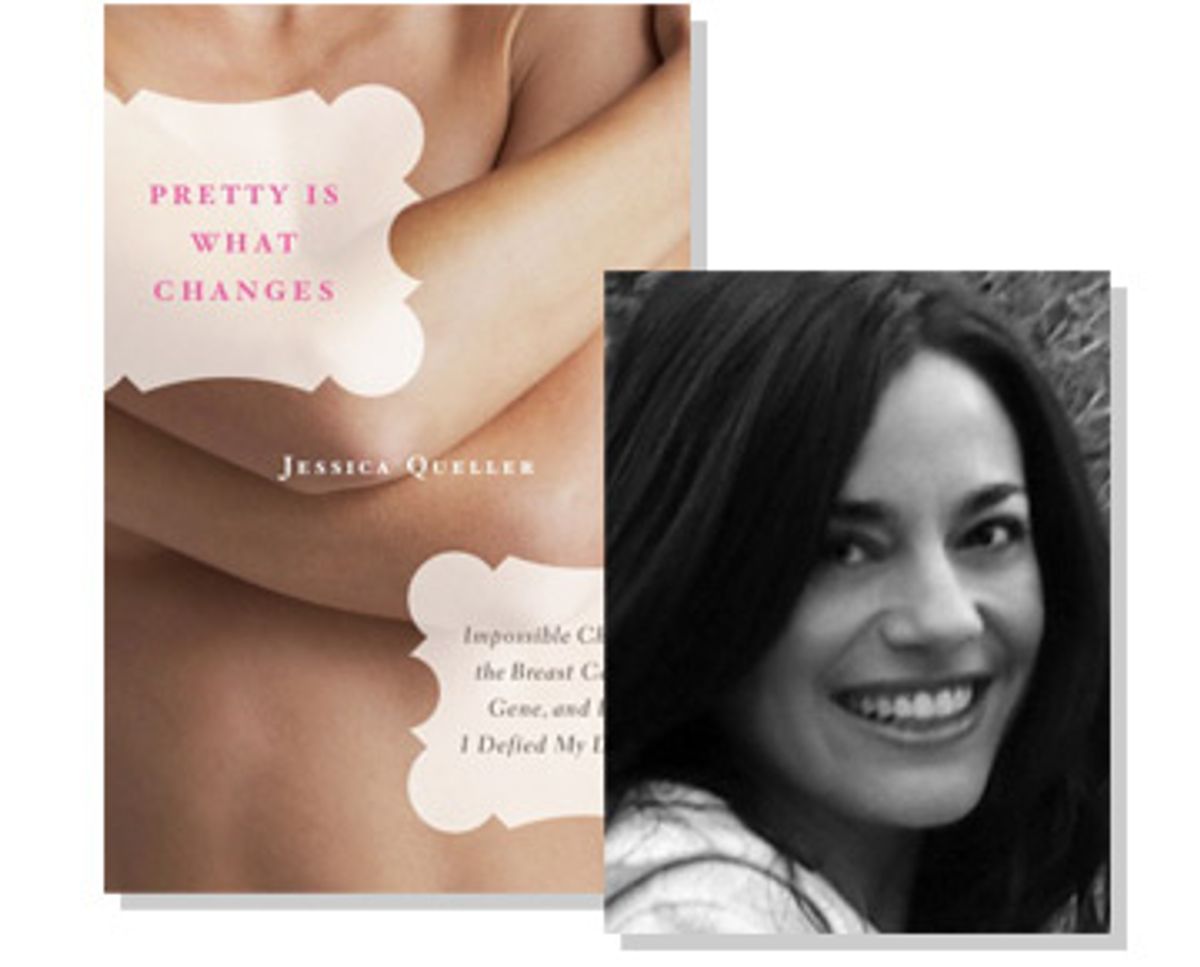
After testing positive for the "breast cancer gene," "Gilmore Girls" writer Jessica Queller made a radical choice -- a preventive double mastectomy.

  • more
    • All Share Services

To cut my breasts off, or not to cut my breasts off ...

One morning in September 2004, while writing a rent check to her landlady and brainstorming ideas for a meeting, Jessica Queller made the call that would throw her life into a tailspin. Queller, a successful, 34-year-old television writer in excellent health, was about to discover she tested positive for the dreaded BRCA “breast cancer gene” mutation, which meant she had an 87 percent chance of developing breast cancer and a 47 percent chance of developing ovarian cancer — the disease that had killed her mother almost exactly one year earlier. What’s more, there was no way of predicting when the disease would strike; she could be 36 or 56. “It was as if I’d fallen down the rabbit hole and decks of cards were talking. As if the logic and rules of my universe had suddenly changed. And in fact, they had,” Queller writes in her new memoir, “Pretty Is What Changes: Impossible Choices, the Breast Cancer Gene, and How I Defied My Destiny.”

Queller eventually learns that women with the BRCA mutated gene face a no-win situation: They can submit to a life of constant medical surveillance (not to mention ever-present anxiety), or they can have radical preventative surgery — having their breasts and ovaries removed.

“To cut my breasts off or not to cut my breasts off,” she writes at one point. “That is the question.” This unforgettable memoir, which evolved from a provocative 2005 editorial in the New York Times, takes us through Queller’s agonizing decision to undergo a double mastectomy. (She plans to eventually have her ovaries removed as well.) In addition to explaining the medical research for laypeople, she turns her focus inward to examine notions of beauty, sexuality and identity, in a way that is not just personal and moving but also sharp and funny. Queller is a former actress who has worked as a writer and producer for shows like “Gilmore Girls,” “Felicity,” and currently, “Gossip Girl,” and her humor and cinematic narrative skills give her story a lively snap.

Finally, Queller uses this book to pay homage to her glamorous fashion designer mother, whose slow death by cancer at 58 clearly still haunts her. “For me, this book is about my mom,” Queller says. “My decision to choose surgery is nothing compared to what she went through, and what my sister and I had to watch.”

Jessica Queller recently spoke with Salon by phone from her home in Los Angeles.

Can you explain how you came to take a test for the breast cancer gene?

When my mom was diagnosed with this advanced ovarian cancer, my best friend from high school, Gillian, said, “I’m on the board for a charity for women’s cancers, and I think you’re at high risk now. You should speak to my friend who runs this organization and get some information.” I was not worried about myself at all at that point. I was 31 years old, and even though I knew my mom was dying, I felt completely invincible — my own health was not on my mind.

I didn’t think about it once for the next two years. Then, about eight months after my mom died, I was finally going back to L.A., getting a job and going back to normal. I was realizing that my driver’s license had expired, my teeth hadn’t been cleaned in three years, all these things. So I started to think about focusing on my own life, after three years of taking care of my mother. I said to myself, “I might as well just get that blood test and know for sure that I have a clean bill of health.”

After you tested positive, what was your reaction when the counselor brought up the idea of prophylactic surgery like mastectomies and oophorectomy?

I was indignant. I thought she was supposed to be a therapist, helping me to feel better, and it was like she was scaring me with these outrageous proposals. How dare she make me feel like I was sick or could be sick soon! Looking back on it now, I realize I was just so in the clouds.

In the book, you express frustration that there was “no clear course of action” and that the doctors couldn’t offer you any guidance. What was the guidance you were looking for?

When you find yourself in that kind of dire medical situation and you’re feeling very vulnerable, you want the doctors to just tell you what to do. But it was surprising to me that none of the experts really felt they could give you a directive. There are pros and cons to each decision, and it’s such a personal choice. As science advances, I think it’s important for all people to grasp that they will have to be their own medical advocates in the future, and that doesn’t mean you don’t get guidance from doctors, but every person is responsible for educating themselves as much as possible and weighing the choices, because they’re not clear-cut.

How did you come to the decision of getting the preventative double mastectomy?

This kind of thing really forces you to soul-search and tap into your own values. For me, the question was: Would I be happier to not to take the test at all, not have the knowledge, and whatever happens happens? A lot of people feel that way. Or would I be happier knowing everything, even if I don’t like the news? Then, later, the question became, would I be happier to keep my breasts and take my chances and if I get cancer I’ll just deal with it then, or will I be happier to go through this awful surgery now and have peace of mind that I probably won’t get cancer?

People often ask me, “Do you tell all women that they have to do this?” I don’t believe in proselytizing about anything, and especially about this subject. Obviously I felt that the choices I made were right for me and my life, but this is so personal that everybody really has to decide for themselves what would make them most at peace.

When your mom was your age, this test didn’t exist, so she never had to face this kind of decision. Were there moments when you envied that kind of blissful ignorance?

I had a few moments of that, but mostly I didn’t feel that way. My personality is such that if there is news out there, I want to know it, even if it’s bad news. I’m the type of person who wants to know if my boyfriend is cheating on me. I don’t like people to know things that I don’t know. I do wish the test wasn’t true. I do wish I didn’t have this gene. But if I had it, then not knowing wasn’t going to make me feel any better.

Were there people who tried to convince you that the mastectomy was an unnecessary measure?

Absolutely. Many of my friends were shocked and horrified and thought I was being melodramatic. They thought this was just extreme, and wrong, that I was traumatized from my mom’s death. People were very judgmental. Everyone from my friends to strangers online. So many people posted things online after this “Nightline” interview that I did, saying things like, “Please, Jessica, don’t do it, you could get hit by a bus tomorrow, you never know. ” One guy wrote, “I can’t believe she’s doing this. It’s the equivalent of being castrated.”

Why do you think people had that kind of reaction?

This concept touches a nerve. People are imagining themselves in this situation and trying to decide what they would do, and they don’t want to accept that [the preventative surgeries] might be a smart thing. The concept of mastectomy is still so scary. After hearing my story, strangers would actually say, there’s no such thing as that test, that can’t possibly exist. This is alien to a lot of people. And it does seem very science-fiction.

At the time you were writing for “Gilmore Girls.” What was it like to write for a show about two women who are quite possibly the most idealistic mother-daughter pair ever, when you suddenly had to start worrying about your own chances of bearing a child?

Making up silly plotlines like, “Are Luke and Lorelai finally going to get together? Is Lorelai going to go back to Christopher?” — it was not that emotional. My own life was so heavy that writing for TV was an escape.

Did you ever think about incorporating any of your own experiences into your work?

For stuff like “Gilmore Girls,” it wasn’t really appropriate. But my friend David was the head writer for “ER,” and he actually wrote an episode for that show based on my story. He called to tell me they were doing the show just as I was going under the knife. I was in bed, in bandages, when I watched the “ER” episode. I had such a crazy emotional reaction. I’m usually the one in the writer’s room stealing stories from all my friends’ lives, and now I was the subject of this drama that I normally make up! It was very surreal. A few weeks later, “Grey’s Anatomy” did a story almost identical to my story as well. I never got confirmation that it was based on me, but I’ve worked with some of those writers previously.

The prophylactic surgeries are still not 100 percent effective, are they?

The statistics I read online said it only decreased your chance of breast cancer by 90 percent, and that concerned me. But when I interviewed surgeons, I learned that if you go to a very aggressive surgeon who focuses on getting every cell, every scrap of breast tissue, the odds improve. The studies haven’t come out yet, but it is believed that your chances of getting breast cancer can be reduced to 1 to 3 percent, whereas the average American woman has more like a 12 percent chance of getting breast cancer. That made me feel comfortable. I went to one plastic surgeon who told me I should go to a breast surgeon who leaves some tissue because I’d get a better aesthetic result. I was like, “Are you insane?! The point is to have a zero percent chance of getting cancer! I’m not going to leave in tissue so that my breasts look a little prettier!” You can never be 100 percent sure, but I feel really confident that the danger of my getting breast cancer now is minute.

The reconstructive surgeries sound much more advanced than I’d expected.

Thank God! I think the reason why I was terrified — and a lot of women are still terrified — about the concept of a mastectomy is because we think about our mothers’ generation and our grandmothers’ generation and what a mastectomy looked like back then. The concept and the stigma still linger, but plastic surgery is so advanced that you’re really put back together again beautifully.

Your last reconstructive operation was two years ago. Are you still happy with your breasts?

I am happy. I had nipple reconstruction, because preserving your own gives you a higher risk of getting cancer. So they’re not real — it’s skin grafting from my hips. But they look so real, it’s uncanny. I do have visible scars, battle scars. But otherwise, it’s totally fine. For a year, my breasts were numb, like with Novocaine. And then all of a sudden, I was like, oh my God! I have feeling in them again!

You know, I just have to say, it’s really embarrassing for me to talk about anatomy and this kind of thing out loud. If I hadn’t been through all of this, I’d be the last person who would ever be talking about my body.

Well, I thought it was wonderful how all the post-mastectomy women you talked to in the book were so open. The women who’d had reconstructive surgery seemed so eager to show you their new breasts!

It’s very sweet. Everyone who has to go through this is so afraid that they’re going to look deformed, and that their femininity will be ruined and their appeal will be gone. So when the results actually are quite pretty and appealing, you want to be like, “Look! Don’t be scared! It’s not that bad. It’s even kind of nice.”

As a single woman who has yet to have kids, have you found that you are in the minority among women who chose to undergo prophylactic surgeries?

When I was having my surgeries three years ago, I was. Back then, I couldn’t find any threads on the FORCE [Facing Our Risk of Cancer Empowered] Web site about young single women. Now, there are dozens of them. It’s definitely moved into the zeitgeist, especially in this past year. A woman in Chicago named Lindsay Avner started an organization called Bright Pink as a resource for young women dealing with this. Lindsay had prophylactic mastectomy at 23. She’s been all over the media, and she’s kind of become the spokeswoman for young women like us.

You’re 38 now. Are you still planning on having your ovaries removed at age 40?

Yes. Ovarian cancer is rarely early onset, and risks increase tremendously after age 40. Ovarian cancer is especially deadly because there isn’t a reliable screening method. By the time someone is diagnosed, it’s often late-stage.

In the book, you talk about your desire to have children of your own. Are you seeing anyone now?

I am not. My last serious boyfriend and I broke up about a year ago, and I dated a little bit after that, but right now I’m really focused on fertility.

Have you pursued your intention to become artificially inseminated?

Yes. I’ve tried artificial insemination several times, and so far it hasn’t worked out. With the stress of traveling and promoting the book, I’ve put it on hold. To be honest, I had been hoping to be pregnant by the time the book came out.

In the book, you mention a technique called preimplantation genetic diagnosis that would allow you to genetically test fertilized embryos for the BRCA mutation. Are you considering this procedure?

No. I don’t think I could do it. To not select embryos that have the gene that I had and my sister had … the guilt would be too much to handle. If I have a daughter I will pray she is in the 50 percent that don’t have the BRCA mutated gene. If she does, I’ll hope that by the time she’s 35, we’ll have a cure for breast cancer. Now, I’m not pregnant yet, so I suppose I could change my mind. But at this point, I feel like that’s a line I can’t cross.

Corrie Pikul writes about women's issues and pop culture. She lives in Brooklyn.

Komen scandal: Goodbye, Karen Handel

One week after the foundation's blunder, its scandal-plagued V.P. steps down

  • more
    • All Share Services

Komen scandal: Goodbye, Karen HandelKaren Handel (Credit: AP/John Bazemore)

It was perhaps inevitable. But it speaks volumes nonetheless. On Tuesday morning, the Susan G. Komen Foundation announced that its vice president for public policy, Karen Handel, was resigning.

It was the latest very public – and very bitter – turn in a story that has thrown the traditionally esteemed Komen foundation for one hell of a loop. Just one week ago, Planned Parenthood announced that Komen was halting its funding for the organization’s breast cancer screenings.  The move, the Komen foundation insisted, was about “the charity’s newly adopted criteria barring grants to organizations that are under investigation by local, state or federal authorities” – itself a dubious smear on a respected women’s health organization. But it didn’t take long for critics to note that Handel, who was hired just last year, had run for governor of Georgia on a platform of conspicuously anti-Planned Parenthood rhetoric. In 2010, she declared “I do not support the mission of Planned Parenthood,” and that she “strongly supports” laws prohibiting “the use of taxpayer funds for abortions or abortion-related services.” A lady like that in the driver’s seat of your organization just as you’re distancing yourself from Planned Parenthood looks like a whole more than a coincidence.

With a relentless social media nightmare and a surge of high-profile promises of financial support for Planned Parenthood on its hands, the Komen foundation had, by Friday, backed off, apologizing “to the American public for recent decisions” and vowing to “continue to fund existing grants, including those of Planned Parenthood.” Yet the shadow of its anti-Planned Parenthood bigwig loomed large, especially for an organization that insists it has no political agenda. So as a new campaign for Komen to oust Handel was picking up steam across Twitter and Facebook on Tuesday, she stepped down.

Her departure doesn’t appear to be that of a woman cowed by the events of the recent past. She says she has declined any severance package, and in her resignation letter, she says she is “deeply disappointed by the gross mischaracterizations of the strategy, its rationale, and my involvement in it” and that “neither the decision nor the changes themselves were based on anyone’s political beliefs or ideology.” Indeed, Handel could not possibly have gone rogue on this one and implemented the disastrous decision about Planned Parenthood all by her lonesome. But in a Huffington Post story Sunday, Laura Bassett reported that a Komen insider told her “Karen Handel was the prime instigator of this effort, and she herself personally came up with investigation criteria. She said, ‘If we just say it’s about investigations, we can defund Planned Parenthood and no one can blame us for being political.’”

For now, the matter seems at an end. A representative for Planned Parenthood referred Salon this Tuesday morning to the organization’s statement from last Friday and told us, “We have no plans to say anything further.” But in this crucial election year, the Komen mess and the departure of Handel send a powerful message — that when you screw around with screenings and services to women who might otherwise not afford them, it does not go unnoticed. You say it’s not political? It’s about women’s health and women’s bodies. It’s political as hell. And it will be in November.

Continue Reading Close
Mary Elizabeth Williams

Mary Elizabeth Williams is a staff writer for Salon and the author of "Gimme Shelter: My Three Years Searching for the American Dream." Follow her on Twitter: @embeedub.

Susan G. Komen’s priceless gift

A radical decision woke the country up to an alarming rightward drift, and gave new life to women’s health advocacy

  • more
    • All Share Services

Susan G. Komen’s priceless giftMembers of Planned Parenthood, NARAL Pro-Choice America and more than 20 other organizations hold a "Stand Up for Women's Health" rally in Washington (Credit: Joshua Roberts / Reuters)

The startling intensity that we saw this week in response to Susan G. Komen for the Cure’s decision to pull its grants from Planned Parenthood — an intensity that prompted the Komen foundation to reverse its decision today — may be the best thing that’s happened to the conversation about reproductive rights in this country for decades. It certainly should be.

Practically since Roe v. Wade was decided in 1973, reproductive rights activists have been left to play stilted defense against ideological opponents who grabbed the language of morality, life, love and family as their own, always deploying it with reference to the fetus. The rhetoric around reproductive rights, which has more recently begun to creep into arguments over contraception, has become suffocating in its emotional self-righteousness, but too muscular, too ubiquitous to effectively combat.

But the overreach by the Komen foundation, while surely intended to strike yet another blow on the side of antiabortion activism, succeeded instead in waking a powerful constituency — armed with precisely the language and emotional heft they’ve been lacking for too long.

That this week’s blow against Planned Parenthood came not directly from John Boehner’s House of Representatives – which, ever since taking power a year ago promising to focus on jobs, has manfully focused on the single task of attacking women’s reproductive rights – but instead from a popular, officially nonpartisan organization dedicated wholly to women’s healthcare somehow brought this argument into the open.

The response to Komen was surely so tinderbox explosive because it had been building with every politically theatrical investigation launched by Cliff Stearns and every grisly abortion scene enacted on the House floor by U.S. Rep. Chris Smith. But it was not just Washington wonkery, and was not ginned up or amplified by professional political cranks. It was the reflexive kick of a shin hit just below the knee, and the visceral anger spilled everywhere, from a Planned Parenthood Saved Me tumblr and onto Facebook, where people posted images of Komen’s pink ribbon cut in half. It poured from bank accounts, including that of New York Mayor and former Republican Michael Bloomberg.

It came from often dispassionate media figures like Andrea Mitchell, was tweeted by novelists like Judy Blume, Terry McMillan and William Gibson, actors Ellen Barkin and Martha Plimpton, politicos like Donna Brazile, Reps. Gwen Moore and Jackie Speiers, former Speaker Nancy Pelosi and from 22 senators including Frank Lautenberg, Al Franken and Kirsten Gillibrand, who signed a letter urging Komen to reverse its decision. It came from callers to radio programs, announcing their intentions to drop out of Komen races, and from the American Association of University Women, which canceled a scheduled service event with Komen. In the three days after Komen’s announcement of its Planned Parenthood break, Planned Parenthood received more than $3 million in donations, said PPFA president Cecile Richards in a press call on Friday.

More than that, though: The starkly observable attack against something as crucial and basic as breast exams for poor women, as well as the fact that so many divergent voices were pulled into it, meant that the conversation was not about partisan politics; it was about women. For the first time in what feels like forever, passion and fury were being loudly, proudly given in a full-throated voice, on behalf of women – women as moral actors; women as citizens with rights, health, bodies, freedoms; women as people with families and economic concerns.

Taken together, these factors mark this as a watershed moment in the contemporary conversation about reproductive rights. This is a story in which we see the possibility of a turned tide, a new way to gauge how the public actually feels about women’s rights and health, and a new way to talk about it, as well. Because what we saw this week was big. It was mass. It was emotional. This was so different from the various polls activists on both sides of the abortion question are always throwing around, polls that depend so much on how a question is asked; polls that offer far less clarity than head-banging confusion about where America stands on the issue of reproductive heath. This was not a poll. This was America announcing that it cared about women’s health, and more specifically, that it cared about Planned Parenthood.

In many ways, the activism that forced Komen to backtrack was ignited by Boehner’s House Republicans a year ago, when they voted to cut off all funding to Planned Parenthood because it provides abortion services. This despite the fact that since 1976’s Hyde Amendment, no federal money has been able to be used to provide abortion services. The organization Republicans want to squash provides more than 800,000 women a year with breast exams, more than 4 million Americans with testing and treatment for sexually transmitted diseases, and 2.5 million people with contraception, which prevents unintended pregnancy and thus abortion. But playing to what they must imagine is overriding public sentiment, Republicans have worked tirelessly to lodge the image of Planned Parenthood as an abortion factory deep in the American imagination.

A year ago, some of the anger at this strategy began to bubble over. In response to Smith’s description of a second trimester abortion, read on the House floor, Democratic U.S. Rep. Jackie Speier went to the House well and described her own painful second trimester abortion. “For you to stand on this floor and suggest that somehow this is a procedure that is either welcomed or done cavalierly or done without any thought, is preposterous,” Speier said, directing her comments at Smith. “Planned Parenthood has a right to operate. Planned Parenthood has a right to provide services for family planning. Planned Parenthood has a right to offer abortions. The last time I checked, abortions were legal in this country … I would suggest to you that it would serve us all very well if we moved on with this process and started focusing on creating jobs for the Americans who desperately want them.”

It was around this time that a viral “Thank You Planned Parenthood” meme cropped up online. With participants noting the instances in which they had relied on PPFA for birth control, breast exams, gynelogical care, and yes, abortions. Twitter, Facebook and blogs began to be dotted with “I stand with Planned Parenthood” emblems. Comedian Lizz Winstead kicked off a tour called “Planned Parenthood, I am here for you.”

But this recent wave of defense of Planned Parenthood has remained broad, ambient. The politics of the congressional witch hunt have been so labyrinthine, so convoluted, that it has been difficult to know how to effectively harness an angry response. When, last fall, Rep. Cliff Stearns launched an investigation into PPFA’s bookkeeping, the move was so needless, such a trumped-up piece of political stagecraft (since PPFA does receive federal funds, it must scrupulously account for every dime it spends, no special investigation required) that it was hard to even know how to make sense of it, let alone respond. This week, a caller to WNYC’s “Brian Lehrer Show” professed her belief that the Stearns investigation centered on whether Planned Parenthood was performing late-term abortions.

The demonization of Planned Parenthood should have awakened the country to the radicalism of the right, and how far it has pushed the political conversation. It’s been hard to measure the degree of the radicalism, so slowly and unceasingly has it crept across our consciousness and the political discourse. But it’s important to remember how mainstream Planned Parenthood used to be. It was the respectable, even Republican, advocate for women’s health, including reproductive services; the leaders of the National Abortion Rights Action League were the activist agitators. Sen. Prescott Bush, the father of President George H.W. Bush, served as treasurer of Planned Parenthood’s first national fundraising campaign. Richard Nixon signed the family planning legislation in 1970 that authorized its federal funding.

As a congressman, George Bush and his wife, Barbara, were reliable friends of the organization. Barry Goldwater’s wife, Betty, was a founding member of Arizona Planned Parenthood; President Gerald Ford’s wife, Betty, was a high-profile supporter of the group. More recently, Ann Romney, wife of the 2012 GOP presidential front-runner, donated $150 to Planned Parenthood in 1994. And when a Romney relative died of a botched abortion in 1963, the family asked that memorial donations go to Planned Parenthood.

But what happened this week was a clarifying moment. Right-wing extremism, coming this time not from the partisan mill but from a mainstream women’s organization, was put in a direct and unflattering spotlight. Suddenly, so much was clear, and finally, the response was unified and thunderous. Right-wing overreach — and the backlash it inspired — feels a lot like the way other radical GOP power grabs in the last year have galvanized the public to fight back. Attacks on collective bargaining, public workers and unions by Republican governors in Wisconsin, Ohio and Indiana have produced mass mobilization in those states, the likes of which we haven’t seen in decades. Public workers – cops, firefighters, nurses, teachers, paramedics, sanitation workers – once were the proud backbone of the middle class. Now they find themselves derided by the GOP as the new welfare queens who are taking more than their fair share. Ohio voters repealed a law that abolished collective bargaining in November, and pro-union organizers in Wisconsin have forced a recall election for Gov. Scott Walker.

Efforts to restrict voting rights are likewise waking up the citizenry; Maine repealed a law that banned same-day voting and registration in November, and Ohio blocked a voter photo ID bill. Even on the issue of reproductive rights, a draconian “personhood” amendment to the state constitution failed to pass in Mississippi, one of the reddest of the red states. Overreach by the right has re-inspired movements – unions, voting rights, women’s rights — that have too long been dormant and too easily dismissed by their ideological opponents as outside the mainstream of American values, when in fact, they used to represent the most American of values.

For defenders of Planned Parenthood, and more broadly for reproductive rights activists, this moment of repositioning is a valuable one. Until now, it has proven very difficult for advocates to resuscitate their side with language anywhere near as powerful as that used by antiabortion forces. Instead they have relied too heavily on the fungible, limp, endlessly open-ended language of “choice.” (Even among “pro-choice” advocates, the “I choose my choice!” joke from “Sex and the City” has become a ubiquitous critique.)

But what happened this week was powerful. It was mass. It was direct. It was emotional. And it restores women as the moral center of this conversation — which is where they belong.

Continue Reading Close
Rebecca Traister

Rebecca Traister writes for Salon. She is the author of "Big Girls Don't Cry: The Election that Changed Everything for American Women" (Free Press). Follow @rtraister on Twitter.

Joan Walsh

Joan Walsh is Salon's editor at large.

Komen victim of “bullying,” sad abortion foe says

Someone make an "It Gets Better" video for poor Kathryn Jean Lopez of the National Review

  • more
    • All Share Services

Komen victim of A very serious anti-bullying message from Kathryn Jean Lopez

Poor Kathryn Jean Lopez, the National Review Online’s resident delicate flower, anti-feminist traditional Catholic, and enemy of all homosexualists and abortionists. She was so delighted when Susan G. Komen for the Cure announced that it would no longer be sending grant money to Planned Parenthood to fund breast cancer screenings and mammogram referrals, because it meant that her side had “won” a battle in the war against women’s health providers that perform abortions and provide contraception.

She was so excited, in fact, that she forgot that the decision was NOT ABOUT ABORTION WHATEVER GAVE YOU THAT IDEA. Later she posted that hilarious YouTube video of Komen CEO Nancy Brinker explaining that the Planned Parenthood decision was not in any way political, no sir. (At least one commenter noted the disconnect: “Really curious what K-Lo thinks Komen is actually doing here. When the news broke, she seemed pleased and pointed out right-to-lifers had been trying to force Komen to shuck PP. But she also believes Komen’s [ridiculous] assertion that the decision has nothing to do with politics and was just a big coincidence? Hunh?”)

After a great deal of public outcry, Komen reversed itself and said Planned Parenthood would be eligible for future grants.

This, obviously, was very sad news for K-Lo. She seemed stunned at first, but then decided that Komen was the victim of bullying.

The years-long campaign by antiabortion groups to lobby Komen to cease sending money to Planned Parenthood — the campaign Lopez cited in her initial post crowing about that campaign’s victory — was just regular political speech, but the widespread outcry over the decision was, obviously, bullying. (Or, as Daniel Foster put it, “gangsterism.” Foster only approves of reasonable and polite “speech,” which is to say, writing checks.)

Lopez, like many conservatives whose baffling interpretation of common liberal concepts leads them to find “hypocrisies” where none exist (Michelle Obama ate a french fry!!!!), darkly mutters about “that anti-bullying campaign,” because accusing a massive charitable foundation of playing politics with its supposed mission is patently the same thing as humiliating vulnerable young people until they become suicidal.

(Bullying, for Lopez’s future reference, is not just “people being mean to you,” but more accurately lengthy campaigns of abuse carried out against people who are or feel unable to defend themselves. Just ask the students of Anoka-Hennepin public schools if you’re still confused.)

Continue Reading Close
Alex Pareene

Alex Pareene writes about politics for Salon and is the author of "The Rude Guide to Mitt." Email him at apareene@salon.com and follow him on Twitter @pareene

How the Internet changed Komen’s mind

The torrent of reactions to the cancer group's Planned Parenthood defunding proves the power of social media VIDEO

  • more
    • All Share Services

How the Internet changed Komen's mindNancy Brinker, founding chair of Susan G. Komen for the Cure (Credit: AP/Salon)

It started with a tweet. And in the end, that’s what won the war. On Tuesday, Planned Parenthood sent out a no-punches-pulling alert that “Susan G. Komen caves under anti-choice pressure, ends funding for breast cancer screenings at PP health centers.” By Friday, Komen for the Cure had said it was sorry, and reversed its decision.

Within minutes on that Tuesday bombshell, the tale had become not just a news story but a social media explosion, with a flurry of responses pouring out across Facebook, Twitter and Komen’s own message boards – overwhelmingly disapproving of Komen for the Cure’s severing of its ties to Planned Parenthood. And in the process, it became an object lesson in how to handle a crisis, how to make it worse, and then how to fix it.

Planned Parenthood is, by now, well versed in how to handle outside attacks and negative publicity. Along the way, the organization has become pretty smooth at it. From the moment that first message about Komen appeared, Planned Parenthood remained relentless in keeping momentum going on the story, posting links to news coverage, retweeting supportive messages, and repeatedly reminding people how to donate to the cause across all of its social media platforms.

Komen, in contrast, could hardly have seemed more spectacularly blundering in all of it. As one commenter posted, “the last thing as unpopular on Facebook as this Komen thing was Michael Jackson’s death.” Not only did the organization clearly not even consider sending out its own preemptive, damage-controlling message, it waited more than a full day before responding to the outcry at all. And when it did, oof. In a tense, frozen-faced message on YouTube, its founder and CEO, Nancy Brinker, talked about moving forward with “new strategies” and declared, “We will never bow to political pressure … The scurrilous accusations being hurled at this organization are profoundly hurtful … and a dangerous distraction.” She never mentioned Planned Parenthood once. Deanna Zandt, consultant and author of “Share This! How You Will Change the World With Social Networking,” told Salon Friday, “I’m going to start using that video in my workshops as an example of what not to do.”

Komen for the Cure is not in the same business as Planned Parenthood – and it doesn’t need to be. But had Komen truly wished to give the appearance of being apolitical, Nancy Brinker might have acknowledged the story in a less obviously gutless way in her message. Surely Brinker could have taken a moment to say something along the lines of, “We’ve had to make some changes that we feel will be of more direct service to low-income women, but we’re proud of our years of association with Planned Parenthood, and support our colleagues in their ongoing efforts for the cause of women’s health.”

Komen’s Twitter feed had been similarly testy of late, with updates that “Our Board approved new grants standards to improve direct services to women” and “Our supporters know that no other #breastcancer organization serves women at the size and scope that Susan G. Komen for the Cure does.”

Why does it matter? Because while Komen was cautiously portioning out terse, defensive responses that smacked of “You should all be grateful for how much we do for you people,” Planned Parenthood and its supporters had been not just expressing their indignation but harnessing it, in ways that will both make you weep and make you laugh. Social media is all about connection. That’s why Planned Parenthood not only posted a letter from a supporter; it made it the organization’s newest petition. “When you go after Planned Parenthood and the people they serve,” it reads in part, “you go after ME.” Direct, personal and powerful.

That’s why Deanna Zandt decided, when people were talking about pulling their money from Komen — “What do you do if you don’t have money to pull?” — to create Planned Parenthood Saved Me with the message to “Pinkwash THIS.” In no time, the Tumblr was flooded with heart-stopping tales of cancer detection, healthcare services, lives saved, all doled out with, significantly, “dignity.” And that’s also why, in the last few days, your Facebook page has likely become a torrent of brilliant eCards and cartoons, and why the Komen Web page was hacked in such a subtly funny manner. You want to get your message across? You want to maintain your credibility with your constituents? Hammer and keep hammering at the heartstrings and the funny bones. And hammer some more.

One could argue that the uppity, snark-lobbing types who tweet their rage and create blogs aren’t the kind of people who can hit Komen where it hurts – in donations. But the backlash was so strong and so sustained that it didn’t take long to ripple right out there to America’s wallets. Planned Parenthood swiftly saw a stunning boom in donations – including a fat promise of up to $250,000 from New York’s billionaire Mayor Mike Bloomberg.

So then what happened? A stunning reversal. On Friday morning, Komen issued the statement that “We will continue to fund existing grants, including those of Planned Parenthood, and preserve their eligibility to apply for future grants, while maintaining the ability of our affiliates to make funding decisions that meet the needs of their communities.” It’s not exactly a rousing endorsement of PP, nor will it likely deflect scrutiny from its future maneuverings, but it’s amazing nonetheless. Amazing that it happened at all, and even more amazing because in the statement on Twitter, Komen even added that “We want to apologize for recent decisions that cast doubt upon our commitment to our mission of saving women’s lives.” Clear. Direct. Human, even. The world sent a message. And Komen learned from it.

UPDATE: Looks like Komen is still getting the hang of these things –  oddly enough, they’ve already made Nancy Brinker’s original YouTube response on the matter “private.” The better to act like it never happened?

Continue Reading Close
Mary Elizabeth Williams

Mary Elizabeth Williams is a staff writer for Salon and the author of "Gimme Shelter: My Three Years Searching for the American Dream." Follow her on Twitter: @embeedub.

Komen for the Cure sells out women, again

The pink-ribbon charity, with a Sarah Palin ally as senior policy director, turns its back on Planned Parenthood

  • more
    • All Share Services

Komen for the Cure sells out women, again Karen Handel and Sarah Palin in August, 2010. (Credit: AP/John Bazemore)

First, the good: Since its founding 30 years ago, Susan G. Komen for the Cure has put over a billion dollars toward research, screening and awareness in the name of eradicating breast cancer. It’s certainly no coincidence that in that same span of time, breast cancer rates have declined sharply, and what was once a devastating diagnosis is now, for many, a treatable condition.

Yet when the news broke Tuesday that Komen was ending its funding for Planned Parenthood breast cancer screenings and services, the organization’s eagerness to throw Planned Parenthood – and the women who depend upon it – under the bus wasn’t surprising. It’s actually thoroughly unshocking for this venerated organization to pull such a crass, insensitive move.

The very name Susan Komen — with its direct association with a real woman, and founder Nancy G. Brinker’s promise to fight the disease that claimed her sister — is heart-tugging. Today, everyone who knows a woman likely has a breast cancer story – and with it, a Komen-flavored story about donning a pink T-shirt and running in a Race for the Cure, or shopping in October for pink-themed “Girls Just Want to Have Fun” notepads to help raise “awareness.” Along the way, Komen has become the McDonald’s of cancer — an easy-to-remember brand with a logo that demands little thought or effort from the consumer. Write a check, buy a ribbon, voila! You get to feel like you’re curing cancer.

It’s not that Komen is some questionable, Wyclef Jean-esque mess. It gets high marks from both the Better Business Bureau and Charity Navigator. Yet this is an organization that has repeatedly come under fire for its extravagant promotion of itself as an organization dedicated to a “cure,” when only a small portion of its expenses go to, you know, curing cancer. Komen itself cops to portioning just 24 percent of its funds to research – and 20 percent to fundraising and administration. For an organization with reported revenues of nearly $350 million, that’s still a lot of money for research. It’s an awful lot for itself, too.

Yet Komen remains pretty damn territorial around that whole “cure” thing. In a 2010 story for the Huffington Post, writer Laura Bassett pointed out that, according to Komen’s own financial records, it spends almost “a million dollars a year in donor funds” aggressively going after other organizations that dare to use the phrase “for the cure” – including small charities like Kites for a Cure, Par for the Cure, Surfing for a Cure, Cupcakes for a Cure, and even a dog-sledding event called Mush for the Cure. Let me just give you that number again. A million bucks a year. Robert Smith, better watch your back.

Komen has also, in its relentless pursuit of ubiquity and corporate sponsorship, aligned itself with more dubious product placement than a “Jersey Shore” marathon. It has a whole online store encouraging visitors to “purchase with purpose to end breast cancer forever,” where you can buy “silicone bling watches” and “Passionately Pink” ribbon-shaped cake pans. And because you’ll have to root around for the numbers, you can spend extravagantly on candles and “spirit gloves” without knowing that merely “at least 25 percent of the retail sales price … will go to Komen to help support … research and community programs.” Twenty-five percent of that $4.95 dog leash? Why, that’s more than a whole dollar!

Komen also famously outsources its merchandising. It’s teamed up with the likes of KFC for “Buckets for the Cure” – because nothing says you care about women’s health like a big vat of fried chicken. Komen has additionally sold a pink-hued “Promise Me” perfume that contains several toxins –  including galaxolide, a synthetic musk that critics claim is a hormone disruptor. Komen has promised to reformulate the scent this year, but as Uneasy Pink calculated last spring, that’s still a lot of questionable chemicals to buy when roughly only 3 percent of the purchase price will go to Komen’s oft-invoked “cure” anyway.

And what of Komen’s latest, most potentially damaging stunt with Planned Parenthood? Komen says the move is just about “newly adopted criteria barring grants to organizations that are under investigation by local, state or federal authorities.” You know what else is pretty “new” around Komen? Its senior vice president of public policy, Karen Handel. During the Sarah Palin-endorsed, Tea Party favorite’s 2010 campaign for governor of Georgia, Handel declared, “I do not support the mission of Planned Parenthood,” making clear that she “strongly supports” laws prohibiting “the use of taxpayer funds for abortions or abortion-related services.” She did, however, emphasize that she “strongly support(s) the noble work of crisis-pregnancy centers.” If you were one of the world’s biggest charities and were looking to hire someone who had women’s welfare as her greatest imperative, would you go for someone who’d send them to a place that offers breast cancer screenings – as well as ovarian cancer screenings and HPV tests? Or someone who prefers a bunch of right-to-life fanatics pretending to be a medical facility? If you picked the former, you’re smarter than Komen for the Cure.

That Komen has raised staggering amounts of money is undeniable. There’s also pretty compelling evidence that it has done so in some pretty boneheaded ways. So given its track record, it’s fair to ask what happens now to the 11 percent of the Komen budget that goes to screening. Does it get funneled toward more glitter bracelets and “Promise Bears”? And what happens to the women who depend upon Planned Parenthood to tell them whether or not they have breast cancer? What becomes of mothers and daughters and wives and friends who believed that Komen’s commitment to “the cure” meant something more than protecting its catchphrase? It’s worth noting that while breast cancer rates are dipping, an October report from the American Cancer Society warned that they are declining more slowly among low-income women, and that “Poor women are now at greater risk for breast cancer death because of less access to screening and better treatments. This continued disparity is impeding real progress against breast cancer.” You know who loses when Komen backs away from Planned Parenthood? Probably not those nice, pink-clad ladies who attend Susan Komen wine-tasting events.

Women’s healthcare is not about lace-trimmed scarves and bottles of perfume. It’s sure as hell not about some feel-good, lip-service version of what my colleague Rebecca Traister calls “infantilizing Pepto-ed advocacy.” It’s not even — for anyone still stupid enough to think Planned Parenthood is some giant fetus-killing complex — about abortion. It’s about screening. It’s about treatment. It’s just that simple. The further away an organization gets from that mission, the more women suffer. It’s just that simple too. And you don’t make good on a “promise” to your dead sister by selling out women who need you most.

Continue Reading Close
Mary Elizabeth Williams

Mary Elizabeth Williams is a staff writer for Salon and the author of "Gimme Shelter: My Three Years Searching for the American Dream." Follow her on Twitter: @embeedub.

Page 1 of 14 in Breast cancer