A nifty Gothic fable about an intersex teen in a desolate coastal town is among the year's most striking debuts.
Film Movement
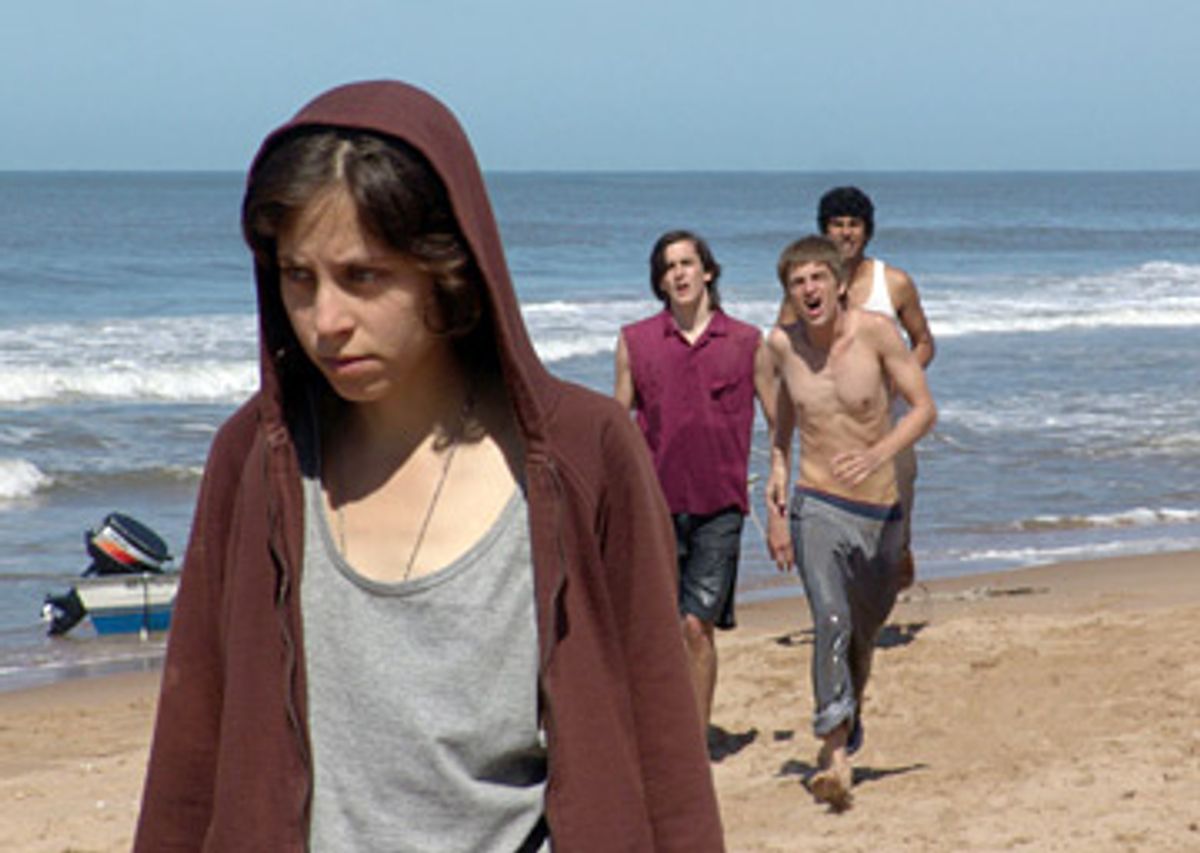
Alex (Inés Efron, foreground) in a scene from “XXY.”
An intimate, atmospheric character study with a lingering erotic charge, Lucía Puenzo’s “XXY” is one of the year’s most impressive directing debuts. Maybe this film’s international success has something to do with its sensational gender-theory subject matter — the central character is an “intersex” teenager, not exactly a girl or a boy — but on the other hand maybe not. (Puenzo won the Critic’s Week Grand Prize at Cannes, and the film has played numerous other festivals.) Speaking personally, I was afraid that “XXY” might be one of those dogmatic, confrontational lecture-demonstrations in the mode of late-’80s “queer cinema.” Instead, it’s a nifty little Gothic fable of loneliness that would be plenty compelling even if young Alex (Inés Efron) knew what sex s/he was.
Alex is 15, and manifests as a girl. but as we gradually gather over the course of “XXY,” that’s the product of significant camouflage and medical effort. Puenzo expertly blends expository nuggets into her minimal narrative, but we don’t need much. That’s largely due to the extraordinary performance by Efron (an adult woman), who plays Alex as an awkward, oddly seductive blend of confidence and confusion. When she first meets Alvaro (Martín Piroyansky), a teenager who’s come with his parents to visit Alex’s family on the remote Uruguayan coast where they live, she says to him, “I’ve never fucked anybody. Do you want to?”
If that question is fraught with danger for any teenager, for Alex the danger is several orders of magnitude more intense, and the uncertainty is tangible. Alvaro doesn’t know about Alex’s secret, but like the area’s other teens he realizes there’s something unusual, something both alluring and off-putting, about this rangy, boyish, oddly aggressive girl. Alvaro’s father (Germán Palacios) is a prominent surgeon from Buenos Aires; as the boy explains to skeptical Alex, he does boob jobs and nose jobs for money, but his real mission in life is “fixing” people with “deformities.”
Puenzo is a 31-year-old writer and director whose father is the prominent Argentine filmmaker Luis Puenzo (he won the foreign-language Oscar in 1986 for “The Official Story”), and she writes dialogue with the compression and hidden explosive power of Harold Pinter. There’s a tension between Alex’s marine biologist father (the great Argentine actor Ricardo Darín, of “Nine Queens” and “The Aura”), who tries to rescue turtles from the vaguely threatening cast of locals, and her mother (Valeria Bertuccelli) that almost never boils to the surface. It certainly has something to do with the visiting surgeon and whether, how and why he might have a private consultation with Alex.
When Alex’s father finds her and Alvaro sharing a startling private moment, he clearly undergoes a private crisis about his daughter’s (or son’s) identity and future. Darín shows us the man’s suffering with a minimum of talk, and none of that spill-your-guts yammering endemic to American indies. Puenzo uses the rugged, beautiful beaches and low, blue-gray skies — it looks more like the coast of northern Europe than a Latin American stereotype — as a powerful corollary to this family’s lonely, loving struggle with itself and the outside world. I don’t think “XXY” is anything as pedantic as a lesson in tolerance. Instead, it’s a haunted, heightened fable about things that are absolutely universal — the terrors of sex and sexuality, the pain of growing up, the difficulty of loving those closest to us.
“XXY” is now playing at the Cinema Village in New York, with national rollout to follow.
Porn is coming for your daughter!
"Nightline" warns of the "deeply disturbing" trend of teen girls watching porn, all thanks to performer James Deen
Last night’s “Nightline” segment on porn star James Deen and his legions of underage female fans is the finest piece of parental scaremongering that I’ve seen in some time. (Well, at least since Caitlin Flanagan’s Sunday New York Times article on the scourge of “hysteria” among adolescent girls.)
ABC’s Terry Moran introduced the segment by warning, “For any parent concerned about what their teen does online, the huge popularity of the young man you’re about to meet may be deeply disturbing.” We’re then introduced to a handful of young women – all well over 18 – who think 25-year-old Deen is totally hot and, like, “the Ryan Gosling of porn.” Then reporter Cecilia Vega announces that the adult business “has now targeted and reached a new demographic: teenage girls.”
That’s right, pornographers are “targeting” your little girls with the help of young porn hunks like Deen and luring them into watching Internet smut! YouPorn must be advertising on Justin Bieber message boards now, I guess? At one point, Vega grills Deen about his teenage fans: “Are you encouraging them in any way to watch your films or read your blog?” It’s not like teenage girls would ever happen across this X-rated material because they want to watch porn — there must be some cute “boy next door” tricking them into it.
It isn’t that parents have no good reason to be concerned about their kids — male or female — using porn as sex-ed. It’s not even that the segment is a total rip-off of Amanda Hess’ piece about Deen and his female teenage fans in GOOD magazine (and it is). My real criticism is that even while reporting on teenage girls who admittedly like porn and seek it out, “Nightline” manages to make it sound like they’re being taken advantage of by porn the predator.
I would embed the video below, except ABC has disabled embedding. Maybe they distrust how their fear-mongering will be received in the the wild west of the Internet. You can find the clip here.
What Occupy can learn from the Hunger Games
A leaderless political movement still trying to find its place might look to heroes of dystopian fiction for ideas
(Credit: AP)
“YOU CAN’T EVICT AN IDEA,” proclaim the banners fronting an otherwise dull building in east London, owned by banking giant UBS but inhabited and decorated by squatters from the Occupy movement. They’ve adapted the phrase from Alan Moore and David Lloyd’s graphic novel “V for Vendetta,” in which the titular terrorist explains his seeming immortality to a detective who has just shot him: “Ideas are bulletproof.” A poster of V’s trademark Guy Fawkes mask smiles eerily at all who walk into the foyer of 8 Sun Street, now dubbed “The Bank of Ideas” and used as a community center. The caption underneath reads, “We are the 99%, and so are you.”
It’s fitting that the Occupy movement should have drawn inspiration from dystopian fiction, an increasingly popular genre for teenagers and young adults in particular. If, as Time magazine suggests, the person of the year was the Protester, the publishing phenomenon was the Dystopia — the story of the dissenter in a repressive society who becomes a revolutionary. The new wave was led by two trilogies, both published from 2008-10: Suzanne Collins’ “Hunger Games” (whose big-budget Hollywood adaptation kicks off in March) and Patrick Ness’ “Chaos Walking” (now being adapted by Lionsgate). Scores of other books and series are now rising in their wake. “V for Vendetta,” from 1988, is an important antecedent, telling the tale of Evey, an adolescent girl in a run-down future London who, indoctrinated by the self-styled freedom fighter V, becomes a thorn in the side of a fascist state. Toward the end of the 2006 film adaptation, hordes of the working class – the 99 percent, if you will – don the Fawkes masks themselves and, led by Evey, stand firm against their oppressors.
Since the film’s release, replicas of these masks have been manufactured widely, and Occupy protesters in the U.S. and the U.K. have often worn them (as have members of the hackers collective Anonymous), both to disguise their faces and show solidarity. But the film is an odd, Hollywood-ized work that the iconoclastic Moore has typically dismissed. In contrast, his book is philosophically more complex than is often acknowledged. Unlike propaganda, literature is difficult to adopt as a template by movements of any stripe, and such is the case with “V for Vendetta.” V is, despite his protestations, is more than just an embodied idea: He’s an ideology, and this makes him dangerous to both the ruling elite and his own followers. And if there’s anything we can learn from dystopian literature, including the work of Collins and Ness, it’s that ideologies can, and should, be evicted.
*
There’s no necessary cause-and-effect relationship between world events and publishing phenomena, but there can certainly be a resonance. Suzanne Collins has said that “The Hunger Games” was inspired in part by coverage of the war in Iraq — and yet it raises issues of economic inequality, misinformation and corporate greed that are even more relevant now. Collins’ heroine, Katniss Everdeen, is an independent and even ornery 16-year-old who saves her younger sister by volunteering for, and then winning, a telecasted fight-to-the-death competition. Though her feats of derring-do have elements of escapist fantasy, her ultimate goal isn’t to win the Games, but to avoid exploitation: She wants to circumvent the rules and figure out a way to shut down the games for good. Just as Collins and other writers of young-adult dystopias cleave to the Romantic nostalgia for childhood freedom, they’re raising the stakes of the coming-of-age novel’s traditional struggles with the pressures of growing up and the need to integrate with society. In these dystopias, integration means the death of freedom and imagination, and subjugation to a way of thinking that curbs creativity and stresses survival of the least scrupulous.
The societies depicted in these novels generally fall into one of two broad categories. In the first, as in “Hunger Games,” Ally Condie’s “Matched” (2010-12) and Veronica Roth’s “Divergent” (2011), they’re dystopias masquerading as utopias, where everyone is supposedly provided for through work assignments that keep the plebs docile and benefit the ruling elite. In the second, as in “Chaos Walking” and Jeff Hirsch’s Collins-blurbed “The Eleventh Plague” (2011), they’re post-apocalyptic settlements where the physically strongest and best-organized have taken power and bent all to their will.
All of these books feature adolescent protagonists of generally unimposing physical stature who, at a crucial point in their lives (usually an adult-initiation process of some kind), reject the limited choices they’re offered and learn self-sufficiency instead. They pull together support from other outsider teens and some adults (especially lapsed countercultural hippie-types who remember pre-dystopian life), and make difficult decisions that open the door to a new and better way of life. Thus, they avert catastrophe and avoid the trap of the minimum-wage, dead-end job – or its near-future equivalent.
The formula for self-sufficiency is a familiar one: The protagonists need to rough it, to live for a time off the land as early colonists did, escaping the dystopias’ infantilizing control and surveillance. This connects them with nature both literally and symbolically, putting them in touch with their inner noble savages. From the start of “The Hunger Games,” Katniss hunts with a bow and arrow in the forbidden wild; later, she becomes known as the Mockingjay, after a species of bird who lives there. In “Crossed,” the sequel to Ally Condie’s “Matched,” the protagonist, having lived all her life in suburbia so sanitized it makes Disneyland look like Bangkok, bolts to a Grand Canyon-like back country to join her dark, brooding outsider boyfriend (the opposite of her society’s chosen match for her, who is of course blonde – even in the future, love triangles will keep young hearts aflutter). There, she learns personal independence through physical effort.
But they’re not quite noble savages, because they’re self-aware. In the wild, they find misfits who safeguard learning, hoarding the books and lore that the dystopias have repressed. The Occupy movement often casts itself in a similar light, as its members “rough it” in parks in the middle of cities as if keeping alive a more earthy, simple, honest way of living; their library tents symbolize their devotion to learning from the past as they forge a better way for the future. Indeed, the library is a synecdoche for the movement itself: in Toronto, protesters chained themselves to theirs as it was about to be removed as part of the camp’s eviction; at Occupy Wall Street, the demolishing of the library has been viewed as a repressive dystopian act.
In the wilderness, the dystopian protagonists also encounter rebels – and not necessarily the same people who read books. Unlike in escapist fantasies such as “Star Wars,” where the rebels unambiguously deserve our support as they fight an evil empire with the light side of the force, the rebels in YA dystopias can be as dangerous as those in power. Often the two are mirror images of one another, led by charismatic but delusional figures who seek to wrest power for themselves by violent means and view the teenage heroes as vehicles for them to do so. In “The Hunger Games,” Katniss becomes an icon for the rebels in the legendary District 13 but ultimately distrusts their humorless and pathologically driven leader, Alma Coin; in “Chaos Walking,” Viola (Todd’s girlfriend and female counterpart) falls in with The Answer, a group of terrorists who are healers by profession but are just as adept at setting off bombs, and wouldn’t blink at blowing her up if it achieved their own ends.
The heroes are called upon to navigate between dystopian rulers and rebel would-be-dystopian-rulers; as champions of democracy, they pull together disparate disenfranchised groups in ragtag bands that become as strong as the sum of their parts. In doing so, they demonstrate the power of not being “confined to one way of thinking,” – a phrase used by the mother of the heroine in the pointedly-titled “Divergent,” shortly before she’s violently killed by a zombified soldier. Homogenization is the enemy – which is why it’s odd to find so many Occupy-movement protesters wearing the V mask.
Like the new YA dystopias, Moore and Lloyd’s “V for Vendetta” highlights problems with rebels who have the same aptitude for violence, disregard for collateral damage and distrust of nuanced world-views as the dystopias they fight. V is a vigilante revolutionary for whom any ends justify his means. He takes Evey under his wing as he attacks members of London’s ruling elite, and when she balks at killing people, he then “kidnaps” her and, in disguise as a police officer, tortures her, effectively breaking her down to nothing and then building her back up again in his own revolutionary image. This is the ur-terrorist narrative, which upholds the belief that each person must be shattered and remade to serve a purpose, in order that the same may be done to civilization itself. It’s the strategy employed, in “Chaos Walking,” by the dystopian Mayor Prentiss as well as the opponent he brands a “terrorist,” the bombing-happy healer Mistress Coyle. But neither can ultimately control the book’s dual protagonists, Todd and Viola, whereas in the even darker “V for Vendetta,” Evey becomes V’s disciple, blowing up 10 Downing Street and offering the citizens of London a choice between “lives of your own and a return to chains” – apparently she has read her Rousseau. The bloodthirsty version of freedom she offers them is more savage than noble, and itself suggests another form of imprisonment. The book ends not with the triumphant Evey but rather with the consistently questioning Inspector Finch, who wanders off alone outside London, into darkness and the unknown, rather than choosing one of two unattractive sides.
Finch refuses to let others think for him. He, not Evey, is the analogue to Todd and Viola in “Chaos Walking,” whose strategy of avoiding violence unites their people as well as other species on the planet. In “The Hunger Games,” Katniss ultimately undermines the regimes of both President Snow and Alma Coin, throwing her society into disarray but perhaps helping to usher in what one character calls “the evolution of the human race.” In “Divergent,” where a future society is split up into factions based on personality traits, Tris grows up as Abnegation (forsaking herself), undergoes initiation as Dauntless (having no fear), and saves both factions from destruction by a third (Erudite) by being divergent – rejecting received and rigid modes of behavior and thought. In “The Eleventh Plague,” in the post-apocalyptic aftermath of biological warfare with China, orphaned and distrustful teenager Stephen and his bad-seed Chinese-American girlfriend Jenny secure help from people that their town elders had thought were plotting their destruction. Ironically, in action-packed, plot-driven novels filled with violence, these novels interrogate the practice of using violence (and sometimes torture) as a solution to political and social problems.
Stories of people who are trampled on by competing ideologies and broken by enforced scarcity are certainly apt at a time when the U.S. political system is regularly brought to a standstill by politicians unwaveringly devoted to ideologies, the European Union threatens to disintegrate due to its members’ conflicting demands, divisions between the rich and the poor are ever-increasing, and those with the power to help offer rhetoric instead. The Occupy movement, as a loosely affiliated band of concerned people – Marxists, anarchists, environmentalists, survivalists, and more – has on the whole avoided ideology and embraced diversity and democracy. Some would say its lack of specific goals has undermined it, but the adoption of a V-style oppositional stance surely wouldn’t help. Occupy has done much to cast the U.S. and U.K. as dystopias, as pictures of police in riot gear confronting protestors have proliferated in the media; nonetheless, it needn’t cast itself as the kind of rebel movement that uses repressive strategies similar to those of the ruling elite.
Propped against a wall inside the Bank of Ideas is a placard that reads, “’1984′ was not supposed to be an instruction manual.” Nor, indeed, is “V for Vendetta,” and neither are “The Hunger Games” or “Chaos Walking.” The new YA dystopian novels are thoughtful books, but they don’t offer solutions or blueprints – they merely suggest ways of combating stifling political ideologies. They’re full of different voices, or what literary theorist Mikhail Bakhtin, writing in – and against – Soviet Russia, called “polyphony”: the opposite of propaganda, and the enemy of ideology. Where they resonate with the Occupy movement, it’s in the protagonists’ determination to recalibrate the world around us in creative ways: seeing a bank as an educational institution, a tent as a library, a movement as a gathering of people asking questions, and encouraging ways of thinking by which solutions could be found.
While you can’t – and perhaps shouldn’t – evict an idea, it’s best, as the U.K. singer Nicolette has said, and as these dystopias suggest, to let no one live rent-free in your head.
The bogus teen orgy trend
Take a deep breath. Despite the headlines this week, there is no need to panic about kids having group sex
(Credit: Piotr Marcinski via Shutterstock)
This week saw the creation of the next “rainbow party” panic. An ABC headline warned: “Teens as Young as 14 Engaging in Group Sex.” The Daily Mail took a sexier angle with: “Group sex is the latest trend for teenagers, says distubing new report.” Even feminist ladyblog Jezebel fell for it with the not intentionally ironic teaser: “Group Sex Is the Latest Disturbing Teen Trend.”
As is often the case with reports on the latest wild-and-crazy teen sex trend, this was all total and complete BS. The original research inspiring these proclamations had been distorted and exaggerated beyond recognition. But if you’re interested in the real story behind these salacious reports, you’re in the right place. (If you want to be titillated by tales of teenage orgies, you’ll have to look elsewhere — sorry.)
I just knew this is what would happen when I first came across the study, which was published earlier this month in the Journal of Public Health. That’s why I reached out last week to the lead researcher, Emily Rothman. I was curious: Did she worry that her findings would be misconstrued in the press to give rise to the latest teen sex panic? At the time, Rothman told me in an email that she was indeed “concerned about reporters ignoring the methodological limitations” — that’s why she tried to include all the important caveats and “frame things responsibly” in early press interviews — but, regardless, most outlets found a way to make her worry come true. The good news is that the study and its mainstream coverage offer up a useful cautionary tale.
Researchers surveyed 328 girls and young women who had visited an urban health clinic in the Boston area. The key thing here is that a study with such a minute sample size is designed to be preliminary; it’s not meant to be definitive. What’s more, the population surveyed places further limits on the findings: These are girls who have gone to a community or school-based clinic in search of services, which excludes those with access to different types of healthcare, or those who weren’t seeking care of that sort. That isn’t to disregard the potential implications of this survey for the health of this particular population, but the findings simply aren’t broadly applicable or representative. On top of all that, the participants ranged in age from 14 to 20: Perhaps you’re already aware, 20-year-olds are not teenagers — so those headlines trumpeting this as “the latest trend for teenagers” are sloppy at best and willfully misleading at worst. That’s not to mention that the difference between a 14-year-old and a 20-year-old is often — at least one should hope — profound.
These aren’t the only inconvenient details that were shamefully elided in most of the coverage. Another unexamined detail is that when the survey talks about the percentage of girls with group sex experience, it includes both those with consensual and non-consensual experiences. In other words, the 7.3 percent of participants, or “one in 13,” who report having “multiple-person sex” (MPS), as the survey refers to it, includes both voluntary sex involving three or more people and … gang rape. No matter how disturbed adults may be by the idea of a teenage girl having a kinky threesome, there is a crucial difference between her choosing it — even if intense cultural pressures are present — and it being forced on her. Much has also been made in the study coverage of the indicated influence of porn on these “group sex” experiences, but participants who had come into contact with X-rated material of any sort, in any context, even just once, over the past month were considered together. This means a 14-year-old girl who accidentally stumbled across her brother’s Playboy was grouped together with, say, a 20-year-old with a subscription to hotmoviesforher.com.
The upshot to all of the survey’s findings, as anyone who bothers to read to the end of the nine-page study will find, is that only 24 of the young women who participated in the survey reported having a “multiple-sexual partner” experience of any sort. Of that two-dozen, 43 percent “reported ever being threatened or forced” (which is to say that many of those 24 cases of “teen group sex” might actually be cases of “teen gang rape”). The researchers recognize the limitations of their survey and even warn readers, “our findings are not representative of adolescent females in the U.S.A.” and “should be considered exploratory” — but no matter, they had my colleagues at “teen group sex.”
Dr. Petra Boynton, a sex researcher and educator who is an outspoken critic of the media’s misreporting on teen sex, tells me that the unfortunate result is that it will “worry parents, mislead teachers and healthcare professionals, and probably lead to slut shaming of young women, as this kind of coverage invariably does,” she says. “All the while ignoring the role of boys at best, or presenting them as gang rapists at worst. None of which is directly helpful to the needs of young people.” That’s the thing: These sorts of stories about teen sex trends are very rarely helpful to young people, even though that is purportedly why they exist, and why we read them.
In many cases, the tendency to engage in handwringing over teen sex comes from a good place: Adults recognize the vulnerability of teens and realize how tremendously powerful sex can be — in fact, many of us are still terrified of it ourselves, on some level. This may sound odd, but when stories like this arise, I sometimes imagine those safety diagrams that you find on airplanes of the mother adjusting her own oxygen mask before putting one on her child — because even in the realm of sex, adults are better able to protect their kids once they take care of themselves. Instead of hyperventilating over the slightest suggestion of a rainbow party, jelly bracelet or group sex trend among teens, maybe we should take a moment to direct all that concern inward.
Obama says no to Plan B for teens
Once again, fear of teen sex trumps public health as a Cabinet secretary overrules the FDA
Kathleen Sebelius (Credit: AP/Evan Vucci)
Why does Obama want your innocent little girl to have sex without you knowing?
The fear of an attack ad along those lines must have motivated the Obama administration’s decision today to overrule the Food and Drug Administration’s recommendation to allow emergency contraception to be sold on store shelves, and made available without a prescription to those under 17. There’s certainly no explanation based in science.
In an extraordinary statement, FDA commissioner Margaret Hamburg said she agreed with an internal study that “there is adequate and reasonable, well-supported and science-based evidence that Plan B One-Step is safe and effective and should be approved for non-prescription use for all females of child-bearing potential.” But, she said, the secretary of Health and Human Services, Kathleen Sebelius, disagreed. Sebelius issued her own wishy-washy statement, claiming there wasn’t enough data on the drug’s effects on adolescents.
But there is no honest public-health reason to force teenage girls to see a doctor before accessing emergency contraception. There are only political ones. (The morning-after pill will still be available at pharmacies without a prescription for women over 17.)
So what happened? Although it’s hard to believe that conservative voters would be particularly swayed by the president’s capitulation on this front, teen sex has always had a special place in paternalistic and politicized approaches to public health. It doesn’t matter that teenagers can, and do, get pregnant (or contract sexually transmitted diseases) just like women over 17. They still have to be “protected” by parental-notification laws about abortion or from comprehensive, scientifically grounded information about sex. Politically speaking, teenagers aren’t exactly a powerful voting bloc — but their terrified parents are presumed to be.
The administration also appears to have bungled its handling of natural allies. Two congresswomen, Reps. Louise Slaughter and Diana de Gette, sounded preemptively triumphant in a Huffington Post Op-Ed yesterday, calling this week “the cusp of an exciting milestone for women’s health.” Women’s groups also seem to have gotten the signal to start celebrating — whoops! Meanwhile, public health officials, who were promised “scientific decisions based on facts, not ideology,” are surely feeling demoralized right about now. So is anyone who cares about reducing the country’s catastrophically high teenage pregnancy rate.
The mythology of teen sexuality
The media can't seem to decide whether youngsters are "sexting" devils or "textually" innocent
(Credit: hartphotography via Shutterstock)
It can be hard to keep straight from day to day: Are teenagers horny little devils or precious little angels? This week, according to the dominant media narrative, it seems to be the latter. After years of hand-wringing over the trend of teenagers texting each other naughty photos, the release of a new study on Monday prompted a flood of headlines like “‘Sexting’ Not a Common Practice for Young Teens” and “Only 1% of Teens Are Actually Sexting.”
So, what is it with the schizophrenic coverage?
More than anything, the coverage of this latest finding should highlight our cultural inability to look at teen sexuality with any nuance. The narrative tendency is to swing between the extreme poles of corruption and innocence. They are either hormonal, sex-crazed maniacs or innocents in need of protection. Take, for example rainbow parties: In 2003, an episode of Oprah sparked a panic over the supposed trend among adolescents. Some two years later, the New York Times exposed it as an urban legend. Cultural panics over teen sex tend to follow the arc of a classic horror film, and perhaps we’ve reached the dénouement of the sexting scare (although, beware the false ending). The coverage of the latest research allows us to believe that we have either slayed the scary beast of teen desire or simply awoken from the nightmare of it.
This isn’t to say anything about the validity of this latest study, which found that far fewer minors are digitally sharing their naughty bits than was commonly believed (roughly one teen in 100). The results, which contradict a past survey reporting that 20 percent of teens had sexted, likely differ so dramatically because of the study’s distinct methodology: Instead of surveying teens and young adults, researchers interviewed only those under 18, and they specifically focused on material that was graphic enough to be considered child pornography and behavior that had taken place within the last year. It’s also possible that sexting has actually decreased over time, thanks in part to growing media coverage and parental concern.
What’s suspect, though, is that this finding is being treated as a revelation when the reality is that single-digit percentages have already been reported in past research on the topic. Two years ago, the Pew Research Center reported that a mere 4 percent of 12- to 17-year-olds had copped to sending a naked snapshot of themselves to someone else. However, most coverage at the time of the study’s release instead highlighted the finding that 15 percent of teens have “received sexually suggestive nude or nearly nude images of someone they know via text messaging on their cell phone.” The dominant narrative was still: Kids these days! And now, suddenly, it’s: The kids are all right! You can blame biased researchers or media fear-mongering for this inconsistency, but the underlying issue is the black-and-white view of teens and sex. The truth is that when it comes to sex, teenagers are not either-or but both — as are we all.
Page 1 of 44 in Teenagers
Demi’s last night out
One day you’re in
Pitch and catch
Whip-it
My debate with Charles Murray
More tips for literary lovers
U.S., China need a green peace, not a trade war
Santorum mangles the Founding Fathers
Chris Christie’s gay marriage headache 

