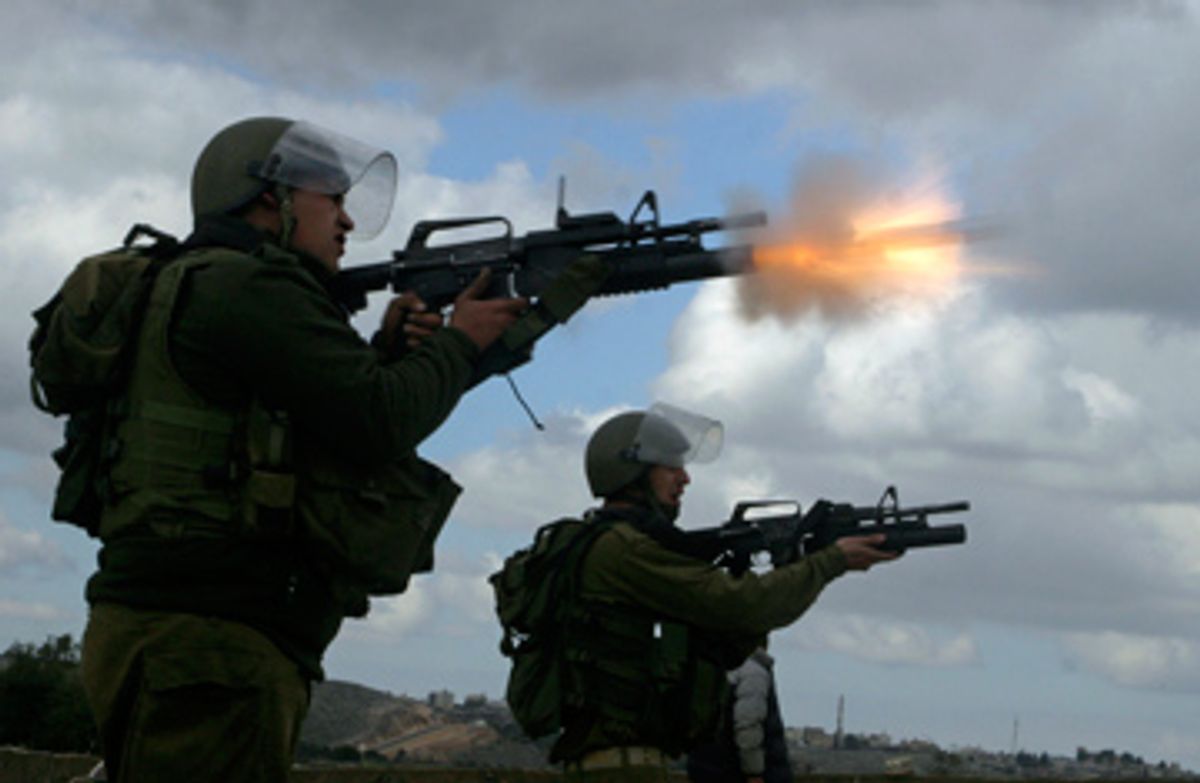
Not long ago, in preparation for an upcoming trip to embed with the U.S. military in Iraq, I met a war correspondent at a bar in Brooklyn, N.Y. Before I could even get in a word, he asked: "You're Jewish, aren't you? In Iraq, your head's worth even more than mine is."
Long before that encounter, however, I had begun asking myself whether Jewish-Dutch author Abel Herzberg's famous maxim still applied: "A Jew without Israel is like a loan without collateral." An idea perhaps worth reconsidering with Israel's reaching the age of 60 -- and assuming Herzberg's maxim ever applied at all.
Wasn't Israel actually more of an albatross around one's neck, especially since the second intifada in 2000, and perhaps even since the first Lebanon war in 1982? Something for which, once unmasked as a Jew, you had to offer an explanation? Something for which you should perhaps even be ashamed? (I have no trouble with being ashamed, but then preferably on my own personal behalf.) When it came to Herzberg's maxim, I decided to stick to neutral ground. Whether I was a loan with or without collateral I was not sure, but the gray zone I actually found quite pleasant. Without a conclusion either way came an essential element of freedom.
In the summer of 2006 I traveled to Afghanistan with the Dutch army. I had become interested in armies and war -- in the army because, at least in theaters of war, conscientious and absolute solitude is ruled out. And in war because the chasm between reality on the ground and accounts from news reports and editorials is so enormous. Like most people, I was raised with the idea that war, above all, is something abject. But once one has accepted that certainty, all that remains is a discussion of war in terms of morality. And that is like trying to talk about sex purely in terms of producing children, which, with all due respect, misses the quintessence of the act itself.
Outside the usual discourse on war and masculinity there exists a world in which the willingness to kill and to die is a crucial aspect of those things. Highly distasteful and even extremely immoral, but no less realistic for all that. And as I began to realize -- first in Afghanistan and later during time I spent with Israel's military -- war held something else that remained unmentioned in the official discourse: a sense of heroism with unmistakable sexual connotations.
As military historian Martin van Creveld wrote in "Men, Women and War": "If war is a man's glory, then assuredly the best antidote ought to be a woman's ridicule." Obviously this antidote does not work (and often is altogether unavailable). Equally obvious is that economic reasons are not the only ones leading men to volunteer for military service -- and to volunteer not for administrative or support duties but, rather, for that which has been the purpose of armies throughout history: fighting. I am talking about men here, because women in armies only rarely if ever take part in combat.
I would come to discover more about armies and war when, shortly after returning from Afghanistan, I decided to pay a visit to the Israeli army. If Abel Herzberg was still right and I was a loan without collateral, then to my mind it was not Israel's land or language or politics that might secure my debts, but rather its army. It seemed only logical to me, then, to observe the Israel Defense Forces from up close.
As it turned out, however, the IDF had little desire to have people like me snooping around. The status of "embedded journalist" was out of the question. Later, I was told that military operations in the West Bank and Gaza Strip were almost always accompanied by operatives from Shin Beth, the Israeli intelligence service. And Shin Beth does not cotton to journalists. But after lengthy negotiations and mediation on the part of various go-betweens, an alternative program proved possible.
I would be allowed to attend training sessions and conduct interviews with a number of service members -- a good number of them female. The role of female soldiers makes the Israeli army unique. Israel is one of the only countries in the world with compulsory military service for women. There are other ways in which that appears to be unique; although I noticed little evidence of it during my visit, the army is considered by many Israelis to be a paradise for promiscuity. After my visit to Afghanistan, that did not come as a surprise. I even dare to say that this is one of the auxiliary functions of any army: to serve as a haven for dabblers in promiscuity.
Even after all the negotiating, my time with the Israeli military was postponed twice. And some training sessions that had been accessible to me at first would turn out at the last minute to be top secret after all. Improvisation was the forte, if not the very essence, of the Israeli army, it seemed. But by early March 2008 I was finally able to leave from my home in New York for Israel.
My first meeting was with Amira Hass, an award-winning journalist. Because I wanted to know more about the army's political context, and because I suspected that not all military personnel would be in a position to speak freely, I also wanted to talk to people on the outside who were nonetheless knowledgeable about Israel's army. (On this trip, I intentionally did not speak with Palestinians or Israeli Arabs; next year I hope to pay a visit to the Palestinian territories.)
Hass writes for the liberal Israeli daily Ha'aretz and has written a book titled "Drinking From the Gaza Sea," about the years she spent in Gaza. These days she works from Ramallah. On a Sunday evening, when we meet in an almost deserted cafeteria in Jerusalem, Hass is sitting at a table with a plate of salad in front of her. "I bet you're hungry," she says. "Here, take my salad. I've had enough." A large shawl is draped over her right shoulder. "You can't talk about 60 years of Israel without talking about the naqba, the Palestinian disaster," she says. "Neither Israel nor the Palestinian elite, with their vested interests in maintaining the status quo, are interested in peace," she continues. "One of the Palestinian negotiators has a son whose company supplies materials for building the border wall. The wall is making him rich. Both [Mahmoud] Abbas and [Ismail] Haniyeh, the political leader of Hamas, are playing Israel's game. The only purpose of the negotiations is to lead to more negotiations. What it's all about is a people refusing to give up its privileges."
The cafeteria is closing. We go outside and sit beneath a parasol as a gentle rain begins to fall. "Gaza is undergoing a process of 'Talibanization,'" Hass says. "Liquor stores being attacked, et cetera. That's new -- we've never had that before. Ramallah, on the other hand, is fine. Ramallah is a five-star prison." A moral change would have to take place in Israel, she says, for the situation really to change. "I don't believe that's going to happen. I'm quite pessimistic. Sometimes I'm afraid that Israel will prove to be just a passing phase."
"But how could a nuclear power simply disappear?" I ask.
It's the only time during our conversation that Amira Hass becomes slightly irritated. "I don't know," she says. "I'm not a fortuneteller who can look into a crystal ball."
The next morning I have an appointment, close to the Ministry of Defense in Tel Aviv, with Capt. Benjy, an Army spokesperson. (Most soldiers will give only their first names.) Benjy was born in Sydney, Australia, and emigrated to Israel a few years ago. He took a job with the army's information service because he felt that his new country did not market itself well abroad. Sounding slightly concerned, he asks me why the new Israel correspondent for NRC Handelsblad, a Dutch newspaper for which I write regularly, has not yet come to see him.
During the next few days an army recruit will travel with me everywhere I go. Officially, to translate for me when necessary, but in actual practice, to monitor the flow of information. "Tomorrow Mirika will be going with you," Benjy says. "If you want to send her personal messages, would you please not do that on her army cellphone?"
"I don't even know Mirika," I say, surprised. "Why would I want to send her personal messages?"
Seeing as the army is unable to provide transport, I arrange a taxi for myself. The Israeli driver has a Filipino girlfriend he calls his "third wife" and says he is in touch with only one of his children, a son who runs a hair studio north of Tel Aviv. The driver is armed. He tells me that he is able to shoot both right- and left-handed. Along with him and an army escort, I will travel back and forth across Israel for the next few days. Never before have I had such an overwhelming sense of having been dropped into a fictional world.
Mirika, I discover, is a 19-year-old recruit. Her mother is a novelist, her father a prize-winning mathematician. With her she has a plastic bag of fruit, which she is willing to share. The day's destination is Bat Egat, an elite officers training school in the Negev Desert, just south of Beersheba. Capt. Avi, the training-school commander, welcomes us. He is 34, is married and has one child. His looks match the cliché of the war hero. Israel may spend a lot of money on weaponry, but when it comes to accommodations and furniture the army gets a raw deal. Avi's little office makes it look as though the state of Israel were established about three weeks ago.
"I fought in the second Lebanon war in 2006, and I took this job in order to apply the lessons learned during that war," Avi says. "We were poorly trained. Israel has become a land of shopping centers, of life's little luxuries."
Avi points to what looks like a series of mimeographed sheets, stuck to the wall with thumbtacks. "Those are the values of the Israeli army," he says. "First you are an individual, then a commander, and only after that are you a warrior. But the army's most important value is completing one's mission."
"Even if that means your own soldiers will die?"
"Yes," Avi replies. "Completing the mission has top priority."
I'm reminded of the son of Israeli writer David Grossman, who was killed during the last war with Lebanon.
"How can you prepare your soldiers for death?"
Avi sighs. "You can't. All you can do is train them. So they know what they have to do, even when they're petrified with fear. And I lead the way. I don't look back; I know they're going to follow me."
"Do you think another war will come, with Hezbollah or with Syria?"
Mirika interjects: "You can't ask that question."
Avi ignores her. "Every army prepares itself for the next war. We are preparing ourselves for a war on the northern front."
"Do you remember the first time you were shot at?"
Avi laughs. "You might as well ask whether I remember the first time I kissed a girl."
I go out to watch artillery exercises, with small and large weaponry. An officer in training with a yarmulke and a beard comes over and asks worriedly who I am. Mirika explains to him that I am not a spy, but I can tell from the look on his face that he's not completely convinced.
On the way back to Tel Aviv, Mirika takes an apple out of her plastic bag.
That evening, in a tiny Jerusalem cafe, I am scheduled to meet with Itamar Shapira, a representative from Combatants for Peace. Combatants for Peace was officially set up in 2006 for the purpose of bringing together Palestinian militants and Israeli soldiers who have had enough of fighting and are interested in peace. The meetings are held in both the Palestinian territories and Israel. The official languages are English, Hebrew and Arabic. Often enough, English is the only language shared. Still, it is extremely difficult for Palestinians from the occupied territories to get into Israel, and Israelis are not officially allowed to enter the Palestinian territories at will.
At the bar of the cafe, frowning in concentration, a youth is playing billiards on a computer. At first I think this might be Itamar. But Itamar himself shows up 15 minutes late, a friendly young man in his 20s who looks older than his years. He has a quiet voice.
"Actually, I'd like to stop with Combatants for Peace," he says. "What we've achieved has been a success, but now I feel like concentrating on my music."
"Are all your participants either soldiers or guerrilla fighters?"
"No, only about 30 percent of them," Itamar replies. "There's a lot of money available for organizations like ours; dozens of NGOs want to support organizations like Combatants for Peace. But the problem is that some people are more interested in power and money than in the goals of the organization."
I ask if he'd like a cup of coffee. He declines, noting that he actually works in this cafe. "I was raised on the same kinds of slogans as a lot of people here. 'A land without people for a people without a land.' That kind of thing. But when I started taking a closer look at it, it turned out to be all wrong. That was the first disillusionment. My father was a pilot in the Israeli air force -- a real patriot. Later, he became an arms dealer. But now he supports my organization too."
"Do you work full time in this cafe?"
"No," Itamar says. "I give guided tours in Spanish and English at Yad Vashem, the Holocaust Museum. That's why I work here in the evening. To escape all that misery. To meet a few everyday people for a change."
We say goodbye. Outside, in the street, he says I can always call him for more information, but that from now on he really wants to concentrate on his music.
The next day, on the bitterly cold Golan Heights near the Syrian border, I attend tank maneuvers. I'm not allowed in the tanks themselves. From the observation tower, the movements of the tanks looks like a game of chess.
My army escort today is Ariel, a young man originally from France. He never leaves my side. He follows me around like a dog. While we wait for the next set of maneuvers, a young soldier by the name of Dmitri -- Dima, to his friends -- tells me that he comes from a place in Siberia where it's always cold, and that he's not Jewish. "So what are you doing here?" I ask. "Life is better here," he says, grinning.
The commander, Tal, tells me that during the last Lebanon war the Israeli army tried using llamas to carry the heavy loads needed for combat. But the experiment failed. "They ran right off to the Hezbollah fighters with our stuff," Tal says. "We had to shoot them to keep our things from falling into the hands of Hezbollah."
In Eilat, in southern Israel, I visit a unit called Caracal, where women are trained to be warriors.
Moshe, the commander, says: "The borders around here are quiet. Our main task is to stop smugglers. They smuggle drugs and prostitutes into the country in order to undermine our morale."
There are additional challenges: "And the Sudanese refugees who come to us across the Sinai -- sometimes they're shot at and they lie there bleeding, one meter on the other side of the border," Moshe continues. "But we can't do anything. If we take one step across the border the Egyptians will start shooting at us. The Jordanians are smart, but the Egyptians are brainless."
Ariel, my escort, interrupts him. "Of course Moshe doesn't mean that all Egyptians are brainless."
After that I'm allowed to talk to three young female soldiers. Ariel gives them instructions beforehand. What I'm really curious about is why they've decided to become soldiers, and therefore to spend an extra year in the army, instead of two years like the other female recruits. All that comes out are clichés, statements like: "We want to defend our homeland" and "We want to give something back."
Only when one of them suggests that we have our picture taken together do they loosen up a little. "We're just as good as the men," says 21-year-old Shira. I nod amiably. There is no doubt in my mind that she could easily get the better of me.
At a kibbutz close to Netanyah I meet with Ruth from the organization New Profile, whose mission is to fight the militarization of Israeli society. Ruth is an American woman who says she came to Israel as a kind of hippie. She has children, and a grandchild as well now, who crawls around the floor of her house as we talk. "My husband doesn't want to leave," she says. "He's happy here." (Her husband was also born in and emigrated from the U.S.) She makes a pot of coffee.
"New Profile is about more than the occupation," she explains. "If the occupation would end tomorrow, our work would go on. What we're concerned about is Israeli society, the way it's become militarized. The sexism that is linked so closely to militarization. We're in favor of a discussion about the desirability of compulsory military service, about whether you can refuse to serve. My sons have refused military service. But we can't go too far, because then it's considered sedition and that is a punishable offense."
She sits down beside me on the couch. "The army is experimenting now with mercenaries at checkpoints in the occupied territories. We keep an eye on things like that, too. I think the army will be making more and more use of mercenaries. But, like I said, we're interested not just in the territories and the occupation, but in Israeli society as a whole. We need help."
My journey ends on a Saturday morning in Mevaseret, outside Jerusalem, in the garden of military historian Martin van Creveld.
"We were a small but brave nation, to cite Moshe Dayan," he says. "Now we are economically big, but cowardly."
I admire van Creveld's books and the regular columns he writes for newspapers ranging from Die Zeit to the International Herald Tribune. "An army must be prepared not only to shed the blood of the enemy, it must also be willing to shed its own," van Creveld says.
"That's cynical," I suggest.
"It's the truth. An army that loses that willingness is better off disbanding. Because of the intifada, the Israeli army has become an army of third-rate policemen. The threat posed by Iran is exaggerated -- the biggest threat facing Israel is an internal threat."
Van Creveld comfortably fires off provocative ideas, some of which he follows by saying that I shouldn't quote him on them.
He eats a strawberry.
"The success of a war can be measured by the way it ends, and by what comes afterward. Despite the general consensus that the second Lebanon war was a disaster, I say, no, we won that war. Because, despite the failure of our ground troops, for two years now it's been quiet on the northern front."
One might look at Israel these days, though, and wonder if it hasn't been fighting one really long war, for 60 years now.
"It's not simply a joke when I say that it would be good for the peace process if Syria were to get nuclear weapons. Nuclear weapons have done more for peace and saved more lives than anything or anyone else."
Van Creveld devours another strawberry.
"The Palestinians on the West Bank have missiles, just like the Palestinians in Gaza. But they don't use them because they know what the consequences would be: transport to Jordan." He asks, rhetorically, if even ethnic cleansing could be a preferred scenario. "No," he says, "my name is not A. Hitler."
Another strawberry disappears into van Creveld's mouth. Once again I am reminded of Herzberg's maxim. I decide to stick with my original position, somewhere between collateral and insolvency. When it comes to self-preservation, it is perhaps wise to bet on more than any one army.
"If the Palestinians had brains and discipline they would make use of the discord in Israeli society. The colonists, particularly the religious ones," he says, referring to the Jewish settlers in the occupied territories, "are hated by a large part of the Israeli population and by the army as well. Why not give them hell, instead of the inhabitants of Sderot?"
A final strawberry, and a final thought on the military paradigm.
"The biggest problem within the Israeli army is anti-intellectualism. I once held a lecture for the general staff. They acted like children with a behavioral disorder. I'm afraid that's a leftover from the Zionist dream. The Jews didn't want to read books anymore. They wanted to finally do something substantial: Fight."
Translated from the Dutch by Sam Garrett.
Shares