Has life in Iraq improved?

With pools of open sewage in the streets and little electricity, life for most Iraqis remains bleak.

Topics: Iraq war,

Has life in Iraq improved?

May 20: Trash pickup in most of Baghdad ended with the rule of Saddam Hussein. Now the garbage chokes the capital’s streets and clogs the sewage pipes and canals, which overflow and burst. The sewage that leaks out of broken pipes seeps through the dirt of roads that were once paved, but now have mostly turned to dirt because the tracks of American tanks and Bradley fighting vehicles have destroyed the asphalt over five years of war.

Above the roads, low-slung electric wires hang like an enormous web woven by some apocalyptic spider, strung from street generators to poles to homes, from one street to the next. Yet, most Baghdadis receive less than four hours of electricity a day. Running water, too, is a rare commodity. As far as safety is concerned, a quiet neighborhood is one where gunfire and explosions are something residents only hear, not see.

But whenever American soldiers ask the locals how they live, the Iraqis’ first response is typically: Much better, thank you. Then they list the basic services they do not have.

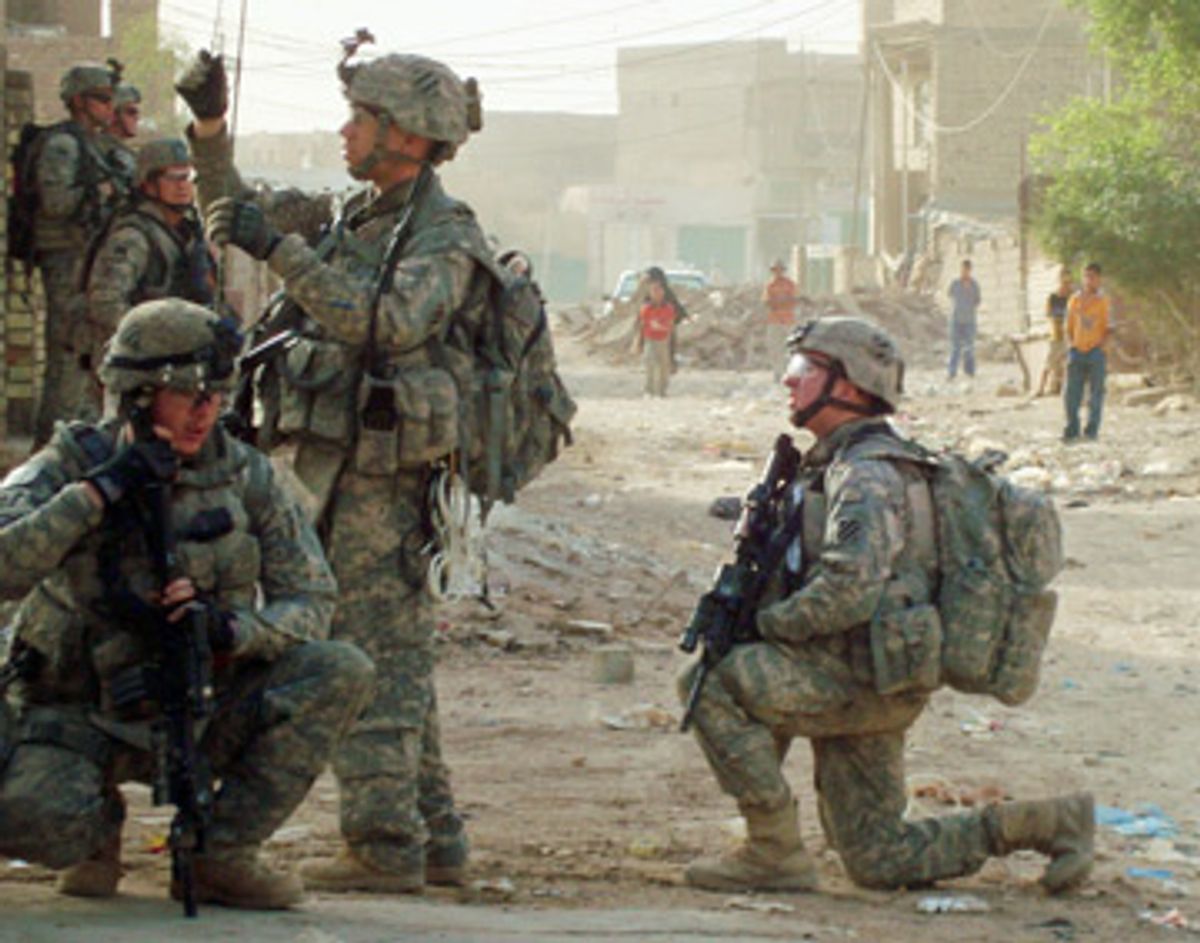
“They say it’s better, but I wonder if it’s really better,” muses Maj. Kelly Dickerson, a U.S. Army reservist and a civil affairs officer who is trying to help the 4-64 Armor Battalion of the 4th Brigade, 3rd Infantry Division reinstate basic services in southwestern Baghdad. Dickerson’s current project is to bring sewage-pumping trucks into the lowlands of Risala, a Shiite militant stronghold where stagnant lakes of raw sewage flood squares and streets. The idea that having human waste pool outside one’s home is somehow a sign of progress doesn’t sit well with Maj. Dickerson.

Better compared to what? I ask. Better compared to 2003, when sewage was still mostly consigned to pipes and canals?

Or better compared to 10 months ago, when stray dogs were feasting on the dead bodies of victims of sectarian bloodshed, which were left to lie in the streets for days? If you ask a patient who has just come out of a coma how he’s doing, he will probably say that he’s much better, thank you — never mind that he is connected to IVs and a respirator and is missing a leg.

Anna Badkhen has reported from Iraq, Afghanistan, Chechnya, Somalia, the West Bank and Gaza. She lives in Massachusetts with her husband, David Filipov, and their two sons.

Next Article

Related Stories

Featured Slide Shows

The week in 10 pics

close X
  • Share on Twitter
  • Share on Facebook
  • Thumbnails
  • Fullscreen
  • 1 of 11
  • A missing poster hangs on a tree outside the Cleveland home of Amanda Berry Wednesday. Berry and two other women, Michelle Knight and Gina DeJesus, made a daring escape this week after being held captive for more than a decade.
    Credit: AP/Tony Dejak

  • Elvis Rafael Rodriguez and Emir Yasser Yeje offer their best impression of  Eric B. & Rakim. On Thursday, New York prosecutors identified the pair as members of an international gang that robbed $45 million in a matter of hours by hacking into a database of prepaid debit cards and draining ATM machines around the world.
    Credit: AP

  • New Jersey Gov. Chris Christie walks to a podium during the groundbreaking ceremony for the Technology Enhanced Accelerated Learning Center at Essex County Newark Tech in Newark, N.J., Tuesday. Christie made less flattering headlines this week after undergoing a secret stomach surgery to curb his weight.
    Credit: AP/Julio Cortez

  • Workers stand outside the Tung Hai Sweater Ltd. factory in Dhaka, Bangladesh, Thursday after a fire broke out in its 11-story building. Eight people were killed in the blaze.
    Credit: AP/Ismail Ferdous

  • Workers rescue a woman trapped for 17 days in the rubble of a garment factory building in Saver, Bangladesh, Friday. The building's collapse was the worst industrial disaster in the country's history, killing more than 1,000 people.
    Credit: AP

  • Former South Carolina Gov. Mark Sanford gives his victory speech Tuesday in Mt. Pleasant, S.C., after winning back his old congressional seat in the state's first district.
    Credit: AP/Rainier Ehrhardt

  • Jodi Arias reacts in Maricopa Country Superior Court Wednesday after being found guilty of first-degree murder in the gruesome killing of her one-time boyfriend, Travis Alexander. Arias has subsequently said she wants the death penalty, claiming she'd "prefer to die sooner than later."
    Credit: AP/The Arizona Republic/Rob Schumacher

  • Ariel Castro stands for his mug shot Thursday at the Cuyahoga County Corrections Center, where he is being held on $8 million bail. The former bus driver is accused of imprisoning three young women and beating them repeatedly over a period of 10 years.
    Credit: AP/Cuyahoga County

  • Charles Ramsey addresses the media Monday after helping rescue three women held captive in Cleveland for more than a decade. Ramsey's hero portraiture has been complicated by revelations of his own domestic violence record.
    Credit: AP/The Plain Dealer/Scott Shaw

  • Michael B. Donley, Secretary of the Air Force, testifies during a Senate Appropriations Defense Subcommittee hearing on Capitol Hill Wednesday. The military branch was rocked this week after its chief sexual assault prevention officer was charged with sexual battery.
    Credit: AP/Carolyn Kaster

  • Recent Slide Shows

  • Share on Twitter
  • Share on Facebook
  • Thumbnails
  • Fullscreen
  • 1 of 11

Comments

24 Comments

Comment Preview

Your name will appear as username

You may use these HTML tags and attributes: <a href=""> <b> <em> <strong> <i> <blockquote>