Democratic Party

Did humor save the left at its darkest hour?

How did Stephen Colbert become a progressive political force? Theodore Hamm discusses "The New Blue Media," the rise of netroots and their role in the next administration.

  • more
    • All Share Services

Did humor save the left at its darkest hour?

When future historians write of the long months between the terrorist attacks on the World Trade Center and the U.S.-led invasion of Iraq, there will most likely be a chapter about the overwhelming failure of the mainstream political media to properly question the Bush administration during the buildup to a failed war. Journalists who should have acted as government watchdogs instead acted largely as yes men, spuriously debating what should be done about Saddam Hussein’s weapons of mass destruction.

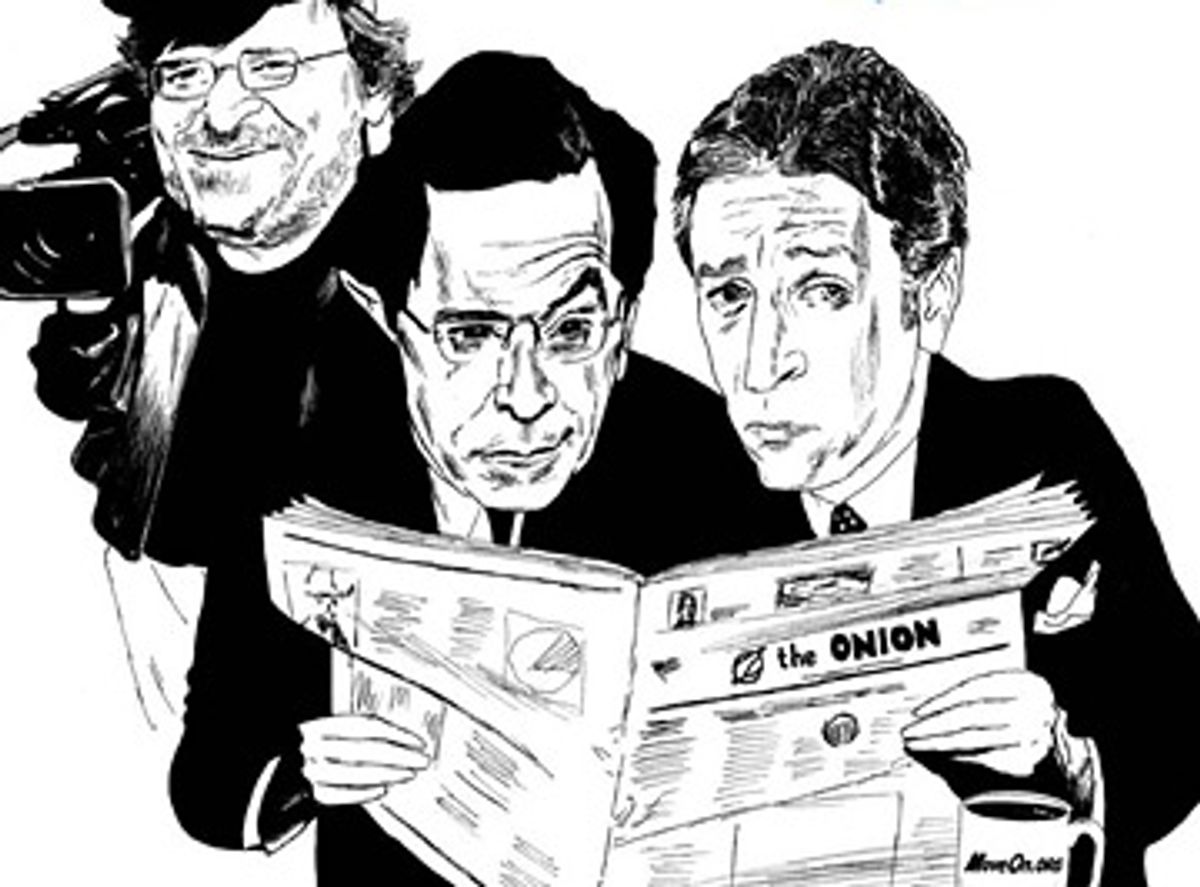
In that recriminatory chapter, there will likely be a section about the exceptions: left-leaning, often satirical media outlets like “The Daily Show” and the Onion, whose headlines in the run-up to the invasion included “Bush Won’t Stop Asking Cheney if We Can Invade Yet” and “Bush Seeks U.N. Support for ‘U.S. Does Whatever It Wants Plan.’” These exceptions are the focus of
“The New Blue Media: How Michael Moore, MoveOn.org, Jon Stewart and Company Are Transforming Progressive Politics” by Theodore Hamm, the founding editor of the arts and politics journal the Brooklyn Rail. The book is what Hamm calls a “critical tribute” to a group of liberal commentators and outlets — Stephen Colbert, Air America and blogs like Daily Kos and MyDD — that have emerged in the last decade. In chronicling their rise and influence, Hamm suggests that some of the most meaningful and independent political discourse has come from the least “serious” of sources. If the book sometimes reads as a bit credulous — there is perhaps more tribute than criticism here — it may be because Hamm cannot conceal his gratitude for what was for him an invaluable source of relief in a bleak time.

Salon spoke to Hamm about the emergence and growing influence of these media outlets and about the future of progressive political discourse.

In “The New Blue Media” you chart the emergence of media entities like the Onion, Air America, Michael Moore, liberal bloggers, “The Daily Show” and “The Colbert Report.” Other than the fact that they are all left-leaning, what makes them a cohesive group or phenomenon?

The project actually originated in the campaign that most of us would like to forget, 2004. The netroots — MoveOn and the blogosphere, which was still kind of young at that time — had essentially backed Howard Dean, but then when Dean imploded and John Kerry became the electable nominee, pretty much everyone on the liberal-leaning left rallied to support him. MoveOn, Michael Moore, Air America, when it was launched in 2004 — they were all kind of joining together, sometimes directly at particular events, or by appearing on each other’s shows and by doing other kinds of cross-promotions, and so there was a constellation of different new media outlets that were pushing Kerry in 2004.

In the section on Air America, you mention that certain corporations like McDonald’s and Hewlett Packard refused to advertise with the network, and you suggest that corporate pressure could be a possible danger for progressive media outlets aspiring to reach the levels of commercial success attained by right-wing media figures, such as Rush Limbaugh and Bill O’Reilly. I wonder if you think the failure of Air America has more to do with the fact it was on the left or with the way it delivered those leftist views?

I think the reason it failed was because of its business model, trying to start as a national network, rather than starting with syndicated programming. And had it retained some of the attempts at comedy, that might have made it more appealing as well. They were also delivering the same kind of mush that was being put forth by Kerry and the Democrats in 2004. Air America didn’t really create anything that new or independent, and then it wasn’t entertaining, at the same time.

I was interested to read just how entrenched the Clinton camp was in the early development of Air America and in Al Franken’s other projects.

Sure, and that put the network so clearly in tandem with the Democratic Party that they weren’t really offering anything independent. And you know, you see that on the right. Limbaugh and company obviously are in alignment with the Republican Party, but they also depart on issues that they hold dear — immigration and so on. There was a spirit of independence lacking in Air America.

And you see that spirit of independence more in the netroots movement. Can you explain what you mean by netroots?

The netroots are the grass roots of the Democratic Party that are organized online, the Internet-based activism that started with MoveOn and mydd.org [now mydd.com] and some of the early blogs, like Daily Kos. The netroots have maintained a spirit of independence, but it fluctuates there as well.

In some ways, the netroots seem sort of like the progressive or left-wing answer to what the Republicans and the Christian Coalition did in the 1980s. That kind of grass-roots politics has been echoed on the Web.

Yeah, and it’s starting to happen on the right, but up until this current campaign, it’s still been liberal terrain or left-leaning terrain. There are definitely influential right-wing Web sites — I wouldn’t really define the Drudge Report as a blog — but in terms of organizing and activism, the left still holds the advantage. The netroots are media watchdogs too. They counter the right-wing noise machine. They are challenging the mainstream political media, and when they are challenging the Democratic Party, which obviously needs to be challenged on Iraq and many other issues, that is when they are most effective.

It is ironic, then, that the outlet you find to be the most successful as a media watchdog is the one that has become the most mainstream: “The Daily Show.” How is it that “The Daily Show” and “The Colbert Report” have become such huge phenomena but have still kept to what you see as the spirit of the “new blue media”?

Because they are asking the questions that the mainstream political media won’t. They are best seen as ongoing works of media criticism. The very fact that Colbert playing a faux Bill O’Reilly now wields nearly as much influence throughout the political media as the actual Bill O’Reilly shows that there has begun to be a successful counter-attack against the right-wing noise machine.

In the book, you say that you see Colbert’s infamous speech at the White House Correspondents Dinner as the moment that embodies the power of the new media to take down the old one.

It was a great moment. He shook up a roomful of the Beltway media elite, and in the wake of it, the old media led by the Washington Post tried to take him down, and they were overwhelmed by the response from the blogosphere.

You write a lot about the huge success that these nontraditional media outlets have had in capturing audiences, more particularly young, white, educated or at least semi-educated audiences. Though you are generally enthusiastic, you hint at the fact that by presenting themselves as comedians rather than political commentators or media critics, Stewart and Colbert are shirking an intellectual responsibility to deliver concrete ideas or fully explain their positions.

But if you look at some of the conversations that Colbert has with various authors and political figures … I mean, Bernie Sanders was on there a couple of weeks ago making a case for socialism. Where else are you going to find that in the mainstream media? So, yeah, they are not presenting serious policy debate, but the issues that are discussed in the Nation and other progressive outlets turn up in “The Daily Show” and “Colbert” critique.

But in a much fluffier form!

I think there is obviously a need for both. People aren’t going to be fully informed simply by watching these shows, even though for young people, ["The Daily Show" and "The Colbert Report"] are increasingly becoming the primary news sources. There is some danger in that, because people do need to be reading other, more serious analyses and different positions. But the success of these outlets also makes candidates recognize that they can’t just give policy issues the typical treatment. They have to actually be accountable and explain why it is they are doing what they’re doing.

But media is not a substitute for politics. I think that the netroots and other organizing that gets people involved are actually more important in some respects than media superstars making the rounds.

In the last chapter, you suggest that the influence of the netroots and the more activist wing of the new blue media would be marginalized in the (increasingly unlikely) case of another Clinton administration, which you characterize as inevitably pro-war and pro-corporate.

Clinton has attacked MoveOn for its organizing capacity, for its ability to turn out volunteers and voters to caucuses. As I show in the book, she’s never been on friendly terms with the blogosphere and generally with the antiwar base of the party, who still won’t forgive her for her vote or trust her. But the interesting thing is that she actually has adopted one of the main styles of the new blue media. To me, in the last few months in particular, she sounds a lot like Howard Dean in 2004, when he was the initial figurehead of the netroots. She’s the combative fighter who, just the other day in North Carolina, was standing up on a pickup truck making her populist appeal. Obama is not coming across as a fighter in that same way, but he is in sync with the interactive nature of the netroots.

What do you mean by “interactive”?

So much of his campaign has been driven by use of the Internet and bringing out volunteers via text messaging and other new technologies. He’s got the whole MySpace/Facebook campaigning thing down, and he’s really succeeded in appealing to youth voters through those means. So two of these styles have emerged in recent years … the fighting Democrat style embodied by Dean and the more interactive, netroots-oriented campaigner.

But in the book it seemed pretty clear that you feel Obama is a better representative of the potential of this new media.

Well sure, because the style is only one component. The substance is important too. I’m showing all along that all of these outlets (except when Al Franken was the figurehead of Air America) have been steadfastly opposed to the Iraq war. So I think that Obama, because of that particular stance, is much more of a fit.

In an Obama presidency, what kind of role do you think the new blue media would play?

Obama is repeatedly stressing that politics flow from the bottom up, not from the top down. And that is the netroots perspective. It’s basically an invitation to maintain pressure from below and keep advancing policy positions.

Why were you personally compelled to write this book right now?

Personally, just having come through the Bush era, I can’t imagine what it would have been like without Jon Stewart, Michael Moore, the Onion, Stephen Colbert and company. It would have been pretty joyless, to say the least, and we probably would have felt powerless without the ability to try to influence the party through the netroots.

Senate Democrats heroically fund TSA

Democrats score the dumbest political victory of 2012

  • more
    • All Share Services

Senate Democrats heroically fund TSA (Credit: Reuters/Frank Polich)

On Tuesday, a Senate Appropriations Committee vote effectively highlighted everything that is stupid about politics.

The Transportation Security Administration, a universally loathed government agency, is facing a shortfall, despite its more than $8 billion budget. Instead of having a debate over what effective airport security might actually look like and how much should reasonably be spent on the honestly rare threat of commercial-air-travel-based terrorism, there was a debate over how best to come up with the money needed for all the radioactive naked picture machines and bomb-sniffing dogs. The Democrats suggested passing on the cost of ineffective, cumbersome and intrusive security theater to citizens, via higher fees on airfares. The Republicans, even more predictably, suggested cutting spending that directly helps poor people to ensure there is enough to spend on stopping imaginary future 9/11s.

The newspaper account of the debate in The Hill just reinforced the Republican spin, highlighting the Democrats’ decision to make people spend more money on the hated TSA and downplaying the actual existing Republican alternative to the proposal, which was not “spend less on the hated TSA” but rather “raise money for the hated TSA by slashing needed aid to states.” The Democrats won, or “won,” and now they will earn the fruits of that victory: well-deserved scorn from everyone. And Ben Nelson (D-Troll Town) voted with the Republicans. (Though surely having users pay the fees for supposedly necessary security measures is perfectly conservative, isn’t it? Am I missing something here? I mean besides the fact that the two sides in this debate weren’t actually “liberal” and “conservative” but rather “people who want to come up with a way of paying for the oppressive and useless national security state” versus “people who want there to be an oppressive national security state but hate government spending on feeding and sheltering impoverished people.”)

I don’t know of anyone not employed by the TSA or some other arm of Homeland Security that believes the TSA does a good job and deserves its massive budget, but everyone in Washington apparently feels differently (and is terrified of being blamed for “voting to cut TSA funding” if there is another terrifying and deadly underwear bomber, of course). This is why everyone hates politics and Congress and Washington. This and Iraq. And the drug war.

Continue Reading Close
Alex Pareene

Alex Pareene writes about politics for Salon and is the author of "The Rude Guide to Mitt." Email him at apareene@salon.com and follow him on Twitter @pareene

The Democratic Senate might just survive

A Senate map that looked bleak a year ago is now littered with surprise pick-up opportunities

  • more
    • All Share Services

The Democratic Senate might just surviveCharles Schumer and Harry Reid (Credit: Reuters/Jonathan Ernst)

The growing likelihood that Richard Lugar will lose next Tuesday’s Indiana Republican Senate primary is the latest in a string of unexpected developments that have bolstered Democrats chances of hanging on to the Senate.

As I wrote yesterday, Lugar’s conservative primary challenger, state Treasurer Richard Mourdock, lacks the incumbent’s broad cross-partisan appeal and is closely identified with Tea Party-flavored Republicanism. Democrats, meanwhile, are poised to nominate Joe Donnelly, a moderate third-term congressman who defied the odds to hold onto his seat in the GOP tide of 2010. Mourdock would still probably be the favorite over Donnelly in the fall, just because of Indiana’s red tint, but the seat would be in play – something that would never be the case with Lugar as the GOP nominee.

The implications of a Democratic pick-up in Indiana could be huge. The party entered the 2012 campaign cycle in a defensive crouch, nursing a 53-47 edge in the upper chamber and facing a very challenging slate of races. The basic problem: Because of strong years in 2000 and 2006, the class of senators up for reelection in 2012 is dominated by Democrats, many of them representing marginal and Republican-friendly states. With a close presidential contest, the party won’t be benefiting from the national tide that lifted its congressional candidates in ’06, leaving Republicans with a host of pick-up opportunities – and Democrats with very few.

Well, that was the case early in the cycle, at least. Back then, there was only one clear Democratic pick-up opportunity on the board: Nevada, where John Ensign, the one-time rising GOP star, was forced into retirement by scandal. The race to succeed him, between the appointed GOP incumbent, Dean Heller, and Democratic Rep. Shelley Berkley, is a toss-up.

But since those bleak early days, Democrats have caught some breaks.

The first came in Massachusetts, where the state’s biggest Democratic names all begged off from running against Scott Brown, leaving an assortment of B- and C-list options to a vie for a nomination that looked worthless last summer. But then Elizabeth Warren stepped in and proved herself to be a powerful communicator and a prolific fund-raiser. The Massachusetts race is now among the most competitive in the country, giving Democrats a 50/50 chance of knocking off Brown.

Then came Olympia Snowe’s surprise February announcement that she wouldn’t seek a fourth term in Maine. Quickly, the state’s former independent governor, Angus King, announced his candidacy. King, who won by 40 points the last time he was on a Maine ballot, is now the overwhelming favorite to win in November. While he won’t say which party he’ll caucus with, Democrats in the state and nationally are treating him like one of their own. Chuck Schumer, one of the top Democrats in the Senate, referred to the Snowe seat this week as “ours.”

Two other races that weren’t supposed to be competitive are also on the radar now. In Arizona, Democrats have recruited a candidate with a compelling biography: Richard Carmona, who served as George W. Bush’s surgeon general only to turn on the administration. A Democratic poll has shown Carmona within striking distance of Republican Jeff Flake, while a recent nonpartisan survey put President Obama only two points behind Mitt Romney in the state. There is hope among Democrats that Arizona, with its growing Hispanic population, is more winnable for them than most assume – and that without favorite son John McCain on the ballot, the state would have been theirs in 2008.

There are subtler clues of an unexpectedly competitive race in North Dakota. When Democrat Kent Conrad announced that he wouldn’t run again, the state was written off as an easy Republican pick-up – and it still might be. But some early developments at least offer a glimmer of hope to Democrats. As Politico reported this week:

With a dearth of public polling, the case for former Attorney General Heidi Heitkamp is based on a body of clues.

A Democratic poll showed Heitkamp with a 5-point lead; no Republican data countered the finding. The latest Crossroads GPS air strike included $76,000 to bruise Heitkamp — a sign she’s on the radar of the cycle’s most notorious super PAC. Even Berg blasted an email to supporters recently claiming the state is “Harry Reid’s #1 target.”

Add Indiana to this mix and Democrats have a total of five opportunities (or potential opportunities) for pick-ups that didn’t exist at the start of the cycle. Obviously, they won’t win all of these races, and they may still get routed in a few of them. But when you’re clinging to a 53-47 majority, any seat gained could be the difference between majority and minority status next year.

Continue Reading Close
Steve Kornacki

Steve Kornacki writes about politics for Salon. Reach him by email at SKornacki@salon.com and follow him on Twitter @SteveKornacki

Dems desert the left

Why aren't Democratic candidates for Senate promoting liberal causes on their websites?

  • more
    • All Share Services

Dems desert the left

Victories in two Pennsylvania House districts over two conservative Democrats who voted against healthcare reform gave liberals something to cheer about this week. And they’re quite right to focus on primary elections: Nomination contests are really fights over who  will control the political parties. And yet liberals appear to be missing some major opportunities to influence the next round of Democratic senators, just when they have the chance to do so. A look at the websites of the 10 Democratic candidates most likely to become U.S. senators reveals that few of them are interested in several of the issues that have been the hallmark of liberal activism and often frustration during the Obama years: marriage equality, a public option on healthcare, filibuster reform and civil liberties.

Why should we care what candidates have on their websites? The truth is that politicians generally try to keep their promises once they are elected. Moreover, the more visible the promise, the more likely it is that the politician will consider herself bound by it – and face consequences if she votes the other way. Ideally, one would want to see what candidates talk about on the stump, and what they advertise in mailers, TV ads and other formats. But websites have some advantages, too. In addition to being easy to access, they also are open-ended. Presumably, candidates will list every issue they believe is important. Or at least, every issue they want to talk about. And those are the issues, again, that they’re likely to act on if they win.

So I looked through the Issues sections of the 10 Democrats who are most likely to be elected – either challengers rated as having a good chance, or open-seat candidates in Democratic or swing states. In Hawaii and New Mexico, that meant both candidates fighting in a contested primary; in six other states, it meant the odds-on favorite for the nomination.

The results should be disappointing for liberals. Two of the 10 candidates, Heidi Heitkamp in North Dakota and Tammy Baldwin in Wisconsin, don’t even have an Issues section on their websites. For the other eight, I’ll run down the numbers quickly. None of them mentioned support for adding a public option to ACA; indeed, three had no healthcare issues page at all, unless you count a page about protecting Social Security and Medicare, which was quite popular. Two of the eight support marriage equality, both of them in New England (Elizabeth Warren in Massachusetts and Chris Murphy in Connecticut). Only two other candidates mentioned LGBT issues at all, Tim Kaine in Viriginia and Tammy Baldwin in Wisconsin, who featured it in her bio page. Filibuster reform also received only two mentions. For civil liberties and the array of issues related to torture and detention, only Martin Heinrich of New Mexico, who opposed renewal of the Patriot Act, had any mention at all.

By contrast, seven of the eight candidates had a whole section of their Issues pages devoted to veterans, usually alone but in two cases bundled with something else. Now, it’s certainly true that most liberals support help for veterans, but as campaign issues go, this is surely one of the most bland.

I was pretty surprised by all of this, but I was most surprised by the candidates in competitive primaries. In Hawaii, Mazie Hirono is attempting to beat Ed Case from the left, and yet Hirono doesn’t hit at any of these issues that might help her with liberal activists in Hawaii and nationally. And it’s not as if either Hawaii or New Mexico, the two states with contested primaries, is exactly Alabama; there are plenty of liberal Democrats who are going to be voting in those primaries, and liberal positions shouldn’t be the kiss of death in the general election.

So what’s going on? It’s possible that the candidates are being overly cautious. I suspect, however, that what’s really happening is that Democratic interest groups, activists and other party actors are not pushing hard on any of these issues.

And that’s a serious mistake. It’s almost certainly the case that the best time for partisans to influence legislators is while they are running for election to some office for the first time. After all, that’s when they need party support the most – especially for those who have tough primaries, but really for all of them. Once elected, they begin to build personal connections with their constituents, based on bringing home pork or on other personal relationships. Party becomes relatively less important. Certainly, that’s what politicians have an incentive to do – to increase support based on who they are, rather than being constrained by specific policy commitments that, odds are, will make someone unhappy.

Now, it’s true, of course, that it’s still early in the cycle, so some of this could change going forward. And as I mentioned, websites are only one form of candidate advertising. It’s certainly possible that some of these Issues sections were put together exactly how I suggested – by volunteers who didn’t have the authority to commit the candidate to potentially controversial positions – and that as the year goes on things will change.

But what they’re showing right now certainly isn’t what most liberals would like to see. If activists want change on these issues after November, they need to start targeting these candidates now, before it’s too late.

Continue Reading Close

Jonathan Bernstein writes at a Plain Blog About Politics. Follow him at @jbplainblog

All for none and none for all

Forty years of culture wars and racial battles wrecked the country and the GOP – but it's not too late to change

  • more
    • All Share Services

All for none and none for all (Credit: AP Photo/Gregory Bull)

My March 4 post “What’s the matter with white people?” was Salon’s top story that week, and it got a lot of comments and online attention. I went on vacation a few days later, but I’ve wanted to address a few arguments, if belatedly.

I asked “What’s the matter with white people?” because my people are increasingly coming under fire from the right and the left. Republicans have begun to blame not the economy but “dependency” on government and rising rates of single parenthood for the economic troubles of the white working class. On the left, meanwhile, whites are dismissed as the backward base of the increasingly radical GOP, and working class whites, in particular, are derided as racists who won’t vote for Democrats because the party is now led by a black man (ignoring the fact that a larger share of working class whites voted for Barack Obama than for Caucasians John Kerry, Al Gore or Bill Clinton.)

The fact is, working and middle class whites have supported too many Republicans who’ve dismantled the opportunity structure that created the vast (white) middle class from the 1930s through the 1960s – but that’s at least partly because too many Democrats turned their backs on those policies, too. The larger point of the piece, if a 4,000-plus word article can be said to have a single point, was this:

The emerging multiracial Obama coalition has the potential to transform the way we all think about race and politics as we invent the next America — but only if we can all forgo petty racial score-setting and 20th century conceptions about identity. And only if more white people wake up to what they’ve let the Republican Party do to the country in the last 40 years, in the name of holding on to what they think they have.

I was making two related arguments: that whites must begin to face up to economic and political reality – that the party most of them support now stands for destroying not only the social programs they (incorrectly) believe benefit “other people,” but also programs they support, like Social Security and Medicare, food stamps and unemployment, as well as protections for workers who have jobs. My second point was just as important and less commonly heard: I asked that the multiracial left have more empathy for working class whites, and stop stereotyping them and dismissing their political choices, when we disagree, as merely “racist.” Interestingly, I got little or no push back on that point from anyone on the multiracial left, although I have been criticized for that argument many times, going back to the fractious 2008 Democratic primary. Maybe we’re making progress.

The criticism of my “White People” argument came almost exclusively from the right, and there were at least a few points worth engaging.

….

Of course, more than a few people reacted to the headline without thinking (or reading the piece), and I heard a lot of what I predicted I would in the article: I am a racist! How dare I generalize about white people? I would never talk about black people that way!

The best response along those lines came from Newsbusters, the fan club Brent Bozell runs especially to promote me. It featured a typically outraged harangue from Noel Sheppard: “Actual Joan Walsh Salon Headline: ‘What’s the Matter with White People?”  and included this: “Maybe Walsh should check her own racist leanings given her hatred of white people.” Noel, I love white people! Some of my best friends are white. As I even revealed in the piece, that includes some of my own family. You can do better, Noel. Try again.

The reply from the Wall Street Journal’s James Taranto was a little bit more substantive – although he kicked it off on Twitter by shrieking at Charles Murray that I’d accused Murray of “attacking white people!”

I didn’t accuse Murray of “attacking” all white people. I’d made the point that Murray now blames poor and working class whites for their economic struggles, much the way he has always blamed the black poor. Their poverty rate is climbing while their wages and family incomes are falling not because of huge shifts in the economy that favor the wealthy, but because they’re lazy and promiscuous and not terribly bright, and they just don’t follow the rules the way the poor are supposed to. This is the oldest argument around, of course, when it comes to explaining away social inequity and defending the economic status quo. You can find it in the Gospels, in clashes between that bleeding heart liberal Jesus Christ, and those who believed poverty was God’s punishment.  In every age, the struggle for justice turns on how successfully the privileged can justify their wealth as the natural result of their hard work and superior talent and/or the innate shortcomings of their lessers.

In my lifetime, that argument has been racialized. As the nation struggled to right the wrongs of racism, some people began to argue that the problems of poor African Americans had more to do with their own personal and cultural shortcomings than society’s, and that our efforts to use government to help made the problem worse.  But I was raised knowing that virtually every awful thing said about black people had once been said about Irish Catholics, and so I’ve spent a lot of my life refuting that racialized scapegoating, sometimes successfully, sometimes not.

Lately, though, I’ve felt that we’re getting some help with that task from Republicans, as they scapegoat working class whites in terms they used to only use against blacks — their economic problems are due to the fact that they’re lazy, too many don’t get married and they want government to take care of them (Charles Murray’s argument). Taranto misunderstands the point I’m making about the new GOP line:

When Walsh accuses Murray of “attacking white people,” she seems to be hoping that persons of pallor will be open to a similar appeal–that they will finally wake up and start voting what the left considers to be their “interests.” Essentially that means embracing government dependency: “Today, many white folks who are voting Republican don’t seem to know one important fact: they are, in fact, the ‘takers.’ ” Once they figure that out, Walsh thinks, they’ll join the blacks and the Hispanics and the professional elite, and the Democratic hold on the electorate will be secure.

That’s not what I was saying, at all. I’m not someone who makes the simplistic case that the working class is voting against its interests by backing Republicans. This is a debate in which I think the right has the better side. Claiming that working class Republicans – or black and Latino Republicans, for that matter — are “voting against their interests” is hugely condescending, a vestigial Marxism that assumes the only thing that matters is material conditions. It can also sound like we’re saying: “How dare you presume you have anything in common with the wealthy, peon?”

The Republican allegiance of some working class people may well be aspirational, as conservatives argue. Liberals like John Rawls’ famous theory of justice, which held that most people would want to design a society in which, should they find themselves at the bottom, they would be protected. It turns out that a lot of people prefer social policies that would protect them if they make it to the top, however unlikely that kind of economic mobility is turning out to be in the U.S. today. Voting Republican may also reflect genuine cultural and religious values. Growing up Irish Catholic, I can’t pretend that my relatives who vote Republican over the issue of abortion are dupes suffering from some kind of “false consciousness.” They care about that issue passionately. We can disagree with conservative working class white people, we can wish they had different priorities, but when we “assume” they’re voting against their own interests, as though we, not they, know their interests, our condescension shows.

….

On the other hand, I do not mean to disrespect working class whites, but I have to say: it would be great if their politics reckoned with reality. As I pointed out in the piece, red-state Republican areas enjoy the highest levels of federal spending. That’s an inconsistency that can’t be totally explained by culture war politics. White working class Republicans are simply wrong about the way government has worked, in their own lives and in the lives of others, and Democrats need to talk about that, respectfully.

Taranto hints at the case other Republicans make more forcefully – that the more Americans become dependent on government, the more they’ll vote Democratic, and that’s Barack Obama’s not-so-secret plan. “Republican supporters will continue to decrease every year as more Americans become dependent on the government,” Tea Party Sen. Jim DeMint wrote in his last book. “Dependent voters will naturally elect even big-government progressives who will continue to smother economic growth and spend America deeper into debt.” I think DeMint’s notion is alarmist GOP propaganda. But I’d be happy to have a political debate about the role of government in our lives – one that’s untainted by racism, fears of a lazy, parasitic “other” or charges that Democrats are “socialists” seeking to impose some Soviet-style or lefty-European system on America. I think it should be clear that Democrats love capitalism, because twice in the last 75 years, under Franklin Delano Roosevelt and then under President Obama, we saved capitalism from itself.

Finally, Taranto (and a lot of letter writers who didn’t seem to read my piece), claimed that the “demographic doomsday” scenario, in which a declining white population leads to the gradual extinction of the GOP, is “overblown.”  I agree – and I said so in the article. I regularly quarrel with liberals who insist that a magical “people of color” alliance is going to move the country to the left, permanently. It’s not going to happen. In the 80s and 90s, it was easy to imagine that Latinos and Asians might be receptive to Republican messaging around family, small business, religion, as well as hostility to big government, given that immigrants often came from countries ruled by oppressive governments (whether of the left or the right). Certainly Karl Rove once believed that. Republicans chased many Latinos, Asians and even conservative African Americans into the arms of Democrats by allowing racism and xenophobia to flourish in their party unchecked. As the GOP gets beaten in coming election cycles, it’s going to have to figure out a way to appeal to more than just white people — or perish as a party.

Also: most scenarios in which the white majority “disappears” in the next couple of decades ignore the fact that about 50 percent of the fastest-growing “minority” – Hispanics or Latinos – consider themselves white. (That’s why the Census has a category for “non-Hispanic whites.”)  So do most mixed-race Americans in many studies. Besides, the definition of “whiteness” has regularly shifted throughout American history – Irish, Italians, Jews and other non-Nordic, Anglo immigrants all took turns in the “non-white” category in the 19th and 20th centuries. It’s quite possible that our notion of whiteness – or let’s just say “the American mainstream” or “real Americans,” in Sarah Palin’s language – will expand to include some categories of Latinos, Asians and mixed-race folks, not to mention Clarence Thomas, Herman Cain and Condoleezza Rice.

To build a better, more inclusive country – to invent the next America – both parties are going to have to forgo identity politics and appeal to voters around principle and policy, not fear and contempt. Democrats are getting there; Republicans still have a ways to go before facing up to the fact that the identity politics practiced by the Tea Party represents a divisive dead end.

Continue Reading Close
Joan Walsh

Joan Walsh is Salon's editor at large.

The economic story Obama must tell

We need government investment to restore prosperity. The president needs to explain that in a way that makes sense

  • more
    • All Share Services

The economic story Obama must tell (Credit: AP Photo/Susan Walsh)

Look at it this way: If the Wall Street banking crisis had taken place in 2007 instead of 2008, George W. Bush wouldn’t be able to leave home without being jeered. (As it is, he rarely leaves Texas.) Hardly anybody would buy the brand of tycoonomics GOP presidential candidates are selling. People would understand that save-the-millionaires tax cuts and deregulation had dramatically failed. President Obama would get more credit for pulling the economy out of a nose dive.

Alas, people have short attention spans and a weak understanding of abstract economic issues. You have to tell them a story. The failure of policymakers to do that has been driving progressive MVP Paul Krugman crazy. How can it be, he asks, that governments foreign and domestic are repeating the mistakes of the early 1930s — slashing government spending to reduce budget deficits, putting more people out of work, reducing demand, and inadvertently increasing  deficits? Rinse and repeat.

Part of it is that the lessons of the Great Depression belong to history, and, as such, are infinitely malleable. Arguments your grandfather would have dismissed — such as Mitt Romney’s plans to assure prosperity by topping off Scrooge McDuck’s bullion tank — are given credence today. Granddad may not have grasped Keynesian economic theory, but he remembered “Hoovervilles” and bread lines. Scrooge McDuck wasn’t a cartoon figure for nothing.

Professor Krugman acknowledges that some kinds of economic thinking seem counterintuitive. “Thus,” he writes, “it’s normal to think of the economy as a whole as being like a family, which must tighten its belt in hard times; it’s also completely wrong.” Yet it makes him crazy that even President Obama has used the belt-tightening analogy.

While deeply misleading, the family metaphor works politically because it sounds like common sense. Sometimes I wonder if Grandpa didn’t also have an advantage in living closer to the farm. Though innately conservative, rural people do understand that if you skimp on fertilizer in April, you’ll have a poor hay crop come September and a hard time getting your livestock through the winter.

But nobody ever puts it to people like that. Even somebody like Krugman can be brilliant at argumentation, less gifted at storytelling. Democrats generally have lost the knack.

The key is to stress government investment. In Arkansas, where I live, nothing could be clearer than the relationship between public investment and economic prosperity. It’s practically written on the landscape, yet many need reminding.

I recently read a beautifully written memoir called “A Straw in the Sun,” by Charlie May Simon, an Arkansas writer who homesteaded in Perry County (where I live) during the 1930s. Back then, rural Arkansans basically lived in the Third World. Simon and her neighbors grew their own food, made their own clothes, music and home brew. They had no electrical power, telephones, indoor plumbing or paved roads. Few in Perry County did. They walked to town, or hitched rides on mule-drawn wagons.

Enchanting as Simon makes it sound, the world she evokes feels not 75 years distant, but 175. After World War II, what brought Perry County into the 20th century was government investment. My 65-year-old neighbor was in high school when the main highway through the county was first paved after the U.S. Army Corps of Engineers bridged the Arkansas River at Conway.

So it came as something of a surprise to read that my ambitious state representative, a genial former neighbor now living over in Conway, has conceived a plan to return us to the bad old days. Supposedly by eliminating income taxes from 40 of the state’s less prosperous counties — along with concomitant cuts in public spending — GOP visionaries envision that nothing less than an economic miracle will take place.

Never mind why no such thing happened during Arkansas’s first 150 years or so of statehood. Thankfully, the proposal got nowhere. What’s amazing to me, however, is that otherwise intelligent people could be so blinded by ideology as to entertain so preposterous a scheme. Believe me; these fellows are rapt with sincerity. What’s more, their ideological brethren are taking over state governments from sea to shining sea.

That Conway, a pleasant town of approximately 60,000, should serve as the epicenter of this backward revolution strikes me as comically ironic. Although filled with Republicans, there are few cities of like size whose prosperity depends more obviously upon public largess. Located along Interstate 40, it’s also home to three state agencies and the University of Central Arkansas, a rapidly growing public institution. Trim UCA’s budget 20 percent, and Conway’s economy would go into a tailspin.

The city’s two private colleges are greatly dependent upon state-sponsored tuition scholarships, just as its nonprofit medical center relies upon Medicaid and Medicare. I could go on. Even Conway’s two newest large private employers are Internet- (hence government) dependent.

Around these parts, alas, Democrats have lost control of the story line.

Continue Reading Close

Arkansas Times columnist Gene Lyons is a National Magazine Award winner and co-author of "The Hunting of the President" (St. Martin's Press, 2000). You can e-mail Lyons at eugenelyons2@yahoo.com.

Page 1 of 165 in Democratic Party