Music

Salon’s guide to summer music festivals

Radiohead! Kanye! My Bloody Valentine! Dylan! Here's what to catch -- and what to skip -- on the festival circuit this summer.

  • more
    • All Share Services

Salon's guide to summer music festivals

“Peace, love, and music” was the rallying cry of 400,000 hippies who converged on Yasgur’s farm in Bethel, N.Y., nearly two generations ago. Despite the overdosing and overcrowding (not to mention that odd moment when Pete Townshend smashed Abbie Hoffman over the head with his guitar), it remains the holy grail of summer music festivals. So great is our continued reverence for Woodstock that there is now a museum dedicated to its memory.

While this summer’s festivals and tours aren’t likely to make Woodstock-size footprints on pop-culture history, they may well reveal as much about youth culture as their forerunner did. Spanning such genres as punk, country, world music, folk and hip-hop, the 2008 lineup is nothing if not diverse, reflecting the broad and eclectic tastes of young music fans for whom a new favorite band is never more than a mouse-click away.

Technology is changing the game for promoters, too. Some festivals are communicating with ticket holders via text message, both at the event and beforehand, to announce secret shows, run contests and share schedule updates. The booking process has also evolved. Kevin Lyman, who created and continues to run the Vans Warped Tour, has found that artists who seemed obscure when he booked them often amass a sizable, Internet-based following by the time the tour kicks off. But because blog buzz can instantly rocket a band to the kind of fame that once required years of courting A&R reps and touring tirelessly to build up a fan base, it’s also increased the pressure to find the next big thing and discard the last one. Now, promoters must be able to judge the staying power of the acts they choose, knowing that a band that’s popular in the winter, when booking decisions are made, may be passé by summer. “Sometimes the buzz on the Internet is so big that it dies out by the time the festival hits,” says Pitchfork Music Festival organizer Mike Reed. “Certain acts are pitched to us that would have made sense at the time, but that we didn’t think had a shelf life until July.”

This summer, as well as banking on bands’ staying power, festival organizers must also contend with the recent economic downturn. And though conventional wisdom holds that entertainment and other luxury industries are the first to take a hit during a recession, promoters claim that ticket sales are as robust as ever. Over six weeks before the festival, Pitchfork has sold out of three-day passes, and fans of My Bloody Valentine snapped up the first round of All Tomorrowís Parties tickets (which bear the hefty price tag of $225) mere hours after they went on sale.

“My personal theory is that when people don’t have the money to go on vacation, they start looking around at home,” says Laura Connelly, program manager for the KCRW World Festival, an idea that many promoters share. Chang Weisberg, who organizes Rock the Bells, believes that consumers are now buying concert tickets with money they would once have spent on CDs. “You can’t download the interaction between musician and fan,” he points out.

That may be why these events are just as exciting now as they were 40 years ago. All of the digital downloads and webcasts in the world can’t match the power of a great live show, whether it’s Woodstock or Bumbershoot. So with summer just beginning, we present Salon’s 2008 guide to summer music festivals. Rather than trying to create an exhaustive list, we’ve explored some of the year’s biggest and best events, in enough depth to help you decide where to spend your economic stimulus payment.

- – - – - – - – - – - -

MEGAFESTIVALS

All Points West

Aug. 8-10

Liberty State Park, Jersey City, N.J.

Big names: Radiohead (8/8 and 8/9), Jack Johnson (8/10)

Don’t miss: All Points West is stacked with bands known for turning out exemplary live performances. If you’re into mind expansion, check out the experimental psychedelia of Animal Collective; the band tends to perform unrecorded material, so you may hear songs that won’t see release for another year or two. At the pop end of the spectrum is Canadian supergroup the New Pornographers, which combines the talents of A.C. Newman, Neko Case and Destroyer’s Dan Bejar. And for those of you seeking nothing more than sweaty fun in the August heat, look out for mash-up maven Girl Talk and manic Brazilian dance-pop outfit CSS.

Bathroom break: Unless coffee shop crooners are your thing, it’s probably safe to skip the Starbucks-approved singer/songwriter Sia.

Survival tips: Only those who purchase a $30 carpool pass will have access to on-site parking, and APW will only sell the permit along with four festival tickets. No outside food or beverages are allowed, so be prepared to overspend on food that’s been sitting in the sun all day.

Special features: Kids under 5 get in free.

If you can’t make it: Radiohead will be playing a slew of North American dates throughout August.

Prices: Three-day pass: $258; single-day ticket: $89

www.apwfestival.com

- – - – - – - – - – - -

Bonnaroo

June 12-15

Manchester, Tenn.

Big names: Pearl Jam, Metallica, Kanye West, Robert Plant & Alison Krauss, the Allman Brothers Band, Willie Nelson, Sigur Rós

Don’t miss: In true Bonnaroo form, this year’s festival is chock-full of crusty old rockers, but it’s the non-sandal-wearing part of the lineup that looks most promising. Solomon Burke’s gorgeous, ’60s soul chops helped define the sound that would eventually give birth to both modern R&B and rock ‘n’ roll. His rare festival appearance will be a perfect prelude for a night of contemporary funk. Ozomatli move crowds with their signature blend of salsa, funk and hip-hop-tinged jazz, and Sharon Jones & the Dap-Kings deliver the kind of airtight, ice-hot soul set that even a detoxed Amy Winehouse can’t match.

Survival tips: Carpool to the festival and you might win a VIP upgrade. Don’t have anyone to carpool with? Join the Bonnaroo Community and find like-minded festival-goers using the Ridefinder.

Special features: This year’s Bonnaroo offers stand-up comedy, a kids tent, and yoga classes, where something called “Spiritual Gangster Yoga” will be available to “rock yogis from all walks of life with its Hip Hop Power.” If you understand what that means, we’re sure you’ll enjoy it.

Prices: Four-day pass: $209.50 and up (includes camping and parking)

www.bonnaroo.com

- – - – - – - – - – - -

Bumbershoot

Aug. 30-Sept. 1

Seattle Center, Seattle

Big names: Beck, Stone Temple Pilots, All-American Rejects, Lucinda Williams

Don’t miss: If you love Lucinda Williams, meet Neko Case. Her country-tinged ballads are refreshing and intoxicating, like a mint julep on a 90-degree Alabama night. Saul Williams’ peerless lyrics fuse underground hip-hop with spoken-word poetry, and singer/songwriter/producer John Vanderslice’s recent meditations on post-9/11 life are as insightful as they are melodic. But no one starts a party like the bespectacled, electronic phenomenon that is Baltimore’s favorite son Dan Deacon.

Bathroom break: Paramore’s derivative, emo melodramatics are likely to bore anyone over 18. And let’s face it: Jakob Dylan has never really contributed much to music besides his father’s quirky good looks and a passable cover of David Bowie’s “Heroes.”

Survival tips: With over 20 stages, attendees who don’t schedule in advance may become overwhelmed.

Special features: The lineup at Seattle Center’s enormous campus includes three comedy stages, North America’s largest short-film festival, and a Literary Arts program that boasts appearances by Adrian Tomine, William Gibson and Daniel Clowes, in addition to theater, dance, visual arts and children’s programming.

VIP perks: Admission to Bumbershoot’s programs is on first-come, first-served basis, so standard pass-holders aren’t guaranteed seats to any given performance. A Gold Pass promises seats to main-stage shows, as well as access to an air-conditioned VIP lounge, while a Platinum Pass buys all that, plus a reserved spot at any of the festival’s many indoor venues.

Prices: Three-day pass: $80 before 8/16 or $100 after; Gold Pass $195; Platinum Pass $395; single-day ticket: $35 before 8/16 or $40 after

www.bumbershoot.org

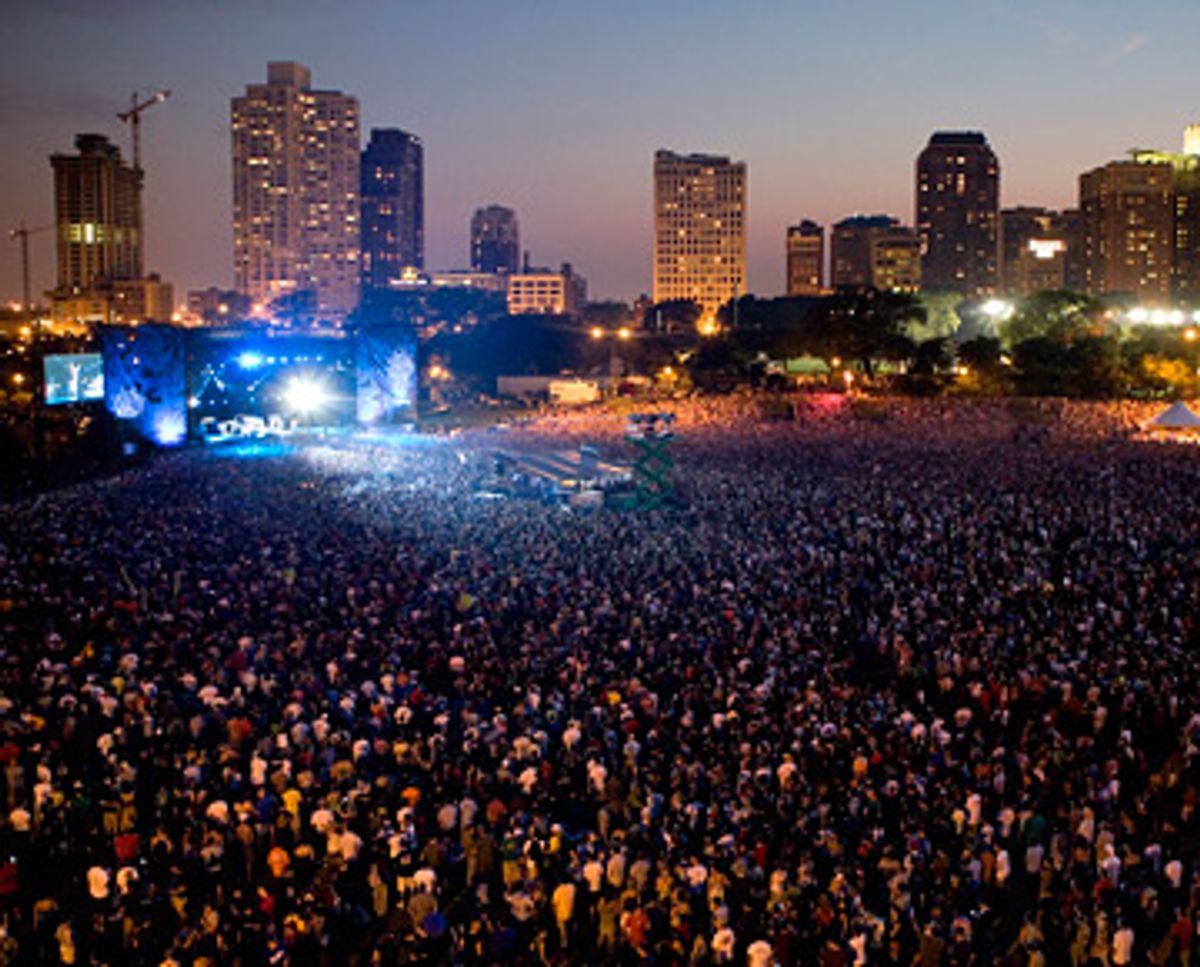
Lollapalooza

Aug. 1-3

Grant Park, Chicago

Big names: Radiohead, Rage Against the Machine, Kanye West, Nine Inch Nails, Wilco, Cat Power

Don’t miss: The Kansas duo Mates of States combine nontraditional song structures and spirited synth-pop riffs to sparkling effect, and Seattle alt-rock duo the Gutter Twins are known for their great live show. Of the better known bands, Gnarls Barkley and Stephen Malkmus and the Jicks are unlikely to disappoint. Two promising upstart acts — Black Kids and the Ting Tings — will likely draw legions of blog-reading believers.

Survival tips:: “The site’s very, very big — 3/4 of a mile,” says promoter Lisa Hickey. “Wear comfortable shoes, and plan in advance.”

Special features: Lollapalooza features environmentally friendly programs including “Greenstreet,” an on-site greening “museum” sponsored by Whole Foods, where festival-goers can learn about products’ environmental footprint and buy food, clothes and other goods from various Whole Foods-approved green vendors. It beats bad acid.

VIP perks: In addition to VIP passes, which include prime seating, food and alcohol, and “mini-spa treatments,” Lollapalooza kicks up the luxury with “private cabanas” for parties of 20 to 100 people. If you can shell out the $1,250-$1,500 per person, you’ll get your own lounge, a private viewing platform at the main stage and your own personal bar staff. Of course, for that kind of money, you can also just take all your friends to Puerto Rico.

Prices: Three-day passes: $190; Lollalounge VIP pass: $850. Private cabanas: $1,250 per person for prime section; $1,500 per person for premier section.

www.lollapalooza.com

- – - – - – - – - – - -

Virgin Festival

Aug. 9-10

Pimlico Race Course, Baltimore

Big names: Foo Fighters, Kanye West, Nine Inch Nails, Stone Temple Pilots, Wilco, Bob Dylan

Don’t miss: This is another one of those dizzyingly eclectic mega-festivals that aims to please every member of a household. Your indie rock little brother can crush on British soul chanteuse Duffy while you engage in a little Balkanized rabble-rousing with gypsy-punks Gogol Bordello. You and bro can rendezvous with your parents later at the Wilco show. Ditch the family altogether on Sunday, when Black Rebel Motorcycle Club stages its West-Coast brand of high-octane, psychedelic garage rock and Iggy and the Stooges kiss Charm City goodnight with their legendary, frenzied rock show.

Bathroom break: Skip Stone Temple Pilots and Moby, unless you have some affinity for self-important fashion victims reliving the ’90s. Also steer clear of Taking Back Sunday, that perfect storm of angst, anger and hair gel.

Survival tips: Even though Virgin bans all outside food and drink from the site, you are allowed two factory-sealed bottles of water per person. So pack up the water, and save your money for overpriced beer.

Special features: In a gambling mood? Go bet on a horse at the on-site Pimlico race course. And of course, because this is Baltimore — home of John Waters and Frank Zappa — there are bound to be freaks galore! The festival Web site promises “stilt walkers, fire eaters, guitar bots and trapeze artists who dangle from motorcycles.”

VIP perks: VIPs have access to exclusive viewing areas, an air-conditioned “Chill” lounge, free refreshments, “real restrooms” (an item that doesn’t bode well for general-admission plebes), goody bags and a shuttle service. But if it’s liquor you’re looking for, don’t expect much: Your $450 only buys a “welcome cocktail” when you arrive and a Sunday-morning Bloody Mary.

If you can’t make it: Get your passport in order and head up north to check out similar lineups at Virgin festival dates in Toronto and Calgary.

Prices: Two-day pass: $175; VIP: $450. Single-day general admission: $97.50; VIP: $250

www.virginmobilefestival

- – - – - – - – - – - -

HIP-HOP

Rock the Bells

July 19-Aug. 30

10 dates in major cities

Big names: A Tribe Called Quest, Nas, Mos Def, De La Soul, Rakim, Method Man & Redman, Raekwon & Ghostface (except at the Chicago show, which they are missing for the Pitchfork Festival)

Don’t miss: There are not a lot of acts worth missing at this granddaddy of hip-hop festivals. The big draw is South Central alt-rappers Pharcyde, who reunited specifically for Rock the Bells. Reunions seem to be the name of the game, with A Tribe Called Quest and most of Wu Tang Clan taking the stage.

Bathroom break: Though they sometimes throw a mean party, De La Soul are inconsistent performers, and the Cool Kids are a high-concept flash in the pan.

Survival tips: If you plan on hitting the Jones Beach date, be forewarned — the site is alcohol-free, which means it’s probably not the best time to throw down for VIP passes (hardly a bargain without free booze).

Milieu: Though festival organizer Chang Weisberg describes the Rock the Bells crowd as “politically conscious” and “revolutionary,” he thinks this year’s inclusion of Mos Def, De La Soul and A Tribe Called Quest will have an aphrodisiac effect on the scene. “This year, it’s going to be lots of ladies, waving their hands in the air and just getting down,” says Weisberg. “It’s the party year for Rock the Bells.”

VIP perks: On top of the normal VIP amenities, Rock the Bells’ VIP pass offers various free stuff like a backpack, a microSD memory card, and, according to Weisberg, “a chance to party with A Tribe Called Quest.”

If you can’t make it: Check out Paid Dues. Same vibe, same promoter, and almost the same lineup (add Blackalicious and GZA, subtract Tribe and the rest of Wu Tang).

Prices: Tickets: $32.50-$125 (varies by seat/venue); VIP: $140-$250

www. guerillaunion.com/rockthebells

INDIE ROCK

All Tomorrow’s Parties New York

Sept. 19-21

Kutshers Country Club, Monticello, N.Y.

Big names: My Bloody Valentine, Yo La Tengo, Dinosaur Jr., Built to Spill

Don’t miss: ATP NY’s clear draw is My Bloody Valentine — the British shoegaze icons are visiting the U.S. for the first time in 16 years in anticipation of their first new album since 1991′s classic “Loveless.” But the rest of the lineup is fantastic, too. Psychedelia is well represented here, in bands as spare and droney as Wooden Shjips and as bracing and symphonic as Mogwai. Also making a rare appearance is Harmonia, a ’70s krautrock supergroup made up of members of Neu! and Cluster.

Survival tips: Unless you’re local to the Catskills, you’ll need to find somewhere to stay during the festival. Spots at Kutshers have sold out, but ATP is happy to book you a three- or four-person room at the nearby Raleigh Hotel. If $150 extra per person doesn’t thrill you, there are plenty of campgrounds in the area.

Special features: ATP NY includes Don’t Look Back, an evening dedicated to bands playing their classic albums in their entirety. Built to Spill has signed on to play “Perfect From Now On,” Sonic Youth’s Thurston Moore will perform “Psychic Hearts,” Tortoise is doing “Millions Now Living Will Never Die,” and the Meat Puppets will be reliving “Meat Puppets II.”

If you can’t make it: You can still catch My Bloody Valentine at a few more dates in New York, Santa Monica, Calif., or San Francisco this fall. But act fast — the Chicago performance is already sold out, as is one of two New York shows.

Prices: Three-day pass: $225 plus optional accommodations

www.atpfestival.com/events/atp-ny

- – - – - – - – - – - -

Pitchfork Music Festival

July 18-20

Union Park, Chicago

Big names: Public Enemy, Jarvis Cocker (of Pulp), Dinosaur Jr., Animal Collective and Spoon

Don’t miss: The Pitchfork lineup is unusually strong this year, boasting performances by the holy trinity of new-school, static-worshiping punk acts: Jay Reatard, No Age, and Times New Viking. Dirty Projectors’ layered vocals and lush but lo-fi instrumentals are gorgeous on record — and positively sublime in the flesh. Be sure to catch some time-tested bands, too: Spiritualized often travel with a full string section in tow.

Bathroom break: Though Vampire Weekend has pretty much dominated the music press this year, their live performances are famously lackluster and amateurish.

Survival tips: “We’re probably the easiest festival to get to via public transportation,” says Mike Reed, the event’s founder and promoter, noting that Union Park is close to a train stop, two bus lines and two highways.

Special features: The first evening of the festival will be devoted to Don’t Look Back, organized in cooperation with All Tomorrow’s Parties. Artists performing entire albums here will include Public Enemy (doing “It Takes a Nation of Millions to Hold Us Back”), Sebadoh (“Bubble and Scrape”), and Mission of Burma (“Vs.”).

Milieu: Reed describes Pitchfork as a “boutique event” whose core audience comprises “a lot of late 20s folks in their offices, trolling Web sites to find out about new music,” but acknowledges that there will be a strong, college-aged hipster contingent, too.

If you can’t make it: There are a lot of similar, if smaller-scale, festivals taking place throughout the summer. We recommend Whartscape, Baltimore’s intimate, four-day extravaganza, and the Village Voice’s free rock show by the (Coney Island) seashore, Siren Music Festival.

Prices: Three-day pass: $65 (sold out); Friday: $30; Sat & Sun: $50

www.pitchforkmusicfestival.com

- – - – - – - – - – - -

PUNK

Vans Warped Tour

June 20-Aug. 17

About 50 dates nationwide

Big names: Paramore, Against Me!, Gym Class Heroes, All-American Rejects

Don’t miss: Kevin Lyman, Warped Tour’s creator, calls this year’s lineup “one of our most diverse ever.” And he’s right. Straying from the skate-punk that comprises Warped’s core will yield some great selections, including underground MC MURS, giddy Sonic Youth protégés Be Your Own Pet, grind-core experimentalists Dillinger Escape Plan, and the all-girl, Japanese ska outfit Oreskaband. If you must indulge your love of pop-punk, stick with time-tested veterans like Pennywise, the Vandals, and Bouncing Souls.

Bathroom break: There are a lot of bland, similar-sounding bands on this bill, but Angels and Airwaves get our vote.

Survival tips: Show up early, because you won’t know in advance when the bands you want to see will be playing. “I don’t write the schedule till the morning of the show,” says Lyman. That means there are no official headliners, with popular and obscure bands alternating throughout the day, in an attempt to ensure that festival-goers check out all the artists Warped has to offer.

Special features: Warped has always included a strong activist element, and this year is no different. The tour is running a program called Earth Echoes, which finds creative ways to exercise the conservationist credo “reduce, reuse, recycle.” They’ll also be partnering with Declare Yourself to register voters and conducting on-site skin cancer screenings.

Milieu: Although the Warped Tour draws a lot of teenagers, Lyman says that in the past few years older punk fans are coming back to acquaint themselves with new music.

Prices: Tickets: around $30, exact price varies by venue

www.warpedtour.com

- – - – - – - – - – - -

WORLD

KCRW World Festival

June 22-Sept. 21 (six Sundays throughout the summer)

Hollywood Bowl, Los Angeles

Big names: Feist, Gnarls Barkley, Gilberto Gil, Bebel Gilberto, UB40, Beres Hammond, Barrington Levy

Don’t miss: For 10 years, the KCRW festival at the Hollywood Bowl has combined popular and lesser-known artists from around the world. This year we’re most excited about the pairing of freak-folk wunderkind Devendra Banhart and Gilberto Gil, Brazil’s legendary singer-songwriter (and the country’s minister of culture!). Also check out Gnarls Barkley sharing a bill with the Senegalese Afro-Cuban superstar Youssou N’Dour and Seattle-based noise-rockers Deerhoof.

Bathroom break: In the cluttered field of American summer festivals, KCRW stands out with a program that is interesting, diverse and thoughtfully composed. That said, UB40 are likely to be schmaltz city. Run for cover.

Survival tips:: “Come early. Bring a picnic. Bring some wine,” says festival program manager Laura Connelly. She also suggests that visitors take the city bus, as the 3,000 parking spots on site fill up fast. Because the Hollywood Bowl is a county venue, neighborhood curfews shut it down at 10:30 on Sundays, so plan something in the city if you want to make it a late night.

Milieu: Think of KCRW attendees as the more adventurous cousins of the NPR crowd. Connelly calls them “well-educated and fun with eclectic tastes.”

Special features: VIP passes be damned. The perks at KCRW go to the Hollywood Bowl season ticket holders, or “subscription members.” If you have a subscription, you can skip the lines, buy souvenirs at a discount and get the best seats in the house, where, according to Connelly, “everyone knows their neighbors.”

Prices: Single-day tickets: $10-$96

www.kcrw.com/events/worldmusicfestival-2008

Judy Berman is a writer and editor in Brooklyn. She is a regular contributor to Salon's Broadsheet.

Quick Hits: Anoushka Shankar performs ISHQ

Legendary sitarist and daughter of Ravi Shankar performs live at New York's City Winery

  • more
    • All Share Services

There was a time when Anoushka Shankar’s music fell under her father’s shadow—how could it not, when you play the sitar and your father, Ravi Shankar, just happens to be the most famous sitar master in the world?  But Anoushka has established herself as an extraordinary musician in her own right, with her own distinct voice. In London she recently won the Songlines Music Award for Best Artist of 2012. Her new album, “Traveller,” finds her exploring the common roots of Indian classical music and Spanish flamenco.  She says the technical challenges were formidable, but the music explodes with an intensity that makes it all sound natural—and beautiful.

And as she explains to SOUND TRACKS reporter Arun Rath, she managed to get it all done through the pregnancy and birth of her first child, who now travels with her on tour.

Trust me on this: The Beatles’ “Let It Be”

The acclaimed author hopes his daughter finds her own musical path but still felt proud when she loved the Beatles

  • more
    • All Share Services

Trust me on this: The Beatles' (Credit: Johnathan M. Thomas via Shutterstock/Salon/Benjamin Wheelock)

How many more of these stories about dads playing music for their children? Every Father’s Day this story comes around! The kid agreeably listens to the beginning of the Goldberg Variations, and then repairs to his bedroom to play with blocks. The kid, no matter how we spin it, ex post facto, is not the center of the story. The dad is. Did I ever pay attention when I was the kid myself? My dad foisted Beethoven on me when I was in grade school, 9th Symphony. He also had a liking for show tunes. Neither rubbed off on me, not Beethoven, not show tunes.

What I remember is when my parents bought that brand-new album “Abbey Roadand played this LP on their brand-new faux-antique console hi-fi, right about when they were separating. That had some impact. I can remember feeling like “Golden Slumbers,” McCartney’s brief, melancholy lullaby from that Beatles album, was a lullaby for me in a time when I could have used one.

Well, now I am a dad myself, and I don’t want to make my daughter have to listen to stuff she doesn’t want to listen to (though, in fact, I have tried to sneak Sun Ra onto the stereo in her presence). I don’t want her to feel that music is an intergenerational chore. I would do almost anything to make sure that music, for her, is something to love.

And yet: Nothing makes me happier than when my daughter does take to a particular piece of music on her own. Recently, e.g., she became obsessed with a very excellent tune by the Pogues. It was “If I Should Fall From Grace With God,” which my daughter refers to as the loud-and-fast song. As in: Papa, play the loud-and-fast song. No delight is more delightful than dancing to the loud-and-fast song with a 3-year-old specialist in the pogo.

And yet, sometimes, it must be observed, the sadder songs are the more genuine songs, or: there are times when the sadder songs come into focus, or: perhaps affirmation in a song is a thing of which one should always be suspect. And so there was a day recently that I was spending the day with my daughter, just me and her, and after all the usual pastimes had been exhausted I said, at last, falling into the trap of so many dads, We still have a few hours here, how about we listen to some music?

I put on “Let It Be.” By the Beatles. In fact, I put on the song “Let It Be.” And I’m talking about the version from “Let It Be,” the Phil Spector production, not the George Martin-produced single that you can find easily, not the “Let It BeNaked” version, which I actually love, too, because I like hearing how guitarist George Harrison thought about what he did on the various recordings. I played my daughter the “Let It Be” I knew best, and which had bludgeoned me much as “Golden Slumbers” had, back in the day, when things at home were coming unglued.

I played the song for her while I was making her a sandwich. It’s really unusual for a 3-year-old to stop moving, unless she’s asleep, and my daughter was not asleep. But she was pretty still. She was transported by the song. Look, you have heard this song 10,000 times, I have heard this song 10,000 times, we are somewhat impervious to the charms of this song, even though it’s a very beautiful song, but when you play it for someone else, in this case someone else who has never heard the song at all, you get back something lost, the original emotional freight of the thing. And with “Let It Be,” which is apparently about a dream Paul had about his dead mother, and, self-evidently, also about the Beatles breaking up, it is hard not to feel that the title, the refrain, is sung with real insight, a real understanding about what it feels like to need the sentiment expressed therein. There really is a lot of misunderstanding and disagreement and dispute in the world, all of it essentially pointless, our time here is so brief, and it would be better if we could all just …

Now, when you’re 3, a sentiment of this kind has maximum impact when repeated, but it’s repeated a lot here, in the song, over and over, and my daughter picked it up quick, the theme, but not so quick that she didn’t want to hear the song again, and so I played the song again, and finished making the sandwich, and then she wanted to hear it again, and I played it again, and then again, and on the third or fourth repetition, that plaintive, moving quality had begun to empty out again, and I was just hearing the song I had heard 10,000 times, and then my daughter asked for it a few more times. We played it six times. That first day. And we have played it more times since. Papa, play that “Let It Be” song.

What’s it like to have resounding success in the dad-playing-music-for-the-kid sweepstakes? I am not sure I want my daughter feeling like she has to like something just because I played it for her. I would like to provide an opportunity, make the music available, then step out of the process, so that she’s absolutely liberated, so that she has self-determination in the matter of her musical interests. That way she can die for Uncle Rock or Dan Zanes if that is what she wants. But I can’t deny, and especially not here, the sense of pride that I feel when she likes something that I too liked, once upon a time in the suburbs. I hope she can do the same when she’s a parent. Maybe one day she’ll share with me things she likes with the same enthusiasm. And maybe one day I can sell her on Sun Ra.

Continue Reading Close

Rick Moody is the author of five books, including "Demonology."

Concord Music Presents: Joe Walsh – “Wrecking Ball”

Joe Walsh performs "Wrecking Ball" live at the Troubadour in West Hollywood, CA

  • more
    • All Share Services


"Wrecking Ball" is off Joe Walsh's new album, Analog Man, available June 5th. Pre-order now on CD and vinyl, plus exclusive T-Shirt bundles.

Born in the U.S.A.: When the president met the Boss

Bruce Springsteen's politics were unformed in the '80s. When Ronald Reagan invoked his name, that changed fast

  • more
    • All Share Services

Born in the U.S.A.: When the president met the BossBruce Springsteen (Credit: AP)
Excerpted from "Bruce Springsteen and the Promise of Rock ‘n’ Roll" by Marc Dolan. Copyright © 2012 by Marc Dolan. With the permission of the publisher, W.W. Norton & Company, Inc.

In the same week that “The River” hit No. 1, in a seemingly unrelated event, Gov. Ronald Reagan of California was elected the 40th president of the United States, garnering a whopping 489 Electoral College votes, while incumbent Jimmy Carter received a mere 49. During the last days of the campaign, Bruce Springsteen and the E Street Band were on tour, of course, still promoting the month-old “River,” but they had election night off. The next night, on November 5, they played a concert at Arizona State University in Tempe that was virtually identical to the one they had played in Los Angeles the previous Thursday — except that it was longer. “All you guys in the aisle find your seats, OK?” Bruce announced three songs in. “There’s gonna be a real long show.”

That night Springsteen rambled, more than usual. Before the postindustrial triptych of “Independence Day,” “Factory” and “Jackson Cage” midway through the first set, he began a long monologue, although not about his father, whom he frequently talked about before “Factory.” Instead, Springsteen used this opportunity to talk about his love of pop music, about what it had meant to him growing up. Spontaneously, falteringly, he offered the most coherent argument he would ever make for the essential unity of the two distinct compositional strains that had flowed into “The River,” its idealistic and pessimistic “hearts”:

I never did good in school, never did good, and they always figured that if you’re not smart in school, it’s because you’re dumb. But I always felt that I never really learned anything, or learned anything that was important to me, till I started listening to the radio back in the early ’60s. And it seemed that the stuff that I was hearing off the radio in all those great songs was stuff that if they knew how, they’d be trying to teach you in school … but they just didn’t know how to. They always talked to your head, they could never figure out how to talk to your heart, you know. And it seems that, like all those singers and all those groups, there’s one thing that they just knew: what it was about. And when I started listening, I found out that the first time … that, instead of the fantasies that you have when you’re a little kid, I had dreams now and that they were different, it was different, and that if that was possible, that I didn’t have to live my life the way that I was, that things could be better. If you just go out, take a chance, find out what’s going on …

It was only toward the end of the first set in Tempe that Springsteen finally addressed the election. “I don’t know what you guys think about what happened last night,” he said as a transition between “The River” and “Badlands,” “but I think it’s pretty frightening. You guys are young, there’s gonna be a lot of people depending on you coming up, so this is for you.” When you listen to recordings of this concert, during this speech you hear scattered cheers from the crowd, but nowhere near as strong as when Springsteen actually started the next song.

Springsteen’s comments before “Badlands” in Tempe that night were virtually the first recorded statement he ever made about politics. At the MUSE concerts a year earlier, he was practically the most apolitical performer on the stage. He had played a small acoustic benefit for George McGovern’s campaign at the Red Bank Drive-In in 1972, but there is no other record of his ever endorsing a political candidate up to this point, or even expressing displeasure with one as he did in the wake of Reagan’s election. In subsequent interviews, he would admit that he had maybe voted once, but no more than that. Like the draft or Kent State, politics was something that happened outside of his life, to his life, while he was trying to make his dreams come true. And he was obviously not the only American who viewed politics that way, especially not in the fall of 1980. Ronald Reagan’s victory, much closer in the popular vote than in the Electoral College, reflected the will of about a quarter of the electorate; only a little more than half of those eligible to vote had done so that year. Like Bruce Springsteen, many other Americans at that point in our history were essentially apolitical.

But there’s a subtle difference between politics and ideology, between elected officials and the policies they enact on the one hand and the underlying principles that cause people to trust or distrust politicians on the other. You can live your life without ever having an opinion on any elected official or legislative body, but you cannot live your life as an adult without having some notion of what a better world would look like. In the late 1970s, as the two dominant political parties in the United States reacted to contemporary economic crises by dissolving into ever greater procedural disarray, such utopian visions of what might work better suddenly became far more important. In 1979, however, only the college professors called this “ideology.” The word that both First Lady Rosalynn Carter and the Reverend Jerry Falwell of the Thomas Road Baptist Church started using that year was “values.”

In 1979 and 1980, as Bruce Springsteen crafted “The River” and began touring to support it, his politics were virtually nonexistent, but his ideology — his “values,” if you must — was all over his songs. Springsteen believed in “freedom,” in as vague a sense as any American would define it, in the freedom to head out where you wanted when you wanted with whomever you wanted with no bossman or exaggerated patriarch telling you what to do. On Springsteen’s first four albums, his ideal world was the road, the way to the next great place but not necessarily the place itself, because all fixed places had the potential to trap you. In Springsteen’s songs, success was seldom material success (no matter how much the singer might want it in real life). In most cases, the success his characters dreamed of or attained was mere survival, making their stand in an environment that was constantly trying to grind them down.

Half of “The River” reinforced this view, not only such “Darkness” survivors as “Sherry Darling” and “Independence Day” but such newer songs as “Ramrod,” “Jackson Cage,” “Out in the Street” and “Cadillac Ranch” as well. There were also all the new songs about connection (“I Wanna Marry You,” “Fade Away,” “Stolen Car,” “The Price You Pay,” “Drive All Night,” and “Wreck on the Highway”), but they were about personal commitments rather than communal ones. Both these aspects of “The River” were undeniably ideological, but they were not political; they sought no help for their characters through governmental or collective action. Even in the album’s title track, the characters’ situation seems more mythic than political. In that song, Springsteen sings, “Lately there ain’t been much work on account of the economy,” but there is no sense here that these characters’ problems could be fixed by a government stimulus package or a cut in the mortgage rates. Their problems are synchronic rather than historical and must simply be endured.

But during this same period, as the nation around him felt adrift in an uncertain and uncommitted age, Springsteen was crafting his first specifically topical songs in almost a decade, since the trendy, epic antiwar songs he had written during the Nixon era. The most obvious of these was “Roulette,” written in a white heat during the first week after the event at Three Mile Island but by all accounts never seriously considered for the album. Almost a year later, toward the end of the “River” sessions, Springsteen had also written the little gem “Held Up Without a Gun,” which managed to turn the most pressing political issue of the late 1970s — the exorbitantly rising price of gasoline — into a rocking good joke.

Indeed, with the gas crisis of the Carter years, history practically forced Springsteen to consider the political implications of his apolitical, personal ideology. In his pre-1979 songs, as in rock songs since at least Chuck Berry, cars and motorcycles were the vehicles of the individualized freedom that he craved. In the late 1970s, however, ration-starved cars and motorcycles became much more specific cultural symbols, emblems of how Americans saw their personal freedom limited by current events. Gas prices had been rising since the beginning of the decade, and in one day, June 28, 1979, OPEC raised the price of a barrel of crude oil by 24 percent. That summer, as Springsteen labored at the Record Plant, blocks-long lines at gas stations became a common, even violent occurrence.

Suddenly, Springsteen’s favorite form of mindless fun had taken on economic, political, and even international significance. The two roadhouse numbers he and the band cut that fall, “Ramrod” and “Cadillac Ranch,” spoke about the sheer fun of driving, in purely sensual terms that were a world away from the desperate tales of escape he had trafficked in on his last two albums. Simultaneously, though, in songs like “Stolen Car” and “The River,” it was also becoming clear that cars could take you nowhere as well, that they could signify escape in the sense of avoidance rather than freedom. In many ways, the great lost album that Springsteen could have released but didn’t in 1980 was a single disc of songs about cars, taking in the freedoms and restrictions that they made possible for his fellow citizens. It would have been a perfect project to release during a year in which driving was an implicitly ideological act.

- – - – - – - – - – - -

Like many other Americans of his era, Springsteen was caught up in the “crisis of the American spirit” about which President Carter had spoken during that same brutal summer of 1979. This was another part of Springsteen’s dissatisfaction during the late 1970s, a more abiding need than could be solved by a simple Top 10 single. He knew that something was missing in his life, that just driving off into the night wouldn’t fill the absence he increasingly felt in his soul, but he was still nowhere near embracing Carter’s solution to this crisis: increased civic involvement. “In a nation that was proud of hard work, strong families, close-knit communities, and our faith in God,” Carter had declared, “too many of us now tend to worship self-indulgence and consumption.” Springsteen obviously believed in hard work, but the only community he had ever been a part of was the Upstage. Ever the proud individualist, he was innately suspicious of virtually all systems, structures, clubs, and experts, even if they claimed they were trying to help him.

In other words, Springsteen’s criticism of Ronald Reagan from the stage in Tempe was in no way a too-late endorsement of Jimmy Carter. It was simply a voiced suspicion of Reagan, who had been clearly labeled a public enemy of rock ’n’ roll since Jeffrey Shurtleff’s mockery of him at Woodstock at the absolute latest. Given his later admissions of political apathy during the 1970s, it is doubtful that Springsteen was acquainted with too many of the specifics of Reagan’s political platform. He just seemed like the kind of person who wouldn’t be too comfortable with “freaks.”

Nevertheless, there was more truth than Springsteen realized to his knee-jerk statement that he didn’t know what his fans thought about what had happened the previous night. What Springsteen probably didn’t know at that time, but would become clear once the 1980 election results were more closely analyzed, was that the youth vote broke slightly for Reagan, with many of the youngest baby boomers casting their first presidential votes that year for the former California governor. Moreover, Reagan received 49 percent of the Catholic vote, 40 percent of the union vote, and 24 percent of the votes cast by registered Democrats, all groups to which Springsteen had strong personal ties.

We will never know for sure, but statistically there is an excellent chance that many of the young women and men in Springsteen’s audience in Tempe who had voted the previous day had voted for Ronald Reagan. This may have seemed inconceivable to Springsteen, but if you weren’t listening carefully, it was surprisingly easy to be a fan of both men that fall. Like Springsteen (not to mention the pop singers of the 1960s whom he so admired), Reagan spoke to the heart, not the head; he “made sense of the world narratively”; and he thought that structures and institutions tended to get in the way of individual effort — all attitudes surprisingly consonant with the ethos of a song like “Out in the Street,” for example. The night before the election, Governor Reagan had even declared that he would be honored to lead what he called “the freest society the world has ever known.” Until Bruce Springsteen started telling audiences what he thought about the Soviet Union or the size of the federal budget — until he told them specifically what he found frightening about the president-elect, which he did not do that night in Tempe — it was perfectly understandable for his more casual fans to think that he might be a “Reagan Democrat” too.

- – - – - – - – - – - – - -

In 1980, Ronald Reagan ran for president mostly on what he considered the most important issues: lowering taxes, shrinking the federal government, rebuilding U.S. defense in the face of what he deemed a détente-emboldened Soviet Union. That year, his campaign aired cheap-looking TV spots in which the candidate spoke directly to the camera about soaring energy costs in front of a fake-looking shelf of books, as if he were a personal-injury lawyer looking for new clients. Four years later, however, after closely reading the poll data, in-house pragmatists like James Baker counseled the president that his long-standing supporters would vote for him no matter what. For the reelection campaign, Reagan’s team focused on images rather than issues, particularly in its advertising, which featured suburban homes, rural churches, forests, and gardens, all of them signifying a bucolic America that the ad copy suggested the president had restored. In 1980, the campaign had sold Reagan. Four years later, it was selling a putatively reborn America, in order to pull in voters who didn’t agree with the president already on specific political policies.

So, just as Bruce Springsteen and his advisers were plotting in the spring of 1984 to snag the broadest possible segment of the record-buying public, Ronald Reagan and his advisers were planning that same season in strategically similar ways to pull in the largest possible portion of the electorate. Reagan might be proceeding from the House Un-American Activities Committee-based right and Springsteen from the Monterey Pop-based left, but in 1984 each man was seeking to go beyond the loyal base that he had painstakingly built during the 1970s in order to capture the hearts and minds of the much wider American center. Viewed side by side, their relaunches look strikingly similar at points, particularly in terms of the visuals they presented. Like Springsteen’s “Dancing in the Dark” video, “Morning in America,” Reagan’s most famous 1984 reelection ad, was filled with pastels and variations on the American tricolor: pretty red roses, a true-blue sky over the District of Columbia, and dazzlingly bright white picket fences and wedding gowns. A casual observer might think that Springsteen was trying to cynically cash in on the contemporary rise in patriotism, but the reverse was actually true: Reagan and his team were, like Springsteen, trying to put on a good show. Walter Mondale might have sought to be the rock ’n’ roll candidate of 1984 by using a Crosby, Stills and Nash song in one of his advertisements, but the sad truth of that year’s presidential campaign is that Reagan knew how to throw a better arena-style concert than Mondale did. Skydivers, hot-air balloons, and forty thousand people chanting “U.S.A.!” may not have been how Franklin Delano Roosevelt would have kicked off a reelection campaign, but it did sound like one hell of a finale for a Van Halen concert.

Politically, Springsteen’s sympathies may have been more with the Democratic camp, but when Democratic politicians spoke about America, none of them seemed to describe the country found in Springsteen songs. At the Democratic National Convention in San Francisco in mid-July — a month after Bruce’s stand at Alpine Valley — Governor Mario Cuomo challenged Reagan’s invocation of John Winthrop’s “shining city on a hill” by speaking about “the other part of the city [where] there are more poor than ever, more families in trouble, more and more people who need help but can’t find it.” Two nights later the Reverend Jesse Jackson famously spoke to the convention of “our Nation [as] a rainbow.” What both Reagan and Springsteen understood in 1984, however, was that, after the last 15 or 20 years of battering national history, most Americans didn’t want their nation to be two or many. They wanted it to be one. As one Reagan aide remarked in a memo written on March 8 (while Arthur Baker was adding aerobic-friendly rhythms to the already synth-heavy “Dancing in the Dark”), “If we allow any Democrat to claim optimism or idealism as his issue, we will lose the election.”

Ronald Reagan’s most deeply held ideological tenet, far more important than any specific policy that might have grown out of it, was his belief that the United States was a nation of individuals. In his acceptance speech at the Republican National Convention, Reagan contended that the core change that his administration had made during the last few years was to shift the government from a philosophy of “statism” that only viewed “people in groups” to one that advanced “the ultimate in individual freedom consistent with an orderly society.” For the casual listener, how different was that from Springsteen’s current variation on the Elvis Presley freedom speech from four years before, now used to introduce “Born to Run” (in this case, in Largo, Maryland, two nights after Reagan accepted the Republican nomination)?

When I was a kid growing up, and I first heard the music of Elvis Presley, the main thing it did for me was it set my mind free a little bit. I could dream a little bit bigger than I had been. His music and the best of rock ’n’ roll always said to me “Just let freedom ring,” and that’s what we’re here for tonight. But remember you gotta fight for it every day.

For the most part, this was as political as Springsteen got in the summer of 1984. Despite the presence of two or three “Nebraska” songs every night, Springsteen’s most notable response to contemporary politics on this tour so far was his decision to cover the Rolling Stones’ “Street Fightin’ Man” during his encores many nights, as significant an addition on this tour as “Who’ll Stop the Rain” had been four years earlier.

That night at the Capital Centre in Largo, “Street Fightin’ Man” directly followed “Born to Run” during the encores, its first appearance after a two-week absence. In the audience that night was syndicated columnist George Will, who had been invited to the show by Max Weinberg’s wife, Rebecca, who was a fan of his tag-team punditry with Sam Donaldson on Sunday morning TV. For his first and only Springsteen concert, Will wore a bow tie, double-breasted blazer, and dress slacks rather than the increasingly de rigueur denim. At Rebecca’s suggestion, the columnist also stuffed cotton in his ears. In general, Will found Springsteen androgynous, noisy and surrounded by pot smokers, yet in the end he concluded that the singer was “a wholesome cultural portent.” As a political commentator, Will may not have cared about rock ’n’ roll’s future, but he did see Springsteen’s abundant success as an emblem of a robust American present.

Although his columns that year never made this clear, George Will was in fact an off-the-books adviser to the president’s reelection campaign. He seems to have come up with the idea of linking Springsteen with Reagan, but his genuine reaction to Springsteen’s concert was very much in keeping with the Reagan camp’s wider reelection strategy — don’t divide, co-opt. In attempting to seize many formerly liberal strains (even ones associated with the 1960s) and claim them for their own, Reagan’s advisers were piggybacking on a larger, hegemonic shift that had been building in U.S. society for the last year or two. In retrospect, historian Gil Troy has dubbed this shift “the Great Reconciliation,” which evidenced itself, in his words, “in the rise of the corporate activist, the consumer with a conscience, a society filled with people yearning to earn like Rockefellers, but occasionally live and sometimes even vote like Beatniks.”

Very much in this spirit, Will essentially announced in his column that rock was not rebellion. It was hard work. “Backstage,” he noted, “there hovers the odor of Ben-Gay: Springsteen is an athlete draining himself for every audience.” Moreover, he classified Springsteen’s brand of rock as a well-made American product, one that produced large profits and need not be shipped overseas (except on well-managed tours). “If all Americans,” Will continued, “—in labor and management, who make steel or cars or shoes or textiles — made their products with as much energy and confidence as Springsteen and his merry band make music, there would be no need for Congress to be thinking about protectionism.”

Whether it was just a lucky accident due to Will’s vacation schedule or a more purposeful delay to help out the president’s cause, Will’s column on Springsteen finally appeared in print on September 13: Over a month after the concert he had attended; a week or so into the official presidential campaign; as “Dancing in the Dark” sank down to no. 50 on the Hot 100, “Cover Me” rose to no. 15, and John Cafferty and the Beaver Brown Band’s ersatz E Street track “On the Dark Side” sat between the two genuine articles at no. 37. Less than a week later, Ronald Reagan made a scheduled stump appearance in Hammonton, N.J., a fairly rural community about an hour’s drive southwest of Freehold and half an hour northwest of Atlantic City. At this appearance, Reagan’s standard stump speech was altered as usual to include a local reference or two. In this case, the president noted, “America’s future rests in a thousand dreams inside your hearts. It rests in the message of hope in [the] songs of a man so many young Americans admire  —New Jersey’s own, Bruce Springsteen. And helping you make those dreams come true is what this job of mine is all about.”

Over the weekend, between shows, Springsteen tried to make light of Reagan’s comments, but the impression persisted that Reaganism and Springsteenism were one and the same. When you heard Springsteen extol unrestricted individualism as he did in the Let freedom ring rap before “Born to Run,” or speak about the Revolutionary War monument in Freehold as he frequently did before “My Hometown,” you could easily understand why. Generationally specific as Springsteen’s remarks before “My Hometown” might be, they were still stylistically in tune with the similarly honorific remarks that the president had made in France in early June on the fortieth anniversary of D-Day, not to mention the tribute to the Statue of Liberty with which he had concluded his speech in Dallas.

By the night of Springsteen’s next performance, at the Civic Arena in Pittsburgh on September 21, it was clear that the singer’s Reagan problem was not going away. That night, almost the first thing Springsteen mentioned to the audience was Reagan’s appropriation of his music. “Well, the President was mentioning my name in his speech the other day, and I kind of got to wondering what his favorite album of mine must’ve been, you know? I don’t think it was the ‘Nebraska’ album,” Bruce concluded, “I don’t think he’s been listening to this one,” and he led the band into their customary rave-up on “Johnny 99.”

Throughout the concert that night, Springsteen made his displeasure at the current administration known, as he had done briefly after Reagan’s election and during the VVA benefit. It’s important to note, though, that in the ensuing three or four years the specific fight that Springsteen had hinted at back then had never really come. In 1980 and 1981, Springsteen implicitly feared another culture war, like the one the nation had experienced during the early Nixon years. But in its rhetoric, the Reagan administration stressed unity rather than division, especially during this election year. Rock ’n’ roll was not a designated enemy for Ronald Reagan (as it might have been for a previous Republican like Spiro Agnew); pessimism was. Springsteen seems to have prepared himself for a fight that wasn’t even an open disagreement.

That night in Pittsburgh, in trying to definitively distinguish himself from Reagan, Springsteen went somewhere he had rarely gone before: Into the politics of class — not the division of the world into conformists and free spirits, but rather its division into haves and have-nots. Pushed to articulate his political convictions, Springsteen finally moved beyond his 1960s rock ’n’ roll individualism, back to the New Deal communalism he had instinctively absorbed from his parents. Now, as he once again reformulated the monuments story before “My Hometown,” he made his most directly anti-Reagan comment yet:

It’s a long walk from the government that’s supposed to represent all the people to where we [are now. It] seems like something’s happening out there where there’s a lot of stuff being taken away from a lot of people that shouldn’t have it taken away from them. Sometimes it’s hard to remember that this place belongs to us, that this is our hometown.

This was a start. If actively articulating his political concern for those less fortunate, those who might benefit from a larger federal government, was all it took for Springsteen to distinguish himself from the president, then a statement like this should have solved his problems of misperception.

But despite Springsteen’s increasingly explicit political statements as the tour rolled on, the ideological similarities between the two men remained. Springsteen could tell you better than anyone else that music speaks louder than words, and arrangements and setlists often speak louder than both. Every night, Springsteen took his audience on the same phased journey from the bad times of late 1981 to the good times of 1983-84, precisely the same historical journey on which President Reagan took his audiences during his stump speeches; from the “Nebraska”-esque days of “drift” and “torpor” to the promise of “you young people.” “[M]y generation,” Reagan declared near the end of his standard stump speech that fall (almost setting his audience up for a rendition of “Born to Run,” his allegedly favorite Springsteen song), “and a few generations between mine and yours . . . grew up in an America where we took it for granted that you could fly as high and as far as your own strength and ability would take you.” In the end, when you compared Springsteen’s fall 1984 tour with Reagan’s, no matter how different their political visions were supposed to be, their rhetoric seemed a lot alike.

Bruce put in more appearances that fall than the president, whose campaign had restricted his stumping to two or three well-chosen photo ops a week. Springsteen was still introducing “Born to Run” by saying “Let freedom ring” but now added “but it’s no good if it’s just for one. It’s gotta be for everyone.” More effectively, he started making room at his concerts for representatives of local food banks and political organizations, giving a shout-out from the stage of the Tacoma Dome to Washington Fair Share, a local coalition dealing with the results of toxic-waste dumping in the Northwest. By that point in the tour, the rock critical establishment (in the person of Jersey Shore-born soon-to-be MTV employee Kurt Loder) had stepped in to try and reburnish Bruce’s liberal reputation. As the tour made its way down the coast to Los Angeles, Loder conducted Springsteen’s first extended interview with Rolling Stone, giving him a widely distributed, rock-friendly forum in which to make his differences from the president clear.

None of it, though, made any difference, at least not in terms of the presidential race. On Sunday, November 4, two days before the election, Bruce and the band finished up a seven-night stand in Los Angeles, pulling out a rarely performed “Shut Out the Light” as a dedication for audience member Ron Kovic. Four days later, they were right back where they had been almost exactly four years earlier: onstage at Arizona State University in Tempe, looking ahead to four years of Ronald Reagan in the White House, this time elected by a wider margin than any nominee since Franklin Delano Roosevelt nearly half a century before. This time, Bruce didn’t say anything from the stage about the election.

Reprinted from “Bruce Springsteen and the Promise of Rock ‘n’ Roll” by Marc Dolan. Copyright © 2012 by Marc Dolan. With the permission of the publisher, W.W. Norton & Company, Inc.

Continue Reading Close

Marc Dolan is an associate professor of English and Film Studies at John Jay Colllege, CUNY, and the author of "Bruce Springsteen and the Promise of Rock ‘n’ Roll"

Trust me on this: David Bowie’s “Hunky Dory”

The Old 97's singer credits Bowie's brilliant "Hunky Dory" for rescuing his adolescence and inspiring his career

  • more
    • All Share Services

Trust me on this: David Bowie's (Credit: Benjamin Wheelock)
This is the second story in the Trust Me On This series, which runs through Father's Day. You can read the other entries here.

Dear Kiddos,

Hey, you turkeys. Listen up. I need you to listen for five minutes. I’m going to impart a little wisdom. You can take it or leave it. For what it’s worth, I’d rather you took it.

The advice is this: David Bowie’s “Hunky Dory” is a perfect album, and, since perfect albums are a rare commodity, it is worthy of deep and repeated listenings.

I’m listening to “Hunky Dory” as I write this. How many times have I listened to this, my favorite record? Like a million? And it never gets old.

I discovered “Hunky Dory” by accident. I was a sad, lonely little kid. Eleven years old and obsessed with Joan Jett, another artist I imagine you kids would enjoy. Back then, the radio was still a real thing that people listened to, believed in and learned from. I stayed up past my bedtime one Saturday night during the Christmas holiday to listen to a weekly show called “The King Biscuit Flower Hour” featuring a concert by my secret girlfriend, Joan Jett. At the end of the set, she played a cover of a song that would forever change the course of my budding musical tastes, “Rebel Rebel.” As it turned out, “Rebel Rebel” would never be one of my favorite Bowie tunes, but I could detect, within its lyric, a narrative voice to which I could relate. Like really relate.

I was a latchkey kid, a thing that no longer exists. Both of my parents worked, so every weekday after school, I had a few hours wherein I could do whatever the heck I wanted. What I usually wanted to do was go to Half Price Books & Records. The next Monday, released from the grim confines of Armstrong Elementary, I walked to Half Price where I found exactly one David Bowie album. I brought home “Hunky Dory,” marveling at its weird, androgynous cover. In those pre-Internet days, one was always left with questions. Is that David Bowie on the album cover? Is that person a guy or a lady? Is it a painting or some sort of artsy photo? Is this even rock ‘n’ roll, or is it some other kind of music, the name of which has been kept a secret from me?

It was just that, some other, new kind of music. New to me, anyway. This album, recorded when I had been less than a year old, opened doors for me. And I thought I caught a glimpse of my own future. My family’s house on Gillon Avenue was empty when the needle dropped on Side A. “Changes,” turned up to top volume, was my anthem from the first line of the first verse. “Still don’t know what I was waiting for,” indeed. This was what I had been waiting for. Putting up with all the cruel dullards in my grade school, all the teachers and coaches, all the stupid kids and mean adults, had been almost unbearable. Suddenly, I wasn’t alone.

“Hunky Dory” is not a kids’ record, but there is certainly a preponderance of imagery relating to childhood. “Changes” speaks of “these children that you spit on.” “Oh You Pretty Things” has the song’s object driving his “mama and papa insane.” In “Kooks,” the singer begs his own kid to stay, reassuring the lucky little guy that “we believe in you.” At the time, I needed to hear that sentiment.  I went back to it over and over again throughout the difficult years of adolescence. David Bowie was not my dad, but he was there in a pinch.

As the album goes on, it gets weirder. And deeper. And darker. “Quicksand” offers up an epic take on the human experience, turning on a phrase that would echo dangerously throughout those most perilous years of my youth, “knowledge comes with death’s release.” I didn’t understand, but I did understand, if you catch my drift. These were meditations on the difficulty of everyday life, and the insane nature of our very existence. Heavy, beautiful stuff.

Antidotes appear in the record’s latter portion. “Happiness is happening/dragons have been bled … fear’s just in your head,” Bowie proclaims in the goofy-but-right-on “Fill Your Heart.” Then he proceeds to introduce the listener to Andy Warhol and Bob Dylan. And then comes “Queen Bitch,” wherein we meet Bowie’s longtime foil, the most underrated guitarist in rock history, Mick Ronson. The riff in “Queen Bitch” hints at what is to come on Bowie’s next LP, “The Rise and Fall of Ziggy Stardust and the Spiders From Mars,” Bowie’s breakthrough album, but “Hunky Dory” is still pre-fame Bowie at his folkie best.

Finally, he leaves us with the epic poem that is “Bewlay Brothers.” As an 11-year-old, I played it repeatedly in an attempt to decipher this song’s meaning. I wrote out the lyrics in my journal, hoping to make sense of them. To no avail. I did know that something had gone horribly wrong, there was madness and sadness, and then the record was over. Just like that.

Again and again, I listened. Memorized. Marveled. Sang along. When I could take it no longer, I found a guitar teacher and learned how to do these things myself. Well, not exactly these things, but my own version thereof. My early songs were such a pale imitation of early-’70s Bowie, that I could have been sued — had anyone ever heard my early songs. It’s quite possible that I spent the whole of my teenage years singing with an English accent. As they say, mistakes were made.

I never got over Bowie. Especially “Hunky Dory.” Many of his other records have remained favorites: “Low,” “Ziggy Stardust,” “Station to Station.” But “Hunky Dory” was my first love. I caught a lot of grief for my borderline-obsessive Bowie fandom. Kids at school used it as ammunition in their attacks on my masculinity. Did I care? Sure. Did I care enough to throw Bowie under the bus and pretend to withdraw my admiration for this artist who set me on the path I knew I was destined to follow? Hell no. David Bowie was and is my hero.

Listen, kids: I want you to hear “Hunky Dory” because I think you will love it. Like I said, it’s a perfect record, and how often do those come along? But the real reason I want you to listen to “Hunky Dory” is because, in its 11 tracks, you will find the clues that will lead you to an understanding of me, your dad. You’ll see signposts pointing the way to the path I chose in life.

Making music for a living isn’t easy. Many things about it are tough as hell: The touring and its requisite absences; the self-absorption; the occasional financial insecurity; the mood swings one attributes to the “artistic personality.” This life, however, is what I was made for. This calling is the only one I’ve ever known. I’m not curing cancer or solving the global hunger crisis. I’m making music. But there is a certain hazy nobility in that vocation. Somewhere, an 11-year-old kid may be putting on an album of mine and discovering that the universe isn’t a meaningless jumble of coincidences, that there is purpose to be found in these three-minute constructions of music and lyrics. Some small but elegant meaning.

Heck, before you guys came along, that was all I had. The great thing is that now I have everything.

Continue Reading Close

Rhett Miller is the lead singer of the Old 97s. His latest solo album, "The Dreamer," will be released on June 5.

Page 1 of 284 in Music