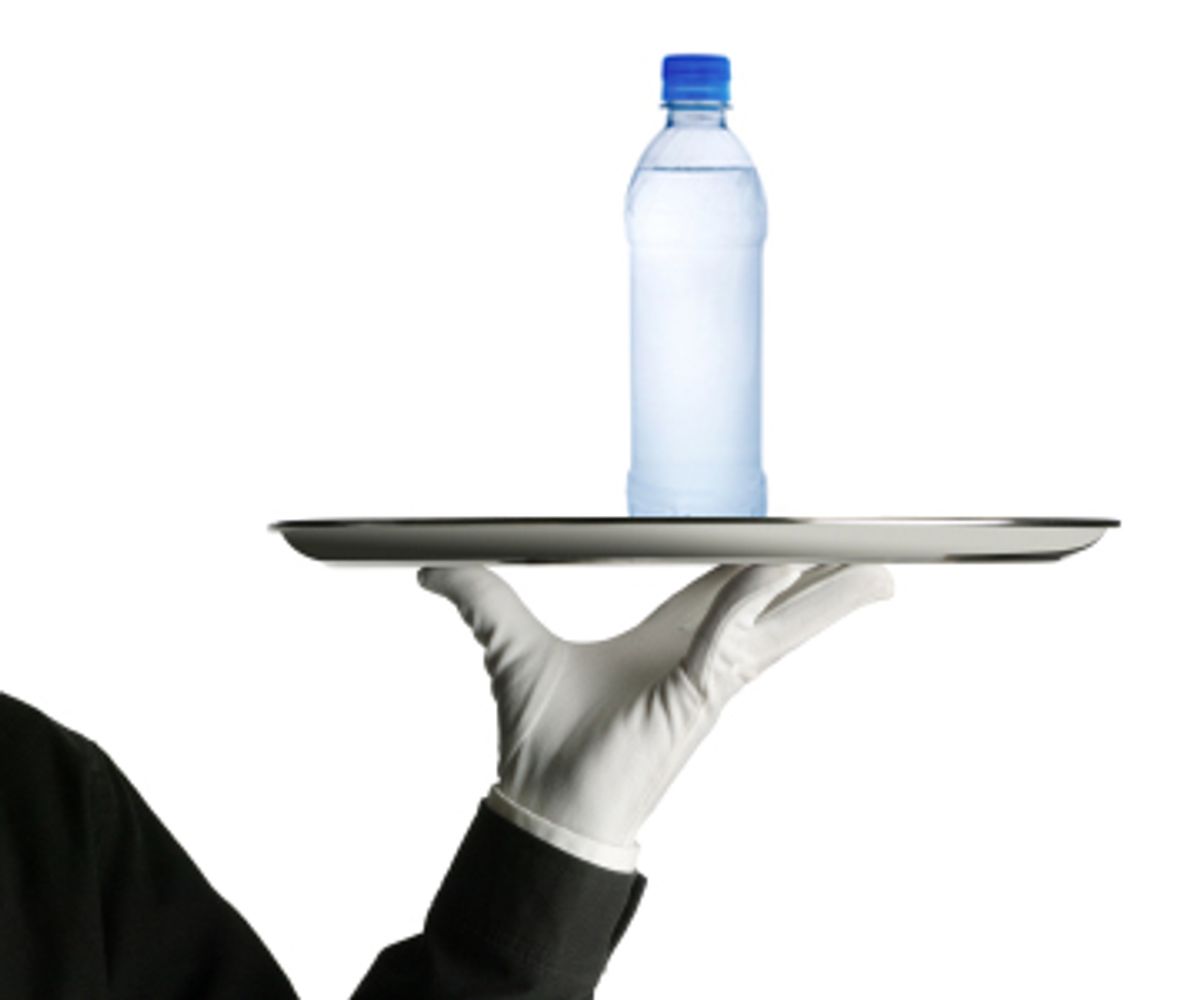
"Bottlemania" author Elizabeth Royte explains how one of life's necessities became an extravagance, denounced by environmentalists and nuns alike.

To listen to a podcast of the interview, click here.
To subscribe: Click here to add Conversations to iTunes or cut and paste the URL into your podcasting software:

Sparkling or still? Spring or tap? Imported or domestic? Flavored or plain? There’s nothing simple about a drink of water, now that the bottled stuff outsells both milk and beer in the United States. In just a couple of decades, we’ve become a nation awash in bottled water — with tens of billions of plastic empties to prove it — transforming the drinking fountain on a city street into a dated curiosity akin to the public telephone booth.
How one of life’s basic necessities became a heavily marketed beverage in a plastic bottle is the subject of Elizabeth Royte’s new book “Bottlemania: How Water Went on Sale and Why We Bought It.” Royte, an environmental journalist based in Brooklyn, N.Y., shares the many, sometimes bizarre, unintended consequences of cracking open that plastic seal.
Twenty years ago, “bottled” largely meant luxury imported from a remote spring (think Perrier); it was a sign of sophistication. Now, Coke and Pepsi sell the two most popular bottled waters in the country, Dasani and Aquafina, by simply filtering and bottling tap water. Between 1997 and 2006, sales in the United States of this newfangled beverage — water! — leapt 170 percent. Not that the upscale stuff has simply evaporated either; today, bottled water is the No. 1 item by units sold at Whole Foods. The average American now drinks almost 28 gallons of bottled water per year, while as recently as 1987 we drank fewer than six.
Yet the staggering popularity of bottled water has inspired a backlash. Royte traces the raucous fight over water rights in one community, Fryeburg, Maine, where spring water is tapped and transformed into Nestle’s Poland Spring, whose green label is familiar to many a parched Northeasterner. While wading into the environmental problems with bottled water, Royte also learns that old-fashioned tap water isn’t just suffering from a bottled water industry smear campaign — antibiotics with your water, anyone?
Salon spoke with Royte by phone from her Brooklyn home office, where she drinks her tap water, filtered, in a glass. (Listen to the interview with Royte here.)
How did bottled water get so popular?
What really happened was a kind of unglamorous technological invention — the introduction of PET plastic, which is polyethylene terephthalate. It’s the stuff with the number “1″ on the bottom, and it’s what most bottled water comes in now. Before, bottlers could put their product into polyvinyl chloride plastic, but it was heavier and more expensive, and it looked a little dull. PET was really clear, lightweight and cheap, which made it very easy to put a lot of water into bottles.
After the advent of PET plastic, Coke and Pepsi got into the business in the ’90s. Pepsi had Aquafina and Coke had Dasani. Since they already had these great distribution systems set up, it was easy for them to push their water onto supermarket shelves and into gas station coolers and everywhere. They started spending tens of millions of dollars on advertising that appealed to our interest in celebrities, models, beauty, fashion and wellness.
Why do you think that water in single-serving sizes became so popular?
Marketers hammered home this idea that we need to stay hydrated, and we need to drink eight 8-ounce glasses of water a day. If it was so important to drink all that, then portability became important.
It turns out there is no scientific basis for that eight by eight rule.
Where did that idea come from?
It got its start when the Food and Nutrition Board of the National Research Council put out a report sometime in the ’40s that said adults should drink about a milliliter of water for each calorie of food, which meant that we should drink about 64 to 80 ounces a day.
But the next sentence in the report was ignored. It says, “Most of this quantity is contained in prepared foods.” When you think about pasta or rice, you know that it absorbs an enormous amount of water. And we get water in coffee and in beer and in soda, and all the other things that we drink. But it was easy to ignore that part of it, if you were selling water.
Is that why you see people walking down the street, toting water everywhere that they go?
I think there are some psychological reasons, too — water as a security blanket. People like to be holding something in their hand. Some people just feel better having their own portable hydration system with them.
We’re also primed for convenience. We’ve become very spoiled as a culture, unwilling to accept being uncomfortable for a short while until we get to a sink or a faucet.
Is there an element of germ phobia as well? Fear of using water fountains?
Oh, yes. An entire generation has grown up thinking that fountains equal filth, and the bottled water people are happy to exploit that. Some of the ads for water and even for water filters play on this, hyping this idea of public fountains being not quite pure.
Bottled water has become so popular that in the last year, it’s experienced a backlash. It’s now a symbol of ecological sin. Why?
In the beginning of 2007, Alice Waters declared that she would no longer sell bottled water. She took it off her menu. Then, many mayors across the country decided to stop spending taxpayer money on bottled water in city buildings. That gave the movement a bit of a push.
The carbon footprint of the water bottle has really caught people’s imaginations — the amount of oil it takes to make all these plastic water bottles, and the amount of oil and energy it takes to transport the bottles to market, and to keep them cold, and then to haul them away again to landfills, since only 14 percent of them go back into recycling systems.
Why are so few of these bottles recycled?
Mostly people drink water when they’re out and about. We spend a lot more time commuting these days, going to school or going to work, or even for recreation, so we’re traveling around a lot more, and we’re traveling in places that don’t have a blue bin around for the water bottle to go in.
Also, another big problem is that only two of the 11 states that have bottle bills take water bottles in those systems. If the bottle bills included the so-called New Age drinks, which are bottled waters and teas and sports drinks, that is another way we would get a whole lot more bottles back into recycling.
When those plastic bottles are recycled, are they made back into new plastic water bottles?
No. No. 1 bottles and No. 2 bottles, which are the most widely collected plastics in this country, have pretty high value. They’re made into things like fleece jackets, carpeting, strapping for pallets and fillings for sleeping bags. But a third of the plastics collected in this country are shipped off to China where they’re made into other things, including textiles.
So is there any recycled content in most of the plastic water bottles that we buy?
No. There isn’t.
You started out your research mistrustful of bottled water. But along the way, didn’t you find out some startling facts about tap water as well?
I did. I was really taken aback. I did go into it thinking it was quite simple: bottled water, bad; tap water, good. Then I learned more and more about various water systems in this country, and some of the problems that we have with contaminants.
Eighty-nine percent of community water systems in this country meet or exceed federal guidelines. That means most people in this country have great tap water. But that still leaves about 29 million people who are served water that misses the mark on either health or reporting standards. That’s a lot of people.
In the Midwest, in farming areas, I learned about high levels of atrazine. I learned about contaminants that aren’t regulated, like perchlorate, in the water of the Colorado River or gasoline additives that are leaking into water supplies.
All tap water isn’t great. But I don’t think that people should leap to the conclusion that their water is bad, and there is nothing they can do about it.
What do you think we should know about our own tap water?
Most people don’t know where their water comes from. Know what’s in your watershed. What is upstream from you? What sort of industry or agriculture? What could be in the water?
Then, know about the condition of the pipes in your house, because your water could be fine, but your pipes could be ancient, and they could be leeching lead or copper. There are some people who maybe shouldn’t drink tap water, even if it meets federal requirements, if they’re immuno-compromised, or if you’re an infant, but that’s something to talk to a doctor about.
If there is concern, test your water — then you’ll really know. Send it off to a certified lab. If there is something that concerns you after you do your tests, then you can get the right kind of filter to deal with whatever your situation is.
Do you think that distrust of tap water has turned people to bottled water? Or displeasure with how the water coming out of their tap tastes?
I think it’s both things. I think some people honestly don’t like the taste of their water. It’s so variable. Some people in L.A. love their water. Some people hate it. Same with Chicago, same in New York. I think that a lot depends on what you grew up with.
But I think there is mistrust of tap water when we hear that there has been a main break, and there is a boil-water order from a utility. That’s when a lot of people lose faith. And we’re having water-main breaks all the time. There is something like 300,000 of them a year. Every time that happens a utility might lose hundreds or thousands of customers, who just throw up their hands. They don’t want to boil water, and so they hear it as a “buy water” order, and there goes another tap-water drinker.
Some activists have charged that the water that Coke and Pepsi sells is just tap. Yet you say that’s not strictly true. Can you explain?
Coke and Pepsi run the water through a gazillion levels of filters and reverse osmosis and UV light to clean it up. So it’s really quite different from what your local utility is doing to the water. And the water, after they’re done cleaning it up, isn’t running through pipes that could be 50 or 100 years old. It’s going into sanitized bottles.
I don’t really want to defend the bottled water industry, but I want to be honest, and say that this water — both the No. 1 and No. 2 selling brands of bottled water in this country — is not just tap water.
What do you think about “ethical water,” as you call it, in which you buy a bottle of water and a portion of the price is donated to a water charity?
I think it’s kind of insidious, because it perpetuates the idea that it’s better to drink water in a bottle. Starbucks, which sells their Ethos Water, has a perfectly good spigot behind their counter, and they should be willing to give you tap water if you ask for it.
Some local communities object to their spring water being bottled and sold elsewhere. But what makes extracting water from a spring one place and selling it somewhere else any different from extracting oil or wood for timber?
What gets people so upset is that water is necessary for life. We can live without timber and we can live without oil, but water is something that everyone has to have access to, and it has to be affordable for everyone. And once we go down this path of letting these corporations control it, there’s no telling where it will go.
You found that it’s not just environmentalists who are denouncing bottled water now; there are nuns doing so, too. Why?
They see water as something spiritual, as well as necessary for life, and they just object to it being turned into a crude commodity, something that someone can control, put in a bottle, sell, and that people can’t afford.
Nuns, and other people of faith, feel a sense of responsibility for the poor and, increasingly, for the earth. Bottled water, if it indeed hurts tap water by taking away public support to improve and protect it, will disproportionately hurt those who can’t afford to buy their water privately.
Bottled water is expensive, no matter how you buy it. And bottled water undeniably takes a toll on the earth. Yes, other products consume even more fuel, but those products aren’t redundant to what comes out of the tap.
In your research, what were some of the most decadent bottled waters that you encountered?
There are lots of egregious examples. One of them is Bling water. It’s $90 a bottle in clubs or $50 off the shelf. The bottles are covered with Swarovski crystals.
Fiji Water is from Fiji, and it has to cross 5,000 miles of ocean, and then go onto trucks, but since there has been so much negative publicity about that, Fiji has not only gone carbon neutral, but has announced the goal to be carbon negative. They’re buying offsets, not only for the energy that they use, but beyond that. But the ships are still coming across the ocean, and the trucks are going around the country.
What is your take on the recent concerns about traces of pharmaceuticals showing up in tap water?
The scientists I’ve talked to say that it is worrisome but not alarming.
Wastewater treatment plants weren’t designed to get this stuff out. So the government has been lagging on regulating it. They want to find out exactly what it’s doing to us first. We need to establish drug take-back programs so that people don’t put unused drugs down toilets. Nursing homes and hospitals and consumers should be able to bring back unused drugs.
The scientists I talked to say continue to drink tap water, because going to bottled water is worse for the environment and worse for your wallet. But go ahead and put a filter on your tap.
What do you think of Brita filters?
A pour-through filter is not going to take out any drugs. I use a countertop pitcher to get the chlorine taste out of my water, and it does a great job, and I’m happy with it, but I know it’s not removing any drugs.
I think the best thing to remove drugs, if you find out there are a lot of pharmaceuticals in your water, is a reverse osmosis unit, and that’s something that you need to install underneath your sink.
After all your research, what did you come away thinking people should do? How should they drink their water?
I think people should know where their water comes from and what’s in it. And if they can’t find out through public sources, then go ahead and have their water tested. If there is anything questionable, filter your water. If you have to go to bottled water, buy it in large quantities from a local source.
What if you still crave bottled water, because you love the bubbly kind?
I bought a seltzer maker from a company called ISI. You fill the metal bottle with tap water and then screw in a capsule of compressed CO2. Presto — bubbly water. And the chargers are recyclable. There’s Soda Club, which sells a countertop appliance that injects CO2 from a larger capsule. You can add flavorings or not.
There are the seltzer delivery folks in many cities, like Los Angeles, San Francisco and New York, who bring beautiful glass bottles of seltzer to your home, take back the empties, clean and refill them. It’s zero waste for you, though there are, of course, emissions associated with truck delivery. It’s an attractive option if you live in an area where there’s already a delivery route.
Do you think that there should be a sin tax on bottled water?
It’s hard to make a case for singling out bottled water, especially when there’s no tax on drinking unhealthy beverages. I don’t want to turn people away from drinking water. I just want people to know what the environmental and social toll of everything is and then make a smart decision. I hope that their tap water is great, and they’ll stick with that, and get a nice reusable bottle.
How do you drink your tap water?
When I’m home — I work at home — I’m just drinking from a nice glass. But when I go out, I always bring a metal bottle with me.
Climate change denial’s new offensive
Global warming is wreaking devastation, but Big Oil won't give up profits without a planet-destroying fight
A crew member from the Nevada Department of Forestry works to control the Washoe Drive fire in Washoe City, Nev. on January 19, 2012 (Credit: Reuters/James Glover II)
If we could see the world with a particularly illuminating set of spectacles, one of its most prominent features at the moment would be a giant carbon bubble, whose bursting someday will make the housing bubble of 2007 look like a lark. As yet — as we shall see — it’s unfortunately largely invisible to us.
In compensation, though, we have some truly beautiful images made possible by new technology. Last month, for instance, NASA updated the most iconic photograph in our civilization’s gallery: “Blue Marble,” originally taken from Apollo 17 in 1972. The spectacular new high-def image shows a picture of the Americas on January 4th, a good day for snapping photos because there weren’t many clouds.
It was also a good day because of the striking way it could demonstrate to us just how much the planet has changed in 40 years. As Jeff Masters, the web’s most widely read meteorologist, explains, “The U.S. and Canada are virtually snow-free and cloud-free, which is extremely rare for a January day. The lack of snow in the mountains of the Western U.S. is particularly unusual. I doubt one could find a January day this cloud-free with so little snow on the ground throughout the entire satellite record, going back to the early 1960s.”
In fact, it’s likely that the week that photo was taken will prove “the driest first week in recorded U.S. history.” Indeed, it followed on 2011, which showed the greatest weather extremes in our history — 56 percent of the country was either in drought or flood, which was no surprise since “climate change science predicts wet areas will tend to get wetter and dry areas will tend to get drier.” Indeed, the nation suffered 14 weather disasters each causing $1 billion or more in damage last year. (The old record was nine.) Masters again: “Watching the weather over the past two years has been like watching a famous baseball hitter on steroids.”
In the face of such data — statistics that you can duplicate for almost every region of the planet — you’d think we’d already be in an all-out effort to do something about climate change. Instead, we’re witnessing an all-out effort to… deny there’s a problem.
Our GOP presidential candidates are working hard to make sure no one thinks they’d appease chemistry and physics. At the last Republican debate in Florida, Rick Santorum insisted that he should be the nominee because he’d caught on earlier than Newt or Mitt to the global warming “hoax.”
Most of the media pays remarkably little attention to what’s happening. Coverage of global warming has dipped 40 percent over the last two years. When, say, there’s a rare outbreak of January tornadoes, TV anchors politely discuss “extreme weather,” but climate change is the disaster that dare not speak its name.
And when they do break their silence, some of our elite organs are happy to indulge in outright denial. Last month, for instance, the Wall Street Journal published an op-ed by “16 scientists and engineers” headlined “No Need to Panic About Global Warming.” The article was easily debunked. It was nothing but a mash-up of long-since-disproved arguments by people who turned out mostly not to be climate scientists at all, quoting other scientists who immediately said their actual work showed just the opposite.
It’s no secret where this denialism comes from: The fossil fuel industry pays for it. (Of the 16 authors of the Journal article, for instance, five had had ties to Exxon.)Writers from Ross Gelbspan to Naomi Oreskes have made this case with such overwhelming power that no one even really tries denying it any more. The open question is why the industry persists in denial in the face of an endless body of fact showing climate change is the greatest danger we’ve ever faced.
Why doesn’t it fold the way the tobacco industry eventually did? Why doesn’t it invest its riches in things like solar panels and so profit handsomely from the next generation of energy? As it happens, the answer is more interesting than you might think.
Part of it’s simple enough: The giant energy companies are making so much money right now that they can’t stop gorging themselves. ExxonMobil, year after year, pulls in more money than any company in history. Chevron’s not far behind. Everyone in the business is swimming in money.
Still, they could theoretically invest all that cash in new clean technology or research and development for the same. As it happens, though, they’ve got a deeper problem, one that’s become clear only in the last few years. Put briefly: Their value is largely based on fossil-fuel reserves that won’t be burned if we ever take global warming seriously.
When I talked about a carbon bubble at the beginning of this essay, this is what I meant. Here are some of the relevant numbers, courtesy of the Capital Institute: we’re already seeing widespread climate disruption, but if we want to avoid utter, civilization-shaking disaster, many scientists have pointed to a two-degree rise in global temperatures as the most we could possibly deal with.
If we spew 565 gigatons more carbon into the atmosphere, we’ll quite possibly go right past that reddest of red lines. But the oil companies, private and state-owned, have current reserves on the books equivalent to 2,795 gigatons — five times more than we can ever safely burn. It has to stay in the ground.
Put another way, in ecological terms it would be extremely prudent to write off $20 trillion worth of those reserves. In economic terms, of course, it would be a disaster, first and foremost for shareholders and executives of companies like ExxonMobil (and people in places like Venezuela).
If you run an oil company, this sort of write-off is the disastrous future staring you in the face as soon as climate change is taken as seriously as it should be, and that’s far scarier than drought and flood. It’s why you’ll do anything — including fund an endless campaigns of lies — to avoid coming to terms with its reality. So instead, we simply charge ahead. To take just one example, last month the boss of the U.S. Chamber of Commerce, Thomas Donohue, called for burning all the country’s newly discovered coal, gas and oil — believed to be 1,800 gigatons worth of carbon from our nation alone.
What he and the rest of the energy-industrial elite are denying, in other words, is that the business models at the center of our economy are in the deepest possible conflict with physics and chemistry. The carbon bubble that looms over our world needs to be deflated soon. As with our fiscal crisis, failure to do so will cause enormous pain — pain, in fact, almost beyond imagining. After all, if you think banks are too big to fail, consider the climate as a whole and imagine the nature of the bailout that would face us when that bubble finally bursts.
Unfortunately, it won’t burst by itself — not in time, anyway. The fossil-fuel companies, with their heavily funded denialism and their record campaign contributions, have been able to keep at bay even the tamest efforts at reining in carbon emissions. With each passing day, they’re leveraging us deeper into an unpayable carbon debt — and with each passing day, they’re raking in unimaginable returns. ExxonMobil last week reported its 2011 profits at $41 billion, the second highest of all time. Do you wonder who owns the record? That would be ExxonMobil in 2008 at $45 billion.
Telling the truth about climate change would require pulling away the biggest punchbowl in history, right when the party is in full swing. That’s why the fight is so pitched. That’s why those of us battling for the future need to raise our game. And it’s why that view from the satellites, however beautiful from a distance, is likely to become ever harder to recognize as our home planet.
To stay on top of important articles like these, sign up to receive the latest updates from TomDispatch.com here.
Wind power: Renewable resource, or another corporate scam?
A fascinating new film about one small-town political fight takes on the pseudo-green wind industry
A still from "Windfall"
In telling the story of a small-town political fight over wind power, Laura Israel’s fascinating documentary “Windfall” at first seems like another entry in the long laundry list of post-”Inconvenient Truth” doomsayer environmental films. Indeed, “Windfall” has some of the rural, homespun feeling of Josh Fox’s Oscar-nominated “Gasland,” which helped ignite a national debate over the natural-gas extraction method known as fracking. Israel’s film also offers a direct riposte to Bill Haney’s “The Last Mountain,” in which Robert F. Kennedy Jr. is seen promoting wind power as a clean alternative to the dirty and destructive combination of mountaintop-removal coal mining and coal-generated electricity.
Viewed through a long lens, “Windfall” is about much more than the hidden costs and unexpected side effects of wind-power generation, or about a citizens’ uprising in the tiny town of Meredith, N.Y., in the Catskill region 150 or so miles northwest of Manhattan. (Mind you, both are gripping stories.) It’s about the American tendency — and very likely the human tendency — to look for magic-bullet solutions to complicated social and economic problems, where none are available. It’s a microcosmic version of the political divisions — between left and right, environmentalists and free-marketers, corporations and citizens — that have virtually paralyzed our republic. It’s a reminder that whenever a virtually unregulated industry (as in this case) offers capitalists a chance to defraud the little guy and make a bundle, they’ll do it. It’s a tantalizing case study that suggests ordinary people still have the power to steer a course between faceless bureaucracies and greedy capitalists, but only just — and only if they can find a way to overcome their differences and work together.
In the abstract, wind power sounds like a good thing to nearly everybody. It relies on an essentially infinite resource, carries little or none of the obvious environmental downside of coal or oil, and presents no Fukushima-style doomsday scenario. Wind generation has become a major focus of venture capital; Israel includes video of a hearing a few years ago at which T. Boone Pickens told a congressional committee that he could imagine, in the relatively short term, 20 to 25 percent of the country’s electricity demand being fulfilled by wind and other renewables. I have no way to evaluate that claim, but the experts Israel consults in the film think it’s hokum. Given the inherently inconstant nature of wind, they argue, it’s not a stable or permanent solution to our energy crisis, and is unlikely ever to amount to more than a drop in the bucket.
Setting aside the discussion of whether it’s worthwhile to pursue wind power in the first place — and we shouldn’t really set that aside — there might be locations in the Great Plains states, the Southwest and the high western deserts where wind farms, even on the enormous scale imagined by Pickens, would do no great harm. But as people in Meredith and numerous other communities in the wind-friendly rural Northeast and Great Lakes region have discovered, living anywhere near those gargantuan wind-harnessing engines is quite a different matter. These days, the typical industrial wind turbine is around 400 feet high — the height of a 40-story building, or twice the length of a jumbo jet. The blades alone can weigh upward of 35 tons, and the entire assembly anywhere from 150 to 400 tons (resting on a platform of concrete and rebar, which itself may be 30 feet deep and weigh several hundred tons). It’s an enormous construction site, culminating in a high-voltage electrical device, that emits a 24/7 whoppa-whoppa-whoppa noise and incessant low-frequency vibration, and is topped with a brilliant flashing light. By daylight, there’s the nightmarish strobe effect — the vast rotating shadow that falls across an entire neighborhood when the turbine is between you and the sun. (While the question of whether it’s actually unhealthful to live near a turbine is unresolved, it’s definitely unpleasant.) If your neighbor put one up in her backyard without asking permission, how would you feel?
As it happens, I have a personal interest in the events and location of “Windfall,” because I spend summers in a town just a few miles from Meredith. But nothing about the town or its surrounding area (in Delaware County, N.Y., one of the poorest and least populated counties in the Northeast) is untypical of rural America. Meredith has a mix of longtime residents and big-city emigrants, and its longtime dairy-farm economy has largely collapsed in recent years, partly replaced by an unstable mixture of tourist-oriented businesses, craft initiatives and boutique organic farming. These social tensions came to the fore, predictably, during the wind-power debate, with the major landowners and dairy farmers on one side — hoping for the rather skimpy royalties paid by the corporate investors in wind — and many “recent” New York City arrivals, convinced that the region’s economic future depends on its unspoiled landscapes, on the other. (I use the scare quotes because anyone who’s lived in Delaware County less than 30 years is often viewed as a newcomer.)
People on both sides of the issue in Meredith assumed at first that the anti-turbine forces were an elitist minority, partly because the town board had always been dominated by the same landowning families, and partly because wind-power companies had signed people up to secret agreements that forbade them from discussing anything about the relationship. What ensued was a fascinating lesson in democracy (and a version of the same lesson the Tea Party and its supporters may learn later this year). After 826 people — more than half of Meredith’s total population — signed a petition opposing the town board’s pro-development policy on wind turbines, it turned out that the people who thought of themselves as the “real” residents were in the minority, and the jig was up for the wind industry in this one tiny corner of America. Yet as one newly elected board member reflects at the end of the film, nobody came out of this fight feeling good. A formerly harmonious community is now bitterly divided, and the Mitt Romney-style venture capitalists of wind power will just move on to the next town and sell their pseudo-green poisoned chalice to somebody else.
“Windfall” opens this week at the Quad Cinema in New York and the Facets Cinémathèque in Chicago. It opens Feb. 9 at the Art House Cinema 502 in Ogden, Utah, Feb. 24 at the Clinton Street Theater in Portland, Ore., and March 2 at the Northwest Film Forum in Seattle, with other cities and festival screenings to follow. It’s also available on-demand from cable, satellite and online providers, including Amazon, iTunes and VUDU.
Can saving the Amazon save the planet?
A global carbon market aims to curb emissions and slow climate change by protecting rainforests
In this Oct. 12, 2005 photo, a drought affects the water levels of Anama Lake along the Amazon River, 168 kilometers from Manaus, Brazil (Credit: AP Photo/Luiz Vasconcelos, Interfoto, File)
LIMA, Peru — International negotiators are closing in on a new solution for combating climate change — and saving the world’s remaining forests.
Some 20 percent of all greenhouse-gas emissions now come from deforestation, especially in the lush, green band of tropical rainforest that circles the earth.
That is more than from global transport.
So representatives from member states involved in UN climate negotiations are attempting to hammer out a way to make it more profitable to protect forests than destroy them.
By providing cash for maintaining healthy forests, they hope to undermine the economic imperative for poor countries or individuals to cut down trees for timber, to free land for agriculture, or to make way for roads, housing and other infrastructure.
The idea, known as reducing emissions from deforestation and degradation, or REDD, will be included in the successor to the Kyoto protocol, which is now the only international treaty aimed at climate change.
The new treaty is due to be finalized in 2015 and take effect in 2020.
Integral to the plan would be the establishment of a multibillion-dollar international carbon market, in which companies could trade forest “credits,” or papers equal to one ton of carbon prevented from entering the atmosphere.
Businesses would buy the credits to offset their own emissions, in compliance with anti-pollution laws in their home countries.
‘’REDD has huge potential as a climate solution,” said Toby Janson-Smith, senior director of the climate program at Conservation International’s Center for Environmental Leadership in Business.
One reason for its popularity: It makes economic sense.
It costs about $2 to $4 to prevent a ton of “forest carbon” from entering the atmosphere. The price tag for capturing the same amount of carbon from a coal-fired power station hovers between $75 and $115.
REDD is also expected to give a helping hand to all kinds of environmentally-friendly forest businesses, from eco-tourism to the sustainable harvesting of timber, bark, nuts and other forest products by local communities.
But there are also major concerns: among them, determining internationally accepted safeguards to maintain the credibility of this new, abstract commodity, and keep companies from exploiting loopholes in the plan. Human-rights advocates also want to protect the rights of millions of poor people who live in the world’s forests.
Closing the loopholes
And one key question: how to quantify the amount of carbon emissions believed to have been avoided by saving a patch of forest?
To do that, baselines of existing forests, and their “carbon density,” must first be established, using a combination of methods, including satellite imagery and the time-consuming counting and measuring of trees on the ground.
Then comes the hard part: Deciding how much of a patch of forest would have been either completely cleared or significantly degraded had it not been for the REDD project protecting it.
At the latest round of UN climate negotiations at Durban last December, the door was opened for countries to use projected deforestation rather than historical deforestation in their calculations.
Environmentalists now fear nations will exaggerate projected deforestation in an attempt to both earn extra REDD cash and avoid having to genuinely reduce deforestation.
“We could even end up rewarding countries for increasing emissions,” said Susanne Breitkopf, a climate policy expert at Greenpeace International.
Indigenous rights
Another source of controversy is the role of forest communities, often indigenous peoples whose ancestors have lived in the same forest for millennia.
Many fear REDD could trigger a new land-grab at their expense. Meanwhile, some of the world’s largest investment banks — including those implicated in the 2008 credit crisis — could profit from trading in the new carbon paper.
That fear has been compounded by the rush of unregulated private REDD projects already being launched in forests in developing nations around the world, partly in anticipation of the 2015 treaty.
Yet many green and human rights groups have now swapped their early opposition to REDD for a place at the negotiating table to ensure that it is implemented with the necessary safeguards. The “ideology” has disappeared from the environmentalists’ positions on REDD, says Conservation International’s Janson-Smith.
Too little too late?
As REDD moves off the drawing board, saving the world’s forests will have other huge benefits.
Tropical rainforests cover just 2 percent of the earth’s surface but house half of all plant and animal species. Modern society uses many of those species for everything from cancer treatments to cosmetics and, of course, food.
But the timing of the new treaty, which will not take effect for another eight years, worries many scientists, who believe emissions must be slashed immediately.
As the climate crisis accelerates from New Orleans to Bangladesh, will REDD and the new UN treaty work fast enough to avoid the worst effects of the climate crisis?
Big government, our one shot against crazy storms
In our age of devastating droughts, wildfires and hurricanes, the federal government is more important than ever
Flames engulf a road near Bastrop State Park as a wildfire burns out of control near Bastrop, Texas September 5, 2011. (Credit: Mike Stone / Reuters)
Look back on 2011 and you’ll notice a destructive trail of extreme weather slashing through the year. In Texas, it was the driest year ever recorded. An epic drought there killed half a billion trees, touched off wildfires that burned four million acres, and destroyed or damaged thousands of homes and buildings. The costs to agriculture, particularly the cotton and cattle businesses, are estimated at $5.2 billion — and keep in mind that, in a winter breaking all sorts of records for warmth, the Texas drought is not yet over.
In August, the East Coast had a close brush with calamity in the form of Hurricane Irene. Luckily, that storm had spent most of its energy by the time it hit land near New York City. Nonetheless, its rains did at least $7 billion worth of damage, putting it just below the $7.2 billion worth of chaos caused by Katrina back in 2005.
Across the planet the story was similar. Wildfires consumed large swaths of Chile. Colombia suffered its second year of endless rain, causing an estimated $2 billion in damage. In Brazil, the life-giving Amazon River was running low due to drought. Northern Mexico is still suffering from its worst drought in 70 years. Flooding in the Thai capital, Bangkok, killed over 500 and displaced or damaged the property of 12 million others, while ruining some of the world’s largest industrial parks. The World Bank estimates the damage in Thailand at a mind-boggling $45 billion, making it one of the most expensive disasters ever. And that’s just to start a 2011 extreme-weather list, not to end it.
Such calamities, devastating for those affected, have important implications for how we think about the role of government in our future. During natural disasters, society regularly turns to the state for help, which means such immediate crises are a much-needed reminder of just how important a functional big government turns out to be to our survival.
These days, big government gets big press attention — none of it anything but terrible. In the United States, especially in an election year, it’s become fashionable to beat up on the public sector and all things governmental (except the military). The Right does it nonstop. All their talking points disparage the role of an oversized federal government. Anti-tax zealot Grover Norquist famously set the tone for this assault. “I’m not in favor of abolishing the government,” he said. “I just want to shrink it down to the size where we can drown it in the bathtub.” He has managed to get 235 members of the House of Representatives and 41 members of the Senate to sign his “Taxpayer Protection Pledge” and thereby swear never, under any circumstances, to raise taxes.
By now, this viewpoint has taken on the aura of folk wisdom, as if the essence of democracy were to hate government. Even many on the Left now regularly dismiss government as nothing but oversized, wasteful, bureaucratic, corrupt and oppressive, without giving serious consideration to how essential it may be to our lives.
But don’t expect the present “consensus” to last. Global warming and the freaky, increasingly extreme weather that will accompany it is going to change all that. After all, there is only one institution that actually has the capacity to deal with multibillion-dollar natural disasters on an increasingly routine basis. Private security firms won’t help your flooded or tornado-struck town. Private insurance companies are systematically withdrawing coverage from vulnerable coastal areas. Voluntary community groups, churches, anarchist affinity groups — each may prove helpful in limited ways, but for better or worse, only government has the capital and capacity to deal with the catastrophic implications of climate change.
Consider Hurricane Irene: As it passed through the Northeast, states mobilized more than 100,000 National Guard troops. New York City opened 78 public emergency shelters prepared to house up to 70,000 people. In my home state, Vermont, where the storm devastated the landscape, destroying or damaging 200 bridges, more than 500 miles of road, and 100 miles of railroad, the National Guard airlifted in free food, water, diapers, baby formula, medicine and tarps to thousands of desperate Vermonters trapped in 13 stranded towns — all free of charge to the victims of the storm.
The damage to Vermont was estimated at up to $1 billion. Yet the state only has 621,000 residents, so it could never have raised all the money needed to rebuild alone. Vermont businesses, individuals and foundations have donated at least $4 million, possibly up to $6 million in assistance, an impressive figure, but not a fraction of what was needed. The state government immediately released $24 million in funds, crucial to getting its system of roads rebuilt and functioning, but again that was a drop in the bucket, given the level of damage. A little known state-owned bank, the Vermont Municipal Bond Bank, also offered low-interest, low-collateral loans to towns to aid reconstruction efforts. But without federal money, which covered 80 percent to 100 percent of the costs of rebuilding many Vermont roads, the state would still be an economic basket case. Without aid from Washington, the transportation network might have taken years to recover.
As for flood insurance, the federal government is pretty much the only place to get it. The National Flood Insurance Program has written 5.5 million policies in more than 21,000 communities covering $1.2 trillion worth of property. As for the vaunted private market, for-profit insurance companies write between 180,000 and 200,000 policies in a given year. In other words, that is less than 5 percent of all flood insurance in the United States. This federally subsidized program underwrites the other 95 percent. Without such insurance, it’s not complicated: many waterlogged victims of 2011, whether from record Midwestern floods or Hurricane Irene, would simply have no money to rebuild.
Or consider sweltering Texas. In 2011, firefighters responded to 23,519 fires. In all, 2,742 homes were destroyed by out-of-control wildfires. But government action saved 34,756 other homes. So you decide: Was this another case of wasteful government intervention in the marketplace, or an extremely efficient use of resources?
Facing Snowpocalypse Without Plows
The early years of this century have already offered a number of examples of how disastrous too little government can be in the face of natural disaster, Katrina-inundated New Orleans in 2005 being perhaps the quintessential case.
There are, however, other less noted examples that nonetheless helped concentrate the minds of government planners. For example, in the early spring of 2011, a massive blizzard hit New York City. Dubbed “Snowmageddon” and “Snowpocalypse,” the storm arrived in the midst of tense statewide budget negotiations, and a nationwide assault on state workers (and their pensions).
In New York, Mayor Mike Bloomberg was pushing for cuts to the sanitation department budget. As the snow piled up, the people tasked with removing it — sanitation workers — failed to appear in sufficient numbers. As the city ground to a halt, New Yorkers were left to fend for themselves with nothing but shovels, their cars, doorways, stores, roads all hopelessly buried. Chaos ensued. Though nowhere near as destructive as Katrina, the storm became a case study in too little governance and the all-too-distinct limits of “self-reliance” when nature runs amuck. In the week that followed, even the rich were stranded amid the mounting heaps of snow and uncollected garbage.
Mayor Bloomberg emerged from the debacle chastened, even though he accused the union of staging a soft strike, a work-to-rule-style slowdown that held the snowbound city hostage. The union denied engaging in any such illegal actions. Whatever the case, the blizzard focused thinking locally on the nature of public workers. It suddenly made sanitation workers less invisible and forced a set of questions: Are public workers really “union fat cats” with “sinecures” gorging at the public trough? Or are they as essential to the basic functions of the city as white blood cells to the health of the human body? Clearly, in snowbound New York it was the latter. No sanitation workers and your city instantly turns chaotic and fills with garbage, leaving street after street lined with the stuff.
More broadly the question raised was: Can an individual, a town, a city, even a state really “go it alone” when the weather turns genuinely threatening? Briefly, all the union bashing and attacks on the public sector that had marked that year’s state-level budget debates began to sound unhinged.
In the Big Apple at least, when Irene came calling that August, Mayor Bloomberg was ready. He wasn’t dissing or scolding unions. He wasn’t whining about the cost of running a government. He embraced planning, the public sector, public workers and coordinated collective action. His administration took unprecedented steps like shutting down the subway and moving its trains to higher ground. Good thing they did. Several low-lying subway yards flooded. Had trains been parked there, many millions in public capital might have been lost or damaged.
The Secret History of Free Enterprise in America
When thinking about the forces of nature and the nature of infrastructure, a slightly longer view of history is instructive. And here’s where to start: in the U.S., despite its official pro-market myths, government has always been the main force behind the development of a national infrastructure, and so of the country’s overall economic prosperity.
One can trace the origins of state participation in the economy back to at least the founding of the republic: from Alexander Hamilton’s First Bank of the United States, which refloated the entire post-revolutionary economy when it bought otherwise worthless colonial debts at face value; to Henry Clay’s half-realized program of public investment and planning called the American System; to the New York State-funded Erie Canal, which made the future Big Apple the economic focus of the eastern seaboard; to the railroads, built on government land grants, that took the economy west and tied the nation together; to New Deal programs that helped pulled the country out of the Great Depression and built much of the infrastructure we still use like the Hoover Dam, scores of major bridges, hospitals, schools and so on; to the government-funded and sponsored interstate highway system launched in the late 1950s; to the similarly funded space race and beyond. It’s simple enough: big government investments (and thus big government) has been central to the remarkable economic dynamism of the country.
Government has created roads, highways, railways, ports, the postal system, inland waterways, universities and telecommunications systems. Government-funded R&D, as well as the buying patterns of government agencies — (alas!) both often connected to war and war-making plans — have driven innovation in everything from textiles and shipbuilding to telecoms, medicine and high-tech breakthroughs of all sorts. Individuals invent technology, but in the United States it is almost always public money that brings the technology to scale, be it in aeronautics, medicine, computers, or agriculture.
Without constant government planning and subsidies, American capitalism simply could not have developed as it did, making ours the world’s largest economy. Yes, the entrepreneurs we are taught to venerate have been key to all this, but dig a little deeper and you soon find that most of their oil was on public lands, their technology nurtured or invented thanks to government-sponsored R&D, or supported by excellent public infrastructure and the possibility of hiring well-educated workers produced by a heavily subsidized higher-education system. Just to cite one recent example, the now-familiar Siri voice-activated command system on the new iPhone is based on — brace yourself — government-developed technology.
And here’s a curious thing: everybody more or less knows all this and yet it is almost never acknowledged. If one were to write the secret history of free enterprise in the United States, one would have to acknowledge that it has always been and remains at least a little bit socialist. However, it’s not considered proper to discuss government planning in open, realistic and mature terms, so we fail to talk about what government could — or rather, must — do to help us meet the future of climate change.
Storm Socialism
The onset of ever more extreme and repeated weather events is likely to change how we think about the role of the state. But attitudes toward the Federal Emergency Management Agency (FEMA), which stands behind state and local disaster responses, suggest that we’re hardly at that moment yet. In late 2011, with Americans beleaguered by weather disasters, FEMA came under attack from congressional Republicans, eager to starve it of funds. One look at FEMA explains why.
Yes, when George W. Bush put an unqualified playboy at its helm, the agency dealt disastrously with Hurricane Katrina back in 2005. Under better leadership, however, it has been anything but the sinister apparatus of repression portrayed by legions of rightists and conspiracy theorists. FEMA is, in fact, an eminently effective mechanism for planning focused on the public good, not private profit, a form of public insurance and public assistance for Americans struck by disaster. Every year FEMA gives hundreds of millions of dollars to local firefighters and first responders, as well as victims dealing with the aftershock of floods, fires and the other calamities associated with extreme weather events.
The agency’s work is structured around what it calls “the disaster life cycle” — the process through which emergency managers prepare for, respond to and help others recover from and reduce the risk of disasters. More concretely, FEMA’s services include training, planning, coordinating and funding state and local disaster managers and first responders, grant-making to local governments, institutions and individuals, and direct emergency assistance that ranges from psychological counseling and medical aid to emergency unemployment benefits. FEMA also subsidizes long-term rebuilding and planning efforts by communities affected by disasters. In other words, it actually represents an excellent use of your tax dollars to provide services aimed at restoring local economic health and so the tax base. The anti-government Right hates FEMA for the same reason that they hate Social Security — because it works!
As it happens, thanks in part to the congressional GOP’s sabotage efforts, thousands of FEMA’s long-term recovery projects are now on hold, while the cash-strapped agency shifts its resources to deal with only the most immediate crises. This represents a dangerous trend, given what historical statistics tell us about our future. In recent decades, the number of Major Disaster Declarations by the federal government has been escalating sharply: only 12 in 1961, 17 in 1971, 15 in 1981, 43 in 1991, and in 2011 — 99! As a result, just when Hurricane Irene bore down on the East Coast, FEMA’s disaster relief fund had already been depleted from $2.4 billion as the year began to a mere $792 million.
Like it or not, government is a huge part of our economy. Altogether, federal, state and local government activity — that is collecting fees, taxing, borrowing and then spending on wages, procurement, contracting, grant-making, subsidies and aid — constitutes about 35 percent of the gross domestic product. You could say that we already live in a somewhat “mixed economy”: that is, an economy that fundamentally combines private and public economic activity.
The intensification of climate change means that we need to acknowledge the chaotic future we face and start planning for it. Think of what’s coming, if you will, as a kind of storm socialism.
After all, climate scientists believe that atmospheric concentrations of carbon dioxide beyond 350 parts-per-million (ppm) could set off compounding feedback loops and so lock us into runaway climate change. We are already at 392 ppm. Even if we stopped burning all fossil fuels immediately, the disruptive effect of accumulated CO2 in the atmosphere is guaranteed to hammer us for decades. In other words, according to the best-case scenario, we face decades of increasingly chaotic and violent weather.
In the face of an unraveling climate system, there is no way that private enterprise alone will meet the threat. And though small “d” democracy and “community” may be key parts of a strong, functional and fair society, volunteerism and “self-organization” alone will prove as incapable as private enterprise in responding to the massive challenges now beginning to unfold.
To adapt to climate change will mean coming together on a large scale and mobilizing society’s full range of resources. In other words, Big Storms require Big Government. Who else will save stranded climate refugees, or protect and rebuild infrastructure, or coordinate rescue efforts and plan out the flow and allocation of resources?
It will be government that does these tasks or they will not be done at all.
To stay on top of important articles like these, sign up to receive the latest updates from TomDispatch.com here.
Fracking: The new front of Occupy
In New York, protesters unite to stop the poisonous oil-extraction process before it starts
Protesters in front of the Academy of Natural Sciences in Philadelphia before an appearance by Environmental Protection Agency (EPA) Administrator Lisa Jackson Friday Jan. 13, 2012 (Credit: AP Photo/Jacqueline Larma)
This is a story about water, the land surrounding it, and the lives it sustains. Clean water should be a right: There is no life without it. New York is what you might call a “water state.” Its rivers and their tributaries only start with the St. Lawrence, the Hudson, the Delaware and the Susquehanna. The best known of its lakes are Great Lakes Erie and Ontario, Lake George and the Finger Lakes. Its brooks, creeksand trout streams are fishermen’s lore.
Far below this rippling wealth there’s a vast, rocky netherworld called the Marcellus Shale. Stretching through southern New York, Pennsylvania, Ohio and West Virginia, the shale contains bubbles of methane, the remains of life that died 400 million years ago. Gas corporations have lusted for the methane in the Marcellus since at least 1967 when one of them plotted with the Atomic Energy Agency to explode a nuclear bomb to unleash it. That idea died, but it’s been reborn in the form of a technology invented by Halliburton Corporation: high-volume horizontal hydraulic fracturing — “fracking” for short.
Fracking uses prodigious amounts of water laced with sand and a startling menu of poisonous chemicals to blast the methane out of the shale. At hyperbaric bomb-like pressures, this technology propels five to seven million gallons of sand-and-chemical-laced water a mile or so down a well bore into the shale.
Up comes the methane — along with about a million gallons of wastewater containing the original fracking chemicals and other substances that were also in the shale, among them radioactive elements and carcinogens. There are 400,000 such wells in the United States. Surrounded by rumbling machinery, serviced by tens of thousands of diesel trucks, this nightmare technology for energy release has turned rural areas in 34 U.S. states into toxic industrial zones.
Shale gas isn’t the conventional kind that lit your grandmother’s stove. It’s one of those “extreme energy” forms so difficult to produce that merely accessing them poses unprecedented dangers to the planet. In every fracking state but New York, where a moratorium against the process has been in effect since 2010, the gas industry has contaminated ground water, sickened people, poisoned livestock and killed wildlife.
At a time when the International Energy Agency reports that we have five more years of fossil-fuel use at current levels before the planet goes into irreversible climate change, fracking has a greenhouse gas footprint larger than that of coal. And with the greatest water crisis in human history underway, fracking injects mind-numbing quantities of purposely-poisoned fresh water into the Earth. As for the trillions (repeat: trillions) of gallons of wastewater generated by the industry, getting rid of it is its own story. Fracking has also been linked to earthquakes: eleven in Ohio alone (normally not an earthquake zone) over the past year.
But for once, this story isn’t about tragedy. It’s about a resistance movement that has arisen to challenge some of the most powerful corporations in history. Here you will find no handsomely funded national environmental organizations: some of them in fact have had a cozy relationship with the gas industry, embracing the industry’s line that natural gas is a “bridge” to future alternative energies. (In fact, shale gas suppresses the development of renewable energies.)
New York’s “Little Revolution”
While most anti-fracking activists have been responding to harms already done, New York State’s resistance has been waging a battle to keep harm at bay. Jack Ossont, a former helicopter pilot, has been active all his life in the state’s environmental and social battles. He calls fracking “the tsunami issue of New York. It washes across the entire landscape.”
Sandra Steingraber, a biologist and scholar-in-residence at Ithaca College, terms the movement “the biggest since abolition and women’s rights in New York.” This past November, when the Heinz Foundation awarded Steingraber $100,000 for her environmental activism, she gave it to the anti-fracking community.
Arriving in the state last October, I discovered a sprawl of loosely connected, grassroots groups whose names announce their counties and their long-term vision: Sustainable Otsego, Committee to Preserve the Finger Lakes, Chenango Community Action for Renewable Energy, Gas-Free Seneca, Catskill Citizens for Safe Energy, Catskill Mountainkeeper. Of these few (there are many more), only the last has a paid staff. All the others are run by volunteers.
“There are so many people working quietly behind the scenes. They’re not in the news, they’re not doing it to get their names in the paper. It’s just the right thing to do,” says Kelly Branigan, co-founder of the group Middlefield Neighbors. Her organization helped spearhead one of the movement’s central campaigns: using local zoning ordinances to ban fracking. “In Middlefield, we’re nothing special. We’re just regular people who got together and learned, and reached in our pockets to go to work on this. It’s inspiring, it’s awesome and it’s America — its own little revolution.”
Consider this, then, an environmental Occupy Wall Street. It knows no divisions of social class or political affiliation. Everyone, after all, needs clean water. Farmers and professors, journalists and teachers, engineers, doctors, biologists, accountants, librarians, innkeepers, brewery owners. Actors and Catskill residents Mark Ruffalo and Debra Winger have joined the movement. Josh Fox, also of the Catskills, has brought the fracking industry and its victims to international audiences through his award-winning documentary film “Gasland.” “Fracking is a pretty scary prospect,” says Wes Gillingham, planning director for Catskill Mountainkeeper. “It’s created a community of people that wouldn’t have existed before.”
Around four years ago, sheltered by Patterson’s stay against fracking, little discussion groups began in people’s kitchens, living rooms and home basements. At that time, only a few activists were advocating outright bans on fracking: The rest of the fledgling movement was more cautiously advocating temporary moratoria.
Since then a veritable ban cascade has washed across the state. And in local elections last November, scores of anti-fracking candidates, many of whom had never before run for office, displaced pro-gas incumbents in positions as town councilors, town supervisors and county legislators. As the movement has grown in strength and influence, gas corporations like ExxonMobil and Conoco Philips and Marcellus Shale corporations like Chesapeake Energy have spent millions of dollars on advertising, lobbying and political campaign contributions to counter it.
Shale Shock
Autumn Stoscheck, a young organic apple farmer from the village of Van Etten just south of New York’s Finger Lakes, had none of this in mind in 2008 when she invited a group of neighbors to her living room to talk about fracking. She’d simply heard enough about the process to be terrified. Like other informal fracking meetings that were being launched that year, this was a “listening group.” Its ground rules: listen, talk, but don’t criticize. “There was a combination of landowners, farmers like us and young anarchist-activists with experience in other movements,” she told me. Stoscheck’s neighbors knew nothing about fracking, but “they were really mistrustful of the government and large gas corporations and felt they were in collusion.”
Out of such neighborhood groups came the first grassroots anti-fracking organizations. Stoscheck and her colleagues called theirs Shaleshock. One of its first achievements was a PowerPoint presentation, “Drilling 101,” which introduces viewers to the Marcellus Shale and what hydraulic fracturing does to it.
When Helen Slottje, a 44-year-old lawyer, saw “Drilling 101” at a Shaleshock forum in 2009, she was “horrified.” She and her husband David had abandoned their corporate law careers to move to Ithaca in 2000. “We traded corporate law practice in Boston for New York State and less stressful work — or so we thought. New York’s beauty seemed worth it.”
When news reports about fracking started appearing, the Slottjes thought about leaving. “I kept saying, ‘What’ll happen if fracking comes to New York? We’ll have to move.’” “Drilling 101” made her reconsider. Then she visited Dimock, Pennsylvania, 70 miles southeast of Ithaca and that sealed the deal.
By 2009, Dimock, a picturesque rural village, had become synonymous with fracking hell. Houston-based Cabot Oil & Energy had started drilling there the year before. Shortly after, people started to notice that their drinking water had darkened. Some began experiencing bouts of dizziness and headaches; others developed sores after bathing in what had been their once pure water.
For a while, Cabot trucked water to Dimock’s residents, but stopped in November when a judge declined to order the company to continue deliveries. The Environmental Protection Agency was going to start water service to Dimock in the first week of January, but withdrew the offer, claiming further water tests were needed. Outraged New Yorkers organized water caravans to help their besieged neighbors.
p>“When I went to Dimock,” says Slottje, “I saw well drilling, huge trucks, muddy crisscrossing pipeline paths cutting through the woods, disposal pits, sites of diesel spills, dusty coatings on plants, noisy compressor stations — you name it. So I decided to put my legal background to work to prevent the same thing from happening where I lived. We’d been corporate lawyers before. We know the sort of resources the energy corporations have. The grassroots people have nothing. And they have this behemoth coming at them.”
In May 2009, the Slottjes became full-time pro bono lawyers for the movement. One of their first services was to reinterpret New York’s constitutional home rule provision, which had allowed local ordinances to trump state laws until 1981. In that year, the state’s Department of Environmental Conservation Division of Mineral Resources exempted gas corporations from local restrictions.
“I spent thousands of hours on the research,” saysSlottje. “And then last August we were brave enough to go public and say the emperor has no clothes.” The Slottjes’ reinterpretation of the provision was simple enough: the state regulates the gas industry; towns and villages can’t regulate it, but what they can do is keep its operations off their land through the use of zoning ordinances.
Zoning Out Fracking
The town of Ulysses is nestled in the heart of the state’s burgeoning wine country in the Finger Lakes region. In 2010, a grassroots group, Concerned Citizens of Ulysses (CCU), asked the Slottjes to speak with members of the town board, which controls Ulysses’s planning and its zoning laws.
The board members opposed fracking, but couldn’t see how to prevent it. While the board talked with the Slottjes, CCU activists drafted a petition. If enough registered Ulysses voters signed on, the board would have the popular backing it needed for declaring a ban. Ann Furman, a retired schoolteacher who helped found CCU and write the document, recalls, “The petition was pretty specific: ‘We the undersigned want to ban hydrofracking in the town of Ulysses.’” A six-month-long door-to-door campaign followed.
“There was a lot of education going on in Ulysses at the town board and at forums, as we were going house to house. Even people who would sign the petition would say, ‘Tell me a little bit more about it.’ And in that next 15 to 20 minutes you would do a whole lot more education.” In the end, 1,500 out of 3,000 registered voters signed. This past summer the Ulysses town board voted to ban fracking.
Middlefield, 119 miles east of Ulysses and home of the grassroots group Middlefield Neighbors, enacted a similar ban. So did Dryden, 22 miles east of Ulysses. An out-of-state gas corporation that leased land for drilling in Dryden is suing to get the zoning ban declared illegal. A Middlefield landowner is suing that town on the same basis. The cases are pending.
Meanwhile bans proliferate. Six upstate New York counties have zoned out fracking, including Binghamton, which declared a ban in December. An organic brewery in Cooperstown, the Ommegang, mobilized 300 other businesses, including Cooperstown’s Chamber of Commerce, to support more bans in the region.
Chefs for the Marcellus, a group headed by Food Network star Mario Batali, has urged Governor Andrew Cuomo to ban fracking at the state level. “Call it home-rule democracy,” says Adrian Kuzminsky, chair of the Cooperstown-based organization Sustainable Otsego. “If local communities can seize control over their destinies, a giant step will have been taken toward a sustainable future.”
This past October, activists were preparing to take on the state’s Department of Environmental Conservation (DEC). That agency finds itself caught in a perpetual conflict of interest: on the one hand, protecting the environment; on the other, regulating the industries that exploit it. In fact, the 1981 legislation exempting gas corporations from New York’s home rule had been written by Greg Sovas, then head of DEC’s Division of Mineral Resources.
Guidelines for the hydraulic fracturing industry were first issued by the department in late 2009 and rejected in 2010 under withering public criticism. Then-Governor David Paterson declared a moratorium on fracking in the state pending DEC revisions. Revised guidelines appeared this past September in the form of 1,537 mind-numbing pages bearing the title, “Supplemental Generic Environmental Impact Statement,” aka the “SGEIS.”
A World of Water
In study groups and online tutorials, activists prepared to write letters of commentary and protest to the Department of Environmental Conservation and Governor Cuomo, and to speak out in public hearings the department was organizing around the state. Thousands attended these. Pro-gas speakers predictably stuck to the twin themes of the jobs fracking would produce and the economic renewal it would bring about.
Opponents included an impressive line up of scientists (among them Robert Howarth, co-author of last year’s landmark Cornell University study, which established the staggering greenhouse-gas footprint of fracking), engineers, lawyers and other professionals. A letter sent to Cuomo by 250 New York State physicians and medical professionals deplored the DEC’s failure to attend to the public health impacts of fracking.
Part-time Cooperstown resident James “Chip” Northrup, a retired manager for Atlantic Richfield (ARCO, America’s seventh largest oil corporation), in one public agency hearing called the performances of pro-gas speakers “disgraceful” and the SGEIS “junk science.” Citing an industry study that shows 25 percent of frack wells leak after five years and 40 percent after eight, he said, “Everybody in the industry knows that gas drilling pollutes groundwater… It’s not… whether they leak. It’s how much.”
As 2012 began, the movement was demanding that the department withdraw the SGEIS. In mid-January, DEC spokesperson Lisa King said that once all the comments are tallied, “We expect the total to be more than 40,000.” Earlier, agency officials had told the New York Times they didn’t know of any other issue that had received even 1,000 comments. (Ten thousand letters were mailed from the Catskills’ Sullivan County alone on January 11th, just before the commentary deadline.) Gannett’s Albany Bureau has reported that anti-drilling submissions outnumber those of drilling supporters by at least ten to one.
Sustainable Otsego’s website lists 52 serious and fatal flaws in the document. A letter posted at the website of Toxics Targeting, an environmental database service in Ithaca, elaborately details 17 major SGEIS flaws. By January 10th, when the Toxics Targeting letter was sent to the DEC and the Governor, it had more than 22,000 signatures representing government officials, professional and civic organizations, and individuals. (The DEC counts this letter with its signatures as only one of the 40,000 comments.)
At a November 17th rally in Trenton, N.J., to celebrate the postponement of a vote on allowing fracking in the Delaware River Basin, Pennsylvania and New York activists pledged future civil disobedience. “The broad coalition of anti-frackers has been operating on multi-levels all at once,” says Sustainable Otsego’s chair, Adrian Kuzminsky. If the governor approves the SGEIS “there will be massive disillusionment with the state government and Cuomo, and from what I’m hearing there will be ‘direct action’ and civil disobedience in some quarters.”
At the moment, in fact, the anti-fracking movement in the state only seems to be ramping up. Should the government approve the SGEIS in its current form, lawsuits are planned against the Department of Environmental Conservation. And a brief “Occupy DEC” event that took place in the state capital, Albany, on January 12th may have set the tone for the future. Meanwhile some activists, turning their backs on established channels, are already working on legislation that would criminalize fracking.
This past November, Sandra Steingraber told a crowd of hundreds of activists why she was donating her $100,000 Heinz Award to the movement. The money, she said, “enables speech, emboldens activism and recognizes that true security for our children lies in preserving the… ecology of our planet.”
She raised a jar of water. “This is what my kids are made of. They are made of water. They are made of the food that is grown in the county that I live in. And they are made of air. We inhale a pint of atmosphere with every breath we take… And when you poison these things, you poison us. That is a violation of our human rights, and that is why this is the civil rights issue of our day.”
To stay on top of important articles like these, sign up to receive the latest updates from TomDispatch.com here.
Page 1 of 155 in Environment

Bridging the Irish-Italian divide
Paul Gauguin’s Polynesian “paradise”
Taking sex out of the city
“Walking Dead” creator: Get ready for breakneck pace
Female soldiers fight the brass ceiling
Catholic tribalism and the contraceptive flap
Salman Rushdie fears nothing
The two Americas clash at CPAC
Making the perfect cover girl
A birth-control compromise could divide the right 

