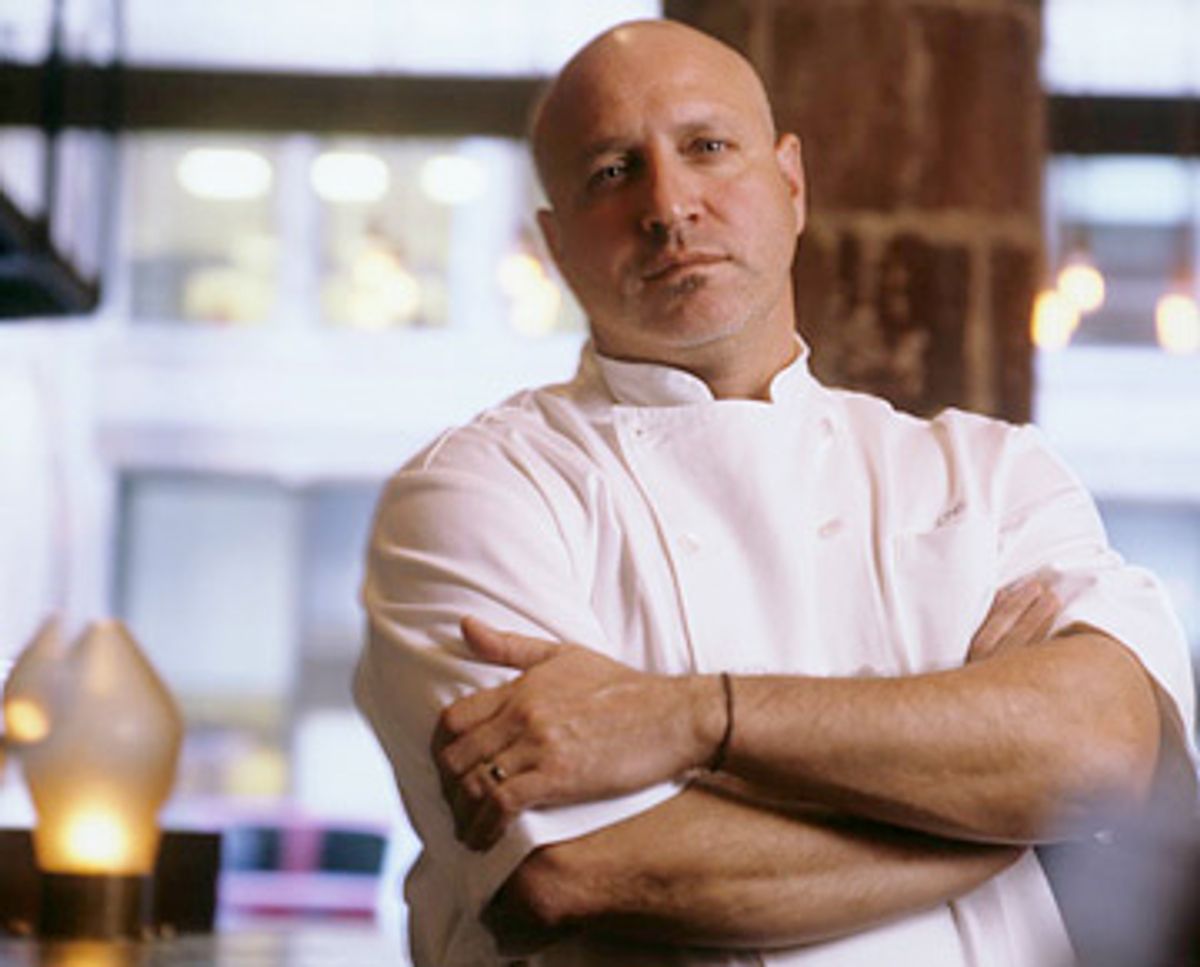
In this interview and podcast, Tom Colicchio dishes on his favorite contestants, how our food obsession sprang from disco's demise, and why he's nothing like Gordon Ramsay.

To listen to a podcast of the interview, click here.
To subscribe: Click here to add Conversations to iTunes or cut and paste the URL into your podcasting software:

There has been one key question running through the fourth season of “Top Chef”: “Can a woman finally win?” So far, only men have nabbed the title on the beloved Bravo reality show, as if the victors’ circle were a reflection of the cooking profession itself, which is famously male-dominated. From episode to episode, the producers made sure to remind us just what a boys club the chef world can be. “It’s not common to have one woman in the kitchen,” said Zoi, a lesbian contestant whose girlfriend also competed on the show. “That is probably the biggest struggle as a female — just break[ing] people’s image of what a chef is.” But as the season wore on, the dudes who had been sharpening their Wüsthofs for a dick-slinging showdown — Dale with his “I’m not here to make friends” attitude, Spike with his smug grin and tilted porkpie hat — were forced to pack their knives and go. And by the time it got down to the final four, a sea change had occurred: Three women and one man remained.
Their fate rests, at least partly, in the hands of “Top Chef” co-host Tom Colicchio. The former chef and co-owner of Gramercy Tavern and creator of Craft, the influential Manhattan restaurant that now has locations in Dallas and Los Angeles (and offshoots such as Craftsteak, Craftbar and ‘Wichcraft), Colicchio has found fame as the show’s measured voice of experience. TV chefs often lean on gimmicks and razzle-dazzle, but Colicchio has a subdued approach, offering critiques that are direct, honest and articulate. The same could be said for the man’s approach to a meal; Colicchio has made simplicity in cooking something of a rallying cry. At his restaurants, and in books like “Craft of Cooking” and “Think Like a Chef,” it is as though he is urging people to actually cook less, focusing instead on the best, freshest ingredients. (He has said the most underrated seasoning is salt and pepper; he detests microgreens.) He’s a good fit for Bravo’s viewing audience — sophisticated, never ingratiating. (Oh, and in case you hadn’t heard, Colicchio has a bit of a following among gay men. Interested parties can read more about this here.)
On Wednesday night’s episode, which relocated the contest from Chicago to balmy Puerto Rico, the ever-driven mother figure Antonia was booted in an upset. Now three contestants remain: Richard, the wacky innovator who has dominated from Day One; Stephanie, the versatile and eminently likable fan favorite; and Lisa, the feisty underdog everyone loves to hate. Colicchio, interviewed over the phone two weeks before the finale airs on June 11, can’t talk about the final contestants. But he can assure us, repeatedly, that whoever takes the title, he and the people behind “Top Chef” have no agenda aside from making sure the best man — make that chef — wins. (Listen to the interview with Colicchio here.)
This has been a particularly good season for women on the show. On a show like “Top Chef,” where you need to differentiate one season from the next, do you feel pressure to have, say, the first female winner?
No, not at all. Pressure from who?
I don’t know. From fans?
No. If we start doing what the fans want, then we might as well just open up the voting to the fans. And they’re not tasting food, so that might be hard to do.
The competition has traditionally been male-dominated, as are most professional kitchens. Why is cooking such a macho profession?
Well, that’s a two-part question. I’d like to go back to the first part. I don’t think the show has been male-dominated. In the first season, Tiffany came so close to winning. In the second season, Elia was in the finale. In the third season, Casey was in the finale. So I don’t agree with that.
OK. Would you agree that cooking is a macho profession?
It can be. A lot of professions happen to be male-dominated because women drop out at a certain point. It’s unfortunate. When I was a chef at Gramercy Tavern, I think we’d been open for five years, at least half the kitchen staff, probably more, were women, and in fact they were all in the big positions — saucier, sous-chef. Of the six or seven women in the kitchen — well, more like 10 or 12 — only two of them are still cooking.
And why do you think they drop out?
They have children. If you want to have a family, it’s a very tough business. You’re working nights. You’re working weekends. It’s not conducive to rearing children. I have a 15-year-old and when he was 8, 9, 10, it was hard for me.
So let’s talk about this season. A lot of people were surprised that Dale was kicked off. He was one of the more seasoned chefs on the show, no?
I wasn’t there that night. When I saw the episode the night it aired, I could see why people were upset. But I didn’t taste the food. And this is what I keep lecturing people about when they say we make bad decisions. I think, “Great, I’m glad you were next to me eating food. I don’t remember seeing you.”
If you’re basing your decision on a two-hour discussion and you saw five minutes of that discussion and those five minutes were clearly made to keep people in suspense, then I can understand why you’re upset that Dale was gone. But what I know from behind the scenes is that they thought his dish was by far the worst dish that night, and it was such a bad dish that it got him thrown out. It’s about food. We judge only on that episode. People think we sit around and watch tape of all the [behind-the-scenes footage of the contestants] before we make a decision? We don’t see that stuff. We’re not allowed to talk to the contestants during shooting.
Let’s talk about your role on the show. You’re kind of the opposite of Gordon Ramsay. You have this evenhanded way about you.
The show is not about me. The show is about the contestants, so I’m just there to judge them. I don’t say anything for shock value. I don’t mug for the camera. These chefs work their asses off. They’re not sleeping, they’re constantly being judged, they have no idea what’s coming at them, and I think I owe them a certain amount of respect. And that doesn’t include dressing them down and screaming at them and belittling them. That’s how I run my kitchen. I know from personal experience, if a chef yelled at me in a kitchen, the first thing I’d want to do is hit them with a pot.
Have I raised my voice in the kitchen? Of course I have. When I was 26, 27 years old I was running a kitchen in New York, and I was a raving lunatic. The older you get, you figure out you don’t need to do that. You realize at a certain point, there’s a certain gravity to what you say and what you do. If that’s not enough, all the yelling in the world is not going to matter.
So what you see on the show is how I run my kitchens. The show is not about me. And I think Gordon Ramsay’s show is about Gordon.
One of the contestants said that 99.9 percent of the competition is getting your point of view across. Would you agree with that?
No, 99.9 percent of the competition is cooking good food. Really. There’s nothing more to it than that. It’s amazing to me when I read the blogs and the conspiracy theories that are swirling around — the producers want a woman to win and all this. We don’t care. We want to make a good TV show. And I personally want to make sure that our decisions are the best decisions.
I’m curious what stands out to you as maybe the worst dish you’ve tasted this season.
I don’t recall spitting anything out this season. There were some things that weren’t very good, but there was nothing I can think of that was just so godawful that I was, like, “This is terrible!”
Have the cooks gotten better each year?
I think this is the strongest group as a whole. They have a lot of experience; they’ve worked in a lot of good restaurants collectively. I remember in the first episode I stepped back and said, “Wow, this is going to be a great season.” Because usually, early on, you can see five or six people that there’s no way they’re going to make it. This season it was one or two. Don’t ask me who — I’m not going to tell you.
Fair enough. So why would somebody with a successful restaurant business decide to go on television?
I always tell this story. My wife says, “You gotta stop telling this.” I got tired of sitting next to Mario Batali or Bobby Flay at a book signing when they sign 200 books and I sign 10. And I don’t think it’s because they’re better chefs or they have a better book.
Twenty years ago, 30 years ago when I started cooking, media wasn’t even a path that we thought about. Things have changed, and I wouldn’t do it unless it drove business to my restaurants.
A couple of months ago, I was down in Florida for the Food and Wine Festival. And this journalist grabbed me and said, “How does it feel to be a TV guy? You’re no longer in the restaurant business.” And I laughed. I asked him, “How long do you think it takes me to do a season?” He said, “Well, 200 days.” And I was like, “200 days? Try 20!”
Why do you think there’s so much interest in chefs at this time?
It started, I would say, in the early to mid-’80s, when people realized they couldn’t just keep going to discos and snorting coke, and they had to grow up and find another form of entertainment. And it became restaurants. I’m serious about that. I’m not joking.
But then chefs started coming out from behind the stove, and you started to know who they were as people. I’m talking chefs. Julia Child was a great TV personality, but when you say the word “chef,” it means “boss,” and I don’t know what she was boss of, but it wasn’t the kitchen. Not to take anything away from Julia; she was brilliant. But she wasn’t a chef. The first chef to step out from behind the stove and become a personality was Paul Bocuse. And I think in the States we just followed suit. When you have Wolfgang Puck, who’s clearly a great personality, and you have Paul Prudhomme, these were great personalities that people want to know. Once you eat their food, you want to know the person behind it. It’s like anything. The actors, it’s great that you see them on the screen. But who are these people?
I always look at it as though people are hobbyists when it comes to chefs. First, they start collecting cookbooks and recipes, and that’s going to lead to redoing their kitchen with fancy appliances, and then they go out and buy all the fancy olive oils and vinegars, and maybe they’ll get to wine along the way. At a certain point, they start collecting chefs.
Obviously the Food Network’s had a lot to do with it. I think also the success of things like the Food and Wine Festival in Aspen. This is, I think, the 25th anniversary this year. And so when you have 4,000 to 5,000 people at a festival in a town as small as Aspen, where the chefs and the winemakers are the reason people are there, it becomes more than just a little movement. It sort of blends right into lifestyle. There’s so much affluence in America — where people have the leisure time to do their kitchens over and collect the chefs and stuff like that. It’s not inexpensive to go to Aspen for a weekend to rub shoulders, see the seminars, attend the book signings and things like that.
There was a New York magazine cover story a while back about how Bravo reality shows were churning out these eccentric personalities who were having trouble turning their wins into business success. How much do you concern yourself with the fate of these contestants after they leave your show?
Some of them. [Season 1 winner] Harold, when he was opening his restaurant, called me for advice and I spoke to him at length. I talk to Sam a lot. I’d like to see all the chefs do well. And again, for several reasons. One, it validates the show. And two, I think that if anyone in the industry does well, it’s good for our industry.
Which of the winners of your show would you hire for your kitchen?
Any of them. I have purposefully stayed away from hiring anybody that’s been a contestant. But I think Tiffany, a woman from Season 1, was fabulous. She wasn’t a fan favorite, but I thought her cooking was brilliant. Harold I would have hired. Forget about the show for a second — if Harold walked into my restaurant and said he wanted a job, I would have hired him. Same thing with Sam. [Season 3 winner] Hung, definitely. I think a better question would be, “If you were going to open a restaurant with one of them, who would it be?” That’s a little different. Probably Harold or Hung. I think [Season 2 winner] Ilan — he’s a good cook, just a little immature, and he has a little way to go. If I were going to raise money and put someone in charge of the kitchen, I’d want someone with a little gravity or weight to them.
I have to ask you how you feel about being what’s known in the gay community as a bear.
Whatever! [Laughs] It’s fine. I’m very comfortable with my sexuality.
How did you find out about your status there?
You get little rainbow-colored bear things. They just show up in your mail one day, and you know you’re an honorary member. No, you know, I read the blogs. It’s kind of funny. I think my wife found it one day. She e-mailed me and said, “Tom, guess what? You’re an honorary bear!”
Did you know what that was?
Yeah, I knew what it was. I’m in the restaurant business. I’ve got plenty of gay friends. I get a kick out of it. But I took it as someone saying, “You need to lose weight.” I started running after that.
My “Top Chef” dreams go splat
I thought I was a culinary hotshot when I took a job cooking for a large church. Then I got my own dose of reality
As of today, I have had my job cooking at a large Protestant church for five months. I had imagined it as a kind of “Top Chef: Church.” In reality it tends to be more like a combination of “Upstairs, Downstairs” and some kind of circus in which animals are replaced with small children and the high-wire is represented by gigantic pots of boiling soup. I still love it, I still look forward to going in, but there is very little preparation of truffle-scented foam.
When I took this job, I was at a point in my life as a home cook that allowed me to watch “Top Chef,” “Hell’s Kitchen” and “Iron Chef” with a certain smug and informed confidence. It was, for me, like watching a sport that I could actually play.
“He’s going to go for a sous vide!” I would announce to my spectacularly uninterested family.
“Those scallops are overcooked — I can tell from here!”
I knew the secrets of roux that didn’t taste raw and flour-y, how to poach tender and flavorful chicken, and — my equivalent of the Hail Mary pass — how to make croissants, doughnuts and bagels from scratch. I could party with a spice rack like nobody’s business and present a finished product that spoke of Mumbai, Phuket or Puglia. In the same way that I had lived my childhood years as Dorothy Gale, Jo March and Anne Shirley, I was hitting middle age as Fantasy Chef, in the mold of Anthony Bourdain. Not French and effete, my secret self had tattoos, a pierced nose, Batali-bright cooking shoes, a foul mouth and a favorite late-night watering hole that served marrow and tripe soup.
As it turns out, I have not lulled so much as a single snail to eternal rest in a bath of garlic butter. There is no sous vide machine in the church basement, nor is there much call for truffle oil, Hawaiian sea salt, lemongrass or chutney. I cook for families, and not the kind of families that live in Manhattan and take their precocious children out for dim sum on Sundays. I am cooking for children who eat nothing “mixed” or otherwise arcane, for elderly folk who can’t tolerate spice like they used to, and everyone in the middle. I have a tight budget. I am, despite my fantasies, completely untrained, and I sometimes make awful mistakes based on a combination of optimism and ignorance. To wit: The scalloped potatoes that failed to “gel” and turned into potato soup, the grilled cheese for 100 people on the griddle that ranged from “torched” to “touchable” in the space of a square inch, and the broccoli cheddar soup that doomed four pots to spend eternity wearing an immobile scrim of vulcanized dairy products.
I am learning, all the time, but it is clear that the work I do is not like that of a restaurant chef working on a line and searing pan after pan of perfect quail breasts; it is far closer to catering or cooking for a school, hospital or all-you-can-eat establishment. Quantities are big, food has to be able to endure the steam table, and the lack of individual choice for diners means hitting the “happy medium” every time. I am not Anthony Bourdain; I am Chris Farley in a hairnet. I work with volunteers who are concerned that I will trigger the apocalypse by putting salad dressing on the table in its original containers, and I cook for funerals, cake auctions, parenting classes and women’s club teas. I know who likes Earl Grey, and which kids don’t eat any vegetables.
Last week there was a line-dancing class for senior citizens, which required me to hear “Boot Scootin’ Boogie” approximately 62 times, and a tornado warning that brought a parade of sleep-pinked babies from the second floor preschool into my basement to ride out the storm. Yesterday, my kitchen was the hub of a voting precinct and I spent the day dodging volunteers who wandered in to get a snack, or to chat with me despite those white cords hanging out of my ears, and the fact that I was juggling 350-degree pans the size of Rhode Island. It is a circus of humanity, leaving me with a head full of dancing, white-haired ladies in matching sweat suits and ironically detached poll challengers wiping Frito dust on their tweed jackets.
There is no swearing (well, not much), no tattoo, no piercings and no after-hours drinking in this cooking life. There are spectacular failures, retorts bitten back, and the odd, impotent rage when things don’t go according to plan. I’m thinking that’s all stuff that every working person deals with at one time or another. On the other hand, the time-worn, broad and generous hand of fate, I get to put on a show at least once a week, create something from nothing, get a round of applause, and come home rich with stories, experiences and satisfaction. If I were really on “Top Chef,” I would have been instructed to “pack my knives and go” the first time the scalloped potatoes left the kitchen in soup bowls. In my kitchen, the glass may be full of Church Lady Punch instead of Malbec, but it is always, always half-full.
Thursday link dump: Congrats to John Podhoretz!
Healthcare polls, Bush's book, and why you should stop shopping at Target
- At 10:22 AM EDT this morning, Jeffrey Goldberg referred to Commentary editor John Podhoretz as “the editor of Mother Jones magazine.” Eight hours later, this remains uncorrected. And hilarious. Another embarrassing example of what happens when you hire a reporter who came up without proper supervision and toilet-training.
- Fewer people hate healthcare reform than hated it back when it was being screamed about on TV all day, every day. But those who hate it hate it even more, every day.
- George W. Bush is releasing his stupid book the week after the primaries end — but what if stuff leaks before the primaries, and reminds people of George W. Bush, who was terrible?
- Just FYI, you should probably be boycotting Best Buy and Target for their scummy two-faced treatment of the gay community.
- This season of Top Chef is kind of lame, but is it also unethical? Michael Roston says yes!
- Phyllis Schlafly knows that Obama was only elected because horrible unmarried women need the government to provide for them. And: “All welfare goes to unmarried moms.” So, that’s that.
- Here is the cover of Sarah Palin’s new book, “An American Flag: God Babies Etc.”
“Top Chef” just improves with age
From high-stakes challenges to egocentric chefs, the 7th season shows why Bravo's culinary contest is king
Most reality TV shows get old eventually. Even the very best shows of the genre – “Project Runway,” anyone? – fall apart as the producers get bored or create product-sponsored challenges or try to spice up the cast with aggressive wild cards, hoping that a few Jerry Springer-style outbursts might give their show a little “Jersey Shore”-style shot in the arm.
“Top Chef” (Wednesdays at 9 p.m. on Bravo) is one notable exception. Despite recent discussions over whether or not the show has lost its edge, the seventh season of “Top Chef” has proven beyond a shadow of a doubt just how resilient and dynamic the popular cooking competition is. Thanks to a combination of smart casting and daring new challenges, the show started at a slow simmer and has rapidly heated to a rolling boil in the past two episodes.
First there was the unexpected tournament-style elimination last week, in which teams of two competed in breakfast, lunch and dinner rounds and the least successful team was brutally eliminated at the end (It’s hard to imagine Arnold “not just a Louis Vuitton bag” Myint leaving this early if not for his ill-fated pairing with eternally flustered Lynne). Then, on Wednesday night’s episode, the cheftestants were asked to prepare a meal together in a chilly cow pasture. Tempers flared, meat cooking times were second-guessed, alpha males clashed, and a bowl of cauliflower tumbled into the tall grass below.
At judges’ table, none of the judges held back on their true feelings about the worst dishes. Tom Colicchio fired off his usual deadpan gripes about lackluster flavors and foolhardy choices. Padma Lakshmi matter-of-factly declared several dishes inadequate. Hell, even the usually sunny and forgiving Eric Ripert scoffed at the worst dishes like they weren’t fit to touch his plump French lips. The previously cocky Amanda got called “amateurish.” Steven’s salad was scolded as “overthought and overdressed.” But it was the eminently likable Timothy’s bland turnips and overall shaky performances that underwhelmed the judges the most, and he was sent packing.
Although some readers have argued over the years that “Top Chef” doesn’t work because viewers at home can’t taste the dishes along with the judges, this might actually represent what works about the show. Thanks to our inability to taste, the descriptions and the personalities and the track records of the cheftestants add up to something better: a guessing game. A few episodes into the season, it’s hard not to find yourself wagering on which risks will pay off and which won’t. When the outspoken but able Kelly started to throw together a bonus-round strawberry rhubarb dessert on Wednesday night, it might’ve been the kiss of death for another competitor on another season, but Kelly’s choices have generally been pretty sound, so we suspected that she’d hit it out of the park – and she did end up in the top four.
And while it’s often easy to tell which three or four cheftestants will make it to the end by the second or third episode (last season, you could’ve put money on one of the Voltaggio brothers winning after the first ten minutes of the first episode), it’s still entertaining to see which of the favorites will win each week. This season, the Kenny “The Beast” vs. Angelo “The Bitch” showdown has proven to be endlessly entertaining, whether the two men are embracing utterly different strategies in the Quickfire Challenge or openly yelling at each other when forced to collaborate in the Elimination.
Angelo presents an obvious villain – albeit one with a little less flair than, say, Hung Huynh, the ultra-confident winner of season three. But what Angelo loses in style points, he makes up for in sheer unpredictability. Having admitted that he has a little thing for Tamesha, a young chef from Barbados, Angelo proceeds to describe her cherry compote as “really tart and luscious — I mean it’s just super sexy.” Got it. But nothing is sexier than what Angelo is doing with his duck. “I’m working on the duck, I butchered it perfectly, I marinated it, I rendered out the fat, I let it rest, I cooked it more. I basically made love to that duck, to be honest with you.”
Sure, we feel a little sorry for the duck – but you have to love a show that brings out this kind of freakishly passionate streak in a person. It’s no wonder love is in the air. Not only is Angelo following Tamesha around and whispering in her ear, but the formerly obnoxious Ed, who doesn’t hold back in outlining the bad choices of his competitors, is now swooning over Tiffany, a pretty Texan with great laugh.
Budding romance, temperamental outbursts, ruthless judges, bestiality – what more could you ask for in one show? Unlike some of their competitors, the producers of “Top Chef” have made all the right choices over the years, maintaining the elements of the show that we depend on (Judges Colicchio, Lakshmi and Gail Simmons are never far from the action; the Restaurant Wars episode is always one of the best) while mixing things up to keep the stakes high (luring in truly respected chefs to judge competitions, dishing up increasingly difficult and brutal challenges). Throw in a skilled but also wildly emotional cast of characters this season, and you’ve got a truly satisfying flavor profile.
On the other hand, maybe chefs are just the kinds of people who belong in front of the camera: They’re passionate, they’re hotheaded, they drink a lot, and they live or die over the acid balance of a little plate of fish. You might not want to work for them (or, if you’re a duck, go within a few square miles of them), but they’re endlessly entertaining to watch on TV.
Why “Top Chef” gets me cooking
The Bravo show isn't just a spectator sport. For me, it offers what a million cookbooks can't: Inspiration
"Top Chef" season seven premieres Wednesday, June 16.
I can hardly wait for tonight’s premiere of “Top Chef.” Not because I expect the season’s seven cheftestants to reprise last year’s Shakespearean battle for kitchen supremacy between the fiercely rival Brothers Voltaggio. Not in the vain hope of forming a geek bond with Michigan engineering grad-turned-chef John Somerville like the one I had with losing finalist Kevin Gillespie, who ditched MIT to go to culinary school. Not even for a glimpse of Padma Lakshmi, post baby bump. (Well, maybe a little.)
Why, then, am I literally drooling with anticipation? Because of the way I’ll eat afterward. Let me explain.
I will be the first to admit that “Top Chef” is a fundamentally flawed enterprise. Say what you will about “American Idol,” but the audience at home can hear Crystal Bowersox caterwauling just as well as Simon Cowell. On “Top Chef,” you get to watch frantic knife work, precise plating and maybe a little bickering around the walk-in, but you’ve got to rely on Judge Tom Colicchio and friends to tell you how the food on those elegant plates tasted. Indeed, the producers at Magical Elves edit the episodes with an eye toward maximum suspense rather than ultimate clarity. Midway through last season Laurine Wickett’s pork rillette was likened to cat food by one cranky judge, but she wasn’t canned that week, and another contestant was ordered to “pack up your knives and go” (PUYKAG, to faithful viewers). Which is why Colicchio and the other judges devote a substantial portion of their Bravo.com blogs to explaining/defending the outcomes.
To twist an adage often applied to music writing, watching “Top Chef” is a bit like smelling architecture.
But it’s still worth watching anyway — especially if, like me, you like to cook.
In a buzzworthy New York Times magazine piece last summer, food guru Michael Pollan slammed shows like “Top Chef” for turning cooking into a spectator sport. “Today the average American spends a mere 27 minutes a day on food preparation (another four minutes cleaning up); that’s less than half the time that we spent cooking and cleaning up when Julia [Child] arrived on our television screens,” he argued. “It’s also less than half the time it takes to watch a single episode of ‘Top Chef’ or ‘Chopped’ or ‘The Next Food Network Star.’ What this suggests is that a great many Americans are spending considerably more time watching images of cooking on television than they are cooking themselves — an increasingly archaic activity they will tell you they no longer have the time for.”
While Pollan is right about most things foodly, I fear he’s missed the mark this time. Like most home chefs, I’ve got a kitchen full of cookbooks and a growing trove of Internet resources. I don’t need instruction, I need inspiration.
And more than anything, watching “Top Chef” gets me hungry. And when I’m hungry, I want to cook. After the cheftestants struggle through a Quickfire Challenge, I’ll steal off to the kitchen during a commercial break to whip up a curried aioli. Or a Meyer lemon marinade. Or a pancetta omelet. This watch/cook, watch/cook ritual is repeated week after week, all season long. Contrary to Pollan’s thesis, I spend more quality time in the kitchen during “Top Chef” than any other time of the year.
Sometimes the show’s inspiration is pretty general. During last season’s Restaurant Wars, I filled the fridge with everything from spunky goat cheese crepes to postmodern baked beans enlivened with Guinness and 70 percent Lindt dark chocolate. Other times, it’s quite specific, like the time I channeled Mike Voltaggio’s audacious — but ultimately disastrous — egg concoction. I scratched my head, fondled a fresh free-range egg laid that morning by a spunky, young hen named Clover, and deconstructed it, sunny side up. (Separate the egg, scramble the white curd-free with creme fraiche in the style of Jean-Georges Vongerichten, and top the scrambled white with the lightly poached yolk.)
Therein lies the appeal of “Top Chef.” Unlike the contestants on, say, “The Next Food Network Star,” who seem chosen largely for their ability to smile and stir at the same time, the men and women vying for supremacy can flat-out cook. Even those sterling regional chefs who inevitably get PUYKAG’d before the finals — like Ariane Duarte, from my hometown of Montclair, N.J., ushered off midway through Season 6 — make food that’ll challenge your mind as well as your taste buds. And unlike the one-off contestants of “Chopped” and “Iron Chef,” or even the competing-for-charity virtuosos of the recently concluded “Top Chef Masters,” there’s something serious at stake for the cooks of “Top Chef”: The juice from winning the title or coming close can make a career, and I know from experience that desperation can be a key ingredient in a successful dish.
Sure, I’d like to see telestratored super slo-mo replays of the knife work. Or a primer on trussing a chicken that goes into half as much detail as this You Tube video on inguinal hernia repair. And I’d like to know more about how the contestants assemble their flavor profiles and less about who’s doin’ what to/with whom (see the Season 2 hazing of Marcel Vigneron by Cliff Crooks and friends, and the Season 5 dalliance between Leah Cohen and eventual champ Hosea Rosenberg). The food is interesting enough.
There are indications that this season, like last, might offer more of the right kind of heat. Xie Xie’s Angelo Sosa has cooked with heavyweights like Jean-Georges and Alain Ducasse, while Ed Cotton of Plein Sud has opened restaurants for Daniel Boulud, and Kevin Sbraga is a protégé of Jose Garces. The fact that snarkmeister Toby Young will be replaced at the judges table by the peerless Eric Ripert of Le Bernadin fame is another hopeful sign.
I know that “Top Chef” is bound to fall back on its reality-show tropes, from simmering feuds between the chefs (“You’re not my mother!”) to stunt cooking challenges (alligator, anyone?) to episodes that pay lip service to this season’s Washington, D.C., location (“Your challenge is to create a truly bi-partisan brunch … using only red and blue foods”). But strip away these made-for-TV trappings and you have a show that does something rather remarkable: It sparks the imagination. So program the DVR, sharpen the Shun santoku, and head into the kitchen to make something that’s worth eating. I’m getting hungry already.
Who won “Top Chef Masters”?
The finalists wow the judges in a cheftastic cook-off that should probably be a three-way tie
Marcus Samuelsson, Susur Lee and Rick Moonen compete for the title of "Top Chef Masters."
Unrealistically ambitious plans. Uncooked proteins lying about, glistening menacingly. Quirky ovens. Clocks ticking down. Stressed out human beings, running around in little circles, wailing in agony, knocking into each other, dropping stuff on the floor, sweating, cursing, slicing their fingers off with sharp knives. “Top Chef Masters” has more than a little in common with the nightly routine in my house.
Luckily, my judging panel doesn’t mind a sloppy presentation or overbearing acidic notes as long as the dish in question is covered in melted cheese and/or it just feels right when you rub it into your scalp. (That’s my smallest judge’s way of communicating that classic Gail Simmons style of high praise, aka “I could bathe in this” or “I want to stick my entire head into a vat of this” or “I could eat this until I quite literally explode.“)
In contrast, the celebrity chefs on the “Top Chef Masters” finale Wednesday night were held to such a ridiculously high standard that it was almost too much to bear. Super chefs Rick Moonen, Marcus Samuelson and Susur Lee all prepared dishes that made the judges and guest judges gasp and gush and sigh deeply over their marvelous textures and flavors.
Of course, the stakes have been sky high all season: When that finicky Saveur editor James Oseland or skeptical Jay Rayner or passionate food fetishist Gail Simmons weigh in, it’s hard not to squirm along with the cheftastic heavyweights on the chopping block. And thrillingly enough, these chefs often don’t agree with the judges’ assessments – but they purse their lips and tolerate Oseland’s sniffing and Rayner’s grumbling and Simmons’ finger-licking and host Kelly Choi’s terrible outfits. They’re restrained that way.
In fact, the one thing that I find disappointing about the professional chefs on “Top Chef Masters” is their unflagging professionalism. Sure, this is an elaborate publicity/charity event for Susur, Rick and Marcus, just one part of a multi-tiered marketing strategy that involves a restaurant (or two), a cookbook, maybe a speaking tour after this, and God knows what else. These men are food artistes, sure, but they’re also figureheads promoting their personal brands. They have to stay cool.
But most of us would prefer to see them losing their heads occasionally, “Real Housewives”-style. Perhaps this is what made the second season finale of “Top Chef Masters” so particularly delightful, and what has made the previous two episodes so satisfying as well. Instead of remaining calm as Persian cucumbers going into the home stretch, Susur, Rick and Marcus begin to look a little shaken. They seem to forget about their empires back home and what this win will mean for their favorite charities. Instead, their egos get wrapped up in the game.
A few minutes into the finale, Marcus raves that winning would mean having “bragging rights forever.” Susur says that “being a chef is like being a Ninja. Your mind has to be very strong.” Rick says his friends have been giving him hell about his elimination last season, so he wants to redeem himself, but he also wants money for his charity. Rick is a talker. Most of all, he says, he doesn’t want to let anyone down.
“I think my biggest competition is Susur,” Rick admits. “He’s an enigma. He is so confident that he emits an intimidation. He doesn’t have any doubt, any hesitation whatsoever in what he does. Once you’re in that state of mind, you’re unstoppable. I predict that it’s going to come down to Susur and me.”
Let’s see what the judges and guest diners have to say about that. Apparently the regular judges will be joined by Tom Colicchio, plus the three finalists from last season, Hubert Keller, Rick Bayless, Michael Chiarello.
Here’s the challenge: The first course is a dish “inspired by your first food memory.” The second course is a dish “inspired by the experience that made you decide to become a chef.” The third course “describes you as a chef.”
“It’s a very emotional thing. Three plates gotta tell my story,” says Susur. “It’s pretty heavy.” He then explains that his first wife died when the Korean Air Lines Flight 007 was shot down over Russian airspace. See how throwing in a little emotional backstory works? Now I want Susur to win.
Next, Marcus sees Rick trimming some dark red meat and asks, jokingly, “What fish is that? The venison, the holy fish of the forest?” See how humor works? Now I want Marcus to win.
Rick says he’s very anal, and he’s annoyed by Susur’s gigantic sloppy messes in the kitchen. “There’s an accident looking for a place to happen,” says Rick. “Now you’re making me pissed off now,” replies Susur, so pissed off that he’s repeating himself. But Rick’s right. Susur is too messy. I want Rick to win.
Once the cooking comes into play, I’m even more confused. The judges and guest diners love the first courses across the board, but particularly love Marcus’s. “I don’t think the execution is quite there,” Rayner says of Rick’s second course, and they’re also underwhelmed by Susur’s second, but they love Marcus’s again. Third course, Rick Bayless is blown away by Susur’s Lamb Thailandaise with Chiang Mai sausage, saying “It’s sooo good.”
“This is going to be a very difficult one to call,” says Bayless.
Back at the “Top Chef Masters” table, the three finalists are having a beer together. Rick Moonen is feeling expansive, as he often does. “There are no losers here, really,” he says.
This is lost on Susur, who replies, “Well, there will be two, right?” Rick just stares at him blankly.
Now it’s time for the three finalists to appear before the judges. Gail Simmons says that she could eat nothing but Susur’s black bean sauce for the rest of her life, that’s how good it is. She’d like to be covered in a thin film of Susur’s black bean sauce at all times. She wouldn’t mind taking a swim in Susur’s black bean sauce, and rubbing it into her scalp would just feel right. She demonstrates, rubbing some black bean sauce into her scalp.
Well, OK, all she really says is that the black bean sauce was “so sweet” and “the texture was beautiful.” But we know what she means.
The judges in general have some problems with Rick’s second course, and with Susur’s. Gail Simmons says that Marcus’s flan blew her away. James Oseland is actually grinning, about the food, which is a little unnerving. There aren’t a lot of flaws to evaluate. Maybe they should rub each course all over their bodies to see how it feels.
“And now it’s out of our hands,” says Rick once the chefs are safely back around their special round table. Each chef takes a big glass of red wine and chugs it with a speed that suggests that they’ve been prohibited from drinking heavily up until now.
Jay Rayner says Rick’s oyster was the best oyster he ever had. The judges agree that Susur’s meal’s “highs were exceptionally high.” Gail says Susur reinvented tastes. Rayner says Marcus’s foie gras flan was an “extraordinary, extraordinary thing.” Rayner is moved by Marcus’s story, but Oseland does not appear quite as moved by Marcus’s last dish. Basically, each of the chefs presented one dish that was problematic, and everything else was spectacular. It’s tough to even guess who might come out on top.
Somehow, a decision is reached, and the chefs are called into the room. Susur gets 17 stars, which is impressive. Incredibly enough, Marcus gets 17 ½ stars, with Simmons and Raynor each favoring him, and Oseland not.
Susur is out, and looks pretty crushed. It’s down to Marcus and Rick.
Oseland says that Rick has “raised the bar on cooo-linary mastery.” And then he asks Rick, “Can I marry you?” Oseland, who really does seem to want to have a million of Rick’s babies, gives Rick five stars. But the diners give Rick four stars. Marcus wins by half a star! What a finish! (Now it’s Rick’s turn to look crushed.)
“People all over the world will celebrate this with me. I guarantee you that,” says Marcus. Who knew that a win for Marcus would mean worldwide celebration? Now I wish Rick had won.
But to be fair, the final competition was so tight that any one of these three chefs really could’ve taken home the title of “Top Chef Master.” They made it through an insanely stressful series of challenges, and they did it without insulting each other ruthlessly, attacking each other with their bare hands, or bringing shame on their families. They cooked great food and they remained professional to the very end. There are no losers here tonight!
(Well, there are two, actually. Rick and Susur. Sorry, guys!)
Page 1 of 4 in Top Chef
Female soldiers fight the brass ceiling
Catholic tribalism and the contraceptive flap
Salman Rushdie fears nothing
The two Americas clash at CPAC
Making the perfect cover girl
A birth-control compromise could divide the right
Unions in a “death spiral”? Not on my job site
The answer that’s been staring them in the face
And the Oscar goes to … “Twilight”!
Adele: Too fat for fashion designer 

