Washington, D.C.

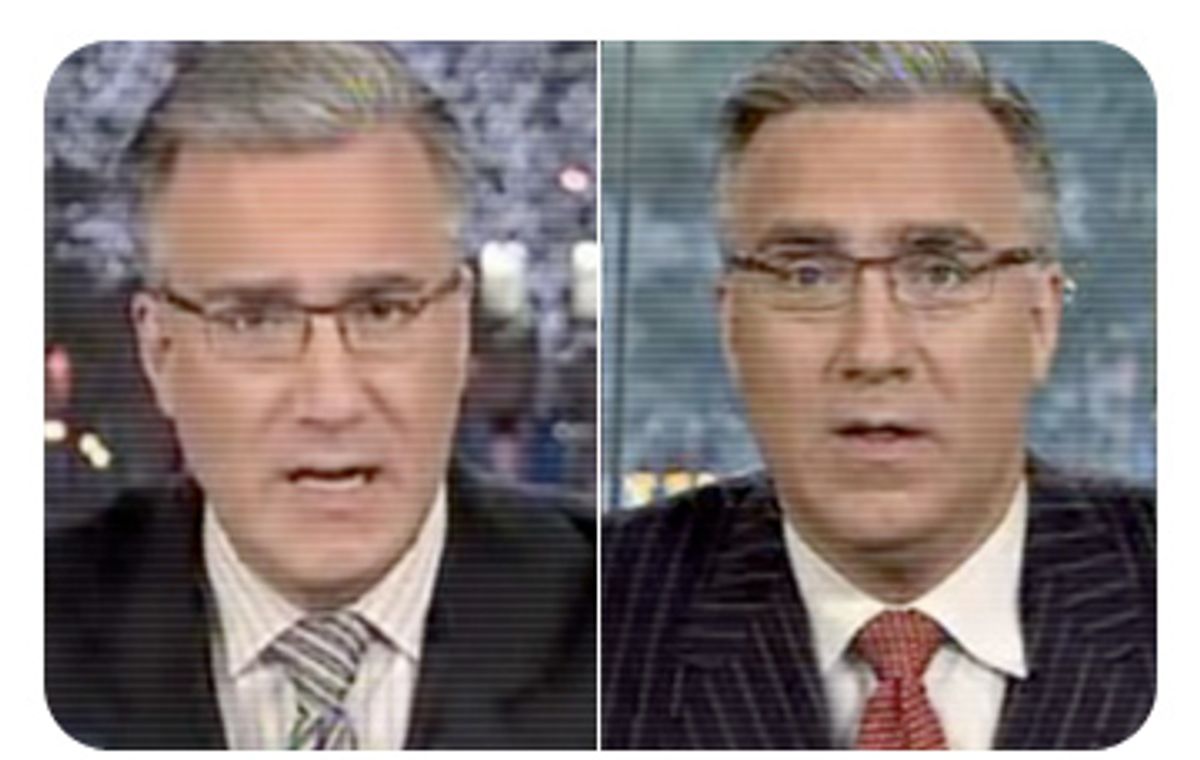
Keith Olbermann: Then and now

In January, the MSNBC star denounced telecom immunity as "textbook fascism" designed to "immunize corporate criminals." Wednesday night, he heaped praise on Obama for supporting it.

  • more
    • All Share Services

Keith Olbermann: Then and now

(updated below – Update II)

On January 31 of this year, Keith Olbermann donned his most serious face and most indignant voice tone to rail against George Bush for supporting telecom immunity and revisions to FISA. In a 10-minute “Special Comment,” the MSNBC star condemned Bush for wanting to “retroactively immunize corporate criminals,” and said that telecom immnity is “an ex post facto law, which would clear the phone giants from responsibility for their systematic, aggressive and blatant collaboration with [Bush's] illegal and unjustified spying on Americans under this flimsy guise of looking for any terrorists who are stupid enough to make a collect call or send a mass email.”

Olbermann added that telecom amnesty was a “shameless, breathless, literally textbook example of Fascism — the merged efforts of government and corporations that answer to no government.” Noting the numerous telecom lobbyists connected to the Bush administration, Olbermann said:

This is no longer just a farce in which protecting telecoms is dressed up as protecting us from terrorists conference cells. Now it begins to look like the bureaucrats of the Third Reich, trying to protect the Krupp family, the industrial giants, re-writing the laws of Germany for their benefit.

Olbermann closed by scoffing at the idea that telecom amnesty or revisions to FISA were necessary to help National Security:

There is not a choice of protecting the telecoms from prosecution or protecting the people from terrorism, Sir. This is a choice of protecting the telecoms from prosecution or pretending to protect the people from terrorists. Sorry, Mr. Bush, the eavesdropping provisions of FISA have obviously had no impact on counter-terrorism, and there is no current or perceived terrorist threat the thwarting of which could hinge on an email or phone call that is going through Room 641 of AT&T in San Francisco.

Strong and righteous words indeed. But that was five whole months ago, when George Bush was urging enactment of a law with retroactive immunity and a lessening of FISA protections. Now that Barack Obama supports a law that does the same thing — and now that Obama justifies that support by claiming that this bill is necessary to keep us Safe from the Terrorists — everything has changed.

Last night, Olbermann invited Newsweek‘s Jonathan Alter onto his show to discuss Obama’s support for the FISA and telecom amnesty bill (video of the segment is here). There wasn’t a syllable uttered about “immunizing corporate criminals” or “textbook examples of Fascism” or the Third Reich. There wasn’t a word of rational criticism of the bill either. Instead, the two media stars jointly hailed Obama’s bravery and strength — as evidenced by his “standing up to the left” in order to support this important centrist FISA compromise:

OLBERMANN: Asked by “Rolling Stone” publisher, Jann Wenner, about how Democrats have cowered in the wake of past Republican attacks, Senator Obama responding, quote, “Yeah, I don’t do cowering.” That’s evident today in at least three issues . . .

Senator Obama also refusing to cower even to the left on the subject of warrantless wiretapping. He’s planning to vote for the FISA compromise legislation, putting him at odds with members of his own party . . . But first, it’s time to bring in our own Jonathan Alter, also, of course, senior editor of “Newsweek” magazine.

Good evening, Jon.

JONATHAN ALTER, NEWSWEEK: Hi, Keith.

OLBERMANN: “Yeah, I don’t do cowering.” This is not just the man, but the campaign?

ALTER: Yes. This is part of the message that is consistent across the last couple weeks and it comes down to one word — strength. The United States is not going to elect a president that perceives to be as weak. You look weak if you’re flip-flopping. You look weak if you’re not taking actions that seem to be securing the United States against terrorists. And you look weak if you don’t fight back against your political adversaries.

OLBERMANN: But this cuts, I mean, this terminology cuts in more than one direction here. Not cowering to Republicans is one thing in the Democratic, recent Democratic history, it’s a thing that I think anybody who has a “D” near their name cheers, but not cowering to the left, not going along with the conventional, the new conventional thinking on the FISA bill, that’s something altogether different, isn’t it?

ALTER: Yes. I don’t really think it is. It was only a matter of time before the left was disappointed in Barack Obama, at least in a limited way. No politician is ever going to do everything that somebody likes.

And I think some folks in the netroots in particular on this FISA bill who are, you know, pulling their hair out over this, they have to realize, he’s always been a politician, he’ll always be a politician, and politics is the art of the possible. And he’s a legislator. He knows that you can’t always get everything that you want in a bill, even if he personally believes that the immunity for Telcoms is a bad idea. The larger idea of the bill was important.

And I actually think one of the big points, Keith, that hasn’t been made about this bill is that currently, as of last August, since last August, we’ve been operating in an unconstitutional environment, clear violation of the Fourth Amendment.

So, there was tremendous urgency to get the FISA court back into the game. And does this bill do it imperfectly? Yes. But it does do it and it restores the Constitution, which is a point that’s not getting made very much.

Leave aside the fact that Jonathan Alter, desperate to defend Obama, doesn’t have the slightest idea of what he’s talking about. How can a bill which increases the President’s authority to eavesdrop with no warrants over the current FISA law possibly be described as a restoration of the Fourth Amendment? That would be like describing a new law banning anti-war speech as a restoration of the First Amendment.

As Jim Dempsey and Marty Lederman both note, not even the nation’s most foremost FISA experts really know the full extent to which this bill allows new warrantless spying. Obviously, Jonathan Alter has no idea what he’s saying, but nonetheless decrees that this bill — now that Obama supports it — restores the Fourth Amendment. Those are the Orwellian lengths to which people like Olbermann and Alter are apparently willing to go in order to offer their blind devotion to Barack Obama.

Moreover, Alter’s own explanation is self-contradictory. In the course of praising Obama’s FISA stance, he says that a politician looks “weak if you’re flip-flopping” and “you look weak if you don’t fight back against your political adversaries.” But that’s exactly what Obama is doing here — completely reversing himself on telecom amnesty and warrantless eavesdropping, all in order to give the right-wing of the GOP everything it wants on national security issues in order to avoid a fight. By Alter’s own reasoning, what Obama’s doing is “weak” in the extreme, yet Alter bizarrely praises Obama for showing “strength.”

All of the decades-old, conventional Beltway mythologies are trotted out here to praise Obama. Democrats move to the “center” by embracing hard-core right-wing policies. Democrats will look “weak” unless they turn themselves into Republican clones on national security. A President becomes “strong” when he tramples on the Constitution and the rule of law in the name of keeping us safe. Democrats must embrace the Right and repudiate the base of their own party, and they must support Dick Cheney’s policies while “standing up to the ACLU.”

That’s just the garden-variety New Republic Syndrome I wrote about earlier this week. That’s the mentality that led large numbers of Democrats to vote for the attack on Iraq, and then ignore and/or enable the whole stable of Bush’s lawlessness and other radical policies (“that’s how we’ll avoid looking weak and liberal”). Those Move-to-the-Center cliches just tumble reflexively out of the mouths of every standard Beltway establishment pundit.

What’s much more notable is Olbermann’s full-scale reversal on how he talks about these measures now that Obama — rather than George Bush — supports them. On an almost nightly basis, Olbermann mocks Congressional Democrats as being weak and complicit for failing to stand up to Bush lawbreaking; now that Obama does it, it’s proof that Obama won’t “cower.” Grave warning on Olbermann’s show that telecom amnesty and FISA revisions were hallmarks of Bush Fascism instantaneously transformed into a celebration that Obama, by supporting the same things, was leading a courageous, centrist crusade in defense of our Constitution.

Is that really what anyone wants — transferring blind devotion from George Bush to Barack Obama? Are we hoping for a Fox News for Obama, that glorifies everything he says and whitewashes everything he does? Compare what Russ Feingold said in an interview yesterday about the Democrats’ support for the FISA bill to Olbermann’s absurd effort to depict Obama as courageous for supporting it:

It’s the latest chapter of running for cover when the Administration tries to intimidate Democrats on national security issues. It’s the most embarrassing failure of the Democrats I’ve seen since 2006, other than the failure to vote to end the Iraq War. . . . It’s letting George Bush and Dick Cheney have their way even though they’re that unpopular and on their way out. It’s really incredible.

It isn’t that difficult to keep the following two thoughts in one’s head at the same time — though it seems to be for many people:

(1) What Barack Obama is doing on Issue X is wrong, indefensible and worthy of extreme criticism;

(2) I support Barack Obama for President because he’s a better choice than John McCain.

As but one example, John Cole was a vehement supporter of Barack Obama throughout the primary. He viciously criticized Hillary Clinton on a regular basis and raised tens of thousands of dollars for Obama’s campaign through his blog. But this week alone, Cole lambasted Obama for what he called Obama’s “total collapse and a rapid abandonment of principle” regarding FISA and pronounced as a “pathetic performance” Obama’s refusal to be photographed anywhere near Muslims or to meet with Muslim leaders. Despite that, just yesterday, Cole said:

No, I don’t have buyers remorse. Yes, he still is better than Hillary or McCain. No, I am not disillusioned (I never thought he was a flaming liberal in the first place). I am, however, disgusted, and I will caution the Obama campaign that “better than McCain” is not much of a rallying cry. We all remember how “anything is better than Bush” turned out in 2004.

That’s called being a rational adult who refuses to relinquish one’s intellectual honesty, integrity, and political principles in order to march lockstep behind a political leader. Those who think that Barack Obama should not be criticized no matter how wrong he is — or those who justify anything that he does no matter how craven and unjustifiable, including things that they viciously criticized when done by Dick Cheney or Harry Reid — are no different, and no better, than those who treated George Bush with similar uncritical reverence in 2003 and 2004.

The real danger is that those who defend Obama the Candidate no matter what he does are likely to defend Obama the President no matter what he does, too. If we learn in 2009 that Obama has invoked his claimed Article II powers to spy on Americans outside of even the new FISA law, are we going to hear from certain factions that he was justified in doing so to protect us; how it’s a good, shrewd move to show he’s a centrist and keep his approval ratings high so he can do all the Good things he wants to do for us; how it’s different when Obama does it because we can trust him? It certainly looks that way. Those who spent the last five years mauling Bush for “shredding the Constitution” and approving of lawbreaking — only to then praise Obama for supporting a bill that endorses and protects all of that — are displaying exactly the type of blind reverence that is more dangerous than any one political leader could ever be.

* * * * *

Today’s Wall St. Journal has an article on the new Strange Bedfellows coalition and the campaign to punish and remove from office selected members of Congress who support civil-liberties-destroying measures such as the current FISA bill (a campaign I first announced here). The abstract of the WSJ article is here, and the full text can be read by clicking on the link on this page [link fixed]. The details for the “money bomb” the article describes will be disclosed very shortly. Yesterday, Jane Hamsher recorded a Bloggingheads session with former Rep. and current third-party presidential candidate Bob Barr (who Republicans are petrified will destroy McCain’s chances) and discussed with him the ideologically diverse efforts to battle against the political establishment’s assault on core constitutional liberties. For now, contributions to the campaign — which now has more than $320,000 — can be made here.

UPDATE: Comedy Central’s Indecision 2008 blog discusses Obama’s FISA stance here.

UPDATE II: Olbermann has responded to this post at Daily Kos, and my reply is here.

Glenn Greenwald

Follow Glenn Greenwald on Twitter: @ggreenwald.

D.C. firm inks lucrative public-relations contract with Bahrain

As the Gulf monarchy cracks down on an international aid group, it hires Qorvis for $40,000-per-month P.R. job

  • more
    • All Share Services

D.C. firm inks lucrative public-relations contract with BahrainA Shiite Bahraini woman gestures as others shout anti-government slogans outside a public forum Saturday, July 23, 2011, outside a religious community center in Sanabis, Bahrain, denouncing the alleged destruction and vandalizing of Shiite mosques, community centers and cemeteries during a government crackdown on a largely Shiite spring uprising. Clerics who spoke during the meeting, blamed Saudi Arabia for targeting religious sites, because they allegedly distrust their own Shia minority and sent forces to help quell the Bahrain uprising. (AP Photo/Hasan Jamali)(Credit: AP)

Bahrain is in the news again, this time for what appears to be the comically evil persecution of the humanitarian group Doctors Without Borders.

So, naturally, the ruling monarchy of the Gulf nation has hired a top Washington public relations firm to burnish (or attempt to salvage) its image, according to a new foreign agent registration filing. Qorvis Communications will be paid $40,000 per month, plus expenses, for the public relations work, according to a contract submitted to the U.S. Department of Justice.

Here is the latest on the events in Bahrain, where the Sunni regime’s crackdown on a Shia protest movement is now focusing on prosecuting or harassing those — including doctors — who came to the aid of protesters back in the spring:

The trouble for the group — which is also known by its English name, Doctors Without Borders — started about a week ago. Activists say a young man who had been protesting in his village was hit in the head at close range by police firing a tear-gas canister.

The protester went to the MSF office in the capital, Manama. Owing to the severity of his injuries, an ambulance was called, and the patient was taken to the hospital. On July 28, the next day, 14 police vehicles pulled up to the MSF office. Authorities raided the building and reportedly took away furniture, medicine and patient files — and arrested the group’s local driver, Saeed Mahdi.

Now, the rented villa that used to house the MSF office is locked up and empty.

Qorvis distributed a statement to American journalists writing about the incident, with the Bahrain Health Ministry claiming that Doctors Without Borders “was operating an unlicensed medical center in a residential apartment building.”

Qorvis, which promises clients “integrated strategies to help you tell your story better,” did not immediately respond to a request for comment about its work for Bahrain. The contract is signed by Qorvis partner Matthew Lauer, who was previously a public diplomacy official in the Bush State Department and a spokesman for the South Carolina Democratic Party.

Earlier this year Huffington Post reported that several Qorvis partners had departed the firm because, in the words of one unnamed insider, “I just have trouble working with despotic dictators killing their own people.” Qorvis had previously worked for Bahrain through another PR firm, Bell Pottinger.

Continue Reading Close
Justin Elliott

Justin Elliott is a reporter for ProPublica. You can follow him on Twitter @ElliottJustin

Poll: Public sides with Obama on deficit

The potentially catastrophic effects of a default are finally sinking in with Americans

  • more
    • All Share Services

Poll: Public sides with Obama on deficitIn this July 14, 2011, file photo, President Barack Obama sits with House Speaker John Boehner of Ohio, House Minority Leader Nancy Pelosi of California, House Majority Leader Eric Cantor of Virginia, as he meets with Republican and Democratic leaders regarding the debt ceiling in the Cabinet Room of the White House in Washington, Thursday, July 14, 2011. Obama's decision to haul lawmakers in day by day to negotiate a debt deal comes down to reality: He has no other choice. The president has essentially cleared his agenda to deal with one enormous crisis. (AP Photo/Charles Dharapak)(Credit: AP)

Most Americans want to see a compromise on the debt ceiling, according to a new NBC/Wall Street Journal poll.

62 percent of self-identified Democrats said they would want Democratic leaders in the House and Senate to make compromises to gain consensus on the current budget debate, while only 43 percent of Republicans want to see their party leaders concede some of their positions. However, around 70 percent of independent respondents said they wanted to see both parties compromise.

The poll results, released Tuesday show that 55 percent of respondents think that failing to raise the debt ceiling would be “a real and serious problem,” while only 18 percent said it would not be. This contrasts starkly to results gleaned from a Gallup survey in May, in which 47 percent of people said they would want Congress to vote against raising the debt ceiling.

Meanwhile, support for President Obama’s proposal for lowering the deficit significantly trumps that for Republican proposals: 58 percent of NBC/WSJ poll respondents said they preferred Obama’s suggestions to lower the federal deficit by $4 trillion over 10 years by cutting federal spending, raising tax revenue from the wealthy and reducing some Medicare spending. Contrastingly, only just over a third prefer the House Republican proposal to reduce the deficit by $2.5 trillion over 10 years through cutting spending alone and not raising additional revenues.

Continue Reading Close

Natasha Lennard covers the Occupy movement for Salon. A British-born, Brooklyn-based journalist, she has been covering Occupy Wall Street since before the first sleeping bag was unrolled in Zuccotti Park. One of the first journalists arrested at an Occupy action, she has managed to enrage Andrew Breitbart, Rush Limbaugh and Glenn Beck. You can follow her on Twitter (@natashalennard), and email her any Occupy updates/videos/ideas to natasha.lennard@gmail.com

Lobbyists are overtaking Congress

Since the GOP takeover, the number of lobbyists in congressional staff positions has more than doubled

  • more
    • All Share Services

Lobbyists are overtaking Congress

(Updated below)

A new report from the Center for Responsive Politics (CRP) looks at the pervasiveness of former lobbyists now working in congressional staff positions. The number of former lobbyists in Congress has more than doubled between the last Congress and the current one, with a significant partisan skew. In the current 112th Congress, 79 former lobbyists work for Republicans while 48 for Democrats; during the Democratic-led 111th Congress (which ran from 2009-2010), 33 worked for Democrats, while 27 worked for Republicans.

The report, titled “From Hired Guns to Hired Hands: ‘Reverse Revolvers’ in the 111th and 112th Congresses,” is available in full here and has a number of noteworthy takeaways:

  • 60 former lobbyists worked in critically important staff positions in the 111th Congress, 128 former lobbyists can be found working in the same positions in the 112th Congress.
  • The House Energy and Commerce and the House Financial Services committees have the highest cumulative number of former lobbyists employed by their members. The lobbyists of certain companies may be highly desirable to members of Congress serving on committees that handle legislation of concern to these companies. AT&T alone has six former lobbyists who at one point lobbied on behalf of AT&T and now work for senators or representatives sitting on the Senate or House committees related to energy and commerce.
  • 50 former finance sector lobbyists work in the 112th Congress, as do 44 former telecommunications sector lobbyists and 40 former healthcare industry lobbyists. Meanwhile, only seven former labor lobbyists occupy these congressional staffer positions.
  • Certain companies — particularly telecommunications, healthcare and defense contracting firms — are well-represented in the portfolios of former lobbyists now working on Capitol Hill. CRP notes a particular example involving Lockheed Martin. “Charles Kinney, currently working for Sen. Joe Manchin (D- W.Va.), lobbied on behalf of Lockheed in 2004… Now, Kinney is deputy chief of staff and general counsel for Manchin, who currently sits on the Senate Armed Services Committee, as well as the Senate Budget Committee” reads the report. [Update: a representative from Manchin's office informs us that Kinney stopped working for Manchin in May. He was still staffer for the senator at the time of CRP's research]

What does this all mean? As CRP is careful to note, there are numerous reasons why lobbyists might take congressional staffer jobs. “For some people,” the report states, “working in government is exciting, fulfilling work, where the psychic rewards make up for the smaller paycheck. In other cases, people may have lost lobbying jobs due to the poor economy and find the Hill to be a place where their expertise and skills are highly valued.” However, the K Street/Congress revolving door could well spin into concerning territory, as the report concludes:

It may, plausibly, be the case that these individuals are able to keep the wishes of their former clients separate from the wishes of the constituents their bosses represent. But it may also be the case that these former lobbyists are now in the position to exercise considerable sway over everything from policy outcomes to government contract decisions and anti-trust decisions. Particularly where the issues are complicated and do not drive significant constituent interest, former clients of ex-lobbyists now working in Congress could be well placed to reap the rewards of enhanced access and deeper connections into government’s legislative branch.


Continue Reading Close

Natasha Lennard covers the Occupy movement for Salon. A British-born, Brooklyn-based journalist, she has been covering Occupy Wall Street since before the first sleeping bag was unrolled in Zuccotti Park. One of the first journalists arrested at an Occupy action, she has managed to enrage Andrew Breitbart, Rush Limbaugh and Glenn Beck. You can follow her on Twitter (@natashalennard), and email her any Occupy updates/videos/ideas to natasha.lennard@gmail.com

Shariah law instituted steps from the White House!

Predicting an overblown right-wing outrage

  • more
    • All Share Services

Shariah law instituted steps from the White House!Do I spot crescents in this CityCenterDC promotional brochure?

There is a giant real estate development happening in downtown Washington, D.C., near the White House, on the site of the old convention center. Boring news for non-D.C. residents. But I’m willing to bet that the CityCenterDC complex — office space, retail, condos, your standard massive downtown “revitalization” project — will soon be very interesting to a lot of people who don’t live in the area. Not because anyone cares about urban land-use issues, but because of one of the project’s investors: Muslims.

The Washington City Paper noticed a bombshell buried at the bottom of a New York Times piece:

Even before the Qatari investors became involved, Hines and Archstone determined that leasing to banks would not help them create lively shopping streets, Mr. Alsup said. But as it happened, their hesitancy on bank branches meshed with the policies of their financial partners, who adhere to the restrictions of Shariah, or Islamic law, including the ban on collecting interest. Restaurants will be able to serve liquor, but retailers whose primary business involves selling alcohol will not be allowed, Mr. Alsup said.

That’s right: Shariah law, a stone’s throw from the U.S. Capitol. I am assuming the Times just neglected to mention that in addition to banning bars from the complex, all women will be required to wear the niqab, and obviously all infidels will be murdered, while shopping at the Apple store or whatever ends up there. And no dancing!

What’s astounding is that as far as I can see, Matt Drudge hasn’t picked this up. Pamela Geller hasn’t written a lengthy screed about it. Robert Spencer has not weighed in. No one at the Corner has mocked liberals for mocking the threat of creeping Shariah. Get on it, guys! SHARIAH LAW HAS BEEN IMPOSED IN WASHINGTON!

Continue Reading Close
Alex Pareene

Alex Pareene writes about politics for Salon and is the author of "The Rude Guide to Mitt." Email him at apareene@salon.com and follow him on Twitter @pareene

What line between civilian and military authority?

An increasingly powerful Pentagon is taking over the culture of Washington

  • more
    • All Share Services

What line between civilian and military authority?U.S. President Barack Obama meets with troops at Bagram Air Base, December 3, 2010.

I have a fairy tale for you. Once upon a time, a representative democracy was established with a constitution that distilled the wisdom of the ages. Its foundational principles included civilian control of the military and a system of checks and balances that encouraged vigorous public debate as a basis for effective policy-making.

In this fabled land, the role of civilian leaders was, in part, to serve as a check on military ambition and endless wars. They were to prove cautious, too, in committing their citizen-soldiers to battle, and when they did, they would issue Congressional declarations of war so that everyone could grasp the nature of the national emergency at hand and the necessity of military action. In waging war, they would rely on shared sacrifice and even raise taxes. When necessary, it was their job to rein in or even remove military leaders who acted like Caesar (read: General Douglas MacArthur) rather than Cincinnatus (read: General George Washington).

Yes, you’ve guessed it: It’s not a fairy tale, or at least not completely. It’s the United States — an older America that, despite a decidedly checkered and often imperial past, was nevertheless proud of its reluctance to fight, but steadfast in its commitment to win once it decided that battle was the course of action. Even then, this America remained resolute in its reluctance to embrace a military ethos or bow down before military gods, committed as it was to civilian primacy and the avoidance of a large standing army.

Paradoxically, the last vestiges of this America could still be seen some 50 years ago under President Dwight D. Eisenhower, himself a retired five-star general, who tried with varying degrees of success to limit defense spending, and who famously warned in his farewell address in 1961 of the dangers of a surging “military-industrial complex.”

And leaping forward almost four decades, here’s another paradox for you: prior to September 11, 2001, what many leading pundits and commentators fretted most about was an alleged widening gap between American civilians and their now all-volunteer military. In 1997, Wall Street Journal Pentagon correspondent Tom Ricks typically worried about an all-volunteer military that saw civilians as privileged and flabby, increasingly considered itself a breed apart, and held the public it served in contempt.

Concerned as well was Richard Kohn, former chief historian of the U.S. Air Force. In a special lecture to Air Force Academy cadets in 1999 on “the erosion of civilian control of the military in the United States today,” Kohn worried about a military that openly disrespected President Bill Clinton, its commander-in-chief, even as it meddled in areas like policy-making for which it was not suited and from which it had been excluded by the Constitution.

How times have changed. In the post-9/11 world, a far more insidious problem confronts us. That gap, if it ever existed, is no more. Instead, at the highest levels, what’s civilian and what’s military are increasingly difficult to tell apart as the two spheres blur and blend. Today, civilian control of the military is largely a principle without a meaning, while inside Washington’s Beltway, even with a scorecard it’s hard to tell the players apart.

In the process, the military has gained a kind of unspoken and distinctly un-American primacy. Put another way, after a decade-long budgetary feeding frenzy, the Pentagon has soared, while an eclipsed Department of State, all those civilian diplomats, has been left to eke out a living on budgetary scraps or, as in Iraq today, arm and militarize itself. State, in other words, has become a remora clinging to the predatory shark that is the Department of Defense.

Large and small, symbolic or otherwise, signs of this civil-military blending (with the military significantly running the show) can be found almost anywhere you look. Civilian presidents regularly appear in military flight gear or jackets, as George W. Bush famously did before his “Mission Accomplished” speech on the deck of the U.S.S. Abraham Lincoln in 2003 and as President Obama did on a visit to U.S. troops in Afghanistan in 2010. Military leaders are now regularly put in charge of previously civilian intelligence agencies, as in the case of General David Petraeus, now nominated to leave the Afghan battlefield and become director of the Central Intelligence Agency.

Civilian agencies now militarize themselves and wage war (as the CIA has done or is doing in various drone wars in the Greater Middle East, often in conjunction with the military). America’s part-time citizen-soldiers have morphed into full-time warriors and warfighters, if not the equivalent of foreign legionnaires. America’s civilian embassies continue to morph into so many militarized fortresses protected by armed mercenaries. And above all, among policy arguments in Washington, whether you’re a civilian official or a military one, the choices are increasingly between militarized alternatives — say, counterinsurgency versus counterterror — with that most civilian of all options, peace, not even on that “table” where officials eternally claim that all options are placed.

At the same time, a new civic religion at whose heart is military-worship implores us to “support our troops” (without any concomitant call to uphold our laws and our Constitution). And even as ordinary Americans express serious doubts about the wisdom and cost of an open-ended commitment to Afghanistan — 64 percent of Americans don’t believe the Afghan war is worth fighting, and 73 percent would prefer sizable withdrawals of U.S. troops this summer, according to a recent Washington Post/ABC News poll — the Pentagon continues to prepare for a future of “two, three, many Afghanistans,” as Michael Klare, defense correspondent for the Nation magazine, noted in April 2010.

Clearly, if we’re not careful, the civilian and military will become the Washington equivalent of Siamese twins, co-joined at the head and, however bitter their internecine arguments, sharing the same underlying militarized thought processes.

Militarism Run Rampant

To separate such twins is a dicey thing, medically speaking, and no less so politically when the lines between civilian and military authority are being so rapidly erased. Make no mistake, as President Obama is wont to say, the impact of this erasure has been devastating.

It’s both sensible and logical to argue that our president and elected representatives must serve as a check on the military establishment, rather than issuing blank checks to them. It’s both sensible and logical to argue that all wars, as required by the Constitution, must have a Congressional declaration before American troops and treasure are committed. It’s both sensible and logical to argue that, as good as our military is, it ultimately can’t win someone else’s civil war (Iraq) or nation-build in a place where the concept of “nation” is little more than notional (Afghanistan).

Sensible and logical, yes, but such arguments have been made — and roundly ignored. They aren’t given the time of day among serious policy types in Washington, where to question the efficacy and legitimacy of the forces and tactics being used is simply not acceptable. Sharing one brain and one ethos means being incapable of grasping one’s own militarized rigidity or truly recognizing the perils that have been unleashed on this nation.

There’s a word for this disease, even if after all these years it remains remarkably foreign to American ears: militarism. When Americans think of that word, they tend to conjure up images of fanatical jackbooted Nazis or suicidal Japanese kamikazes, and so the concept seems eminently dismissible. But militarism also describes a situation in which a country’s civil society and political culture are permeated to the point of dominance by military attitudes and values — an undeniable fact of life, I would argue, in America today.

Militarists see war as productive, as offering solutions rather than posing problems. They see it as heroic. (President Bush famously waxed poetic about the “exciting” and “romantic” nature of fighting in Afghanistan.) When wars are romanticized as action-packed tests of a nation’s warriors, cuts to war spending are naturally seen as perfidiously unpatriotic — as kneecapping those same heroes. Hence our ever-growing “defense” budgets, even as a sledgehammer of a national debt hobbles America’s economic vitality and social security.

The end result of this militaristic mindset is a garrison state, constantly girding itself for national security crises, real or perceived, as in the last decade’s open-ended and frantic “war on terror.”

A singular danger of such a mindset, as pointed out by Laurence Radway in a telling article on “militarism” in the “International Encyclopedia of the Social Sciences,” is that militarists, unable to select means appropriate to true defense needs, end up jeopardizing the very national security they say they’re seeking to safeguard. By exaggerating threats, defining all responses to those threats in military terms, dismissing dissenters as weak and deluded (even when they prove right), and being incapable of questioning their principles, they repeat the same mistakes again and again.

Until Americans turn away from militarism and learn again how to “support our Constitution” more than our troops (and don’t worry: those troops swear an oath to that very Constitution), until we return to a broader vision of national security that deemphasizes a garrison mentality, we will continue to wound, perhaps mortally, a once great republic.

And that’s no fairy tale, it’s a fact.

Continue Reading Close

William J. Astore is a retired lieutenant colonel. He has taught cadets at the U.S. Air Force Academy, officers at the Naval Postgraduate School, and currently teaches at the Pennsylvania College of Technology. He is the author of "Hindenburg: Icon of German Militarism," among other books. He may be reached at wastore@pct.edu.

Page 1 of 272 in Washington, D.C.