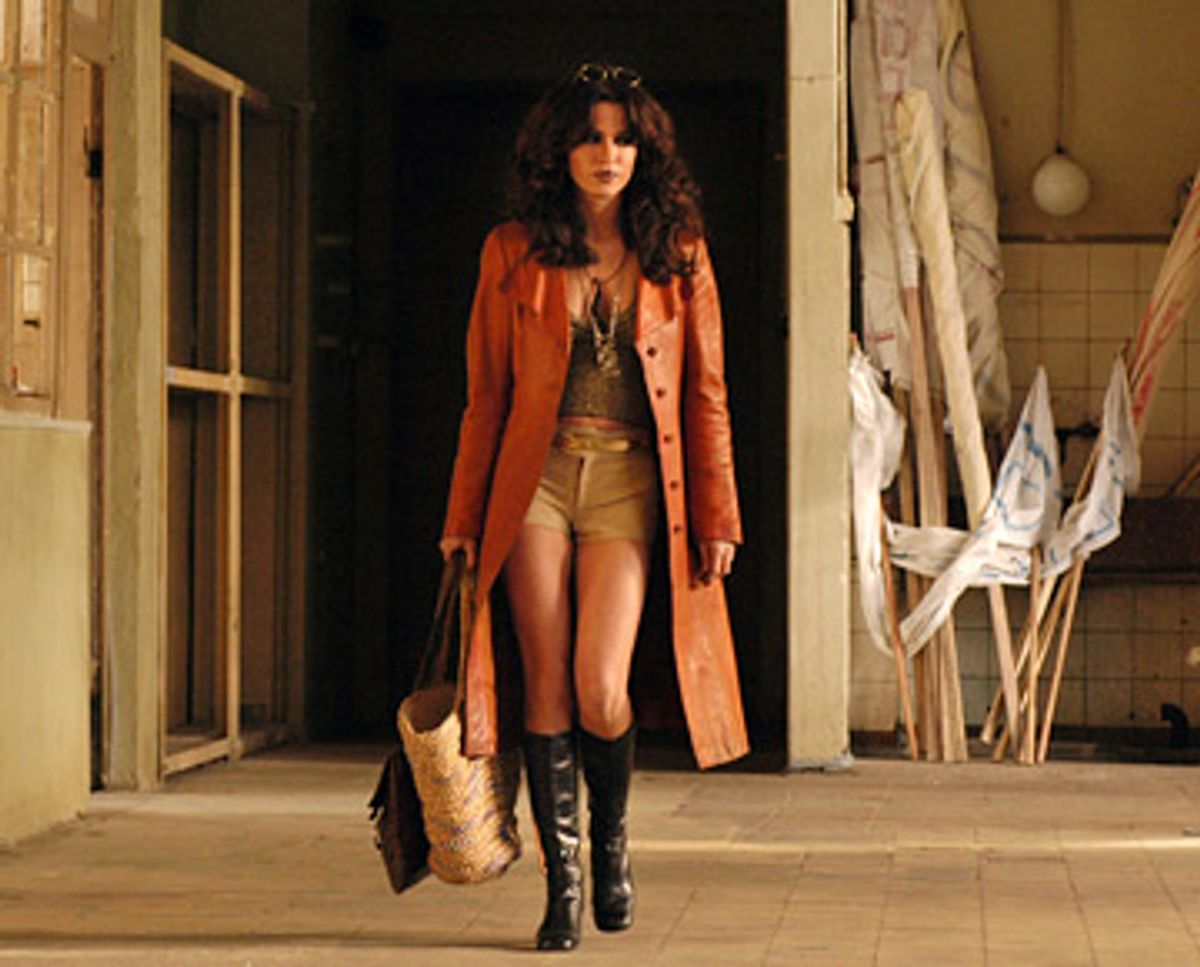
A Swedish actor as Mick Jagger, a perpetually naked heroine and the glorious Euro-cheapness of "Eight Miles High."
Export Film
Natalia Avelon as Uschi Obermaier in “Eight Miles High.”
Just a word about “Eight Miles High,” the English title of a deliciously dumb, reasonably well-made German hit called “Das Wilde Leben.” (My German is crap, but doesn’t that translate as “The Wild Life”? What was so wrong with that title?) It’s based on the memoirs of Uschi Obermaier, a quasi-legendary model, groupie and scenester of the ’60s and ’70s who might be described as equal parts Jane Fonda, Edie Sedgwick and Paris Hilton. And it’s every bit as silly as it sounds, complete with obligatory scenes at radical communes, political demonstrations and decadent rock ‘n’ roll parties, where no-name actors provide abysmal impersonations of Mick Jagger and Keith Richards.
As Uschi, Natalia Avelon has the requisite curves, bee-stung lips and piled brunette ringlets, along with a calculated blankness that seems more contemporary than her period-kitsch surroundings but may lend the film some accidental sense of significance. She is butt-naked in the very first shot, and periodically dons clothes after that for the purpose of taking them off again. On one level Uschi is simply Moll Flanders, a beauty who uses her sexuality to rise in the world; on the other, “Eight Miles High” (which has five credited screenwriters) may dimly be making the case that her persona was a sort of creative act, the one available to her in the excessively macho milieu of Love Generation pseudo-rebellion. OK, it’s a stretch.
There’s considerable grace, along with a few flickers of discordant intelligence, to Achim Bornhak’s direction, but the various ’60s and ’70s set-pieces verge on self-parody and the whole thing has an almost irresistible quality of Euro-cheapness that is itself a kind of nostalgia. On-screen titles tell us when the action has moved to Rome or London or New York, but there’s no serious attempt at convincing location work. The actors who play Mick and Keith are Swedish and German, respectively, so they spend their screen time striking album-cover poses and not talking. Given how dopey Uschi’s other paramours are — a pallid Berlin revolutionary (Matthias Schweighöfer) and a mustachioed Hamburg adventurer (David Scheller) — maybe that’s OK. I stopped counting the number of scenes in which a blowjob leads to a quarrel after I’d gotten to four.
“Eight Miles High” opens July 11 at the Cinema Village in New York, with more cities to follow.
Sympathy for the devil worshipers
Inside Norway's infamous black-metal scene: Misunderstood Robin Hoods or Satanic church-burning maniacs?
Gylve "Fenriz" Nagell, from the black-metal band Darkthrone.
It’s taken more than a full decade for the most widely demonized and vilified music scene in rock history — the Norwegian black metal scene of the early to mid-’90s — to get anything close to a fair treatment in a documentary film. In truth, the job isn’t finished yet. As crafty and compelling as Aaron Aites and Audrey Ewell’s “Until the Light Takes Us” is, it may go too far in its understandable desire to correct the bias and prejudice of mainstream journalism.
Black metal burst onto the international scene like an explosion of media catnip 16 or 17 years ago with a wave of church burnings in Norway and other Scandinavian countries that destroyed numerous historical landmarks, including the legendary Fantoft stave church, originally built in 1150. A few weeks after the fires started an articulate young musician named Varg Vikernes (aka Count Grishnackh, of the one-man band Burzum) discussed them with a reporter, suggesting that he knew who was responsible and elaborating a complicated litany of motives, from neo-paganism and anti-Christianity to Nordic nationalism and anti-Americanism.
Vikernes was immediately arrested and almost as quickly released; indeed, while he was later convicted of many other crimes, it remains unclear whether he started the Fantoft fire. Nonetheless, all his erudite self-taught ideology, much of it crazy but a lot of it surprisingly insightful, got almost instantly boiled down to one concept: Vikernes was a Satanist, and he and his fellow devil-worshipers were running amok in northern Europe.
This turned Oslo’s tiny black metal scene — three or four bands, a storefront and a basement record company — into Pop Culture Public Enemy No. 1 and, of course, made millions of teenagers around the world yearn to sign up, without the slightest idea what they were signing up for. Copycat church attacks followed throughout the Northern Hemisphere, often accompanied with spray-painted pentacles and 666′s and so forth, and whatever had once been distinctive about the Norwegian scene just became, in Vikernes’ words, “a bunch of brain-dead heavy-metal guys.”
But as Aites and Ewell’s film reveals — the two American filmmakers moved to Norway for several years to gain the trust of their subjects — both the music and the ideology of black metal were always more interesting than that summary suggests. With its emphasis on coldness, darkness and hardness and its Nordic, often symphonic sense of space, the music of Vikernes’ Burzum and such bands as Mayhem, Gorgoroth, Darkthrone and Satyricon is surprisingly varied and weird, and often doesn’t sound much like rock at all.
Interweaving grainy home videos of early Oslo live shows and interviews with survivors of the scene (at least two of whom appear anonymously), Aites and Ewell depict a vibrant, adventurous and often ghoulishly self-destructive world, where conversations about the negative effects of Christianity, American-style democracy, NATO and commercial globalization sometimes blended into outright nihilism. Even before the church burnings began, Mayhem vocalist Pelle Ohlin (aka “Dead”) lived up to his nickname by literally blowing his brains out with a shotgun. Before calling the police, one bandmate snapped a notorious photo of Ohlin’s mutilated corpse, which later appeared on the cover of the Mayhem live album “Dawn of the Black Hearts.” (Seriously, don’t click that link unless you’re sure you want to see it.)
If you believe the testimony of Vikernes, Darkthrone drummer Gylve Nagell (aka Fenriz) and Satyricon drummer Kjetil Haraldstad (aka Frost), no one in black metal ever wanted to get famous or reach a mass audience, let alone spark an international trend of kids in corpse paint and black overcoats. Against the changed landscape of multicultural 21st-century Europe, musicians like Fenriz and Frost — who were never directly involved with Vikernes’ quasi-terrorist campaign — seem semi-reconciled to their fate as professional entertainers, scraping out a living deep into middle age from the stylized remnants of adolescent pain and anger.
Neither of those guys, likable and wounded characters that they are, has the star power or philosophical depth of Vikernes, whom the filmmakers interviewed extensively in the relatively posh surroundings of his Norwegian prison cell. (Vikernes was released last May, after “Until the Light Takes Us” was completed.) With a tidy little goatee and a short jailhouse haircut, he looks like an unusually gym-toned specimen of late-30s academic. Loquacious and funny, he discourses at length, and in excellent idiomatic English, on the many crimes of Christianity and American-style commercial capitalism, which he blames for uprooting indigenous religious cultures not just in the Nordic countries but all over the world. He makes the church fires sound almost innocuous, a slightly overzealous effort to make the public “wake up” to the evils of mainstream religion.
That’s all fascinating as far as it goes, but to some degree Vikernes is playing his liberal American guests, coming off as a Robin Hood combination of anti-globalization activist, Situationist intellectual and neo-Norse acolyte of Odin and Thor. In fairness, Aites and Ewell pull back the curtain on Vikernes little by little, revealing first why he spent so long in prison (for a gruesome crime whose details he recounts without emotion) and then the precise nature of his objections to Christianity. Its repression of women and gay people? Um, not exactly. Its crushing of open dissent and heresy? Its toadying to despots of all stripes? No and no. But the fact that Christianity is a historical offshoot of Judaism — now that’s a problem.
Do Aites and Ewell owe the viewership a clearer explication of Vikernes’ ties to white nationalist groups, his long record of troubling racial, sexual and religious rhetoric and his public flirtation with Nazi ideology? You won’t learn this in the film, for instance, but Vikernes is viewed as the philosophical father of the musical-political subgenre called “National Socialist black metal,” or NSBM. Or is it fairer to this disturbing and complicated figure to present him on his own terms, without recourse to prejudicial buzzwords? (For the record, Vikernes has not called himself a Nazi since the late ’90s, preferring the invented term “Odalism,” said to signify “paganism, traditional nationalism, racialism and environmentalism,” along with an opposition to modern civilization in all its forms.)
I can see both sides of the argument, and I’ve long been interested in the “Ezra Pound problem,” meaning the tendency of underground aesthetic rebels to become enmeshed in noxious political ideologies. Maybe it doesn’t invalidate Vikernes’ music in particular (his forthcoming post-prison album was originally to be called “The White God”) or the entire anti-modernist, atavistic spirit of black metal to observe that it comes with some heavy and evil-smelling baggage. But I suspect it’s worth, you know, actually noticing and talking about.
“Until the Light Takes Us” is now playing in New York, Detroit, Grand Rapids, Mich., and Providence, R.I. It opens Dec. 8 in New Orleans, Dec. 10 in Houston, Dec. 11 in Los Angeles, Jan. 8 in Chicago, Jan. 15 in Seattle, Jan. 22 in Milwaukee and Jan. 29 in Denver, with more cities to follow.
On “The Road” with John Hillcoat
The Aussie director talks about Viggo Mortensen, Coke, cannibalism and adapting Cormac McCarthy's bleak parable
John Hillcoat
John Hillcoat spent many years honing his craft with music videos and struggling to get feature projects launched. So his emergence in 2006 with the stylish, startling and violent Aussie western “The Proposition” — scripted by singer-songwriter Nick Cave, an old friend and current neighbor — wasn’t as sudden as it appeared to be. (It was actually his third feature.) That film’s depiction of a memorably harsh environment brought Hillcoat to the attention of producer Nick Wechsler, who was planning an adaptation of Cormac McCarthy’s post-apocalyptic father-son parable, “The Road.”
Hillcoat’s resulting film (scripted by British playwright Joe Penhall) has already been touted this year as an Oscar contender, which is remarkable when you consider that its characters have no names and its color scheme — a few momentary digressions aside — features steely gray, dark gray and pale gray. Indeed, the sun-baked 19th-century outback of “The Proposition” is like a summer garden party on the Seine compared to the world of “The Road,” which has been devastated by an unexplained nuclear or environmental catastrophe that has killed off nearly all life, plunged the planet into endless winter and reduced human society to pure atavism.
A nameless man, played in Hillcoat’s film by Viggo Mortensen — he is literally called “The Man” in McCarthy’s novel — struggles through this forbidding landscape with his son (remarkable newcomer Kodi Smit-McPhee), a boy on the verge of manhood who has no memories of our world, the one of color and commerce, trees and flowers and cities. Not only must the Man try to protect the boy from the ever-present danger of kidnapping, murder, rape and cannibalism — hazards the film and the book make all too clear — he must also provide him with a reason to keep on going. As I suggested to Hillcoat when I met him in New York recently, this is the same challenge the story itself faces: how to convince its audience that the emotional rewards of this harrowing journey will be worth it.
Literary adaptation is always a tricky affair, and admirers of McCarthy’s hypnotic, pseudo-biblical prose may have mixed feelings about the Penhall-Hillcoat adaptation. They have stuck closely to McCarthy’s story but stripped out its inessentials, producing something leaner, more muscular and closer to an action movie: “Mad Max” in slow motion mixed with “28 Days Later,” set in a landscape that resembles the final stages of the Donner Party, or the end of the Civil War. For most viewers, of course, the movie will be the only version they encounter, and Hillcoat reveals himself again as a genre-film visionary in the mode of Sam Peckinpah, a connoisseur of gorgeous bleakness who creates images of soul-searing intensity.
Hillcoat was more than an hour late meeting me at a hotel bar on Manhattan’s Upper East Side, but he had a pretty good excuse — Cormac McCarthy, a legendary talker, had been holding court at his hotel nearby, and the director couldn’t tear himself away. “It’s like doing mental gymnastics,” Hillcoat said. “He’s so completely lucid that he challenges you at virtually every minute.”
So what made you think that “The Road” had a movie in it? McCarthy’s book is on the one hand so literary and on the other hand so painful. It doesn’t strike me as the best combination for cinema.
In that pain, there’s also something — after I read it, I couldn’t stop thinking about it for a long time. And it does have that effect of, you know, making you hug your child, reminding you about what is so special in life, what should be protected. I found it very moving, in a positive way. It’s positive pain, as opposed to negative pain, shall we say. And I also realized that the dialogue, the conversations, are just so fantastic, you can literally just take them off the page.
The story is deceptive — if you take away all that beautiful prose poetry, you have a very simple tale. And the tale is actually like some ancient parable: To set a man and his son on a journey to the coast, in hopes of finding something. It reminded me of “The Grapes of Wrath.” Where, you know, human goodness is tested and there’s this journey through this apocalyptic world in hopes of finding something better. And also that idea, human goodness, where does that come from? The boy has been born into that world, so he has no reference to the world as we know it. Yet he is the one who gives the man back his humanity, and who takes a leap of faith, which is extraordinary against those odds. If you simplify it down to that, that’s when I thought, well, this is the most filmable of Cormac’s books.
Joe Penhall, who adapted it, his approach was more like editing, rather than trying to change anything. We talked to other writers, and they were almost bamboozled by the poetic prose. Joe’s very pragmatic. He was like, “It’s all there on the page.” The scenes and the conflict are riveting, and Cormac’s a master of action. Any action that happens is always startling and terrifying and has an ingredient of reality that feels very fresh. He puts characters in such jeopardy, yet there’s always something interesting that he’s trying to say about people and how we behave.
How much or how little was McCarthy involved with the film?
Cormac was very helpful. In the first conversation I had with him, he explained, “A book’s a book, it’s a totally different medium.” He didn’t ask for a script, and we never gave him a script. He let us run with it, but he was always there to answer questions, he came on set and so on. The ruthless bit, the tough bit, was editing it down: What bits do you keep in, what do you take out? Now what we have are the key scenes from the book, the turning points. There’s a lot of repetition in the book that we had to get rid of.
It strikes me that this movie poses a really stiff challenge, first of all for you and then for the audience. When we’re watching it, we have to make the same decision the characters do in the story: Is it worth it? Can I stand to keep on living in this world where everything is dead or dying?
Well, yeah. But I agree with Mr. Ebert on this: There’s never been a good movie that’s depressing. The only thing that’s depressing is bad films. I grew up watching films in the ’70s, and, you know, that was like a renaissance. Films had the freedom to explore real drama, and I think there’s been a return to that in recent years. “No Country for Old Men” is much more nihilistic, much bleaker, than this story. It’s got the action element, it’s a thinking man’s action film. But there’s a nihilism in that villain that doesn’t exactly conclude well, you know?
I’m sure some audiences just go to the cinema to shut down their mind, but I love being transported into other places. I also think that there’s a lot of humanity in this story. In terms of all the heaviness of the story, I think that’s greatly rewarded. My great reference was to films like “The Bicycle Thief,” where the father and son are under unbelievable pressure, just in terms of day-to-day survival. And how often do you see a positive love story between father and son that’s realistic? You have to go back to “Bicycle Thief,” almost. Mostly in film you see tyrannical or absent fathers.
You know, the more I thought about this film, the more I saw it as a parable about the relationships between fathers and sons, the things we all deal with. And when you look at it that way, the background becomes more allegorical than real. Maybe it’s not about this unimaginable world after the apocalypse. Maybe that’s a metaphor for ordinary life and how difficult it can be.
Right, and even if you don’t have a child, you’ve had a father. It’s a generational story. One generation must take over from the last. We’ve been going through a whole decade of being reactive, reacting to fear. The older we get, often the more fearful and rigid we become, and it’s the new generation that has to challenge that. That’s what the story is doing: There comes a point when the younger generation becomes the teacher, instead of the other way around. We need that challenge. It’s that cycle: One generation has to hand the fire to the next. So I think there’s very much an allegorical element.
And yet, what’s amazing about the book — I love genres, and I love to find something new in the genre that no one’s seen before. What Cormac does, and what we tried to do in the film, is show a world that’s familiar but that we’ve never seen before. Having all your possessions in a shopping cart — we’ve all seen that with the homeless. Living their day-to-day existence, and in their own way living the apocalypse. Yet we’ve never seen that in apocalyptic films, where it tends to be about the big event, the spectacle.
There’s plenty of violence and terror in your film, but in fact you don’t go quite as far as McCarthy’s book does, in terms of describing some of the things the man and boy come across. There’s a scene in the book where they find a …
You’re talking about the baby. We filmed that. We had all those ingredients. But what happened is — in film it has a different effect, and at that point in the story it was almost redundant. It was almost like, “Oh, we’re going back to the cannibal threat, I thought we’d been through all that.” At that point the story is more about their relationship changing, and the kid standing on his own two feet. So it just felt structurally inappropriate, it just didn’t work. And some things magnify a lot more in your mind when you visualize them. It has a different effect. It’s about the emotional journey — the more you put that stuff in, the more it overwhelms the rest of the story and turns it into something else. The more you describe the big event, the less relevant the present-tense, day-to-day journey becomes.
Speaking of the big event: There are hints and allusions about what horrible event has happened, but it’s never explained. That’s completely true to the book, but I wonder whether some viewers will feel frustrated.
What I find is that as you go along you become accepting of that. You read more into it. The whole book works like that — the man is the Man, the boy is the Boy. They don’t even have names. And then there’s just the realistic aspect. Apocalyptic films tend to be all about the big event, and we’re actually making the point that 10 years later you’re just thinking about the next day, and getting through what you have to get through. If you look at people who survived Katrina or Mount St. Helens or 9/11, they’re not thinking about the context: This happened for such-and-such a reason. That’s the last thing on their mind. They’re just thinking about how they’re going to get through the next day, the next hour. Even in a car accident, you’re not analyzing how it happened. You’re thinking about: “How am I going to get out of here? Am I OK?”
This isn’t exactly a comic movie, but the moment when Viggo’s character finds a can of Coke and gives it to his son is funny and tragic and weirdly upsetting. If there’s one product that will taste exactly the same 15 years after the end of the world, that’s it.
What I love about that is that it’s also making a point: At the moment there’s nothing more powerful in our world than corporations, and we’re all suffering from corporate cannibalism. But in this world, they have zero meaning and zero power. They’re finished. And the boy doesn’t even know — he’s responding to the actual ingredients, and has no idea what the significance is.
There are people who’ve seen that scene and thought, “Hang on, what is this product placement?” And we had to beg Coca-Cola to let us do this. It took Viggo Mortensen to talk the head of Coke into it. We filmed the scene with five other soft drinks, and none of them would agree. It’s the exact opposite of product placement. They let us do it, without giving us a cent, and it was really to make a point. I think most people get it, even people who haven’t read the book.
One area where you depart from the book, at least in a sense, is with these little snippets we see of the man’s previous life, from his dreams. It’s probably only a couple of minutes of screen time, but it’s extraordinarily painful to see the regular world, our world, in natural color, in the middle of this dreadful gray landscape.
Yeah, that world, our world, is sprinkled through the movie. Again, how do you translate a book that’s very much inside the mind of a character? There are cinematic tools that can do that, like memories and flashbacks, which are internalized states. And there’s also use of voice-over, very sparingly, whenever we need to get inside that character’s head. We needed more of that in the film in order to remind us what the man has to hide from the boy. What the man can never really share, even when he teaches him about this world. It’s also a reminder for all of us, of just how precious those little moments are that we all take for granted. The influence and inspiration there is actually William Eggleston, the great American photographer, with his vivid colors, his heightened little familiar snippets of life.
Viggo Mortensen has become so famous for his methodology, for his intense preparation and immersion in characters. But how did he go about creating a character who has no name, no history, no job? We don’t know any of the things about this guy that you’d know about a character in an ordinary motion picture.
I mean, Viggo fully embraces things, but this was quite a challenge. There was nowhere to hide. He’s in almost every frame of the film. We had a long rehearsal period, but it was about discussing the text, not actually about blocking scenes. He did talk to McCarthy, but more about their shared experiences, more about the fact that they both have sons. Since his character is an Everyman, it was about getting to the emotional truth in those moments. At the end of the day it was about understanding the meaning and point of each scene. Being out in the real environment helped. Viggo went off and created his character, he slept in his clothes, he talked to homeless people, he did all that stuff. But it really came down to baring his soul when the moment came, reacting to the environment and reacting to the boy, Kodi, who was his partner in the story and in the film. We talked more about that than anything else.
“The Road” is now playing in New York, Los Angeles and other major cities, with wider national release to follow.
Werner Herzog among the demented iguanas
The legendary German eccentric on his most American film, the dirty, profane, dazzling non-remake "Bad Lieutenant"
Director Werner Herzog, left, and actor Nicolas Cage pose for a portrait at the 34th Toronto International Film Festival in Toronto Tuesday, Sept. 15, 2009. (AP Photo/Carlo Allegri) (Credit: Associated Press)
If the essence of Werner Herzog could somehow be bottled and preserved, it could make a more effective remedy for clinical depression and seasonal affective disorder than anything found in the pharmacist’s cabinet. Whatever you make of the guy’s movies — a prodigious and often baffling output unlike anything else in cinema history — he’s the most irrepressibly optimistic man in show business. At one point in our recent phone conversation, he took a break from listing all his innovations and brewing projects and exclaimed in his trademark Bavaria-by-way-of-West L.A. drawl: “You name it — it just can’t get any better!”
Maybe “show business” sounds like a dis, when applied to a filmmaker who began as one of the young lions of 1970s New German Cinema (with “Aguirre: The Wrath of God” and “Nosferatu the Vampyre”), developed a global reputation for overweening ambition (mainly “Fitzcarraldo”) and then moved on to become a groundbreaking American documentarian (with films like “Grizzly Man” and the Oscar-nominated “Encounters at the End of the World”). I don’t mean it to. What I mean is that Herzog loves traveling the world making movies — lots and lots of movies — and showing them to as many people as possible.
While Herzog is endlessly imaginative about getting his films before the public in various forms, he has almost no interest in Hollywood or its internal machineries, and also isn’t much of a cinephile. When I asked him whether his grimy and delirious new cop drama “Bad Lieutenant: Port of Call New Orleans” was inspired by the nihilistic American crime films of the ’70s, he insisted that he’s never seen most of those films. I mentioned “Taxi Driver” and “Chinatown,” and suggested that they were relatively well known pictures, and might strike some viewers as morally, tonally and visually influential on “Bad Lieutenant.”
You could pretty much hear Herzog scratching his head on the other end of the line. It emerged that he wasn’t sure what “Taxi Driver” was or who had made it. “Chinatown” rang more of a bell, and I reminded him that it was directed by a European auteur even more notorious than Herzog himself. He admitted he’d probably seen that one, but didn’t really remember it. American crime films from the ’40s and ’50s, though? Sure, he had seen them while growing up in postwar Germany.
Given that background, it shouldn’t surprise anyone that Herzog has never seen Abel Ferrara’s 1992 “Bad Lieutenant,” which is nominally the basis for this film but has very little to do with William Finkelstein’s screenplay and almost nothing to do with Herzog’s finished product. For Herzog, making movies is about exploring the world and adventuring into unknown philosophical and artistic terrain. His relationship to film genres or cinema history or the other things critics love to talk about is minimal. So “Bad Lieutenant,” with its memorable lead performance by Nicolas Cage as a charismatic, agonized, drug-addicted and possibly schizophrenic New Orleans homicide detective, is, as Herzog puts it, a crime movie refracted through a demented prism.
Although the story of Cage’s character, Lt. Terry McDonagh, as he rises, falls and is improbably redeemed while trying to solve a gruesome drug-related massacre, is straightforward enough, Herzog leaves the genre’s dispassionate objectivity behind and shows us at least some of what happens in McDonagh’s mind. Hence the iguanas in his apartment (not visible to any other character), or the dead soul break-dancing on a drug dealer’s carpet. Or the shot from the point of view of a bereaved alligator. (Could I make something like that up?) It’s often difficult to decide which of McDonagh’s failings is the worst: When he makes a date with an incredibly hot highway patrol officer (Fairuza Balk), he’s cheating on his hooker girlfriend (Eva Mendes) — and then it turns out he’s only interested in the jackbooted tootsie for her access to confiscated narcotics.
When I spoke to Herzog on the phone, I hadn’t yet seen his other new release this season, the still more demented cop drama “My Son, My Son, What Have Ye Done?,” in which Willem Dafoe plays the San Diego cop trying to unravel the reasons why a messianic murder suspect (Michael Shannon) is holed up in his house with a pair of flamingos. If “Bad Lieutenant” is something close to a work of dirty, profane genius, “My Son, My Son” is a mixed bag, with patches of dark-comic brilliance and an uneven plot that flirts with shaggy-dog obscurantism. (It’s getting a small-scale theatrical release, beginning in December, from Absurda, David Lynch’s company.)
Both pictures are unmistakably the work of one of the strangest and bravest of contemporary filmmakers, a man who has combined a wire walker’s level of artistic daring with a work ethic that would have made his Bavarian grandparents proud. Werner Herzog called me from his home in Los Angeles, a few days before the theatrical opening of “Bad Lieutenant: Port of Call New Orleans.”
Werner, I know you’ve had some difficulty getting narrative feature projects off the ground in recent years. And you’ve made so many great documentaries — I pretty much assumed you’d do that for the rest of your career. But with “Rescue Dawn” and now “Bad Lieutenant” and “My Son, My Son, What Have Ye Done?” you’re a narrative filmmaker again, which must be gratifying.
Look, let’s face it, in the last 10 years I made four feature films, which is quite a lot, according to Hollywood standards. But in fact I’ve made 15 or so [total films] in the last 10 years. It’s not being back, because I was never away from it, and the next four or five projects are all feature films too. Of course there’s some documentary stuff as well. Those are like home invasions: uninvited guests that I have to wrestle somehow!
You’ve never made a film before that felt as specifically American, in setting and tone, as this one does.
Well, no. I’m now completely comfortable making a film in English. If you look at this film or at “My Son, My Son,” you would never guess that somebody made it whose first language is not English. I’ve settled in very comfortably, and you see I’ve never stood still. I’ve been out here looking for new horizons, new projects, new alliances with production companies, new forms of distribution, new actors. You just name it, it just can’t get any better!
“Bad Lieutenant” is also an American film in the sense that it belongs to such a familiar genre. Are you a fan of American crime films ?
No. I must confess I hardly ever have seen any of them, neither on TV or in the theaters. Some of the film noirs of the early ’50s and late ’40s, but that’s about it. I suppose this is a genre film, in a way. But you see, there’s a clear stamp on it. There are things that are not in the screenplay that came into it, which I kept inventing en route, like the demented iguana or the dancing soul. I had the feeling, “Yeah, there is a certain genre here, but I shouldn’t be completely docile. Just be imaginative and go wild!”
You have the iguanas and you have an alligator point-of-view shot. Do reptiles have some symbolic importance in this movie?
No, I think it’s just — these reptiles are not even visible to anyone else. When the bad lieutenant says, “What are these iguanas doing on my coffee table?” the other guys say, “There ain’t no iguana!” It’s just a demented sort of vision under drugs.
Nicolas Cage’s performance in this movie is amazing. The character is both irresistible and thoroughly despicable. I wasn’t sure whether I loved him or hated him, which may be exactly what you guys were going for.
You can see the film the way you want to see it, I do not want to dictate that. But one thing is obvious: He is absolutely formidable. Hold on, please, that’s the door. A double espresso is coming to keep me awake! I’m sorry, I lost your last question.
We were talking about Nic and his character. You said he was “formidable.“
Yes, you see, there’s something which was guiding us. I told Nicolas that there’s such a thing as, like, the bliss of evil. Let’s go for it! Enjoy yourself! The more vile and the more debased you get, the more you have to enjoy it. That creates this very strange and very subversive humor.
This is another frame of reference, but you may appreciate it. He reminded me of the demons in Hieronymus Bosch’s paintings of hell: He’s hunchbacked, leering, with this insane gleam in his eye.
Yeah, yeah, yeah! You are the first one to mention that, but I think it’s not completely far-fetched. I think there was a basic pose or physical appearance for him. We talked about it quickly, and Nicolas asked me what he should look like. The character has a back injury, and I told him, “I would like to see you with a slanted shoulder line, preceded by your gaze.” Which is exactly what he does! Sometimes I give very laconic, condensed instructions, which you see throughout the film.
So I gather that when I say this film reminds me of certain of the nihilistic American crime films of the ’70s, that doesn’t mean much to you?
No, I don’t know those films. I can tell you where it comes from, it comes from the screenplay. Billy Finkelstein, who wrote the screenplay — wonderful dialogue and a very intense story — has profound knowledge of this genre. He has written a lot for television — I don’t even remember the series ["Law & Order" and "NYPD Blue," among others] — but he’s a very experienced man in this field, and brought this knowledge into the film.
Tell me about the way you and Peter Zeitlinger, your cinematographer, envisioned the film. We’re not exactly seeing the world from the Cage character’s point of view, because he’s in almost every shot. But nonetheless we’re seeing the world as he sees it.
Not in all instances, but of course there’s a tendency toward that. Sometimes it’s a demented view. He’s the only one who sees those iguanas, for instance, and of course the secret conspiracy is that we, the audience, see them as well.
I don’t want to give too much of the plot away, but maybe we can talk about the strange scene near the end of the film where everything that has gone wrong in McDonagh’s story suddenly goes right. All the narrative obstacles suddenly melt away, in about 15 seconds. It seems like a fantasy, it seems as if it can’t be real. Is that what you intend?
Yes, exactly. That’s very well observed. Besides, it gives the feeling and hope of a false ending, a happy ending that does not really occur. It goes into overdrive, in a way. It was clearly scripted, and it was a very good idea. We almost have a deus ex machina, which floats down from the sky and settles everything for the good. Except that it does not!
You have such a tremendous cast here. I loved all these actors: Nic Cage and Eva Mendes, of course, but also Brad Dourif, whom you work with a lot, as a bookie; Vondie Curtis-Hall, as Nic’s superior officer; Jennifer Coolidge, as his alcoholic stepmother. And the rapper Xzibit [Alvin Joiner], who is just terrific as the drug lord.
I’m always very careful and cautious about casting. It’s not just about putting names together. There has to be a texture, and what you probably have seen is that every single actor in this film, including the smallest speaking parts, is always at their very best. There’s absolutely no doubt in my heart. And don’t forget the writer, Billy Finkelstein, who plays a gangster, the one in the pink jacket whose soul is dancing. The writer turned out to be a very fine actor.
Again, without giving anything away your ending really defies expectations. I’m not quite sure what to think about it, in fact. We expect one of two possible endings — the bad lieutenant triumphs, or he is punished for his misdeeds. And you really don’t give us either one.
In my opinion, it’s a very beautiful and very mysterious ending. You see, according to the screenplay, it ended with a false happy ending that became a real abyss of darkness. And I thought, no, we should not dismiss the audience like that, out into the street. There should be something vague, something poetic, something mysterious.
That’s yet another way this film reminds me of both “Chinatown” and “Taxi Driver.” I’m sure other journalists have brought those films up.
Actually, nobody has asked me that. People sometimes ask me about Abel Ferrara, and I’ve never seen his film. Now that my film is out, people can see that it’s nothing like a remake. What can I say? Now, as to “Taxi Driver,” I’ve never seen it. “Chinatown” I believe I saw, but that was a long time ago. I’ve forgotten that film.
“Bad Lieutenant: Port of Call New Orleans” is now playing in New York, Los Angeles and other major cities, with wider release to follow.
John Woo on “Red Cliff” and the rise of Chinawood
Back home after 17 years, the action maestro has created his biggest spectacle -- and rebooted China's film biz
When John Woo left Hong Kong in the early 1990s, a few years before the then-British territory was to be handed over to the People’s Republic of China, it clearly marked the end of an era. Although he was hardly the only important Hong Kong filmmaker, Woo symbolized the sudden global emergence of the territory’s highly choreographed action cinema. With pictures like “Bullet in the Head,” “The Killer,” and the “Better Tomorrow” series, he had personally elevated the violent police thriller to implausible levels of symbolism and visual poetry.
Woo’s move to Hollywood suggested that Chinese authorities might have trouble convincing the best talents in Hong Kong’s film industry to stay home, under what was presumably going to be a censorious and intrusive regime. It also suggested that however corporatized mainstream American film had become, it could still attract exciting directors from overseas. Indeed, while Hong Kong studios struggled with budgets and distribution problems over the next few years, Woo became a certified Hollywood hitmaker, directing the cult faves “Broken Arrow” and “Face/Off,” along with the Tom Cruise vehicle “Mission: Impossible II,” which grossed $565 million worldwide.
But you can go home again, it appears. When I caught up with Woo for a few minutes on the phone recently, the 63-year-old action legend was partway through a whirlwind American tour to promote a film he calls the biggest and most ambitious he’s ever done — a massively-scaled, visually spectacular historical epic called “Red Cliff” that was entirely conceived, financed and made in China. He was also serving as a de facto spokesman for China’s burgeoning campaign to build a new global film industry that can compete on equal terms with both Hollywood and Bollywood. Yeah, if the suits in west L.A. haven’t made the logical deduction yet, they might make it now: Chinawood is coming, and it’s going to be a very big deal.
This isn’t an entirely new phenomenon, of course. From “Crouching Tiger, Hidden Dragon” to “Hero” to “Curse of the Golden Flower,” productions financed or co-financed by China’s film industry have occasionally combined big budgets with artistic vision and become hits on a global scale. But “Red Cliff” has definitely kicked the game up a notch, and you have to wonder whether veteran Chinese filmmakers like Chen Kaige and Zhang Yimou are feeling disrespected. Woo spends a dozen years in L.A. living the high life with Tom Cruise and Nic Cage while they’re making serious films, and then he gets to come back and become a huge national hero.
After protracted discussions with Chinese authorities, Woo got near-total carte blanche to come home and make this long-contemplated dream project, one for which Hollywood producers had displayed little enthusiasm. In the process, Woo — a devout Christian who is widely assumed to be anti-Communist — has clearly been tasked with driving Chinese cinema in a more commercial direction. “I have learned so much from Hollywood,” Woo told me, “and I thought it was about time to bring what I have learned in Hollywood back to Asia. There are so many young and talented filmmakers in China. I think it’s great for them to have the chance to work on a big-budget, Hollywood-type movie. To learn some new spirit, you might say.”
Whether Chinese film really needs an injection of Hollywood’s spirit is very much open to debate, but the Chinese authorities, like Woo himself, are thinking big. Woo’s grandiose retelling of the 208 A.D. Battle of Red Cliffs, between Han Empire forces and the rebellious kingdoms to the west and south — a legendary conflict as well-known to Asians as the Trojan War is to Westerners — veers, like most of his films, from the portentous to the breathtaking (and is often both at the same time). It combines Asian action cinema and Hollywood-style CGI effects in truly dazzling fashion and on a scale never seen before. And it’s become the biggest-grossing release in Chinese history (breaking the record previously held by “Titanic”), and a record-breaker in several other Asian countries as well.
Unfortunately, American moviegoers will only see a sliced-’n'-diced version of “Red Cliff,” edited down from the two-part, five-hour opus that played in Asian markets to a single, 148-minute release stitched together with voiceover narration and explanatory on-screen titles. This only drives home the point that “Red Cliff” wasn’t made for Americans; its release here by Magnet, a genre-oriented offshoot of Magnolia Pictures, is almost an afterthought by comparison. (Woo says the full-length Asian version will eventually be released here on DVD; you can probably find it now, if you know where to look.)
Despite the occasional clunkiness of the foreshortened “Red Cliff” and its ancient-world setting, it’s unmistakably a John Woo movie. (I haven’t seen the full-length version.) It’s built around patterns of male friendship and enmity, a deadly feud over a beautiful woman who represents the domestic bliss Woo’s violent heroes always yearn for, and three or four of the most elaborate action sequences ever filmed. (Yes, Woo devotees, there are still doves. Lots and lots of doves!)
Woo says the climactic, three-stage naval battle that lends the movie its name involved building two dozen or so full-size wooden warships, creating many more digitally, and shooting with four different filmmaking crews: a first unit to capture the principal action, a second unit, a stunt unit and a special-effects unit. “We had to shoot all kinds of live-action scenes while the ships were actually on fire,” he laughed. “We CG’d the rest of the ships and the rest of the fire, but a lot of it is real. And we were shooting against bad weather. It was extremely cold and we were facing high winds. We had to get creative in every shot. This was definitely the biggest movie, and the toughest movie, I’ve ever tried to do.”
Given that the historical battle of Red Cliffs took place 1,800 years ago, and the best-known account is a fictionalized version written in the 13th century, more than a millennium later, Woo and his writing team felt free to simplify and amplify the story as they see fit. Three of Asia’s biggest male stars play the principal roles: Tony Leung plays Zhou Yu, the rebel hero who joins forces with Zhuge Liang (Takeshi Kaneshiro), a rival kingdom’s military strategist, to confront the massively superior forces of Prime Minister Cao Cao (Zhang Fengyi), a nefarious schemer who has convinced the Han Emperor to go to war.
There are dozens of other characters in the mix, but none are as memorable as the ethereal Xiao Qiao (Taiwanese supermodel Chiling Lin), who is married to Zhou Yu but, of course, coveted by the evil Cao Cao, whose uncontrollable desire for her will prove to be a near-fatal failing. (No one is ever likely to accuse Woo of being a feminist filmmaker. His women come in two flavors: lovely and mysterious or tomboyish and spunky.)
Despite the wide variety of fantastical violence depicted in “Red Cliff,” Woo insists he has stayed true to his code of never glorifying killing in the service of entertainment. “It’s very much an entertaining film, but I think there’s a human story in there too, that’s important for me to tell,” he said. “It’s a war movie, and I like to stress that in war there are no winners. I think we have an antiwar message in there. As I’m sure you can see, I emphasize that when people get shot, there is death and tears. I think that’s the way to send the right message.”
Woo was able to borrow up to 1,500 soldiers from the Chinese army to serve as extras in the battle scenes and work on building sets, which gives you some idea how much national pride became officially invested in this prodigal son’s homecoming. For his part, Woo describes working in his native country after all these years as “a dream come true.” (He was born in Guangzhou, in southern China, and moved to Hong Kong as a child around the time the Communists came to power.)
”I’ve wanted to make this movie for more than 20 years,” he said. “I always dreamed about making a movie like ‘Lawrence of Arabia’ or ‘Spartacus’ or ‘Seven Samurai’ — that scale of movie. And I really love this part of history. This is the most famous battle in Chinese history. Anybody who grew up in China knows this story. The Japanese know it, the Koreans know it, all the other Asian countries know this story.”
Seeing the audience reaction in China and other East Asian countries, says Woo, made him see the potential of a Hollywood-scale Chinese film industry. “The movie was so successful in China and Japan and that was very, very gratifying,” he said. “The audience really felt so much excitement about the movie. Most Asian audiences are used to watching big Hollywood movies, which honestly are much higher quality, with the heroes and the big stars. But a movie like ‘Red Cliff’ has really changed their minds. It’s a movie on the Hollywood scale that has so much of the Asian spirit. It has drawn the Asian audience back to the movie theater. We will have to see what happens, but I think the film industry in China will grow very fast, very fast. People in China really want to watch this kind of movie.”
“Red Cliff” is now playing in New York, and opens Nov. 25 in Atlanta, Boston, Chicago, Dallas, Denver, Houston, Los Angeles, Minneapolis, Nashville, Philadelphia, Portland, Ore., San Diego, San Francisco, San Jose, Calif., Seattle and Washington; Dec. 4 in Honolulu, Monterey, Calif., Sacramento, Calif., and Santa Cruz, Calif.; and Dec. 11 in Baltimore, Cleveland, Hartford, Conn., Indianapolis, Kansas City, Las Vegas, Memphis St. Louis, San Antonio, Texas, and Santa Fe, N.M., with more cities to follow. Also available on-demand via many cable-TV systems.
Joseph Gordon-Levitt: Caught between two worlds
After starring in a summer rom-com and kicking ass in "G.I. Joe," the one-time TV teen returns to "Uncertainty"
Joseph Gordon-Levitt in "Uncertainty."
At the ripe old age of 28, Joseph Gordon-Levitt is simultaneously a showbiz old pro and one of the hottest young acting talents to emerge in this decade. When Gordon-Levitt played his first high-impact dramatic roles in edgy, independent films like “Mysterious Skin” (2004) and “Brick” (2005), there were a handful of snickers at first: Wait, isn’t that Tommy, the teenage kid from “3rd Rock From the Sun”? It was indeed, but Gordon-Levitt has been acting since early childhood. He had an extensive TV résumé long before the first of his 133 “3rd Rock” episodes — with recurring roles on “Roseanne,” “The Powers That Be” and the early-’90s “Dark Shadows” reboot — and he damn sure hasn’t let that role define his subsequent career.
Gordon-Levitt’s movies since his “Brick” breakout have quite frankly been hit and miss, with an accent on miss. Scott Frank’s intriguing neo-noir “The Lookout” generated a cult following, but highly anticipated films like Kimberly Peirce’s “Stop-Loss” and Spike Lee’s “Miracle at St. Anna” wound up impressing neither audiences nor critics. Frankly, I think Gordon-Levitt is a difficult actor to cast correctly. He’s handsome, intelligent and funny, but his demeanor always seems a little aloof, as if he’s hiding a secret or smiling at a private joke. He’s too charismatic to play the second banana in most movies, but doesn’t seem perfectly suited as the romantic lead either.
At least, he didn’t — not until busting out his Hall & Oates dance moves in this summer’s chronologically challenged rom-com “(500) Days of Summer,” which became a modest hit. This year he has also established himself as a viable action-spectacle supporting character in “G.I. Joe: The Rise of Cobra” (he’s in both the film and the video game), before returning to home turf with the low-budget New York indie “Uncertainty,” a tricky narrative experiment from the writing-directing duo of Scott McGehee and David Siegel (“The Deep End” and “Suture”).
“Uncertainty” is a carefully structured but largely improvised film — that’s actually not a contradiction — which is two different movies at once, both of them about Kate (Lynn Collins) and Bobby (Gordon-Levitt), a semi-hip young urban couple facing an unexpected pregnancy and all the Big Life Questions that come with it. In the opening of the film, they flip a coin on the Brooklyn Bridge, and then sprint away on foot into two parallel but separate story lines: “Yellow,” a Manhattan thriller involving a lost cellphone, armed assassins and mysteriously large sums of money; and “Green,” a low-key domestic drama, mostly set at the Queens home of Kate’s South American immigrant parents.
I can’t explain it a whole lot better than that, except to say that both actors are tremendous and that there’s a lot of poetry and ambition to McGehee and Siegel’s project. Even though the stories are so disparate, and the characters themselves come to seem like different people, there are areas of near-intersection: The doubled twosomes drink coffee at the same time, have sex at the same time and go (or do not go) to the same downtown party. The Green couple pick up a stray dog on the street; the Yellow couple kill some time, during their ill-advised extortion scheme, by going to see “Stray Dog,” the 1949 Kurosawa noir.
I’m not quite sure that “Uncertainty” hangs together as well as it might — if anything, the Yellow story is too outrageous, and the Green story too muted — but the unshowy, street-level cinematography by Kathy Li is wonderful and, as I told Gordon-Levitt when he called me last week, it’s great to see a film supposedly set in New York that was actually 100 percent shot there.
“Shooting on the street like that — I mean, it was explosive,” he said. “Maybe that’s a bad word for it. There’s so much energy pulsing through New York City, and film sets are already very high-energy places. When you put that in the middle of New York, it gets pretty intense.”
As ever, Gordon-Levitt was among the most pleasant and personable conversationalists in the business. He claimed to remember an interview we did two and a half years ago in Austin, Texas, and signed off (as he did the last time) by urging me to plug his “collaborative online art project,” which gives him a way to engage with the public that’s distinct from his movie-actor persona. As far as his reported role goes in Christopher Nolan’s upcoming — and much blog-drooled — “Inception,” Gordon-Levitt would only say that yes, he’s in it, and he’s promised not to talk about it. Like I say, an old showbiz pro, in a 28-year-old body.
I guess one of the things that’s nice about shooting on the streets of New York is that people just aren’t that impressed, right? They’re like, “Ah, another film shoot? Who cares?”
True enough. They just want to get where they’re going. It’s hard to shoot a scene when you have to watch out for bike riders on the Brooklyn Bridge. Staying in character, and making sure you don’t get hit. Acting is a challenge, man.
With “(500) Days of Summer,” “G.I. Joe” and now “Uncertainty,” you seem devoted to appearing in every possible kind of movie within a single year.
Well, thank you. I guess I have an eclectic taste, I don’t just like one thing. Contrast is key. What do they say? Variety is the spice of life. My favorite actors are the chameleons, guys like Daniel Day-Lewis, Billy Bob Thornton, Meryl Streep, people who are always different.
But do you concentrate on that? I mean, are you thinking, “I want to do something totally different from the role I just did?” Or did things just fall out that way?
To be honest, that’s not really what I think about. Here’s the way it works: I just see a lot of scripts, and if I like one of them, then I try to get the part. A lot of the scripts I see I don’t particularly like, so I don’t try to get those parts. And then some of the ones I do like, I don’t get the part. But somewhere in there there’s a decision, whether or not I want to pursue a given piece of material. I wouldn’t say I think that much about what I just did, so much as I think about how I feel about the piece that’s in front of me right now.
This particular movie, “Uncertainty,” was created in a highly unusual fashion. Have you ever done anything before with this much improvisation to it?
No, no. This was a unique creative process that the filmmakers, David and Scott, pretty much innovated. I don’t know, maybe other people have done it this way before, but I certainly haven’t done it this way before. They wrote a script, it just didn’t have any dialogue. The story was all very meticulously and thoroughly thought through. It’s not one of those improvisational movies that sort of meander along the way real life does.
And, by the way, I love some of those movies, like Cassavetes, you know, “A Woman Under the Influence,” something like that. I love that movie, and I don’t exactly know what their creative process was on those Cassavetes movies. But “Uncertainty” is different. It’s not so much a slice of life. It’s a highly structured, precisely told story. It’s just that any given moment was left up to that actual moment.
So the movie diverges, right at the beginning, into these two stories, the Yellow story, which is a thriller, and the Green story, which is more like a quiet, indie-film-type family drama. Did you shoot them separately?
Yeah. We shot all of the Yellow story first, and then we shot all of the Green story.
And when you shot them, were you aware of the parallels, or the areas where the stories kind of imitate each other or brush up against each other? Was all of that in the script?
Yeah, we were really aware of that. Those were things that Scott and David were very precisely orchestrating. It’s all there in the script. It’s not like we just shot two different stories and then mingled them together in the editing room. That’s, I think, where a lot of the most beautiful and telling parts of the movie are, in the juxtapositions between what’s happening in one world and what’s happening right at the same time in the other world. Which is a construct that definitely doesn’t exist in your more conventional movie, and I think it’s one of the most stimulating aspects of this one.
Since you shot the Yellow story first, that must have affected the experience of shooting the Green story.
Yeah, definitely. I think it raised the stakes. And I think we weren’t forced to make those Green scenes real dramatic, you know what I mean? The stakes were already so high, the tension and intensity of the movie were there already. We’d done that, we’d been yelling and running and shit. I think that gave us the freedom and confidence to let the Green scenes be very organic and natural, not force them. Often what happens in drama is that people don’t want them to be boring, you know? So they try real hard to make it really intense. The truth is, that’s not how a lot of those conversations really go.
I understand you and Lynn Collins and the directors did an unusual amount of rehearsal before the shoot.
Yeah, we did a lot of rehearsal. We spent a solid month hanging out, walking around New York, going to different places, talking about the characters and playing some of the scenes. We also played out a lot of scenes that weren’t in the story, stuff that happened before the story takes place: How the characters met, how they fell in love, what it was like the first time they had sex, when they first started getting serious. We had all that under our belts by the time we started shooting.
And wasn’t there some kismet at work in the casting too? You and Lynn are so great together, and I’ve heard that you auditioned together, even though you hadn’t even met each other before.
Pretty much. I think we had met before, but we didn’t really know each other at all. We auditioned together, and that audition was one of the favorite audition experiences of my life. I’ve been on a lot of fucking auditions, and to be honest auditions are generally devoid of any creative spark. [Laughter.] Everyone understands that it’s a process you have to do, but it’s not ideal. You’re in some office and you’re reading some scene in the wrong place or whatever. This audition was just Scott and David and me and Lynn — and I still feel like it was some of my favorite acting I’ve ever done. It was just really immediate and resonant. I loved it. As soon as we were done with that, I was like, “I really want to do this. I hope they let me do this. I hope they let me do this with her.”
Filmmaking is so mysterious in that way. Some directors rehearse and rehearse and rehearse, and some don’t want to rehearse at all — show up, do the scene in a take or two, and go home.
Yeah, in “Mysterious Skin” we didn’t rehearse, almost at all, and I think it was a wise choice for that movie. Filmmaking is like catching lightning in a bottle. You only have to capture that thing once, and then you have it. So you do whatever needs doing to try to ramp up to it happening right then and there. You don’t want it to happen before the cameras are rolling.
“Uncertainty” was different from a normal rehearsal process because “Uncertainty” is different from a normal filmmaking process. The scenes weren’t written, so you could almost classify the rehearsing as writing. Not that we were writing anything, but we were creating what the movie was going to be, not just practicing what we already knew it was going to be.
“Uncertainty” is now playing at the IFC Center in New York, with more cities to follow. It’s also available on-demand via IFC In Theaters, on many cable-TV systems.
Page 1 of 78 in Beyond the Multiplex
A match made on Craigslist adult services
Can’t see the forest for the wood
The things I carry
When I lost the ability to type
Pop art, the beaded edition
The beautiful banality of high school
The unemployed meet MacArthur’s tanks
Demi’s last night out
One day you’re in
Pitch and catch 

