Smart Phones

Why the iPhone is the best and worst e-book reader ever

Reading a long novel on a tiny screen is claustrophobic, but if the book is good your brain will get the message.

  • more
    • All Share Services

Why the iPhone is the best and worst e-book reader ever

Everyone’s already written plenty about the new iPhone 3G’s most important feature — third-party applications — and I’m amazed at how so many tiny new programs were kept under wraps with nary a leak. But there’s one app in particular I’d like to focus on, one that, when I discovered it, nearly knocked me off my chair. (It didn’t, though a little later I knocked my original iPhone off the desk and shattered the screen to bits, but that’s another story.)

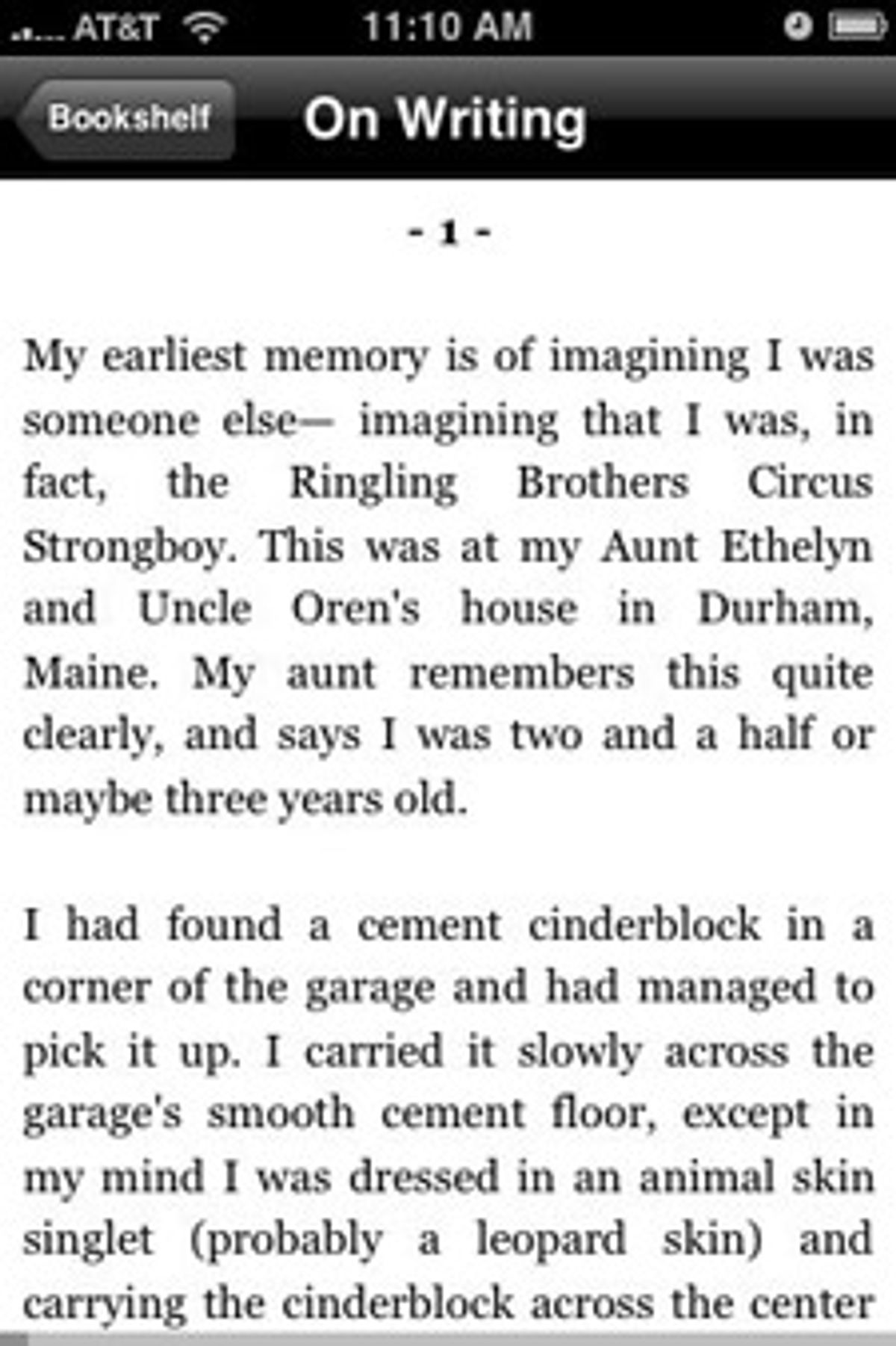
Seeing the eReader program icon on the iPhone’s screen literally brought tears to my eyes. Seriously. Having spent the last decade reading scores of e-books from backlit cover to cover on Palm, Windows Mobile, Nokia and BlackBerry devices, I thought the arrival of eReader to the iPhone was a dream come true …

… and at the same time, a nightmare, turning the iPhone into the worst e-book reader in the world, which I’ll get to in a minute.

(Full disclosure: My first novel was one of the first mainstream titles by a commercial publisher to be offered as an e-book, by Peanut Press, which eventually became eReader and was recently purchased by FictionWise; the e-book version of the novel, “The Deal,” went out of e-print — which I didn’t know was possible — and will likely rejoin the catalog in coming weeks.)

Yes, I’ve handled the Kindle and Sony reader devices and flipped through a few pages, but that’s as far as I got on either device because two major bummers make the experience too unpleasant: 1) There’s no backlight, and though the text is gorgeous, I’m irked by the screen blackout when turning pages (necessary to refresh the bits), and 2) the devices are clunky and I don’t want to carry more than a single do-all device in the first place. What the Kindle got right (really, really right) is the ability to browse and purchase books over the air, without having to connect to a computer to sync titles the way I had to with my Treo.

To be fair, reading an entire novel on the tiny Palm Treo screen is a little claustrophobic, but if the story is worth its weight in salt you soon see past the screen size and see only what the writer evokes in that most powerful graphic processor of all, your brain. (All the same, I can’t say the same for the Kindle/Sony reader blackout-blink, which made my jaw clench with every turn of the page.)

It was only a matter of time before e-books would show up on the iPhone. It took a year, but it was worth the wait. OK, in truth I was able to read freebie e-books like those by whiz-thinker Cory Doctorow on my jail-broken original iPhone before the 3G was released, but the titles were few, with no access to the wider mainstream e-book selection offered by eReader.com or FictionWise.com or Amazon.

Unlike Palm or BlackBerry or Nokia smart phones, the iPhone’s screen is comparatively gargantuan. No, not as large as the Kindle’s with its nice wide margins that add to the illusion of actual ink on paper, but wonderfully white and bright with beautiful contrast. (My guess is an update will offer the same margin width option available in the other versions of eReader.)

The backlight means you can read in bed without disturbing your bedmate (in my case, a side-hogging Jack Russell terrier). The backlight is also a minus because it drains the charge, so plugging in to the charger is advised if you don’t want to awake to a pitch-black screen. Turning the brightness all the way down makes the text too hard to see in daylight settings the way Kindle does it, though notching up the brightness a smidge offers just the right amount of light to provide enough illumination to see things clearly.

The default text size is fine to my eyes, and I actually prefer even tinier text. (I’m talking teeny tiny, like the nearly microscopic type used in the mass-market paperback edition of Ayn Rand’s “Atlas Shrugged.”) Those who prefer larger print can increase the font to large or huge. The default serif font, Georgia, is as smooth as you’d expect on the printed page, and two sans serif fonts, Marker Felt and Helvetica, are also available. (I’m guessing eReader will eventually support the optional typeface collections available for the other versions of the program.)

Downloading e-books on the iPhone is as easy as downloading on the Kindle — sort of. Type in your eReader or FictionWise user name and password and up pops a list of titles you own. Click to download, and in less than a minute you’ve got your nose to the pages, which flip right to left with a flick of the finger. Hold your fingertip down on a word to look up the definition in previously purchased reference books like Merriam-Webster — and that’s the second time I mentioned that the books available are ones you already own.

Unlike the Kindle, there’s no way to directly browse and purchase titles with eReader alone. To do that you must visit the companies’ Web sites on the iPhone or a computer. The latter is easier, since neither FictionWise nor eReader offers a slash-mobile version of its site (yet). Obviously the ability to directly browse and purchase titles with eReader is the way to go, and I’m hopeful the feature will show up in an upcoming version. Regarding updates, FictionWise boss Scott Pendergrast said in a phone conversation last week that version updates would occur frequently, with 1.1 possibly available as soon as Friday.

I may write more about e-books this week, and if so I’ll be sure to relay any eReader developments I uncover.

As for that nightmare realization I mentioned at the start — why the iPhone is at once the best and worst e-book reader ever?

With eReader being the dream-come-true application for this avid reader, that leaves an additional 499+ applications to browse through and distract me away from reading into the wee hours of the morning.

Time for that second cup of java.

Nobody ever calls me anymore

I feel like the last person who still likes talking on the phone. Why did we give it up, and should we reconsider?

  • more
    • All Share Services

Nobody ever calls me anymore (Credit: Anatema via Shutterstock)

As a teenager, my friend Jennifer used to sneak into her mother’s room after bedtime and steal the phone. She would call the boy she was dating, or “going with,” or whatever we called it back then, and they would talk all night, sometimes till 4 a.m.

But something shifted a few years ago. She became afraid of talking on the phone. Just hearing it ring could provoke panic. Maybe it was the suffocation of carrying her cellphone all day long. (“There are these tentacles in you all the time,” she said.) But she rarely answered the phone, preferring to text message, and the voice mail piled up like unopened bills dumped in a desk drawer – frightening and unknown and ever present — until she couldn’t bear it anymore, and in a rush of guilt she would delete dozens of messages that had been left for her without even listening to them.

Sometimes she would text the person to find out what they needed: “Sorry I missed your call,” she would type, although technically she wasn’t, and technically she hadn’t. Instead, like so many people I know, she had simply stopped using her phone for the one purpose Edison intended: to speak to another person.

Jennifer calls this “telephobia,” and whenever she mentions it, friends nod in vigorous empathy: I have that. Me too. But “telephobia” is not quite accurate, because the truth is that most of us, Jennifer included, covet and depend on our telephones in a way that was unfathomable to previous generations, burdened by such clunky accouterments as Samsung video recorders and leather Day Runners big as a phone book. (Dang, phone books: Remember those?)

Instead, our phones have become so powerful, and so enmeshed in our lives, that a whole genre of journalism has sprung up around our thorny relationship to them: People who can’t break away from their cellphones for a mere conversation; people who rediscover the joy of life only after chucking them. Our phones are a 24/7 carnival of distraction – Facebook, Twitter, texting, Words With Friends – and the temptation to lose yourself, to become overwhelmed by the demands of a portable fun factory is an American experience currently being hammered out in a thousand trend stories (this one included).

People talk about how tough earlier generations had it, and I for one have no clue how to plow a field. But challenges simply mutate according to the demands of the day. I may be worthless with crop rotation, but I’d like to see a pioneer woman take a left-hand turn at a busy intersection while reading a suggestive text from the guy who is currently making her heart pound. Or, because we all know that’s a terrible idea, I would like to see her take that left turn and not read that text message from the guy. The internal fortitude it requires not to cave in to these seductions on a minute-to-minute basis? Massive.

But this is a story about talking on the phone, and why so many of us stopped doing it. It’s not news that this happened. A December 2011 Nielsen study on mobile media usage shows that voice calls have dipped 12 percent since 2009, while text messaging has exploded in the same time period, even tripling in volume among teens. When I asked friends whether they felt anxiety about talking on the phone, the response was more of a confused look: Why would I talk on the phone? A great 2011 New York Times Styles story by Pamela Paul talked about this shift, how much easier it was to punt our daily communication over to text and email, where we could fiddle with the knobs at our convenience, leaving a trail of evidence as to what we agreed upon and when. Even Miss Manners declared that the old-fashioned phone call was, well, kind of rude.

What I wish I heard more in all these stories about how we communicate — whether it’s about the death of voice mail, or whether or not Facebook is destroying our humanity — is the fact that it’s just plain scary to talk to other people. We avoid it not because people don’t matter — but because they do. And each of us brings emotional baggage to these interactions. When my phone rings, and I don’t recognize that number – forget it. I’m too scarred by the years I spent dodging credit card companies to take that kind of dare. I also don’t jump off cliffs, or do cartwheels on the highway. In fact, it’s amazing to me that there was a time when the phone rang, and someone just answered it. Who could it be? Could it be the guy who was currently making your heart pound? Oooh, let’s pick it up and find out! Now, when I see an unfamiliar number, I feel nothing but outrage: How the hell did someone in the 405 area code get this number? What could they possibly want?

Our social expectations evolve. After all, there was a time when door-to-door salesmen made the rounds in every neighborhood, but if anyone rang the doorbell in my New York apartment, I would cower like I’d seen a masked man outside wielding a crowbar. That’s just the moment we’re living in. We make ourselves wildly available online – dangerously available, some would say – and in real life, we are way more defended. Celebrities pay publicists hefty salaries to control their image, and then jump on Twitter and tippy-type away. Surely it won’t always be like this.

But we have so many alternatives for communication that agreeing on one dominant form is simply not necessary. A lot of people I spoke with despise the phone, and have for a long time. Why would they use it if they didn’t have to? “I’m pretty much always better in written communication than spoken,” a male friend told me via Gchat, where our conversations can thread throughout an entire workday, flaring up for 10 minutes at noon only to pick up steam again at 5 p.m. He adores instant message. “You don’t have to worry about interrupting the other person. You don’t have to listen to the other person while also trying to think of what you want to say. If the other person is telling a long, boring story, you can just let them tell it.”

A voice call, on the other hand, demands too much attention from him while offering not enough in return. No visual stimulation. Even a casual silence “can feel like a thousand deaths.” Not to mention crappy reception. As phones all go digital, the warmth of a land line has been replaced by an irritating buzzmuffle that requires constant affirmation. Can you hear me? Are you there?

Still, I was taken aback by the vitriol some friends have for talking on the telephone. “I really, really hate it,” a friend said over email, which is how she and I often have deep conversations. “Maybe it’s that there are too many distractions (TV, folding laundry) and I am guilty of giving in to them OR it’s that I can hear the other person doing the same thing. There just never seems to be a good time to sit down and speak into the void.”

Another friend complained that chatting on her iPhone was like “cradling a brick to my ear.”

And don’t even get people started on voice mail. Everyone detests it. “I cannot handle how uncomfortable it makes me,” said a friend, who is the kind of extrovert who can join any conversation. “There is an intimacy that seems too great, like a song that was written just for me.”

At a time when devices keep us at arms’ length, phone calls rocket the voice straight into the ear. It’s a revealing way to communicate. “The telephone conversation is one that really exposes nuances of meaning,” says Edward Tenner, a visiting scholar in the Rutgers School of Communication and Information, who is also the author of “Our Own Devices.” “So much of language is not just the words as they might appear but the inflection or accent, the deciphering of sarcasm.” Tenner and I spoke by phone, naturally, where the land line he used was nearly decadent in its clarity. I felt, at times, like he was in the room with me. “People have become much more guarded about their public persona,” he continued. “They will manage it on social media and dating sites. They will present carefully tailored pictures. When they’re in an actual conversation, there’s more revelation than they’re comfortable with.”

But that’s different from not wanting to converse at all. In fact, what I heard in these conversations was not a retreat from connectedness but a desire to do it better, to play to one’s own strengths. I happen to love long conversations on the telephone, probably because I think I’m pretty great at it – I’m highly verbal, thrilled by the joust and parry of a good debate, and the pure audio allows me to stop worrying about stupid stuff like how I look in this dress, and what your eyes are staring at right now OMG there is something in my nose. Because my closest friends are scattered across the country, I make regular phone dates that I treat like actual dates. That’s not to say I play Barry White and sprinkle rose petals on the bed (though, sure, when the mood strikes), but I do commit to offering that person my full attention for an hour, or an evening, or until the batteries on our phones go dead. A phone call offers a connection you can’t get anywhere else — not from a text, or email, or Gchat. Not even from a face-to-face conversation.

Then again, I also understand my friend Jennifer’s irrational fears of the phone. How do you say no to someone on the other end? How do you untangle yourself from an awkward conversation? Avoiding those messy, human questions can be awful tempting. But Jennifer found her anxiety, or her “telephobia,” or whatever we’re calling it was getting in the way of her life. “I was not available for people,” she says, “and that bothered me a lot.”

So she made a resolution to call a friend every weekday for a month. They didn’t always have long conversations. Often they were quite short. She says it was nothing short of amazing, though. I don’t want to pretend that Jennifer made a few phone calls and, poof, her life changed. But I also don’t want to undersell how transformative it can be to stare down a real, live fear and slay that sucker. In her month of voice calls, Jennifer grew a little closer to people in her life, but she also grew a little closer to the person she wants to be, who is not someone ducking into the closet whenever the phone rings.

The tricky thing about technology is letting it work for you, but not letting it do all the work. Otherwise, you don’t grow. Personally, I hope in the future we have robots that can do difficult things, like standing in line at the DMV or waiting for a text message from the guy who is currently making your heart pound. Until then, I have my friends to help. I can call Jennifer – and I know she’ll pick up.

Continue Reading Close

Sarah Hepola is an editor at Salon.

Google to buy Motorola Mobility for $12.5 billion

Search giant completes largest acquisition in its history to up the ante in smart-phone wars

  • more
    • All Share Services

Google to buy Motorola Mobility for $12.5 billionFILE - In this May 11, 2011 file photo, attendees await the morning keynote address at the Google IO Developers Conference in San Francisco. Google Inc., releases quarterly financial results Thursday, July 14, 2011, after the market close. (AP Photo/Marcio Jose Sanchez, file)(Credit: AP)

Google Inc. is buying cell phone maker Motorola Mobility Holdings Inc. for $12.5 billion in cash. It’s by far Google’s biggest acquisition to date and a sign the online search leader is serious about expanding beyond its core Internet business.

Google will pay $40.00 per share, a 63 percent premium to Motorola’s closing price on Friday.

Motorola Mobility was separated from the rest of Motorola in January. The company has remade itself as a maker of smartphones based on Google’s Android software, but has struggled against Apple Inc. and Asian smartphone makers.

“Motorola Mobility’s total commitment to Android has created a natural fit for our two companies,” said Google CEO Larry Page in a statement. “Together, we will create amazing user experiences that supercharge the entire Android ecosystem for the benefit of consumers, partners and developers.”

The acquisition has the approval of both companies’ boards and is expected to close by the end of this year or early 2012. It dwarfs Google’s previous biggest deal, the 2008 purchase of DoubleClick for $3.2 billion.

In premarket trading, shares of Motorola Mobility soared 60 percent, or $14.72, to $39.19. Shares of Google, meanwhile, fell $14.68, or 2.6 percent, to $549.95.

Continue Reading Close

Cartoon Saturday: Is your phone getting too smart?

Does your life really need more color commentary?

  • more
    • All Share Services

Liza Donnelly is a contract cartoonist for The New Yorker and contributor to CNN.com and others national publications. Her most recent book is "When Do They Serve the Wine?".

AT&T to buy T-Mobile USA for $39 billion

Merger would make AT&T the United State's wireless carrier by a wide margin

  • more
    • All Share Services

AT&T to buy T-Mobile USA for $39 billion

AT&T Inc. said Sunday it will buy T-Mobile USA from Deutsche Telekom AG in a cash-and-stock deal valued at $39 billion that would make it the largest cellphone company in the U.S.

The deal would reduce the number of wireless carriers with national coverage from four to three, and is sure to face close regulatory scrutiny. It also removes a potential partner for Sprint Nextel Corp., the struggling No. 3 carrier, which had been in talks to combine with T-Mobile USA, according to Wall Street Journal reports.

AT&T is now the country’s second-largest wireless carrier and T-Mobile USA is the fourth largest. The acquisition would give AT&T 129 million subscribers, vaulting it past Verizon Wireless’ 102 million. The combined company would serve about 43 percent of U.S. cellphones.

For T-Mobile USA’s 33.7 million subscribers, the news doesn’t immediately change anything. Because of the long regulatory process, AT&T expects the acquisition to take a year to close. But when and if it closes, T-Mobile USA customers would get access to AT&T’s phone line-up, including the iPhone.

The effect of reduced competition in the cellphone industry is harder to fathom. Public interest group Public Knowledge said that eliminating one of the four national phone carriers would be “unthinkable.”

“We know the results of arrangements like this — higher prices, fewer choices, less innovation,” said Public Knowledge president Gigi Sohn, in a statement.

T-Mobile has relatively cheap service plans compared with AT&T, particularly when comparing the kind that don’t come with a two-year contract. AT&T CEO Randall Stephenson said one of the goals of the acquisition would be to move T-Mobile customers to smart phones, which have higher monthly fees. AT&T “will look hard” at keeping T-Mobile’s no-contract plans, he said.

AT&T’s general counsel, Wayne Watts, said the cellphone business is “an incredibly competitive market,” with five or more carriers in most major cities. He pointed out that prices have declined in the past decade, even as the industry has consolidated. In the most recent mega-deal, Verizon Wireless bought No. 5 carrier Alltel for $5.9 billion in 2009.

Stifel Nicolaus analyst Rebecca Arbogast said the deal will face a tough review by the Federal Communications Commission and the Justice Department. She expects them to look market-by-market at whether the deal will harm competition. Even if regulators approve the acquisition, she added, they are likely to require AT&T to sell off parts of its business or T-Mobile’s business. Verizon had to sell off substantial service areas to get clearance for the Alltel acquisition.

To mollify regulators, AT&T said in a statement Sunday that it would spend an additional $8 billion to expand ultrafast wireless broadband into rural areas. Instead of covering about 80 percent of the U.S. population with its so-called Long Term Evolution, or LTE network, AT&T’s new goal would be 95 percent, it said. That means blanketing an additional area 4.5 times the size of Texas. The network is scheduled to go live in a few areas this summer, but the full build-out will take years.

The offer would help the FCC and the Obama administration meet their stated goals of bringing high-speed Internet access to all Americans. They see wireless networks as critical to meeting that goal — particularly in rural areas where it does not make economic sense to build landline networks.

AT&T said its customers would benefit from the cell towers and wireless spectrum the deal would bring. In some areas, it would add 30 percent more capacity, AT&T said.

“It obviously will have a significant impact in terms of dropped calls and network performance,” Stephenson said.

AT&T would pay about $25 billion in cash to Deutsche Telekom, Germany’s largest phone company, and stock that is equivalent to an 8 percent stake in AT&T. Deutsche Telekom would get one seat on AT&T’s board.

Like Sprint, T-Mobile has been struggling to compete with much larger rivals AT&T and Verizon Wireless, and its revenue has been largely flat for three years. Bellevue, Wash.-based T-Mobile USA’s subscriber count has stalled at just under 34 million, though it posts consistent profits.

Deutsche Telekom has been looking at radical moves to let it get more value out of its U.S. holding, including a possible combination with a U.S. partner.

There was a big hurdle to a T-Mobile USA-Sprint deal: The two companies use incompatible network technologies. The same hurdle would apply in a Verizon Wireless-T-Mobile USA deal. But the networks of AT&T and T-Mobile use the same underlying technology, so to some large extent, AT&T phones can already use T-Mobile’s network, and vice versa.

The deal has been approved by the boards of both companies. Dallas-based AT&T can increase its cash portion by up to $4.2 billion, with a reduction in the stock component, as long as Deutsche Telekom receives at least a 5 percent equity ownership interest in the buyer.

The agreement doesn’t leave room for other buyers to jump in with a higher bid, AT&T said.

AT&T would finance the cash part of the deal with new debt and cash on its balance sheet and will assume no debt from T-Mobile.

AP Technology Writer Joelle Tessler contributed to this report from Washington, D.C.

Continue Reading Close

A guide to the end of SXSW’s Interactive Festival

It's never too late to network at Austin's South by Southwest tech meet-up

  • more
    • All Share Services

A guide to the end of SXSW's Interactive FestivalAre you cool enough for SXSW?

Though the interactive portion of Austin’s South by Southwest festival just ended, there is still enough time to squeeze a week’s worth of 2.0 fun and networking into the final moments before the music portion of the event begins! Below, our guide to maximizing your “SXSW” (as the kids write it) experience before the end of the weeklong geek rave you’ve somehow convinced your employer to send you to “on business.”

Schedule:

9 a.m.: “Crowdsourcing Interactive Strategic Content Design and the Ubiquitous User Experience” (lecture) — Learn this year’s hottest empty buzzwords to use in presentations to possible investors of your start-up from the leading self-proclaimed experts in the industry, none of whom you’ve ever heard of.

10:30 a.m.: “Malcolm Gladwell: Genius or over-rated hack who has no idea what he’s talking about?” (panel) – Several professors and more experts you’ve never heard of will tell you exactly why it’s not cool to like “The Tipping Point” anymore.

12:00 p.m.: Lunch – Use your FourSquare, GroupMe and GroupOn apps to make the most out of your dining experience and piss off everyone else in your friend network who happen not to be in Austin right now but still have to receive updates on how you’re now the mayor of a coffee kiosk. (Tip: Try the coffee! Bring 10 friends and get a 25 percent discount on your next cup!)

1:30 p.m.: Five-hour nap because nothing interesting is happening until tonight’s parties anyway.

6:30 p.m.: Wake up, check Twitter. Find out that while you were asleep, Google and Apple announced they were joining forces to create world’s first sentient iPad with GPS locators for everyone in your social network and, additionally, not in your social network. Shit.

8:00 p.m.: Mobile Showcase of Something on 6th Street — Everyone else was lining up outside this van and you heard that Dennis Crowley might be involved with whatever’s happening inside, so may as well check it out. Turns out to be Porta Potty sponsored by Miller Lite. It’s still worth it, as someone hands you a free USB drive with the Miller logo on a lanyard as you exit. Free shwag!

9:30 p.m.: Party time! — Check out the awesome, open-bar events thrown by everyone from Gizmodo to Vimeo to Wired Magazine to Funny or Die. Wait in line for an hour before being told at the door that you’re wearing the wrong colored wristband. It’s OK, these guys are just looking for the secret code phrase that will allow you to gain entrance to this year’s hottest tech parties. (The phrase is, “Wow, I guess guys who make iPhone apps for a living really are the next rock stars!” or, if you’re attending a Gawker party, “Brett Favre’s penis.”) Definitely do not use the word “amazing” at these events, since the Guardian has declared that adjective officially “over” at South by. (And if you don’t know to call it South by, you don’t deserve to be there.)

12:00 a.m.: Stumble home after making out with a guy who you thought was Digg founder Kevin Rose, but was actually a local high school student who sneaked in with his dad’s press pass. Your pants pockets are heavy with the weight of hundreds of business cards given to you by strangers, all of who have promised to add you to their social network feed. Your iPad blinks once, red and ominous.


(Photo via Flickr)


Continue Reading Close

Drew Grant is a staff writer for Salon. Follow her on Twitter at @videodrew.

Page 1 of 19 in Smart Phones