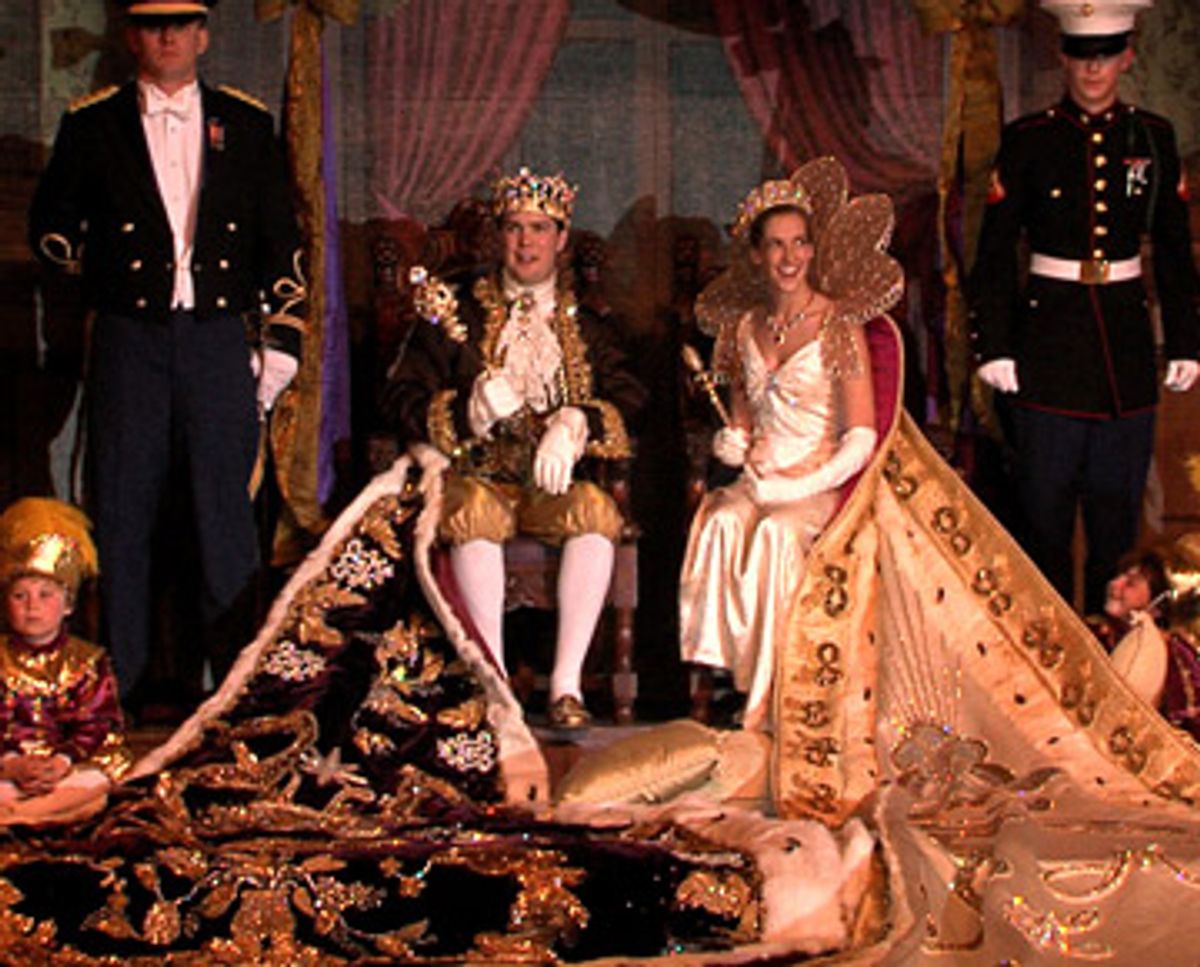
An arch, acute and haunting documentary about the segregated Mardi Gras traditions of Mobile, Ala., "The Order of Myths" might be the nonfiction film of the year.
Courtesy of The Cinema Guild
The King and Queen of Mobile, Alabama’s Mardi Gras, Max Bruckmann and Helen Meaher, and their court in the documentary “The Order of Myths.”
Throughout Margaret Brown’s moving and surprising documentary “The Order of Myths” we are assured that the Mardi Gras traditions of Mobile, Ala., remain strictly segregated because both of the city’s major racial communities want it that way. Of course, it’s generally white people who say that to Brown’s camera, and the way they say it isn’t terribly different from the way many Southern whites, in another era, talked about the Jim Crow laws.
But Brown’s film is nothing if not subtle, and the fact that those sentiments spring from a racist history doesn’t necessarily make them untrue. Across the breadth of Brown’s compassionate portrait of Mobile’s black and white Mardi Gras festivities in 2007 — which coexist peaceably enough but rarely interact — we come to see a city alternately puzzled, imprisoned and enraptured by its past, where people do things a certain way because they can’t imagine anything else. Overt racial discrimination plays no role in Mobile today (the city has an African-American mayor, its first), but its society remains economically and geographically segregated with a rigor that rivals apartheid South Africa.
But “The Order of Myths” is not some Yankee carpetbagger’s exposé on the lingering effects of Deep South white supremacy, although they are as inescapable as the Gulf Coast humidity. Brown is a white Mobile native, with a personal connection to the city’s Mardi Gras history that is revealed late in the film. She views Mardi Gras in Mobile — it’s the oldest such tradition in America, because the city was founded before New Orleans — with a combination of ruthlessness and tenderness. She moves effortlessly from upper-crust social clubs (where the only black people wear white dinner jackets and have napkins over their arms) to African-American churches and storefront photography parlors.
In Mobile, certain kinds of Faulknerian detail that might astonish outsiders just come with the territory. The white Mardi Gras queen in 2007 is a petite, drifty young woman named Helen Meaher, whose ancestors were slave owners and traders and whose family still controls most of the land in an all-black, semi-rural area called Africa Town. The district’s name goes all the way back to an illegal slave ship brought into Mobile Bay by the Meahers in 1859 (after the importation of new slaves had been banned), whose human cargo scattered into the untracked woods thereabouts. During the course of the film, Stefannie Lucas, a vivacious, zaftig Mobile schoolteacher who is the 2007 black Mardi Gras queen, learns that her great-grandfather was aboard that ship.
On both sides of the Mobile Mardi Gras divide, people seem to be edging toward a desire for reconciliation, but there remain significant differences about what that might entail. Some African-Americans in the film seem almost painfully eager for the esteem and approval of whites, while one black preacher delivers an eloquent address in which he says that his black community does not seek financial reparations for the past but rather “a change of heart.” It is not clear how much the cosseted, isolated, privileged world in which Helen Meaher and her consort Max Bruckmann (aka Emperor Felix III, Lord of Misrule) have been raised is likely to change.
Not that there are no rays of light amid the wry, rich historical lessons of “The Order of Myths. Lucas and the African-American Mardi Gras king, Joseph Roberson (also a teacher in the city’s all-black public schools), attend Meaher and Bruckmann’s coronation ceremony, and are received with pomp and courtesy. The white king and queen reciprocate by attending Lucas and Roberson’s ball, where they dance the night away in the finest tradition of awkward white kids at a black party. It’s a bittersweet climax to a film that gazes deeply into the racial tragedies of Mobile and Alabama and the South and America without finding any resolution — but the sweet, for those few moments, outweighs the bitter.
“The Order of Myths” is now playing at the IFC Center in New York, and opens Aug. 8 at the Nuart Theatre in Los Angeles, Aug. 15 in Mobile, Ala., and Sept. 5 in San Francisco, with more cities to be announced.
Interview With My Bully: When I confronted my bully about racism
In seventh grade, Mary's "ching-a-ling" routine scarred me. But years later, she was the one who cried victim
(Credit: Salon)
Judy Blume, my mentor and friend, told me not to engage with my bully. “Forget her, she isn’t worth it,” she told me. But I had a strange curiosity over what happened to the woman — I’ll call her Mary — who had once been my tormentor. Over the years I’d developed a secret theory of bullies, that they were the ultimate softies, the ones who have to build a fearsome spiked carapace over some sad, sad hurt. It’s that kind of empathy, perhaps, that made me a novelist. And Mary certainly gave me a story to tell.
Bullying, unfortunately, was a part of the warp and weave of my childhood. I grew up in northern Minnesota in the ’70s, where my Asian family was the only color in a sea of Scandinavians. When I was in second grade, a crew-cutted boy shoved me against some metal monkey bars, cracking the back of my head open.
But the most difficult time came when I entered junior high. I was underweight, bookish, bespectacled. Gym class was a convergence of all my anxieties. The other girls were tall with pretty hair that feathered and training bras, while I had no breasts and not even an undershirt for camouflage underneath the one-piece uniforms that looked like a baby’s onesie.
Mary was the instigator. She was not particularly popular or athletic. She had that kind of genericism that I would have killed for — she was just like everybody else.
One day in the locker room, Mary leapt out in front of me and started to sing, “ching-ching-a-ling” while doing some kind of interpretive dance that involved pulling the lids of her eyes into slits. Her friend Terry (also not her real name) echoed her taunts. I had a feeling this was not the end of it — and it wasn’t.
My Asian parents valued nonconfrontation over everything. When I vaguely hinted at this assault that waited for me daily (or, at least as it seemed at the time), they suggested I stay quiet and concentrate on my schoolwork. Some people didn’t know how to deal with minorities, they said. One day, this would pass, and I would leave Hibbing behind for an Ivy League school, and everything would be all right. That might have been good advice for the long term, but in the meantime, the ching-ching-a-ling routine continued, my only solace being that it often fell flat.
And then one day, two “tough” girls brought the whole thing to an end. They spoke quietly to Mary and Terry, who then approached me, ashy-faced, and each muttered, “I’m sorry, I won’t ever do it again.”
Now in my 40s, enter the brave new world of Facebook. Like many, I receive requests from classmates I barely knew — including this: Mary the Bully wants to be friends! I deleted the request and didn’t think about it. But after a few months, another request would appear. Then another.
It occurred to me that maybe Mary had read one of my novels, including one, in which a Korean American girl growing up in Minnesota — surprise, surprise — suffers through a “ching-ching-a-ling” song (and in the novel, at least, the protagonist manages to fight back). There was a mention of my novel in People, and classmates were definitely reading it. But while people like my piano teacher wrote tearful letters (“I had no idea this was going on”), the apologies I thought I might receive never arrived. The closest thing to an apology: “I didn’t know why you let it bother you so much, people were just kidding.”
With Mary’s enthusiastic friending — she also went to the trouble to find and join my Facebook author page — I thought, maybe the novel had made her more reflective, and now as adults it would be possible to talk about what happened. I accepted her friend request, only to discover she just liked to write things about Sarah Palin on my wall. But after more time passed, I thought this was a unique opportunity to do something I never had the courage to do when I was younger. I wanted to try one last time to understand my bully.
Mary lives in Oregon now and is married with an assortment of children, stepchildren and grandchildren. She agreed to talk with me, and we had an hour-long conversation on Skype.
When I asked her why she had tormented me for so long in junior high, she said she didn’t remember the specific incident nor its duration. In a rush, she told me she had “blacked out” most memories of junior high because her parents had gotten divorced and she was having a hard time; therefore, she didn’t have any memories of me, specifically. In fact, she went on, she was bullied: Right before entering junior high, she’d moved among the town’s three elementary schools where “people were mean” to her, particularly at her last elementary school, where “the bitches” made her life miserable. She added that she had older brothers who beat her up all the time. At one point, I almost wanted to say plaintively, “But what about my being bullied?”
The more I tried to pin her down about the “ching-ching-a-ling” routine, though, the more she sought cover.
“I’m a good person, I’m compassionate,” she said. She never came out and said, “I didn’t do it,” or “You’re crazy.” Instead, she said, “I’m not a racist.” And, “I don’t see color.” She went on to postulate that if she did do that routine, it wasn’t an expression of racism, it was more out of a desperate need to get laughs. “And it was at your expense,” she admitted. “I tried to be nice to all these other girls and they weren’t nice back to me. All I wanted to do was fit in.” She started crying. She apologized. I suggested she didn’t need to apologize for something she can’t remember doing. We said goodbye. Cordially, I thought.
There is a quote attributed to Plato and/or Philo of Alexandria — “Be kind, for everyone you meet is fighting a hard battle” — that is probably anachronistic to both, but still useful. Hearing about what was going on in Mary’s life at the time made me open to the possibility that she wasn’t motivated by racism, or, at least, that wasn’t the primary motivation. I believed her: She was desperate to get laughs from our peers, and my being Asian conveniently sat right in front of her, and my 85-pound weakling demeanor made it all the more attractive.
But that’s certainly not how the seventh-grade me perceived it. It has been disturbing to read that a government study found that Asian Americans endure the most bullying in school of all ethnic groups: 54 percent of Asian American teens compared with 38 percent of blacks, 34 percent of Latinos, 31 percent of whites. This study was released last October, the same month U.S. Army Pvt. Danny Chen was dragged from his bed on a base in Afghanistan and forced to crawl on the ground while his fellow soldiers threw rocks at him while yelling ethnic slurs.
Hours later, Danny Chen shot himself. His journal read, “Everyone here jokingly makes fun of me for being Asian.”
One lingering effect of this bullying was that for years afterward, I disavowed all things Asian that could in any way be connected to me; I even turned away from the Seoul Olympics, refusing to watch any non-event footage, puzzling my college boyfriend who thought I might at least want to watch a cultural spectacle with him. Living in New York and meeting other Korean and Asian American friends who did not deny or avoid their ethnicity helped me get over my self-loathing, as did a year I spent living in Asia.
But even now, as a fairly composed adult, when I read about bullying, particularly racial bullying, I am back in seventh grade with Mary, while she pleads amnesia, telling me: “Honestly, my first memories of you aren’t until high school.”
The day after we spoke, Mary further muddied the water by sending me a long email that was at once apologetic, evasive, ambiguous, contradictory, ashamed, conciliatory:
Again, I can only say that if I did do those things you say I did, I am truly sorry. I was a dumb, insecure preteen who was trying to fit in and in doing so I hurt you, and I am very sorry. I cannot change the past, or your memory of what may or may not have happened.
Followed by,
What I am equally ashamed about is that during the course of that call, my 26 year old daughter was in the other room listening to the entire conversation. Imagine the shame of having your child hear these terrible accusations, of which, she does not believe. Thank goodness.
Then she closed with this:
Its’ [sic] not always about you being Asian. You need to understand that the world is not against you because your [sic] Asian…I will continue to be the woman I am, I am kind, considerate, caring, compassionate & loving. I am a good mother and grandmother. I raised my children to be compassionate, caring and good stewards of our environment.
It occurred to me that she could indeed be a good steward of the environment and still be the girl who made my life a living hell in junior high. Don’t we all recast our memories to bolster the stories we tell ourselves, about who we are? My friend who also grew up Asian in the Midwest had an unforgettable experience of having her face slammed into a brick wall, breaking a bunch of her teeth, but the perpetrator now tells people, oh, no, she was trying to help by putting a hand on her back to stop her face from hitting the wall. Perhaps she honestly believes it. Mary told me many times she is not a racist but that Terry, well, she never liked minorities too much; what was her point revealing that? I could whine that what I hoped would be a spiritual exercise ended up an unproductive mobius-loop meditation on the fungibility of memory.
Another possibility, however, is that while that experience colored my life, it wasn’t a big deal to her, maybe it even fell in the category of affectionate “teasing” and was thus unworthy of remembering; it has been 30 years. Another friend says she receives Facebook friend requests all the time from mean girls who singled her out; clearly, to them, their behavior was not a big deal. That’s the insidious underside to this: What may be unremarkable, forgettable, deniable (“I was just joking!”) for one person can cause wounds that never fully heal in another.
There was a girl, let’s call her Heather, who came to our high school senior year. She, like me, was bookish and the subject of unkind remarks about her looks, and, as we were all graduating in a few months, no one bothered to befriend her. At least she was brilliant in physics class, and I presumed in a few short months she’d be out and on to some great career as a rocket scientist.
She came to a book signing I had in Minneapolis, and at first I didn’t recognize her. She was disheveled, with at least three equally disheveled children in tow. We had a short, uncomfortable chat where she informed me she was a single mother on welfare (and possibly drugs?). Right before she left, she asked, in a voice full of pain: “How did you do it? How did you get past it?”
I didn’t know what to say. I was lucky? The most damaging part of being bullied is the awful feeling of being alone. Maybe what saved me was that I wasn’t alone. In seventh grade I had the tough girls who stood up for me. By high school, I had teachers, friends and writing to carry me through. Writing nonfiction helped me figure out the world, fiction allowed me to revisit these memories, examine them as an outside observer, and to alchemize them into art, something I was proud to own. My earliest novels were young adult and middle grade novels, set in junior high and high school, and perhaps they were a message-in-a-bottle to the next generation of kids: You are not alone.
Ironically, while I was reading Mary’s long, conflicted, seemingly heartfelt note to me, she was composing a different kind of screed on Facebook — one that I was blocked from, but calling out an “Asian” from school, prompting a few helpful classmates to forward it to me. Her blacked-out memories of me apparently had been miraculously revived:
I’m tired and weary of people making everything about their race. Guess what, if you perceive people as mean to you solely due to your race, maybe they just don’t like you as a person? Perhaps they don’t give a rats [sic] ass what your race is…maybe your [sic] just a bitch, with a giant chip on your shoulder!!
At least, I don’t have to worry about defriending her on Facebook again. Maybe Judy was right. This was a can of worms I might have been better to leave alone.
CPAC welcomes white nationalists
Three noted white supremacy enthusiasts to host anti-diversity panel at conservative conference
Sen. Marco Rubio addresses the annual Conservative Political Action Conference in Washington, Feb. 9, 2012. (Credit: Jonathan Ernst / Reuters)
CPAC is here, so it’s time for everyone’s annual look at the psychos invited to the premier conservative event of the year, and those unfortunate enough to have been excluded.
GOProud, the gay Republican group that was founded because the Log Cabin Republicans were considered too concerned about gay civil rights and not sufficiently focused on “fiscal issues,” is not invited this year, because they are too “aggressive” about being gay, which made Jim DeMint uncomfortable.
CPAC also uninvited the John Birch Society, which had made a triumphant return to mainstream conservative acceptance in 2010, when they co-sponsored the conference.
But! While the Birchers and the open homosexualists are no longer welcome, there is still room for multiple outspoken white nationalists!
The National Review’s John Derbyshire, a stock “pervert Tory” character from a Martin Amis novel sprung to life and given a sinecure at the National Review, is hosting a panel on “multiculturalism” (boo hiss) featuring two of America’s most detestable sacks of shit: Peter Brimelow, founder of white supremacist site VDARE, and Robert Vandervoort, the director of some sort of “don’t make me press one for English” nativist group and a white nationalist from way back.
CPAC organizers are like, we didn’t specifically organize this panel ourselves so whatever, but they are not canceling the panel, because the conservative movement has always quietly set a place at the table for their white supremacist allies when they get together for Thanksgiving. And after everyone says grace (and sings “God Bless America” and the national anthem and does the Pledge of Allegiance) comes the ceremonial declaration that liberals are the real racists, for inventing welfare.
The Derbyshire, Brimelow, and Vandervoort (these names!) panel is called “The Failure of Multiculturalism: How the Pursuit of Diversity Is Weakening the American Identity,” and the fact that these panelists are all well-compensated members in good standing of the conservative movement instead of shrieking their “defense of Western Civilization” nonsense for free from a bench outside a subway station does suggest that something has gone wrong with the American experiment. (I think we let too many racist British people enter the country and steal our right-wing think tank and magazine contributor jobs, personally.)
I am guessing the panel will feature at least one “why is there no white history month” joke.
CPAC’s biggest draw today was the speech by Marco Rubio, who many expect to be Mitt Romney’s eventual running mate, because Republicans think he’ll appeal to the voters they accuse of poisoning American identity with their insufficiently Western European heritages.
Charles Murray does it again
Big government has created a new lower class of lazy, shifty, low-IQ folks, argues Charles Murray
People wait in line at the 2011 Maximum Connections Job and Career Fair Thursday, Sept. 15, 2011, in Portland, Ore. (Credit: AP/Rick Bowmer)
Hey, white people – they’re talking about you again!
I argued a few weeks ago that Newt Gingrich and Rick Santorum might be able to believe they’re not singling out black people, or “blah” people, when they rail against food stamps and government “dependency” on the campaign trail. Yes, Republicans have long used not just dog whistles but foghorns to tell white working- and middle-class voters that welfare programs only support lazy, undeserving African-Americans. Ronald Reagan gave us those iconic Cadillac-driving “welfare queens” and “young bucks” using food stamps to buy T-bone steaks. Gingrich is certainly playing on that long history with his remarks. (It’s funny how our first “food stamp president” also happens to be black.)
But increasingly the right wing argues that government programs have created a dangerously expanding lower class that includes white people, too. This new white lower class, like the black lower class before it (in the telling of conservatives), is struggling not because of the decline in median wages, the rise of unemployment or the disappearance of middle-class jobs, but because it prefers casual coupling over marriage, and government-subsidized slacking over work.
A little over a year ago, the conservatives behind “When Marriage Disappears: The Retreat From Marriage in Middle America” tied the decline of the American middle and working class to the drop in marriage and the rise in the number of children living in single-parent homes – trends that are most stark, over the last few decades, among white people. Now comes Charles Murray to make the issue of race even more pronounced. In “Coming Apart: The State of White America, 1960-2010,” Murray identifies a new “white lower class” consisting of men who choose not to work hard, women who choose not to marry, and children who are deprived of the values-generating support of the two-parent family, and are thus doomed to repeat the cycle all over again.
Murray, of course, has said all of these things about black people before. In his 1984 tome “Losing Ground,” he provided the intellectual justification for Reagan’s bromide, “We fought a war on poverty, and poverty won.” The book argued that the explosion of welfare programs didn’t help their intended targets, especially poor African-Americans; in fact it hurt them, encouraging men to forgo supporting their children by substituting government in the role of provider. In “The Bell Curve,” Murray went on to argue that racial and class divisions in society were largely due to genetic intelligence differences that caused whites and Asians to excel and consigned blacks and Latinos to lower status, and there was nothing government could do to fight that natural order. In fact, government made the problems worse, as Murray believed he’d “proven” in “Losing Ground.”
In “Coming Apart,” Murray seems to have learned a little bit from the racial controversies that greeted his earlier work. Now he sets out to show how similar forces are at work among white people. But his premise and arguments in this book are no less skewed or more persuasive.
….
For a book that purports to be dispassionate and data driven, Murray makes the odd decision to create two fictional towns, “Fishtown” and “Belmont,” to represent the two poles of the white lower and upper classes he’s trying to describe (you can guess where the lower class lives). He only includes statistics for people from 30 to 49, to best get at the marriage and work habits of adults who are most likely to be parents and married (or should be married) couples. It gets even weirder when he includes interviews from a genuine case study of the real-life “Fishtown,” an actual white working-class Philadelphia neighborhood, which happens to be home to Irish Catholics, my people, who have so often been scapegoated in similar class terms. (The lower IQ of Irish Catholics once was used to defend discrimination against them, from Northern Ireland to New England.)
Murray’s odd foray into fiction doesn’t invalidate the actual statistics he assembles on white lower- and upper-class family life, but it makes his conclusions seem less data-driven and objective than anecdotal and subjective.
And that’s because they are.
But let me take a moment to note what I found interesting in the book: Murray’s description of a new white super-elite, whose wealth and education get more concentrated with every generation, as does its isolation from the rest of us. Unfortunately his portrait of this new uber-class draws heavily from David Brooks’ “Bobos in Paradise” for color, making many of its observations about the NPR-supporting, New York Times-reading, helicopter-parenting residents of “latte towns” seem tired. But the data Murray marshals are fascinating, showing the ways the uber-rich have walled themselves off geographically (as well as culturally and economically) in real-live “SuperZips” much like the fictional Belmont: ZIP codes where everyone is wealthy for miles around. Devoted to the ferocious accumulation of more, the new uber-rich are building ever-wider moats and higher walls.
Murray also takes time to show how admission to the most elite universities — Ivy League schools plus the highly selective “Public Ivies” — has become vastly more exclusive than even a generation ago, in terms of student test scores and family income. Roughly 80 percent of the students admitted to these top-tier schools come from the top quartile of American families in terms of income; only 2 percent come from the bottom quartile. Then, because young people tend to find their mates in these hothouses of privilege, that wealth concentrates, as they marry and breed and pass their advantages on to a next generation, which repeats the process. One way that wealth used to redistribute itself – by a high-income, well-educated man marrying someone from another class, maybe a girl he met in high school back when even most privileged folks went to public schools and almost no one lived in exclusive SuperZips – just doesn’t happen much anymore. Elite education facilitates wealth, wealth facilitates elite education, and the rich get richer, like the old song says, in ever more staggering ways.
But the other thing going on at the very top of white America, Murray argues, is that elites are far more likely to get married and to stay married than other people – particularly the new white lower class. Some 90 percent of kids in the SuperZips live with both parents. And where the authors of “When Marriage Disappears” talked mainly about a “marriage gap” — they noted a decline in “bourgeois values” among the unmarried lower class, but didn’t dwell on it — Murray’s book is intended to highlight a values gap. He identifies what he calls the “founding virtues” of America – industriousness, religious practice, honesty and marriage – and finds the new white lower class lacking in all four. Meanwhile, at the very top of society, he says, adherence to those virtues persists, and it’s working very well. Divorce and single parenthood did rise among the rich for a while in the ’60s and ’70s, but then it leveled off.
In Murray’s telling, the ’60s seem like a hoax designed to trick the poor into hedonism while the wealthy stayed abstemious. It’s as if Puritans dressed up and played swingers for a while, then took off the costumes and went back to work. In fact, Murray argues that the white upper class, particularly but not exclusively the liberals within it, has betrayed the lower class, by refusing to “preach what they practice” – that hard work and marital fidelity are the reliable time-tested path to success.
….
There are so many problems with Murray’s cause-and-effect arguments it’s hard to know where to begin. The marriage and family trends he identifies continued to worsen even after Congress and President Clinton accepted some of the questionable conclusions about the relationship between “dependency” and poverty Murray drew in “Losing Ground,” and abolished with the program he found most disastrous: Aid to Families With Dependent Children. AFDC became TANF, Temporary Aid to Needy Families, 15 years ago, forcing welfare recipients to get work and limiting the amount of time they could spend on the program, and dropping many millions of people from the rolls. Yet the rate of single parenthood among poor and working-class people continued to rise.
I also had an enormous amount of trouble with the premise that the rich are more virtuous than other people. I’m blessed to know a lot of rich people as well as a lot of working-class people (my extended family), and I’ve never noticed that, at all. I found myself wanting to introduce Charles Murray to Charles Ferguson, whose “Inside Job” chronicled not only the greed and corruption of the Wall Street hotshots who brought us the 2008 banking crash, but their depravity: the hookers, the cocaine, the conspicuous consumption of decadence. I thought Ferguson overdid it in his attempt to prove the complete and utter evil of the Wall Street elite, but it’s a welcome correction to Murray’s pale picture of upright, honest businessmen reaping the just reward of their hard work and self-discipline.
To be fair, Murray occasionally nods to bad behavior at the top. He rather comically looks at the 2008 banking crash for evidence that maybe today’s rich lack some moral fiber, too, but finds nothing he believes is reliable. He also acknowledges that the Founders didn’t always practice what they preached, when it came to either marital fidelity or religious observance. The important thing is that they tried to embrace and advance those values. And it’s true that even skeptics like Jefferson thought religion was a good thing — for other people, anyway.
Murray also pretends to consider the possibility that the decline in wages and opportunities for working-class men might be behind the drop in marriage rates within the same group. But he shows that married men work harder and earn more than unmarried men, even within the same social class, and makes the case that the absence of marriage discourages work, rather than that the absence or scarcity of work discourages marriage (or some more subtle interplay between the two). A rise in the number of working-class people declaring bankruptcy proves to Murray that they’re dishonest, not increasingly shackled to debt by a decline in wages. An increase in the number of white working-class Americans who tell pollsters that they value job security over the rewards of a job well done provides Murray with evidence that they’re lazy, rather than rightly insecure about employment in a changing economy.
Of course, Murray never mentions the fact that the country’s so-called red states have the least government and the highest levels of religious practice, yet they have the highest poverty and divorce rates in the country. Conversely, the godless liberal blue states have the lowest rates of divorce and single parenthood. He also ignores the possibility that changes in our tax code have given the wealthy ever more powerful incentives to practice the “moral” behavior that wealth rewards, while a shrinking public sector makes it feel more imperative to secede from the commons into their SuperZips and private schools. And he ignores the way wealth can also save marriages, allowing unhappily married husbands and wives to console themselves with separate vacations, homes, even separate lives.
But hypocrisy on the part of the wealthy or the Founders doesn’t bother Murray at all. The fact is, rich people can mostly be trusted to do the right thing — even if, when it comes to marriage, they sometimes try and fail and fake it, or in the case of religion and our skeptical Founders, they don’t personally practice what they preach. It’s among the lower classes that the loss of “virtue” matters most. Because the non-wealthy have to be forced to do the right thing, whether by strict religious mores or the threat of going hungry. Ideally, in Murray’s view, it’s both.
The fact that these family trends have accelerated even as the U.S. has cut back much of its welfare state would seem to undercut Murray’s argument. Unless, that is, you believe that any government support at all encourages indolence. And Murray does. The only major increase in government social spending has come in the category of Social Security and Medicare, which take care of old people after they work. But maybe those programs let the working and middle classes work less hard, since they don’t have to fully support their parents in old age.
And maybe if we all had to rely exclusively on our kids to take care of us, we’d try harder to make sure they’re thrifty, honest and industrious; that they either don’t have kids before they’re married (or if they slip, they get married ASAP). In fact, maybe we’d do away with child labor laws entirely, and have them help support the household, the way Newt Gingrich thinks they should. Maybe we’d all stay on a hamster wheel of nonstop work, until we dropped dead in our pre-assigned places.
That’s always been the formula the rich use to scapegoat and exploit the poor, of course. Shame, stigma and deprivation are every bit as crucial as honesty, industry, religious belief and marriage in creating the world Murray envisions.
….
At bottom, Murray’s old genetic fatalism undoes him in “Coming Apart.” Clearly the new lower class can’t be helped by government programs, but Murray doesn’t seem to think they can climb into the upper class by hard work and self-discipline either. Ultimately, he believes the sorting and separation of the classes is inevitable, given the cognitive intelligence differences between them. And here we’re back to IQ again.
Modern society is vastly more unequal, Murray believes, because we’ve created a new sorting mechanism – college, but particularly the elite colleges – that identifies the best and brightest and lets them find one another. Kids of the upper class marry kids of the upper class at least partly because they wouldn’t find partners who would understand them in the new lower class. But even when some benighted lower-class kids manage to climb into Harvard or Yale, they’re not going back either, Murray says. Isolated in their old world of cognitive intelligence losers, they’ve finally found a place where they can be themselves.
Thus the only real way to address the growing gap between the wealthy and the rest of us, Murray argues, is to implore the white uber-class to take more of an interest in the growing underclass. But taking more of an interest, in Murray’s view, basically involves latte-town liberals realizing the only thing that will save the lower class is more self-discipline, and therefore abandoning their traditional support for government programs that try to help them, but only make things worse. Murray takes pains to show that the four most Super of the SuperZips – New York, Washington, D.C., Los Angeles and the San Francisco Bay Area – are also the home of our liberal media and government elite, seeking to prove that the country is being governed by the people who are most isolated from the rest of America.
These liberal elites bear special blame for the problems of the new lower class, because they refuse to face the truth as Murray tells it:
There are genetic reasons, rooted in the mechanisms of human evolution, why little boys who grow up in neighborhoods without married fathers tend to reach adolescence not socialized to the norms of behavior that they will need to stay out of prison and hold jobs….[Liberals] will have to acknowledge that the traditional family plays a special, indispensable role in human flourishing and that social policy must be based on that truth.
Murray tries to correct some of his past mistakes by professing to believe that the lessening of prejudice and discrimination against African-Americans and women was a long overdue victory for justice. Meanwhile he derides “big government,” without which those goals wouldn’t have been achieved, and demands that we return to the traditional family, which makes real equality for women impossible. Murray promises that this will be his “valedictory,” his last book trying to win us over to his libertarian politics and traditionalist values. That’s probably good for everyone, since this new effort simply dresses up his old arguments in a different color, white rather than black.
But maybe one more piece of evidence that the right regards them with the same contempt that they once reserved for poor African-Americans will wake up the white working class to the way the GOP’s politics of scapegoating minorities in fact helped one tiny minority: the top 1 percent.
GOP race-baiting masks class warfare
By demonizing some, the Republicans seek to discredit the safety net for the 99 percent
Occupy DC protesters hold signs during a march (Credit: Jonathan Ernst / Reuters)
It’s commonplace to note that Newt Gingrich’s dog-whistle appellation that Barack Obama is the “food stamp president” is both racist and politically cynical. But the stereotyping of black government dependency also serves the strategic end of discrediting the entire social safety net, which most Americans of all races depend on. Black people are subtly demonized, but whites and blacks alike will suffer.
Gingrich persists because it’s a dependable applause line, and because his political fortunes keep rising. Compare that to September, when Mitt Romney attacked then-candidate Rick Perry for calling Social Security a “Ponzi scheme.” Perry backtracked, insisting that he only wanted to bolster the program and ensure its solvency. But in his 2010 book “Fed Up,” Perry made his opposition to Social Security clear, calling it “a crumbling monument to the failure of the New Deal.” Scrapping entitlements is a core tenet of contemporary fiscal conservatism, but most of the time politicians only get away with attacking the most vulnerable ones: Medicaid, food stamps and welfare cash assistance, which are means-tested and thus associated with the black (read: undeserving) poor, although whites make up a far greater share of food stamp recipients. Government welfare programs with Teflon political defenses — Medicare and Social Security — are nearly universal entitlements and thus associated with “regular” (read: white) Americans.
“Ending welfare as we know it,” as Bill Clinton and congressional Republicans did in 1996, is one thing. “Ending Medicare,” Republicans were last year reminded, is something else altogether. “Keep your government hands off my Medicare,” declared a 2009 Tea Party town hall attendee who today might very well be an ardent supporter of Gingrich’s assault on food stamps. It is a political lesson that free-market fundamentalists have to relearn with some frequency. It was only 2005, after all, when President George W. Bush launched his ill-fated proposal to privatize Social Security — a setback he later called his greatest failure.
Yet as more government programs of any sort are framed as pernicious, laissez-faire ideologues are again emboldened to get rid of everything.
As recently as November 2009, the New York Times reported that stigma around food stamps had faded; the program received strong bipartisan support as millions of newly impoverished Americans reached out for food assistance. But temporarily cautious politicians had only stashed the old playbook on the top shelf, and the revival of welfare queen demagoguery made for quick political results. Nationwide, state legislatures are moving to impose drug testing of welfare, and even unemployment insurance, recipients.
“If you go apply for a job today, you are generally going to be drug-tested,” Florida Gov. Rick Scott said in October 2010. “The people that are working are paying the taxes for people on welfare. Shouldn’t the welfare people be held to the same standard?”
And and then came the push for cuts. Few noticed in April 2011 when House Budget Committee Chairman Paul Ryan, R-Wis., proposed cutting $127 billion from the food stamp program. The same went for the proposed dismantling of Medicaid, the healthcare entitlement for the nation’s poorest, which would be transformed into a block grant to the states with no coverage requirements. Everyone was focused on Ryan’s audacious proposal to privatize Medicare, and conservative pundits were eager to sink the popular entitlement under the banner of pragmatic fiscal seriousness. “The Ryan budget,” David Brooks wrote at the time, “will put all future arguments in the proper context: The current welfare state is simply unsustainable and anybody who is serious, on left or right, has to have a new vision of the social contract.”
Republicans quickly backtracked. But the effort to dismantle the “poor black people” entitlements continues unabated. In Pennsylvania, Gov. Tom Corbett this month announced that people under 60 with more than $2,000 in savings or other assets — cars and homes generally excluded, savings very much included — will be barred from receiving food stamps. The move elicited widespread criticism from anti-hunger advocates but little concerted political resistance. Corbett’s administration also cut 88,000 Pennsylvania children from Medicaid.
But politicians have more trouble getting away with criticism of less stigmatized benefits. Corbett suggested on the campaign trail that “The jobs are there. But if we keep extending unemployment, people are just going to sit there.” Democrats pounced and he rushed to issue a clarification, though a conservative think tank eagerly backed up his original position.
Unemployment benefits, however, are on the political cusp: Once somewhat invincible like Social Security and Medicare, some states have made cuts amid the campaign of stigmatization. In South Carolina, state-funded jobless benefits were reduced from 26 to 20 weeks. Republican state Sen. Kevin Bryant blogged, “I’m disappointed that we have a significant segment of our society leeching [off] the system.” Arkansas, Missouri, Michigan and Florida have also reduced benefits. Yet it was just two months ago that Republicans suffered their greatest embarrassment of 2011 after nearly blocking the extension of unemployment benefits.
Welfare was “reformed” in 1996 because politicians, and many white Americans, were convinced the program’s beneficiaries weren’t meritorious. Indeed, the entire history of the American safety net is one of programs losing popularity as they are associated with poor black people. Initially blacks were largely excluded from New Deal welfare. It was when the War on Poverty broke down racial barriers that white public opinion turned against it. “Increasingly associated with Black mothers already stereotyped as lazy, irresponsible, and overly fertile,” writes Northwestern School of Law’s Dorothy Roberts, “it became increasingly burdened with behavior modification, work requirements, and reduced effective benefit levels.”
The same was true for public housing, which once received broad-based support. But in the 1950s, whites moved to segregated suburbs and blacks were left behind, and the projects became unpopular and underfunded. Housing benefits for upper-income Americans, like the mortgage interest rate deduction, are not, to be sure, subject to such negative stereotypes, and neither are the billions in federal and state dollars that have been spent on highways and federally subsidized mortgages for disproportionately white homeowners.
Or take public schools. If all of our children, black and white, rich and poor, were in one big system, that system would get ample support. But since many poorer students of color are segregated into separate, unequal and low-performing districts, policy solutions like charters and an obsession over standardized testing that would never pass muster in a wealthy district are advocated as pragmatic solutions.
Count yourself lucky that rich people still (for the meantime) breathe the same air as everyone else.
Rick Santorum has declared, “I don’t want to make black people’s lives better by giving them somebody else’s money.” (He now says that he said “blah” people.) On Social Security, Santorum is making what appears to be a safe argument for reform: cutting rich people out of the program. Right now, Social Security belongs to everyone. Cutting rich people out is the first step to making it a program for the poor. Making something a program for the poor — see food stamps, Medicaid and welfare — is the first step toward eliminating it. While crazy Newt Gingrich talks about black people and food stamps, Mitt Romney (whom Brooks, of course, calls “serious”) resurrects a big idea: privatize Medicare. That, of course, is why conservatives so fear single-payer universal healthcare: They know that once we got it, we would never let them take it away.
If some whites reap some cold comfort from Gingrich’s performance, the racial hostility on display comes at a much higher cost to the American people as a whole. We have long since traded the possibility of a decent society for fear and resentment. So watch out for the next attack on “the food stamp president.” The entitlement they end might be your own.
Our selective stance on bigotry
Some of Paul's stances are odious. But our racist drug war and Islamophobic invasions are equally offensive
Rep. Ron Paul, R-Texas, speaks during a campaign stop Wednesday in West Columbia, S.C. (AP Photo/David Goldman) (Credit: AP)
If they have any value at all anymore, presidential election campaigns at least remain larger-than-life mirrors reflecting back painful truths about our society. As evidence, ponder the two-sided debate over Republican candidate Ron Paul and bigotry.
One camp cites Paul’s hate-filled newsletters and his libertarian opposition to civil rights regulations as evidence that he aligns with racists. As the esteemed scholar Tim Wise puts it: This part of Paul’s record proves that he represents “the reactionary, white supremacist, Social Darwinists of this culture, who believe … the police who dragged sit-in protesters off soda fountain stools for trespassing on a white man’s property were justified in doing so, and that the freedom of department store owners to refuse to let black people try on clothes in their dressing rooms was more sacrosanct than the right of black people to be treated like human beings.”
The other camp tends to acknowledge those ugly truths about Paul, but then points out that the Texas congressman has been one of the only politicians 1) fighting surveillance, indefinite detention and due-process-free assassination policies almost exclusively aimed at minorities; 2) opposing wars that often seem motivated by rank Islamophobia; and 3) railing against the bigotry of a drug war that disproportionately targets people of color. Summarizing this part of Paul’s record, the Atlantic Monthly’s Conor Friedersdorf has written: “When it comes to America’s most racist or racially fraught policies” affecting the world today, “Paul is arguably on the right side of all of them (while) his opponents are often on the wrong side.”
So which side is right? Both of them, and thanks to that powerful oxymoron, Paul has become a mirror reflecting back our own problematic biases. Specifically, his candidacy is showing that the conventional definition of intolerable bigotry is disturbingly narrow — and embarrassingly selective.
This reality is best demonstrated by those voters who say they detest Paul not because of his extreme economic ideas, but because they feel his record represents an unacceptable form of racism. These folks will likely tell you that their alleged commitment to policies promoting racial equality has moved them to support Mitt Romney or Barack Obama, politicians who, of course, support bigoted civil liberties atrocities, Islamophobic foreign invasions and a racist drug war.
In making such a choice, then, these voters are tacitly embracing the definition of unacceptable bigotry as only hate speech (Paul’s newsletters) and opposition to civil rights laws (Paul’s odious position), but not also various forms of institutional bigotry that their favored candidates support and that Paul has fought to end. Incredibly, this selective definition asks us to ignore many of the most destructive tenets of what legal scholar Michelle Alexander’s celebrated book calls “The New Jim Crow.” And yet, as the reaction to Paul proves, it is precisely this definition that pervades so much of American society.
To be clear: Noting this hypocrisy is not meant to urge a vote for Paul (I’m not a Paul supporter), nor does it absolve those Paul fans who wholly ignore the objectionable parts of their candidate’s record on race. Instead, it is simply meant to argue that if we’re going to have a long overdue discussion about bigotry, then let’s have an honest conversation about all forms of bigotry — not our current talking-points-driven screamfest that rightly criticizes one kind of prejudice but wrongly tolerates other forms of prejudice that are often just as destructive.
Perpetuating that kind of naked bait-and-switchery may help one set of candidates and hurt another in a given presidential campaign, but it does nothing to advance the cause of equality in America.
Page 1 of 72 in Race
Interview With My Bully: When I confronted my bully about racism
Iran’s Greens aim to rise again
The prettiest boy in the world
Should I donate a kidney to my friend?
America’s billionaire-run democracy
The bishops go off the deep end
No, Newt, don’t quit to make room for Santorum
Whose Wisconsin recall is it?
Can Greece thwart a complete meltdown?
Ruth Bader Ginsburg’s alternative abortion history 

