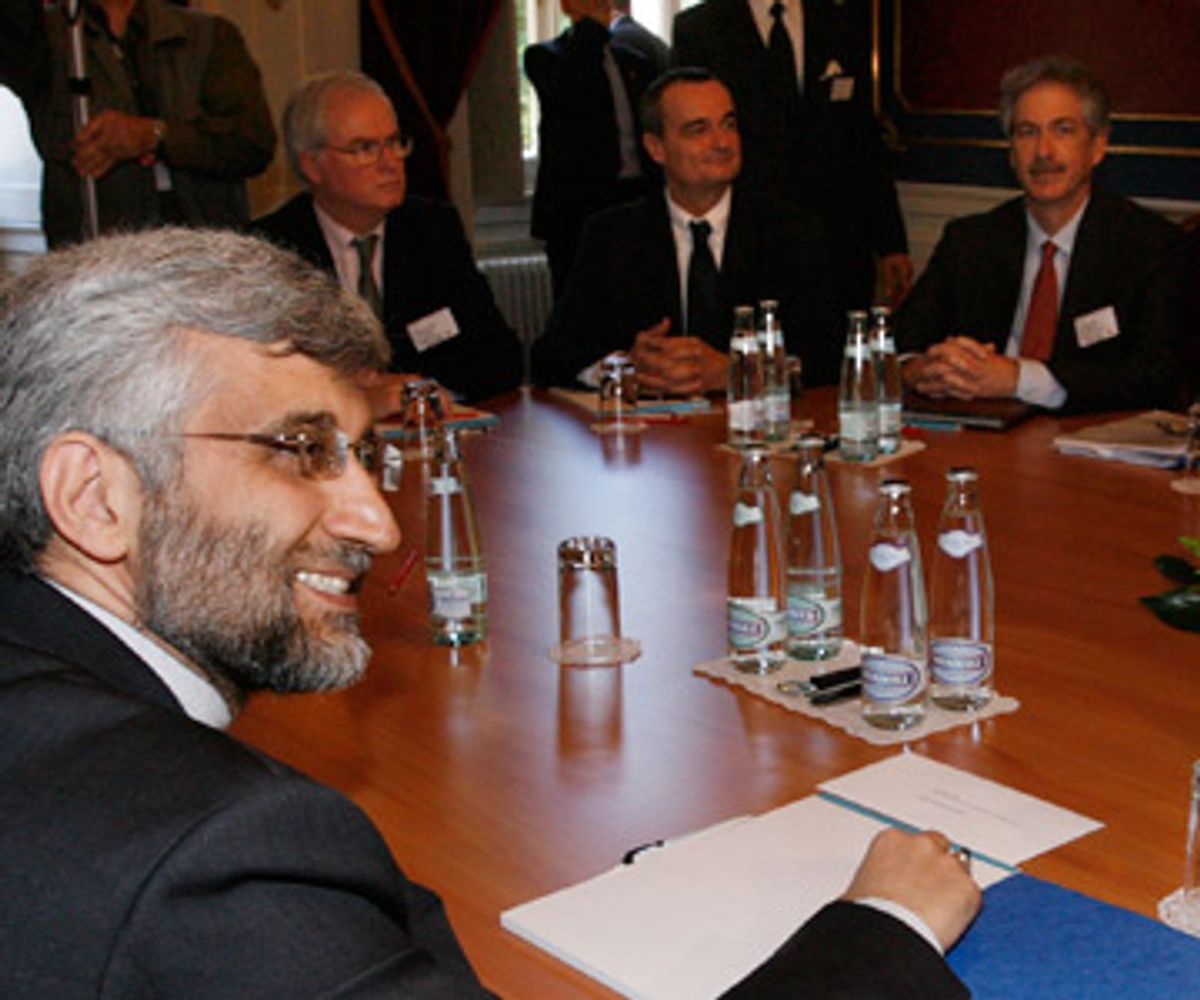
Pundits and diplomats nearly got whiplash from the double take they did when George W. Bush sent the No. 3 man in the State Department to sit at a table on July 19 across from an Iranian negotiator, without any preconditions. When Bush had addressed the Israeli Knesset in May, he made headlines by denouncing any negotiation with "terrorists and radicals" as "the false comfort of appeasement." What drove W. to undermine John McCain by suddenly adopting Barack Obama's foreign policy prescription on Iran?
Back in mid-July, the Geneva talks were attended by representatives of the five veto-wielding nations on the United Nations Security Council, including the U.S., along with a delegate from Germany and chief European Union negotiator Javier Solana. E.U. parleys with Tehran have been going on for years, but the presence of undersecretary of state for political affairs William Burns signaled a new seriousness to Washington's commitment to the diplomatic track. What the U.S. and its European allies were offering Iran at the Geneva meeting was termed a "freeze for freeze" deal. Iran would not attempt to improve on its rudimentary ability to enrich uranium to low levels, or go beyond running 3,000 centrifuges, in return for a pause in the spiral of economic sanctions imposed on Iran by the U.N. Security Council.
The blogosphere and Op-Ed pages were rife with speculation about the reason for Bush's startling reversal. Former National Security Council staffer and Columbia University Iran expert Gary Sick implied that Vice President Dick Cheney and the hawks had lost control of Iran policy to foreign policy realists such as Secretary of Defense Robert Gates in a behind-the-scenes Oval Office rumble. His thesis was supported by the howls of outrage against Bush's "appeasement" of Iran published in the Wall Street Journal opinion pages by former U.S. ambassador to the United Nations John Bolton and by the American Enterprise Institute's Michael Rubin, both prominently associated with the neoconservative movement and with propagandizing for the Iraq war.
As usual, the neocon doth protest too much. Burns conducted no real negotiations with the Iranian delegation, simply restating Washington's insistence that Iran cease its enrichment activities. His presence at the negotiations was mainly symbolic. Still, on the symbolic level of politics, Washington's change of direction was momentous. Bush had clearly executed a "Rockford" or reverse 180 of the sort you see stunt drivers pull off in spy movies. And the reason for that reversal of course was, indeed, reality -- not just a recognition of the limits of the U.S. military, but a taste of $5-per-gallon gas. Bush and Cheney, both oilmen, invaded one oil-rich country and said its reconstruction would be paid for by a flood of cheap oil. Now, ironically, one of the main reasons they have had to scale back their ambitions for a second oil-rich country, Iran, is the crushing effect of expensive oil on the U.S. and world economy.
It was just a year ago that war with Iran seemed imminent. Last August David Wurmser, a major neoconservative figure who had just left Cheney's staff revealed that the vice president was talking about having Israel hit Iran's nuclear research facilities. At the same time, Afghanistan expert Barnett Rubin went public with what he was told by a Bush administration insider -- that Cheney would make a big push for a strike on Iran in the fall of 2007. Journalist Seymour Hersh reported that Cheney was attempting to reconfigure the Iraq war as a struggle with Iran. And, indeed, Cheney did make threats against Iran at institutions of the Israel lobby such as the Washington Institute for Near East Policy.
In December 2007, however, the intelligence community pushed back. Key findings from the National Intelligence Estimate, released that month, showed that Iran had mothballed any weapons-related research since early 2003. The Cheney push for one more war was effectively blocked.
In recent months, several major developments have strengthened the case for dealing with Iran diplomatically rather than militarily. The U.S. military is more overstretched in Iraq and Afghanistan than ever. The resurgence of the Taliban in Afghanistan and the tribal areas of northwest Pakistan has required a significant increase in the number of U.S. and NATO troops during the past year. Iranian proxies in Iraq and Afghanistan could easily target U.S. bases with Katyusha rockets in retaliation for any U.S. strike on the nuclear research facilities at Natanz near Isfahan.
These concerns have been openly admitted by Adm. Mike Mullen, chairman of the Joint Chiefs of Staff. On May 26, Mullen was asked on CBS's "Early Show" about possible U.S. military means of curbing Iran's regional ambitions. He replied, "Well, I think, actually, it's more than just the military. It's got to be the full spectrum of national elements of power -- economics, finances, diplomacy, politics, as well as military." In a briefing in early June after his return from Israel, Mullen complained that "we haven't had much of a dialogue with the Iranians for a long time," and when pressed if he was calling for talks, he affirmed the need for a "broad dialogue."
Mullen seemed to warn hawks in the U.S. and Israel against a strike on Iran of the sort Cheney had earlier envisaged, saying that in light of the Iraq and Afghanistan wars, "opening up a third front right now would be extremely stressful on us." Mullen admitted when pressed that the Iranians "have capabilities which could certainly hazard the Strait of Hormuz," though he was confident that the U.S. could reopen it. Despite that confidence, Mullen said that he was worried about instability in the Middle East, and about anything that might contribute to it.
Neither Secretary of State Condoleezza Rice nor Defense Secretary Gates, sometimes seen as foreign policy realists in the mold of George H.W. Bush, were pushing as hard in public for a dialogue with Iran as Mullen was last May, though Gates had begun actively warning against a frontal military conflict with Iran beginning last March.
The run-up in petroleum prices has also had major implications for Iran strategy. Oil companies and European governments are not happy with U.S. policy toward Iran. American and European energy corporations are losing billions in potential profits because of congressionally mandated third-party sanctions on companies that attempt to develop Iran's oil and gas. The sanctions do not produce regime change, but they do reduce the world supply of oil and gas, and they irritate U.S. allies. In the past few months Royal Dutch Shell and Total S.A. have both pulled out of plans to develop lucrative and vast Iranian gas fields, under strong U.S. pressure and threats of economic sanctions. Sanctions are pushing up the cost of oil -- but a war with Iran would push up the price still more. Meanwhile, the sanctions have enough of an economic impact on Iran to make it more amenable to negotiations. Well aware that internationally supported economic sanctions had helped turn Iraq into a fourth-world country prior to the U.S. invasion, the Iranians were eager to seem accommodating during the July 19 meeting in Geneva.
The initiative for the July 19 negotiations with Iran in Geneva came from the meeting of the Group of Eight on July 7-9 in Tokyo, which determined to dispatch the European Union's Javier Solana for talks with Tehran. Secretary of State Rice strongly supported the joint approach to Tehran, telling the Voice of America: "So there is a diplomatic way to do this. And that's why the United States is a part of the group -- that is, Germany, France, Great Britain, Russia and China -- [that] has made a proposal to the Iranian government that we hope they will accept."
Given the sequence of events that led to Burns' presence in Geneva, it appears that this initiative was probably developed in Europe, by countries stung that their oil majors would be excluded from Iran for the foreseeable future because of U.S. third-party sanctions. Ironically, the administration figure closest to the position of the Europeans was precisely Adm. Mullen, who may thereby have earned a hearing from Gates on the issue of talking to Iran.
The U.S. has therefore simultaneously been interfering with the availability of cheap petroleum products globally and making the case for military action against Iran less compelling. Both the U.S. and its European allies know that the negative fallout from a war could be immense. Its effect on the world oil supply would be catastrophic. Iran's perennial threats to close the Strait of Hormuz at the mouth of the Persian Gulf in the event that it is attacked have to be taken especially seriously when oil supplies are as tight as they are now. Some 40 percent of the world's petroleum flows through that choke point, and any significant interruption of supply under today's conditions could send prices skyrocketing so far as to threaten the world with another Great Depression. In short, Iran is far more powerful when petroleum is $127 a barrel than when it is $25 a barrel, and that power makes it more prudent to negotiate with it than to rattle sabers. The opening to Iran was not a victory of the realists, but of realism. That in the aftermath, Bush's Iran policy looks more like that of Barack Obama than that of John McCain, is just an indication that Obama is more realistic about the increasing constraints on U.S. foreign policy toward the Middle Eastern oil states than is McCain.
Shares