Iraq war

Embedded reporters or Republican activists?

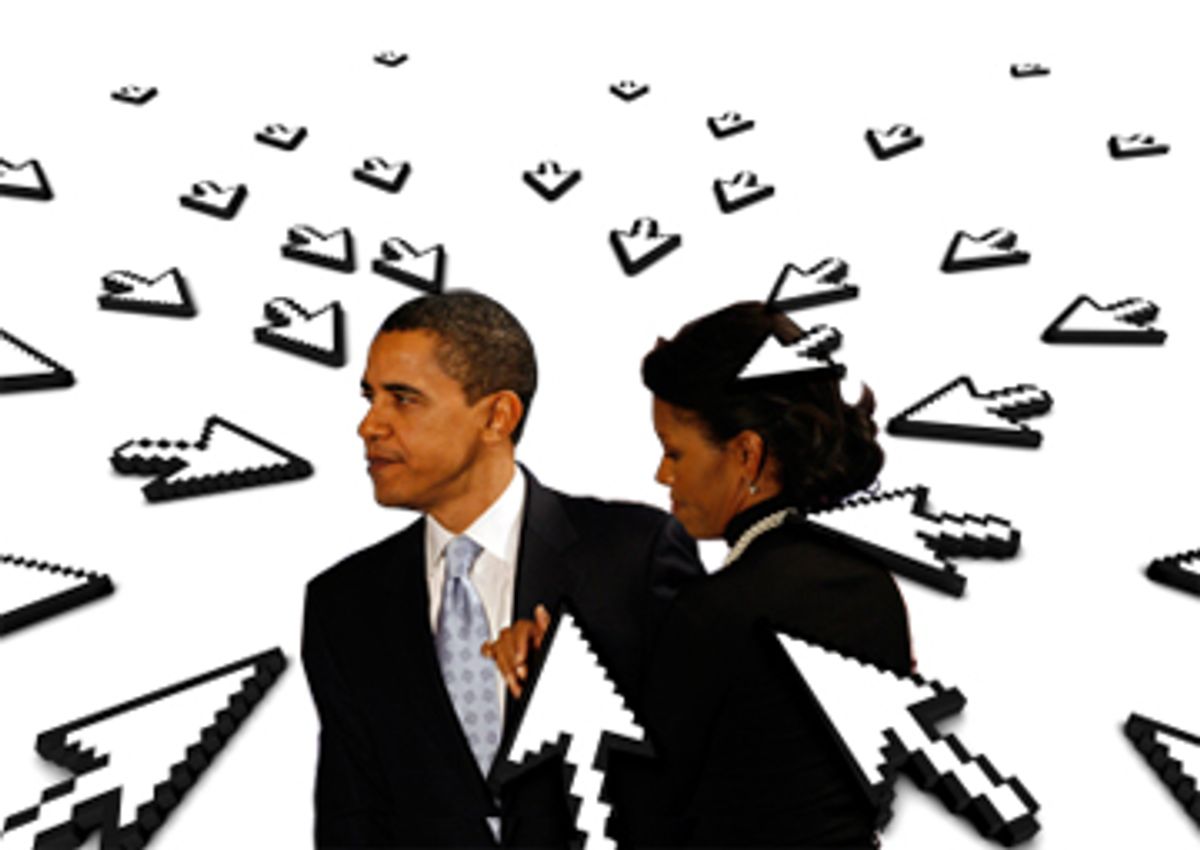
Members of Vets for Freedom have campaigned for John McCain and made anti-Obama ads, but while they're in Iraq, you're paying for their gas, food and lodging.

  • more
    • All Share Services

Topics: ,

Embedded reporters or Republican activists?

On its face, it seems like an idea any enterprising editor could have come up with: Gather a group of veterans of the Iraq war who also have journalism experience, including some highly decorated soldiers. Then send them back to the areas of Iraq in which they served, this time as reporters embedded with the troops still fighting there, and get their assessment of the security situation and whether the surge is working.

Someone has organized just such an expedition, and this Monday eight veterans left for Iraq. But the “Back to Iraq” trip wasn’t put together by the Washington Post or the New York Times; it’s the brainchild of Vets for Freedom (VFF), a pro-war group. VFF is nominally nonpartisan, but it has a remarkable number of ties — some previously unreported — to Republicans generally and John McCain’s campaign specifically. And it has run attack ads against Barack Obama.

It’s unremarkable to send reporters with thin journalistic credentials to Iraq, or to promise that journalists with a known political bias will report “objectively.” Conservative and liberal publications send their preferred reporters to Iraq all the time, and their representatives come home, unsurprisingly, with differing conclusions. But what about sending political activists and GOP operatives to Iraq in the guise of journalists, with the cooperation of the U.S. military and on the taxpayers’ dime, so that the activists can come home and proselytize for the Republican presidential candidate’s position on the war?

For journalists, getting to Iraq isn’t cheap. At a minimum, there’s the airfare to Kuwait, plus the cost of body armor, helmet, protective eyewear and insurance. But once they’re in Iraq, embedded reporters don’t have to spring for much else. The military typically flies the journalist from Kuwait to Baghdad and supplies food, lodging and transportation within Iraq. (VFF flew commercially from Kuwait to Baghdad.) The military provides translation and personal bodyguard services, acting as a sort of super-fixer. Without embed status, the on-the-ground costs for any reporter or private citizen traveling in Iraq are dramatically higher. The cost of security alone, which often means an armored car and a driver as well, drives the price of any Iraq trip sky-high. In an e-mail, a reporter for a major American daily who has been to Iraq as an un-embedded reporter said that paying for non-embedded reporters involves “an infrastructure cost that can be very pricey, in the millions of dollars each year.”

Under the Pentagon’s standards for Iraq embeds, the people that Vets for Freedom is sending to Iraq qualify as journalists. Six of them have impeccable military credentials but no reporting experience, with clippings largely limited to Op-Eds. A would-be embed, however, needs only to provide the military’s public affairs officers with three samples of published or broadcast work, and proof that he or she is credentialed by a publication. Three conservative media outlets — the Weekly Standard, National Review Online and BlackFive.net – have provided the eight members of VFF’s Iraq team with credentials. Asked about how the Vets for Freedom received clearance as embeds, Army Sgt. Brooke Murphy, media operations NCO with the Multi-National Force-Iraq’s Combined Press Information Center in Baghdad, emphasized that the military does not conduct ideological vetting. ” “We don’t screen reporters or media personnel for political agenda or political affiliation … We give groups that want to come over the chance to report on what’s going on in Iraq, provided that the information that they report doesn’t jeopardize national security or the safety of our soldiers.”

From the mission statement that appears on VFF’s Web site, it’s also clear that the purpose of what it has dubbed the “Back to Iraq” trip fits within the bounds of journalism, albeit advocacy journalism of the foregone-conclusion variety, strident conservative division. “Its [sic] essential for the American people to know the facts about what is happening in Iraq. Some media outlets, and certain politicians, still fail to assess the situation objectively; so Vets for Freedom is heading Back to Iraq to let them know what has been accomplished, what still needs to be done, and how we should proceed in order to attain sustainable security in Iraq.”

But VFF’s representatives in Iraq are political activists first, and journalists second. Or third. VFF chairman Pete Hegseth, who is making the trip, has campaigned for McCain. According to disclosure records, another, executive director Joel Arends, was on the McCain campaign’s payroll between March 2007 and February 2008; he was also working for VFF at the time. David Bellavia, one of VFF’s co-founders and now its vice chairman, introduced the presumptive Republican nominee at an event sponsored by VFF by saying, “You can have your Tiger Woods. We’ve got Sen. McCain.” Another member of the Back to Iraq team was the star of one of the group’s anti-Obama ads.

The rest of VFF is similarly connected. Former executive director Wade Zirkle, one of the group’s co-founders and a member of its board of advisors, had been listed as a member of McCain’s Virginia leadership team. He’s still a member of Veterans for McCain, as is fellow VFF co-founder Knox Nunnally, who also heads VFF’s Texas chapter.

Almost everyone who’s been listed as a press contact for the group over the past year has a long history with Republican causes, or with the PR effort in Iraq, or both. Brian Marriott was the Bush campaign’s political director in Missouri in 2000; later, he worked as an advance man for President Bush and Vice President Cheney and as a special assistant for media relations to the chairman of the FCC. Communications director Adam Fife started at VFF shortly after returning from a stint as strategic communication advisor to the Multinational Force-Iraq. Adriel Domenech, formerly a press contact for the group, had also returned from a civilian public affairs position in Iraq not long before he began working for VFF. Before that, he worked for Bush’s reelection campaign.

But by traveling to Iraq as journalists, VFF enjoys the cost savings of the military’s embed program. This is at least the third time VFF has sent fact-finders to Iraq; in all three cases, they went as embedded journalists. But VFF leaders say they chose to have their team members become embedded reporters for journalistic, not financial, reasons. “I think it’s just the most unfiltered, transparent approach,” Bellavia says. “We want to know what these soldiers think.”

All this may raise questions about the group, but there’s likely no problem involved with campaign-finance law. Lawrence Noble, the former general counsel of the Federal Election Commission, says it is probably not illegal for a group involved in the presidential campaign to be using the monetary benefits of the military’s embed program to subsidize trips to Iraq. (Noble adds that the connections between VFF and McCain’s camp do not by themselves constitute illegal coordination between a PAC and a presidential campaign. “There’s no broad statement that you can make that you can’t have somebody who works with an organization involved in a campaign.”)

Still, VFF’s decision to embed reporters does raise concerns for experts in media ethics. Christopher Hanson, an associate professor at the University of Maryland’s Philip Merrill College of Journalism who researches media-military relations and who covered the first Gulf War, says that “subsidized journalism” funded by nonprofits “is on the rise across the political spectrum.” He doesn’t think that’s necessarily a bad thing as long as there’s full disclosure of the funding. But he also thinks that VFF’s case brings with it a different set of issues. “If essentially you have reporters who are the founders and the activists in the organization, then getting credentialed and going with preconceptions … and then going out and campaigning, that’s highly questionable, and that deserves scrutiny. It seems to me that to some extent the question is, Is there any chance that any of them change their views or is it simply a kind of a fraud?” Hanson said, cautioning that he doesn’t know the group’s intentions and is not accusing them of fraud.

“It’s not independent journalism,” says Kelly McBride, ethics group leader at the Poynter Institute. “If I were [VFF], I’d be saying, ‘Gosh, the Army should be paying me PR fees.’”

Additional reporting by Vincent Rossmeier.

Continue Reading Close

Alex Koppelman is a staff writer for Salon.

America’s real Hunger Games

Young people are already being sacrificed at the whims of the 1%. Just look at Iraq and Afghanistan

  • more
    • All Share Services

Topics: , ,

America's real Hunger GamesU.S. Army soldiers respond after a suicide attack on the US..-led provincial reconstruction team (PRT) compound in the Behsood district of Jalalabad, east of Kabul Afghanistan, on Sunday, April 15, 15 2012. (Credit: AP Phot/Rahmat Gul)
This piece originally appeared on TomDispatch.

When I was growing up, I ate books for breakfast, lunch and dinner, and since I was constantly running out of reading material, I read everyone else’s — which for a girl with older brothers meant science fiction. The books were supposed to be about the future, but they always turned out to be very much about this very moment.

Some of them — Robert Heinlein’s “Stranger in a Strange Land” — were comically of their time: that novel’s vision of the good life seemed to owe an awful lot to the Playboy Mansion in its prime, only with telepathy and being nice added in. Frank Herbert’s “Dune” had similarly sixties social mores, but its vision of an intergalactic world of disciplined desert jihadis and a great game for the substance that made all long-distance transit possible is even more relevant now.  Think: drug cartels meet the oil industry in the deep desert.

We now live in a world that is wilder than a lot of science fiction from my youth. My phone is 58 times faster than IBM’s fastest mainframe computer in 1964 (calculates my older brother Steve) and more powerful than the computers on the Apollo spaceship we landed on the moon in 1969 (adds my nephew Jason). Though we never got the promised jetpacks and the Martians were a bust, we do live in a time when genetic engineers use jellyfish genes to make mammals glow in the dark and nerds in southern Nevada kill people in Pakistan and Afghanistan with unmanned drones.  Anyone who time-traveled from the sixties would be astonished by our age, for its wonders and its horrors and its profound social changes. But science fiction is about the present more than the future, and we do have a new science fiction trilogy that’s perfect for this very moment.

Sacrificing the Young in the Arenas of Capital

“The Hunger Games,” Suzanne Collins’s bestselling young-adult novel and top-grossing blockbuster movie, is all about this very moment in so many ways. For those of you hiding out deep in the woods, it’s set in a dystopian future North America, a continent divided into downtrodden, fearful districts ruled by a decadent, luxurious oligarchy in the Capitol. Supposedly to punish the districts for an uprising 74 years ago, but really to provide Roman-style blood and circuses to intimidate and distract, the Capitol requires each district to provide two adolescent Tributes, drawn by lottery each year, to compete in the gladiatorial Hunger Games broadcast across the nation.

That these 24 youths battle each other to the death with one lone victor allowed to survive makes it like — and yet not exactly like — high school, that concentration camp for angst and competition into which we force our young. After all, even such real-life situations can be fatal: witness the gay Iowa teen who took his life only a few weeks ago after being outed and taunted by his peers, not to speak of the epidemic of other suicides by queer teens that Dan Savage’s “It Gets Better” website, film and books aspire to reduce.

But really, in this moment, the cruelty of teens to teens is far from the most atrocious thing in the land. “The Hunger Games” reminds us of that.  Its Capitol is, of course, the land of the 1 percent, a sort of amalgamation of Fashion Week, Versailles and the KGB/CIA. Collins’s timely trilogy makes it clear that the 1 percent, having created a system of deeply embedded cruelty, should go, something highlighted by the surly defiance of heroine Katniss Everdeen — Annie Oakley, Tank Girl and Robin Hood all rolled into one – who refuses to be disposed of.

Now, in our world, gladiatorial entertainment and the disposability of the young are mostly separate things (except in football, boxing, hockey and other contact sports that regularly result in brain damage and sometimes even in death). But while the Capitol is portrayed as brutal for annually sacrificing 23 teenagers from the Districts, what about our own Capitol in the District of Columbia? It has a war or two on, if you hadn’t noticed.

In Iraq, 4,486 mostly young Americans died.  If you want to count Iraqis (which you should indeed want to do), the deaths of babies, children, grandmothers, young men and others total more than 106,000 by the most conservative count, hundreds of thousands by others. Even the lowest numbers represent enough kill to fill nearly 5,000 years of Hunger Games.

Then, of course, there are thousands more Americans who were so grievously wounded they might have died in previous conflicts, but are now surviving with severe brain damage, multiple missing limbs, or other profound mutilations. And don’t forget the trauma and mental illness that mostly goes unacknowledged and untreated or the far more devastating Iraqi version of the same. And never mind Afghanistan, with its own grim numbers and horrific consequences.

Our wartime carnage has been on a grand scale, but it hasn’t been on television in any meaningful way; it’s generally been semi-hidden by most of the American media and the government, which censored images of returning coffins, corpses, civilian casualties and anything else uncomfortable (though in our science-fiction era when every phone is potentially a video camera, the leakage has still been colossal). Most of us did a good job of being distracted by other things — including reality TV, of course.  The U.S. Ambassador and military commander in Afghanistan were furious not that our soldiers struck jokey poses with severed limbs, but that the Los Angeles Times dared to publish them last month. And those whistleblowers who took the effort to reveal the little men behind the throne are facing severe punishment.  Witness one Hunger-Games-style hero, Bradley Manning, the slight young soldier turned alleged leaker, long held in inhumane conditions and now facing a potential life sentence.

The Return of Debt Peonage

In “The Hunger Games,” kids in poor families take out extra chances in their District lottery — that is, extra chances to die — in return for extra food rations; in ours, poor kids enlist in the military to feed their families and maybe escape economic doom. Many are seduced by military recruiters who stalk them in high school with promises as slippery as those the slave trade uses to recruit poor young women for sex work abroad.

And then there’s another form of debt peonage that is far more widespread in our strange and ever-changing land: student loans. The young are constantly told that only a college education can give them a decent future. Then they’re told that, to pay for it, they need to go into debt — usually into five figures, sometimes well into six. And these debts are, in turn, governed by special laws that don’t allow you to declare bankruptcy — no matter what.  In other words, they are guaranteed to follow you all your life.

One of my close friends wept when her husband began to earn enough money to pay off her $45,000 loan, structured so that it looked like she would continue to pay interest on it for the rest of her life; not so dissimilar, that is, from the debts sharecroppers and workers in company towns used to incur.

In other words, we’re creating a new generation of debt peonage. And she’s not the worst case by far. Early in the Occupy Wall Street moment, she told me, someone arrived at Zuccotti Park in downtown Manhattan with markers and cardboard on which participants were to write their debt.  What shocked her was how many of the occupiers in their early twenties were already carrying huge debt burdens.

According to the website for Occupy Student Debt, 36,000,000 Americans have student debts.  These have increased more than fivefold since 1999, creating a debt load that’s approaching a trillion dollars, with students borrowing $96 billion more every year to pay for their educations. Two-thirds of college students find themselves in this trap nowadays. As commentator Malcolm Harris put it in N + 1 magazine:

Since 1978, the price of tuition at U.S. colleges has increased over 900 percent, 650 points above inflation. To put that number in perspective, housing prices, the bubble that nearly burst the U.S. economy, then the global one, increased only fifty points above the Consumer Price Index during those years. But… wages for college-educated workers outside of the inflated finance industry have stagnated or diminished. Unemployment has hit recent graduates especially hard, nearly doubling in the post-2007 recession. The result is that the most indebted generation in history is without the dependable jobs it needs to escape debt.

About a third are already in default. You can only hope that this bubble will burst in a wildcat strike against student debt, and if we’re lucky, a move to force tuition lower and have a debt jubilee.

The rest of us, the 99 percent, need to remember that, when it comes to public education, the crisis has everything to do with slashed tax rates — to the wealthy and corporations in particular — over the last 30 years. We went into bondage so that they might be free. Getting an education to make your way out of poverty and maybe expand your mind is becoming another way of being trapped forever in poverty. For too many, there’s no way out of the hunger labyrinth.

The Labyrinths of Poverty

Which brings us to the hungriest in our 2012 real-life version of the Hunger Games: the poor. The wealthiest and most powerful nation the world has ever seen is full of hungry people. You know it, and you know why. In this vast, bountiful, food-producing, food-wasting nation, it’s a crisis of distribution, also known as economic inequality, described at last with clarity and force by the Occupy movement.

One of the sad and moving spectacles of camps like Occupy Oakland last year was the way they became de facto soup kitchens as the homeless and hungry came out of the shadows for the chance at a decent meal. Some of the camps had really dedicated chefs who cooked superbly.  They also had rudimentary medical clinics where the poor received the healthcare they couldn’t get anywhere else.

We are in a new era of desperation, when lots of people who were getting by these last several decades aren’t anymore. There are no jobs, or the jobs available pay so abysmally that workers can barely survive on them.

Of course, we do have one arena in which meals are guaranteed, and the population there keeps growing. Six million Americans live there, and it often does get gladiatorial inside. It’s called prison, and we have the highest percentage of prisoners per population in the world, higher than in the U.S.SR gulags under Stalin. Half of them are there for drug offenses, 80 percent of those for simple possession.

Which, as I’m sure you’ve noticed, hasn’t stopped the flow of drugs meant to numb the pain we’re so good at creating here.  We should create a measure for Gross National Suffering (GNS) before we even think about the Gross National Happiness they measure in Bhutan.

And once our prisoners get out, they’re a stigmatized caste, uniquely ill-suited to survival in this economy — speaking of hunger, debt, poverty, being branded for life and hopelessness. Like universities, prisons are profitable industries, though not for the human beings who are the raw material they process.  In this age, both systems seem increasingly like so many factories.

In the Shadow of 900 Tornados

But if you want to think about all the ways we’re dooming the young, there’s one that puts the others in the shade, a form of destruction that includes not just American youth, or human youth, but all species everywhere, from coral reefs to caribou. That’s climate change, of course.

Our failure to do anything adequate about it has rocketed us into the science-fiction world Bill McKibben so eloquently warned us about in his 2010 book “Eaarth.” His argument is that we’ve so altered the planet we live on that we might as well have landed on a new one (with an extra “a” in its name), more turbulent and far less hospitable than the beautiful Holocene one we trashed.

There were 160 tornados reported on March 2nd of this year. Remember that, in April of 2011, 900 tornadoes were ripping up interior United States, and this April was similarly volatile.  Remember the unprecedented wildfires, the catastrophic floods, the heat waves, the bizarrely hot North American January and other oddities? That’s science fiction of the scariest sort, and we’re in it. Or on it, on the crazy new planet we’ve made ourselves. Here in the U.S.A sector of Eaarth in the year 2012, 15,000 high-temperature records were broken in March alone, and summer is yet to come. A town in north-central Texas hit 111 degrees — in April! What turbulent planet is this?

One grain of good news: a lot of us, even in this country, finally seem to be of aware of the strangeness of the planet we’re now on. As the New York Times reported, a new survey “shows that a large majority of Americans believe that this year’s unusually warm winter, last year’s blistering summer, and some other weather disasters were probably made worse by global warming. And by a 2-to-1 margin, the public says the weather has been getting worse, rather than better, in recent years.”

If you want to talk about hunger, talk about the unprecedented flooding that’s turned Pakistan from one of the world’s breadbaskets into a net food-importing nation, with dire consequences for the agricultural poor. Talk about China’s many impending ecological disasters, its degraded soil, contaminated air and water, its many systems ready to collapse. There’s more disruption of food production to come, a lot more, and lots more hunger, too.

Around this point in science fiction books and even history books, a revolution seems necessary. The good news I have for you this May Day is that it’s underway.

Revolution 2012

2011 was the year of strange weather, but it was also the year of global uprisings, and they’re far from over. They erupted in Russia, Israel, Spain, Greece, Britain, much of the Arab-speaking world, parts of Africa and Chile, among other spots in Latin America (some of which got their revolutions underway earlier in the millennium). Uprisings have blossomed even in what the rest of the hungry world sees as the elite Capitol, the United States and much of the English-speaking world, from London to New Zealand.

Remember that revolution doesn’t look much like revolution used to. That might be the most retrograde aspect of the very violent “Hunger Games” trilogy, the way in which the author’s imagination travels along conventional or old-fashioned lines. There, violence is truly the arbitrator of power, along with cunning, whether in the ways the teenagers survive in the gladiatorial arena or the Capitol, or how both sides operate in conflicts between the Districts and the Capitol. In our own world, the state is very good at violence, whether in its wars overseas or in pepper-spraying and clubbing young demonstrators. You’ll notice, however, that neither the Iraqis, nor the Afghanis, nor the Occupiers were subjugated by these means.

Violence is not power, as Jonathan Schell makes strikingly clear in “The Unconquerable World,” it’s what the state uses when we are not otherwise under control. In addition, when we speak of “nonviolence” as an alternative to violence, we can’t help but underestimate our own power.  That word, unfortunately, sounds like it’s describing an absence, a polite refraining from action, when what’s at stake — as demonstrators around the world proved last year — is a force to be reckoned with; so call it “people power” instead.

When we come together as civil society to exercise this power, regimes tremble and history is made. Not instantly and not exactly according to plan, but who ever expected that?

Still, many regimes have been toppled by this power, and the capacity to do so is ours in the present.  As Erica Chenoweth and Maria Stephan point out in their recent “Why Civil Resistance Works: The Strategic Logic of Nonviolent Conflict“, since 1900 people-power campaigns have been successful in achieving regime change more than twice as often as violent campaigns.

It’s May Day, a worldwide General Strike has been called, and last week tiny Occupy Norman (Oklahoma) announced that it “had won a major battle”: their city is moving all its money out of Bank of America into a local bank. Last fall’s Move Your Money campaign included city money from the outset and quiet victories like this could begin to reshape our economic landscape. Activism in the streets is so intimidating that next month’s G8 Summit scheduled for Chicago will hole up at Camp David instead.

Meanwhile last week, both the Wells Fargo and General Electric shareholders’ meetings were under siege from Occupy activists.  The Wells Fargo meeting and protests took place in San Francisco, and afterward an arrested friend of mine posted this on Facebook: “I forgot to mention that Max gave me the Hunger Games salute in jail today. It was awesome.”

In this way do fiction and reality meld in misery and triumph as, this very day, janitors in California go out on strike and even Golden Gate Bridge workers will be protesting. May Day actions are planned across the globe.

Still alive and kicking, Occupy is chipping away in a thousand places at the status quo. 350.org, the little organization that defeated the Keystone XL Pipeline (so far), is holding a global Climate Impacts Day on May 5th and plans to take on the petroleum industry in its next round of actions.

Of course, this is only a beginning, and the banking and oil companies, the 1 percent, and the prison and education rackets are more than capable of pushing back.  So we need one more tool in our arsenal, and that’s a picture of what we want, of what a better world looks like. McKibben’s “Eaarth” and “Deep Economy” offer such a picture, as does William Morris’s “News from Nowhere,” even 120-odd years later, but we won’t get that from “The Hunger Games,” which, for all its thrilling, subversive and surly delights, is all dystopia all the way home. We may still get it, however, on our stranger-than-fiction planet.

May Day is a day of liberation — a day to be seized and celebrated, a day to remember who was shot down on it and who fought for it.  It’s a day to join those who fought and fight for liberation, to imagine what its most delicious and profound possibilities might look like.

So skip work, flip a bird at the Capitol, commit your deepest love and solidarity to the young whose lives are being gambled away, feed the hungry, take a long look at how beautiful our planet still is, find your way into solidarity and people power, and dream big about other futures. Resistance is one of your obligations, but it’s also a pleasure and a way of stealing back hope.

To stay on top of important articles like these, sign up to receive the latest updates from TomDispatch.com here.

Continue Reading Close

Rebecca Solnit grew up in California public libraries and is thrilled to be revisiting them all over the state as part of the Cal Humanities California Reads project, which is now featuring five books, including her A Paradise Built in Hell: The Extraordinary Communities That Arise in Disaster.

Neocons’ new lie

You thought they were gone, but now they're popping up to claim that Iraq inspired the Arab Spring

  • more
    • All Share Services

Topics: ,

Neocons' new lieDick Cheney, left, and Elliott Abrams (Credit: AP/Pablo Martinez Monsivais)

The rulebook for conservative punditry is straightforward. Push for a policy. When it turns into a disaster, defend it. When the defense becomes untenable, ignore it. Finally, when something unrelated but positive occurs, take credit for it.

The newest conservative myth is that the upheavals in the Middle East — called the Arab Spring but occurring too in non-Arab countries like Iran — are a result of the Iraq War. The “freedom” that George W. Bush brought to Iraq had a domino effect on other countries in the region, the argument goes. Neocon Robert Kagan told Salon recently that “there were repeated free elections in Iraq and that undoubtedly had some effect on how neighboring people views their government.” Said Kagan: “I think Egyptians said. ‘If the Iraqis can have elections, why can’t we have elections?’”

Kagan wasn’t the first to make this argument. Bush’s deputy national security advisor Elliott Abrams wrote in January 2011 that “the revolt in Tunisia, the gigantic wave of demonstrations in Egypt and the more recent marches in Yemen all make clear that Bush had it right.” Bush speechwriter Peter Wehner claimed “vindication for Bush’s freedom agenda” when the uprising began. Even Dick Cheney said that “I think that what happened in Iraq, the fact that we brought democracy, if you will, and freedom to Iraq, has had a ripple effect on some of those other countries.”

Few things could be more condescending than the argument that Middle Easterners had never thought of freedom or democracy before George W. Bush began speaking about it. Countries from Algeria to Iran had held elections or saw large-scale protests long before any former Texas governor illegally invaded Iraq.

But the idea that the Iraq War had a galvanizing effect on the freedom movements under way in the Middle East is best refuted by simply listening to the movements’ leaders. Those individuals leading the protests from Iran in 2009 to Syria in 2012 are unanimous: the Iraq War hurt, not helped, the cause of democracy in the Middle East. By unleashing anarchy and a civil war that caused the deaths of hundreds of thousands of Iraqis, the invasion in 2003 actually discredited democracy, if anything.

Here is leading Iranian dissident Akbar Ganji: “Since Iranians, in particular opposition groups, do not want to see a repeat of Afghanistan or Iraq in Iran, they’ve actually had to scale back their opposition to the government … The belligerent rhetoric of Bush didn’t help us [the Iranian democracy movement], it actually harmed us during that period.” In fact, what helped facilitate the large-scale protests in 2009 was the Obama administration’s engagement with Iran. According to Ganji, “the mere fact that Obama didn’t make military threats made the Green Movement possible.”

Or consider Wael Ghonim, who helped foment the Egyptian revolution and was imprisoned for his deeds. Asked if the cause of Egyptian self-determination was helped by the Iraq War, he was succinct: “Not at all.” He continued: “The war in Iraq killed so many innocent people, and it’s not something that any civilized nation should be proud of.” His thoughts on revolution represent the views of almost all Middle Easterners: “People who live in a country are the ones to decide their destiny because they are the ones who eventually pay the price for whatever choices they make.”

Leadership aside, it is clear that few people in the region take seriously the claim that the Iraq War sparked a wave of inspiration, for the simple reason that they see the war as a disaster for the Iraq people. A November 2011 conducted by Zogby found that most people in Iran, Egypt, Jordan, Lebanon, Iran, Saudi Arabia and the United Arab Emirates believed that Iraq was worse off as a result of the American invasion. Even most Iraqis — those who are said to have received the blessing of democracy — agreed that their country was worse off as a result of the war. If those in the Middle East believe the American-led war was a calamity for Iraqis, it is hard to believe they would think it was a model to be emulated in their own respective countries.

Of course, none of this will change the mind of those desperate to retrospectively justify the Iraq invasion. If an Arab Spring had broken out in 2050 instead of 2011, some student of a current neoconservative would have claimed Iraq was the spark the caused the fire. That fallacy may be pleasing for Bush’s intellectuals and policymakers unable to face the consequences of their decision to push for war in Iraq, but those in the region are under no such delusion. Nobody else should be either.

Continue Reading Close

Jordan Michael Smith writes about U.S. foreign policy for Salon. He has written for the New York Times, Boston Globe and Washington Post.

“War crime” delusions

A WikiLeaks video of an Iraq war massacre raises questions about international laws governing armed conflict

  • more
    • All Share Services

Topics: ,

Still of Namir Noor-Eldeen, a 22-year-old war photographer, from WikiLeaks' Collateral Murder video
This originally appeared on TomDispatch.

Anyone who would like to witness a vivid example of modern warfare that adheres to the laws of war — that corpus of regulations developed painstakingly over centuries by jurists, humanitarians, and soldiers, a body of rules that is now an essential, institutionalized part of the U.S. armed forces and indeed all modern militaries — should simply click here and watch the video.

Wait a minute: that’s the WikiLeaks “Collateral Murder” video!  The gunsight view of an Apache helicopter opening fire from half a mile high on a crowd of Iraqis — a few armed men, but mostly unarmed civilians, including a couple of Reuters employees — as they unsuspectingly walked the streets of a Baghdad suburb one July day in 2007.

Watch, if you can bear it, as the helicopter crew blows people away, killing at least a dozen of them, and taking good care to wipe out the wounded as they try to crawl to safety.  (You can also hear the helicopter crew making wisecracks throughout.) When a van comes on the scene to tend to the survivors, the Apache gunship opens fire on it too, killing a few more and wounding two small children.

The slaughter captured in this short film, the most virally sensational of WikiLeaks’ disclosures, was widely condemned as an atrocity worldwide, and many pundits quickly labeled it a “war crime” for good measure.

But was this massacre really a “war crime” — or just plain-old regular war? The question is anything but a word-game. It is, in fact, far from clear that this act, though plainly atrocious and horrific, was a violation of the laws of war.  Some have argued that the slaughter, if legal, was therefore justified and, though certainly unfortunate, no big deal. But it is possible to draw a starkly different conclusion: that the “legality” of this act is an indictment of the laws of war as we know them.

The reaction of professional humanitarians to the gun-sight video was muted, to say the least.  The big three human rights organizations — Human Rights Watch (HRW), Amnesty International, and Human Rights First — responded not with position papers and furious press releases but with silence.  HRW omitted any mention of it in its report on human rights and war crimes in Iraq, published nearly a year after the video’s release. Amnesty also kept mum.  Gabor Rona, legal director of Human Rights First, told me there wasn’t enough evidence to ascertain whether the laws of war had been violated, and that his organization had no Freedom of Information Act requests underway to uncover new evidence on the matter.

This collective non-response, it should be stressed, is not because these humanitarian groups, which do much valuable work, are cowardly or “sell-outs.”  The reason is: all three human rights groups, like human rights doctrine itself, are primarily concerned with questions of legality.  And quite simply, as atrocious as the event was, there was no clear violation of the laws of war to provide a toehold for the professional humanitarians.

The human rights industry is hardly alone in finding the event disturbing but in conformance with the laws of war.  As Professor Gary Solis, a leading expert and author of a standard text on those laws, told Scott Horton of Harper’s Magazine, “I believe it unlikely that a neutral and detached investigator would conclude that the helicopter personnel violated the laws of armed conflict. Legal guilt does not always accompany innocent death.”  It bears noting that Gary Solis is no neocon ultra. A scholar who has taught at the London School of Economics and Georgetown, he is the author of a standard textbook on the subject, and was an unflinching critic of the Bush-Cheney administration.

War and International “Humanitarian” Law

“International humanitarian law,” or IHL, is the trying-too-hard euphemism for the laws of war.  And as it happens, IHL turns out to be less concerned with restraining military violence than licensing it.  As applied to America’s recent wars, this body of law turns out to be wonderfully accommodating when it comes to the prerogatives of an occupying army.

Here’s another recent example of a wartime atrocity that is perfectly legal and not a war crime at all. Thanks to WikiLeaks’ Iraq War Logs, we now know about the commonplace torture practices employed by Iraqi jailers and interrogators during our invasion and occupation of that country.  We have clear U.S. military documentation of sexual torture, of amputated fingers and limbs, of beatings so severe they regularly resulted in death.

Surely standing by and taking careful notes while the Iraqi people you have supposedly liberated from tyranny are getting tortured, sometimes to death, is a violation of the laws of war.  After all, in 2005 General Peter Pace, then Chairman of the Joint Chiefs of Staff, publicly contradicted his boss Secretary of Defense Donald Rumsfeld by commenting into a live mike that it is “absolutely the responsibility of every American soldier to stop torture whenever and wherever they see it.” (A young private working in Army Intelligence named Bradley Manning, learning that a group of Iraqi civilians handing out pamphlets alleging government corruption had been detained by the Iraqi federal police, raised his concern with his commanding officer about their possible torture.  He was reportedly told him to shut up and get back to work helping the authorities find more detainees.)

As it turned out, General Pace’s exhortation was at odds with both official policy and law: Fragmentary Order 242, issued by Donald Rumsfeld’s Pentagon, made it official policy for occupying U.S. troops not to interfere with ongoing Iraqi torture.  And this, according to some experts, is no violation of the laws of war either. Prolix on the limits imposed on the acts of non-state fighters who are not part of modern armies, the Geneva Conventions are remarkably reticent on the duties of occupying armies.

As Gary Solis pointed out to me, Common Article 1 of the Fourth Geneva Convention assigns only a vague obligation to “ensure respect” for prisoners handed over to a third party.  On the ground in either Iraq or Afghanistan, this string of words would prove a less-than-meaningful constraint.

Part of the problem is that the laws of war that aspire to restrain deadly force are often weakly enforced and routinely violated. Ethan McCord, the American soldier who saved the two wounded children from that van in the helicopter video, remembers one set of instructions he received from his battalion commander: “Anytime your convoy gets hit by an IED, I want 360 degree rotational fire.  You kill every [expletive] in the street!”  (“That order,” David Glazier, a jurist at the National Institute for Military Justice, told me, “is absolutely a war crime.”)  In other words, the rules of engagement that are supposed to constrain occupying troops in places like Afghanistan and Iraq are, according to many scholars and investigators, often belittled and ignored.

Legalized Atrocity

The real problem with the laws of war, however, is not what they fail to restrain but what they authorize.  The primary function of International Humanitarian Law is to legalize remarkable levels of “good” military violence that regularly kill and injure non-combatants.  IHL highlights a handful of key principles: the distinction between combatant and civilian, the obligation to use force only for military necessity, and the duty to jeopardize civilians only in proportion to the military value of a target.

Even when these principles are applied conscientiously — and often they aren’t — they still allow for remarkable levels of civilian carnage, which the Pentagon has long primly (and conveniently) referred to as “collateral damage,” as if it were a sad sideline in the prosecution of war.  And yet civilian deaths in modern war regularly are the central aspect of those wars, both statistically and in other ways.  Far from being universally proscribed, the killing of high numbers of civilians in a battle zone is often considered absolutely legal under those laws.  In the pungent phrase of Professor David Kennedy of Harvard Law School, “We should be clear — this bold new vocabulary beats ploughshares into swords as often as the reverse.”

The relative weakness of the laws of war when it comes to preventing atrocities is not simply some recent debasement perpetrated by neoconservative Visigoths.  Privileging the combatant and his (it’s usually “his”) prerogatives has been the historical bone marrow of those laws.  In the Vietnam War, for instance, the declaration of significant parts of the South Vietnamese countryside as “free-fire zones,” and the “carpet bombing” of rural areas by B-52s carrying massive payloads were also done under cover of the laws of war.

IHL has certainly changed in some respects.  A century ago, the discourse around the laws of war was far more candid than today.  Jurists once regularly referred to “non-uniformed unprivileged combatants” simply as “savages” and the consensus view in mainstream scholarly journals of international law was that a modern army could do whatever it wanted to such obstreperous, lawless people (especially, of course, in what was still then the colonial world).  On the whole, the history of IHL is a long record of codifying the privileges of the powerful against lesser threats like civilians and colonial subjects resisting invasion.

Even though the laws of war have usually been one more weapon of the strong against the weak, a great deal of their particular brand of legalism has seeped into antiwar discourse. One of the key talking points for many arguing against the invasion of Iraq was that it was illegal — and that was certainly true.  But was the failure to procure a permission slip from the United Nations really the main problem with this calamitous act of violence?  Would U.N. authorization really have redeemed any of it?  There is also a growing faith that war can be domesticated under a relatively new rubric, “humanitarian intervention,” which purports to apply military violence in precise and therapeutic dosages, all strictly governed by international humanitarian law.

Here is where the WikiLeaks disclosures were so revealing.  They remind us, once again, that the humanitarian dream of “clean warfare” — military violence that is smoothly regulated by laws that spare civilians — is usually a sick joke.  We need to wean ourselves from the false comfort that the law is always on the side of civilians.  We need to scrap our tendency to assume that international law is inherently virtuous, and that anything that shocks our conscience — that helicopter video or widespread torture in Iraq under the noses of U.S. soldiers — must be a violation of this system, rather than its logical and predictable consequence.

Let’s be clear: what killed the civilians walking the streets of Baghdad that day in 2007 was not “war crimes,” but war.  And that holds for so many thousands of other Afghan and Iraqi civilians killed by drone strikes, air strikes, night raids, convoys, and nervous checkpoint guards as well.

Regulatory Capture

Who, after all, writes the laws of war?  Just as the regulations that govern the pharmaceutical and airline industries are often gamed by large corporations with their phalanxes of lobbyists, the laws of war are also vulnerable to “regulatory capture” by the great powers under their supposed rule. Keep in mind, for instance, that the Pentagon employs 10,000 lawyers and that its junior partner in foreign policy making, the State Department, has a few hundred more.  Should we be surprised if in-house lawyers can sort out “legal” ways not to let those laws of war get in the way of the global ambitions of a superpower?

It’s only fair that the last words on the laws of war go to Private Bradley Manning, now sitting in a prison cell in Ft. Leavenworth, Kansas, awaiting court-martial for allegedly passing troves of classified material to WikiLeaks, documents that offer the unvarnished truth about the Afghan War, the Iraq War, and Guantánamo.  They are taken from the instant-message chatlogs he wrote under the handle of “bradass87” to the informant who turned him in.  The young private saw very clearly what so many professors and generals take pains to deny: that the primary function of the laws of war is not to restrain violence, but to justify it, often with the greatest lawyerly ingenuity.

(02:27:47 PM) bradass87: i mean, we’re better in some respects… we’re much more subtle… use a lot more words and legal techniques to legitimize everything…

(02:28:19 PM) bradass87: but just because something is more subtle, doesn’t make it right

To stay on top of important articles like these, sign up to receive the latest updates from TomDispatch.com here.

Continue Reading Close

Chase Madar, is a lawyer in New York, a contributor to the London Review of Books and Le Monde diplomatique and the author of a new book, The Passion of Bradley Manning (OR Books).

Our real Iraq losses

We left their nation in turmoil and our own country entangled in an endless "national security" nightmare

  • more
    • All Share Services

Topics: ,

Our real Iraq lossesA man, left, inspects his destroyed vehicle at the scene of a car bomb attack in Ramadi, 70 miles (115 kilometers) west of Baghdad, Iraq, Tuesday, March 20, 2012. Officials say attacks across Iraq have killed and wounded scores of people in a spate of violence that was dreaded in the days before Baghdad hosts the Arab world's top leaders. (AP Photo) (Credit: AP)
This originally appeared on TomDispatch.

People ask the question in various ways, sometimes hesitantly, often via a long digression, but my answer is always the same: no regrets.

In some 24 years of government service, I experienced my share of dissonance when it came to what was said in public and what the government did behind the public’s back. In most cases, the gap was filled with scared little men and women, and what was left unsaid just hid the mistakes and flaws of those anonymous functionaries.

What I saw while serving the State Department at a forward operating base in Iraq was, however, different. There, the space between what we were doing (the eye-watering waste and mismanagement), and what we were saying (the endless claims of success and progress), was filled with numb soldiers and devastated Iraqis, not scaredy-cat bureaucrats.

That was too much for even a well-seasoned cubicle warrior like me to ignore and so I wrote a book about it, “We Meant Well: How I Helped Lose the War for the Hearts and Minds of the Iraqi People.” I was on the spot to see it all happen, leading two Provincial Reconstruction Teams (PRTs) in rural Iraq while taking part up close and personal in what the U.S. government was doing to, not for, Iraqis. Originally, I imagined that my book’s subtitle would be “Lessons for Afghanistan,” since I was hoping the same mistakes would not be endlessly repeated there. Sometimes being right doesn’t solve a damn thing.

By the time I arrived in Iraq in 2009, I hardly expected to be welcomed as a liberator or greeted — as the officials who launched the invasion of that country expected back in 2003 — with a parade and flowers. But I never imagined Iraq for quite the American disaster it was either. Nor did I expect to be welcomed back by my employer, the State Department, as a hero in return for my book of loony stories and poignant moments that summed up how the United States wasted more than $44 billion in the reconstruction/deconstruction of Iraq. But I never imagined that State would retaliate against me.

In return for my book, a truthful account of my year in Iraq, my security clearance was taken away, I was sent home to sit on my hands for months, then temporarily allowed to return only as a disenfranchised teleworker and, as I write this, am drifting through the final steps toward termination.

What We Left Behind in Iraq

Sadly enough, in the almost two years since I left Iraq, little has happened that challenges my belief that we failed in the reconstruction and, through that failure, lost the war.

The Iraq of today is an extension of the Iraq I saw and described. The recent Arab League summit in Baghdad, hailed by some as a watershed event, was little more than a stage-managed wrinkle in that timeline, a lot like all those purple-fingered elections the U.S. sponsored in Iraq throughout the Occupation. If you deploy enough police and soldiers — for the summit, Baghdad was shut down for a week, the cell phone network turned off, and a “public holiday” proclaimed to keep the streets free of humanity — you can temporarily tame any place, at least within camera view. More than $500 million was spent, in part planting flowers along the route dignitaries took in and out of the heavily fortified International Zone at the heart of the capital (known in my day as the Green Zone). Somebody in Iraq must have googled “Potemkin Village.”

Beyond the temporary showmanship, the Iraq we created via our war is a mean place, unsafe and unstable. Of course, life goes on there (with the usual lack of electricity and potable water), but as the news shows, to an angry symphony of suicide bombers and targeted killings. While the American public may have changed the channel to more exciting shows in Libya, now Syria, or maybe just to “American Idol,” the Iraqi people are trapped in amber, replaying the scenes I saw in 2009-2010, living reminders of all the good we failed to do.

Ties between Iraq and Iran continue to strengthen, however, with Baghdad serving as a money-laundering stopover for a Tehran facing tightening U.S. and European sanctions, even as it sells electricity to Iraq. (That failed reconstruction program again!) Indeed, with Iran now able to meddle in Iraq in ways it couldn’t have when Saddam Hussein was in power, that country will be more capable of contesting U.S. hegemony in the region.

Given what we left behind in Iraq, it remains beyond anyone, even the nasty men who started the war in 2003, to claim victory or accomplishment or achievement there, and except for the odd pundit seeking to rile his audience, none do.

What We Left Behind at Home

The other story that played out over the months since I returned from Iraq is my own. Though the State Department officially cleared “We Meant Well” for publication in October 2010, it began an investigation of me a month before the book hit store shelves. That investigation was completed way back in December 2011, though State took no action at that time to terminate me.

I filed a complaint as a whistleblower with the Office of the Special Counsel (OSC) in January 2012. It was only after that complaint — alleging retaliation — was filed, and just days before the OSC was to deliver its document discovery request to State, that my long-time employer finally moved to fire me. Timing is everything in love, war, and bureaucracy.

The charges it leveled are ridiculous (including “lack of candor,” as if perhaps too much candor was not the root problem here). State was evidently using my case to show off its authority over its employees by creating a parody of justice, and then enforcing it to demonstrate that, well, when it comes to stomping on dissent, anything goes.

My case also illustrates the crude use of “national security” as a tool within government to silence dissent. State’s Diplomatic Security office, its internal Stasi, monitored my home email and web usage for months, used computer forensics to spelunk for something naughty in my online world, placed me on a Secret Service Threat Watch list, examined my finances, and used hacker tools to vacuum up my droppings around the web — all, by the way, at an unknown cost to the taxpayers. Diplomatic Security even sent an agent around to interview my neighbors, fishing for something to use against me in a full-spectrum deep dive into my life, using the new tools and power available to government not to stop terrorists, but to stop me.

As our government accumulates ever more of what it thinks the American people have no right to know about, there will only be increasing persecutions as prosecutions. Many of the illegal things President Richard Nixon did to the famous Pentagon Papers whistleblower Daniel Ellsberg are now both legal (under the Patriot Act) and far easier to accomplish with new technologies. There is no need, for instance, to break into my psychiatrist’s office looking for dirt, as happened to Ellsberg; after all, the National Security Agency can break into my doctor’s electronic records as easily as you can read this page.

With its aggressive and sadly careless use of the draconian Espionage Act to imprison whistleblowers, the Obama administration has, in many cases, moved beyond harassment and intimidation into actually wielding the beautiful tools of justice in a perverse way to silence dissent. More benign in practice, in theory this is little different than the Soviets executing dissidents as spies after show trials or the Chinese using their courts to legally confine thinkers they disapprove of in mental institutions. They are all just following regulations. Turn the volume up from six to ten and you’ve jumped from vengeance to totalitarianism. We’re becoming East Germany.

What I Left Behind

There has been a personal price to pay for my free speech. In my old office, after my book was published in September 2011, some snarky coworkers set up a pool to guess when I would be fired — before or after that November. I put $20 down on the long end. After all, if I couldn’t be optimistic about keeping my job, who could?

One day in October, security hustled me out of that office, and though I wasn’t fired by that November and so won the bet, I was never able to collect. Most of those in the betting pool now shun me, fearful for their own fragile careers at State.

I’ve ended up talking, usually at night, with a few of the soldiers I worked with in Iraq. Some are at the end of a long Skype connection in Afghanistan, others have left the military or are stationed stateside. Most of them share my anger and bitterness, generally feeling used and unwanted now that they need a job rather than rote praise and the promise of a parade.

“We Meant Well” is, I think, pretty funny in parts. I recall writing it as an almost out-of-body experience as I tried to approach the sadness and absurdity of what was happening in Iraq with a sense of irony and black humor. That’s long gone, and if I were to write the story today, the saddest thing is that it would undoubtedly come out angry and bitter, too.

A Member of a Club That Would Have Me

Having left behind friends I turned out not to have, a career that dissolved beneath me, and a sense of humor I’d like to rediscover, I find myself a member of a new club I don’t even remember applying for: The Whistleblowers. I’ve now met with several of the whistleblowers I’ve written about with admiration: Tom Drake, Mo Davis, John Kiriakou and Robert MacLean, among others.

As ex- or soon-to-be-ex-government employees all, when we meet, we make small talk about retirement, annuities and the like. No one speaks of revolution or anarchy, the image of us the government often surreptitiously pushes to the media. After all, until we blew those whistles, we were all in our own ways believers in the American system. That, in fact, is why we did what we did.

My new club-mates represent hundreds of years of service — a couple of them had had long military careers before joining the civilian side of government — and we cover a remarkably broad swath of the American political spectrum. What we really have in common is that, in the course of just doing our jobs, we stumbled into colossal government wrongdoing (systematized torture, warrantless wiretapping, fraud and waste), stood up for what is right in the American spirit, and found ourselves paying surprising personal prices for acts that seemed obvious and necessary. We are guilty of naiveté, not treason.

Each of us initially thought that the agencies we worked for would be concerned about what we had stumbled upon or uncovered and would want to work with us to resolve it. If most of us are now disillusioned, we weren’t at the outset. Only by the force of events did we become transformed into opponents of an out-of-control government with no tolerance for those who would expose the truth necessary to create Thomas Jefferson’s informed citizenry. In meeting my club-mates, I learned that whistleblowers are not born, but created by a government with much to hide and an unquenchable need to hide it.

One of those whistleblowers, Jesselyn Radack, wrote a book about her experiences called “Traitor: The Whistleblower and the American Taliban.” At the dawn of the War on Terror, Radack, an attorney at the Department of Justice (DOJ), wrote a memo stating that John Walker Lindh, the “American Taliban” captured in Afghanistan, had rights and could not be interrogated without the benefit of counsel.

The FBI went ahead and questioned him anyway, and then DOJ tried to disappear Radack’s emails documenting this Constitutional violation. Ignoring her advice, the government tossed away the rights of one of its own citizens. Radack herself was subsequently forced out the DOJ, harassed, and had to fight simply to keep her law license.

As proof that God does indeed enjoy irony, Radack today helps represent most of the current crop of government whistleblowers (including me) in their struggles against the government she once served. Radack and I are now working with Academy Award-nominated filmmaker James Spione on a documentary about whistleblowers.

What Will Be Left Behind

So what’s left for me in my final days as a grounded State Department worker assigned to timeout in my own home? Given my situation, there is, of course, no desk to clean out; there are no knickknacks collected abroad over my 24 years to package up. All that’s left is one last test to see if the system, especially the First Amendment guaranteeing us the right to free speech, still has a heartbeat in 2012.

Though I could be terminated by State within a few weeks, I am otherwise only months away from a semi-voluntary retirement. Since I’m obviously out the door anyway, State’s decision to employ its internal security tools and expensive, taxpayer-paid legal maneuvers at this late date can’t really be about shortening my tenure by a meager four months. Instead, it’s clearly about mounting my head on a pike inside the lobby of State’s Foggy Bottom headquarters as a warning to its other employees not to dissent, or mention wrongdoing they might stumble across. Better, so the message goes, to sip the Kool Aid and keep one’s head down, while praising the courage of Chinese dissidents and Egyptian bloggers. The State Department is all about wanting its words, not its actions, to speak loudest.

Running parallel to the State Department termination process is an investigation by the Office of the Special Counsel into my claim of retaliation, which State is seeking to circumvent by tossing me out the door ahead of its conclusion. State wants to use my fate to send a message to its already cowed staff. However, if the Special Counsel concludes that the State Department did retaliate against me, then the message delivered will be quite a different one. It just might indicate that the First Amendment still does reach ever so slightly into the halls of government, and maybe the next responsible Foreign Service Officer will carry that forward a bit further, which would be good for our democracy.

One way or another, sometime soon the door will smack me in the backside on my way out. But whether the echo left behind inside the State Department will be one of justice or bureaucratic revenge remains undecided. My book is written and my career is over either way. However, what is left behind matters not just for me, but for all of us.

[Disclaimer: The views expressed here are solely those of the author in his private capacity and do not in any way represent the views of the Department of State, or any other entity of the U.S. Government. It should be quite obvious that the Department of State has not approved, endorsed, embraced, friended, liked, tweeted or authorized this post.]

To stay on top of important articles like these, sign up to receive the latest updates from TomDispatch.com here.

Continue Reading Close

Peter Van Buren spent a year in Iraq as a State Department Foreign Service Officer serving as Team Leader for two Provincial Reconstruction Teams (PRTs). Now in Washington, he writes about Iraq and the Middle East at his blog, We Meant Well. His book, We Meant Well: How I Helped Lose the Battle for the Hearts and Minds of the Iraqi People (The American Empire Project, Metropolitan Books), will be published this September.

He was our eyes

The tragic death of Anthony Shadid has made the world a little darker

  • more
    • All Share Services

Topics: , ,

He was our eyes The late Anthony Shadid

I was stunned and saddened to learn of the death of Anthony Shadid, the great New York Times reporter who covered the Middle East. Shadid was quite simply the best mainstream reporter working the most important foreign beat in the world. From his superb coverage of Iraq to his groundbreaking reporting on the Arab Spring, he set the journalistic standard. Shadid’s profound knowledge of the Arab world, his even-handedness, his historical sophistication, and above all his empathy for the ordinary people he wrote about, made him indispensable.

His death is not just a terrible loss to journalism: it is a loss to America. Even though the United States is at war with two Middle Eastern countries, and stands on the brink of war with a third, most Americans, including our politicians and many so-called “experts,” know almost nothing about it – which is one of the reasons we embarked upon the disastrous Iraq war. Like all great reporters, Shadid penetrated the darkness. He took us not just into streets and cafes, but into hearts and minds. He showed the impact of decisions made by politicians and generals in far-away lands on housewives and young girls and street vendors, on small human beings just trying to live decent lives. He was our eyes.

In his extraordinary 2005 book “Night Draws Near: Iraq’s People in the Shadow of America’s War,” Shadid wrote about one of those small people, a woman named Karima Salman, and her family. This is from my Salon review of the book:

“Karima, a desperately poor mother of eight, lived in a squalid, cockroach-infested apartment in Baghdad. The first story Shadid tells about her takes place before the war. Most of her family and friends had already fled Baghdad. She was exhausted, lonely, unable to pay the rent, faced with skyrocketing food prices. Her 21-year-old son, Ali, who had been working as a plumber, had been sent north days earlier to man an antiaircraft battery.

At their parting, movingly recounted by Shadid, Karima and Ali simply exchanged the basic phrases of Islam. “There is no God but God,” she told Ali as he boarded a bus. “Muhammad is the messenger of God,” Ali replied, completing the phrase. Her final words to him were prayers of farewell: “God be with you. God protect you.” As she recounted their parting, tears ran down her cheeks. “A mother’s heart rests on her son’s heart,’ she told Shadid. ‘Every hour, I cry for him.”

“Faith for Karima and her family was not a matter of religious zealotry,” Shadid writes. “It was not even piety, really. It gave their lives cadence … It spoke with clarity, offered simplicity, and served as a familiar refuge in troubled times.” As Karima sat with her five daughters on old mattresses on a tile floor and waited for the war to begin, ‘in her voice was the hopelessness that forced so many in the once-proud city to put their faith and future in God’s hands. ‘We only have God,’ she told me. ‘Thanks be to him’ … To Karima, the war that had begun was a play; on its grand stage, people were mere actors. ‘Life’s not good, it’s not bad,’ she told me, as we sipped the bitter coffee. ‘It’s just a play.’”

The fate of small people like Karima and her family, unknown, of no political consequence, is easy to forget as nations rush to war and powerful men plan and redraw maps. “Ordinary people are, as Karima recognized, only pawns on a giant board; if one or one thousand of them are swept off, no one notices.” It is one of the functions of journalism, perhaps the noblest, simply to bear witness to these forgotten ones.

Anthony Shadid bore that witness. He died at the age of 43 on the front lines of his profession, of an asthma attack while reporting inside violence-ravaged Syria. He joins the honored list of reporters who gave their lives to give the world the truth. Every journalist, and every American who cares not just the consequences of American wars, but about humanity, owes him a debt. His loss is incalculable.

Also in Salon, the story of Shadid’s last book: Anthony Shadid yearned for home. 


Continue Reading Close

Gary Kamiya is a Salon contributing writer.

Page 1 of 299 in Iraq war