Russia

Chaos in the Caucasus

An expert on Russian politics talks about what's behind the military assault on Georgia, and how the U.S. and Europe failed to prevent it.

  • more
    • All Share Services

Topics:

Chaos in the Caucasus

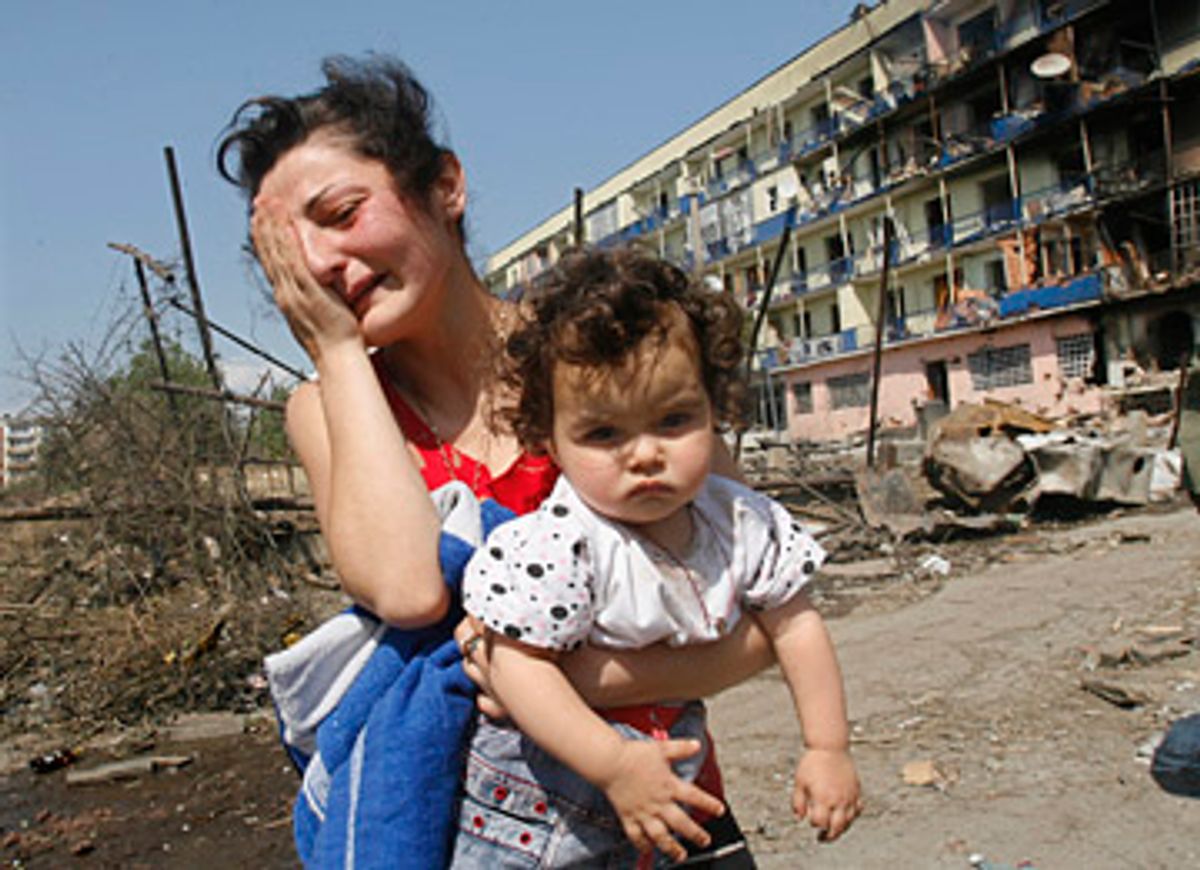
Russian President Dmitri Medvedev announced Tuesday that his country would stop its attacks against Georgia, declaring that the small southern country had been adequately “punished” for its own recent military actions against the separatist region of South Ossetia. Medvedev’s agreeing to a cease-fire nominally ended the hostilities, with President Nicolas Sarkozy of France, who negotiated the agreement, then heading from Moscow to Tbilisi to negotiate with Georgian President Mikheil Saakashvili. According to several news reports late Tuesday, however, Russian attacks continued after the announcement in Moscow, including airstrikes and ground operations. The conflict seems far from over.

The Caucasus region to Russia’s south has been a volatile place for years, with various factions struggling for control and post-Soviet Russia seeking to reassert its hegemony. To better understand how the long-simmering conflict boiled over into a full-blown assault by the Russians, Salon turned to Michael McFaul, an expert on Russian politics and a director of the Freeman Spogli Institute for International Studies at Stanford University. McFaul has also served as a foreign policy advisor to the Obama campaign. He spoke to Salon by phone on Monday night.

What is the conflict in Georgia all about?

There were skirmishes between fighters in South Ossetia and Georgia that went on for some time. President Saakashvili then decided he needed to use greater military force and actual soldiers to quell it. He went into South Ossetia, escalated the conflict in doing so and, by the way, struck civilian targets.

The Russian response to that was to invade Georgia, not just to try to get back to the status quo. They have been attacking cities in Georgia proper, and bombing civilian targets in Georgia proper. I think the bigger reason why we see this happening is that Mr. Putin — and he’s the one calling the shots here, it seems to me, the prime minister, not President Medvedev — decided [to do so] a long time ago. This was a fight that they have wanted to have for some time. The events of last week [in South Ossetia] were the trigger to make it happen.

The Russians are extremely frustrated with Georgia’s move toward the West, thinking of themselves as part of the Euro-Atlantic community, and especially upset about their petition to join NATO. The Russian leaders see the world in, I would say, very old-fashioned, 19th-century real-politick ways — in terms of spheres of influence and regional powers and super powers. So what they’re trying to do, in a grotesque way, is to reassert Russian power in the region. But they’re not doing it through what we call soft power. They’re using hard power.

What does Russia have to gain from a protracted confrontation?

I would speculate that they’re trying to destabilize the regime, the Georgian government. I don’t quite see how what they’re doing leads to that, but they’ve hinted at that enough to suggest that that’s what they’re trying to do. They’ve said Mr. Saakashvili is the problem.

Does Georgia have anything to gain from extended conflict?

They have absolutely nothing to gain from this fight. They know, and they’ve said this repeatedly, that they have no chance to fight a war with Russia. The asymmetries are overwhelming. They are suing for peace unconditionally. They’re fighting for their lives, they’re fighting to survive, so I’m quite convinced when they say they want a cease-fire.

So why provoke Russia by sending troops into South Ossetia in the first place?

I think they miscalculated. I don’t think they anticipated that Russia would invade their country. I mean, I was very critical of the use of force against Tskhinvali, the capital of South Ossetia. I think that was inappropriate use of military force. Civilians died. But they didn’t anticipate that Russia would respond the way they did. And, let’s be clear: However awful it was, President Saakashvili was using force inside his own country, inside the borders of Georgia that all countries of the world recognize. Russia, when it invaded, was violating the territorial integrity of Georgia, and therefore violating all sorts of treaty obligations and international law that they’ve signed onto.

You mentioned Putin’s role; is Medvedev, the Russian president, a relevant player in this situation?

If he is, he’s a really behind the scenes kind of guy. I mean, I haven’t been following closely who’s been saying what publicly, but all the optics and everybody in Russia that I know sees this as Putin’s show, not Medvedev’s.

I think it sends a very strong signal to everybody else in the Russian government, in the Russian presidential administration and abroad, that Putin is in control — and not on just security matters, but all matters.

What do you think of the way the U.S. government has been reacting so far?

“Reacting” is exactly the right way to say it. We’re reacting to things that are happening there, when instead we should have been proactively — and I would even use the word preemptively — involved in a political solution in South Ossetia and Abkhazia. It’s not like this is some new thing. There should have been an international mediator appointed. There should have been genuine international peacekeepers in those territories, not Russian soldiers. None of that was really tried with great strength or force, and it should have been, certainly months if not years ago.

I’m convinced that this whole war could have been avoided. It was not inevitable. Had that kind of negotiation started, I think Saakashvili himself in particular would have been much more constrained in the initial use of force that he deployed.

How do the U.S., the E.U., the U.N. and to the extent that it’s participating, NATO, work effectively to get Russia to back down?

That’s the million dollar question which I do not have a good answer for. I think at a minimum you show solidarity with Georgia. You make sure all the allies are in line.

When it comes to punitive measures, though, the West is constrained. I think this is an important point. Part of the reason we’re constrained, and why we don’t have any leverage today, is because we don’t have much of a relationship with Russia. We’ve allowed it to deteriorate over the last several years. When you go and you look at your toolbox, and what leverage we have, there’s really nothing there. I think, if one compares to other periods and other crises, we’re a lot more limited because of the neglect of this relationship.

What might a solution to the crisis look like?

I know what I think it should be, I just don’t think it’s very probable. I think now we have to—we just can’t go back to the way it was before. [We need to focus on] permanently helping resolve these territorial disputes. But that’s going to be very hard to get to from where the situation lies now.

Continue Reading Close

Pick of the week: A class-war thriller from Putin’s Russia

Pick of the week: A middle-aged wife and mom contemplates the unthinkable in the masterful, mysterious "Elena"

  • more
    • All Share Services

Topics: , , , , ,

Pick of the week: A class-war thriller from Putin's RussiaNadezhda Markina in "Elena"

As readers of Chekhov and Gogol and Dostoyevsky are well aware, the pervasive melancholy of Russian culture long predates the Soviet era, and there was no reason to believe that the end of communism would lift the gloom. Some Western reviewers have described “Elena,” the mesmerizing new family drama from the brilliant Russian filmmaker Andrei Zvyagintsev, as an updated film noir. That may be a workable shorthand, in that “Elena” is about an ordinary person who persuades herself to commit a terrible crime, with uncertain consequences. But it attaches the movie to the wrong heritage and the wrong set of expectations. “Elena” is a moral drama, all right, but one pitched in a dark and ambiguous Russian register reminiscent of a 19th-century short story or a fairy tale, with no clear lesson delivered at the end.

Indeed, if the message of most classic Hollywood noir is that crime does not pay, one might say that the message of “Elena” is that crime is the only thing that pays, at least in the crude Darwinian universe of Putin-era Russia. While there are no overt politics in “Elena,” it’s a movie about the most pernicious forms of class warfare, made barely 20 years after the collapse of the regime that was supposed to end class warfare for good. That’s enough politics, and enough knife-edged Russian irony, for a dozen ordinary movies. I’m not claiming that Zvyagintsev feels this way, necessarily, but “Elena” put me in mind of the Russian witticism that’s been repeated in many varieties since 1991: Communism was a dreadful system, we had no food and no freedom. Nothing could possibly be worse than that — except maybe the way things are now.

Zvyagintsev isn’t an international art-house brand name the way Andrei Tarkovsky once was, and that probably isn’t possible these days. So I won’t pretend that “Elena” is likely to become a crossover smash. But it’s going to play quite a few North American cities (see below) and is a breakthrough movie after its own fashion, a mysterious existential thriller that’s brilliantly acted and masterfully directed, without a second of wasted screen time. There’s nothing especially cryptic or confusing or pretentious about it, and once you adjust to the long, hypnotic takes of cinematographer Mikhail Krichman and the almost wintry pace with which Zvyagintsev draws you in, this tale of a frumpy, heavy-set Mother Russia type in late middle age (the amazing Nadezhda Markina) who is driven to desperation becomes utterly absorbing.

Zvyagintsev’s previous two features, “The Banishment” and “The Return,” were staged in timeless, nonspecific settings that recalled Tarkovsky’s more allegorical works. “Elena” takes place in the 21st-century Moscow built by the post-Soviet Putin oligarchy, where the rich live in opulent, barren detachment and the poor are clustered in crumbling Brezhnev-era apartment buildings plagued by skinhead gangs and irregular electricity. In almost every indoor scene, some inane reality show is playing in the background, and while I know that sounds heavy-handed, it works perfectly here, both as realism and as a kind of symbolic shadow-play version of the main action.

Markina’s character, the eponymous Elena, has apparently risen in class late in life, after marrying a sour, elderly business tycoon named Vladimir (Andrei Smirnov, himself a well-known Russian director) whom she met when she was a nurse and he was a hospital patient. Both have children from previous marriages: Elena’s unemployed son Sergei (Aleksei Rozin) lives with his wife and two kids in grinding, despairing poverty, and her eldest grandson is on the verge of flunking out of school and ending up in prison or the army. Vladimir’s daughter Katya (Yelena Lyadova), on the other hand, is a decadent 30ish beauty who is only interested, as he drily puts it, in “the pleasurable things of life.” We meet her only briefly when she comes to meet Elena, but the character is so slinkily rendered that we can see it all: the parade of guys (and perhaps girls too), the drinking and drugs and long, long nights ending at dawn, the overwhelming boredom with herself and her rich dad and the world.

If you think you see where this is going, you’re both right and wrong. After suffering a devastating heart attack, Vladimir has a partial reconciliation with Katya and decides to leave her nearly all his fortune, despite her evident flaws as a money manager. Although he promises to provide for Elena with an unspecified annuity, he refuses her requests for emergency funds to save her errant grandson from the draft. (As we see in a terrifying interlude, by the way, said grandson may not be worth saving.) What happens next is, indeed, a series of noir-type plot points — but, again, that’s a bit like describing “Crime and Punishment” as a murder mystery. “Elena” absolutely has a plot, and one that will keep you guessing up to the last seconds, but the movie’s real point lies in the long and often wordless scenes that pull you along, stealthily, toward moments of revelation or coincidence.

When Vladimir goes to his posh gym for an afternoon workout, for example, we watch him ogling a younger blonde with that predatory rich-guy gaze. She notices, and returns his stare, and we know — because this is that kind of movie — that their paths will soon cross again. But how? Is she a gold digger? An upscale hooker? An entrapment device, placed by journalists or gangsters or government officials? In this world, no encounter is ever innocent of avarice or naked self-interest. Even stranger and more powerful is a scene aboard a train that Elena is riding, with many thousands of rubles in cash clutched nervously in her purse. The train bumps to a stop, and men in uniforms rush through the car. We see her visibly tense up — will she be the victim of a robbery on this voyage, above all others? — but what has actually happened is even odder, an almost dreamlike event that (I think) may actually be borrowed from a Chekhov or Tolstoy story.

“Elena” isn’t really a film noir, because those kinds of crime films always involve the iron application of Murphy’s law, in its most moralistic form: Whatever can go wrong will go wrong, in order to punish the transgressor and restore the rightful order of things. In Zvyagintsev’s world, as in most classic Russian art and literature, the rightful order is non-recoverable. We live in a fallen world, and whatever could go wrong already did so, a long time ago. What Elena does is indefensible, certainly — but then, we don’t know what Vladimir did in the first place to become so rich that his daughter never has to work. Will Elena “get away with it”? I don’t know, but it’s not the right question. The truly terrible question asked by this quiet, haunting and magnificent film is: Dear God, isn’t there some better way to live?

“Elena” is now playing at Film Forum in New York. It opens May 25 in Los Angeles; June 1 in Boston; June 6 in San Jose, Calif.; June 8 in Miami, San Francisco, Portland, Maine, and Tallahassee, Fla.; June 15 in Portland, Ore.; June 22 in Houston and Washington; June 26 in Boulder, Colo.; June 29 in Wilmington, Del.; July 6 in Philadelphia; July 13 in Chicago, Denver and Seattle; July 20 in Minneapolis; July 27 in Salem, Mass.; Aug. 3 in Santa Fe, N.M.; and Aug. 10 in St. Louis, with other cities to follow.

Continue Reading Close

Russia’s xenophobia problem

Putin vows to tighten immigration laws. Will it make life even worse for the nation's migrants?

  • more
    • All Share Services

Topics: ,

Russia's xenophobia problem Russian Prime Minister Vladimir Putin (Credit: AP Photo/Ivan Sekretarev)
This article originally appeared on GlobalPost.

MOSCOW — There was a Congolese man, stabbed on the Moscow metro. And a Muslim girl, beaten with a bat by three teenage boys, who told her to get out of their northern Russian city, Kondopog.

Global Post

But perhaps the most disturbing recent example of racial violence was the murder of Muslim activist Metin Mekhtiyev, who was knifed in the neck and face outside his building in central Moscow earlier this month.

Police say it was a robbery, since his Vertu mobile phone, money and keys were missing. But the brutality of the crime points to a racially motivated attack, said Vera Alperovich, an expert in extremism at Moscow’s Sova Center for Information and Analysis.

Xenophobia toward non-whites is rising in Russia, especially toward migrant workers from Central Asia and the restive North Caucasus region, where unemployment is rampant.

Polls demonstrate how widespread the problem is. One in five Russians strongly agrees with the slogan “Russia for Russians,” while 43 percent believe that any measure taken to protect “my people” is good, according to research by Higher School of Economy professor Mark Ustinov. Nearly 70 percent of Russians have negative feelings toward people of another ethnicity, Ustinov’s research found.

The growing influx of migrant workers — 13 to 14 million annually by some expert estimates — most of them temporary, from poor former Soviet republics Tajikistan, Uzbekistan and Kyrgyzstan, exacerbates the already tense racial and ethnic relations in Russia. Russia is second to the U.S. in migrant arrivals.

Many Russians fear newcomers will take over their jobs, towns and eventually their country.

This has led to a spate of attacks on foreigners, and contributed to the rise in popularity of racist political slogans.

“Stop feeding the Caucasus,” a slogan coined over the winter by anti-corruption activist blogger Alexei Navalny, gained much resonance with the public.

The number of violent attacks on non-white foreigners peaked in 2007, when up to five were killed each month. That number has dropped significantly. Thirty-two people were attacked and two killed in xenophobic and racist violence since the beginning of this year, according to Sova, which monitors racism and xenophobia in Russia.

The real number of attacks is likely much larger, however, since most go unreported, said Tanya Lokshina, the deputy director of the Human Rights Watch Moscow office.

“If locals beat an Uzbek worker in an industrial zone on the outskirts of Moscow, police are not likely to seriously investigate the case,” Lokshina said. “And the Uzbek is not likely to report the attack. He either won’t know how to do it, or, God forbid, won’t have proper documents.”

Law enforcement stepped up hate crime arrests in the last three years, especially after mass beatings of non-whites during the December 2010 riots on Manezhnaya Square in central Moscow caused wide outrage.

Most of Russia’s violent nationalist gangs have been liquidated, with leaders in jail for decades to come. Earlier this month, five members of a nationalist gang were sentenced to life in prison for killing 27 people and committing other crimes.

Last September, a nationalist businessman was sentenced to nine years in jail for several charges, including designing and promoting an online game that required players to kill a migrant street cleaner and a police officer to get to a higher level. Players must then kill human-rights activist lawyer Stanislav Markelov, who was gunned down in Moscow in 2009, to win the game.

The arrests have brought down the level of violent attacks. But an attitude of xenophobia still pervades Russian culture.

A blond waitress with pale skin and blue eyes laughed when two well-dressed Africans walked into an upscale restaurant frequented by foreigners, GlobalPost observed while waiting to interview a source for this story.

She turned to another waitress, a dark-skinned brunette. “Your people have walked in,” she said. “I’m white. You are closer to them,” the blonde said, pointing out the brunette’s darker skin and hair.

Some are exploiting that for political advantage.

Migrants are not blending in to the Slavic society, said Dmitry Demushkin, the leader of the right-wing nationalist council “Russkiye,” or Russians. He plans to register a party called the Nationalist Party in the near future. “They are taking over certain industries — outdoor markets, street cleaning. Of course people don’t like it,” Demushkin said.

His party plans to advocate for the interests of ethnic Russians and those who have historically lived on the territory of the Russian Federation, Demushkin said.

The organization is against violence toward migrants, he said. Instead, Demushkin proposed to make working conditions in Russia unattractive for the migrant workers so they stop coming. His proposals include liquidating corruption and fighting what he sees as monopolies of ethnic groups in certain industries, he said.

Demushkin believes the party will become a powerful force in the near future, especially since nationalists are growing in strength across Europe.

Some migrants do violate the law. The frequency of crimes committed by foreigners has gone down, but the gravity has increased, Moscow prosecutor Sergei Kudeneyev said earlier this month, the Interfax news agency reported.

Last year more murders, attempted murders, serious robberies and rapes were committed by foreigners than in 2010.

More migrants in Russia work illegally than legally, experts said. CIS countries have a visa-free regime with Russia, but foreigners are required to register seven days after arrival. In order to register, an address or a job is required.

New arrivals, many of whom do not have contacts in Russia and cannot afford to live in a hotel, can’t get registered. Without registration, they cannot get permission to work.

“They are pigeonholed by these limits,” said Kamil Dilmuradov, a lawyer with the Union of Migrant Workers.

Many come from rural areas and don’t know the law. Some don’t speak or read Russian, Dilmuradov said.

President-elect Vladimir Putin has said migrants strengthen Russia’s economy and broaden its demographics, but he has proposed to toughen immigration regulation, including boosting penalties for violations and requiring Russian language and culture exams for all workers during his election campaign in January.

The politicians have the right idea to make the country more monolithic, Russia-Asia Union of Industrialists and Entrepreneurs political consultant Grigory Trofimchuk said.

The migrants aren’t doing anything bad, they just don’t know how to act, according to Trofimchuk.

“A crowd of young Uzbek men walking down the street and blaring their national music from their cell phones might cause tension,” Trofimchuk said.

The Federal Migration Service has drafted a conception of immigration policy, which includes education and integration initiatives for foreigners. The proposal is being reviewed at the top levels of government, according to Tatiana Bazhan, who heads the service’s department to facilitate integration. She said it is not yet clear when the proposal will be implemented.

But critics said the government is not doing anywhere near enough to solve the problem.

Business dictates migration politics, said migrant rights activist Lidiya Grafova, who is also a member of the government committee on migration policy. She pointed out the steady decline of quotas for migrant workers, which went from 3.9 million in 2009 to 1.7 this year.

“Migration politics are just words for now,” Grafova said. “In real life, everything occurs as it’s profitable for business. It’s profitable to hire cheap, powerless Tajiks.”

Migration will remain Russia’s potential tinderbox, unless comprehensive reform is passed, Dilmuradov said.

“The fact is, while there are migrants, there will be those moods. If these problems won’t be solved, it could get worse and worse,” Dilmuradov said.

Continue Reading Close

Punk’s cultural revolution

Pussy Riot's masked women have become icons of Russia's anti-Putin movement -- and turned the genre on its head

  • more
    • All Share Services

Topics: , ,

Punk's cultural revolution Seven members of the band Pussy Riot (Credit: Wikipedia)
This piece was originally posted on The New Inquiry. Follow TNI at @newinquiry and subscribe to TNI Magazine here.

Russia Today, the politsiya and Western punks alike all want to know: Who is Pussy Riot, when is their next gig, and where can I get their album? Despite having no releases or merchandise for sale, no tour dates, no Myspace or even recorded music, the band of masked women who perform only aggressive guerrilla shows has achieved a level of punk legitimacy not reached since the era when the combination of bleached hair and three chords was on its own automatically scandalous.

The New InquiryThe days of the Fraternal Order of Police suing the Crucifucks, Tipper Gore taking on the Dead Kennedys, and black metal goblins burning churches are long past. Punk is now no more a social threat than some leftist fringe group selling poorly designed newspapers. And yet, with three of its alleged members now imprisoned and facing seven-year jail sentences, the pastel-balaclava-wearing, sloppy-guitar-playing riot grrrls have become an icon of a brewing cultural revolution in Russia.

Pussy Riot’s now famous performance of Punk Prayer in Christ the Savior Cathedral in Moscow’s Kremlin, which earned them the personal ire of both the Orthodox Church’s patriarchate and Vladimir Putin himself, was a call for the Virgin Mary to become a feminist and exorcise Putin. Other feminist and anti-authoritarian performances included disrupting a fashion show by taking over a catwalk, performing unpermitted in a posh boutique, and playing a song called “Freedom to Protest — Death to Prisons” on the roof of a building in a Moscow prison complex to jailed anti-Putin protesters.

Last week a “Party Riot Bus” circled Moscow blasting punk rock and stopping for news conferences and performances calling for the release of the imprisoned band members. Riot grrrl matriarch Kathleen Hannah released a video pledging her support to the band, telling her fans she would “see you out in the streets.” A concert in Tallinn, Estonia, to support the band drew several notable politicians, including President Toomas Hendrik Ilves.

On the flip side, counterprotesters have attacked supporters in Moscow, focusing on removing the masks of female supporters. An anti-Pussy Riot rally was held the same day is Krasnodar, drawing an estimated 10,000 calling for a “moral revival” in the “fatherland.”

The band has derived their success — and scorn — by turning contemporary punk culture on its head. Where punk was once relegated to musky basements, squats and other shabby makeshift venues, Pussy Riot makes all public spaces — the streets, the metro, the church — their stage. While punk bands play for punks, Pussy Riot plays for commuters, police  and clergy. While punk bands seek fame with glamorous pseudonyms and outlandish rock star antics, Pussy Riot is masked. While punk bands engage in nihilistic lyricism, Pussy Riot’s songs are direct attacks on the confines of their authoritarian state and patriarchy. Since punk fell from the pop charts in the early ’80s, it has been sent on a quest to define and sustain its own identity, creating punk houses, venues, record stores and community centers, resulting in the introverted and self-obsessed situation of the sub-genre today. Pussy Riot does precisely the opposite.

It is fitting, then, that one conservative Russian website translated Pussy Riot to “Uprising of the Uterus.” What was once scandalized, forbidden, subaltern, rises from its rightful caste hidden and below and speaks in the very locations of its oppressing power. Who are these women, these punks, to perform, to pray, to protest in sacred locales? To desecrate is one of punk’s existential tasks. The smashing of sacred relics conjures society’s most archaic reactions: in this case, imprisonment, public shaming, flogging, concerns of Satanism, witchcraft, hysteria.

Punk has needed a Pussy Riot for so long. In many ways, it is the literal projection of the riot grrrl movement, which employed satire and third-wave theatrics to intervene in the traditionally macho and misogynist punk scene. It succeeded in creating a new type of punk — the grrl — but, until now, it had never successfully caused a riot.

Through the 2000s, bands have unsuccessfully attempted to wreck cultural terror. There was San Diego’s the Locust, who wore masks and bodysuits similar to Pussy Riot, played noisy and aggressive punk, but were not actually anonymous, nor were their lyrics directly political. The band shocked a lot of punks and sold a lot of records, but had very little cultural impact outside their genre. Black metal-heads became enamored with the “Cultural Terrorist Manifesto,” which also has had seemingly no effect. In 30 years, punk had perfected only gestures.

Perhaps part of the reason punk has begun to lash out so effectively in the former Soviet Union is the nature of the extreme oppression in Russian society. I spoke to Moscow anti-fascist Kostya about the dual dangers to the Russian anarchopunk — the right wing and the State:

I came up with the scene when it was possible to organize a strictly antifascist show, and you could be sure that only the right people will visit it. But still there was a danger of being attacked by Nazis before or after the show. Today it continues, but the situation is even worse. First of all, nobody fights with the fists, you’re more likely to be stabbed or shot with a traumatic gun. Secondly, and what is worse, there is strong oppression from the state and police. The situation in Russia isn’t stable, that’s why the government tries to control all the young people who can be dangerous today or in the future. They always try to put the same number of Nazis and anarchists in prison.

Kostya tells me Russia has its own anti-activist police force, called the “Department of Fighting Extremism.” Along with the threat of right-wingers burning down political squats or punk venues, the result has been a neutralized public face for the punk scene. All radical politics have been forced underground. It is no surprise, then, to see it return masked.

In 1977 the Ramones toured America like an Armed Struggle cadre of cultural terrorists, all dressed alike, playing the simplest and loudest music yet formulated. They not only invented punk that year, but they planted it everywhere they went. Punk’s success was its virility; reproducing with such ease that soon there were Ramones at every corner of the globe.

Reacting to increasingly technical progressive rock, the Ramones liberated the guitar to the world. Pussy Riot has taken this communization a step farther. To be a “member” of Pussy Riot, you don’t need to be able to play guitar or even to know the original band. As one member, Garadzha, told the newspaper Moskvkie Novosti: “In principle anyone can join.” You don’t even need to sing very well, she continues. “It’s punk, you just scream a lot.”

What would be the shape of punk outside the confines of the world of rock music? If Pussy Riot is any indication, it appears at scenes of intense banality or oppression. They have appeared on the catwalk, on top of a prison and of course at the altar. They sound something in between a streetpunk band (Blatz’s Fuk Shit Up is the first thing to come to mind) and an battle-worn activist giving an impassioned speech through a megaphone. The precarity of their performances gives a new spin to the typical speedy bursts of punk — the songs need to be so short because they could be apprehended any second.

Everything about the band is similarly practical. The rawness of their sound reflects the semi-improvised site-specific nature of the songs. Their masks obscure their identities from police detection. Their bombastic performance (use of fire, flares and the iconic punch-dancing) makes up for the lack of amplification. While other novel punk bands form their own stylized front against the limits of society, society’s limits seems to have fully formed Pussy Riot.

Perhaps antagonistic counterculture, once self-ghettoized within the margins of society, is beginning to coalesce into a new political form, one that transcends both its anti-social roots and the populism that activism too often demands. The Occupy movement is the most obvious example, but disruptive feminist and queer situations similar to those created by Pussy Riot have occurred in the United States over the last several years. The radical queer group Bash Back! disrupted service at a Lansing, Mich., megachurch, making out on the pulpit and dropping pro-queer flyers. Repetitive comments by law enforcement official that rape is a result of women’s attire lead to massive anti-rape and sex-positive “Slut Walk” protests last year. With a new right-wing offensive against women escalating to the withholding of contraception and forced transvaginal ultrasounds, the coalition between the church and authoritarianism is as relevant in the United States as in Russia. Could time be ripe, then, for some of the aforementioned agitators to arrange a Pussy Riot U.S. tour?

The New Inquiry is an online journal of social and cultural criticism. Every month,TNI releases a subscription-based magazine for $2, available for download in both PDF and e-reader formats. The New Inquiry Magazine, No.3: “Arguing the Web” (April, 2012) is available now! Support TNI and subscribe for $2 here.

Continue Reading Close

A.M. Gittlitz is a fiction writer, essayist and bike delivery boy living in Brooklyn, New York. He formerly wrote for Arthur Magazine blog, and a contributer to Death Panel Press and Modulo Magazine.

Putin’s ruthless Russia

An Economist editor discusses changing attitudes toward the president-elect and why Russia needs to accept its past

  • more
    • All Share Services

Topics: , ,

Putin's ruthless Russia Prime Minister Vladimir Putin (Credit: AP Photo/RIA Novosti, Yana Lapikova, Government Press Service)
This interview first appeared in The Browser, as part of the FiveBooks series. Previous contributors include Paul Krugman, Woody Allen and Ian McEwan. For a daily selection of new article suggestions and FiveBooks interviews, check out The Browser or follow @TheBrowser on Twitter.

Edward Lucas, the international editor of the Economist and author of a new book about Russia, gives an excoriating critique of Putinism and explains how Russia’s amoral present is rooted in a failure to come to terms with its past.

The BrowserWherever you turn – from contemporary literature to media reporting – there seems to be an unremittingly negative portrayal of modern Russia as corrupt, undemocratic and gangster-run. Is that a fair description?

Well, it’s both better and worse than the popular perception. It’s worse in the sense that I think the country is really run by what amounts to a gangster syndicate which is ruthless in its pursuit of wealth and power, and distorts the machinery of the state in order to achieve that and to perpetrate crimes against the Russian people. So I think Russia is worse than the slightly sanitized picture we get in the media, not least because of libel laws that mean it’s quite hard to write clearly and bluntly about some of the people involved.

But I think things are also better, because you have a new generation of Russians who don’t remember the Soviet Union, except possibly for childhood memories, are living lives largely unclouded by fear and official propaganda, and are integrated into the world in a way in which Russians haven’t been for 100 years. It’s those people who made up a chunk of those protesters who were filling the streets of Moscow and other cities during the weeks after the phony Duma elections in December [2011]. There’s cause for hope there, and the Putin propaganda bubble seems to have popped pretty substantially. Although he’s still in power he no longer enjoys the hypnotic popularity that he’s had over the last 10 years.

You’ve written about the threat that the current Russian regime presents to Western interests, and argue that the West has been complacent in dealing with Russian espionage.

The West tends to treat Russian espionage as a bit of a joke. What I did in my book was to investigate 10 Russian illegals [spy cells], the most notorious of which was Anna Chapman. I found out they were doing rather a lot and their activities weren’t a joke but were serious and potentially damaging. Russia is still jolly good at spying, and we have lots of vulnerabilities that they are very willing to exploit.

Why do they still play these spying games?

I think it’s partly because they can. They don’t have a navy really, they don’t have an air force, they don’t even have a serious space program compared to what the Soviet Union had, but they can still spy. Second, the leadership is addicted to information. It believes that there are conspiracies out there and with enough spying they will uncover them. So the paradox is that even when there’s no secret, Russian spies are tasked with trying to discover one, which leads to some tragicomic outcomes which I talk about in my book “Deception.”

One of the big priorities is getting their money into the West. They need to understand how our decision-making works – who makes the rules on money-laundering, who makes the rules on stock exchange listings and who makes the rules on energy regulation. They want to know whether they can change the rules, evade them or subvert them. So we do have secrets and for them espionage is one of the best ways of trying to secure their objectives, and my book is meant to be a bit of a wake-up call and say this is what’s going on. There is also a historical pattern to it. In the past we have been comprehensively suckered by the Soviet KGB, which ran rings around us in many respects. I uncover some glaring historical scandals of operations by MI6 and the CIA in the Soviet Union which went completely wrong, and provide an important contrast to the rather more successful operations that Russia is running against us now.

Rather than compare Russia with Europe, might it be more appropriate to compare it with other countries whose oil exports make up a disproportionate amount of their wealth and are often ruled by corrupt, undemocratic and potentially dangerous regimes?

There’s a danger of being patronizing and deterministic. It’s like saying African countries can’t be democratic or Asian values are antithetical to democracy. Actually, what we have seen in Europe in the last 25 years is that countries that conventional wisdom thought were doomed to poverty and chaos have become very successful ones and countries that we thought were doing very well have fallen into great difficulties. So I’m very hesitant to say that Russia is beset by eternal woes that mean it can never be democratic, prosperous or law abiding.

I do think the shock of the Soviet collapse was very deep, and many people underestimated how difficult things were going to be after that. The country was ruined in so many ways – from brains to bridges – and a huge work of reconstruction is still needed to get over the terrible damage done by communism. I think it was fanciful to think it was ever going to be very easy, but that doesn’t mean one shouldn’t deplore things that have gone wrong. I think the 12-year Putin experiment in retrospect looks like a very serious wrong turn for Russia, rather than being a gateway to a bright and better future as it was portrayed at the time.

The dominance of the oil and gas sector has allowed Russia to punch above its weight in the world. Without it, the Russian government would surely behave differently.

I think that’s true. The main business of the regime is stealing natural resource rents. Rents is a rather technical economic term, but it’s the windfall money you get from just digging something out of the ground and selling it for a lot of money. There are also what people call bureaucratic rents, which is a fancy word for bribes. I think there are two pyramids in Russia – one of natural resource rents and one of bureaucratic rents or bribes. The regime sits at the top and sucks money up from both of those and then squanders some of it on high living in Moscow but pumps a lot of it into the West, where it’s laundered in places like Vienna and even London and New York.

You’ve chosen five books for us, all of which have been published relatively recently. Is there a single thread that ties your choices together?

I think history and the legacy of the past is something of a thread. The communist party has gone but the KGB is still there, and the difficulty in confronting the crimes of KGB – and the regimes whose instrument it was – is a very big deal. I spent a lot of time in West Germany in the 1980s and was very aware of the very painful and sometimes rather intrusive idea of Vergangenheitsbewältigung, which is the coming to terms with the past. It’s always been striking that once you go east of the Iron Curtain, people are often ignorant about the misdeeds of their country’s history or relativize them in a way that is really shocking by the standards of Western Europe.

There is a feeling that the Soviet Union is gone and forgotten, when it shouldn’t be. There should be a memory of the totalitarian past in a country like Russia. Which is not to say that every Russian should feel personally guilty for it, but everything you see is built on the bones of millions of innocent people and that should be a really big deal in Russia. But sadly – and partly because of the Putin regime – it is not.

Well that segues nicely to your first book choice, which talks about this question of Russia coming to terms with its past. Please tell us more about “It Was a Long Time Ago, and It Never Happened Anyway.”

I think David Satter has really captured the role of the past in the present in Russia. He’s a very experienced correspondent from the Soviet era who has maintained his interest in post-Soviet Russia. He’s a really energetic, gumption reporter – he just goes to places that foreign correspondents don’t often go to in the provinces and follows up stories he first reported in the 1970s. Also, he’s unashamedly interested in morality. He feels that the Soviet Union hollowed out both public and private morality and left people without a moral compass when it collapsed. He highlights some of the extraordinary instances of casual, amoral treatment of people by the system and by other people in the book. It’s quite a pessimistic book. He feels Russia has been poisoned by the Soviet past and until that poison is out of the system it is going to be sickened by it.

His reportage is based on real life things. He has a gripping, haunting story of this guy who’s got drunk and ended up in a rubbish bin. The bin is then emptied into a garbage truck. The man wakes up and has his mobile phone on him. He phones from the back of the garbage truck and gets through to the police and tells them that he’s about to be crushed to death by the crusher. He tells them the part of Moscow he thinks he’s in and asks them to do something. And the police react with such casual boredom to this – the whole conversation is recorded – and you can hear the man becoming more and more desperate. You just think, when you have such a vivid human tragedy here, what kind of person would be a police dispatcher answering these emergency calls who wouldn’t sympathize with this person’s plight?

The title of his book is the quintessence of the Putinist attitude to the past. On the one hand, it’s a long time ago, so it’s irrelevant. On the other, if you say it is relevant, it wasn’t like that anyway – Stalin wasn’t such a bad man and his crimes really weren’t committed. It’s a classic Russian contradiction and an excellent title. Another thing he’s touching on is the role of the secret police in Russian thinking. The current regime is a corrupt secret police state and the role of the FSB [Federal Security Service] as an enforcement agent for the Kremlin is absolutely vital and Satter touches on that too and illuminates it.

Does he give any cause for optimism?

I think what he feels is that you’ve got to have a change at the top and you’ve got to have a government that tells the truth to its citizens about the past and deals with it and until that happens you’re always going to be navigating with a wonky compass. He doesn’t really write so much about the current political situation, which I think gives an opening at the moment. Putin’s looking quite weak and it’s unclear that he will last the full six years. It’s at least possible that out of that weakness will come a change in the regime or even a change of the regime. But it could also go wrong. It could be that the regime chucks Putin overboard and survives in some other form. It’s a stealing machine based on tens of billions of dollars, which the people in charge aren’t going to give up lightly.

Satter talks about how the rights and desires of individuals were subjugated in the Soviet era. This tradition has continued under Putin, hasn’t it?

Yes, and this touches on one of the other books I have chosen, Alexander Etkind’s “Internal Colonization,” where he says the relationship between the rulers and the ruled in Russia has always been a colonial one ever since the first Russian state came into existence. It has really followed the same pattern since. Russian rulers treat Russia the way that other countries’ rulers treat their colonies. It’s a callous, exploitative way where the quick win based on grabbing something someone else has got, or getting something out of the ground and selling it, is far more important than the long-term development of the economy. I don’t think that’s a complete explanation of Russia, as the Soviet Union did invest heavily in education, the space race, the arms race and other things, but I think the basic model of Russia as a quasi-feudal, quasi-piratical state is a very good one.

OK, let’s move on to Etkind now, who is a Cambridge academic. Can you tell us more about the thesis of this book?

Etkind’s thesis is that Russia has had a unique model of development, which is that it colonized itself. Lots of European countries had empires, but they colonized other countries and territories across the world – sometimes with conspicuous brutality and other times with a civilizing mission, and sometimes a mixture of the two. But in Russia’s case the colonization started from the very earliest stage of the Russian state. It was initially based on fur and timber and other types of resources and then later moved on to gas and oil. It’s meant that you’ve never had a proper relationship between the rulers and the ruled. It encouraged the impetuous and exploitative acts of behavior, first by the barons of the feudal overlords, then the aristocracy of the Tsarist era and then the communist aristocracy. It’s always based on contempt and brutality and it hasn’t really changed.

This is a short book and very digestible. I read it relatively recently and was very impressed by it. We know all about Russian colonization of other countries, and the Soviet empire in Eastern Europe, but the idea that Russia itself had been colonized is quite a new one.

You’ve touched on the question of whether Putin will last the six years of the presidency. Masha Gessen, who is a Russian American journalist, also thinks the Putin bubble is likely to burst at some point. Can you tell us about her book, “The Man Without a Face”?

It’s a very polemical portrait of Putin, a man whom she detests. I think she nails a lot about him. She really focuses in on Putin the man and inverts this common picture of a glamorous, decisive, tough guy to show that the reality is sordid, scary and in a way rather pathetic.

One quite interesting thing she notes is that he has a kind of kleptomaniac streak. She points out the occasions where he has embarrassingly pocketed trinkets. Once there was a glass model of a Kalashnikov filled with vodka and he just swiped it. He also took a ring from an American sports tycoon who had to claim he had given it to Putin as a gift. She concedes that you can’t do an armchair diagnosis, but she thinks he is afflicted by a rare form of kleptomania called pleonexia, where you get quasi-sexual satisfaction from expropriation.

The book tells the story of this small, grey man from the back rooms of the KGB – he was not even a distinguished frontline spy but a pretty unimpressive backroom boy – and how he worms his way into the inner councils of the St Petersburg city administration, then enriches himself hugely before moving to Moscow. Then there is an account of him rescuing the Yeltsin family from possible impeachment and disaster and then taking over the whole country. It’s a compelling biographical story. But what she also does is place it in a very impressive political and bureaucratic context. She says the hybrid of the old KGB and the new mafia in St. Petersburg – which sort of mated and mutated under Putin in the years he was there – transposed to Moscow and then took over the whole country. I found that a convincing and compelling account of what’s happened. You have on the one hand these “espiocrats”, these people whose mindset is absolutely conditioned by the world of the secret police and the secret service abroad. On the other hand is this mafia and its basic motivation, which is money and the ruthless desire to steal as much as possible from anybody who gets in their way or anybody they can reach.

Despite the protests from sections from the middle class, Putin does retain quite a large degree of popularity. Even if he did rig the last election, nobody really doubts that he would have won it.

A free election is not just about counting the votes correctly; it’s about what happens in the campaign. And I think that the way the campaign was constructed meant there wasn’t any doubt about Putin winning it because you didn’t have any serious challenger on the ballot – you had two professional losers, a clown and a stooge. So obviously Putin looked good against them. The other thing is that he had the relentless support of all the mainstream media and particularly television where most Russians get their news. The rigging you do on election day is the least important bit of election rigging.

But I think there has been a huge change. For a long time, Russians would say that the health system was bad, corruption was bad, the criminal justice system didn’t work, and that they were fed up with their elected representatives. But if you were to ask them if they approved of Putin they would say they did. He may have his faults, they would argue, but he’s got the country back on its feet again and there’s no real alternative. But I think that has profoundly changed now. It’s really hard for people to feel enthusiastic about Putin. His public approach now is based on kicking out foreigners and standing up for the ordinary Russian against the elites in the big cities. But that’s not really a programme. It’s the few cards he’s got left to play. If you compare that to the visionary rhetoric of his early years in power – with the promise of turning Russia into one of the most prosperous countries in Europe and a commitment to “dictatorship of the law” – now people just say: “Well, you had 12 years to do it and you didn’t when you could have done it, when you were hugely popular and had lots of money. Why should we get excited about any promises that you make now?”

Tell us about your next choice, Rachel Polonsky’s “Molotov’s Magic Lantern.”

Both Etkin’s and Polonsky’s books have an admirable way of taking cultural allusions from Russian literary history and using them to explain the history of the time but also the present. Rachel Polonsky’s book is based on her chance discovery of [Vyacheslav] Molotov’s library. Polonsky finds out that her upstairs neighbor’s flat in Moscow still had Molotov’s library in it. Molotov was of course Stalin’s great henchman. He signed 373 death warrants for senior officials, including his close colleagues during the Great Terror, so he was a very bad man. He was also the principal Soviet signatory to the Molotov-Ribbentrop pact of 1939. But he was a bibliophile – he loved books. He had made lots of notes in the books and occasionally even used his moustache hairs as page markers.

That’s one axis of this book. The other is the author’s own travels. She goes around all sorts of places in Russia and describes what she finds and links that back into Russian literature, chiefly Molotov’s books but others as well. It’s a very captivating read. You don’t feel you are being bombarded by learning when you’re reading it. But at the end you feel a great deal better informed.

Would you describe it as a travelogue?

It’s what you might call a literary travelogue, although that sounds possibly a bit disparaging because she’s genuinely well-informed about Russia. When she goes to places she doesn’t have the ingenuous naivety of the travel writer. She hones in on what’s important and what really matters.

She’s also very determined not to be swept away by this consumerist bombast which is very characteristic of modern Russia – “Look, I’ve got a bigger car than I had last year and I’ve a bigger flat,” and so on. She wrote this book at the height of the Putin boom, so her quite acerbic and at sometimes rather mordant approach to Russia was prescient.

Your final book, “Let Our Fame Be Great,” is by former Reuters Moscow bureau chief Oliver Bullough and looks at the history of the Caucasus.

I think the Caucasus is Russia’s Achilles heel, really. It was the great triumph of the Tsarist empire getting the Caucasus. It was a great military feat trouncing these supposedly barbarian, wild mountain people. So it was celebrated in Russian literature and history as a great conquest. Then in the 1930s and 1940s it was the site of the extraordinary great deportation of the Chechen and Ingush people – tens of thousands of people driven from homes in the middle of the night, put on cattle trucks and dumped on the Steppe in central Asia with appalling casualty rates. And then when the Soviet Union broke up, Chechnya tried to regain independence and conflict ensued.

Actually, what we are seeing is the point at which the Russian empire busts. It’s tried to digest the Caucasus but it hasn’t. What Oliver Bullough does absolutely brilliantly is look at the forgotten history of the Caucasus. What I particularly like about it – although he writes very well about all the bits of the Caucasus – is his focus on the Circassians and one of the great untold stories of the 19th century. This was a large country which had the misfortune to be on the southern fringe of an expanding Russia. There was what nowadays we would call a genocide, and one that rivals the treatment of the North American Indians or the Australian Aborigines or any of the other victims of European imperialism. But it has just vanished from our collective memory. I don’t think one person in a thousand knows about tens of thousands of Circassians who were massacred on the beaches of the Black Sea, in fact very close to Sochi where Russia will host the 2014 Winter Olympics.

What Bullough does brilliantly is to bring to our attention the fragments of documents we have from these pathetic remnants of cemeteries in Turkey – where the ships laden with dead bodies arrived. He also goes to places like Syria and Jordan where the Circassian diaspora has now become very influential and well-established and interviews them, and you get this feeling for this whole world you just don’t know about. These people with their language, their history, their culture and their colossal tragedy behind them, trying with satellite television, Twitter and the Internet and all these modern means, to get themselves back together again and get their story told.

The book also looks at the history of Russia’s interventions in Chechnya, in which both sides have committed atrocities. Is this a conflict that is likely to raise its head again in the near future?

The Chechens are a very tough people who have been brutalized by their historic experience. I don’t think anyone should take a naive, romantic view that this is a captive nation struggling to be free and they’ll become the Switzerland of the Caucasus if they’re allowed to be, because the damage done by history leaves very deep scars on all sides. I wouldn’t want to particularly judge the question of what should be the constitutional arrangements in the North Caucasus – I just think that Russia is struggling and failing to hold on to the North Caucasus. Russians are leaving, and you have bunch of corrupt and very oppressive satrapies that pay lip-service to Russia, but where the Russian constitution doesn’t actually apply any more. They consume very large amounts of Russian money and I just don’t think that’s very sustainable. The combination of some mistakes by the Chechens and many more mistakes by the Russians has created a really horrible situation that is going to be around for a long time.

Continue Reading Close

Russia’s embattled media

After stepping up election coverage, independent news sites face tighter scrutiny under president-elect Putin

  • more
    • All Share Services

Topics: ,

Russia's embattled mediaA protester holds a newspaper showing president-elect Vladmir Putin during an opposition rally in Moscow, Russia, Saturday, March 10, 2012 (Credit: AP Photo/Ivan Sekretarev)
This article originally appeared on GlobalPost.

After a brief period of freedom in the 1990s, president-elect Vladimir Putin has largely cracked down, and kept up pressure, on independent media during his first two terms as president in 2000 and 2004. The last 12 years saw a decline of independent press and critical journalism in Russia. Today the main television channels and many news outlets are either majority owned by the state or Kremlin insiders.

Global PostPress freedom grew under President Dmitry Medvedev. Last year’s reforms included demoting libel to a less serious crime and increasing jail terms for assault on journalists. But, as after each major event in Russia since 2000, a crackdown on independent media followed the Dec. 4 parliamentary elections, which sparked mass rallies all over Russia over alleged fraud.

The government maintains that Russia’s press is free.

“Freedom of the press is guaranteed and provided in this country,” Putin’s press secretary Dmitry Peskov said. The policy toward the media will continue after Putin officially becomes president — again — on May 7, Peskov said.

However, Pulse’s recent troubles underscore the costs of criticizing the government.

Pulse may be evicted from the building it has occupied for the last two decades because of violations in radio frequency technologies, Sklyarov said. If the regional court of arbitration finds his internet company guilty of licensing violations later this month, Pulse will lose a major source of its funding.

Sklyarov admits to infractions, but said that they are minor and long-standing. He connects the inspections with his decision to change programming and monitor the election.

To draw attention to the pressure, Sklyarov has spoken at an anti-government rally in Moscow and has been in touch with Medvedev’s administration. Despite a phone conversation with an unnamed official from the Kremlin and a request from Mikhail Fedotov, the head of the Presidential Council for Civic Society and Human Rights, to look into the sudden rash of inspections, local government continues to pursue its investigation of Pulse.

While independent outlets and journalists in Russia’s regions face more pressure than their counterparts in Moscow, the capital’s news outlets are also coming under scrutiny.

A planned June reshuffling of the board of directors has been moved up three months at the prominent independent radio station Echo of Moscow. Echo’s parent company, state-run gas company Gazprom division Gazprom Media, replaced two long-time independent members with company-appointed candidates.

At the station, the move, which gives a majority to Gazprom appointees, is seen as a “crooked” attempt to control editorial policy, deputy chief editor Sergei Buntman said.

The announcement came after Putin criticized the station for “pouring diarrhea” all over him “from morning to night.” Echo of Moscow, which is often critical of the government, featured extensive coverage of opposition leaders and anti-government protests after Dec. 4.

“I understand that the initiative [for the reshuffling] did not come from Gazprom Media, but from higher political authorities,” Echo chief editor Alexei Venediktov said in a statement published on the station’s website.

Nikolai Senkevich, the president of Gazprom Media, said the decision was prompted by “increased attention” to the station from “all different sides” and the dismissal of the independent directors was a necessary change, Russian news service Ria Novosti reported.

Other recent incidents include an investigation into funding of opposition channel Dozhd, the freezing of funds for opposition newspaper Novaya Gazeta, a dismissal of an editor from the respected Kommersant newspaper after publication of a photograph of a defaced election ballot, and police beatings of several journalists covering anti-government protests.

In January, Russia’s Union of Journalists, an organization thought to be controlled by the Kremlin, appointed a new director for the Center of Extreme Journalism, a group that monitors freedom of press violations in Russia. The new director was one of the center’s analysts and has previously worked in the administration of Russia’s first president, Boris Yeltsin.

The members of the center’s staff saw the new director as a government functionary and viewed his appointment as an attempt to control the organization, said Irada Guseinova, a former analyst at the center.

The entire staff of the Moscow office and affiliates in the CIS quit as a sign of protest.

“It all looks good on paper,” Guseinova said. The union has the right to appoint directors for the center, a subordinate organization. “But [in this environment] what’s the point of monitoring?”

While the government cracks down on the independents, it has shown an uncharacteristic openness in policy and state-run television channels.

A law that facilitates registration of political parties is about to pass. Earlier this week, Natalia Morar, a Moldovian-born journalist who wrote about state corruption in Moscow’s New Times magazine was allowed back into the country after being refused entry for four years. Putin proposed to create a “speaker’s corner” where everyone can come and speak their mind, modeled after London’s Hyde Park.

For the first time ever, the “stop-list,” or an unofficial list of people not allowed to be broadcast, that includes government opposition and is usually decided by a channel’s top officials, seems to have been lifted.

Opposition leaders Boris Nemtsov and Sergei Udaltsov appeared on two state-run channels last month, a first for prominent Kremlin opponents.

Television had to adapt to the demands of the people, said Alexander Morozov, the head of the Center for Media Studies, a Moscow think tank.

“It is impossible to hide what’s happening in the country,” Morozov said.

However, Gos Dep, a political talk show aired in February on Russian MTV and hosted by celebrity “It-girl” Kseniya Sobchak, was cancelled after just one episode for what many say was Sobchak’s decision to bring Alexei Navalny, a popular blogger and anti-corruption activist, on the next show.

“Navalny is just not allowed on television,” Morozov said.

NTV, also owned by Gazprom Media, has recently broadcast a series of reports, accusing the opposition of receiving money from the United States. The reports, largely thought by analysts, journalists, opposition and many Russians, to be smear documentaries ordered by the government, led to a rally protesting the reports, and a mass boycott of the channel.

Medvedev’s proposal to create a public broadcaster has been revived. The bill introduces public television and radio, with minimal government involvement, and programming aimed to create a civic society and inspire the viewer to be a better citizen, the Presidential Council’s Fedotov, who is heading the project, said.

“The channel will make the viewer morally cleaner, inspire him to vote, recycle,” Fedotov said. Medvedev will pick the channel’s founders from a group nominated by the Presidential Council and the Public Chamber, seen as largely subordinate to the Kremlin.

However, at least some of the channel’s funds will come from the state budget, Fedotov said. For many, this casts doubt on the project’s claims of independence from the government. Other issues up for debate include competing with other channels for viewers and the broadcaster’s educational functions.

Television is a source of information, not mass education, Echo’s Buntman said. After decades of Communist rule, with only a brief period of relative media freedom, a strong, independent press is not a tradition in Russia. Forming this demand through public television is total nonsense, Buntman said.

“This understanding won’t magically emerge from public television,” Buntman said. “It will only emerge in a competitive media atmosphere, where each outlet will try to compete with the other for accurate coverage of events.”

Buntman doubts the broadcaster won’t be controlled by the Kremlin.

“What if someone will decide there is too much negative information?” Buntman said.

The question on everyone’s mind is, what will happen after Putin’s inauguration on May 7.

The future of media depends on what political course Putin will take, either to try to work with everyone or take the nationalistic, patriotic line, Morozov said. It is possible that Putin will not pressure the media because he does not have any reason to be nervous, since he faces little criticism from abroad, Morozov said.

What looks like new media liberalization is temporary, said Aleksey Simonov, the president of Glasnost Defense Foundation, a nonprofit organization that monitors violations against press. After Putin’s inauguration, the Culture Ministry will become responsible for media, now under the jurisdiction of the Communications Ministry, Simonov said. All three choices for the new minister in charge of media are heads of three state-run television channels, according to Russian news reports.

Although the inspections and, what Sklyarov calls “assault” on Pulse, has not stopped, on Tuesday Sklyarov won the first of two cases against his internet company in the local court.

“We are fighting, and we will continue to fight,” Sklyarov, 63, said. “I have a hot temper despite my age. I weigh 120 kg (260 lbs). Once you get me going, you can’t stop me.”

Continue Reading Close

Page 1 of 41 in Russia