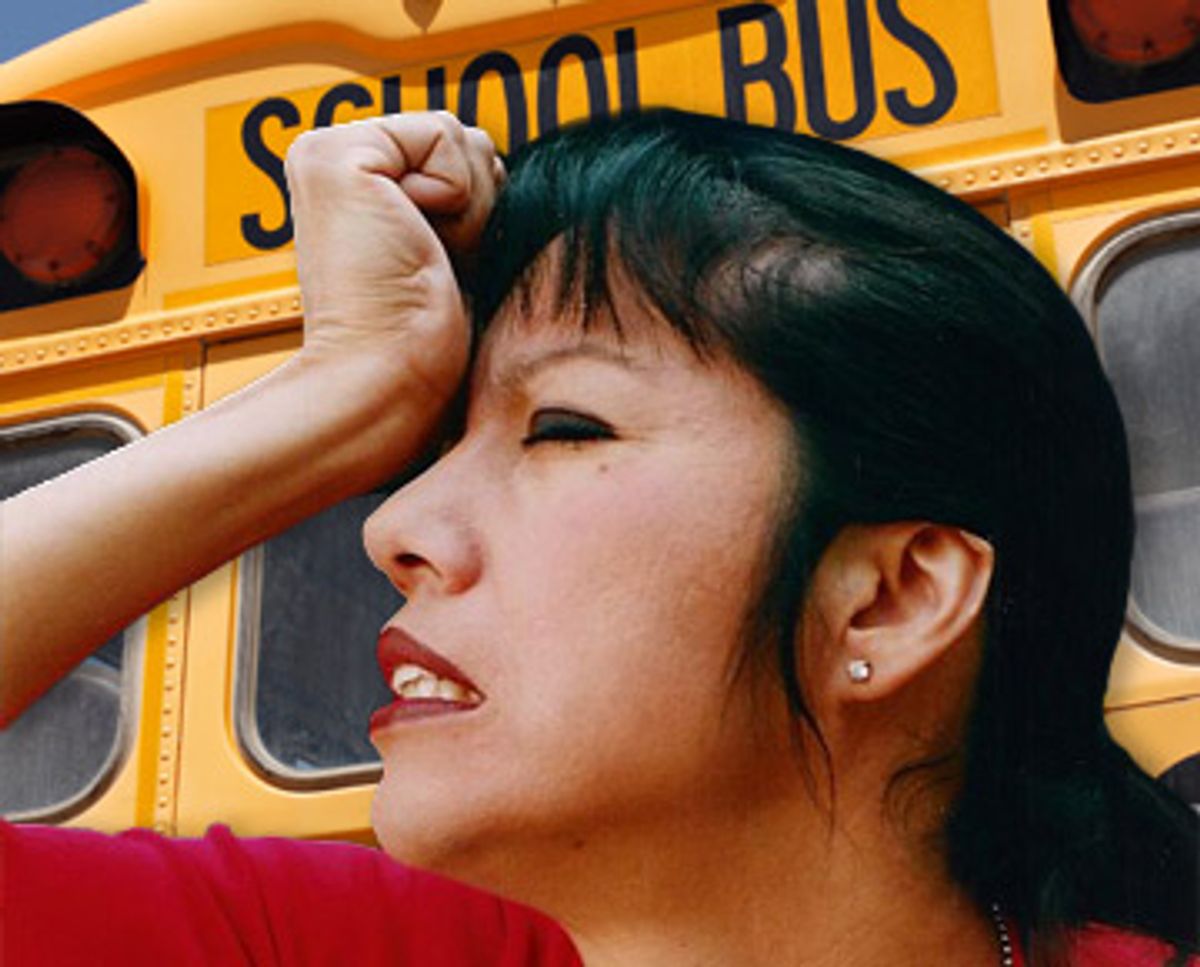
You! says Sandra Tsing Loh, whose hilarious "Mother on Fire" is a rallying cry for urban parents who can't afford a fancy private institution.

To listen to a podcast of the interview, click here.
To subscribe: Click here to add Conversations to iTunes or cut and paste the URL into your podcasting software:

Once upon a time, Sandra Tsing Loh was a poster child for the First Amendment — “the Jennifer Aniston of amendments,” she says — popular, glamorous, easy to love. This was back in 2004, shortly after Justin Timberlake ripped off part of Janet Jackson’s costume and revealed her bejeweled right breast to the Super Bowl-halftime-show-watching masses. Freedom of speech was very much on everyone’s mind — and when Loh got fired for inadvertently uttering the F-word on her Los Angeles public radio show, she found herself a cause célèbre.
“It was amazing. Suddenly I was the coolest thing,” she says now, recalling the heartfelt letters and enraged editorials written on her behalf, the invitations to swanky events. “When you’re finally in that little updraft, you’re like, ‘Oh, this is the high life — fantastic!’”
But not long after her big media moment, Loh — who has five books and one-woman shows to her credit, has been a regular commentator on NPR’s “Morning Edition,” PRI’s “Marketplace” and Ira Glass’ “This American Life,” and now holds forth on everything from science to women’s issues on her two Los Angeles radio shows and in the Atlantic Monthly, where she is a contributing editor — found her real cause: rescuing our urban public schools. Yes, yes, she can hear you yawning. “This public education thing is so huge, yet … it’s so unsexy,” she says. “I would go to parties and people would back away. ‘Oh, there’s Sandra. She was fired last year for obscenity. Now she’s into public school. Good luck with that.’”
Those people haven’t read Loh’s hilarious new book, “Mother on Fire: A True Motherf%#$@ Story About Parenting.” Or maybe they just don’t live in a big city and have kids they can’t afford to send to private school. Anyone who does will be riveted by Loh’s lively, furiously paced, brutally frank account of her own search for a school for the elder of her two daughters — or, as she dubs it, “the year I exploded into flames.” They will also undoubtedly, and regretfully, recognize their own shameful insanity, their own unshakable obsessions, their own false starts and interludes in which they followed false prophets (private school admissions officers, mothers who think they have all the answers, therapists who live cloistered, tastefully appointed lives).
For any parent who has ever worried that her children will end up uneducated and deprived of art and music because she has chosen a career in the creative fields rather than, say, podiatric surgery, for any parent who has ever dissolved in tears after being ignored by the self-important secretary behind the desk at her corner public school, for any parent who has ever felt the searing pain of unrequited love after touring a fancy private school or suffered an existential crisis while considering a move to the suburbs, “Mother on Fire” will function as much-needed salve — and inspiration. Because if public school is the urban middle class’s tragic fate, it is also one that can end in a catharsis. And after we follow Loh on her journey — through fluorescent-lit schools, complicated female friendships, the elaborate dances of decades-old marriages — we emerge euphoric, flush with community spirit and able to laugh at our own insanity.
Still shaky from my own all-consuming quest to find a school for my 5-year-old son (he’ll enter kindergarten in one of New York City’s fine public schools in September), I spoke with Loh. I reached her at her bungalow home in Van Nuys, Calif., where she was no doubt surrounded by women’s literature, PTA fliers and thousands of her daughters’ tiny socks.
Why does the search for school make parents so crazy?
I think it’s partly a generational thing. I’m 46. In our 20s, women in my generation, we all wanted to be Laurie Anderson. “Oh, she’s playing violin on roller skates on an ice block in New York City and going directly from that to her Warner Bros. ‘O Superman’ tour.” So we thought that’s what you do: You stay true to your own artistic principles, you don’t compromise anything, and then you end up with a giant record deal, all this money and a fashion spread in British Vogue. You go to college, don’t get married, don’t have kids, become Laurie Anderson, make all this money and sing your song. And then our 30s came along, and reality set in.
And now that we have had kids, parenting has become so consumerized. Even when your baby is in the womb, you have to eat a certain kind of kale and put the Mozart headphones over the belly and have the right kind of sleep pillow. And because communities have fallen out, where you don’t have the grandmother or the aunt around to help you, you’re just kind of alone in your fear bubble. Into that void come the lactation consultants and the new mommy groups that are all heavily marketed. The mommy Web sites, if you are unfortunate enough to read them, have the Bugaboo stroller ads — all the “advice” is always laden with stuff that you’re supposed to buy.
You’re just in the habit of swiping the Visa and solving all your parental problems. So by the time you get into preschool, everybody is kind of fear-based and chattering. And even the 2-year-olds are trying to practice their block work to get into the best kindergarten. You’re pretty much surrounded in this bubble by people who are going to swipe their Visas and get themselves out of the horrible public school system. Which I had never directly experienced.
It’s a key theme in your book: how people fear public schools — without knowing anything about the public schools.
When I was at public radio looking at kindergartens for [my older daughter] Madeline, for months I did not meet anybody who had their kids in public school in Los Angeles, which is really shocking. I’m a journalist so my friends are journalists: magazines, newspapers, even public radio. Nobody had their kids in public school. That’s why I would never think of just going to the corner school and poking my head in. Because that’s like going to the DMV.
My generation is so used to having our public spaces look like the Starbucks, with the beautiful lighting and the little bit of Nina Simone and my coffee that’s blended a certain way from Costa Rica. So the first time you walk into a public school, you go, “Oh my God the lighting is really ugly. Why are those flags drooping so sadly there? Why does the person typing not look up?” It’s a real shock to the system.
And yet when you looked inside it, you found some surprising things.
I did. There’s so much catastrophizing about public school by people who have not set foot in there for decades because “no one goes there.” I really don’t think our school system is an evil borg force. It’s sort of like the government. It’s not even efficient enough to be a borg of total evil, even if it wanted to be.
So yeah, you find many things. It’s like Costco, as opposed to a specialty store like Dean & DeLuca. The Dean & DeLuca is very inviting, it’s personal, it’s got the beautiful lighting and everything is where you’d expect to find it, but you’re spending an arm and a leg. Costco has hellacious lighting and the parking is terrible and you’ve got these huge towers of paper towels. But if you comb through those aisles, you see hothouse tomatoes on sale and Glenlivet for, what, $10? I remember one time seeing Yo Yo Ma actually play at our local Costco! You’ll find some amazing value in there if you just get over the lighting and look. And as a middle-class person — because there’s a huge divide that’s fallen out between the upper class and lower class [in our cities] — we just have no choice. The good school district is $1.5 million homes. Private schools when I was looking were starting at $14,000 and now they’re definitely in the 21s. Especially for two kids, it’s really unaffordable.
So part of it is that we’re accustomed to paying our way out of parenting trouble spots, but is choosing a school for our kids also about our own identities as parents?
I think identity is definitely a part of it. And it may be something that we women are going through at this peculiar time in our lives. I know a fair number of women who have opted out in that Lisa Belkin way [Belkin's 2003 Times magazine cover story told the story of Ivy League-educated women leaving the workplace to stay home with their children]. They just simply — no matter what feminist argument you try to throw at them — really are happy to be out of the grind of the workforce. But then they’re looking around and thinking, well, what do I do next?
There’s the competition of getting into these schools, which in a way replicates what one may have had in the workforce — but in a way that you go, I can win this game, though, because it’s just kids. I had, at the beginning, a false confidence that I could game this system. People would go, “Oh, call this number of this person on this card, they’d love to have you guys at their school. You’re at public radio, that’s so cool!” So there was a moment of flattery — before I realized that public radio is like being the genteel poor in L.A. It doesn’t actually count for that much. I thought it would, and it didn’t. Only Ira Glass’ name counts.
Even if you can’t afford it, the private schools can be awfully alluring.
That’s what’s so fascinating about them. I often thought, you know, if I wanted to make some money, I could start a private school. I could start it out of my own house in Van Nuys and call it “The Cottage” or “The Bungalow.” And you know we’ve got mulberry trees around here, and they’re dying, but we could call it “The Mulberry Cottage.” And we could start a newsletter. I became fascinated studying the newsletters of all the private schools.
There was one nearby here where the newsletter was all written by the parents, which is, when you think of it, a little infantilizing. There were men and women writing about how, that day, the first graders had looked at rain coming down on petals. And one parent was writing about his own memories of rain coming down on petals. So the newsletter was an ad hoc literary magazine for the bored parents to think about their own childhoods. In a way these private schools allowed a certain class of parent a way of being that they didn’t find anywhere else in society. And especially in L.A., where people find themselves cut off and it’s really very hard to find your tribe. Sometimes a private school will give you a sense of tribe that you don’t find anywhere else in the city.
That’s interesting, because we’ve lost a sense of community by not sending our kids to public school, too. When we were kids our parents just marched down to whatever public school was handy and enrolled us, and that was our community, because those were our neighbors.
Oh, absolutely.
But now there’s all this fear, all this isolation. How did we get here?
You know, the magnet system is so complicated in L.A. We would throw these soirees called “Martinis and Magnets” to explain the system and then ply the crowd with martinis just to ease the pain.
I started doing these questionnaires. I’d say, “OK, before we get started: On a scale of 1-10, how terrified are you of your local kindergarten?” 11! “Have you ever set foot inside that kindergarten?” No! “Do you know any living soul who has ever set foot inside that school?” No! “How do you know the school is so bad?” Uh, neighbor …? Nobody had any direct experience of that school, but they were so terrified.
And the other thing we would do on this questionnaire. I’d say, “What was your peak educational moment?”
One woman wrote, “None! The day I left grad school was my peak educational moment, and I want to spare my 4-year-old the same experience.” And you’d go, well, that’s not very promising.
And another person wrote, “My peak educational moment was in graduate school in modern dance choreography, the day we turned our chairs in toward each other in a circle and were able to finally share freely.” And then you’re going, OK, so you’re trying to re-create in kindergarten what you had at the graduate modern dance choreography level. This just is not possible, it’s not realistic, and it actually may not even be very good for your 4-year-old who probably just needs to learn to hold a pencil and sit in a room without twiddling.
On the other hand, public education has to come into the 21st century. They have to say, “Good morning, may I help you?” at the front desk. And maybe in big public school systems there haven’t been enough highly demanding, aggressive parents to say, this is insane. We are going to sue you unless you say “Hello.” I think the two poles can come a little closer together.
Well, I’ve had that experience at the front desk at some schools. And then I’ve found, as you did when you dove a little further into the system, these pockets of amazing people working in the school system — who really care and want to make a difference. It’s your Costco theory: You look a little further, and you find the gourmet tomatoes. So how do you get people to look? And have you noticed a change since you first became an evangelist for public education?
Yes. When I began, in 2004, nice, liberal, Democrat, NPR-listening people [in Los Angeles] did not even discuss public school. They just slid you the card of some private school under the table. Now the conversation is very much on the table. It feels like there is a bulge in families whose kids are going into public school now. It’s the tipping point of the real estate prices being so ridiculous. And we were one of those families that, had we been able to buy our way out of the problem, I would have been the first one off the train. Because I thought, it’s undoable. I can’t fix it. But we just could not move from our house and buy a $900,000 house. And we couldn’t afford the $30,000 a year for my kids to go to private school either.
That’s when I thought, how bad is that corner kindergarten anyway? If they even take them off my hands for three hours, that’s free childcare right there, and then I’ll drill them on the alphabet. It really cannot be worth this much money. And then I visited, and I realized, well, they do have an alphabet and they do have a playground and they teach them numbers — this is not bad. And I started putting back my expectations.
Many of us turn to public schools because we really don’t have a choice.
Everyone has been outpriced. Because the generation before us, those dreaded baby boomers, they swiped the Visa and left nothing behind. It was like strip mining. They took what they could and left nothing for the rest. Not that I blame the boomers, but why not? Let’s blame them! They stopped the war, then they worked at corporations, and they were done — and they still think they’ve saved the world. But in terms of public education, many of them left a blasted landscape behind.
So you think this is really our generation’s fight?
I think so. When busing occurred in the ’70s, it was not in a very sophisticated way. So in L.A., you had white Jewish Valley children being bused to South Central. I’m all for cultural blending, but I think it has to be done in a smart and thoughtful way. And it was not done that way. So that was the first big exodus — in the ’70s. Now you have these children in their 40s going, you know, it may be time to do this legacy a different way. I think it is.
It’s also a shift in terms of conversation. I think for good liberal Democrats of my ilk, for people to sit around and say, “Public education, no one can go there” — I don’t think that’s a fight that should be allowed to be abandoned in conversation anymore. It’s a bit like if you said, “Yeah, I toss my recycling right into the landfill. I don’t even bother to separate my recyclables. What’s the point? We’re all going to hell, anyway.” That wouldn’t pass in nice company. I think we need to start changing the conversation so it’s not just a given that we’re going to send our kids to private school and that that’s better.
Part of the appeal with private school is that it’s full service: Once you write the check, you don’t have to do a thing. That’s a big difference between what we public school parents face. We need to get in there and actively make things happen. For instance, you started a music program at your public school.
At our school, they’re learning to read like gangbusters, the teachers are great, the solids are definitely there. But they didn’t have instrumental music. So I found out that VH1 gives grants of new musical instruments to schools, and I did a lot of fancy footwork to get these instruments to our school. Sometimes with these school grants, it’s like the Mafia truck drives up and stereos fall off. And it’s like, get the stereos! I don’t know where we’ll put them, but get them! It was like that with these instruments. We got them, and then I had to find a music teacher and then pay the music teacher. It was a bit of a thing to unravel. Yet for me it was sort of fun.
We needed an after-school program. We didn’t have one. And our PTA, we were able to start an after-school program with arts and crafts — and even piano. Piano lessons, they’re $55 for half an hour to teach a 6-year-old. We can’t afford that either. And if we don’t have affordable piano lessons, no one will play the piano. So we got these affordable lessons. I’m in a pocket of bohemian parents who have a little extra time and can teach an art or craft class. Five dollars a lesson, maybe $6, pretty cheap. We scholarship people for free and we still have money left to pay our violin teacher. It’s an economy of scale. We know how to rub quarters together and make something.
It sounds like you’re advocating volunteerism as a way out of our parental fear bubbles.
Yes, and I think many times people who are in those bubbles feel so much more trapped and alarmed about their children. In my book, I drew a lifeboat, where, at the very tip of the lifeboat, are the top 1 percent of the earners. They’re both dual lawyers. Their children are set financially. But they’re the people that are most anxious that Dylan doesn’t have a native French speaker in second grade. The whole thing will collapse! They’re looking over the tip of the lifeboat and seeing the sharks circling, rather than looking behind them and seeing how much luckier they are than the rest of the country. When you look at immigrant children, four out of five English-learning immigrant children will not even have one native English-speaking friend. And white children are actually the most segregated of all tribes in America right now because they’re so kept from the other children. And that’s really alarming for these immigrant children who are not even going to be around native English speakers so they can have a better chance of those higher ways of learning the language. Our children are going to be totally fine.
It’s like we’ve forgotten how to think communally.
Right, even with play dates. When you first have a child, you realize either I can hire a baby sitter for every single hour that my kids need to be watched, or if I can make a mommy friend, they can go over there for two hours while I work and then they can come over here for two hours and then she can work. Just on a basic level, you start seeing that there are financial advantages to forming little tribes and groups, that you can save a lot of money.
And I think that goes back to the public school thing, where on one affluent block, in Los Angeles, every morning about 7 a.m. you see the four Lexuses and Range Rovers bolting out of the driveways and going to four different private schools in four different remote parts of the city. If they each just went to the corner public school and took one year of tuition — $25,000 a year — and put it into that school for one year, that would be $100,000. That school could buy a new gym, and everyone would save so much money — you’d save gas, you’d save the planet — if people just looked around and started thinking a little more communally rather than competitively. And we may have to do that in these apocalyptic times.
I feel good about the apocalypse. Because I think people will have to relearn their habits, and I think it’s going to be better.
Are high-tech classrooms better classrooms?
Despite the hype over Apple's new iPad textbooks, there's little proof that gadgets do much to improve education
(Credit: iStockphoto/Willsie)
The release of Apple’s computer-based textbooks last month had the usual technology triumphalists buzzing. “Apple and the Coming Education Revolution,” blared the headline at Fast Company magazine. “Apple puts iPad at head of the class,” screamed Macworld. And Time magazine declared the announcement the “debut (of) the holy grail of textbooks.” It sounds exciting — a rise of the machines that promises educational utopia rather than “Terminator”-style cataclysm.
Or does it?
Though it may be too soon to definitively answer that question, it’s not too soon to ask it. Because despite the celebratory hype, there’s no guarantee that a hyper-technologized education system is synonymous with genuine progress.
Ponder, for starters, the much-discussed issue of financial efficiency. As the tech website Gizmodo noted in a post titled “You Can’t Afford Apple’s Education Revolution,” the new iPad-based books might “only cost $15 a pop,” but “instead of selling an updated textbook every 5-10 years for $100, (publishers will) update and sell every year for $15,” and “it’s not like you can hand down an iBook from year to year … you expressly can’t.” It’s the same story with so many other vaunted education-branded technologies: They seem to promise resource-strapped school districts a way to constructively reduce expenditures, but the dazzle of flashy gadgets and interactivity often means budget-busting costs over the long haul.
Those costs might be justifiable when a new device is a sure bet to improve education. But a school’s wager on computer technology as a pedagogic panacea is often just that: a blind gamble, and one that evidence shows is hardly safe.
Here in Colorado, for instance, the nonprofit I-News Network recently reported that students attending the state’s “full-time online education programs have typically lagged their peers on virtually every academic indicator, from state test scores to student growth measures to high school graduation rates.” Stanford University researchers found similar results in their separate study of online schools in Pennsylvania. And after its exhaustive national investigation of the trend, the New York Times concluded that “schools are spending billions on technology, even as they cut budgets and lay off teachers, with little proof that this approach is improving basic learning.”
In lieu of empirical data, why are schools rushing into this brave new world of technology?
For one thing, there’s the allure of a quick fix, as gadgets seem to hold out the possibility that school districts can sustain huge budget cuts without sacrificing quality tutelage. The idea is that teachers can be replaced by cheaper computers, at once saving schools money, preventing tax increases for school resources, and preserving educational services. Even if data prove that’s a pipe dream, the desire for a cure-all has convinced many desperate schools to chase the fantasy.
There’s also political pressure from high-tech companies that, according to Education Week, “are thriving in the K-12 market.” As the Investigative Fund’s Lee Fang recently documented, these firms use some of the loot they’re generating to finance state-based political front groups, hire lobbyists, and employ has-beens like Gov. Jeb Bush as their public representatives. The result is a powerful political infrastructure that pushes state legislatures and local school boards to divert money away from proven education tools (teaching staff, textbooks, etc.) and into risky technology procurement.
There’s little doubt, of course, that some technologies may end up bringing about genuine advancements in education. But that possibility is no reason to suddenly ignore Ronald Reagan’s notion of “trust, but verify.” After all, before it was the Gipper’s, that motto was the mantra of the most devoted science and technology geeks — just as it should be schools’ mantra now.
Stories don’t need morals or messages
A "stupid" test shows that the Puritan ethic lives on. Why do we insist on learning lessons from the books we read?
(Credit: iStockphoto/Yayayoyo via Shutterstock)
What is the purpose of reading stories, especially made-up stories? That’s the question lurking behind a recent posting to the New York Times’ education blog, SchoolBook. Ann Stone and Jeff Nichols, the parents of twins, wrote about taking their kids’ third-grade English Language Arts test with some friends as a party game on New Year’s Eve. The group read an inane little story about tiger cubs learning to tear bark off logs, but, to their surprise, couldn’t agree on a single answer to the multiple choice question that followed: “What is this story mostly about?”
Tests like this, the couple asserts, do students “a double disservice: first, by inflicting on them such mediocre literature, and second, by training them to read not for pleasure but to discover a predetermined answer to a (let’s not mince words) stupid question.” The problem, they feel, stems from the standardized testing regime, which forces the learning experience into a too-rigid structure. Even a “banal” story like this tiger-cub number admits “multiple interpretations,” and the prod to “reduce the work to a single idea” does a disservice to both reader and text.
I’m sure Stone and Nichols are right that the current, reductive obsession with standardized testing has made this propensity worse, but discomfort with fiction — with all its slippery, non-utilitarian qualities — goes back to the beginning of American culture. As the historian Gillian Avery observed in her “Behold the Child: American Children and Their Books, 1621-1922,” 17th-century Puritans had big doubts about any kind of non-scriptural storytelling, for adults as well as for children. They were as determined to teach their kids to read as any modern helicopter parent, if for other reasons: For Puritans, reading the Bible was essential to getting into heaven, rather than into Harvard (though to hear some people talk today, you wouldn’t think there was much of a difference).
As the Puritans saw it, writes Avery, fiction might “deflect the reader from more profitable occupation” and was furthermore “untrue, therefore a lie.” It belonged to a category of falsehood known as the “sporting lie,” whose purpose was neither white nor black, but something too troublingly colorful: “to make one merry or to pass away Precious Time,” as one Boston schoolmaster put it.
If you think we’ve gotten past this starchy point of view, guess again. Today’s parents may anxiously urge their kids to read novels like “Charlotte’s Web” or “Fahrenheit 451,” but any desire to make their offspring merry is far overshadowed by the belief that reading is essential to getting ahead in life. You have to be a “good reader” to get good grades and you need good grades to get into Harvard (or wherever) and you need that prestigious degree to get a good job. The Protestant work ethic has not so much forgiven reading fiction for passing away Precious Time as it has swallowed it whole. Reading books has become a kind of work, at least for children.
In adults, the old Puritan attitude leads us to treat fiction as the delivery mechanism for instructional or inspirational messages. Whenever a novel’s merits are described in terms of the “life lessons” that it “teaches,” you can detect that old uneasiness over the “sporting lie” being appeased. In movies and television, literature class discussions almost always consist of students earnestly announcing that what Fitzgerald (or Hemingway or Shakespeare) is really saying is that you should follow your heart (or face your fears or be true to yourself — pick your empty nostrum). If you’ve ever turned on the option that lets you see other readers’ highlights in a Kindle book, you’ll find that they almost always underline similar mottos, such as this line from Abraham Verghese’s “Cutting for Stone”: “The key to your happiness is to own your slippers, own who you are, own how you look, own your family, own the talents you have, and own the ones you don’t.”
The weakness of this approach to fiction should be obvious: If what you really want is a set of fortifying maxims, why bother with stories about feckless romances or foolish kings? Why not just go straight to the self-help section — the secular equivalent of the sermon — as so many American readers already do?
Others (including, recently, the novelist Philip Roth) reject fiction entirely and turn to history or narrative nonfiction, explaining that, at the very least, they can be sure they’re “learning something” from what they read. Learning can certainly be fun, but the implication is that acquiring facts about, say, the life of Cleopatra, has more value than following the story of an imaginary person like Elizabeth Bennet. The Precious Time thus passed away has something to show for itself, and the American mania for self-improvement has been appeased. Never mind that most of us will find little practical use for information on quantum mechanics, the military stratagems of World War II or the private lives of British aristocrats.
Ultimately, all of these attitudes — and the standardized tests that Stone and Nichols complain about — boil down to the belief that reading can only be the means to an end, whether that end is moral betterment or worldly success (two classic Puritan preoccupations). For some of us, however, reading is an end in itself, and what fiction has to offer isn’t lessons but an experience, a revelation, a sudden expansion of the spirit. Like any art, it can teach or motivate, but it doesn’t have to, and it’s often better when it doesn’t.
Further reading
The ugly truth about “school choice”
The Koch brothers want you to think the movement's about racial justice and empowering parents. They're lying
VIDEO
(Credit: Petro Feketa via Shutterstock)
National School Choice Week, a pet project of big corporations and conservative billionaires like the Koch brothers, kicked off Monday with celebratory forums throughout the country. Billing itself as a social justice movement committed to “ensuring effective education options for every child,” “school choice” has actually become a deeply divisive wedge issue for the right. But the folks at School Choice Week would prefer that you didn’t know that.
On their website, you can find photographs and videos of shiny happy children of all races and ethnicities. And you’ll see that Bill Cosby is a major supporter. And since he has a doctorate in education and has acted as a philanthropist on behalf of many African-American schools, many will see his endorsement as an important mark of legitimacy.
But there are a few serious problems with the school choice movement. Though it attracts mainstream conservatives like Cosby, as well as Democrats like President Barack Obama, it is not, at its core, a bipartisan endeavor. Its most important backers are rightwing organizations like the Heritage Foundation, Americans for Prosperity and other groups supported by billionaire rightwing ideologues like the Koch brothers. They want to dismantle public education altogether and run schools as businesses, judged as “successes” or “failures” based on abstract data taken from high-stakes standardized test scores.
Access to opportunity is replaced with demands for universal “excellence” and “achievement,” in which teachers are punished for student “failure.” This pits parents against teachers, and it ultimately sidelines already marginalized children of immigrant families, poor children and/or children of color.
But you won’t see any of these shortcomings acknowledged in the video below:
To counter some of the misinformation School Choice Week organizers are disseminating to the public, I give you the five biggest lies you’ve heard about school choice:
1. It’s not about racial justice and equal opportunity.
In fact, school choice often makes inequality worse. But because public schools have not solved the achievement gap between white and black children in America, proponents of school choice dishonestly take up the mantle of the Civil Rights Movement.
It isn’t that all aspects of school choice are objectionable to educators. Dennis van Roekel, president of America’s largest teachers’ union, the National Education Association (NEA), acknowledges that school choice can benefit underserved populations some of the time. He says magnet schools – that is, schools in poor neighborhoods that provide a range of diverse classes for students not usually offered in public schools – are a good model for school choice. Such schools draw students who are attracted, for example, to advanced arts or sciences programs. The extra funding ensures that magnet schools, located in poor areas, become a district’s best schools. Van Roekel sees this as a worthy innovation that furthers equity, and says the NEA supports it.
His organization also supports teacher-led schools that empower teachers to administer schools and tailor them to the needs of students. He even says that some charter schools – that is, independent public schools designed to fill a specific community’s needs and are less regulated that other public schools – are good ones. He thinks there is room in public education for some charter schools.
But he doesn’t think they’re a viable answer to inequality everywhere. He cites a 2009 Stanford study, which found that only 17 percent of charter schools provided better education than regular public schools. And that, he says, is not acceptable to the NEA because “it ought to be better than that. It needs to be 100 percent.”
He is not as open to school vouchers, which divert public money away from public schools and allot it to parents to assist with private school tuition. Ultimately, Van Roekel says, vouchers disproportionately serve the wealthy. Less funding for public schools is just not good for poor communities, which usually have to rely on the public system.
Karey Hardwood, an ethics professor at NC State University and public school advocate, is also concerned about how school choice affects poor children. She is an activist with Great Schools in Wake, an organization that formed in 2009 to oppose a school choice platform pushed by a newly elected right-wing school board in Wake County, North Carolina. The state chapter of the NAACP has also opposed school choice, arguing that it will lead to the re-segregation of schools in Raleigh, North Carolina and its surrounding suburbs.
Harwood asks: “When they talk about choice, whose choices are they referring to? Are the children of people who are savvy enough to get out of the public schools the only children who are worth educating in our society? What happens to the children who don’t get out? It seems the [people behind School Choice Week] knowingly embrace the idea of creating a second tier of schools for those American citizens who don’t or can’t ‘choose’ – and they are perfectly okay with a divided society of winners and losers.”
Carrie Rogers, a Wake County parent and former teacher who describes herself as a moderate Republican, agrees. She says school choice largely benefits well-educated middle and upper-middle class students. Rogers notes that she devoted 12 hours per week for six months to investigating her children’s options, and says that working class parents who work multiple jobs do not have that kind of free time on their hands. She adds that poor children, who most need access to excellent schools, will end up in the worst schools as a result. Ultimately, she says, “I think ‘school choice movement’ is a misnomer. I view it a movement based on prejudice, xenophobia and racism. The idea sounds good, and we all hate the idea of bussing our children [to outside communities to enforce Wake County’s former economic diversity policy]. But if you don’t want your child bussed, don’t break the entire system. We’ve allowed a very small group of vocal opponents to ruin our schools for everybody.”
Brian Jones is a New York City teacher and activist with the Grassroots Education Movement, an organization that supports progressive school policies. He says, “I think [racial and economic] segregation is the sinister subtext [of school choice]. Very wealthy benefactors are going into Harlem and promoting segregated schools as a solution. But the Civil Rights movement saw racial justice as bound up with economic justice. The school choice movement claims to be about racial justice, but distances itself from questions of economic justice. Under the banner of ‘school excellence,’ school choice advocates would like for us to forget about equity.”
John Wilson, former president of the NEA who now resides in Raleigh, says it is a “travesty that we are allowing our schools to be re-segregated” in the name of social justice. “If you really want to help poor children,” he insists, you have to desegregate your schools.” A native of the South who spends half of his time in North Carolina, Wilson says his background “absolutely informs” his perspective on school choice. When Southern schools were forced to integrate, he remembers, educators ultimately realized that integration was the best way to promote equity.” In other words, it brought home the lesson of Brown v. Board of Education – the groundbreaking 1954 Supreme Court decision mandating school integration on the basis that segregated “separate but equal” schooling always privileged white students and could never be equal in practice.
2. It’s not about making public education stronger
The school choice movement promotes the dismantling of public education at every turn.
Van Roekel says that, for school choice to benefit public education, it must prioritize the needs of students. The problem is that this rarely happens. Instead, school choice is too often a mechanism of privatizing education and defunding public schools. When funds are diverted away from public schools, they are not strengthened, but starved. Teachers end up with so many students per classroom that it is impossible to give every child the attention she needs. Van Roekel says attempts to profit on the back of public education are unacceptable.
Wilson tells AlterNet that he thinks School Choice Week’s primary aim is to promote vouchers at the expense of public education. He says, “Private schools undermine the public school system,” and adds that no evidence suggests they are better than public schools. School Choice Week, he says, is promoting the demise of public education under the guise “excellence.” In the end, he says, they are “doing a disservice to children.”
Judith Armfield, who retired from the Wake County Public School System in 2004 after 31 years in teaching, agrees. She opposes the privatization of education because she thinks diversity is an important aspect of learning. According to Armfield, private schools “encourage withdrawal from reality” such that “students…are not as well-prepared for success in a diverse world. My boys began their school experience in private school in [segregationist George Wallace’s] Alabama, but we realized that they were being sheltered and put them in public school classrooms” where they had access to better school curriculum and learned to coexist with people different from themselves.
Harwood is also concerned about the privatization trend, noting, “One of the most problematic aspects [of it] is the idea of ‘choice’ itself. What the [people behind School Choice Week] seem to be saying…is that, rather than strengthen a weakened public school system because we believe in public schools as the foundation of a democratic society, the solution is to abandon public schools altogether, let them deteriorate, and replace them with alternative private schools and charter schools that can claim they cater to every possible parental preference.”
Harwood has seen this happen firsthand in North Carolina, where wealthy conservatives like Art Pope and the Koch brothers are promoting the privatization of education as a way of shoring up profits for themselves and other large corporations. She says applying this business model to education results in a system that “pits schools against each other in a competitive market…, [and] that’s really not the best way to go about improving school quality. In fact, it’s very counterproductive.” Rogers agrees, saying it creates a system in which “there has to be a school that’s the worst school in the country. We have decided [under the George W. Bush administration’s No Child Left Behind Act], that, if you’re the worst school in the country, we will shut you down. We’re not looking at whether that school is working” within the confines of limitations like large class size or high homeless rates.
Jones tells AlterNet that the same kinds of corporate interests that promote school choice in North Carolina are at work in New York City. He says, “We have a lot of Wall Street Money involved. We recently learned that Goldman Sachs was backing [one prominent charter school in New York City]. Wall Street bankers and hedge fund executives run that school. They seem to believe that you don’t need to know anything about education in order to run schools.” And this is the sort of hubris, Van Roekel and Wilson say, that is unlikely to benefit students.
3. It’s not about supporting teachers.
School choice often results in a punitive atmosphere for teachers. Why? Well, parents choose schools for their children at least partly on the basis of high-stakes standardized test scores. And the quality of teachers is usually reduced to a zero-sum question about how well a school’s students score on standardized tests. As a result, teachers are blamed when students score poorly on standardized tests, and advocates for school choice use the numbers – and the bogeyman of bad teachers – to advance their cause.
Radical right-wing bigwigs like Rush Limbaugh have also contributed to the demonization of teachers, casting them as “socialists” working to “indoctrinate” students. And though the scapegoating of teachers gets particularly ugly on the far right, anger at teachers is not reduced to the fringe elements of the conservative movement. For example, Jones notes that New York City Mayor Michael Bloomberg says that up to half of the city’s school teachers may be so incompetent they have to be replaced.
But why teachers? Wilson thinks the school choice movement is particularly hostile to teachers because the NEA is a strong opponent of school vouchers. Jones agrees, telling AlterNet he sees the proliferation of non-union charter schools in New York City as a tool to punish public school teachers. Why? Well, precisely because charter schools are usually non-union schools. In New York, he says, non-union charter schools are promoted because they act as “a significant wedge against the teachers’ union.” He says the rise in numbers of non-union teachers leads to the union being pitted against workers who have fewer bargaining rights and worker protections. And it becomes harder for teachers to organize effectively against vouchers.
Rogers agrees that the impetus behind the school choice movement’s call for teacher accountability is to punish teachers, not make them better. She notes, “teacher accountability is [a way of scapegoating teachers in spite of the fact that] problems in education are usually systemic – and not the fault of individual teachers. It hurts morale,” she says, and is counterproductive given that low morale is rarely conducive to outstanding job performance. “When people say teachers are overpaid or should be fired,” she says, “I just don’t believe that… If a school is doing really badly, it’s not because the teachers, administrators and support staff have all gotten together and said, ‘Who cares?’ Educators do try to make it work. We become educators because we are committed to the personal and academic growth of our students.”
Rather than blaming teachers, my sources all suggest that systemic factors like poverty and class size need to be taken into account in assessing school performance. Rogers thinks high teacher-to-student ratio is a major reason why some schools perform poorly, and Jones agrees. He adds, “When you have growing numbers of homeless students, increasing economic inequality and waves of budget cuts year after year,” it is unrealistic to blame failure on the teachers. “It’s nonsensical that they would promote this demand for excellence” even though they have presided over the depletion of public school resources. At the end of the day, teacher accountability is usually bound up with the push for privatization, and it rarely improves teacher performance.
4. It’s not about giving parents what they want.
To the contrary, many of my sources point out, school choice seduces parents by making hollow promises they think will resonate with parents. Jones says many parents are drawn to the idea of school choice – and the accompanying promotion of private education – at first. Plus, the inflammatory rhetoric that school choice advocates use against teachers helps the school choice movement divide and conquer teachers and parents. In other words, it pits parents and teachers against one another, and as a result, the quality of public education suffers.
At first, Jones says, “Historically underserved groups may see it as a solution to inequality. I can understand why some parents buy into it at first. If you feel like your child’s education has been neglected or if you’re a member of a group that has historically been underserved, you feel like finally someone is paying attention. But, in fact, school choice often disempowers parents.” It restricts their level of involvement, for example, in Parent/Teacher Associations. They are afforded less influence over school policy. A bit ironically, then, school “choice” may actually result in less choice for parents.
Jones says, “What we’ve seen over and over again is that many of the parents [who initially pushed for school choice] will switch to our side after they experience it. They realize that school choice does not promote equality or benefit them. Not to mention, what happens when parents have no good choices available?” In any case, he says, “as school choice plays out, parents begin to see that it crushes genuine learning. For example, it reduces literature to a main idea and education to a chore [that is organized around high-stakes standardized multiple choice tests]. The real lesson is that school is not a place where you investigate your own questions, but where you learn to answer someone else’s questions the way they want you to answer them. It makes education a chore rather than a joy.”
Rogers sees may parents becoming disillusioned with school choice in the Raleigh area as well. She says many parents are overwhelmed with complicated school application forms and the imperative to choose the best schools for their children. They must also make ample time to visit schools holding open houses where teachers and administrators and charged with “selling” their schools. Sometimes, she says, the parents who get burnt out are the very same people who welcomed school choice at the beginning. In practice, she says, they find the process taxing and stressful, recognizing that they may be unqualified to determine which school is best for a specific child.
Jones thinks that the alienation of parents and teachers means that school choice advocates are “in danger of creating a very strong alliance of teachers and parents to challenge their agenda.” Jones says one example of this is New York City Public School Parents, an organization through which parents advocate for more parental involvement in schools by way of strengthening public education. Organizations like this facilitate cooperation between parents and teachers, who often begin to side with teachers’ unions opposing vouchers. When that happens, it’s a significant boon to public education.
5. It’s not a bipartisan, secular movement.
School choice is a deeply partisan fight, and one which many – but not all – private church schools have taken up. Don’t get me wrong. This myth, like any successful political narrative, is at least partly true. Moderate conservatives and a range of liberals often lend their support, obscuring the rightwing ideology behind the movement.
So, yes, choice does have a modicum of bipartisan support across party lines. Rogers notes, “I know several parents who are very liberal and
who are pro-school choice… As someone who is kind of hard to pin down politically, I shy away from putting a political label on this, but I know it isn’t only about the Tea Party. There are a lot of very liberal people out there who are in favor of school choice.”
Rogers believes this is due, at least in Wake County, to the pervasiveness of racism across party lines. She stresses that “Republicans are not the only racists. Of course liberals are theoretically less likely to embrace school choice and support public initiatives in education, but then they often get down to it, and go, ‘oh wait, we have to send our kids to schools with the black kids or the poor kids?’” She says she knows many liberals who fail to live up to their high-minded ideals when it comes to school choice.
Though she argues that this is largely motivated by racism, Rogers thinks that some parents – on both the right and left – may not understand that the consequences of school choice – and that includes negative consequences like re-segregation and greater inequality. She says, “Parenthood gives you a very narrow focus… We want to protect our children. If we feel that a school is not doing what it needs to do, we’ll fight to send our children to another one. These parents sometimes don’t realize that what they’re advocating is not fair to everybody.”
Because of this, school choice maintains enough bipartisan support to appeal believably to bipartisanship. Jones points out that President Obama has consistently supported school choice despite a campaign platform that involved overturning No Child Left Behind. In fact, he says, “Obama applauded the mass firing of teachers in a poor school district in Rhode Island that was deemed a failure. And he supports the proliferation of charter schools” that has so negatively affected teachers unions’ in places like New York.
This is because school choice is, at its heart, about the kind of “bootstraps” ideology in which some people win and some lose, as Harwood pointed out. School Choice Week is backed by many private schools associated with the Christian Right, which have an interest in steering children away from public schools that they believe will “indoctrinate” their children with liberal ideology, tolerance for LGBT people, and instruction that recognizes evolution as a viable scientific concept. Because Fox News caters to this audience, coverage of school choice is most prominent there. As a result, religious institutions often favor vouchers as a way of promoting their own political agenda.
Perhaps even more significant are the corporate sponsors of School Choice Week. Morna McDermott of the Baltimore Education Reform Examiner writes that corporate backers, perhaps more than private schools, are interested in the complete dismantling of education. She says “corporate-led [conservative] reformers must have gotten wind that there were billions of dollars to be made by funneling federal dollars through these schools” because they “have since taken the lead to legislate policies to their benefit.” And, she points out, most of the organizations affiliated with School Choice Week “have direct connections with, or strong ties to, a right-wing agenda to privatize many American institutions including education.”
The most powerful, she says, is the American Legislative Exchange Council (ALEC), which brags of helping introduce more than one thousand pieces of school choice-related legislation to legislators every year. She explains, “ALEC describes itself as a ‘unique,’ ‘unparalleled’ and ‘unmatched’ organization,” and adds, “Their largest contributing members include the tobacco industry and big oil.”
But ALEC isn’t the only right-wing supporter of School Choice Week. Conservative organizations like the Goldwater Institute, New Jersey Tea Party Caucus, Heritage Foundation, Alliance for School Choice, Friedman Foundation, Heartland Institute, Reason Institute, and many other right-wing groups are also behind this week’s school choice celebrations. Despite some liberal support, its primary backers are deeply conservative activists whose goal is to dissolve public education in the United States. That’s why school choice bipartisanship is a myth – that is, its advocates use their few liberal supporters to obscure the real political base.
It is crucial to debunk these kinds of myths because, as Harwood says, “School choice is not the panacea that [its supporters are] making it out to be. There is plenty of room for creativity and innovation within public schools. There should be plenty of motivation to strive for excellence. To rely always on this free market ideology as the solution to problems in the public schools [signals] a very limited way of thinking. When students are healthy and well-fed and schools are well-resourced, the results in American schools are excellent. Poverty and extreme social inequality are the real” barriers to adequate education. And as all of my sources confirm, school choice is an unsuitable one-size-fits-all solution that often marginalizes poor children and children of color rather than fixing their schools.
Public education itself is not the lost cause that advocates of School Choice Week would have you believe. The effects of inequality undoubtedly undermine the progress many marginalized students, but this does not require that we do away entirely with public schools. A woman from an Eastern European immigrant family recently told me that, until recently, she thought the United States had largely figured out how to do education well. But causes like school choice now undermine progress our education system has achieved, and that is why its propaganda has to be disputed.
America’s dangerously removed elite
It's easy to cut public education funding when your kids go to private school. Just ask Christie and Emanuel
New Jersey Governor Chris Christie and Rahm Emanuel (Credit: AP/Reuters)
Last week, my local Twittersphere momentarily erupted with allegations that Denver’s public school superintendent, Tom Boasberg, is sending his kids to a private school that eschews high-stakes testing. Boasberg, an icon of the national movement pushing high-stakes testing and undermining traditional public education, eventually defended himself by insisting that his kids attended that special school only during preschool and that they now attend a public school. Yet his spokesman admitted that the school is not in Denver but in Boulder, Colo., one of America’s wealthiest enclaves.
Boasberg, you see, refuses to live in the district that he governs. Though having no background in education administration, this longtime telecom executive used his connections to get appointed Denver superintendent, and he now acts like a king. From the confines of his distant castle in Boulder, he issues edicts to his low-income fiefdom — decrees demonizing teachers, shutting down neighborhood schools over community objections and promoting privately administered charter schools. Meanwhile, he makes sure his own royal family is insulated in a wealthy district that doesn’t experience his destructive policies.
No doubt this is but a microcosmic story in a country whose patrician overlords are regularly conjuring the feudalism of Europe circa the Middle Ages. Today, our mayors deploy police against homeless people and protesters; our governors demand crushing budget cuts from the confines of their taxpayer-funded mansions; our Congress exempts itself from insider-trading laws and provides itself healthcare benefits denied to others; and our nation’s capital has become one of the world’s wealthiest cities, despite the recession.
Taken together, we see that there really are “Two Americas,” as the saying goes — and that’s no accident. It’s the result of a permanent elite that is removing itself from the rest of the nation. Nowhere is this more obvious than in education — a realm in which this elite physically separates itself from us mere serfs. As the head of one of the country’s largest urban school districts, Boasberg is a perfect example of this — but he is only one example.
The Washington Post, for instance, notes that it has become an unquestioned “tradition among Washington’s power elite” — read: elected officials — to send their kids to the ultra-expensive private school Sidwell Friends. At the same time, many of these officials have backed budget policies that weaken public education.
Outside of Washington, it’s often the same story; as just two recent examples, both Republican New Jersey Gov. Chris Christie and Chicago Mayor Rahm Emanuel have championed massive cuts to public education while sending their kids to private school.
In many cases, these aristocrats aren’t even required to publicly explain themselves. (Boasberg, for example, is never hounded by local media about why he refuses to live in Denver.) Worse, on the rare occasions that questions are posed, privacy is the oft-used excuse to not answer, whether it’s Obama defenders dismissing queries about their Sidwell decision, Christie telling a voter his school choices are “none of your business” or Emanuel storming out of a television interview and then citing his “private life” when asked about the issue.
This might be a convincing argument about ordinary citizens’ personal education choices, but it’s an insult coming from public officials. When they remove themselves and their families from a community — but still retain power over that community — they end up acting as foreign occupiers, subjecting us to policies they would never subject their own kin to.
Pretending this is acceptable or just a “private” decision, then, is to tolerate ancient, ruling-class notions that are no longer sustainable in the 21st century. Indeed, if this nation is going to remain a modern republic, it can’t also be a Medieval oligarchy — no matter how much America’s elite wants to keep governing from behind the palace walls.
The dumbest third-grade assignment ever?
For an Atlanta elementary school, slavery references plus word problems equals a heap of trouble
VIDEO
(Credit: iStockphoto/CherylCasey)
Let’s see if you’re smarter than a Gwinnett County third-grade math teacher. If, in the year 2012, an Atlanta-area elementary school asks its students to solve arithmetic problems about how much fruit a slave can pick — and how many beatings he might get in a week — exactly how many rounds of ammunition has that school just fired into its own feet?
In the most misguided attempt at social understanding since Kirk Lazarus donned blackface, Beaver Ridge Elementary School decided earlier this term to shoehorn a little of the antebellum into its math worksheets. “Each tree had 56 oranges. If eight slaves pick them equally, then how much would each slave pick?” asks one. Another posits, “If Frederick got two beatings per day, how many beatings did he get in one week?” Let’s see … Divide by eight, multiply by seven … got it. The answer is, “Oh my God are you people crazy?”
In a surprise to exactly no one, save the school’s faculty, parents were displeased to discover their children — the majority of whom are minorities – were being grilled on the subjects of slave labor and ass whippings. Apparently at Beaver Ridge, there are four R’s – reading, writing, arithmetic and racism. As one stunned father told local station WSB-TV, “It blew me away.”
In a hasty damage control effort, school official Sloan Roach explained that the questions were part of a “cross-curricular activity” designed to incorporate math and social studies. Another question, for example, touched upon the fine Susan B. Anthony received for attempting to vote. But without context, the word problems make abuse seem as normal as a question about how many pencils are in a box.
The school says it will now more carefully review assignments before handing them out, and the vice principal assures that the worksheets have now been shredded. And in a breathtaking understatement, Sloan admitted to the Atlanta Journal-Constitution Saturday that “Clearly, they did not do as good of a job as they should have done. It was just a poorly written question.” Time to compare and contrast, students! “Where’s the party at?” — that’s a poorly worded question. “How many beatings would the slave get?” is a fiasco.
The AJC reports that “62 percent of the school’s students are Hispanic or Latino, 24 percent are black or African-American and 5 percent are white.” But Beaver Ridge’s ethnic makeup is almost irrelevant. The questions would simply be a different kind of horribly wrong were the student body predominantly white.
Were the school’s teachers — who have conspicuously not been identified — being deliberately provocative by setting their questions within a difficult chapter of American history? Likely they were just being stunningly insensitive. As one poster on the AJC website noted, they sure didn’t ask any questions like, “If 20 slaves escaped each day of the month, how many slaves would be free by the end of the month?”
Using social studies as a springboard for math is actually a great idea. And making classroom lessons dynamic with real-world context is a time-tested device to teach children the ways numbers are applied in life. Let’s hope this failure doesn’t stop smart and more sensitive teachers from coming up with creative approaches that, you know, don’t involve beatings. Sadly, too, the whole screw-up reinforces the stereotype of what a poster at the New York Daily News referred to as “the New South [that] still has people who loved the Old South.”
Of course, our kids need to be taught history, especially its most painful aspects. But it doesn’t take a whiz to figure out that the debacle in Georgia would earn a big fat zero from the start. The best it can become now is a teachable moment – for school administrators.
Page 1 of 60 in Education
A passport to utopia
“The Fault in Our Stars” and “There Is No Dog”: Not kids’ stuff
Ricky Gervais: My conscience never takes a day off
Lessons of a very sexy pirate costume
America’s failed promise of equal opportunity
Is gay literature over?
A voice that touched us all
Whitney Houston dies at 48
Didn’t she almost have it all?
Porn’s taboo transsexual stars 

