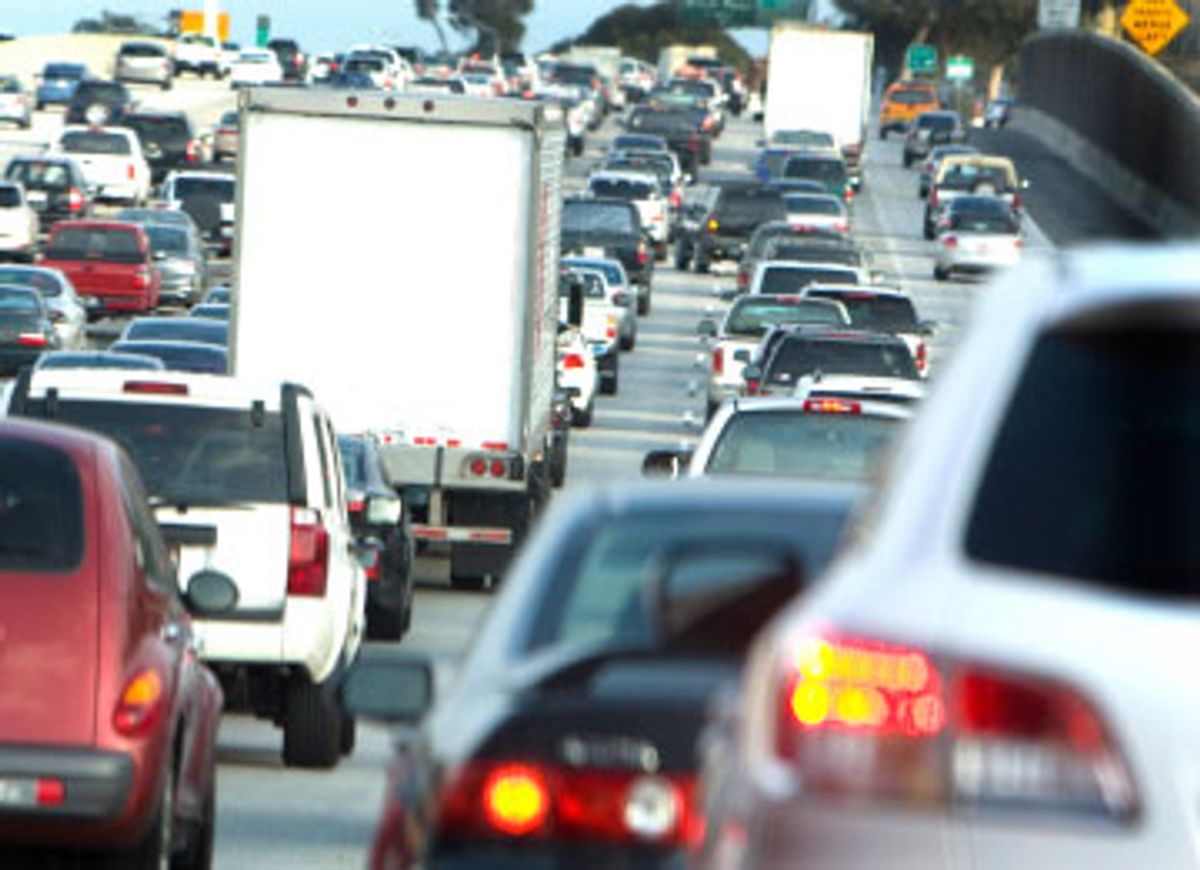
Tom Vanderbilt is telling me that he got the idea to write "Traffic: Why We Drive the Way We Do" while merging one day from the New Jersey Turnpike to the Pulaski Skyway. Should he tuck into the crowd as soon as the road sign says "Merge Right" and practice a "random act of kindness," or stay in his lane and dart onto the skyway at the last minute with the bold attitude, "Live free or die"?
Right now we're in his 2001 Volvo on the Brooklyn-Queens Expressway, merging onto the Belt Parkway, and I'm giving him a little bit of a hard time for driving as if he's caught somewhere between the bumper sticker and the New Hampshire state motto. As we approach the intersection, he lowers his speed, checks his side mirror, looks over his shoulder and tentatively accelerates onto the parkway.
"You have to be careful here," he says. "People come blazing out of the Battery Tunnel with an E-Z Pass and don't stop for you."
"I notice you didn't signal," I say.
"It's New York drivers. It's one thing I've observed from living here: They will not slow down. It's almost like you're taunting them. I was told in Boston that signaling is revealing your intentions to the enemy. It's the same here. You're better off not signaling."
That's a fun and smart insight and "Traffic" is full of them. Vanderbilt is a Brooklyn freelancer with a keen skill at delivering fresh perspectives on everyday things -- sneakers, public storage spaces, prefab houses -- in Wired, Slate and Artforum. His previous book, "Survival City," is a lively travelogue through American ghost towns -- bomb shelters, nuclear waste sites -- haunted by Cold War fever. For "Traffic," he disappeared for three years into the university warrens of road scholars, who, more than 125 years after the advent of the automobile, are legend. "There are people with entire academic careers devoted to off-ramps," he says.
Vanderbilt emerged from his road trips with the world's arcane professors of traffic with a narrative humming with vigorous facts. Did you know more people travel on Saturday at 1 p.m. than during typical rush hours? That only 16 percent of daily trips are to work? Where's everybody going? Given that Americans spend all the money they make, and bury their credit cards in debt to buy more things, "it should come as little surprise," Vanderbilt writes, "that much of our increase in driving stems from trips to the mall."
Perhaps most eye-opening is Vanderbilt's declaration that "the way we drive is responsible for a good part of our traffic problems." That's right, it's not what urban philosophers Lewis Mumford, Jane Jacobs, James Howard Kunstler and, well, my brother and I, in our 1993 book, "Where the Road and the Sky Collide: America Through the Eyes of Its Drivers," have been saying all along -- we are burning in traffic hell for our greedy sins of rampant urban sprawl.
No, what's gumming up the highways are hideously self-absorbed drivers who weave in and out of lanes -- creating a chain reaction of people stepping on the brakes -- desperate to get to some utterly inane appointment for which they think they can't be late. It's not that America has too many people and too few highways. Nearly 90 percent of our roads are not congested 90 percent of the time. Look at it this way: If one-fifth of solo drivers hitched a ride with neighbors or friends to the business park or mall, we'd be sailing along Happy Highway every day.
The tall and slender Vanderbilt, a rather soft-spoken scholar himself, doesn't resort to loud adverbs to make his points about congestion. In his book, he gives way to traffic behaviorist Alan Pisarski, who blames affluence for cities jammed with narcissists in BMWs. Congestion, Pisarski says, is "people with the economic means to act on their social and economic interests getting in the way of other people with the means to act on theirs."
By no means is Vanderbilt's book dry or boring. It's no mean feat to translate academic interviews and papers into prose that skates across the page. And Vanderbilt can rev up the tone when he wants to: "The problem is that if everyone tries to do what they think is the best thing for themselves, the actual travel time for all drivers goes up!"
To see some of Vanderbilt's ideas in action, and glimpse what traffic says about human "lines of desire," his nice phrase, I had the terribly original idea to go for a drive. Which is why we're weathering the late afternoon heat in his Volvo, motoring to Coney Island.
Cruising along the beltway's middle lane at a civil 50 mph, the speed limit, a Nissan Pathfinder speeds by us in the left lane, nearly drives up the back of a Volkswagen Golf, cuts less than a foot in front of us and straddles two lanes. Beneath Vanderbilt's Gary Cooper exterior, I see, stew a few driving resentments.
"I don't know what this person is doing using two lanes at once," he says. "I've always had a dislike of SUVs and now I have even more of one. When it comes to traffic flow -- harmony and the highway -- they take longer to go through intersections. And because of their size, they pose so many dangers to other drivers. That begs the question, 'What's the legal liability for near crashes?' What's the ethical burden of driving at 85 mph? To be honest, I could care less about what happens to the person choosing to do that. But he's putting every other person on the road at a risk. How do we charge for that as a society?"
Death on the highway is the most repressed nightmare in American life. The number of people killed on our roads is like Sept. 11 happening 13 times every year. We seldom discuss the carnage because we don't dare puncture the illusion of safety.
In "Traffic," Vanderbilt puts the fear in us by pulling together neurological studies that suggest our brains lack the power to process all the things happening on the road. We see what we expect to see, like a "Yield" sign on a familiar street. Replace it with a "Stop" sign and we'll drive right through it. Motorcycle riders best understand "inattention blindness," as they are nearly drilled daily by drivers who only "see" cars. Give Frappuccinos and iPhones to drivers and you have emergency rooms working nonstop.
In the Volvo, Vanderbilt puts it simply. "If we have trouble with decision-making in other areas of life, how can that not be a problem on the road, where we face numerous decisions every mile, coming at speeds we're not used to dealing with?"
I tell him I don't entirely accept the futility of neurological studies. After all, my brother and I, in our other book, "Zen Driving," argue that with practice we can learn to drive without preconceptions, as if every moment on the road is a discrete frame in a film, allowing us to be mindful and humble, aware and much safer drivers.
"Yeah," Vanderbilt says. I'm not sure, though, he's buying the Zen line. Besides, he's lost. "You would like to go to Coney Island, right? I'm sorry, we overshot it and we're actually in Brighton Beach."
We pull to the curb near a dead end and he punches letters into a portable GPS monitor on his dashboard. "All I need to do is type in 'Neptune Avenue.' All the streets here have funny nautical names. It says we're two minutes away. That's the danger with these things -- you lose your own sense of direction. Hmmm, why is it recommending we go this way? Oh, well." We cut across a cul-de-sac that says "Do Not Enter," make a sharp left turn and maneuver down lanes of brick row houses.
I remind Vanderbilt of a fact from "Traffic" that drivers on unfamiliar roads are 25 percent less efficient than they should be, and total mileage driven could be cut by 2 percent if they were shown the best routes. Although the GPS in this case doesn't seem to be helping.
"True," he says. "And being lost obviously corrupts your driving and makes you more stressful."
"I know it's hard to talk and drive at the same time," I say, trying to make him feel comfortable.
"The worry is it makes my driving worse. Plus I worry I'm giving you meandering quotes."
"Not at all," I say.
"Oh, I think I just went through a red light. Sorry about that. Maybe you shouldn't put that in the story," he says. We both laugh.
Finally we find a parking space and walk along the famous Coney Island boardwalk, past Nathan's, the giant yellow hot dog palace, and the old wooden Cyclone roller coaster. I've never been here and am duly charmed by the amusement park's faded glory, the sense that time here stopped in the 1930s. Except for all the sunbathers with iPods.
Vanderbilt and I talk about how people, cloaked in the anonymity of their cars, exhibit the worst human traits. Like readers hiding behind pseudonyms online, self-importance inflates through the roof, social convention vanishes, and naked aggression rules. Vanderbilt confirms that recent studies show that drivers are fueled by ancient parts of the brain where instructions to hunt and kill reside. At the same time, it's true that in some metropolitan areas, where road architects have managed to keeps speeds under 20 mph, and some drivers, notably in convertibles, make eye contact with other drivers and pedestrians, the streets can be home to a modicum of decorum.
One of those areas, however, doesn't appear to be Brooklyn. As we leave the beach in the Volvo, we approach a stoplight on a narrow street. Before we reach the intersection, we have to wait for a Geo Metro, which is backing into a parallel parking space. Just then a Lincoln Town Car behind us blares the horn. "Why are you honking?" a bemused Vanderbilt asks aloud. "Can you not see the red light right here? Or see this guy trying to park? What am I going to do, move 10 feet?"
Gabbing through patches of stop-and-go traffic on the beltway, we make it back to Vanderbilt's Brooklyn apartment in about 25 minutes, having been cut off by a black Corvette and honked at only three times for going the speed limit. We park and walk to a bar, where we sit outside in the warm twilight. I tell him that in the 286 pages of "Traffic," I'm surprised he mentions the environmental impact of cars only in a couple of sentences near the end.
"Didn't you think the nasty thing that traffic is doing to our environment was important to include?" I ask.
"I didn't get into that because I felt it's been treated well elsewhere," he says. "Undoubtedly, there could be a million things to talk about. Emissions. The flood implications of land being given to parking. Wildlife not breeding because roads fragment their habitats. All that would require a number of pages, and I was asked to turn the book in at a certain length. But is anyone really disputing the environmental impact at this point? Do I even have to go there?" He pauses. "I can tell by the look on your face that I'm going to have to write an afterword to the paperback."
I laugh. I say it's important but I'm not sure it will make a difference to remind people of the environmental ravages of driving. If there's a single theme that emerges from his book, it's the pretty depressing one that people don't change.
By the end, he's expertly shown that despite being told for years that we can avoid traffic by planning our time better, that we can reduce congestion by not swapping lanes every 200 yards, and that we can stop killing our neighbors by not downing two martinis before commuting home, we still drive according to our lines of desire.
"Do you think you emerged from your research as a pessimist about human nature?" I ask.
"I guess so," Vanderbilt says. "Car companies had their problems with trying to skimp on safety in the '50s and '60s. But since then cars have gotten physically safer every year. But our behavior hasn't caught up. We are driving more and killing tens of thousands of people a year."
A woman pushes a stroller down the sidewalk in front of us. Guys on bikes pedal by. A Prius glides down the street. "Now I hear Chrysler wants to put Internet access in cars," Vanderbilt says. "We never seem to learn."
Shares