Barack Obama

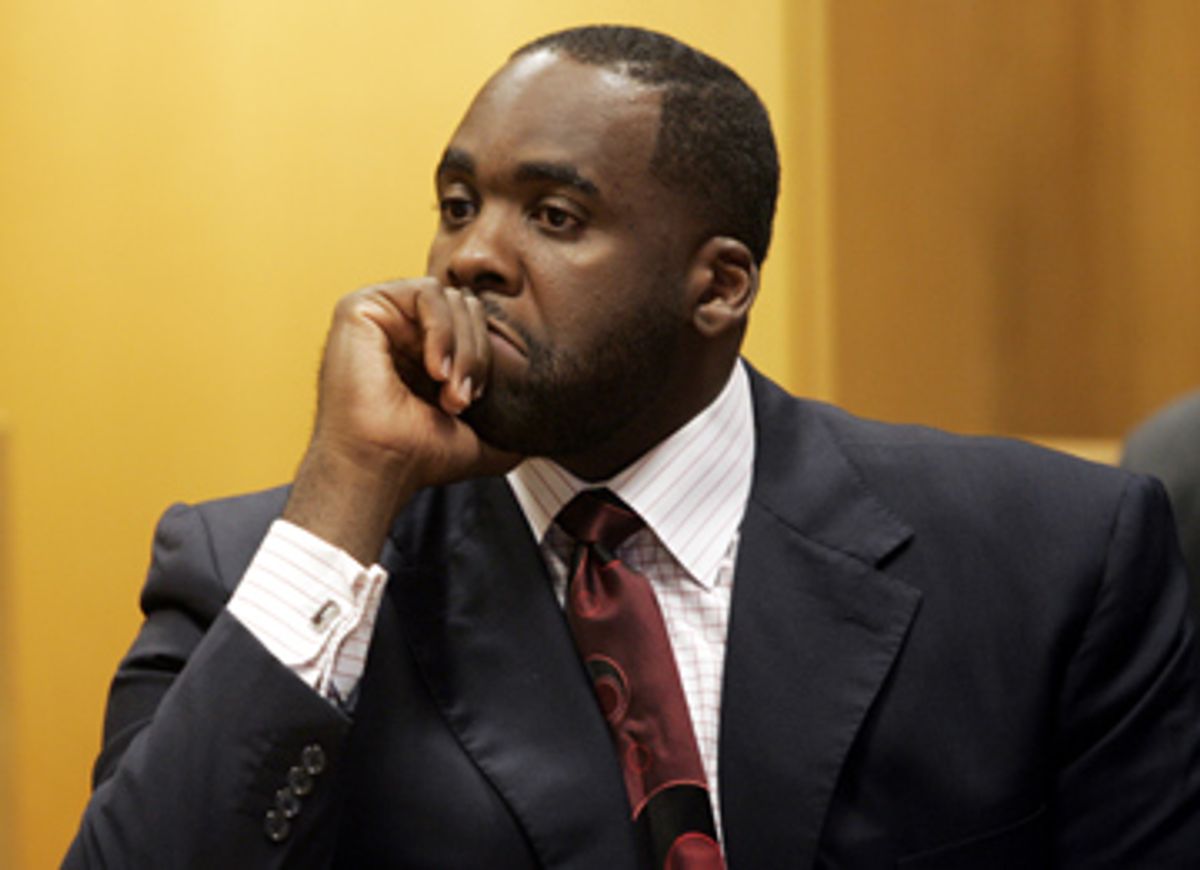
Kwame Kilpatrick exits, with Barack Obama holding the door

With the presidential race in Michigan too close for comfort, it can only help Obama that Detroit's racially divisive and felonious mayor has finally lost his job.

  • more
    • All Share Services

Topics: ,

Kwame Kilpatrick exits, with Barack Obama holding the door

Detroit Mayor Kwame Kilpatrick pleaded guilty to two felony counts of obstruction of justice on Thursday morning. Kilpatrick will forfeit his office and serve 120 days in jail, ending a scandal that began when the Detroit Free Press published raunchy text messages between Kilpatrick and his ex-chief of staff. Messages proving that, in spite of Kilpatrick’s testimony during a civil lawsuit, the pair had, in fact, been knocking boots.

As much as Detroiters are relieved to be rid of their lubricious, dissembling mayor, Barack Obama has to be even more relieved.

Last year, before addressing the Detroit Economic Club, Obama praised Kilpatrick as “a great mayor.” This year, he told the mayor to stay away from the Democratic National Convention. On Wednesday, as Kilpatrick apparently balked at accepting a plea deal, Obama issued a public statement asking him to resign. The longer Kilpatrick stayed in office, the more the Detroit-phobic white voters of Michigan were liable to ask, “If a black Democrat can’t run the city, how can one run the country?”

In 2008, with the economy in recession — in free fall in Michigan — this bluish-purple state, which hasn’t gone for a Republican presidential candidate since 1988, should be Obama’s for the taking. With Kilpatrick’s misbehavior dominating the local news on every TV station in a metro area that holds nearly half Michigan’s population, he’s barely leading: A recent Detroit News poll has him beating McCain 43-41.

Ever since the 1967 riot sent hundreds of thousands of whites in a great migration across 8 Mile Road — the city limit, and the symbolic border between black and white Detroit — the city and its suburbs have coexisted as uncomfortably as Soweto and Johannesburg.

It was pollster Stanley Greenberg who discovered Detroit’s white exiles resettled, but still seething, in Macomb County, and gave them the Linnaean name “Reagan Democrats.” The original Reagan Democrat, circa 1980, was a blue-collar voter who abandoned his native party over antiwar protests, busing, affirmative action and welfare queens. Some Reagan Democrats were from an Appalachian background, their forebears having moved north for auto factory jobs. Many were ethnics, white Catholics whose ancestors had come to America long after slavery was abolished. Neither strain had much patience with white guilt, many were stung by Michigan’s industrial implosion, as those factory jobs disappeared, and all were outraged by a court decision ordering cross-district busing to integrate their children’s schools. (It was overturned by the Supreme Court.) They were also horrified at Detroit’s transformation into the original New Jack City. Thanks to drug outfits like the Chambers Brothers and Young Boys Inc., the city had the highest murder rate in the nation.

During Greenberg’s first trip to Macomb County, at the height of the Reagan years, he found that whites “expressed a profound distaste for black America, a sentiment that pervaded almost everything they thought about government and politics. Blacks constituted the explanation for their vulnerability and for almost everything that had gone wrong in their lives.”

And now, for the last eight months, the local news emanating every day from this black city to its white suburbs has featured the legal, sexual and administrative misadventures of a black mayor who doesn’t just play the race card, he is the race card.

Kilpatrick’s legal and political problems stemmed from his testimony in a lawsuit by former Deputy Police Chief Gary Brown. Brown claimed he was fired in 2003 for testifying in an investigation into a wild party with strippers at the mayoral mansion, in which Kilpatrick’s wife allegedly physically attacked one of the strippers. During the trial, Kilpatrick swore he never had a romantic relationship with his chief of staff, Christine Beatty. But in January, the Detroit Free Press published these booty text-messages:

Kilpatrick: “And, did you miss me, sexually?”

Beatty: “Hell yeah! You couldn’t tell. I want some more.” Kilpatrick had already settled the suit for $8.4 million and cut a side deal with the ex-cop’s lawyer to keep the texts secret, so he really had to feel burned by the press.

Last month, Kilpatrick spent a night in jail after violating his bond by crossing the Canadian border to Windsor, Ontario, on city business. The mayor has also been charged with assault for allegedly shoving a sheriff’s deputy who tried to serve a warrant at his sister’s house. For a time, he wore an electronic tether, confining him to metro Detroit.

Kilpatrick is an odious politician, but he’s only a symptom of Detroit’s problems — a monster created by the racial estrangement between urban blacks and suburban whites. Kilpatrick kept himself in office by exploiting Detroit’s tensions, cleverly maneuvering on a political landscape that was in place before he was born.

After the scandal broke, Kilpatrick used his State of the City address to drop the N-bomb. “In the past thirty days, I’ve been called a nigger more than any time in my entire life,” he claimed. It didn’t work. The City Council asked him to resign.

Kilpatrick refused to go, so the council asked Gov. Jennifer Granholm to step in. As governor, Granholm has the power to remove shady officials from their posts. As a white Democrat, Granholm was reluctant to yank the black mayor of a city whose voters provide her party’s margin of victory. But she was even more reluctant to allow Kilpatrick’s shenanigans to inflict more bruises on downtrodden Detroit — and possibly scuttle Obama’s campaign in Michigan. On Wednesday, she convened the removal hearing that finally forced Kilpatrick’s hand.

Kilpatrick became mayor in January 2002 at age 31, winning his office the old-fashioned way — through nepotism. The son of U.S. Rep. Carolyn Cheeks Kilpatrick — who nearly lost this year’s primary because of her son’s scandals — he defeated elderly city councilman Gil Hill, a former police detective who gained fame for playing Eddie Murphy’s boss in the “Beverly Hills Cop” movies.

By his reelection campaign in 2005, Kilpatrick already had his head on the chopping block. His 300-pound ex-footballer’s frame, his chalk-striped suits and his diamond earrings had earned him the nickname “The Hip-Hop Mayor.” Kilpatrick had alienated voters by leasing a $25,000 Lincoln Navigator on the city’s dime and traveling with a Caesarian security detail. He allegedly used a city card to charge champagne and spa massages.

Whites are only one-sixth of the Detroit electorate. The election was a battle between the bourgeois blacks west of Woodward Avenue, who disdained Kilpatrick, and the poor blacks on the East Side, for whom he was a hero.

Kilpatrick escaped from the 2005 primary with 27 percent of the vote. But his opponent in the general election, an all-Democratic runoff, had a fatal handicap. Former Deputy Mayor Freman Hendrix had come in first in the primary with 44 percent of the vote, almost enough to prevent the runoff. But Freman wasn’t his first name. It was Helmut, a moniker given him by his mother, an Austrian Army bride named Rudolfine Ernegger. Kilpatrick knew how to play the Oreo card. His supporters took out an ad in the Michigan Chronicle, Detroit’s black newspaper, asking voters to “Just say ‘no’ to the suburban raiders and their puppet Helmut Hendrix (a.k.a. Freman).” Kwame’s father, Bernard “Killer” Kilpatrick, compared his son’s critics to Nazis. On Election Day, the mayor skunked the pollsters with a 6-point win.

It was a racist campaign, but it also played on the pride of black Detroiters. They relish their control over City Hall and the regional water supply (the Detroit Water and Sewerage Department serves all of southeastern Michigan), and are adamant that suburbanites have no right to reclaim what they abandoned.

“There’s still a fear that the whites will come back and they’ll take over the city, they’ll take over the water department,” a man from the West Side told me as I covered the campaign in 2005. “People say, ‘We stayed. We suffered through the city for 40 years. The whites fled. Why should they come in and reap the benefits?’”

The whites are unlikely to return. If anything, they’d like to jackhammer 8 Mile and replace it with razor wire. Earlier this year, Greenberg went back to Macomb, where he found Obama “underperforming” among its tradition-minded Democrats. John Kerry lost the county by 1 point, but Obama was trailing McCain 46-39. Only 71 percent of Democrats were ready to vote for him, versus 85 percent of Democrats nationwide.

This time around, Greenberg found that voters still resented government aid to blacks. Presented with Robert F. Kennedy’s statement that America has a “special burden” to help blacks, they responded, “Get over it” and “Didn’t they get forty acres and a mule? That’s more than I got.” But they also distinguished Obama from black leaders like Al Sharpton and Jesse Jackson, who were disdained as demanding troublemakers. This time, Macomb County voters were far more concerned about the economy than about blacks, although there was a hint that Kilpatrick could revive the racial rivalry.

“Welfare, crime, reverse discrimination, blacks and Detroit were never mentioned in the discussion of why the country and state are off track, except for some asides about Detroit’s pathetic mayor,” Greenberg wrote. Obama’s soft support in Macomb was more a matter of hesitation than resistance. Voters wanted assurance that Obama won’t put black interests above white interests, that he’ll work to keep blue-collar jobs in America, and that his exotic name and background won’t prevent him from fighting terrorism. Race played a role in some of those concerns. But the poll also demonstrated that white, blue-collar voters are the toughest sell in any election: Resolutely middle class, they’re skeptical of both elites and the poor, and they don’t worship at the altar of either party.

Macomb County has come to stand for white backlash against black Detroit, but it’s unfair to single out one suburb. Northwest of the city is tony Oakland County, home to Big Three execs. For years, Oakland’s county executive, L. Brooks Patterson, has campaigned to bring back the death penalty, even though Michigan abolished it in 1846.

Patterson has been outspoken about Kilpatrick’s drag on the Democratic ticket.

“Every day Kwame is in trouble, every day he puts on that tether, every time they march him to jail is a day the Democrat Party loses favor with the voting public,” he told the Detroit News.

Livonia, just west of Detroit, is America’s whitest city with over 100,000 people. On the day Kilpatrick was reelected, Livonia voted to detach itself from the regional transit system.

I once put it to a woman from Livonia that Detroit is the entire state’s responsibility. If Detroit fails, I said, Michigan fails. She seemed taken aback.

“I … I don’t know what to say to that,” she responded.

Plenty of suburbanites believe the blacks ruined Detroit, and that Kilpatrick is only the latest avatar of their misrule.

“I wouldn’t move back to Detroit even if you gave me a free house,” I heard from a white riverboat captain who’d grown up on, then fled, the city’s southeast side. “The garbage never gets picked up. Dennis Archer” — Kilpatrick’s predecessor, seen as a bridge builder between city and suburb — “is the only decent mayor Detroit ever had.”

The fact is, Detroit is hardly a city anymore. The whites have skedaddled to the north, west and south. They took the department stores, the basketball team, the middle-class jobs, the theaters and the concert halls, and prevented the blacks from building a train system to chase after them. Detroit can only become a city again by following the examples of Toronto and Indianapolis, and consolidating the old urban core with the suburbs. That’s not likely to happen: The whites would complain about sharing tax dollars, the blacks about sharing power. Detroit and its suburbs will continue to revolve around each other like twinned planets, one black, one white, never touching, but never able to break free into broader orbits.

No city needs Obama’s message of racial reconciliation more than Detroit. But he can’t win the presidency without Michigan. With Kilpatrick gone, it’s less likely that Detroit’s divisions will cause his defeat.

Continue Reading Close

Please don’t kill me, Obama

Why I created a petition for the president to create a "do not kill" list -- and why you should sign it

  • more
    • All Share Services

Topics: ,

Please don't kill me, Obama (Credit: AP)

In the trio of unalienable rights outlined in the Declaration of Independence, the reason “life” was listed first should be obvious: If you aren’t alive, you can’t have liberty or pursue happiness (or much of anything else, for that matter). That’s why this week’s revelations about President Obama personally overseeing a “Kill List” is so significant — the president’s extralegal actions undermine the very right from which all other rights exist. And it’s why I launched an official White House petition asking the president to create a “Do Not Kill” list that would at least allow Americans to protect themselves from being deprived of their lives at the hand of the president.

Following the lead of other government-administered lists like the “Do Not Call” list and the “No Fly” list, the petition’s proposal is straightforward. It reads:

The New York Times this week reports that President Obama has created an official “Kill List” that he uses to personally order the assassination of American citizens. Considering that the government already has a “Do Not Call” list and a “No Fly” list, we hereby request that the White House create a “Do Not Kill” list in which American citizens can sign up to avoid being put on the president’s “Kill List” and therefore avoid being executed without indictment, judge, jury, trial or due process of law.

Sadly, the need for the government to create a “Do Not Kill” list is no longer theoretical. As the Times (and other media) have reported, the president ordered the execution of American citizen Anwar al-Awlaki without so much as charging him with a single crime, much less convicting him of one. The Times reports that in doing so, the Obama administration issued a memo claiming that the Fifth Amendment’s guarantee of due process (i.e., a right to formal charges and a trial by a separate co-equal branch of government) can now “be satisfied by internal deliberations in the executive branch.” As if underscoring the extrajudicial nature of the actions, even the memo remains secret.

Today, this kind of execution has become the norm. According to the Times, since the al-Awlaki killing, the White House now convenes “Terror Tuesday” meetings attended by various agency officials and President Obama’s top reelection strategist, David Axelrod. These meetings are specifically focused on deciding which American citizens and foreigners will next face due-process-free assassination. The newspaper additionally reports that the administration’s official rationale is that anyone the president orders killed is, by definition, “up to no good.” As Philadelphia Daily News columnist Will Bunch notes, that’s the same word-for-word rationale George Zimmerman used to justify hunting down Trayvon Martin.

This all underscores why we need a “Do Not Kill” list — and thanks to the White House’s new petition system, there’s a chance we can make that a reality. If we get 25,000 signatures, the administration will have to consider the proposal and issue a public response to it. I hope everyone reading this will click here to sign the petition, forward it on to your friends, post it on your Twitter feed and post it on your Facebook page.

If we want the most unalienable of rights to survive, we must speak out now and force the president to at least give us one way to avoid his execution orders.

Continue Reading Close
David Sirota

David Sirota is a best-selling author of the new book "Back to Our Future: How the 1980s Explain the World We Live In Now." He hosts the morning show on AM760 in Colorado. E-mail him at ds@davidsirota.com, follow him on Twitter @davidsirota or visit his website at www.davidsirota.com.

Obama’s next line of attack

He's moving on to Romney's Mass. record; Scott Walker's defense fund; and Thursday's other top political stories

  • more
    • All Share Services

Topics: , ,

Obama's next line of attackPresident Barack Obama points to the audience as he and first lady Michelle Obama leave the stage after a Memorial Day ceremony at the Vietnam Veterans Memorial Wall to commemorate the 50th anniversary of the Vietnam War, Monday, May 28, 2012, in Washington. (Credit: (AP Photo/Carolyn Kaster))

- 47th out of 50 in job creation: That’s what the Obama campaign wants you to know about Mitt Romney’s record as governor of Massachusetts. Chicago is rolling out a new line of attack against the Republican today, focusing on his tenure in the Bay State. Like its previous campaign against Bain, the Mass. attack features a website and video that include interviews with lawmakers who served with Romney criticizing his record in the state.

The campaign has also organized a press conference with Massachusetts lawmakers that will take place on the steps of the statehouse in Boston later today. Obama political svengali David Axelrod will be on hand.

- Scott Walker pours in more cash to legal defense fund: Wisconsin Gov. Scott Walker and his staff have been under a “John Doe” investigation for three years looking into his time as county executive in Milwaukee. And just ahead of next week’s recall election, the governor transferred $100,000 to his legal defense fund from his campaign account. The two transactions of $70,000 and $30,000 are a major escalation from Walker’s camp, which has so far tried to pretend the probe does not exist.

- Walker and Democrat Tom Barrett face off in final debate: With the recall election on Tuesday, tonight’s debate will be one of the last chances for the candidates to sway undecided voters — if there are any left in the state.

Democratic Governors Association (DGA) chairman Martin O’Malley, the governor of Maryland and an early favorite for the 2016 Democratic presidential nomination (seriously), will campaign for Barrett today, according to the DGA. But the race is not looking great for Democrats, as a new poll shows Barrett down 7 points. The RNC says it is “very confident” about the race.

- Chamber pulls trick to hide donors to campaign ads: Faced with a court ruling that would make them disclose the funders behind their political ads, the U.S. Chamber of Commerce — which plans to spend more than $50 million during the 2012 election cycle — has announced they will merely tweak their ads’ content to get around the disclosure order. “By changing the focus of its ads to specifically support or oppose candidates, it will not have to disclose any of its donors,” the Washington Post’s Dan Eggen reports.

While the move will prevent the Chamber from disclosing, some watchdog groups think it may help Americans understand just how political the Chamber has become. Unlike local chambers of commerce, the U.S. Chamber is essentially is an independent GOP electioneering outfit, not unlike Karl Rove’s Crossroads groups.

- Is Mitt Romney too hawkish for Henry Kissinger?: The former secretary of state has failed to endorse Romney, like other top Republican foreign policy figures. The New York Times reports: “As Republican leaders fell in behind Mr. Romney this spring, many members of the party’s foreign policy establishment have been more muted. Reluctance by this group to come forward for Mr. Romney more quickly reflects an unease over some of his positions, including his hard line on Russia and opposition to a new missile treaty … [and] Mr. Romney’s aggressive statements on trade policy toward China.”

- Mitch McConnell has made his picks: The Senate minority leader has selected which Senate races he thinks will help him become the Senate majority leader, telling Roll Call:

The Senator said he sees three different levels of competitiveness in 2012 races where his party could add seats. The races that represent the best chance for GOP pickups are the open seat in North Dakota, Sen. Jon Tester’s (D) very competitive race in Montana, the open seat in Nebraska, Sen. Claire McCaskill’s (D) uphill re-election bid in Missouri and the marquee matchup between former Govs. Tim Kaine (D) and George Allen (R) in Virginia.

McConnell’s “tier two” races include Sen. Sherrod Brown’s reelection effort in Ohio and the open seats in Wisconsin, New Mexico and Hawaii.

Then there are states less likely to lead to GOP pickups this cycle. “Maine, Pennsylvania, Florida are examples of ones you take a look at later,” said McConnell, who was chairman of the National Republican Senatorial Committee in the 1998 and 2000 cycles. “Sorta see what develops.”

Meanwhile, Bloomberg reports that Senate Democrats are being outspent three-to-one by super PACs on TV ads.

- Senate candidate defends call for national “birther office”: Former congressman Pete Hoekstra, who is now challenging Sen. Debbie Stabenow, D-Mich., defended yesterday his recent comments that the U.S. should create a national office to verify the birth certificates and other citizenship materials of candidates for federal office. Earlier this month, he criticized Sen. John McCain (R-Ariz.) for not making a bigger issue of President Obama’s birth certificate in 2008.

Yesterday, CNN’s Brooke Baldwin took the Senate hopeful to task for the comments, but Hoekstra stood by them, calling the birther office a “simple,” commonsense solution. He insisted his proposal had nothing to do with Obama, though acknowledged that, “For someone else, it might be about President Obama. So be it for them. For me, it’s not.”

Unlike lots of other birther candidates, Hoekstra should really know better. He served nine terms in the House and was even the ranking member on the Intelligence Committee (though Rep. Michele Bachmann (R-Minn.) is also on that committee, so… ). Hoekstra the Senate candidate is perhaps most well known for running an ad during the Super Bowl that featured a stereotypical representation of an Asian woman thanking Stabenow for sending jobs to China. The ad was produced by Fred Davis, the man behind the recently exposed proposal to run ads hitting Obama on his connection to Reverend Wright.

- Romneys collect cash poolside with CEO laying off thousands of workers: Romney is on a West Coast fundraising jaunt, including a stop at the home of Meg Whitman, the former California gubernatorial candidate who, as CEO of HP, announced recently that she was preparing to lay off as many as 30,000 workers. Whitman co-hosted a “poolside ‘ladies lunch’ Wednesday honoring his [Romney’s] wife at the Palo Alto home of Cisco Systems CEO John Chambers and his wife, Elaine.”

- VoteForEddie.com gets a website: An independent congressional candidate in Florida legally changed his name to his campaign website so his URL could appear on the ballot. Eddie Gonzalez, who says he has an innovative plan to lower energy prices, went before a Miami-Dade judge in January to rename himself “VoteforEddie.com.” But in that case, shouldn’t his website instead be VoteForVoteForEddie.com?

Continue Reading Close

Alex Seitz-Wald is Salon's political reporter. Email him at aseitz-wald@salon.com, and follow him on Twitter @aseitzwald.

Obama’s Iran charade

The shrill, militaristic Manichean worldview that brought us the Iraq war is gone -- except when it comes to Iran

  • more
    • All Share Services

Topics: ,

Obama's Iran charadeThe main reactor at the Bushehr nuclear facility in Iran. (Credit: Reuters/Raheb Homavandi)

The nuclear summit that concluded last week between Iran and six world powers was a ridiculous charade. The Obama administration never intended it to succeed. Its sole purpose was to placate hawks in U.S. Congress, ensure that Democratic donors keep writing checks during election season, and buy another month of time during which Israeli Prime Minister Benjamin Netanyahu will not be able to bomb Iran. In the meantime, American drivers can sit back and enjoy more $4-per-gallon gas.

The talks failed because the U.S. and the rest of the P5+1 (Russia, China, Britain, France and Germany) refused to take yes for an answer. The key issue on the table was Iran’s accumulation of uranium enriched to 20 percent – not a high enough level to make a nuclear weapon, but close enough that it would be much easier for Tehran to do so. Iran made it clear that it was prepared to stop enriching to 20 percent and to even ship its stockpile of enriched uranium out of the country, if the U.S. and the other powers agreed to relax the draconian sanctions they have imposed on the country.

This deal would have been a major diplomatic breakthrough. It would have greatly reduced Iran’s capacity to develop a nuclear weapon, defused tensions in the region, calmed the oil markets, driven prices at the pump down and made it impossible for Netanyahu to attack Iran. In a presidential campaign as tight as this one, a significant drop in gas prices could be the difference between Obama being reelected and Romney defeating him. So why didn’t the Obama administration take the deal?

The ostensible reason, piously mouthed by Secretary of State Hillary Clinton, is that the U.S. believes that the upcoming, even harsher round of sanctions on Tehran will generate even further concessions. According to this line of reasoning, Iran only came to the bargaining table because of sanctions, and more sanctions will produce better results.

But this justification is transparently false. First, Iran has made it clear again and again that it will never allow itself to be seen as folding under U.S. pressure. It is prepared to negotiate, but successful diplomacy requires not just sticks but carrots. The carrot the P5+1 offered at Baghdad was ridiculous: If the Iranians agreed to suspend 20 percent enrichment, what they would receive in return was not a reduction in sanctions, but rather spare aircraft parts. For Tehran, accepting this deal would have been tantamount to surrendering. As Iranian analyst Hasan Abadini said, “Giving up 20 percent enrichment levels in return for plane spare parts is a joke.” These are not arcane diplomatic mysteries. As Iran expert Gary Sick pointed out in an interview on NPR, what it will take to reach a resolution of this issue is clearly understood by all the players involved. It is no more possible that the Iranians would have taken that deal than that the Palestinians would agree to establish their state in Jordan.

Second, Clinton’s argument that the Iranians will make more concessions begs the question: what concessions? The only remaining significant concession Iran could make would be to agree to give up enriching uranium altogether – and it has made it clear that it is never going to give up that right, which it is guaranteed as a signatory of the Non-Proliferation Agreement. In an interview with Washington Post columnist David Ignatius, former Iranian negotiator Seyed Hossein Mousavian made it clear that Iran would be prepared to give up 20 percent enrichment if its rights to enrich uranium were recognized.

All of this makes clear that the U.S. knew going into the negotiations that they were not going to succeed. The entire process was an elaborate ritual whose dual purpose was to inoculate President Obama against charges that he was “soft on Tehran” and to make it impossible for Netanyahu to go postal.

In fact, despite the conventional wisdom, it is extremely unlikely that the far-right Israeli leader will attack Iran. His constant threats to do so were the reason that Congress imposed the latest round of sanctions, against the Obama administration’s wishes. But despite Congress’s lockstep support for Netanyahu and anything he decides to do, up to and including an attack on Iran, it would be far too risky for Netanyahu to actually do it. The American people, unlike their bought-off, coerced and/or ideologically myopic political representatives, are sick of Middle East wars. Many, including increasing numbers of American Jews, are growing weary of Israeli intransigence and extremism. They’re also broke. An Israeli attack on Iran would draw in the U.S. and plunge the world into a depression – and the American people would hold Israel to account. Netanyahu may, as the former head of Israel’s spy service said, be “messianic,” but even he knows better than to jeopardize his country’s relationship with America. However, in order to manipulate America, it is essential that he constantly give the impression that he is about to attack Iran.

The Obama administration probably knows that Netanyahu is bluffing. But it has to play out this farce to placate Congress, keep pro-Israel Democrats writing checks, remove a Romney attack line and generally appear tough on Iran.

The irony is that the U.S. and Israel are always claiming that Iran uses negotiations over its nuclear program to play for time while it works feverishly to develop a bomb. But playing for time is precisely what the U.S. just did.

Obama is trying to run out the clock on Iran before the November election. He adroitly stalled the nuke-Iran hysteria that built up during the AIPAC conference in March, but he did so at a price, painting himself into a corner with tough rhetoric denying that containment of a nuclear Iran was an option and threatening to use military force. The negotiations in Baghdad had to fail in order for him to maintain that posture.

His strategy may work. He may stumble over the finish line in November, still dragging out negotiations. And he may overcome the serious headwind of high gas prices and beat Romney. But there is nothing good to be said about his weak and pandering approach. It will not stop the Iranian nuclear program, it is causing the Iranian people to suffer, and it hurts the average U.S. citizen. At bottom, it is an approach predicated not on achieving real progress in dealing with the Tehran regime but on overthrowing it. As such, it is antithetical to Obama’s proclaimed desire to reach out to Iran and to reset America’s relationship with the Middle East. In the long run, he will have to decide whether he really wants to continue a brinkmanship game that locks the U.S. into the self-defeating Middle East policies it pursued during the Bush years.

For the truth is that Obama’s Iran policy represents the last vestige of Bush-era neoconservative extremism. The moralistic, shrill, militaristic Manichean worldview that brought us the “Axis of Evil” and the Iraq war is gone – except when it comes to Iran.

Obama’s schizoid foreign policy – extreme and ideological on Iran, pragmatic and flexible everywhere else — was brought into sharp relief this week. Even as the Baghdad summit broke down, events elsewhere in the Middle East and South Asia demonstrated the utter failure of Bush’s approach – and provided a cautionary warning to Obama of the follies of continuing it with Iran.

Start with Iraq, where Bush’s nine-year-long military adventure is coming to an inglorious end. That unprovoked invasion was supposed to bring an end to an evil regime and transform the Middle East – the same reasons neocons now give for attacking Iran. It left an ethnically fractured, horribly wounded land in the grip of a strongman that is just now emerging from a nightmarish civil war and is still plagued by sectarian violence and terrorism. Our moral responsibility predates the war: America’s crippling pre-war sanctions devastated Iraq’s entire society, and they were one of the reasons why it was so difficult to rebuild it. Congressional proponents of sanctions against Iran should take note.

Then there’s Afghanistan, where after 11 agonizing years we have essentially given up. Afghanistan has proven beyond the shadow of a doubt that even a superpower cannot always succeed in imposing its will, that cultural and anthropological differences are critical, and that trying to combine nation building and counterinsurgency in one of the most backward and impoverished places on Earth is a recipe for disaster. The best we can hope for now is that not too many more U.S. troops are shot dead by the Afghans they are training – and that the Taliban does not roll into Kabul the moment we roll out.

Next there’s Syria, where an appalling regime is locked in a brutal struggle with a murky opposition and where all the options are so bad that we have no choice but to remain on the sidelines.

Finally, there’s Egypt, where a nascent democracy is fighting to be born. Everything about this inspiring, painful and threatened revolution, culminating in this week’s elections, was generated by the Egyptian people themselves. America had nothing to do with it. Contrary to claims made by Bush apologists, the appalling example of Iraq was actually a disincentive to throw off Mubarak’s tyranny. As for the rise of the Muslim Brotherhood, that dire event so feared by neoconservatives and Islamophobes, they may turn out to be the stable, conservative, don’t-rock-the-boat party.

The lessons these different situations hold for our dealings with Iran are very simple. First, we have far less ability to control what happens in the Middle East than we think. In Iraq and Afghanistan, we tried to impose our will directly and failed. In the other two, we either do not have the ability to intervene (Egypt) or the risks of doing so would be too high (Syria). Second, none of these situations are susceptible to the kind of good-and-evil moralizing that characterized Bush’s approach to the Middle East. Individually they are incredibly complex, and as a whole they are even more complex. There is no simple way to approach any of them. Basing our policy toward them on a Manichaean, good guys vs. bad guys worldview is self-defeating. Bashir Assad is a bad guy, but if we sided with the rebels, we could unleash a civil war even more catastrophic than the one going on now. Some of the Salafis in Egypt may be planning to ban beer and abrogate the Camp David treaty, but if we tried to prevent them from taking power, we would be thwarting the will of those Egyptian people who want those outcomes. Nouri al-Maliki may be a sectarian thug, but the alternative could be worse. Hamid Karzai may be a corrupt, drug-addled charlatan, but he’s the guy who’s there.

And so on, down the list, from Pakistan to Hamas to Netanyahu to Libya. The real world, as opposed to the black-and-white world of the neocons, is all about complexity, grey areas, compromises, diplomacy, flexibility. It’s about accepting that America will have to deal with regimes that do not toe our line. It’s about realizing that our soft power is more effective than our military power. It’s about putting down the Big Stick and trying to actually listen to what the people in the region are saying. It’s the opposite of the Bush Doctrine.

Obama knows this, but the dead hand of neoconservative ideology still drives his Iran policy. Until he shakes it off and accepts that Iran is a regional power and must be dealt with realistically, even though it does not always share our interests, his Middle East policy will continue to resemble that of his predecessor.

Continue Reading Close

Gary Kamiya is a Salon contributing writer.

Obama campaign raps Romney on Trump rhetoric

McCain has yet to speak out against "Birthers"

  • more
    • All Share Services

Topics: , ,

Obama campaign raps Romney on Trump rhetoricRepublican presidential candidate, former Massachusetts Gov. Mitt Romney, looks out the campaign charter airplane window during the flight between San Diego and Hayden, Co., Monday, May 28, 2012. (AP Photo/Mary Altaffer)(Credit: AP)

WASHINGTON (AP) — President Barack Obama’s re-election campaign is releasing a television advertisement accusing Mitt Romney of failing to stand up to “the voices of extremism” in his party.

The ad was released Tuesday as Romney was poised to clinch the Republican presidential nomination in the Texas primary. It takes the former Massachusetts governor to task for failing to speak out against real estate mogul Donald Trump, a supporter who has consistently charged that Obama is not a U.S. citizen.

The commercial opens by showing 2008 nominee John McCain brushing aside a woman who raised the citizenship issue at a town hall-style meeting, and asks, “Why won’t Mitt Romney do the same?”

A Romney aide is shown telling a TV interviewer that “a candidate can’t be responsible for everything a supporter has said.”

Guess who’s coming to dinner?

George and Laura Bush dine with the Obamas

  • more
    • All Share Services

Topics: , ,

Judy Gold

Emmy Award-winning actress and comedian Judy Gold is best known as the star of her two critically acclaimed off-Broadway shows, "The Judy Show - My Life As A Sitcom," and "25 Questions For A Jewish Mother." Judy has had her own comedy specials on HBO, Comedy Central and Logo. She appears regularly on Tru TV's World"s Dumbest. Check out www.JudyGold.com and follow her on Twitter at @JewdyGold.

Page 1 of 587 in Barack Obama