Democrats and Republicans are blaming accountants for Wall Street's woes. They are wrong.
Reuters/Kevin Lamarque
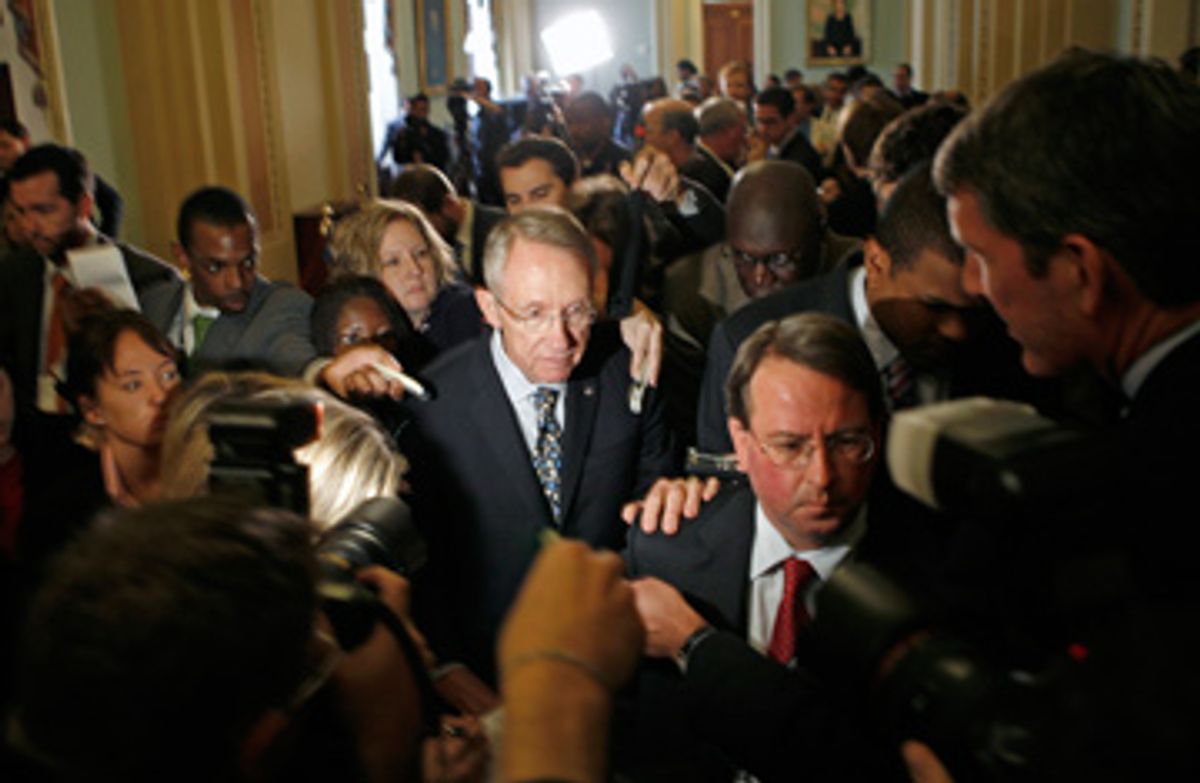
Senate Majority Leader Harry Reid is surrounded by reporters in the Capitol in Washington October 1, 2008.
When a bunch of hardcore House Republican conservatives denounced “mark-to-market” accounting during the debate on the bailout bill on Monday, I was disposed to dismiss the gambit as just another example of free market ideologues carrying water for the corporate sector. But now that I see that suspending “mark-to-market” or “fair value” accounting is also part of an alternative fix-it plan proposed by liberal Democrat Peter DeFazio, D-Ore., and the SEC is making noises about letting financial institutions be more flexible in how they interpret the rule, it is clearly time to take a second look.
And I still think it stinks.
In a nutshell, fair value accounting requires corporations to value their assets according to the current market price. This is great for financial institutions when markets are booming — they can book all kinds of profits without ever having to actually sell anything. But it is dismal when markets crash, and toxic, risky assets suddenly get priced by the market at rock-bottom levels.
Now that there is essentially no appetite for risky mortgage-backed securities, collateralized debt obligations, and other exotic derivative fare, Wall Street is telling us, hey, how about we suspend the rules, and value all this stuff at the price it would fetch, say, a few years from now, when markets recover and the credit crunch is nothing more than a bad dream?
OK — there is a legitimate issue buried here. I asked University of Oregon economist Mark Thoma, who keeps track of the state of economic thinking on the relevant issues of the day better than anyone I know, whether there was a basis to the sudden upswell of criticism of mark-to-market accounting. Here’s what he told me:
“One way to think about it is that when there is market failure of some sort that is temporary, values will be distorted during that time period and will not reflect the true value at maturity.
…I think the idea is that when the market is in a bubble, marking to market (instead of to fundamentals…) inflates the asset values, and that drives further demand, raises the values, and thus chases price upward.
If the price were marked to fundamentals instead, then the value of the asset wouldn’t follow the market up, and that would have a stabilizing effect relative to the mark-to-market approach.
Now they are making the same argument on the other side. The true, fundamental values are different from the values we see today, so, it’s like a negative bubble in that sense. Prices chase values down, this becomes self-reinforcing, and makes the problem worse. If prices held at their fundamental values, then there would be more stability.”
So, mark-to-market accounting contributes both to credit bubbles, which no one on Wall Street ever complains about because they are too busy raking in the cash, and credit busts, at which point, Something Must Be Done.
There’s just one big fat honking problem. If mark-to-market rules are suspended, what replaces them? Surely we don’t trust the owners of these risky assets to decide for themselves what they’re worth?
From the SEC’s “Clarifications on Fair Value Accounting,” released Sept. 30:
Can management’s internal assumptions (e.g., expected cash flows) be used to measure fair value when relevant market evidence does not exist?
Yes. When an active market for a security does not exist, the use of management estimates that incorporate current market participant expectations of future cash flows, and include appropriate risk premiums, is acceptable.
Internal assumptions! Never mind what the market says, we’ll just trust you to figure it out for yourselves, boys, because we know you would have no reason to lie about something as immaterial as the state of your own finances!
The attempt by members of both parties to suspend “fair value” accounting is outrageous. Despite Republican claims to the contrary, the United States is not facing a severe financial crisis because of accounting issues. The crisis was created by investors who made huge bets with borrowed money on risky loans and complex derivatives that they did not understand and that blew up in their face when the housing market collapsed. The crisis was created by greedy fools who blithely sold insurance against the possibility of anything bad happening to these securities, without ever dreaming that they might actually have to pay up. The crisis was created by politicians who explicitly made sure that these bond-default insurance policies — credit default swaps — were unregulated.
Don’t blame the accountants. Listen to them: (Compiled by Calculated Risk.)
“Suspending mark-to-market accounting, in essence, suspends reality.” — Beth Brooke, global vice chair at Ernst & Young LLP, WSJ, Sept 30, 2008
“Blaming fair-value accounting for the credit crisis is a lot like going to a doctor for a diagnosis and then blaming him for telling you that you are sick.” — analyst Dane Mott, JPMorgan Chase & Co., Bloomberg
“Suspending the mark-to-market prices is the most irresponsible thing to do. Accounting does not make corporate earnings or balance sheets more volatile. Accounting just increases the transparency of volatility in earnings.” — Diane Garnick, Invesco Ltd., Bloomberg
The just released draft of the Senate bailout bill, a 451-page monstrosity, includes a provision expressly giving the SEC authority to suspend mark-to-market accounting.
The secret to making American workers competitive
Despite GOP claims, big business won't bring us more and better jobs. Obama should outline how the government will
(Credit: AP)
Who should have the primary strategic responsibility for making American workers globally competitive – the private sector or government? This will be a defining issue in the 2012 campaign.
In his State of the Union address, President Obama will make the case that government has a vital role. His Republican rivals disagree. Mitt Romney charges the president is putting “free enterprise on trial,” while Newt Gingrich merely fulminates about “liberal elites.”
American business won’t and can’t lead the way to more and better jobs in the United States. First, the private sector is increasingly global, with less and less stake in America. Second, it’s driven by the necessity of creating profits, not better jobs.
The National Science Foundation has just released its biennial report on global investment in science, engineering and technology. The NSF warns that the United States is quickly losing ground to Asia, especially to China. America’s share of global R&D spending is tumbling. In the decade to 2009, it dropped from 38 percent to 31 percent, while Asia’s share rose from 24 to 35 percent.
One big reason: According to the NSF, American firms nearly doubled their R&D investment in Asia over these years, to over $7.5 billion.
GE recently announced a $500 million expansion of its R&D facilities in China. The firm has already invested $2 billion.
GE’s CEO Jeffrey Immelt chairs Obama’s council on work and competitiveness. I’d wager that as an American citizen, Immelt is concerned about working Americans. But as CEO of GE, Immelt’s job is to be concerned about GE’s shareholders. They aren’t the same.
GE has also been creating more jobs outside the United States than in it. A decade ago, fewer than half of GE’s employees were non-American; today, 54 percent are.
This is all good for GE and its shareholders, but it’s not necessarily good for America or American workers. The Commerce Department says U.S. based global corporations added 2.4 million workers abroad in first decade of 21st century, while cutting their U.S. workforce by 2.9 million.
According to the New York Times, Apple Computer employs 43,000 people in the United States but contracts with over 700,000 workers abroad. It makes iPhones in China not only because of low wages there but also the ease and speed with which its Chinese contractor can mobilize their workers – from company dormitories at almost any hour of the day or night.
An Apple executive says “We don’t have an obligation to solve America’s problems. Our only obligation is making the best product possible.” He might have added “and showing a big enough profits to continually increase our share price.”
Most executives of American companies agree. If they can make it best and cheapest in China, or anywhere else, that’s where it will be made. Don’t blame them. That’s what they’re getting paid to do.
What they want in America is lower corporate taxes, less regulation and fewer unionized workers. But none of these will bring good jobs to America. These steps may lower the costs of production here, but global companies can always find even lower costs abroad.
Global corporations — wherever they’re based — will create good jobs for Americans only if Americans are productive enough to summon them. Problem is, a large and growing portion of our workforce isn’t equipped to be productive.
Put simply, American workers are hobbled by deteriorating schools, unaffordable college tuitions, decaying infrastructure and declining basic R&D. All of this is putting us on a glide path toward even lousier jobs and lower wages.
Get it? The strategic responsibility for making Americans more globally competitive can’t be centered in the private sector because the private sector is rapidly going global, and it’s designed to make profits rather than good jobs. The core responsibility has to be in government because government is supposed to be looking out for the public, and investing in public schools, colleges, infrastructure and basic R&D.
But here’s the political problem. American firms have huge clout in Washington. They maintain legions of lobbyists and are pouring boatloads of money into political campaigns. After the Supreme Court’s Citizen’s United decision, there’s no limit.
Who represents the American workforce? Organized labor represents fewer than 7 percent of private-sector workers and has all it can do to protect a dwindling number of unionized jobs.
Republicans like it this way, and for three decades have been trying to convince average working Americans government is their enemy. Yet corporate America isn’t their friend. Without bold government action on behalf of our workforce, good American jobs will continue to disappear.
World on the verge of a nervous breakdown
Capitalism's ceaseless quest to cut costs made us more jittery in 2011, and there's no relief in sight.
Italian equities shape American realities (Credit: Tony Gentile / Reuters)
For those looking for signs of how globalization has woven the world into a web of unexpected vulnerability, 2011 offered a bumper crop.
An earthquake in Japan sent the global auto manufacturing industry into a conniption.
A flood in Thailand drastically reduced supplies of computer hard drives, forcing even a titan like Intel to swiftly reduce revenue forecasts.
State-subsidized solar panel production in China crushed a U.S.-subsidized solar start-up, thereby igniting a Washington political scandal.
It is child’s play to find further examples. The underlying reality is that unexpected consequences make everyone nervous. Sensibilities are on hair trigger. Just two weeks ago, the New York Times captured the new jitteriness in a single quote. In a story reporting how U.S. stock traders were increasingly setting their alarm clocks for the middle of the night, in order to absorb the latest news from Europe as soon as it started to break, one stock analyst, Michael Mayo, complains in a tone of bemused wonder: “Who would have thought we would have to be looking at Italian sovereign debt yields to figure out what Morgan Stanley’s stock will do?”
For those who haven’t been living and dying on every twist and turn of the European financial crisis, some unpacking of that sentence may be in order. Most modern governments routinely auction some form of state-backed bonds or other securities in order to raise cash. If the bond investors aren’t excited about the opportunity — let’s suppose, just for argument’s sake, that they’re afraid the Italian economy is about to collapse — then Italy must offer a higher interest rate, or yield, on those bonds to attract buyers. The higher the yield, the more negative the bond market’s judgment is assumed to be.
But for most of November and December, the health of Italy’s debt sales became not merely a judgment on Italy’s economic health and fiscal stability, but a swiftly translated proxy for investor sentiment about the state of all Europe. If Italy ran into real trouble, so the theory went, France and Germany would soon be swept into the vortex. And a European recession would obviously be bad news for the rest of the world. So one unsuccessful auction in Rome becomes immediate cause for bearish sentiment in New York and Tokyo and Shanghai.
And no one wants to be caught more than one nanosecond out of the loop. If the orders go out to sell or buy, you want to get there first. Since now, more than ever, bad news travels fast, everyone’s got to be quick on the trigger.
It doesn’t seem healthy, but we’re going to have to get used to it. Volatility and vulnerability are built into the infrastructure of our modern world. The jury may still out on the chaos theory question of whether a single butterfly flapping its wings in Botswana can cause a typhoon in the Philippines, but we now know without a shadow of a doubt that the relative success or failure of a troubled European government’s attempt to raise cash can send instant shock waves across financial markets across the globe.
And we know, intimately, that it doesn’t take much to set off a cascade of trouble — after the great global crash of 2008, traders everywhere are in a state of permanent PTSD. Beyond the obvious surface connections between markets — that European recession slowing U.S. economic growth — there are abundant linkages beneath the scenes that are obscure and hard to unravel, interconnections woven by complex derivatives and hedging strategies and computer-driven high-speed trading algorithms that instantly translate woe in one market to panic in another.
The inescapable conclusion: Our modern high-tech markets, in which more money than ever before swirls around the globe in a blink of an eye, are better at transmitting panic and fear than anything heretofore created by humans. If civilization is supposed to imply progress, then something has gone very awry: In the second decade of the 21st century, our infrastructure is increasingly fragile, increasingly prone to disruption. The sword of Damocles hangs above everyone’s head, and the thread that keeps it from falling is fraying perilously thin.
What is perhaps most fascinating about this state of affairs is how it has arisen as a consequence of global capital’s relentless quest for lower operating costs and greater efficiency and flexibility. The better we get at extending supply and production chains across the globe, the more vulnerable those chains become to a disruption at any given point. The faster we enable the transmission of information around the world and through the financial markets, the more volatile those markets become, as every new headline sends a different trading signal.
The marvelous shipping ports of the West Coast, able to transport unthinkable quantities of goods from ship to train or truck via their state-of-the-art cranes, offer a perfect example. We’ve never been so good at moving stuff around. But shut down one of those ports for a week, and we’re suddenly stuck. There’s nowhere else for all that stuff to go!
We’re going to see more of this in the future, rather than less. Climate disruptions will increase in frequency and severity, influencing commodity prices and immigration flows and insurance-industry profit margins. Higher prices for fossil fuels will complicate those transportation logistics — a single shock in Saudi Arabia would blast through economies everywhere. The temptation to hit the panic button will become increasingly irresistible.
Our systems need more redundancy, and our temperament would benefit from a heaping dose of prudence. But it’s hard to see where the encouragement to change our ways will come from. Because if there’s one thing that’s even more clear than the emergence of a constantly-on-the-verge-of-a-nervous-breakdown global economy, it’s that, for the most part, our political systems are not up to the task of dealing with these challenges.
Which, of course, just increases our overall sense of antsy powerlessness. As individuals, we’ve never been so much at the mercy of events that play out thousands of miles away, and we are remarkably unable to do anything about it.
And here comes 2012, which will witness a U.S. presidential election, crunch time for the European fiscal union, a potentially slowing Chinese economy, more weather disruptions, and a whole bunch of stuff that we have no idea is coming. If 2011 was the year when globalization’s downside became impossible to ignore, then 2012 will likely raise the ante by another order of magnitude.
The “American Century” has ended
The Great Recession, the Arab Spring and the euro crisis show how global relations are fundamentally shifting
Barack Obama, Moammar Gadhafi and George Papandreou (Credit: AP)
In every aspect of human existence, change is a constant. Yet change that actually matters occurs only rarely. Even then, except in retrospect, genuinely transformative change is difficult to identify. By attributing cosmic significance to every novelty and declaring every unexpected event a revolution, self-assigned interpreters of the contemporary scene — politicians and pundits above all — exacerbate the problem of distinguishing between the trivial and the non-trivial.
Did 9/11 “change everything”? For a brief period after September 2001, the answer to that question seemed self-evident: of course it did, with massive and irrevocable implications. A mere decade later, the verdict appears less clear. Today, the vast majority of Americans live their lives as if the events of 9/11 had never occurred. When it comes to leaving a mark on the American way of life, the likes of Steve Jobs and Mark Zuckerberg have long since eclipsed Osama bin Laden. (Whether the legacies of Jobs and Zuckerberg will prove other than transitory also remains to be seen.)
Anyone claiming to divine the existence of genuinely Big Change Happening Now should, therefore, do so with a sense of modesty and circumspection, recognizing the possibility that unfolding events may reveal a different story.
All that said, the present moment is arguably one in which the international order is, in fact, undergoing a fundamental transformation. The “postwar world” brought into existence as a consequence of World War II is coming to an end. A major redistribution of global power is underway. Arrangements that once conferred immense prerogatives upon the United States, hugely benefiting the American people, are coming undone.
In Washington, meanwhile, a hidebound governing class pretends that none of this is happening, stubbornly insisting that it’s still 1945 with the so-called American Century destined to continue for several centuries more (reflecting, of course, God’s express intentions).
Here lies the most disturbing aspect of contemporary American politics, worse even than rampant dysfunction borne of petty partisanship or corruption expressed in the buying and selling of influence. Confronted with evidence of a radically changing environment, those holding (or aspiring to) positions of influence simply turn a blind eye, refusing even to begin to adjust to a new reality.
Big Change Happening Now
The Big Change happening before our very eyes is political, economic and military. At least four converging vectors are involved.
First, the Collapse of the Freedom Agenda: In the wake of 9/11, the administration of George W. Bush set out to remake the Greater Middle East. This was the ultimate strategic objective of Bush’s “global war on terror.”
Intent on accomplishing across the Islamic world what he believed the United States had accomplished in Europe and the Pacific between 1941 and 1945, Bush sought to erect a new order conducive to U.S. interests — one that would permit unhindered access to oil and other resources, dry up the sources of violent Islamic radicalism, and (not incidentally) allow Israel a free hand in the region. Key to the success of this effort would be the U.S. military, which President Bush (and many ordinary Americans) believed to be unstoppable and invincible — able to beat anyone anywhere under any conditions.
Alas, once implemented, the Freedom Agenda almost immediately foundered in Iraq. The Bush administration had expected Operation Iraqi Freedom to be a short, tidy war with a decisively triumphant outcome. In the event, it turned out to be a long, dirty (and very costly) war yielding, at best, exceedingly ambiguous results.
Well before he left office in January 2009, President Bush himself had abandoned his Freedom Agenda, albeit without acknowledging its collapse and therefore without instructing Americans on the implications of that failure. One specific implication stands out: we now know that U.S. military power, however imposing, falls well short of enabling the United States to impose its will on the Greater Middle East. We can neither liberate nor dominate nor tame the Islamic world, a verdict from the Bush era that Barack Obama’s continuing misadventures in “AfPak” have only served to affirm.
Trying harder won’t produce a different result. Outgoing Secretary of Defense Robert Gates caught the new reality best: “Any future defense secretary who advises the president to again send a big American land army into Asia or into the Middle East or Africa should ‘have his head examined,’ as General MacArthur so delicately put it.”
To be sure, Freedom Agenda dead-enders — frequently found under K in your phone book — continue to argue otherwise. Even now, for example, Kagans, Keanes, Krauthammers and Kristols are insisting that “we won” the Iraq War — or at least had done so until President Obama fecklessly flung away a victory so gloriously gained. Essential to their argument is that no one notice how they have progressively lowered the bar defining victory.
Back in 2003, they were touting Saddam Hussein’s overthrow as just the beginning of American domination of the Middle East. Today, with Saddam’s departure said to have “made the world a better place,” getting out of Baghdad with U.S. forces intact has become the operative definition of success, ostensibly vindicating the many thousands killed and maimed, millions of refugees displaced, and trillions of dollars expended.
Meanwhile, al-Qaeda in Mesopotamia remains in the field, conducting some 30 attacks per week against Iraqi security forces and civilians. This we are expected not to notice. Some victory.
Second, the Great Recession: In the history of the American political economy, the bursting of speculative bubbles forms a recurring theme. Wall Street shenanigans that leave the plain folk footing the bill are an oft-told tale. Recessions of one size or another occur at least once a decade.
Yet the economic downturn that began in 2008 stands apart, distinguished by its severity, duration and resistance to even the most vigorous (or extravagant) remedial action. In this sense, rather than resembling any of the garden-variety economic slumps or panics of the past half-century, the Great Recession of our own day recalls the Great Depression of the 1930s.
Instead of being a transitory phenomenon, it seemingly signifies something transformational. The Great Recession may well have inaugurated a new era — its length indeterminate but likely to stretch for many years — of low growth, high unemployment and shrinking opportunity. As incomes stagnate and more and more youngsters complete their education only to find no jobs waiting, members of the middle class are beginning to realize that the myth of America as a classless society is just that. In truth, the game is rigged to benefit the few at the expense of the many — and in recent years, the fixing has become ever more shamelessly blatant.
This realization is rattling American politics. In just a handful of years, confidence in the Washington establishment has declined precipitously. Congress has become a laughingstock. The high hopes raised by President Obama’s election have long since dissipated, leaving disappointment and cynicism in their wake.
One result, on both the far right and the far left, has been to stoke the long-banked fires of American radicalism. The energy in American politics today lies with the Tea Party Movement and Occupy Wall Street, both expressing a deep-seated antipathy toward the old way of doing things. Populism is making one of its periodic appearances on the American scene.
Where this will lead remains, at present, unclear. But ours has long been a political system based on expectations of ever-increasing material abundance, promising more for everyone. Whether that system can successfully deal with the challenges of managing scarcity and distributing sacrifice ranks as an open question. This is especially true when those among us who have been making out like bandits profess so little willingness to share in any sacrifices that may be required.
Third, the Arab Spring: As with the floundering American economy, so with Middle Eastern politics: predicting the future is a proposition fraught with risk. Yet without pretending to forecast outcomes — Will Tunisia, Egypt and Libya embrace democracy? Can Islamic movements coexist with secularized modernity? — this much can be safely said: the ongoing Arab upheaval is sweeping from that region of the world the last vestiges of Western imperialism.
Europeans created the modern Middle East with a single purpose in mind: to serve European interests. With the waning of European power in the wake of World War II, the United States — gingerly at first, but by the 1980s without noticeable inhibition — stepped in to fill the void. What had previously been largely a British sphere now became largely an American one, with the ever-accelerating tempo of U.S. military activism testifying to that fact.
Although Washington abjured the overt colonialism once practiced in London, its policies did not differ materially from those that Europeans had pursued. The idea was to keep a lid on, exclude mischief-makers, and at the same time extract from the Middle East whatever it had on offer. The preferred American MO was to align with authoritarian regimes, offering arms, security guarantees and other blandishments in return for promises of behavior consistent with Washington’s preferences. Concern for the wellbeing of peoples living in the region (Israelis excepted) never figured as more than an afterthought.
What events of the past year have made evident is this: that lid is now off and there is little the United States (or anyone else) can do to reinstall it. A great exercise in Arab self-determination has begun. Arabs (and, arguably, non-Arabs in the broader Muslim world as well) will decide their own future in their own way. What they decide may be wise or foolish. Regardless, the United States and other Western nations will have little alternative but to accept the outcome and deal with the consequences, whatever they happen to be.
A Washington inhabited by people certain that decisions made in the White House determine the course of history will insist otherwise, of course. Democrats credit Obama’s 2009 Cairo speech with inspiring Arabs to throw off their chains. Even more laughably, Republicans credit George W. Bush’s “liberation” of Iraq for installing democracy in the region and supposedly moving Tunisians, Egyptians and others to follow suit. To put it mildly, evidence to support such claims simply does not exist. One might as well attribute the Arab uprising to the 2010 Deepwater Horizon oil spill in the Gulf of Mexico. Those expecting Egyptians to erect statues of Obama or Bush in Cairo’s Tahrir Square are likely to have a long wait.
Fourth, Beleaguered Europe’s Quest for a Lifeline: To a considerable extent, the story of the twentieth-century — at least the commonly-told Western version of that story — is one of Europe screwing up and America coming to the rescue. The really big screw-ups were, of course, the two world wars. In 1917 and again after December 1941, the United States sent large armies to deal with those who had disturbed the peace. After the first war, the Americans left. After the second, they stayed, not only providing soldiers to safeguard Western Europe, but also rejuvenating the shattered economies of the European democracies.
Even with the passing of a half-century, the Marshall Plan stands out as a singular example of enlightened statecraft — and also as a testimonial to America’s unsurpassed economic capacity following World War II. Saving continents in dire distress was a job that only the United States could accomplish.
That was then. Today, Europe has once again screwed up, although fortunately this time there is no need for foreign armies to sort out the mess. The crisis of the moment is an economic one, due entirely to European recklessness and irresponsibility (not qualitatively different from the behavior underlying the American economic crisis).
Will Uncle Sam once again ride to the rescue? Not a chance. Beset with the problems that come with old age, Uncle Sam can’t even mount up. To whom, then, can Europe turn for assistance? Recent headlines tell the story:
- “Cash-Strapped Europe Looks to China For Help”
- “Europe Begs China for Bailout”
- “EU takes begging bowl to Beijing”
- “Is China the Bailout Saviour in the European Debt Crisis?”
The crucial issue here isn’t whether Beijing will actually pull Europe’s bacon out of the fire. Rather it’s the shifting expectations underlying the moment. After all, hasn’t the role of European savior already been assigned? Isn’t it supposed to be Washington’s in perpetuity? Apparently not.
Back to the Future
In the words of the old Buffalo Springfield song: “Something’s happening here. What it is ain’t exactly clear.”
American politicians stubbornly beg to differ, of course, content to recite vapid but reassuring clichés about American global leadership, American exceptionalism and that never-ending American Century. Everything, they would have us believe, will remain just as it has been — providing the electorate installs the right person in the Oval Office.
“To those nations who continue to resist the unstoppable march of human, political and economic freedom,” declares Republican presidential candidate Jon Huntsman, “we will make clear that they are on the wrong side of history, by ensuring that America’s light shines bright in every corner of the globe, representing a beacon of hope and inspiration.”
“This is America’s moment,” insists Mitt Romney. “We should embrace the challenge, not shrink from it, not crawl into an isolationist shell, not wave the white flag of surrender, nor give in to those who assert America’s time has passed…. I will not surrender America’s role in the world.” With an unsurprising absence of originality, the title of Romney’s campaign “white paper” on national security is “An American Century.”
Governor Rick Perry’s campaign web site offers this important insight: “Rick Perry believes in American exceptionalism, and rejects the notion our president should apologize for our country but instead believes allies and adversaries alike must know that America seeks peace from a position of strength.”
For his part, Newt Gingrich wants it known that “America is still the last, best hope of mankind on earth.”
The other Republican candidates (Ron Paul always excepted) draw from the same shallow and stagnant pool of ideas. To judge by what we might call the C. Wright Mills standard of leadership — “men without lively imagination are needed to execute policies without imagination devised by an elite without imagination” — all are eminently qualified for the presidency. Nothing is wrong with America or the world, they would have us believe, that can’t be fixed by ousting Barack Obama from office, thereby restoring the rightful order of things.
“Is America Over?” That question adorns the cover of the latest issue of Foreign Affairs, premier organ of the foreign policy establishment. As is typically the case with that establishment, Foreign Affairs is posing the wrong question, one designed chiefly to elicit a misleading, if broadly reassuring answer.
Proclaim it from the rooftops: No, America is not “over.” Yet a growing accumulation of evidence suggests that America today is not the America of 1945. Nor does the international order of the present moment bear more than a passing resemblance to that which existed in the heyday of American power. Everyone else on the planet understands this. Perhaps it’s finally time for Americans — starting with American politicians — to do so as well. Should they refuse, a painful comeuppance awaits.
To stay on top of important articles like these, sign up to receive the latest updates from TomDispatch.com here.
How to solve the corporate tax problem
Our globalized economy creates too many loopholes for multinational firms. It's time to push for a universal system
(Credit: AP/Mary Altaffer)
The United States is teeming for tax reform. Obama speaks eloquently of the rich “paying their fair share” while Republicans pledge never to raise taxes. Warren Buffett is taxed less than his receptionist. Occupiers rally for the 99 percent, while Tea Partyers rally behind 9-9-9.
Meanwhile, 25 of the Forbes top 100 companies paid their CEOs more than they paid Uncle Sam in 2010. Some of the big names are GE, Prudential and Verizon, all of which paid their CEOs well over $10 million, but paid no income tax whatsoever.
That’s right, they paid nothing. This is especially strange since the U.S. recently surpassed Japan as the country with the highest corporate tax rate, weighing in at 35 percent.
But the rate doesn’t tell the whole story. Current rules for multinational corporations (MNCs) allow companies to defer income earned in other countries, effectively paying no taxes at all until the money is returned to the U.S., or “repatriated.” Companies can defer income indefinitely, and are currently salivating at the prospect of a tax holiday that would allow repatriation at a meager 5.25 percent. In the last holiday of 2004, higher corporate margins did not lead to more jobs.
Beyond deferrals, MNCs also can deduct taxes paid to foreign governments from their U.S. tax burden, and can even offset credits earned in high-tax countries onto income earned in low-tax countries.
These complex tax provisions are easy for some firms to exploit, especially if they have lots of tax attorneys. Last year, Bloomberg exposed Google’s fancy tax-avoidance technique known as the “Double Irish” and the “Dutch Sandwich.” (No, it is not a fun game of jump-rope.) While selling America’s intellectual property rights to overseas subsidiaries, Google aligned loopholes in four countries’ tax codes, ultimately reducing its total tax burden to 2.4 percent. In fairness, Google’s CEO made a measly $313,219.
This tendency of MNCs to find complementary loopholes among countries harkens back to the pre-globalization era, when multistate companies would shift operations to the lowest-tax states. The race to the bottom of tax revenues was relieved when states pooled their collective bargaining power to create more consistent tax rules.
To end the race to the bottom, states adopted a new approach to taxation. Known as formulary apportionment (FA), companies divide their total tax burden among host states based on the percentage of sales (and sometimes payroll and property) located in each state, rather than on the elusive headquarters’ location. The apportionment approach increases simplicity (which businesses love) and increases tax revenue (which governments love.) That’s what we call a win-win.
Of course, firms would not be happy with the change if it increased their tax burden. A shift to FA could be paired with lower tax rates to be revenue neutral, so America would no longer have the highest corporate tax rate. Policies designed to be revenue neutral, however, should err on the side of the Treasury, especially if we truly want to reduce the deficit.
The best global scenario is for all countries to adopt apportionment, so that MNCs would have one general tax rule to follow, rather than the current system where MNCs have different rules for every country in which they operate.
In the short term a truly global policy is unlikely. But the EU is now considering moving to apportionment, creating an opportunity for the U.S. to collaborate with Europe. We may even be able to leverage a U.S./EU partnership into a larger OECD policy. Basing taxes on sales would create a reasonably level playing field among all adopting countries. It’s time the private sector stop holding all the bargaining chips.
Even in the less ideal event that the U.S. adopt apportionment unilaterally, we would be at a competitive advantage for start-ups, since companies could avoid being doubly taxed on domestic sales. This would likely spur other countries to adopt FA. Some supporters of FA include Jason Furman, Deputy Director of the Obama Administration’s National Economic Council, and even Larry Summers.
FA would create jobs by removing existing incentives to shift production overseas. Increases in corporate tax revenue would allow the U.S. to invest in education and infrastructure, both known job creators. We would also have more capital to invest in new technology and innovation.
FA would prevent firms from exploiting international loopholes, ensuring that they pay their fair share. In this recession, we need to transfer more of the tax burden to corporations and their wealthy stakeholders, currently the only remaining untapped reserve of revenue. The middle class has been squeezed dry.
In fact, while most of us have seen our incomes grow less than 2 percent per year since 2000, the wealthiest 1 percent saw their incomes grow over 10 percent every year. This inequity has finally percolated into widespread demonstrations and unrest. The time is now for redistributive action.
What’s the language of the future?
As English takes over the world, it's splintering and changing -- and soon, we may not recognize it at all
No language has spread as widely as English, and it continues to spread. Internationally the desire to learn it is insatiable. In the twenty-first century the world is becoming more urban and more middle class, and the adoption of English is a symptom of this, for increasingly English serves as the lingua franca of business and popular culture. It is dominant or at least very prominent in other areas such as shipping, diplomacy, computing, medicine and education. A recent study has suggested that among students in the United Arab Emirates “Arabic is associated with tradition, home, religion, culture, school, arts and social sciences,” whereas English “is symbolic of modernity, work, higher education, commerce, economics and science and technology.” In Arabic-speaking countries, science subjects are often taught in English because excellent textbooks and other educational resources are readily available in English. This is not something that has come about in an unpurposed fashion; the propagation of English is an industry, not a happy accident.
English has spread because of British colonialism, the technological advances of the Industrial Revolution, American economic and political ascendancy, and further (mostly American) technological developments in the second half of the twentieth century. Its rise has been assisted by the massive exportation of English as a second language, as well as by the growth of an English-language mass media. The preaching of Christianity, supported by the distribution of English-language Bibles, has at many times and in many places sustained the illusion, created by Wyclif and Tyndale and Cranmer, that English is the language of God.
The history of English’s global diffusion is littered with important dates: the planting of the Jamestown colony in 1607; Robert Clive’s victory at the Battle of Plassey in 1757, which ushered in the dominion of the British East India Company; the creation of the first penal colony in Australia in 1788; the British settlement at Singapore in 1819 and establishment of a Crown Colony in Hong Kong in 1842; the formal beginning of British administration in Nigeria in 1861; the foundation of the BBC in 1922 and the United Nations in 1945; the launch by AT&T of the first commercial communications satellite in 1962. This list is condensed. It takes no account, for instance, of the various waves of Anglomania that swept much of Europe in the eighteenth century. But it will be apparent that the diffusion of English has had a lot to do with material reward, the media, and its use as a language of instruction. A fuller list might intensify the impression of a whiff of bloodshed.
Wherever English has been used, it has lasted. Cultural might outlives military rule. In the colonial period, the languages of settlers dominated the languages of the peoples whose land they seized. They marginalized them and in some cases eventually drove them to extinction. All the while they absorbed from them whatever local terms seemed useful. The colonists’ languages practised a sort of cannibalism, and its legacy is still sharply felt. English is treated with suspicion in many places where it was once the language of the imperial overlords. It is far from being a force for unity, and its endurance is stressful. In India, while English is much used in the media, administration, education and business, there are calls to curb its influence. Yet even where English has been denigrated as an instrument of colonialism, it has held on – and in most cases grown, increasing its numbers of speakers and functions.
In the early decades of the twentieth century, H.G. Wells imagined what would become known as World English in his prophetic novel, “The World Set Free.” That term for the concept of English as an international language, a global second language, an intellectual and commercial lubricant, even an instrument of foreign policy on the part of the major English-speaking nations, grew common only in the 1960s. It has circulated since the 1920s, though, and the idea was touched upon earlier, not just by Wells, but also by Alexander Melville Bell, who had in 1888 presented World-English, a scheme of revised spellings intended to help learners acquire the language that, as he saw it, exceeded all others “in general fitness to become the tongue of the World.” Robert Nares, writing in 1784, presented with no little relish a vision of English extending prodigiously around the globe. Even before that, John Adams had prophesied that it would become the most widely spoken and read language – and “the most respectable.”
The term World English is still in use, but is contested by critics who believe it strikes too strong a note of dominance. Today World English is known by several names, perhaps the most catchy of which is Globish (though personally I think this sounds silly), a term popularized by Jean-Paul Nerrière in his book “Don’t Speak English, Parlez Globish.” Globish, as conceived by Nerrière, is a pragmatic form of English consisting of 1,500 words, intended to make it possible for everyone in the world to understand everyone else.
Nerrière’s Globish is not alone. Madhukar Gogate, a retired Indian engineer, has independently come up with an idea for something he too calls Globish. It would use phonetic spellings to create what he considers a neater form of English. This could become a global language enabling links between people from different cultures. Meanwhile Joachim Grzega, a German linguist, is promoting Basic Global English, which has a mere twenty grammatical rules and a vocabulary comprising 750 words that learners are expected to supplement with an additional 250 words relevant to their individual needs.
Although these schemes may be intended in a different spirit, promoting a neutral form of English rather than one freighted with “Anglo” values, they are part of a larger, often invisible project: to establish a community, without territorial boundaries, of people who use English; to make its use seem not just normal, but also prestigious; and to market it as a language of riches, opportunity, scholarship, democracy and moral right. This is supported economically, politically, in education and the media, and sometimes also by military force. Much of the endorsement happens covertly. And as English continues to spread, it seems like a steamroller, squashing whatever gets in its way. True, it is often used alongside local languages and does not instantly replace them. Yet its presence shifts the cultural emphases in the lives of those who adopt it, altering their aspirations and expectations. English seems, increasingly, to be a second first language. It is possible to imagine it merely coexisting with other languages, but easy to see that coexistence turning into transcendence. As English impinges on the spaces occupied by other languages, so linguists are increasingly finding that they need to behave like environmentalists: instead of being scholars they have to become activists.
There have been attempts to create an artificial language for use by all the world. In the second half of the nineteenth century and then especially in the early years of the twentieth, schemes to construct new languages were numerous. Most of these are now forgotten: who remembers Cosmoglossa, Spokil, Mundolingue, Veltparl, Interlingua, Romanizat, Adjuvilo or Molog? Some of the innovators sound like remarkably odd people. Joseph Schipfer, developer of Communicationssprache, was also known for promoting means of preventing people from being buried alive. Etienne-Paulin Gagne, who devised Monopanglosse, proposed that in time of famine Algerians help their families and friends by exchanging their lives or at least some of their limbs for food, and was willing if necessary to give up his own body to the needy.
Only two schemes enjoyed success. In 1879 a Bavarian pastor, Johann Martin Schleyer, devised Volapük. It was briefly very popular: within ten years of its invention, there were 283 societies to promote it, and guides to Volapük were available in twenty-five other languages. As Arika Okrent observes in her book “In the Land of Invented Languages,” Volapük is a gift to people with a puerile sense of humour: ‘to speak’ is pükön, and ‘to succeed’ is plöpön. More famous and less daft-sounding were the efforts of Ludwik Zamenhof, a Polish ophthalmologist of Lithuanian Jewish descent, who in the 1870s began work on creating Esperanto, a language without irregularities. He published his first book on the subject in 1887, summing up the language’s grammar in sixteen rules and providing a basic vocabulary. Zamenhof’s motives were clear; he had grown up in the ghettos of Bialystok and Warsaw, and, struck by the divisiveness of national languages, he dreamt of uniting humanity. Esperanto is certainly the most successful of modern invented languages, but although it still has enthusiastic supporters there is no prospect of its catching on as Zamenhof once hoped.
You are more likely to have heard Klingon, which was originated by Marc Okrand for the “Star Trek” films, and the Elvish languages – notably Quenya and Sindarin, modelled on Finnish and Welsh respectively – devised by J.R.R. Tolkien and faithfully used in Peter Jackson’s films of “The Lord of the Rings.” A more recent example of a new artificial language is the one conceived by Paul Frommer that is spoken by the blue-skinned Na’vi in James Cameron’s 2009 film “Avatar.” Where once they embodied political hopefulness in the real world, invented languages have become accessories of art and entertainment.
Today it is English, rather than any created alternative, that is the world’s auxiliary tongue. There are more people who use English as a second language than there are native speakers. Estimates of the numbers vary, but even the most guarded view is that English has 500 million second-language speakers. Far more of the world’s citizens are eagerly jumping on board than trying to resist its progress. In some cases the devotion appears religious and can involve what to outsiders looks a lot like self-mortification. According to Mark Abley, some rich Koreans pay for their children to have an operation that lengthens the tongue because it helps them speak English convincingly. The suggestion is that it enables them to produce r and l sounds, although the evidence of the many proficient English-speakers among Korean immigrants in America and Britain makes one wonder whether the procedure is either necessary or useful. Still, it is a powerful example of the lengths people will go to in order to learn English, seduced by the belief that linguistic capital equals economic capital.
In places where English is used as a second language, its users often perceive it as free from the limitations of their native languages. They associate it with power and social status, and see it as a supple and sensuous medium for self-expression. It symbolizes choice and liberty. But while many of those who do not have a grasp of the language aspire to learn it, there are many others who perceive it as an instrument of oppression, associated not only with imperialism but also with the predations of capitalism and Christianity. (It is mainly thanks to Lenin’s 1917 pamphlet about imperialism and capitalism that the two words have come to be pretty much synonymous.) The Australian scholar Alastair Pennycook neatly sums up English’s paradoxical status as ‘a language of threat, desire, destruction and opportunity’. Its spread can be seen as a homogenizing (some would say, Americanizing) force, eroding the integrity of other cultures. Yet it is striking that the language is appropriated locally in quite distinct ways. Some times it is used against the very powers and ideologies it is alleged to represent. Listening to Somali or Indonesian rappers, for instance, it seems sloppy to say that the use of English in their lyrics is a craven homage to the commercial and cultural might of America.
In his book “Globish” (2010), Robert McCrum diagnoses English’s “subversive capacity to run with the hare and hunt with the hounds, to articulate the ideas of both government and opposition, to be the language of ordinary people as well as the language of power and authority, rock’n’roll and royal decree.” He considers it “contagious, adaptable, populist,” and identifies the fall of the Berlin Wall in 1989 as the symbolic moment that signalled the beginning of “a new dynamic in the flow of information.” McCrum sees English as performing a central role in what Thomas L. Friedman has catchily called “the flattening of the world,” the new “single global network.”
There are challenges to the position of English as the dominant world language in the twenty-first century. The main ones seem likely to come from Spanish and Mandarin Chinese. Both have more first-language users than English. But at present neither is much used as a lingua franca. The majority of speakers of Mandarin Chinese live in one country, and, excepting Spain, most Spanish-speakers are in the Americas. There is an argument that the revitalization of minority languages is good for English, because it weakens English’s large rivals and thus removes obstacles to the language’s spread. So, for instance, the resurgence of Catalan, Basque and Galician weakens Castilian Spanish, making it a less powerful rival to English. Apologists for English invert this argument, claiming that the advance of English is good for minority languages. The inversion is spurious.
Nicholas Ostler, a linguist whose insights are often brilliantly surprising, observes that “If we compare English to the other languages that have achieved world status, the most similar – as languages – are Chinese and Malay.” All three have subject-verb-object word order, and their nouns and verbs display few inflections. Moreover, “the peculiarly conservative, and hence increasingly anti-phonetic, system is another facet of English that bears a resemblance to Chinese,” and “as has happened with Chinese … the life of English as it is spoken has become only loosely attached to the written traditions of the language.” It’s an intriguing link, but hardly a guide to what will happen next.
The main challenges to English may come from within. There is a long history of people using the language for anti-English ends – of creative artists and political figures asserting in English their distance from Englishness or Britishness or American-ness. For instance, many writers whose first language has not been English have infused their English writing with foreign flavours; this has enabled them to parade their heritage while working in a medium that has made it possible for them to reach a wide audience.
Two challenges stand out. I have mentioned India already; English is important to its global ambitions. The language’s roots there are colonial, but English connects Indians less to the past than to the future. Already the language is used by more people in India than in any other country, the United States included. Meanwhile in China the number of students learning the language is increasing rapidly. The entrepreneur Li Yang has developed Crazy English, an unorthodox teaching method. It involves a lot of shouting. This, Li explains, is the way for Chinese to activate their “international muscles.” His agenda is patriotic. Kingsley Bolton, head of the English department at the City University of Hong Kong, calls this “huckster nationalism.” It certainly has a flamboyant quality; one of Li’s slogans is “Conquer English to Make China Strong.” A few dissenting voices suggest that he is encouraging racism, but the enthusiasm for his populist approach is in no doubt, and it is a symptom of China’s English Fever: the ardent conviction that learning English is the essential skill for surviving in the modern world.
The embrace of English in the world’s two most populous countries means that the language is changing. Some of the changes are likely to prove disconcerting for its native speakers. The “English-ness” of English is being diluted. So, more surprisingly, is its American flavour. English’s centre of gravity is moving; in fact, in the twenty-first century the language has many centres. As this continues, native English-speakers may find themselves at a disadvantage. Native speakers freight their use of the language with all manner of cultural baggage. An obvious example is the way we use sporting metaphors. If I say to a Slovakian associate, “you hit that for six,” she probably won’t have a clue what I am on about. Nor will an American. An Indian very likely will (the image is from cricket), but really I should choose my words with greater care. The trouble is, often I and many others like me do not exercise much care at all. To non-native speakers, quirks and elaborations of this kind are confusing. Non-native speakers of English often comment that they find conversing with one another easier than sharing talk with native speakers. Already many people who learn English do so with little or no intention of conversing with its native users. If I join their conversations, my involvement may prove unwelcome.
At the same time, native speakers of English tend to assume that their ability in this potent language makes it unimportant to learn other languages. The reality is different. British companies often miss out on export opportunities because of a lack of relevant language skills. Moreover, there is a chance that a command of English will within twenty or thirty years be regarded as a basic skill for business, and native speakers of the language will no longer enjoy any competitive advantage. When polled in 2005, more than 80 per cent of people in the Netherlands, Denmark and Sweden claimed to be able to speak English. The figure was around 60 per cent in Finland, 50 per cent in Germany, 30 per cent in France and Italy, and 20 per cent in Spain and Turkey. These figures can safely be assumed to have increased. They come from a study published in 2006 by the British Council, an organization set up in 1934 and today operating as an “international cultural relations body” in more than a hundred countries. In 1989 its Director General, Sir Richard Francis, stated that “Britain’s real black gold is not North Sea oil, but the English language.” That view is often played down, but the role of the British Council in promoting British English ties in with British corporate interests. Large companies such as British Petroleum (now BP Amoco) have worked with the British Council, funding educational schemes to encourage foreign nationals to learn English. This is not exactly an act of altruism. As Robert Phillipson punchily says, “English for business is business for English.” But while English is being pushed, it is also being pulled; it is the language, more than any other, that people want to learn.
The consequences are complex. Some, it would seem, are not as intended. Even as vast amounts are spent on spreading British English, the reality is that English is taking on more and more local colour in the different places where it is used. Accordingly, while the number of languages in the world is diminishing, the number of Englishes is increasing.
Henry Hitchings was born in 1974. He is the author of “The Secret Life of Words,” “Who’s Afraid of Jane Austen?” and “Defining the World.” He has contributed to many newspapers and magazines and is the theater critic for the London Evening Standard.
Excerpted from The Language Wars: A History of Proper English, by Henry Hitchings. Published in November 2011 by Farrar, Straus and Giroux, LLC. Copyright © 2011 by Henry Hitchings. All rights reserved.
Page 1 of 385 in Globalization
Female soldiers fight the brass ceiling
Catholic tribalism and the contraceptive flap
Salman Rushdie fears nothing
The two Americas clash at CPAC
Making the perfect cover girl
A birth-control compromise could divide the right
Unions in a “death spiral”? Not on my job site
The answer that’s been staring them in the face
And the Oscar goes to … “Twilight”!
Adele: Too fat for fashion designer 

