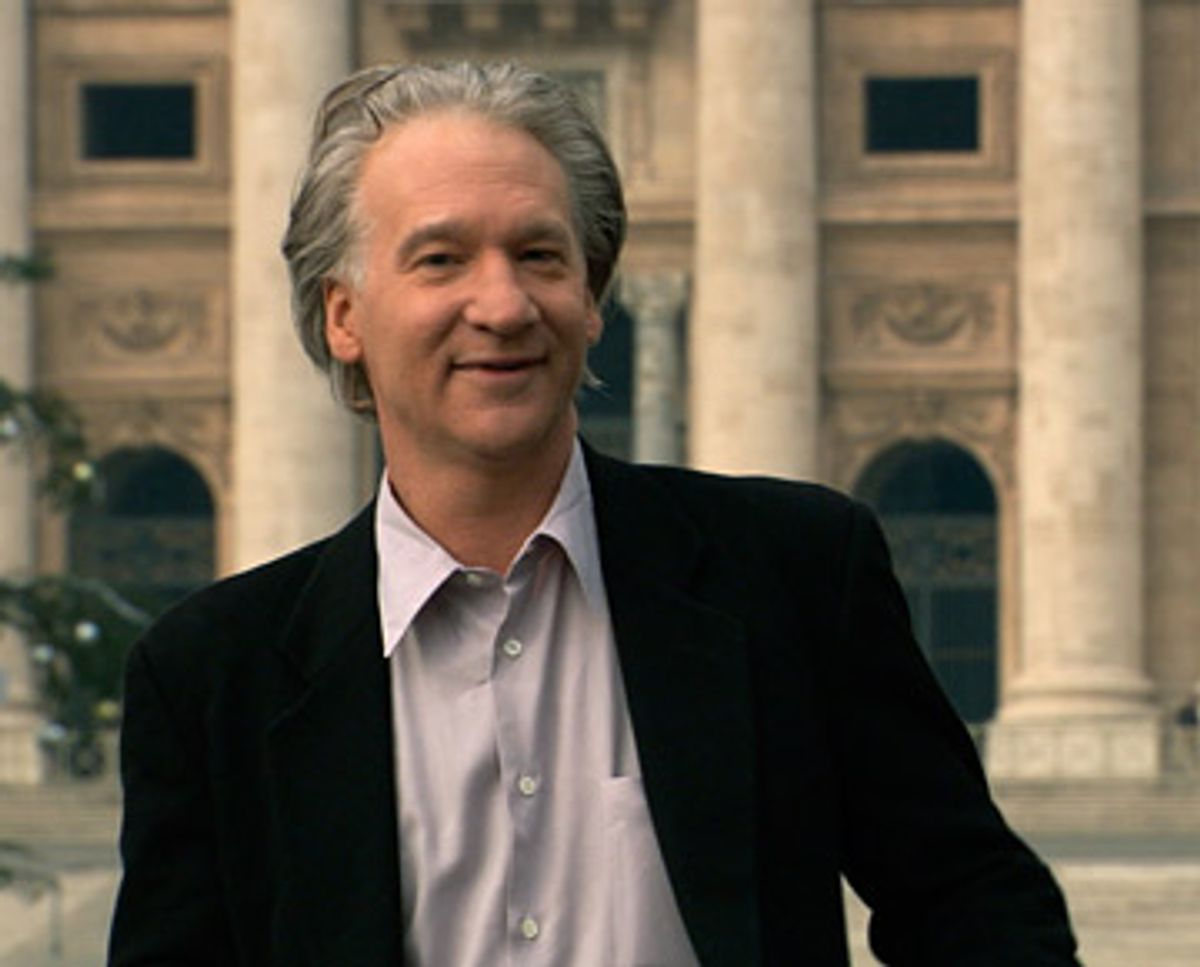
The HBO host and comedian talks about "Religulous," his onslaught against the religious idiocy that threatens to deliver America to Sarah Palin and her fellow "space god" worshipers.
Photo courtesy of Lionsgate
Bill Maher outside the Vatican City in “Religulous.”
What if there was a religion, asks comedian Bill Maher, in which an all-powerful god from outer space decided to send his unborn son on a suicide mission to planet Earth? So this space-god impregnates a human female in some mystical, not-quite-physical fashion, and she gives birth to a baby who is both a human being and a divine incarnation, simultaneously the space god’s spawn and the space god himself. (Oh, space god also has a third manifestation, one that’s totally invisible.) So space-god junior is born on Earth destined to be killed, even though he’s a space god and therefore immortal.
As you’ve picked up by now, the religion Maher is describing is not imaginary, and in various forms and guises is professed by most people in the United States, including every president we’ve ever had or are likely to have in the foreseeable future. (I’m sorry, that’s right — one of this year’s candidates is a Muslim.) In the acerbic late-night talk-show host’s new movie “Religulous,” made with “Borat” director Larry Charles, Maher keeps bludgeoning you with stories like these to make the point that the central story behind mainstream Christianity, when considered at face value and taken literally, sounds every bit as loony as the oft-derided tenets of Mormonism or Scientology.
As in his TV work, Maher is best as a wry, outrageous commentator on the idiocy and hypocrisy of the world around him, a sourpuss Will Rogers who’ll say things others are thinking. When he meets John Westcott, a Florida pastor and leader of the “ex-gay” Christian evangelical movement, Maher blurts out the obvious: Westcott is a neatly attired, well-groomed, handsome and athletic fellow who would immediately be hit upon by every gay guy in any bar of any major American city. (After they embrace at the end of the interview, Maher says: “Whoa! That wasn’t a hard-on, was it?”) Later, when interviewing the only two patrons he finds in a Muslim-oriented gay bar in Amsterdam, Maher says: “Well, I hope you guys find each other attractive, because otherwise …”
In this Borat-meets-Michael Moore world tour of religious extremism, which encompasses Jerusalem, the London Underground, the Hague, an African-American megachurch in North Carolina and an ultra-Orthodox Jewish village in suburban New York, Maher is pretty good at making boobs and fanatics look like boobs and fanatics. He reveals Miami minister José Luis de Jesús Miranda, who has claimed to be both Jesus Christ and the antichrist, as an anti-Semitic moron, and U.S. Sen. Mark Pryor, a middle-of-the-road Arkansas Democrat, as a garden-variety American moron who refuses to commit to believing in either evolution or creationism. (As Pryor himself says, you don’t have to pass an I.Q. test to be a senator.)
Maher is kicked out of the Vatican in Rome and the Mormon Temple in Salt Lake City, and prayed for by the worshipers at the Truckers’ Chapel in Raleigh, N.C. He avoids eviction at the Holy Land Experience theme park in Orlando, Fla., and spends quite a bit of time with the park’s Jesus impersonator, a slick bastard who stays with him quip for quip. He himself walks out on Rabbi Yisroel Dovid Weiss, an anti-Zionist Jew who attended Iranian president Mahmoud Ahmadinejad’s so-called Holocaust conference, and pretty much refuses to let British Islamic rapper Aki Nawaz (aka Propa-Gandhi) get a word in edgewise.
Himself raised in a mixed Jewish-Catholic family in suburban New Jersey, Maher has long used religion as a comic target. He used to riff on his family background, joking that the Jewish side compelled him to bring a lawyer into the confession box. (“Bless me, father, for I have sinned. I believe you know Mr. Cohen.”) As he once observed during a discussion on “Real Time With Bill Maher,” his HBO talk show, he objects to religion “because it makes people do stupid shit.” He gets no argument from me on that point, and to the extent that “Religulous” is meant to bemoan the auto-lobotomized mandatory Christianity of American public life (I’d include such honorary Christians as Joe Lieberman), and to encourage atheists, agnostics and other doubters to come out of the closet and claim their share of the debate, it’s performing a genuine social mitzvah.
As Maher observes, some 16 percent of the American public claims no religious affiliation, which makes the nonreligious minority a larger group than African-Americans, Latinos, Asians, Jews, Muslims or gays and lesbians. Yet those groups are recognized as legitimate stakeholders in American society, while nonbelievers pretty much are not. (As Maher says in our interview, he doesn’t call himself either an atheist or an agnostic, although the latter term seems to fit.)
It’s also arguably true that the most extreme and ludicrous forms of religion have been on the rise, or have at least become understood as normal and respectable. To have a major-party vice-presidential nominee who apparently believes in a literal-minded understanding of Scripture rather than in modern science would not, once upon a time, have been deemed acceptable. (Even three-time Democratic presidential nominee William Jennings Bryan, although claimed as a hero and role model by modern fundamentalist Christians, did not remotely believe that the Earth was created in six literal days a few thousand years ago.)
But as I gently tried to suggest to Maher during our recent phone call, his scattershot and ad hominem attacks against many different forms of religious hypocrisy don’t add up to a coherent critique, and he’s not qualified to provide one. Any serious theologian from the mainstream Christian or Jewish traditions would have eaten his lunch for him, and that’s why we don’t see anybody like that in this film for more than a second or two. During their brief appearances, for instance, Vatican Latinist Reginald Foster and astronomer George Coyne, who are both Roman Catholic priests, make it clear that contemporary Catholic theology resists literal readings of Scripture and is not in the least antiscientific. You can find liberal Christians who will argue that the resurrection of Jesus was somewhere between a con game and a dream sequence, and numerous Jews who treat the Torah as legendary material and God as a distant hypothesis.
It’s perfectly legitimate to argue that all such people are putting lipstick on a pig, to coin a phrase — that they’re apologizing for a ruinous and ridiculous body of mythological literature whose influence on human history has been overwhelmingly negative. But Maher’s idiots-of-all-nations anthology in “Religulous” doesn’t even try to make that case; it’s as if he doesn’t even know that religion has centuries’ worth of high-powered intellection on its side, whether you buy any of it or not. Maher and Charles’ film also doesn’t engage the value of religious narrative in moral or existential terms, nor does it even try to address the ubiquitous nature of supernatural and spiritual experience in human life.
Instead, like most of Maher’s comedy, it’s a scabrous, irreverent, hit-and-miss broadside against a society mired in pathological stupidity and mesmerized by faith in a “talking snake.” That’ll have to do for now. I spoke to Maher by telephone on Tuesday, just before “Religulous” was set to open in New York theaters.
Bill, you’re a busy guy right now. You’ve got a movie and an HBO talk show to promote, and an election and a financial crisis to make fun of. But I wonder whether the current economic situation really lends itself to comedy.
Well, it is funny, if you can laugh through your tears. You’ve got to make fun of everything, and this is certainly something people are aware of and talking about. I try to talk about it in a kitchen-table way, but one of the difficult things about it is that nobody really understands it.
You know, we’ve been asked to trust Secretary Paulson. Now I don’t know this man, and maybe he’s brilliant. What I know about him is that he’s a Bush appointee, like Rumsfeld, Gonzales, Miers and Cheney. What I know about him is that he worked for Goldman Sachs, who are part of the problem. And I know that he was on his knees in the Oval Office recently. Maybe he was looking for change under the couch, but I don’t think so.
Like everybody else, I guess, I don’t quite know what to think. On one level, I understand that Congress was being irresponsible in shooting down the bailout the other day. On the other hand, doesn’t everybody want to see those rich bastards get what’s coming to them?
I guess the problem is, it’s cutting off your nose to spite your face. You get the rich bastards, but our 401K plans are on Wall Street, that’s our retirement money. It’s all mixed together, and that’s the problem.
The root problem, I think, is that Americans stopped making stuff. We used to make cars, houses, furniture. We were a manufacturing country. Now we just push numbers around on a computer screen. It’s all about debt and margins and short-selling. Eventually that house of cards is going to come down. You find third-world countries and other nations doing better than us. The Chinese actually make things. OK, they make DVD players full of poisonous materials, lead and mercury, but at least they’re making something. We’ve become a small-print economy. Not even a service economy, a small-print economy.
And, you know, we’re such a religious country, at least supposedly. But charging interest is specifically forbidden by the Old Testament.
Right. Don’t banks in Islamic countries actually obey that prohibition? Or at least find imaginative ways around it?
That’s true. As usual with the Muslims compared to us, we pretend to be religious and don’t really follow it. They actually walk the walk and talk the talk. Which of course is not a good thing when it leads to beheading homosexuals. We don’t do that, we just dis them with Pat Robertson. But yes — Muslim banks do not charge interest. They find other ways of making money; it’s more about sharing with the customer.
I guess that brings us to the topic of “Religulous,” which I read as this effort to get agnostics and atheists out of the closet in American society.
That’s certainly one of the goals. I don’t use the word “atheist” about myself, because I think it mirrors the certitude I’m so opposed to in religion. What I say in the film is that I don’t know. I don’t know what happens when you die, and all the religious people who claim they do know are being ridiculous. I know that they don’t know any more than I do. They do not have special powers that I don’t possess. When they speak about the afterlife with such certainty and so many specifics, it just makes me laugh.
People can tell you, “Oh yes, when you get to Paradise there are 72 virgins, not 70, not 75.” Or they say, “Jesus will be there sitting at the right hand of the Father, wearing a white robe with red piping. There will be three angels playing trumpets.” Well, how do you know this? It’s just so preposterous. So, yes, I would like to say to the atheists and agnostics, the people who I call rationalists, let’s stop ceding the moral high ground to the people who believe in the talking snake. Let’s have our voices heard and be in the debate. Let’s stand up and say we’re not ready to let the country be given over to the Sarah Palins of the world.
It seems like your major target in this movie are the religious extremists, those who belong to the fundamentalist camps of various different religions.
That’s not really true, that’s not really true. I mean, take Sen. Pryor — I don’t think he’d consider himself a fundamentalist. I think he’s like a majority of Americans. I mean, 60 percent of Americans believe the Noah’s ark story to be literally true. To me, that’s mainstream. When people say, “You’re going after extremists,” I say, well, to be religious at all is to be an extremist. It’s to be extremely irrational. Not that everybody believes in Noah’s ark, or the guy who lived to be 900 years old. But even to believe the central story of Christianity — a lot of people would say, “I’m not like those kooks out in Kansas who believe the Earth is 5,000 years old. But I do believe God has a son, who he sent down to earth on a suicide mission, and he said, ‘Hey, Jesus, I’m sending you on this suicide mission, but don’t worry, they can’t kill you because you’re really me.’ I, God the father — wink, wink — let’s split up the work! OK? Because there’s two of us, but not really! I’ll go down to Earth first and I’ll see if I can’t impregnate a Palestinian woman so she can give birth to you.” It’s just as silly a story. We’re just used to it.
Right, well, it’s pretty funny when you argue that that story is every bit as ridiculous as the space-alien gods and billion-year-old beings and volcanoes of Scientology. But you could find liberal theologians, sophisticated intellectuals, who are not fundamentalists and who could argue their way out of any corner you try to paint them into.
I disagree again. This is the idea that people have in their heads, that somehow you can have a person who sounds very rational and can hold his own in a conversation about whether religion is silly or not. And I just disagree with that premise. If you’re defending the story I just described, you are going to come out sounding ridiculous no matter who you are and no matter how intelligent you are. We interviewed Francis Collins in the film. He’s the man who mapped the human genome, he’s a brilliant scientist. But he says some pretty cuckoo things, some things that are just factually wrong and make him look foolish.
I said, “We don’t even know for sure whether Jesus lived,” and he said, “We have eyewitness accounts.” I said, “No, every scholar agrees that the gospels were written from 40 to 70 years after Jesus died.” And he said, “Well, that’s close.” That’s close to an eyewitness account? Forty years after somebody dies, 2,000 years ago? This idea that there’s somebody out there who can make a case for this and make it sound reasonable, that just doesn’t exist.
Well, you’ve got these two Vatican priests in the film, and one of them, Reginald Foster, is this very funny guy who is totally not defending the most ridiculous aspects of Christianity.
He’s actually debunking them! Here’s a guy who lives down the hall from the pope. We saw where the pope lives. And he’s just saying, “Ah, they’re all just stories.” It gave us a real insight that perhaps some of these people who are in the hierarchies of the religions — they don’t really believe it. But they understand that you can’t tear it all down for the common man, that people need their stories. It’s just amazing that he would say it to me publicly, and on camera.
Well, that raises a philosophical question, which maybe a 100-minute comedy film can’t deal with. Do these stories serve a purpose in human life that isn’t entirely negative, even if it’s foolish to take them at face value? It seems to me you’re arguing that they don’t.
That’s a good question, and of course no one can argue that religion hasn’t done some good. Even in the world today, the Catholic Church certainly organizes a lot of antipoverty programs. It feeds the poor, runs soup kitchens, and so forth. I would argue that all that can be accomplished without the bells and whistles of religion. People behave ethically all the time without relying on myths. And I would argue that when you bring religion into it, yes, the comfort that religion brings comes at a terrible price. Probably the majority of wars in our history have been fought over religion.
Of course we’re now involved in Iraq, and the main reason that conflict has been so difficult to solve is that there are two sects of Islam who have a disagreement about who succeeded the prophet Mohammed in the seventh century. This is the reason they’re ethnically cleansing each other! Not to mention the Crusades and, you know, keeping women in their place and the repression of minorities and exorcism and burning witches and honor killings and suicide bombings and having sex with children. I mean, I could go on. Does religion have a place? Yeah, you kind of have to balance that against all the bad it does.
You deal with Christianity and Judaism, and toward the end of the film you wrestle with Islam a little bit. But there’s no mention of Hinduism or Buddhism — a religion that allows for considerable doubt and isn’t so sure about the existence of God, for example.
We made the decision early on that in a 90-minute movie we weren’t going to be able to delve into the Eastern religions. First of all, Americans — and I’m one of them — don’t know that much about them. We don’t have that intimate lifelong relationship with them, the way we do with Judaism and Christianity and, in recent years, with Islam. We go into Mormonism and Scientology, but people know a little about them because this is America. If we were going to go into Shintoism and Buddhism and Hinduism, that’s another movie, and one I’m not going to make.
You’ve been pretty consistent on TV and in your stand-up routines in criticizing Islam, in arguing that the religion and its followers really have a problem they don’t seem to be dealing with. You go after Islam again in this film, and you aren’t especially delicate about it.
No, you can’t be. You can’t pull your punches, and you wouldn’t be respected if you did. We show a little of the Theo van Gogh film ["Submission," which apparently led to the Dutch filmmaker's murder by an Islamic radical], which is pretty rough stuff. You see that woman with her face all beat up, saying, “This is what my husband does to me in the name of his religion.” And we talk to a number of Muslim people and you hear me saying that I think when they talk amongst each other they’re more honest about the predicament of their religion, but they won’t say it to a stranger. I’m sure some of this is going to ruffle feathers, but you know what? The Christians don’t love what we say about them either.
You’ve been called anti-Muslim from time to time. How careful are you, do you think, about raising criticisms that don’t cross the line into prejudice and stereotype?
I don’t think I’m involved with prejudice. Prejudice comes from the words “pre” and “judge,” and I don’t think I’m prejudging. I’m judging. I reserve the right to make judgments. We all have to make judgments.
“Religulous” is now playing in New York, and opens Oct. 3 in major cities around the country.
Jesus versus the GOP
The man from Nazareth would have been appalled by the “Christian” Republican candidates
Find the Christian in this group (Credit: AP)
There has never been a more loudly Christian group of presidential candidates than this primary season’s GOP contenders. From the start, the campaign has been an exercise in Christian one-upmanship. Minnesota Rep. Michele Bachmann set the standard for religious fervor, boasting of setting her alarm clock at 5 a.m. so she could read the Bible and issuing born-again testimonials like “I radically abandoned myself to Jesus Christ.” Herman Cain said that he was inspired to run for president by the parable of the talents in Matthew 25. Rick Perry released a video in which he intoned, “I’m not ashamed to admit that I’m a Christian … As president, I’ll end Obama’s war on religion and I’ll fight against liberal attacks on our religious heritage.”
Bachmann, Cain and Perry are no longer sharing their spiritual rectitude with a national audience, but the remaining candidates continue to flaunt their Christianity. Newt Gingrich, who has noisily proclaimed that his conversion to Catholicism saved his soul, repeated Perry’s charge, accusing President Obama of launching a “war on religion” by requiring that church-owned hospitals and universities provide insurance that covers birth control. “It’s a fundamental assault on the right of freedom of religion,” Gingrich said. “On the very first day I’m inaugurated I will sign an executive order repealing every Obama attack on religion.”
Gingrich has framed the election as a battle for America’s soul, warning that if Obama is not defeated, the United States is in danger of becoming a “secular atheist country, potentially one dominated by radical Islamists.” Such apocalyptic warnings, combined with statements like “I can’t imagine being comfortable with an atheist in the presidency,” insinuate that Obama is a fake Christian – a widespread belief among the religious right. (That’s actually a comparatively moderate view: The hardcore see him as the Antichrist.)
Rick Santorum went even further, essentially calling for America to become a theocracy. At the Thanksgiving Family Forum last year, Santorum said, “Our civil wars have to comport with the higher law … That’s why as long as abortion is ‘legal,’ according to the Supreme Court, we will never have rest, because that does not comport with God’s law … As long as there is discordance between the two there will be agitation.”
The Republican strategy — loudly proclaiming one’s Christian faith, while attacking Obama as an agent of secular evil, if not actually Satan himself – is right out of the Fox News playbook. As the voice of the American far right, the ultimate undeclared super-duper-GOP-PAC, Fox News has embraced the cracked “birther” movement and generally done everything within its latitudinous definition of “fair and balanced” to portray Obama as a fake-Christian, foreign-born, America-hating Muslim. (Fox’s “War on Christmas” rants appear with such clockwork regularity at Christmastime that I use them as reminders to open my Advent Calendar.)
The only GOP candidate who has not openly pursued this strategy is the front-runner, Mitt Romney. Romney has avoided the subject because as a Mormon, his own Christian credentials are suspect. But as the ultimate political panderer and opportunist, he would play the Christian card if he could. Like all the GOP candidates, Romney has tried to paint Obama as an alien Other, elite, mysterious, malevolent – in a word, slightly satanic. And also like them, Romney presents his free-market, anti-government ideology as more “American,” and by implication more “Christian,” than Obama’s.
As someone who has spent many happy hours studying Christian theology, from Origen to Hans Kung, as well as modern scholarship about Jesus, I supposed I should be pleased by this eruption of holy fervor among the Republican candidates for the highest office in the land. But there’s just one little problem.
Jesus would have been appalled by the whole pack of them.
We do not know very much about the historical Jesus. But everything we know indicates that the carpenter from Galilee would not have been pleased to learn that this pack of coldhearted, sanctimonious, wealth-exalting politicians were claiming to be his followers.
I’m not saying that Jesus would have been a Democrat. Anyone who pretends to find support for specific political policies or ideologies in the Bible is delusional. Scholars cannot agree if Jesus was a social revolutionary, a tortured mystic, or something altogether different. Even what Jesus himself believed about the most essential aspects of what was to become “Christianity’ – a religion founded not by him, but by his disciple Paul of Tarsus — is unclear. As leading biblical scholar Bart Ehrman noted in “Jesus, Interrupted,” some of the most important Christian doctrines, including the divinity of Christ, the Trinity and the concept of heaven and hell, were not held by Jesus himself: They were added later, when the church transformed itself into a new religion rather than a Jewish sect.
Ehrman told me that the authors of the four Gospels portray Jesus in such contradictory ways that there is no intellectually honest way to reconcile them. Mark, for example, depicts Jesus as doubting and despairing on the way to the cross, while Luke portrays him as calm. Ehrman argues that such contradictory accounts can only be reconciled by creating, in effect, a bogus “fifth Gospel” that does not exist.
But having said all that, we still have the evidence of the Bible itself. And one does not need to believe in the infallibility of that document to see that the Jesus who is depicted in it was implacably opposed to authoritarianism, warmongering, contempt for the poor, exaltation of wealth, conformity, and sanctimoniousness – in short, everything the contemporary Republican Party stands for.
In an ugly culmination of the successful, race-baiting “Southern strategy” that has essentially driven the GOP for decades, the Republican candidates have vied with each other to demonize poor people, especially if they’re black. That’s why Gingrich has repeatedly attacked Obama as the “food stamp president,” and why Mitt Romney went out of his way to say “I’m not concerned about the very poor,” contrasting his stance with that of the Democrats, of whom he disparagingly said, “We will hear from the Democrat Party (about) the plight of the poor.” (As Gail Collins wrote in a hilarious column, “It is interesting to hear a candidate directly attacking the opposition for being concerned about the destitute.”)
We have no idea what position Jesus would have taken on progressive taxation or whether he would have supported the Dodd-Frank Act. But we do know that Jesus, unlike Gingrich and Romney, was concerned about the poor. In fact, he made it clear that concern for the poor was an absolutely essential principle of his faith.
This is not surprising. For Jesus himself was completely destitute, and he insisted that his companions be as well. As they traveled around Palestine, they ate whatever they were given and slept in whatever house would take them. If no shelter was offered them they slept outdoors. As he told his 12 disciples in Luke 9:3, “Take nothing for your journey, neither staff, nor bag, nor bread, neither money, neither have two coats apiece. And whatever house ye enter into, there abide, and from there depart. And whoever will not receive you, when ye go out of that city, shake off the very dust from your feet for a testimony against them.”
Romney’s statement that he was “not concerned about the very poor” is telling. For Jesus explicitly stated that he was concerned not just about the poor, but about the poorest, the lowest and most despised members of society. Jesus’ famous saying in the Beatitudes in Luke 6:20 is usually translated as “Blessed are the poor, for theirs is the kingdom of heaven.” But as biblical scholar John Dominic Crossan noted in “The Essential Jesus,” “Greek has two different words for ‘poor’ (penes) and ‘destitute’ (ptochos), so it should be ‘blessed are the destitute.’” Crossan argues that Jesus’ mission was revolutionary precisely because he proclaimed, against all tradition, that the Kingdom to come was not just for the respectable poor – the “deserving poor,” in Republican parlance – but for the destitute.
Jesus again makes this explicit in Luke 9:48: “And said unto them, Whosoever shall receive this child in my name receiveth me: and whosoever shall receive me receiveth him that sent me: for he that is least among you all, the same shall be great.”
Jesus demanded that his followers help the neediest. In Matthew 19:21 he says:, “If thou wilt be perfect, go and sell what thou hast, and give to the poor, and thou shalt have treasure in heaven.” But Jesus went further, warning that the mere possession of wealth, and the overvaluation of worldly possessions, stands in the path of salvation. From Matthew 19:24: “And again I say unto you, It is easier for a camel to go through the eye of a needle, than for a rich man to enter into the kingdom of heaven.”
But Jesus’ most explicit repudiation of the GOP’s ethos is found in Luke 16:19, in his famous story of Lazarus and the rich man.
There was a certain rich man, who was clothed in purple and fine linen, and fared sumptuously every day. And there was a certain beggar, named Lazarus, who was laid at his gate, full of sores, and desiring to be fed with the crumbs which fell from the rich man’s table; moreover, the dogs came and licked his sores. And it came to pass that the beggar died, and was carried by the angels into Abraham’s bosom; the rich man also died and was buried. And in hades he lifted up his eyes, being in torments, and seeth Abraham afar off, and Lazarus in his bosom. And he cried and said, Father Abraham, have mercy on me, and send Lazarus, that he may dip the tip of his finger in water, and cool my tongue; for I am tormented in this flame. But Abraham said, Son, remember that thou in thy lifetime receivedst thy good things, and likewise Lazarus evil things; but now he is comforted, and thou art tormented. And besides all this, between us and you there is a great gulf fixed, so that they who would pass from here to you cannot, neither can they pass to us, that would come from there.
The Republican candidates all claim to be devout Christians. But between the compassionate teachings of Jesus and their coldhearted, mean-spirited ideology, there is a great gulf.
Whether Gingrich and Romney’s callous attitude toward the least among us will hurt them with the 78 percent of Americans who claim to be Christians is uncertain. From the 1925 publication of “The Man Nobody Knows,” a bestseller that depicted Jesus as a successful businessman, there is a long tradition of smug, self-serving Christianity in this country, a Christianity easily compatible with the harshest and most uncharitable values and beliefs. But in their zeal to win over the most resentful, hate-filled members of their party, the Republican candidates run a greater risk. They are turning before our eyes into archetypal villains, bad guys out of our collective cultural memory bank.
And fittingly, the villain they are becoming is associated with Fox News’ favorite holiday, Christmas.
For some devout Americans, Christmas is a primarily religious occasion. But for most, it is a secular holiday, a time to make children happy, see friends, and eat and drink too much. However, it also carries, in its own modest way, a deeper meaning, even for those who are not religious at all. That meaning is imparted by our culture, but it taps into our desire to rise above ourselves. The bell-ringing Santas collecting for charity on street corners, the heartwarming movies like “It’s a Wonderful Life,” create a small but real sense that Christmas is, or should be, about regeneration, kindness, a new start — what St. Augustine called “The enchiridion of faith, love and hope.”
The most powerful expression of this humanistic and moral approach to Christmas is Charles Dickens’
“A Christmas Carol.” In the beginning of Dickens’ tale, the wealthy businessman Ebenezer Scrooge is approached by some fellow businessmen, collecting for charity.
Scrooge’s reply tolls like a great, black bell.
‘Are there no prisons?’
‘Plenty of prisons,’ said the gentleman, laying down the pen again.’And the Union workhouses,’ demanded Scrooge. ‘Are they still in operation?’
‘Both very busy, sir.’
‘Oh. I was afraid, from what you said at first, that something had occurred to stop them in their useful course,’ said Scrooge. ‘I’m very glad to hear it.”
… “I help to support the establishments I have mentioned — they cost enough; and those who are badly off must go there.’
‘Many can’t go there; and many would rather die.’
‘If they would rather die,’ said Scrooge, ‘they had better do it, and decrease the surplus population.”
It is one of the great indirect cries from the heart in all of literature.
“Are there no prisons?” may play well with the resentful Republican base. But Romney, or whoever runs against Obama, may discover that the American people are not going to vote for Scrooge.
Praying to be skinny and straight
An expert explains what evangelical weight-loss and ex-gay movements say about America -- and us
(Credit: iStockphoto LincolnRogers)
Fatness and gayness have a few things in common: They are both highly charged social issues that can anger people in ways few other things can. To many people, they both represent a sinful inability to control urges – in the case of fat folks, to eat food, and in the case of gay people, to have sex. In evangelical circles, however, fatness and gayness are not just stigmatized, they are actively fought.
In her eloquent new book, “Seeking the Straight and Narrow: Weight Loss and Sexual Reorientation in Evangelical America,” Lynne Gerber examines the ways these two separate issues interact in that most morally stringent segment of American culture. A University of California, Berkeley, scholar in residence whose work emphasizes intersections of sexuality, bodies and health in contemporary Christianity, Gerber spent more than three years documenting evangelical weight loss and ex-gay culture, primarily in two evangelical ministries, First Place, a weight loss group, and Exodus, an ex-gay ministry with aims to train gays into straightness. Along the way, Gerber unpacks the historical influence of evangelicalism on American society, while providing a thoughtful look at real people struggling to change.
Salon spoke with Gerber over the phone about her new book, out this week from University of Chicago Press. She was kind enough to share her opinion on everything from how fatness and gayness are valuable points of comparison, the often heartbreaking measures “ex-gays” take to curb same-sex urges, and how evangelicalism is a little bit queer sometimes.
In the book, you focus on two specific evangelical ministries: Exodus, a moderate ex-gay group organized around helping members overcome homosexuality, and First Place, a weight-loss ministry. Why were these important groups to compare and contrast?
I have often been interested in the intersection of fatness and homosexuality. They are both places where there is a lot of social energy, and social hatred toward people who represent fatness and gayness. If you think about what fatness and gayness represent, they are similar. One is a sort of excess; the idea that fat people have this excessive desire for food, and gay people are depicted as having this excessive sexual tendency. Excess is directly linked to social efforts to control those excesses, to get fat people down to size and gay people into the “correct” sexual orientation.
In ex-gay ministries, they have a somewhat psychoanalytic explanation for how homosexuality develops in childhood. What is their theory exactly?
They draw on some pretty psychoanalytic ideas to explain their theory. Basically the theory is that homosexuality is not a problem of sexual attraction to people of the same sex, it’s a problem of gender identification. So if I am a homosexual man, the issue is not so much that I want to sleep with other men, it’s that I don’t see myself as adequately masculine enough. The idea is that people are attracted to what they feel that they are not. So if I am a hypothetical gay man, that means that I think of myself as more female (because they frame it with only two genders). Their idea is that to shift sexual orientation one needs to shift one’s gender identity. A hypothetical gay male needs to start feeling more grounded in his masculinity in order to find his attraction toward women. They say that a homosexual person’s “gender deficiency” is the result of a breakage in the relationship between the same-sex parent during childhood. It’s interesting because this can be anything from abuse to perceived abuse to perceived neglect. It can be anything from the most intentional egregious violation on the part of the same-sex parent to the most unintentional slight that the child experienced.
In the book you explain that Exodus has to maintain this delicate balance; to make gay people feel accepted while at the same time attempting to fundamentally change who they are. How do they manage this?
What they want to do with these “strugglers” is give them a place. They really don’t want people with same-sex desire to leave the church, because their thinking is that once they leave the church, they go into the gay culture and they’re lost forever. They want to give them a place that feels like a home within the church. On the other hand, they believe that homosexuality is a sin, and they have to emphasize that homosexuality is a sin if they want their institutional allies. Ex-gay ministries have this paradoxical effect where people who are struggling with same-sex desires can be out about those desires, there is a place where they can talk about it without getting kicked out, there’s a place where they can acknowledge it, but they have to acknowledge it as “ex-gay.” So that’s the price.
There’s a chapter in the book that I found really compelling about the differences between change in theory and change in practice within the ministries.
In the book I argue that in evangelical culture there is a deep impulse to make a conscious initial choice about one’s faith. To choose God, recognize oneself as a sinner, and make a choice to become a disciple of Christ is a very strong value in evangelical culture. The notion is that this decision becomes a real place where all kinds of transformations can happen: The sinner becomes saved, the drunk becomes sober, and the gay becomes straight. Then the choice has to keep being made over and over again. In First Choice, the initial choice to lose weight brings this endless opportunity for choice where every time I eat I ask myself, is my eating in alignment with God’s will? Once you have been in either ministry for a long time and don’t become straight or lose weight, it shifts to this notion that change is a process. There is this balance between the initial, simple choice and this ongoing pathos to get further and closer to the goal. I think that is also a common polarity in therapeutic culture. There is a similar back and forth between making the first decision, and making a lifestyle change that is going to take a very long time.
In the beginning of the book, you talk about how evangelical Christianity is defined by paradox: the desire to identify with but also to distinguish itself from American culture.
There is a famous argument in academic circles that evangelical culture is a subculture. A subculture works by trying to distinguish itself from the mainstream culture. It does a lot of symbolic and discursive work in order to make that difference. What is interesting in evangelical culture is where they choose to accentuate difference. Clearly homosexuality is a place where they have really chosen that point of distinction.
And they are really proud of that.
They see it as a bold line in the sand that can’t be crossed. The extent to which evangelicalism has been willing to make their identity almost conterminous with their opposition to homosexuality is remarkable.
How does the weight loss ministry, First Place, differ?
Evangelicalism is very much part and parcel with the mainstream weight loss culture. I don’t know that they would consider it an intentional effort, but I think it’s a real reflection of how very deep the overlaps are. For example, Dr. Oz, the weight loss guru, just started working with Rick Warren, a pastor from one of the biggest evangelical churches in the country. They have a new weight loss plan called the Daniel Plan. Evangelicals have a proprietary sense — this deep identification with American culture. There is a notion that they do things just like the rest of Americans, just with more piety. First Place is like secular weight loss programs except the Bible is involved. It gives opportunities for Christians to explore a range of American culture within a Christian context.
Are both fatness and gayness considered sins?
Exodus, as part of its definition, believes homosexual sex, defined as genital acts between people of the same sex, is a sin. First Place is more vague about sin. They call weight a “fleshly problem with a spiritual solution.” They want to fall short of calling it a sin. In First Place, they are also not exactly sure what the sin even is. Is it being fat? Is it in excessive eating? In Exodus, they really limit the sin and say that only genital acts are sins because they want to make a breathable space for people who have same sex attraction to feel welcome.
And in the book you have some heartbreaking accounts about the extents to which some of these people would go in order to fight their urges and try to have this God-oriented agency.
The one that really sticks in my mind is this man I interviewed, an ex-gay man from a very cold state in New England. He wanted to stop fantasizing about men before he went to bed at night, so he would lie in bed and if he found himself veering into this realm of fantasy, he would get out of bed without a blanket and lie on the cold floor of his apartment and read the Bible until he fell asleep. That was his choice to do. That’s not a practice that Exodus necessarily endorses, but it definitely goes to show the extreme choices that people made in order to curb their desires.
What happens when people in these groups end up failing, either with weight loss or with their “struggle” to become heterosexual?
The goal post for success can be very porous. There’s a lot that counts for success. For example, at First Place, members have nine commitments that include things like following a certain eating plan, getting exercise, doing Bible study, showing up at meetings, encouraging others in between sessions, etc. If people aren’t necessarily losing weight, it becomes easy to call upon one of these other standards as success. In the case of the ex-gay ministry, they overtly say that the opposite of homosexuality isn’t heterosexuality, it’s holiness. Well, holiness may in fact be easier to achieve than heterosexuality for a lot of people in the ministry. When people actually fail, when they actually transgress, when a man goes and has sex with another man, for example, there is the opportunity to repent through confession. They tell the group what they did, they are adequately remorseful, and they return to the group’s good graces and submit themselves to the group’s discipline once again.
In the conclusion you note something really fascinating, which is that in American culture we tend to construct an opposing duality around the secular and the religious.
I have a good example of this. In terms of this secular/religious question, there is a common-sense understanding that American culture has become increasingly secular. Well, I would argue that certain forms of religious sensibilities have become secularized. They’ve become so common-sense that they are unmarked in American culture, or their underlying religious concerns have become obfuscated. The image that kept coming back to me is one that I saw at First Place. The first thing that folks do in the meetings is a weigh in, and at First Place, before you get on the scale you have to recite your Bible verse for the week. You go in, step on the scale, recite your Bible verse, and the group leader records whether or not you lost weight and whether or not you got your Bible verse right. It’s like the idea of putting your flag on the moon. Is it religion giving its deference to what is actually the moral authority in this culture, weight, or is it just making clear the compatibility between Christian ideals and the weight loss dogma?
Which do you think it is?
I tend to go back and forth, but I do think practices like that reveal the deep religious sensibilities underneath programs like weight loss and things that are addressed in scientific and health-related language. In some ways I think First Place just returns the explicit religious marks to something that seems to be secular, but actually has very deep moral concerns undergirding it.
At the end of the book, you make a really nice observation that evangelicalism can actually be really progressive and queer in certain unexpected ways.
One of the interesting things about the ex-gay ministries is, in a certain sense, how queer they are. I went to Exodus International’s 30th anniversary conference. Jerry Falwell was there to address Exodus, and he is quite controversial because of what he’s said in the past about gay people. The act that preceded Jerry Falwell was a skit from a Christian theater troupe about a former drag queen trying to join a church Bible study. At one point in the skit, the former drag queen talks about how he used to fantasize about a handsome hero taking him away. Eventually he realizes that Jesus is his real hero, and another character says, “That makes it sound like Jesus is your lover! That’s biblical!” So in front of Jerry Falwell, an ex-gay ministry said that it’s biblical for a man to call Jesus his lover! There is a certain kind of playfulness and queerness that is possible in their world to a degree that’s really surprising to me. And Jerry Falwell didn’t get up and leave.
I fell in love with a megachurch
I went to Joel Osteen's ministry on a lark. But after a heartbreak, I found something there I never expected: Hope
The weekend my boyfriend began seeing another woman, I walked into a megachurch for the first time.
My girlfriends and I didn’t go to praise Jesus. We went for fun. (I didn’t know about the boyfriend yet.) My two friends, both 20-something journalists like me, were visiting me in Houston, and we considered Lakewood Church — the largest house of worship in the country and home to controversial superstar pastor Joel Osteen — a tourist attraction.
We parked in a crowded underground garage and followed a trail of people into a stadium built for the city’s basketball team. I’d rarely set foot in a church since growing up catholic in upstate New York, and yet I knew this religious gathering would be nothing like the one I’d attended at home. Everybody in Houston knew about Lakewood. You either went there every weekend — or rolled your eyes at people who did.
An usher guided us to seats up in the stadium’s second tier, practically the nosebleed section. Loud, upbeat music throbbed through the stadium. A woman not far from us clapped to the beat, tears streaming down her face. I stared at her like a child who’d seen the Amish for the first time. Was she really that moved by this song? I wondered whether her sister was sick with cancer or her husband had lost his job. Or maybe she simply felt alone.
When the throbbing music ended – a good half an hour into the service – Osteen didn’t read out of the gospel. Instead, he looked out over the packed stadium and told us, with a fist in the air, that we could accomplish anything we set our minds to. The future was full of hope, he said. “The best things in life are out in front of us!”
To my left, my girlfriends threw their hands in the air with everyone else. “C’mon!” they urged. But I felt awkward and out of place, worried the crowd would pin me for an imposter in this deep sea of believers. Wouldn’t they know I didn’t belong?
Two weeks later, my boyfriend dumped me. The woman he’d connected with the weekend my friends were in town understood him in a way I didn’t, he said. That night I heaved over the toilet, mad at myself for not seeing it coming.
The next Sunday, instead of spending the morning in my now ex-boyfriend’s bed, I went back to Lakewood. I wasn’t exactly sure why I went. I usually dealt with my emotions by running or lifting weights or throwing myself into work, not by praying to someone I wasn’t sure existed. But I felt pulled back toward that uplifting music, and I was too emotionally exhausted to resist.
As I stepped onto the escalator, a greeter handed me a pamphlet, the kind of literature my brother and I would’ve mocked as Jesus paraphernalia. “We’re happy you’re with us today,” she said, looking at me as though she really meant it. I faked a smile.
I could hear the music even before entering the stadium, just like during my first visit with my girlfriends. But this time I was the one alone – and on the verge of tears. Even more than being mad at my ex, I was mad at myself for wallowing over a man when life had something exciting in store for me: I was about to leave my job to go backpacking through Africa, a trip I’d dreamed about for years. Three more months and I’d be on the plane, out in the world, free. Why couldn’t I focus on that?
At the church I’d grown up in, crying would have caused a scene. I remembered kneeling next to my dad at Sunday Mass, just a few days after my grandfather’s funeral, and watching him lean back in his pew to wipe tears from his eyes, then kneel back in position. Catholics were stoic. We repeated the same words every Mass, pausing when we were supposed to pause, sparing our prayers the wrath of inflection, showing neither happiness nor sadness. We showed nothing.
But at Lakewood, emotion pulsed through the crowd. People sang loudly, with both hands outstretched, palms toward their God as if to receive whatever he offered. I put my hands out too, feeling sheepish, glancing around to see if anyone could tell I was a newbie. Soon the whole place was jumping up and down and belting the lyrics, “I’m Still Standing.” (Think worship lyrics; not the Elton John song.) As they waved their arms in the air, I hoped their strength would rub off on me.
Surrounded by people so full of faith and hope, I sensed an escape route for my ache. If I could just let that heaviness out of my chest, believers around me would absorb it, eat it up and digest even the tough parts.
So I let go. With my arms above my head, I let the tears stream down my cheeks just like the woman near me had done during my first trip to the stadium. It was freeing, crying in that crowd, anonymous yet part of something bigger than myself. I was among strangers, yet I felt less broken and alone than when I’d walked in.
I was used to leaving church feeling guilty for my sins from the previous week, for letting my mind wander to sex while Latin words rolled off an old priest’s tongue. But after Lakewood, I felt lighter, like I had handed some of my burden over to … God? Did that mean I believed in Him? Had the energy of this place pulled me here, or was it something bigger?
Maybe this was what it felt like to find God, I thought. In my heartbreak, had I discovered a different kind of love?
I went back to Lakewood the next week. And the next. But I didn’t tell anyone. My friends were still laughing over how a candidate for district attorney had struck a man from a jury pool because he went to the megachurch. “People who go to Lakewood are screwballs and nuts,” she’d told the judge.
Which meant Houston had an awful lot of screwballs and nuts. I was fascinated by the engine that was Lakewood, how the church organized parking for thousands of people, distributed the holy bread to every mouth in the stadium, and manned a bookstore that probably brought in more money on Sunday than most do in a month.
Yet Lakewood felt more motivational than religious – or maybe that was simply what I wanted it to be. Ironically, the secular spirit that drew me there was exactly why some religious folk criticized Osteen: They complained he wasn’t religious enough.
When Osteen did invoke religious images or drift into Jesus talk, I’d tweak his words so they worked for me. He said things were in God’s hands; I heard it as fate’s hands. He said God would send luck my way; I told myself to make my own luck. By performing this sort of calculus, I managed to convince myself that I wasn’t becoming one of those religious nuts.
Until, that is, Osteen mentioned something rather startling. “If you come to Lakewood three times,” he told the audience, pausing to flash his famous supersmile, “we consider you a member.”
My insides tense, I counted the number of times I’d attended. Was it four? Five? Definitely more than three. Oh my God, I muttered. Had I become one of them?
But my discovery was short-lived. Soon I would leave Houston for good, following through on my travel plans. On my last Sunday in the city, I took a break from packing to attend the church a final time. After the usual mix of uplifting songs, the pastor encouraged us to get out of our seats and join one of the prayer partners who were scattered around the stadium. For weeks I’d avoided this part of the service, remaining seated while people around me shuffled through the aisles to share their own personal pleas to God; a friend who’d attended Lakewood told me a prayer partner once spoke to her in tongues. But this was my last chance, and curiosity was on Lakewood’s side. Breathing deeply to shake my nerves, I got in line.
My prayer partner had middle-aged pudge around her middle and warm brown eyes. When it was my turn, she took my hands in hers and said, in perfectly comprehensible English, “What are we praying for today?”
My chin trembled as I contemplated asking her to help my heart heal or give me the strength say goodbye to Houston. But I wanted to look forward, not back. “I’m going on a long trip,” I told her, feeling comforted by her eyes. “A journey by myself. To Africa.”
She squeezed my hands, shut her eyes and prayed aloud to her God – my God? – to keep me safe during my travels. Around us, hundreds of people prayed aloud with their own partner, their words blanketing the stadium with murmurs, a presence that was palpable.
“Keep her safe and healthy and happy,” my partner finished, letting go of my sweaty palms.
As I walked back to my seat, I added my own little prayer, asking Whoever Was Up There to forgive me, knowing my fling with the megachurch, like all good love affairs, would be fleeting. And when the music began again, I lifted my palms to the sky.
The joy of judgmental Christian sex
Two religious sex advice books being hyped as edgy and sexy are actually outdated and bigoted – surprise!
Pastor Ed Young and his wife, Lisa, climbed to the rooftop of their Texas church last week and staged a 24-hour bed-in. Their aim was to encourage other married couples to undertake seven straight days of sex, all in the name of the Lord — and to promote their new book.
There was no nudity, and certainly no nookie, during the webcast stunt, but it nonetheless got the pair on CNN and earned invaluable advertising for “Sexperiment: 7 Days to Lasting Intimacy With Your Spouse.” It’s the second Christian “sex advice” book to be lavished with attention this month for allegedly being edgy and oh so sexy. “Real Marriage: The Truth About Sex, Friendship, and Life Together,” written by pastor Mark Driscoll of Seattle’s Mars Hill Church and wife Grace Driscoll, similarly sings the praises of sex as a form of communion with God.
But having actually read these books, I can tell you they are not the wild sex manuals the media frenzy suggests — in fact, they are treatises against homosexuality, pornography and premarital sex. None of this is exactly surprising, but amid the sexy buzz surrounding these books, it’s important to underscore just how sexually stunted they are.
Now, I may not be the most impartial judge — I’m an arrogant, unrepentant atheist and fornicator, after all — but throw my sex reporting credentials in the mix and I am specially poised to sniff out the most anachronistic and bigoted sexual beliefs espoused in these books.
Where to start, where to even start? How about here: “Good sex, the best sex, is biblical sex — one man and one woman within the context of marriage,” write the Youngs in “Sexperiment.” Later, they explain that “the act of sexual intercourse — in God’s economy — is reserved exclusively for husbands and wives.” Any other kind of sex is sin. Similarly, “Real Marriage” preaches against the worship of creation, or sex, as a god, which it claims leads to worship of “the human body and its pleasures through sinful sex, including homosexuality and lesbianism.”
Premarital sex is another big target, of course. In a bizarre mixed metaphor, the Youngs explain:
We’re not to make big sex (in the context of marriage) into little sex (premarital or extramarital affairs). There are two options when it comes to having sex. … Think of it as the big bed or the little bed. In our house, the little beds are reserved for the dogs. People don’t sleep there. But that’s what sex outside of marriage is doing is taking sex out of the big bed of marriage and putting it into the little dog bed and saying, “I can’t help it. I know what God wants for me to do with sex. I know he’s reserved it for marriage. But I’m just an animal. I can’t help but do it whenever, wherever, and with whomever. I’m a deer in rut, a hound in heat.”
They don’t leave it at that, though: “God doesn’t want us to experience little sex in the dog bed; he wants us to experience the power and purpose of big sex in the right bed.” Got that? All I’m left with is an image of two adults getting it on in a dog bed with a dejected little pup looking on.
Weird metaphors abound in “Sexperiment,” mostly because the Youngs — unlike the Driscolls — are only comfortable talking about sex in the abstract. For example: “Sex is like a Ferrari. If someone gives you a Ferrari, you don’t trash it. … You wash it and wax it. … You drive it on the freeway.” Just as with the Bible itself, the vague allegorical language leaves plenty of room for personal interpretation and co-optation. Let’s just assume that “wash it and wax it” is a tacit endorsement of porn star pubic stylings and “you drive it on the freeway” means that sex in cars is awesome.
On top of the weird metaphors, there’s weird science. The Driscolls, perhaps unintentionally, invoke an image of God in a white lab coat, the biochemist behind your orgasm. “The natural chemical ‘high,’ what some call a ‘biochemical love potion,’ resulting from sex and orgasm was designed by God to bind a husband and wife together.” And, once again, the Youngs bring up the dog-bed allegory:
If we get out of the big bed, and get into the little bed of sexual sin, the repercussions are so far-reaching that it’s difficult to understand them at all. It doesn’t take a neuroscientist to see that our world is facing all kinds of diseases, brokenness, and confusion. And a huge chunk of that is due to sexual sin – using sex outside of God’s design for it.
Worst of all in the science department is the Driscolls’ handling of birth control. Behold this medically inaccurate passage: “Generally speaking, hormonal birth control methods run the risk of causing an abortion.” (Accurately speaking, hormonal birth control prevents ovulation and fertilization, not implantation. But, contrary to the American College of Obstetricians and Gynecologists’ accepted definition, some folks think a pregnancy begins at fertilization.) They go on to explain, “As Christian leaders who are admittedly not medically trained, we do not encourage members of our church to use the pill.” Sure doesn’t hurt the congregation count.
Enemy No. 1 of both of these books is pornography. “Sexperiment” spills pages of ink on the subject, but the message throughout is consistent and unwavering: “A husband and wife who see sex and marriage as God sees it also see the math of marriage as 1+1=1. There is no room there for a third party. Pornography is a third party.” “Real Marriage” is similarly one-note: “The purpose of pornography is clearly lust. And throughout both the Old and New Testaments, God repeatedly condemns – as a grievous evil – lust for anyone but your spouse.” But the Driscolls go so far as to compare hardcore pornography to the “Twilight” series:
In the lust category, along with sexual nudity and pornography, we also include women’s romance novels. They commonly entice sinful lust and cause women to fantasize about sexual sin with all the alluring power of visual pornography for men. This kind of sinful lustful fantasizing extends to such things as the Twilight phenomenon, where older women, many of them mothers, openly fantasize about sexual desires they had for the young actors in the film.
They also lump in women’s magazines like Cosmo, which “fills its covers with pornographic article headlines shouting to the world that lust is a good thing.” They suggest that “lusting eyes” start with a sexy magazine and move on “to orgies, voyeurism, exhibitionism, pedophilia, and wherever else a crooked human heart can venture.” (You heard it here first: Cosmo causes pedophilia?) They also deliver this gem: “Sure, the naked people you like looking at are hot … but so is hell.” However, my hands-down favorite line from the Driscolls on the subject of porn is: “Clearly, while not everyone who looks at porn will end up doing such evil things as Ted Bundy, they will do evil things even if less intently or frequently.” Way to be generous, guys!
Ultimately, the Driscolls’ shortlist of sinful sex acts reads like so: “homosexuality, erotica, bestiality, bisexuality, fornication, friends with benefits, adultery, swinging, prostitution, incest, rape, polygamy, polyandry, sinful lust, pornography, and pedophilia.”
I don’t mean to suggest that there aren’t edgy – relatively speaking – passages in these books. Most notably, “Real Marriage” performs an exegesis of Song of Songs, the sexiest book in the Bible, suggesting that the text celebrates striptease and oral sex. But this is no secret – scholars have long interpreted Song of Songs this way. To the Driscolls’ credit, they encourage couples:
Make love with the lights on, or by candlelight. Sleep together naked. Undress in front of your spouse. Bathe in front of your spouse. “Flash” your spouse around the house. Pull the curtains and hang out in your house naked. … Have a mirror hung near your bed.
Sounds like fun – if only it weren’t restricted to married, heterosexual couples. They also answer questions that most Christians are too afraid to ask their pastors about whether particular sex acts are God-approved and, according to them, masturbation, anal sex, oral sex, menstrual sex and sex toys are A-OK (again, within the context of straight, married sex). In a slam against the Santorums of the world, they explicitly support non-procreative sex within marriage and give a shout-out to female pleasure: “A woman’s clitoris is a nerve center created by God for only one purpose — pleasure, not reproduction. God also made women multi-orgasmic for the joy of sexual pleasure in marriage.”
It’s wonderful to see influential religious leaders celebrating sex as a healthy, pleasurable act and encouraging their flock to get it on in the name of God. But these authors don’t deserve any praise for sticking to the same hoary rhetoric about good sex and bad sex. Show me a Christian advice book that celebrates all types of consensual, adult sex as communion with God, and then we can talk.
What if Tim Tebow were Muslim?
The NFL star has been praised for his public Christianity. It's been different for athletes who follow Islam
Denver Broncos quarterback Tim Tebow (15) prays in the end zone before the start of an NFL football game against the Chicago Bears, Sunday, Dec. 11, 2011, in Denver. (Credit: AP/Julie Jacobson)
Tim Tebow’s profession of faith has thrust the mixture of sport and religion into the national spotlight in a way that few can remember.
Students have been suspended for “Tebowing” — dropping to one knee to pray, even if you’re the only one doing it — in a school hallway in New York. Rick Perry claimed that he would be the Tim Tebow of the Iowa caucuses. “Saturday Night Live” lampooned Tebow’s fan-boy love for Jesus. In response, Pat Robertson has claimed that the skit demonstrates “anti-Christian bigotry.” His supporters even called for a boycott of HBO after a Bill Maher tweet made fun of Tebow and his relationship to Jesus after his Denver Broncos lost to the Buffalo Bills.
After an overtime upset of the Pittsburgh Steelers last weekend, Tebow’s Broncos play the top-seeded New England Patriots on Saturday. For at least one more media cycle, there will appear to be no way to separate Tim Tebow – the person, the quarterback, the Christian – from his religion.
But back in September, the cultural critic Toure asked a fascinating question in ESPN the Magazine. In a piece called “What if Michael Vick were white?,” Toure argued with those who said the quarterback would not have received a two-year sentence for dogfighting if he was white. Would he have been involved with dogfighting? Would an entourage have led him to the same mistakes? Would he have had a stronger paternal relationship?
So I ask, what if Tim Tebow were Muslim? How would our society react if during every interview, Tebow said “Insha’Allah” or “Allāhu Akbar” rather than thank his Lord and Savior, Jesus Christ? Or instead of falling to one knee and praying, Tebow pulled out a prayer rug and faced Mecca? A recent study by the Pew Research Center suggests it would not be well received. While American Muslims in general tend be satisfied with their lives and communities in the United States, 55 percent report that being Muslim in the U.S. has become more difficult since Sept. 11. Twenty-eight percent report that people have viewed them with suspicion and 22 percent report having been called offensive names. The TLC show “All-American Muslim” has lost advertisers who were pressured by groups claiming that the show was Islamic propaganda. Yet Pat Robertson claims that the United States is a breeding ground for anti-Christian bigotry.
I don’t have answers to these questions. We can’t know the answers until we are faced with a prominent Muslim athlete who is willing to be so visible with his faith. In a country that consistently prides itself on freedoms – freedom of speech, freedom to assemble, freedom of religion – we can hope that Muslim athletes who are visible with their faith would find themselves just as revered as Tebow is for his.
But professional Muslim athletes are hard to find. Ahmad Rashād. Rashaan Salaam. Kareem Abdul-Jabaar. Hakeem Olajuwon. Rasheed Wallace. Most of these athletes are retired and went about their religious lives quietly. But it is to that list of retired professionals that we must look to find someone as outspoken about their faith as Tim Tebow – Mahmoud Abdul-Rauf and Muhammad Ali, for example.
In 1990, Chris Jackson was drafted by the Denver Nuggets out of Louisiana State University. In 1991, Jackson converted to Islam. In 1993, he changed his name to Mahmoud Abdul-Rauf. In 1996, Abdul-Rauf refused to stand for the national anthem at an NBA game. A religious storm followed.
Everyone had an opinion, from fans to sports writers to radio hosts. Sports Illustrated reported that some people suggested Abdul-Rauf be deported. Mahmoud Abdul-Rauf was born in Mississippi, however, and deportation from Colorado to Mississippi is rare. Two Denver-area radio hosts even walked into a mosque with a stereo playing the Star Spangled Banner. One was wearing a turban. And a Mahmoud Abdul-Rauf T-shirt. While broadcasting live, on air.
Abdul-Rauf claimed in a 2010 interview with HoopsHype.com that “[a]fter the national anthem fiasco, nobody really wanted to touch me.” He played only three more seasons in the NBA before going overseas to play professionally. In that same interview, he discusses how his home in Mississippi was burned down just a few months prior to Sept. 11. He eventually left the state.
So Mahmoud Abdul-Rauf stood up (or in this case, sat down) for his religious beliefs. He made his religion a visible aspect of his life and a visible aspect of his professional basketball career. Just like Tim Tebow. The difference of course being that Tim Tebow was satirized on “Saturday Night Live.” Mahmoud Abdul-Rauf had his home burned down and felt blacklisted from the NBA.
Mahmoud Abdul-Rauf pales in comparison to the outspoken nature of Cassius Clay. In 1964, Cassius Clay announced his membership in the Nation of Islam, and changed his name to Muhammad Ali. In 1966, Ali spoke out against the draft and became a conscientious objector to the Vietnam War based on his religious beliefs. In 1967, Ali was convicted of draft evasion.
But even before his conviction, Ali was causing controversy. Sports Illustrated dubbed Ali the most hated athlete in the world in April 1966. In the same article, Ali’s faith was referred to as being a part of his “fanatically religious side.” Instead of being something to admire, his faith was inconceivable fanaticism. No Christian leader supported Ali’s display of Islamic faith in the same way that Muslim leaders have supported Tebow’s display of Christian faith. Just like Tebow, though, Ali – the person, the boxer, the Muslim – could not be separated from his religion. This was never clearer than in his conscientious objection to the war in Vietnam.
By now, even casual boxing fans are familiar with Ali’s quote “I ain’t got no quarrel with them Viet Cong … No Viet Cong ever called me nigger.” That one quote made Ali a social activist. And his social activism was based on his faith. Ali claimed that Islam prohibited war unless called for by Allah. That one belief made Ali’s religion a wider social issue. What followed was public outcry. Ali was stripped of his championship belt, had his boxing license suspended, and was convicted of draft evasion. The Supreme Court ultimately overturned it. But for four years, Ali, arguably the greatest boxer of all time, did not fight.
So Muhammad Ali stood up (or in this case, sat out) for his religious beliefs. He made his religion a visible aspect of his life and a visible aspect of his professional boxing career. Just like Tim Tebow 40 years later. Just like Mahmoud Abdul-Rauf 30 years later. Ali was an outspoken proponent of his religion, Islam, but was vilified for his outspoken religious beliefs. His Islamic beliefs.
Again I ask, what if Tim Tebow were Muslim? He’s not. So maybe it doesn’t matter. There is no way to separate the man and the religion. Some people praise him for it, others recoil. When this happens, avid defenders of Tebow invoke freedom of religion. But as Tebowmania makes its way into politics, sports, religion and the everyday life of the mainstream United States, it is important to think about how we approach religion in this country. How we approach religious freedom in this country. Do we accept freedom of religion, any religion? Or do we accept freedom of Christianity?
Page 1 of 132 in Religion
Whitney Houston dies at 48
Porn’s taboo transsexual stars
The Internet makes magic disappear
The case for a global currency
Bridging the Irish-Italian divide
Paul Gauguin’s Polynesian “paradise”
Taking sex out of the city
“Walking Dead” creator: Get ready for breakneck pace
Female soldiers fight the brass ceiling 

