Joy Press

Midrange gifts for the house proud

An Oscar Wilde-inspired mirror boasts style and humor, and graceful LEDs light your way to a lower electricity bill.

  • more
    • All Share Services

Midrange gifts for the house proud

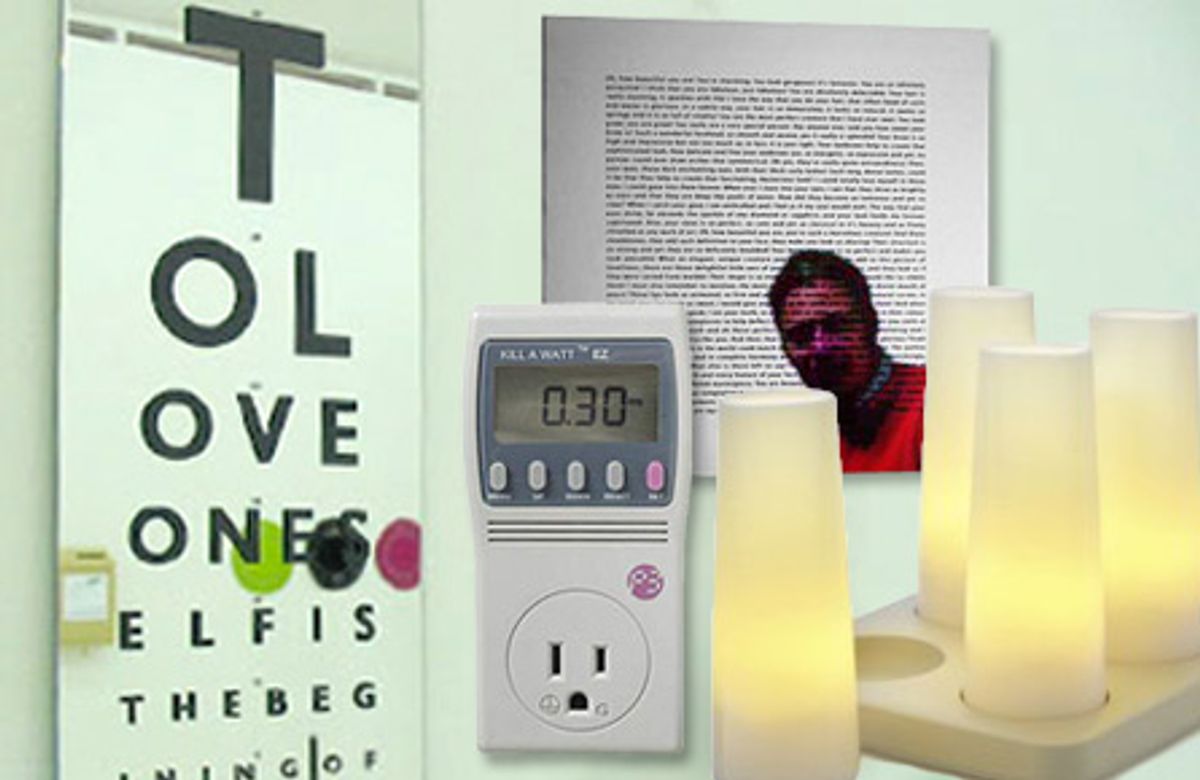
For the person on your list who has a sense of style and humor in equal measures, consider this Innervision Mirror ($89). It may look like an eye test on first glance, but get your eyes checked: It actually bears the Oscar Wilde quote “To love oneself is the beginning of a life-long romance.” Not to be mistaken for the Oh How Beautiful (You Are) mirror ($99), which sycophantically flatters its owner without quoting Oscar Wilde.

How many Republicans does it take to screw in a light bulb? None, if you use these Candela lights ($69 for a set of four), lit by LED rather than bulbs. Rechargeable, graceful and handy, these lights fall somewhere between a candle, a lamp and a flashlight; they can be used indoors and out, to set a mood or just fill in for that light bulb no one ever bothered to replace.

Chances are that most of your friends and loved ones will be spending a lot more time nesting during the recession. And more time at home means more wantonly wasted electricity. Exactly how much does it cost to keep that DustBuster or iPod docking station permanently plugged in? The Kill a  Watt EZ power monitor ($34.99) can tell you. Plug electronic devices into this little gadget and it’ll show how much each household appliance is costing on your energy bill. Who wouldn’t want to know that?

Are you there, God? It’s me, childhood

From "Harriet the Spy" to "A Wrinkle in Time," girl-centric novels of the past come to life in "Shelf Discovery"

  • more
    • All Share Services

Are you there, God? It's me, childhood


“Shelf Discovery: The Teen Classics We Never Stopped Reading” by Lizzie Skurnick

I never actually read “Flowers in the Attic” — just the “dirty pages” clearly marked in the well-thumbed copy passed to every single girl at summer camp  — but Lizzie Skurnick did. In fact, she reread it, along with more than 60 other books she had devoured in her youth for a Jezebel column called Fine Lines, collected into this enjoyable book. As Skurnick points out in the intro to “Shelf Discovery,” the 1960s-1980s were a transitional moment for young-adult lit, particularly for girls. Alongside the wholesome, winsome and plucky heroines of yore, an expanding range of female characters appeared in print: nerdy girls, Jewish girls, fat girls, slutty girls, girls with divorced parents, depressed girls and — of course — girls with ESP.

That last category might explain why I chose ESP and other supernatural subjects for my school science fair projects in grades 4, 5 and 6: too much time poring over Lois Duncan books like “A Gift of Magic” or “Stranger With My Face.” Or perhaps it was the wonderful Meg Murry of “A Wrinkle in Time,” the first of Madeleine L’Engle’s protagonists to “flit across the boundaries of space and time,” as Skurnick puts it, “even more flummoxed by adolescence than they are by being whipsawed across the universe.”

While reading these mini-essays (penned mostly by Skurnick, with a few guest appearances by YA novelists such as “Gossip Girl” scribe Cecily von Ziegesar) it occurred to me that I couldn’t possibly quantify how deeply these books had sunk into my own youthful psyche. But it reminded me of the intense connection I felt with “Harriet the Spy”; the original gossip girl, she skulked around New York jotting down scathing observations, inspiring me to buy my own diary (with a lock, since Harriet gets her comeuppance when schoolmates discover the harsh things she’s written about them). I know that I learned about periods from “Are You There God, It’s Me Margaret?”– but also I gleaned something about religious confusion, since, as Skurnick reminded me, Margaret’s 1970s parents have decided to let her choose her own faith, leaving her adrift in a town just like mine, where everyone went to Sunday school or Hebrew school.

“Shelf Discovery” styles itself as a memoir through books, but revising youthful opinions is encouraged. “Good in Bed” author Jennifer Weiner is slightly horrified to discover that “Blubber” is not “the ne plus ultra of fat-girl lit” but in fact is rather callous about the book’s chubby heroine. And Skurnick’s reading list doesn’t entirely skip boys, giving props to minor classics like Roald Dahl’s “Danny the Champion of the World,” Paul Zindel’s “The Pigman,” and “Farmer Boy” (written by Laura Ingalls Wilder, about her husband’s childhood).

 I’m sure Skurnick read plenty of books growing up, from Tolkien to Salinger; yet it’s great to look back and see this girl-centric canon, waiting to be reread by the grown women who loved them and a new generation of “monsters in training bras.”

Check out previous Critics’ Picks:


“Shelf Discovery: The Teen Classics We Never Stopped Reading”


“Coraline” in 3-D on DVD


Bowerbirds’ CD “Upper Air”


“Mad Men” second season DVD


Phoenix’s CD “Wolfgang Phoenix Amadeus”


Continue Reading Close

Deep inside the Boosh

Noel Fielding and Julian Barratt of "The Mighty Boosh" talk about bringing their fantastical cult hit to America

  • more
    • All Share Services

Deep inside the Boosh"The Mighty Boosh"

They used to say that comedy was the new rock ‘n’ roll, but I could never really see it. After all, how many comedians ever lived up to the rock star mantle? Standing in the dense crowd for the Mighty Boosh’s debut American performance at New York’s Bowery Ballroom, though, I changed my mind.

Behind me was a clutch of girls dressed in new-wave sailor outfits and, in front, a skinny boy dressed head to toe in silver sparkly lamé. The audience was ecstatic, singing along with clips and screaming with bloodcurdling fury at every word the comedy duo utters — surprising, considering that the Mighty Boosh, though huge stars in the U.K., have barely made any dent on America until now. Back in March, Adult Swim (the nighttime wing of Cartoon Network) started showing their freakadelic sketch comedy TV series “The Mighty Boosh” at 1 a.m., and it quickly built a viral cult following via YouTube; this week, all three seasons are being released on DVD.

Comedy is always tough to explain, but the magic of the Mighty Boosh is particularly elusive. The show’s opening sequence calls it a “journey through time and space,” but it’s more like a fantastical children’s show for pop culturally overloaded adult brains, a mash-up of fairy-tale plots, surreal humor, nimble dialogue, twisted musical numbers and homespun visuals and animation. (Its closest reference point might be “Flight of the Conchords,” but tonally it’s a galaxy away.) The series is the mutant brainchild of comedians Noel Fielding and Julian Barratt, who met in 1998 and started a shambolic live show that eventually grew into a British radio and TV phenomenon.

Noel is the genuine heartthrob of the duo, a scenester and intimate friend of Amy Winehouse, Russell Brand and Courtney Love. Impossibly charming, with a permanent grin of dazed glee on his face, Noel has a shag haircut and a penchant for dressing in glam-rock clothes: Imagine T-Rex singer Marc Bolan if he’d joined “Monty Python,” and you’ll start to get an idea. Julian acts as Noel’s more levelheaded foil, a perfect straight man with his mustache, his more settled personal life (he has two small children with comedian Julia Davis of the series “Nighty Night”) and his avowed love of jazz. In the series, they play exaggerated versions of themselves: Noel’s character is Vince Noir, a beguiling poseur in glam clothes who aspires to rock stardom, while Julian plays Howard Moon, a slightly dejected jazz fan with lofty artistic aspirations.

Over three seasons, the duo tumbles headfirst into dozens of wacky adventures: Howard is challenged to a boxing match with a kangaroo; Vince accidentally summons an evil demon disguised as a granny; Howard enters Vince’s bloodstream in order to rescue him from a rogue jazz cell that causes him to scat. Although they bicker hilariously, our two heroes are inseparable and usually end up saving each other from catastrophe, accompanied by a cast of characters that includes a shaman called Naboo (played by Noel’s brother Michael) and a talking gorilla.

Animals are everywhere in “The Mighty Boosh,” inserted blithely into plots as if it were normal for a London hipster to stumble across a crack-addicted fox or Mod-obsessed dancing wolves. Vince even claims that he was raised in a forest by Roxy Music singer Bryan Ferry: In a cartoon flashback, he explains that while Ferry was on tour, “he used to leave me with various different animals. I remember one time he left me with Jahooli the leopard. He used to take me out killing gazelles, knowing full well that Bryan was a strict vegetarian.”

Often Vince and Howard’s escapades force them to face down scary-but-comical beasts and villains, like the Hitcher — a green cockney boogeyman who has been known to break into a ravey tune on occasion, or Old Gregg, a lovesick hermaphrodite merman (like the Hitcher, played by Fielding) who emerges from the sea to dazzle Howard with the light that pours out of his “mangina.”

My favorite villains, though, are the dopplegängers in the third season who steal Vince and Howard’s style. When the copycats arrive at their shop dressed in a sparkly silver jumpsuit (à la Vince) and Hawaiian shirt with porkpie hat (à la Howard), the Boosh guys scramble to find a new look for their band’s concert that night. Vince digs through the dustbin of subcultural history, coming up with a “future sailor” look and then, “taking retro to its logical conclusion,” goes back even further to concoct a medieval theme, complete with lutes and codpieces. Eventually they vanquish the imposters in a “crimp off,” crimping being a wonderfully goofy yet oddly addictive form of rapping the Boosh invented, which has only added to their massive following.

“The Mighty Boosh” is a hodgepodge of stuff that Noel and Julian love (including ’80s synth-pop star Gary Numan, who makes repeated cameos, and their friends and their parents, who play bit parts). But the glue that holds it all together is their odd-couple affection for each other. As Howard remarks in one episode about their partnership, “I’ve got a dark, fractured, paranoid sort of side to me and he had the light, sunny, simpleton feel. Together we made one whole person.”

Salon spoke to Julian and Noel at their New York hotel as they prepared themselves for a week of American appearances — and the unknown.

Is this your first attack on American public consciousness?

Julian Barratt: It’s always so violent with the Americans, isn’t it?

Noel Fielding: Why is it always attacking and storming? We’re not Nazis!

Have any other English comedians who’ve done well here — Sasha Baron Cohen, Russell Brand, Steve Coogan — given you advice?

N.F.: No! We thought we should start with the standpoint that everyone would hate it.

J.B.: We’re not changing what we do. When we started out, it was a little bit in a reaction to what was going on in the comedy clubs that we went to at the time — men standing around in shirt and tie and white sneakers, talking about their dicks and their girlfriends. We wanted to do a weirder sort of comedy.

N.F.: Something that would talk about fashion and music. We just thought, all our mates who like to see bands and wear cool clothes, let’s do a show for them.

J.B.: I don’t have any friends with cool clothes.

N.F.: Yeah, you just like to talk about jazz. Julian needed an outlet to talk about jazz.

So that running joke in “The Mighty Boosh” that Noel is the ultimate hipster while Julian is this earnest jazzbo — that’s actually based on reality?

J.B.: Maybe it looks as though we have this strange, detailed writing process that created these characters, but it’s just us.

N.F.: We’ve always incorporated elements from our own lives. The show is quite fantastical and magical so we try to pepper it with stuff from the fashion and music we’re into, so that it’s anchored in some sort of reality.

Has music been part of the Boosh from the beginning?

N.F.: The first show we ever did, we had this idea of a zookeeper trapped in someone’s Afro. And we thought, “He’s gotta rap.” That was the first song we ever wrote.

J.B.: We were listening to a lot of Wu Tang Clan and Beastie Boys at the time.

N.F.: Then we realized you can’t really rap in an American accent if you’re English. It’s ridiculous. So we started doing more music that was English, like folk or glam rock or electro. And then eventually we figured out a kind of English rap, which is “crimping.” It’s sort of nursery rhyme rap, folk rap. I can’t imagine what the Yanks will make of it.

For Boosh freaks, the crimping segments are probably the most popular bits in the show. Have you ever checked out all the amateur crimpers on YouTube?

Both: [looking slightly aghast] No!

N.F.: I haven’t got a computer. There’s a lot of people on YouTube that … It’s terrifying. There are 40-year-old women dressed as the Moon [a recurring character in the show]. You just think, “What are you doing?” I hate computers. I find YouTube and MyFace and Google really boring.

J.B.: It’s a tool, Noel. It’s just like using a pencil. It’s all about what you do with it.

Are the crimps improvised, or is there a lot of work and advance preparation involved in crafting a crimp?

N.F.: It’s not spontaneous! It’s very complicated. It takes about nine years to write one.

J.B.: You have to find the exact right kind of nonsense. To find something that’s surprising, that has odd angles.

N.F.: There’s a pancake crimp and a soup crimp — that kind of crimp is a bit easier, when there’s a theme. But the ones that are just free-form — ooh! I wouldn’t recommend trying to write one of those bad boys.

J.B.: We were writing the shows and doing these raps and people started saying, What are those things? So we had to call them something. Which I think came from crumping, that clown-dancing thing in that David Lachapelle documentary.

When you mentioned earlier about the first Boosh performance and the zookeeper who gets trapped in someone’s Afro — it sounds like your entire act was there right from the start. Did you just meet and say, “Let’s do really psychedelic, animal-based comedy?”

J.B.: The weirdness, the dialogue, the music, the animal stuff, everything’s there already in the first gig. We should have retired. We had a tight nugget and now we have a big, loose poncho of stuff sprawled everywhere.

Is it all coming from childhood influences, that magical sensibility?

N.F.: Our parents were both quite into psychedelic music — Frank Zappa, Beefheart, Santana, all that.

J.B.: My dad listened to a load of jazz — Mahavishnu, Weather Report, Herbie Hancock.

N.F.: It is our parents, really, isn’t it? They were quite young, my parents — I don’t think they knew how to bring anyone up. They were 18 when they had me, so even by the time I was 10 they were still just running around in the garden having parties, quite irresponsible.

J.B.: And my dad wanted to be a musician, so when I started playing guitar, he was like, “Go for it.” That is what I did for ages, I was in bands. And then I went to university and got into comedy somehow.

N.F.: I went to art college. I did a cabaret act as Jesus there. Everyone else was doing serious performance art and mine was all jokes about lepers, and some Mick Jagger dancing as Christ. But I don’t think either of us went into this thinking, “We’re going to be comedians.”

When “The Mighty Boosh” started, the reigning style in British TV comedy was what I call “the comedy of cringe”: “Alan Partridge,” “The Office,” and over here, “Curb Your Enthusiasm.” Ultra-realistic, and pretty mean. What you guys do seems like the complete opposite: fantastical and basically sweet-natured (if a little foul-mouthed).

N.F.: This is why it took us so long. We had a lot of affection for a lot of things we were taking the piss out of, like jazz.

J.B.: And the monsters and the villains were often quite sympathetic. Also, we wanted to create a world, a visual universe. If you come away from a show thinking of an image, that’s as good as remembering a joke. A lot of those shows, like “The Office,” they are brilliant but they’re not visually interesting.

N.F.: We want magic forests! Epic adventures! “Alice in Wonderland”-type stories and quests and voyages. It wasn’t very fashionable at the time. It took us a long time, because everyone was really into “The Office.” “The Office” changed everything in England. It made it very difficult to do anything different because it was such a success.

J.B.: And “The Office” was so cheap to make!

N.F.: Whereas we were trying to make things like a stylized forest that probably cost the same as doing half of a series like “The Office.”

You have all this stuff that relates to children’s storybook stuff, the marvelous and the grotesque. But there’s a whole other side of the Boosh that’s about witty, ultra-knowing pop culture references, like the dancing Mod Wolves or the retro-electro band Kraftwork Orange. How did Gary Numan end up being the patron saint of the Boosh?

N.F.: Numan was massive when we were kids, he’d be playing stadium shows in the U.K. My dad’s best friend did the sound engineering on “Cars” and I went with him to get his gold record award. I was only about 7 or 8, and that was the first pop star I’d seen in real life. I thought, “Oh my God, how can you dress like that as a man?” I thought it was the best thing ever. And then when I found out Julian was into him. So we thought we should get him in the show.

Recently there’s been all these diatribes in magazines and Web sites about hipsters as superficial trend-hopping poseurs, with strongholds in Williamsburg, Brooklyn, and of course the Shoreditch area of East London [where the third season of "The Mighty Boosh" is actually set]. But you are pretty affectionate in the way you lampoon hipsters, aren’t you?

N.F.: Vince Noir, my character, is probably the ultimate scenester. He wants to be famous, he dresses up like he’s famous, and all his friends are really trendy. Howard Moon, Julian’s character, thinks Vince is absolutely ridiculous, but … it is pretty ridiculous. We went for that a lot in the third series of Boosh. We tried to make all the extras like they were our friends, so they wore all their own clothes.

Is there another series coming?

N.F.: We finished touring, we did six months of that. So we needed a break. There’s talk of a fourth series. Or an album. Or a film …

What would the film be about?

Both: [vague, blank faces]

Are you not excited about the prospect of doing a movie?

J.B.: I’m just trying to imagine what it could be. We always wanted to do a big epic, a Sinbad-type adventure. But then we went ahead and did it on the TV show. A big epic journey in a half-hour — that’s quite a stupid thing to try to pull off. 

Continue Reading Close

The sexual awakening of Hermione

How "Harry Potter" star Emma Watson is navigating the tricky transition from adorable child actor to mature adult

  • more
    • All Share Services

The sexual awakening of HermioneEmma Watson

In the days before the release of “Harry Potter and the Half-Blood Prince,” based on the very dark sixth book in J.K. Rowling’s series, media and fan sites percolated with anticipation over one particular moment in the next movie: the kiss between Harry’s best friends Ron and Hermione. Not hugely surprising, since anxiety about growing up is central to the series and, as James Parker so aptly puts it, these movies “have served as a sort of time-lapse study of puberty.”

“This is 10 years’ worth of tension and hormones and chemistry and everything in one moment. We had to ace it,” Emma Watson, who plays Hermione, told the press last week. She got more specific with MTV about shooting the scene with Rupert Grint, whom she has known since she was 9, explaining, “We were both just like, ‘Oh my God, I can’t believe we have to do this. This is so awkward. Really awkward.’ So I could take comfort in the fact that Rupert felt the same way. We were both giggling. We were like 12-year-olds.”

Growing up in public is always a dicey affair — whether you are a wizard inheriting the weight of the world, or a young actress with a multimillion-dollar movie franchise partially resting on your pale ivory shoulders and rosy lips. But the dangers seem much more perilous for young women than men. I did a double take a few months ago when I spotted Watson — pure as the unicorn-driven snow, beloved of 8-year-old boys the world over — staring saucily from the cover of Interview magazine, mouth open like a blow-up doll. Is this Hermione’s get-out-of-child-stardom card, I wondered? Daniel Radcliffe had already plotted his escape route last year with a quick shortcut to instant adult status: full-frontal nudity. Since it was for a serious role in a serious play (Peter Shaffer’s “Equus”), Radcliffe was feted for artistic credibility and bravery (especially after he talked in interviews about the shriveling effects of a live audience on the male member).

But shifting your image into a more mature gear has very different ramifications for a young woman than for a young guy. I doubt many people actually wanted to glimpse Harry Potter’s wand, whereas at least one creepy Web site counting down the days till Watson’s 18th birthday popped up back in 2004. The media had been chasing after a glimpse of Hermione’s magic underpants since she came of age. In fact, London tabloid the Sun ran a picture of Watson on her 18th birthday, inadvertently flashing a little too much skin getting out of a car. (They kindly placed a little photo of Ron Weasley’s head in her crotch to block out the offending view.) Her more recent “wardrobe malfunction” at the London premiere of “Harry Potter and the Half-Blood Prince” (her elegant vintage gown flipped open while she signed autographs, exposing her flesh-colored panties) sent seedy ripples across the Internet — repeated again when David Letterman showed the photo to his audience while interviewing her.

To her credit, she coolly shrugged off Letterman, saying, “At least I was wearing underwear.” And though Watson told the London Times that she would consider doing nude scenes for an artsy director like Bernardo Bertolucci (“I’m not getting my kit off any time soon, but it is part of my job,” she explained reasonably), she seems in no hurry to expose herself. Flashing skin — or, in Miley Cyrus’ case, wearing hooker boots — may be the quickest route to tabloid fame for a female performer. Watson’s many high-fashion shoots in magazines like Italian Vogue and her Burberry campaign seem to skew more toward powerful, edgy chic than flaunting flesh — though this spread-eagle pose on the forthcoming August cover of British Elle looks slightly uncomfortable.

Despite a recent rumor that she’s considering co-starring with Marilyn Manson in a goth-flavored version of “Cinderella,” Watson assured Letterman that she was headed for an Ivy League American university this fall, rumored to be Brown. “I’m young and indecisive and not quite sure what I want to major in,” she said, like a normal 19-year-old. But it won’t be kissing. “Maybe English, maybe art.”

Continue Reading Close

The great foreskin debate

To snip or not to snip? That was the question facing new parent Danae Elon, who didn't just wrestle with the controversies of circumcision -- she made a documentary about it.

  • more
    • All Share Services

The great foreskin debate

New parents face an endless barrage of questions: which prenatal tests, what kind of diapers, which nursery school? But one choice is irrevocable: to snip or not to snip? That is the daunting question, one freighted with intense cultural and religious meaning. And yet people often don’t give it much thought at all.

For someone like me, a nonpracticing Jew married to a non-Jewish husband, it was a confusing moment. Neither of us had been raised in a religious household, and neither had set foot in a house of worship except to attend the occasional wedding. But I felt myself tempted by the lure of ritual and tradition. Jews consider circumcision a commandment from God, practiced over thousands of years — who was I to cut my son off from that? My husband, meanwhile, considered it an antiquated ritual lacking sufficient medical justification (an opinion similar to that of the American Academy of Pediatrics). On top of that was the fear of robbing one’s child of something — nerve endings, sexual feeling — that can never be returned. It’s an issue that American couples continue to wrestle with; although the number of boys routinely circumcised in the U.S. has decreased dramatically (one study shows the rate at 57 percent, down from a 1960s circumcision rate of 90 percent), the majority of parents still opt for it.

Could so much really depend on this thin slice of foreskin? That’s what Danae Elon set out to explore in her documentary “Partly Private,” which premiered at the Tribeca Film Festival this week. Elon lives in Brooklyn, but she grew up as a secular Jew in Israel with an American mother and an Israeli father, the well-known author Amos Elon. In her first documentary, “Another Road Home,” Elon went back to Jerusalem and to the West Bank looking for the Palestinian nanny who had cared for her as a child, using her own experience as a way to touch on deeply complex issues about class and Palestinian-Israeli relations. Likewise, Elon places herself at the center of “Partly Private,” making her own pregnancy into a fraught and funny investigation into circumcision.

Sitting in the filmmaker’s lounge at Tribeca, Elon looks both radiant and a little anxious. She says that she tried to avoid taking an overt pro- or anti-snipping stand in the film, preferring to survey the whole world of circumcision with an open — if amused — mind. She introduces us to a broad cast of characters, from the mohel (a Jewish specialist who performs the procedure) who keeps all of his clients’ foreskins in a jar, to the anti-circumcision activist who expresses his own penile trauma in a children’s book, to the employees of a skincare company who use discarded foreskins in their antiaging cream. “Every bottle is not a foreskin,” one of them assures the camera.

Elon also ventures further afield, visiting the Italian town that once supposedly housed Jesus’ foreskin (it was stolen) as well as a Turkish party hall called Circumcision Palace, where she films dozens of little boys (aged 6 to 9) dressed in white suits going under the knife in front of their families and friends. Finally she journeys to Hebron on the West Bank, looking for the exact spot where Abraham is said to have received the order from God, and finds instead a wasteland decimated by war and religion. As she says in the documentary, “Did he really say to Abraham, ‘Cut off the tips of your dicks?’ What if we got it all wrong?”

All of this serves as research for Elon’s own charged decision, which she has to make not once during the film but twice. When the movie opens, she is pregnant with her first child. Her husband, Philip, a French-Algerian Jew, feels the strong pull of tradition, and she ambivalently goes along with his desire. But when she gets pregnant with another boy after several years of immersion in the topic, she is forced to decide what she really believes is best for her son’s penis.

Was it always your plan to make a movie about circumcision?

I had always wanted to make a film about it. I thought about extreme rituals, things that might be anthropologically interesting and contradictory, but I could never find a story structure that made sense. So I kind of let it go, until one day I was two months pregnant with my first child and Philip came through the door. We used to live in the East Village in a railroad apartment with a bathtub that was in the kitchen. So he comes through the door, and I’m kind of in this pregnant bliss in the bath, and he says to me, “What are we gonna do about the circumcision?” with a really solemn face — knowing what I was gonna say to him. So at that moment, it clicked. That’s the film!

You come from a secular Jewish family. So was your resistance to circumcision a matter of wanting to shake off that element of religious tradition?

Well, everything in my family is political and to me, creating the mark of circumcision meant also identifying with something I had a very hard time with. So it wasn’t so much the issue of, am I harming the child or not? It’s: What kind of a mark am I giving him? As someone who was born in Israel, that took on a very deep meaning.

In the film, I decided not to make a political statement. But when I went to Hebron, and I realized that this tradition comes from here, and [I saw] this ritual taking place in one of the most conflicted, horrible places in the world and it’s done in such a primitive, very nationalistic way — I was basically saying, you know, why is [what we are doing] different? We’re all doing this because we believe that we belong to this group. And I don’t want to belong to this group, but I do.

Whereas Philip does want to belong. He wants to feel part of this Jewish tradition.

He doesn’t come with the baggage that I have, being from Israel and having such strong reactions to the politics there. He emigrated from Algeria when he was just a month old, came to France to a very hostile environment, and his parents clearly hung on to what they brought with them from Algeria, so for him it’s not even a Jewish rite. Belonging is what it means to him. For me, my belonging is highly politicized.

I know a lot of people who have had these issues come up, but it’s usually from intermarriage. In this case, you were both Jewish, but it was two very different upbringings colliding.

This whole idea of intermarriage was also one of the major forces in my very deep enthusiasm to explore the subject: why it meant certain things to him and why it meant certain things to me. For Philip, his father had died when he was a very young boy. So it was, this is what my father would have wanted.

And on the other hand, your father called your decision to have your first son circumcised “sheer conformity.”

He did call it conformity. But you know, my father, he’s a well-known intellectual — and he would have left it up to my mother. He would not have faced this question. It’s an uncomfortable thing to question, and even the most rational and intellectual of us feel insecure as to what is the right thing to do.

Did either of you have regrets about it afterward?

Both.

Both of you did?

Yes. I think it’s a question of — there’s a certain degree of courage that you need in order to face up to who you really want to be. And I think that having circumcised our first son was the initial mistake. Because it took on so much meaning and we’d documented it and really blew it out of proportion. I was making a film, so of course we became representatives of a certain kind of argument or issue.

How much did the subject seep into your regular life? Did you ask men you met at dinner parties if they were circumcised and unhappy about it? I imagine that would provide some awkward social moments.

The best moments happen off camera. Like when you have a man that’s circumcised and he has a circumcised child, and the wife starts saying well, you know, actually, I didn’t want that … It creates all these uncomfortable moments between couples. Ultimately, I don’t believe [being circumcised or not] does have an impact on your sex life. But it’s kind of funny once people start comparing and contrasting, and men feel a little bit insecure. That’s the kind of stuff that’s very hard to capture. I tried very hard to find someone who was going through the process of getting circumcised as an adult. I couldn’t find someone, and once I did, he kind of flipped out on me.

I met someone recently who was circumcised as an adult because he married a Jewish woman, and I was shocked. It’s an extreme gesture — of love or faith or both.

I know somebody who did the same and ended up getting a divorce two years later!

That’s worse than getting a tattoo!

To me, the interesting part of making this film was exploring life through the prism of circumcision. So I don’t want to become this advocate of what’s good or bad, but I think if you look at something that’s both so significant or insignificant — can you think of anything else that has those two complete opposites in one gesture?

You try to avoid getting overtly political in the film. But I have seen people compare circumcision to female genital mutilation.

I absolutely think that it’s offensive to women to think that there’s any parallel here. Of course, they both involve genitals but are done for very different reasons, and I ran away as far as I could from anything to do with female circumcision, which has to be stopped. It’s not comparable. But what does interest me is why the movement against male circumcision needs to be so extreme? They have such a valid point, but they come off as such extremists.

One of the anti-circumcision activists you interview even gets you arrested while you are filming him. They come across in your film as really, really loony.

They are! Both sides of the equation are crazy, the whole thing is crazy. Those who believe in it and those who believe it must be stopped because it is genital mutilation — they all have valid reasons and all are insane. I love the idea that we look at ourselves through this insane prism, my family included.

In the film, you capture a lot of different contexts for circumcision. But to me the most startling was the Circumcision Palace in Istanbul. Circumcision is treated like a wonderful rite of passage, but there’s one little boy who is screaming because he is being forced to let a man take a scalpel to his penis. I found it hard to watch. What was it like to watch your own son go through it?

It is beyond words. You feel like you’re sucked into this dimension. There’s the supposed spirituality, everything that you’re supposed to buy into, and when it’s all over you feel that you’ve been completely fooled. When you hear your child scream you realize that this was very wrong. Both Philip and I felt it.

Is it a very different experience if you get your baby circumcised in the hospital rather than the synagogue?

I just talked to a woman who gave birth in the hospital and after day two, the doctor came in and said, so are you doing this or not? Her husband’s like, “Well, maybe he should look like me.” That’s it. And that’s how it happens to most people. They don’t even think about it. So I kind of wanted to take you on this journey where you are going to think about it.

You end up having to make choices about whether to circumcise each of your sons. And at the end, you worry that they will be mad at you when they grow up and understand what you’ve done.

Who do you betray? A son who has been circumcised, a decision you’ve just spent nine months ridiculing? Or a son that is intact? I was gonna betray both of them, no matter what way I chose.

Aren’t they going to be more mad about the fact that you made a movie about their penises?

They’re delighted. They don’t know it’s about their penises, but they’re delighted they’re in a movie.

Continue Reading Close

The crumbling beauty of “Grey Gardens”

The 1975 cult documentary inspires this new HBO film, starring Drew Barrymore and Jessica Lange as batty aristocrats living in eccentric squalor.

  • more
    • All Share Services

The crumbling beauty of

How is it possible that two reclusive, batty aristocrats whose lives looked liked the end of a line — albeit the fantastic flaming out of a certain kind of American old wealth — have become a veritable industry? Edith Bouvier Beale and her daughter, “Little Edie,” relatives of Jacquelyn Kennedy Onassis who chose to live in eccentric squalor, steadfastly turned their backs on industry of any kind. Yet, starting with the 1975 Albert and David Maysles documentary “Grey Gardens,” they became cult heroines, the focal points of an obsession that now needs to be fed on a regular basis.

Twenty years after “Grey Gardens,” Albert Maysles released “The Beales of Grey Gardens” with leftover shavings from the original; then there was the celebrated Broadway musical, (accompanied by a documentary about the making of the musical). There are high-fashion photo shoots inspired by Little Edie’s flamboyantly disheveled style, memoirs by people who knew the Beales, CDs — even a jewelry company (the Grey Garden Collection) founded by a relative. And now, on Saturday, HBO premieres the two-hour feature version of “Grey Gardens” with Drew Barrymore as Little Edie and Jessica Lange as Big Edie, her mother and captor. What could possibly be next? A Nickelodeon cartoon called “Little Edie and Big Mama”? Or perhaps a Bravo reality show: “America’s Next Top Eccentric”?

I emerged from the screening of “Grey Gardens” blinking with confusion at the ass-backwardness of it all. A documentary often fleshes out the back story of a real-life event. Yet here I was watching a feature film in order to get the “truth” behind a cinéma vérité classic. The Maysles’ portrait of this extraordinary duo was subtle and invasive in equal measures, bearing very little resemblance to the current genre of reality TV (starring Bonaduces and Baios) that thrives on the rotten luck and poor choices of the formerly famous. Watching the original “Grey Gardens,” you couldn’t help wondering how these women had tumbled into this state of decrepitude and how the filmmakers had inveigled their way into the Beales’ good graces.

The movie answers both of those questions, flipping between the Beales’ glamorous glory days in the 1930s (glimpsed only via old photos and anecdotes in the original doc) and their shambolic existence at the time the Maysles met them in 1971. It’s a strange project, working backward from the snippets of a life as gathered from a documentary, developing a narrative from the flotsam and jetsam of two not-quite-there creatures’ competing memories.

Barrymore has diligently studied Edie’s every move and utterance, trying a little too earnestly to re-create everything from her dancing to her diction (the latter a strange soup of dragged-out syllables that sounds both old-world posh and New Yorkish). She plays the young Edie — the one we don’t know very well — as an ebullient bombshell, a cup perpetually running over. Serenely walking on the Easthampton sand in a white swimsuit with her awestruck little niece Jackie Bouvier, she is a golden-haired It Girl on the verge of coming out to society, courted by the likes of J. Paul Getty and Joe Kennedy Jr. But as the film makes clear via its chronological leaps, the seeds of the 50-something Edie (with her upside-down skirts, impracticality and withering wit) can be traced straight back to her youth. Evidence of her skittish streak: Edie runs out on her own debutante ball. Her mother doesn’t seem all that surprised by Edie’s misbehavior, chiding her, “Always the queen of the dramatic pause.” 

Is Little Edie’s behavior heroically rebellious, stupendously self-destructive or some tragic mix of the two? She’s chasing after pleasure in an era when women of all classes are expected to settle down and hush up. Spurning the attention of suitable bachelors, Edie chooses to sleep with married men, knowing that a husband would snuff out her dream of becoming a performer (just as Edie’s father had curtailed Big Edie’s career as a singer). In a scene taken directly from an anecdote in the documentary, Edie assails the Broadway producer Max Gordon in a restaurant and does a charmingly amateurish little song and dance number for him. It’s hard to know whether Gordon really means it when he compares her to Judy Holliday, but that moment is forever lodged in Edie’s gut as her big chance — a chance she didn’t take. Pressured by both her disciplinarian father (who expects her to work as a secretary until she lands a husband) and her needy mother (who wants Little Edie back home to keep her company), she buckles. And never quite unbuckles.

The glorious thing about the documentary was its ambiguity: There are no clear villains. Sure, Big Edie screeched and bossed her daughter around, but it appeared to be a symbiotic relationship, soaked in mutual affection — the familiar dynamic of so many mother-daughter relationships. But in this incarnation, Little Edie dubs her father, Phelan Beale, “the villain of the piece.” Determined to be rational (especially in the middle of the Great Depression), he crushes the very irrational women in his life, stripping them of their creature comforts. “Neither of you would know stable if it walked through your soup,” he rants at one point. Later on it will be Phelan and Edie’s two pragmatic sons who confront Big and Little Edie, begging them to be realistic about money and the irrationality of hanging on to the house. It is as if something in them demanded all or nothing — and sensing that all was not on the cards, they created their own cocoon, seemingly insensible to the decrepitude around them. 

That decrepitude has been widely fetishized, and so it’s not surprising to see such lavish attention paid here to costumes and set designs. Everything is lushly dilapidated and distressed in a most aesthetically pleasing way. First-time director Michael Sucsy has a good eye for shambles: I particularly remember the tableau of mother and daughter in strange black mourning outfits listening to JFK’s funeral on the radio, sitting primly on a bed swamped by garbage and cats. The camera devours the decay — a tree is growing through the ceiling! A cat is peeing behind the painting of Big Edie propped on the floor! But the women who once lived in luxury treat it all with a certain vagueness, as though the outside world barely registers in comparison to the intensity of their inner lives.

Jessica Lange’s Big Edie is an enigmatic, lonely figure, exuding a low-level warmth that keeps her daughter orbiting around her like a satellite. She sometimes fades into the background, allowing Barrymore to preen in the spotlight before chastening her with a passive-aggressive slap. “I don’t think you see yourself the way others see you,” Big Edie warns her daughter toward the end of the film, as the Maysles are wrapping up their documentary. “You are an acquired taste.”

Cleverly, the making of the documentary becomes an intrinsic part of the movie, used as both a framing device and a happy (or at least happyish) ending. Far from tricking the Beales into revealing themselves, the Maysles stumble upon two women ferociously eager for an audience. They happily agree to be filmed, although they seem somewhat muddled abut the nature of the project. “Is there a script?” Little Edie asks. “I’m a very quick study.”

“Grey Gardens” does a vivid, entertaining job of bringing cinéma vérité to fictional life. But as Hilton Als wrote in 2001 of the Maysles’ documentary, “What draws the viewer in are the stories around what we cannot see: Miss Beale lamenting the loss of a scarf. The suitors turned away. Mrs. Beale’s infatuation with a man whose minor musical talent is better remembered than heard. Money spent.” This movie fills in those bittersweet blanks, forcing “Grey Gardens” lovers into a trade-off: Our curiosity is sated, but we lose some of the most haunting shades of gray.

Continue Reading Close

Page 1 of 4 in Joy Press