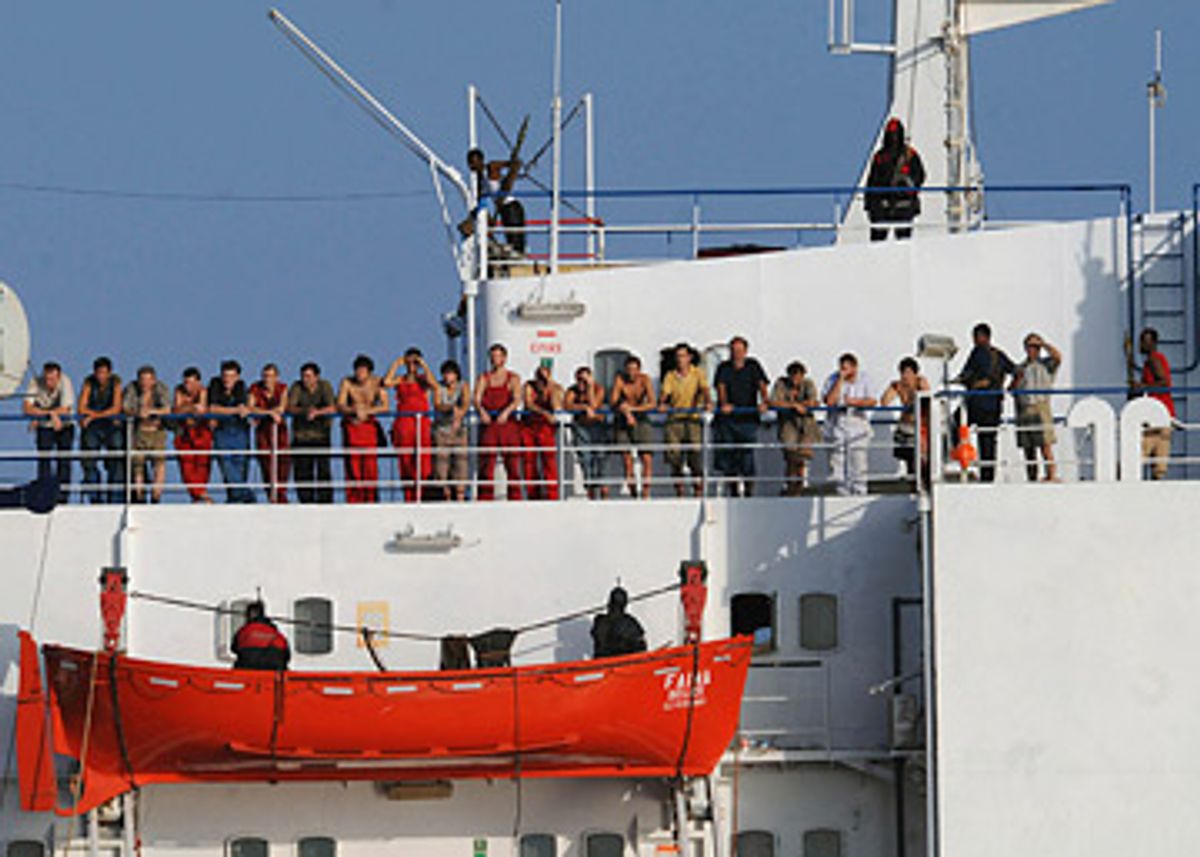
Ships pillaged for their booty, hostages held for exorbitant ransoms and hand-to-hand battles on the high seas -- recently, pirates operating out of Somalia have returned the east coast of Africa to the era of the legendary 18th-century Barbary pirates. Governments around the world are now sending warships into the Gulf of Aden, between Somalia and Yemen, to combat the pirates. Meanwhile, outside mercenary contractors like Blackwater are also offering armed protection services for tankers and freighters traveling in the area.
Blackwater has vowed to use lethal force. Last week, Salon spoke with Nick Davis, a former British Army pilot, who now heads a firm that addresses piracy by non-lethal means. Davis, founder and CEO of the U.K.-based Anti-Piracy Maritime Security Solutions (APMSS), argues that the Somali pirates are far less aggressive than their image in the media would suggest, and that the best way to counteract them is via high-tech audio, not guns. Recent events, however, may undermine Davis' business plan: On Nov. 28, three days after this interview, and after Davis insisted the non-lethal strategy was effective, a three-man crew from his firm had to jump into the ocean to escape from pirates who had overwhelmed a tanker they had been hired to protect. Davis' team was rescued by a German naval helicopter; the tanker's crew of 25 was still being held hostage at press time. Salon spoke with Davis by phone.
Your company emphasizes a non-lethal solution to combating piracy. How is a non-lethal response even possible?
We have ex-Marines and Special Forces that are grouped into three-man teams that board the [merchant] ships to protect them. We travel on board the ship. We don't have vessels that shadow a ship. We actually put supplementary deck security teams on board vessels. They board in Salalah [a city in Oman] or in Aden [a city in Yemen], depending on which way the ships are going through the MSPA, the Maritime Security Protection Area, that the coalition forces have designated as a safe corridor.
Our teams embark with equipment, which will either be the Long Range Acoustic Device [LRAD] or the Magnetic Audio Device [MAD], and these two pieces of equipment are effective. They are sort of parabolic dishes that are loud hailers. Now they transmit warning sounds and tones as well as voice communications at very, very, very high volumes over a distance of approximately 1,000 meters. The pain threshold for a human for noise is around 120 decibels. These transmit at 150 decibels. It's fairly considerable excruciating pain when you get within 200 to 300 meters of this noise. That coupled with the ship going at full speed and zigzagging and water cannons, barbed wire and grease and various other bits and pieces on the back of the ship all basically amount to a fairly effective deterrent for what is basically from the pirate's capabilities a fairly primitive way of boarding, i.e., throwing a grappling hook onto the back of the ship and climbing up a rope ladder.
So you never engage the pirates with more violence than that? You never use any type of weaponry to attack them physically?
No. If in the unlikely event that they might actually get on board, these ex-Marines and Special Forces are all trained in close quarters combat. They will all have their own personal knives on them and obviously it will probably end up in fatalities of the pirates if they did try to board the vessel. Because, while our crews don't have firearms, they don't necessarily need firearms to be able to look after themselves in self-defense mode.
The main goal then is deterrence?
Absolutely. It's earlier identification and vigilance to identify the threat action and prevent the boarding of that threat and then to repel the pirates away from the vessel.
Could you expand on how the LRADs and the MADs work?
Basically, they use a satellite dish hooked up to an MP3 player playing at 150 decibels that has prerecorded tones, warnings and messages. Obviously, you can record any voice message in any language you like, plug it in to the MP3 player, and then as these speedboats get closer, it's a full pan and tilt and the operator then lets them know that they've been seen and it's very, very effective.
How far away are the pirates when this type of warning is activated?
We start it all off at one nautical mile.
Did you see this outbreak of piracy coming before it happened?
Absolutely. It's been mushrooming and becoming visible since spring of this year when we set the company up. I never envisioned it was going to be as busy as what we have been, but obviously I'm extremely grateful that we are. It's great. But at the same time, it is a problem that the U.N. and politicians and the world at large are going to need to address. I don't think that the solution is with coalition forces and firepower. I think the solution is with the U.N. and peacekeeping and reinvestment and regeneration of Somalia.
What is your experience combating these pirates? Have your men been out on the water in the Gulf of Aden recently?
We currently have 10 three-men teams embarked on ships in the Gulf of Aden right now, today. We ourselves have almost daily encounters with the pirates. The last sort of definitive, what we'd call a combat indicator of an attempted attack and boarding was last Thursday [Nov. 20]. The ship had to fully comply with the procedures to avoid hijacking -- attempted pira-hijacking. Put the ship on high speed, zigzagging, water cannons on full power, our teams obviously got them mad with the MAD. We're pretty successful. And to be honest with you, the pirates aren't interested in close quarters combat. They're not interested in ships that have additional deck security because they're completely unaware of whether we're armed or not. And they're not trained to deal with ex-Marines and Special Forces, so they will typically then divert to the next vessel, which ideally for them won't have deck security on board, in which case they've got their ticket.
Generally, do the pirates fire on you? Do they attack you?
They quite often fire weapons. They fire their AK-47s as sort of a warning, a deterrent, to get you to stop the vessel. They never actually normally direct it at any personnel. They direct it at the ship. At the ship's hull, the ship's superstructure. They're not into getting you between the cross hairs and trying to take you out. They're purely after scaring you and getting you to stop the vessel so that they can board.
Have you spoken with any of them or have you been in tense situations that you've had to manage your way out of?
Yeah, we've got sort of tense situations almost daily with the teams that we've got embarked. The only time we speak to the pirates really is over the telephone or over the loud hailing system. They don't come up to the vessel to come up for a chat, that's for sure. And we wouldn't let them get that close because we're employed by the ship's owners to ensure that they do not get close to the vessel. So our actual interaction with them is fairly limited, although we do have fairly extensive intelligence and in-country people who can help us with communicating with them and trying to understand and trying to help them to find the solution, because it's not in our interest really to maintain the offensive towards the pirates and the Somali people. It would certainly be my sort of desire to find a solution and to help broker that solution.
The pirates have been reported to have grenade launchers -- how can the acoustic devices that you use prevent a grenade attack?
You can't prevent a grenade launcher attack, and that's just something that we need to live with. Ninety percent of the grenade launchers when they launch them will bounce off the ship, or they're not very accurate or they don't get close enough in order for their effective range to work. Yes, we've been shown the RPGs [Rocket Propelled Grenade launchers], but they don't themselves want to get into a gunfight, they don't want to get into an armed battle and they have no idea whether we're an armed vessel or an unarmed vessel because of all of us, both the armed military coalition vessels as well as various vessels with coalition forces embarked upon them. It's very difficult for the pirates to differentiate between those that do have weapons and those that don't.
Has there ever been one situation that sticks out in your mind as particularly dangerous that you've had to go through?
Not really. The name of the game is vigilance and preventive measures and good coordination with the master and the ships' crew. All situations are dangerous. It's more dangerous putting the ship up to full force speed and pulling evasive maneuvers when there are 200 ships in close quarters around you because sometimes you can get fairly close to other ships by the time you get back on track. So it's a big team effort. But no real sort of scary times other than ricochet of bullets off of the superstructure when they do fire at you.
That sounds scary.
That can sometimes be a bit entertaining. We're OK. All the guys have got Kevlar vests and helmets and stuff; we use the same military kit that the coalition forces do. They don't have anything more or less than us. All of my guys are ex-Special Forces or Marines, so they all follow the exact military procedures. We're in constant communication with the coalition forces and they are aware of all the ships that my teams are embarked upon.
The pirates usually don't fire first when you're approaching them?
Sometimes they fire a few warning shots, but to be honest with you, as soon as you've activated all of the procedures with regards to the acoustic and the water cannons, and the zigzagging, they know it's not worth it going any further. So they quite often just come up and shout and scream at you and sort of wave and then turn south to the next vessel.
Can you talk a little bit more about the level of sophistication of their operations? They've issued huge ransom demands -- have you ever been involved in handing over a ransom?
We don't get involved in the kidnap and ransom side. That's left to the trained negotiators who are approved by Lloyd's of London to do that, of which there are only three or four companies. Obviously, they use very primitive means to get on board -- they've got a speedboat, a couple of AK-47s and a rope ladder, it's as technical as that. So, they don't use very sophisticated means. Once they're on board, then there's nothing the coalition forces can do. It's not worth trying to fight so you just do as they say. And then the tit for tat starts with demands, counteroffers, demands, counteroffers, demands and it carries on for a week or two months, however long the ship owners want to carry on, and then they settle for a deal that normally is between half a million and one and a half million dollars.
So if they're not overly sophisticated, then why have they been so effective? What are the chief difficulties in combating them?
The prime reason that they've been so efficient is that the ships themselves have been very, I don't want to use the word "lazy," but they've not taken their ships and their crew and vessel security seriously enough to put preventive measures on board prior to them sailing through a known high-risk area. It's almost a case of, oh, it's not going to happen to me, and that's a pretty poor attitude to have so if you don't have the vigilance and the equipment on board to repel and counter piratical attacks in a high-risk area, then I'm afraid the onus is on the ship operator and owner. It's not up to the coalition forces to police the oceans of the world.
The Sirius Star, the oil tanker that was captured on Nov. 15, is the largest ship ever taken by pirates. If you had been aboard, what would you have told them to do differently?
Well, if we'd been on that boat, it wouldn't have been taken. It's that simple. There's no way in the world that that would have happened. They had obviously left the Arabian Peninsula and were heading toward the cape down the Mozambique Channel and they were caught in the only pinch point for known piracy, and I think you have the feeling that you are a far enough distance away from land for there to be no threat. That's not a valid excuse not to maintain vigilance and be aware of other vessels operating within your vicinity.
Has there ever been an instance where a member of one of your crews has been on a boat and a group of pirates has managed to get on it? And if so, would they be authorized to throw the pirates off the boat or counteract them in a more violent way?
No, no pirates have ever gotten on a vessel with our crews embarked. And that's an ultra unlikely scenario. Basically in self-defense, whatever the outcome was, if one did get on board, is what it is. Our men don't have firearms, but like I said earlier, these guys are Special Forces and they know how to look after themselves. And they will have rope knives and/or small combat knives with them.
What is the safest route, whether it's going east or going down past the Cape of Good Hope, for a merchant ship to take? The pirates seem to be expanding outside of Somalia -- they were just caught off the coast of Kenya, which is much farther than they seem to have gone before.
But there's two different pirate groups -- you've got the southern group that took the Sirius Star, not the northern group who have taken all the other ships. You've got two different groups operating and you've got others that are doing copycat because they think, "Well, we've watched how easy it is and how much world media attention the pirates up in the north have had -- if it's that easy, we'll crack on and do it." And that will be the case. In effect, if you sail in the southern oceans you are at threat of a piratical attack and you need to take sufficient countermeasures and provide sufficient deck security to ensure and maintain a good vigilant watch 24 hours a day, on the deck of your vessel.
Prevention doesn't necessarily entail taking a different course than you normally would?
No, absolutely not. Absolutely not. If you invest $100,000 a day to operate a vessel, to put additional deck security aboard is going to cost you $2,000 or $3,000. That's a pretty wise investment in my opinion, if you're operating in the southern oceans, to put up a 24-hour watch with sufficient equipment to repel and defeat what I would call fairly primitive attempts at hijacking.
How much do you charge for your company's services?
For a three-day transit, we charge $20,000.
You mentioned that there are more and more copycat groups. Are the groups also becoming more extreme and more threatening? Are they all still using the same methods?
They're all using the same methods currently, and there's no indication that there's any attempt to be sophisticated or more aggressive.
What is the long-term solution to this problem, in your opinion? Is it the type of security services that your company provides or one that involves addressing the political situation in Somalia?
I think we're currently in a 12- to 18-month problem period before the United Nations and the world leaders come together and start an effective political movement into Somalia and then invest and regenerate the coastal population of that country so that they don't feel that they need to go and hijack ships anymore.
Do you feel like world governments should be engaged in maritime policing?
No. I think the merchant ship owners need to take sufficient due care and attention to their vessels and their crew in the ocean that they sail in. I'm not at all in favor of the coalition forces being the police of the seas because they've got a hard enough job to do trying to basically be all around the world with all the different war zones that we have and providing humanitarian efforts -- they don't need to then put a policeman's hat on and try to catch people with speedboats that are attacking merchant ships because merchant ships haven't taken their own ship security seriously enough.
In a Sept. 30 article in the New York Times, a spokesperson for one of the pirate groups said, "We don't consider ourselves sea bandits ... We consider sea bandits those who illegally fish in our seas and dump waste in our seas and carry weapons in our seas. We are simply patrolling our seas. Think of us like a coast guard." So are these pirates modern-day Robin Hoods or terrorists?
These are definitely modern-day Robin Hoods, for sure. But fairly well organized. There is absolutely zero link with terrorists or anything like that. That philosophy is a bit of a non-starter. They're not a coast guard. Yes, they are extremely and duly upset that we've trounced their fishing grounds and that factory fish ships have come in from all different nations and sucked up just about every single tuna that's in their waters. Also, remember these people don't have daily access and 24-hour access to the media streams that we have; they believe that, yes, we are dumping our waste and chemical waste and nuclear waste in their waters. As well as overfishing them. So generally they're just really, really hacked off that all these ships are passing through their waters but Egypt gets a load of revenue from it, the second biggest revenue generator to Egypt after tourism, and yet right next door and in order to get to that canal, they've got to come through Somali waters, yet Somalia doesn't get a penny.
I'm sure you're aware that Blackwater has said that they are now interested in getting involved in the anti-piracy maritime measures. How do you feel about them? Their public statements suggest that they will be much more aggressive in their tactics.
It fills me with dread, to be brutally honest with you. It's not something that I favor at all. The pirates are not aggressive. They're being cheeky with regard to how brazen their efforts are and the ease with which they're getting away with it. Now, Blackwater has made it clear that they're going there as an armed unit in international waters. It's very difficult because we have situations where some of the vessels that are on transit or on convoy sometimes get a bit close to fishermen. And these people really are fishing. But the fishermen also have rifles on board or basic shotguns and they will take potshots if you're getting close to their nets. If that was a Blackwater vessel, would they then just blow that vessel out of the water, even if it was a Yemeni fishing boat?
It's a very, very difficult and sensitive issue with regards to arms, and no matter how much people tell me how good these Blackwater people are and how they're all ex-Navy Seals -- great, but if they're just come out of Iraq and Afghanistan and they think they're going to have three months of an easy time in the Gulf of Aden aboard the ship, if they're a bit light-fingered on the trigger, and they start killing people in what they claim is self-defense but actually there was no real perceived threat, then I think it's a bad move. I think it would escalate the situation beyond all proportion in a bad way. Because the second that a civil security company starts killing maybe pirates, maybe fishermen, then I think that immediately endangers the 50 [hijacked] ships that are currently held in Somali water off the coast and the 300 seamen that are there. And they will not thank them for it because if then, basically if we start killing people, or private security companies start killing people, then they're going to start killing their hostages and that will then turn the situation upside down and be very, very bad news.
So Blackwater would bring a marked change to how any other firm is combating these pirates at present? Most of the other firms in your field practice non-lethal methods to combat the pirates?
We're all operating down there, and there are four or five companies who are in the market currently, we're all operating non-lethal means. There's hardly anybody offering any form of armed possibility. So to then suddenly put in a ship, but if they then stick some liberty boats, or some 50-caliber machine guns around the convoys as well, that is where the potential threat lies. I think the only people who should have weapons in the Gulf of Aden are the coalition forces.
India reportedly has recently fired on a pirate ship -- do you feel that's a dangerous precedent?
It's just as dangerous as Blackwater being there, to be honest with you. The moment the coalition forces start blowing these boats out of the water instead of finding a solution by talking to the warlords and using the U.N. as the facilitator and negotiator for that, then potentially we are going to start seeing them harming the hostages currently held. People need to remember we've still got 300 guys, innocent merchant seamen, who are held captive on these ships. There's a direct result of what the coalition forces do out on the sea. If they start killing pirates, we can't really justify or explain how they got hurt because we just don't know their situation. There's a press release that comes out that says we've sunk this pirate boat -- well, there's always two sides to a story. You have to remember that in a country that doesn't have massive media attention they would just come up with their own ideas like they have with the chemical nuclear waste being dumped in their waters.
Shares